

How Many Watts Does a Refrigerator Use? Running, Starting and Daily Power Explained
Last updated: July 30, 2026
A refrigerator does not use one fixed amount of power all day. The compressor starts, runs for a while, and shuts off after the interior reaches the set temperature. Defrost heaters, fans, ice makers and door heaters can also switch on at different times.
That cycling behavior is why one website may say a refrigerator uses 100 watts while another says 800 watts. The numbers may describe different measurements: active cooling power, maximum rated input, compressor startup demand or average energy consumption over an entire day.
Quick Answer: How Many Watts Does a Refrigerator Use?
Most modern full-size household refrigerators draw about 60–250 watts while actively cooling.Because the compressor cycles on and off, the refrigerator's true 24-hour average is often closer to 35–90 watts. That corresponds to approximately 0.8–2.2 kWh per day, or roughly 300–800 kWh per year.
Compact refrigerators commonly use around 50–120 running watts. Older refrigerators, garage refrigerators, large French-door models and units with frequent defrost or ice-making cycles may use considerably more.
The compressor may also require a much higher amount of power when it starts. Therefore, anyone choosing a generator, inverter or portable power station must check both running watts and startup demand.
The most useful number for estimating operating cost or battery runtime is usually the refrigerator's annual consumption in kWh/year, printed on the yellow EnergyGuide label.

Refrigerator Wattage Chart by Type
The table below provides practical planning ranges for common refrigerator categories. It should not replace the label or specifications for your exact model. Two refrigerators with similar dimensions can have very different energy use because of compressor design, insulation, age, room temperature and added features.
| Refrigerator Type | Typical Active Cooling Power | Approximate 24-Hour Average | Planning Daily Use | Important Consideration |
|---|---|---|---|---|
| 12V portable compressor refrigerator | 35–70W | 10–35W | 0.25–0.85 kWh/day | Ambient temperature and DC efficiency have a major effect. |
| Compact or mini refrigerator | 50–120W | 15–45W | 0.35–1.1 kWh/day | Small size does not always mean high efficiency. |
| Modern top-freezer refrigerator | 60–180W | 30–60W | 0.7–1.4 kWh/day | Often one of the more energy-efficient full-size designs. |
| Bottom-freezer or French-door refrigerator | 80–250W | 40–90W | 1.0–2.2 kWh/day | Large capacity, multiple fans and ice makers may increase use. |
| Side-by-side refrigerator | 100–300W | 50–110W | 1.2–2.6 kWh/day | Through-door ice and water systems can add energy demand. |
| Older or garage refrigerator | 150–400W | 80–170W+ | 1.9–4.0 kWh/day or more | Hot surroundings, worn seals and aging components increase runtime. |
| Chest or upright freezer | 80–300W | 20–70W | 0.5–1.7 kWh/day | Upright freezers usually lose more cold air when opened. |
These are planning ranges rather than fixed product specifications. Compare the annual consumption of current models through the ENERGY STAR Product Finder or search for a model in the U.S. Department of Energy refrigerator rating tool.
The Three Refrigerator Power Numbers You Should Know
Refrigerator power is easier to understand when the measurements are separated instead of combined into one broad wattage range.
| Measurement | What It Describes | Why It Matters | Best Way to Find It |
|---|---|---|---|
| Active running watts | Power used while the compressor is actively cooling. | Helps determine the inverter's continuous load. | Plug-in power meter or manufacturer electrical data. |
| Startup or inrush demand | Higher power needed when a conventional compressor starts. | Determines whether a generator or power station can start the refrigerator. | Meter with a maximum or inrush-reading function. |
| 24-hour average watts | Total energy used over the day divided by 24 hours. | Best for estimating electricity cost and battery runtime. | EnergyGuide kWh/year or a multi-day meter test. |
| Defrost-cycle power | Temporary load from the automatic defrost heater and related components. | May briefly exceed normal compressor running power. | Monitor the refrigerator for at least 24–72 hours. |
Running Watts
Running watts describe the power being drawn while the compressor, evaporator fan and condenser fan are operating. A modern refrigerator may show a live draw of 80W, 140W or 220W while cooling, then fall to only a few watts after the compressor turns off.
Startup Watts
Conventional compressors may require several times their normal running power during startup. The spike may last only briefly, but an undersized inverter can still overload and shut down.
Inverter-compressor refrigerators often start more gradually and change speed according to cooling demand. However, the exact behavior varies by model, so startup compatibility should still be tested before relying on backup power.
Defrost and Accessory Loads
During an automatic defrost cycle, a heating element melts frost from the evaporator. The temporary load may be much higher than the refrigerator's normal average. Ice makers, water dispensers, anti-sweat door heaters and multiple fans can also increase total energy use.
Watts, Watt-Hours and Kilowatt-Hours Are Not the Same
Confusing these units is one of the most common reasons refrigerator estimates go wrong.
| Unit | What It Measures | Refrigerator Example |
|---|---|---|
| Watts (W) | The rate at which electricity is being used at one moment. | The compressor is currently drawing 150W. |
| Watt-hours (Wh) | Total energy used over a period of time. | A 150W load running for two hours uses 300Wh. |
| Kilowatt-hours (kWh) | One thousand watt-hours; the unit used on electric bills. | A refrigerator using 1.4 kWh per day consumes 511 kWh per year. |
A refrigerator drawing 150W does not necessarily use 3.6 kWh every day. That calculation would assume it runs continuously for 24 hours. If the compressor runs for only eight total hours, the cooling load would be approximately:
Additional fan, control-board, defrost and accessory loads may increase the actual total.
How to Find Your Refrigerator's Exact Power Usage
Generic wattage charts are useful for planning, but the final answer should come from your own refrigerator. The following methods are listed from quickest to most accurate.
Method 1: Read the Yellow EnergyGuide Label
The EnergyGuide label normally lists estimated annual energy consumption in kWh/year. This is usually the most helpful published number because it accounts for compressor cycling under standardized test conditions.
The label also allows shoppers to compare the model with similar refrigerators. The Federal Trade Commission's EnergyGuide explanation describes how to read the annual energy and operating-cost information.
Method 2: Check the Appliance Nameplate
The refrigerator nameplate is commonly located inside the fresh-food compartment, near a door frame, behind a lower kick plate or on the rear of the cabinet. It may list voltage, amperage, frequency and model number.
For example:
Do not automatically treat 575W as the refrigerator's continuous 24-hour draw. Nameplate amperage may reflect rated input or operating conditions that are substantially higher than the long-term average.
Method 3: Use a Plug-In Electricity Meter
A plug-in electricity monitor can show live watts, maximum watts and cumulative kWh. For a meaningful result, measure for at least 24 hours. A 48- or 72-hour test is better because it is more likely to capture normal compressor cycling, a defrost cycle and typical door openings.
- Confirm that the meter is rated for the refrigerator's voltage and current.
- Plug the meter directly into a suitable grounded wall outlet.
- Connect the refrigerator and reset the meter's energy counter.
- Record live running watts after the compressor starts.
- Record maximum watts if the meter supports that feature.
- Read cumulative kWh after 24–72 hours.
- Repeat during hot weather if the refrigerator is installed in a garage.
Method 4: Search by Model Number
When the original EnergyGuide label is missing, use the model number to search the manufacturer's website, owner's manual, ENERGY STAR Product Finder or the Department of Energy rating database.
How to Calculate Refrigerator Watts From the EnergyGuide Label
The EnergyGuide label's annual kWh number can be converted into daily energy use and long-term average watts.
Worked Example: Refrigerator Rated at 500 kWh per Year
Daily consumption:
500 kWh ÷ 365 = approximately 1.37 kWh per day
Average power across the year:
500 × 1,000 ÷ 8,760 = approximately 57.1W
The refrigerator may draw well over 57W while its compressor is running. The 57.1W result is the average after active cooling time and off time are combined.
| EnergyGuide Rating | Average per Day | Calculated 24-Hour Average | General Planning Meaning |
|---|---|---|---|
| 250 kWh/year | 0.68 kWh/day | 28.5W | Very efficient or smaller refrigerator |
| 300 kWh/year | 0.82 kWh/day | 34.2W | Efficient modern refrigerator |
| 400 kWh/year | 1.10 kWh/day | 45.7W | Efficient full-size planning example |
| 500 kWh/year | 1.37 kWh/day | 57.1W | Moderate household energy use |
| 600 kWh/year | 1.64 kWh/day | 68.5W | Larger model or heavier use |
| 800 kWh/year | 2.19 kWh/day | 91.3W | Large, older or hard-working refrigerator |
| 1,000 kWh/year | 2.74 kWh/day | 114.2W | High-use or inefficient refrigerator |
| 1,200 kWh/year | 3.29 kWh/day | 137.0W | Very high energy consumption |
These calculated averages are especially useful for estimating battery capacity. They do not reveal the compressor's startup requirement, so output compatibility must be checked separately.
How Much Electricity Does a Refrigerator Cost to Run?
Refrigerator operating cost depends on annual kWh consumption and the rate charged by your electric utility.
The U.S. Energy Information Administration reported a national average residential electricity price of 18.44 cents per kWh for May 2026. Your local rate may be substantially higher or lower.
| Annual Energy Use | Daily Energy Use | Estimated Monthly Cost | Estimated Annual Cost |
|---|---|---|---|
| 250 kWh/year | 0.68 kWh/day | $3.84 | $46.10 |
| 300 kWh/year | 0.82 kWh/day | $4.61 | $55.32 |
| 400 kWh/year | 1.10 kWh/day | $6.15 | $73.76 |
| 500 kWh/year | 1.37 kWh/day | $7.68 | $92.20 |
| 600 kWh/year | 1.64 kWh/day | $9.22 | $110.64 |
| 800 kWh/year | 2.19 kWh/day | $12.29 | $147.52 |
| 1,000 kWh/year | 2.74 kWh/day | $15.37 | $184.40 |
| 1,200 kWh/year | 3.29 kWh/day | $18.44 | $221.28 |
Electricity price source: U.S. Energy Information Administration, May 2026. Replace $0.1844 with the rate shown on your own utility bill for a local estimate.
Example Using Your Utility Rate
Suppose a refrigerator uses 600 kWh per year and your utility charges $0.22 per kWh:
Utility bills may also include fixed charges, taxes, time-of-use pricing or tiered rates. The calculation above estimates only the refrigerator's variable electricity cost.
What Makes a Refrigerator Use More Watts?
The EnergyGuide label is based on standardized conditions. Actual household use can be higher or lower.
| Factor | Why It Changes Energy Use | Practical Check |
|---|---|---|
| Room temperature | A hotter kitchen or garage increases heat entering the cabinet. | Compare summer and winter meter readings. |
| Door opening frequency | Cold air escapes and warm, humid air enters. | Organize food so the door stays open for less time. |
| Damaged door gasket | Continuous air leakage makes the compressor run longer. | Inspect for gaps, cracks, dirt or loose sections. |
| Dirty condenser coils | Restricted heat transfer can increase cooling time. | Clean according to the manufacturer's instructions. |
| Poor ventilation | Heat becomes trapped around the condenser and compressor. | Maintain the clearances required in the owner's manual. |
| Temperature setting | An unnecessarily cold setting increases compressor operation. | Use an appliance thermometer instead of guessing. |
| Ice maker and dispenser | Ice production and related heaters add energy use. | Disable ice production when it is not needed. |
| Automatic defrost | A heating element periodically adds a temporary electrical load. | Measure for multiple days to capture a complete cycle. |
| Refrigerator age | Older designs may have weaker insulation and less efficient compressors. | Compare measured kWh with current certified models. |
| Warm food placed inside | The refrigerator must remove the added heat. | Allow safe cooling practices without placing excessively hot containers inside. |
Why a Garage Refrigerator Often Uses More Power
A refrigerator installed in a garage may face much higher summer temperatures than one in an air-conditioned kitchen. The compressor may run longer, startup cycles may occur more frequently, and battery runtime during an outage may be much shorter than an EnergyGuide-based estimate.
Cold garages can also create performance problems for refrigerators that are not designed for low ambient temperatures. Follow the manufacturer's approved installation range.
Why an Empty Refrigerator Is Not Always More Efficient
Air warms quickly when the door opens. Food and containers provide thermal mass, helping the interior temperature recover after brief door openings. However, overpacking can block air vents and reduce circulation. The goal is a reasonably stocked refrigerator with clear airflow paths.
How to Reduce Refrigerator Electricity Use
- Keep the refrigerator at or below 40°F and the freezer near 0°F without setting them unnecessarily colder.
- Use an appliance thermometer to verify the actual interior temperature.
- Keep door seals clean and replace damaged gaskets.
- Clean accessible condenser coils as directed by the manufacturer.
- Maintain the required ventilation space around the cabinet.
- Limit unnecessary door openings during hot weather and outages.
- Cover liquids and food to reduce moisture entering the cabinet air.
- Allow space around interior vents for cold-air circulation.
- Turn off the ice maker when ice production is not needed.
- Check whether “quick cool,” “power freeze” or similar modes have been left on.
- Use a plug-in meter to identify an unexpected rise in consumption.
- Compare a very old refrigerator with current ENERGY STAR-certified models before repairing it repeatedly.
ENERGY STAR states that certified refrigerators are approximately 9% more efficient than models that only meet the federal minimum energy-efficiency standard. The savings from replacement depend on the old refrigerator's actual consumption, the replacement model and local electricity rates.
Source: ENERGY STAR refrigerator guidance.
What Size Portable Power Station Does a Refrigerator Need?
Refrigerator backup requires two separate checks:
- AC output: The inverter must support the refrigerator's active running load, compressor startup demand and temporary defrost load.
- Battery capacity: The battery must store enough watt-hours for the required outage duration.
Refrigerator Battery Runtime Formula
The UDPOWER examples in this guide use a 90% AC conversion-efficiency planning factor. Real runtime changes with refrigerator cycling, startup behavior, inverter overhead, temperature, battery condition, door openings and additional devices.
Battery Capacity Needed by Outage Length
| Refrigerator Annual Use | Calculated Average Load | 4-Hour Backup | 8-Hour Backup | 12-Hour Backup | 24-Hour Backup | 48-Hour Backup |
|---|---|---|---|---|---|---|
| 300 kWh/year | 34.2W | 152Wh | 304Wh | 457Wh | 913Wh | 1,826Wh |
| 400 kWh/year | 45.7W | 203Wh | 406Wh | 609Wh | 1,218Wh | 2,435Wh |
| 500 kWh/year | 57.1W | 254Wh | 507Wh | 761Wh | 1,522Wh | 3,044Wh |
| 600 kWh/year | 68.5W | 304Wh | 609Wh | 913Wh | 1,826Wh | 3,653Wh |
| 800 kWh/year | 91.3W | 406Wh | 812Wh | 1,218Wh | 2,435Wh | 4,871Wh |
| 900 kWh/year | 102.7W | 457Wh | 913Wh | 1,370Wh | 2,740Wh | 5,479Wh |
These figures show the battery capacity needed to replace the refrigerator's average energy use. They do not prove that a small inverter can handle compressor startup.
Estimated Runtime by UDPOWER Battery Capacity
| Refrigerator Energy Use | Average Load | C600 596Wh | S1200 1,190Wh | S2400 2,083Wh |
|---|---|---|---|---|
| 300 kWh/year | 34.2W | 15.7 hours | 31.3 hours | 54.7 hours |
| 400 kWh/year | 45.7W | 11.7 hours | 23.5 hours | 41.1 hours |
| 500 kWh/year | 57.1W | 9.4 hours | 18.8 hours | 32.8 hours |
| 600 kWh/year | 68.5W | 7.8 hours | 15.6 hours | 27.4 hours |
| 800 kWh/year | 91.3W | 5.9 hours | 11.7 hours | 20.5 hours |
| 900 kWh/year | 102.7W | 5.2 hours | 10.4 hours | 18.2 hours |
The C600 figures apply only when the refrigerator's startup requirement is within the C600's output capability. It is primarily recommended for portable refrigerators, camping fridges, beverage coolers and measured mini-fridge loads.
For a complete compatibility process, read Can a Portable Power Station Run Your Refrigerator?
Recommended UDPOWER Power Stations for Refrigerator Backup
The right model depends on the refrigerator's measured startup demand, annual energy use and the length of outage you want to cover. The recommendations below are based on current UDPOWER specifications rather than refrigerator size alone.

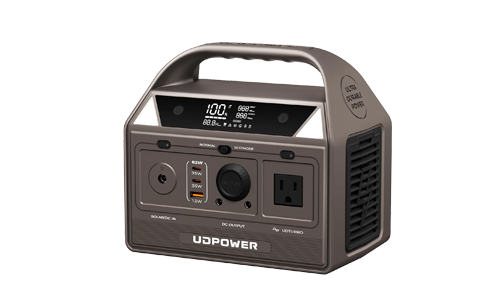
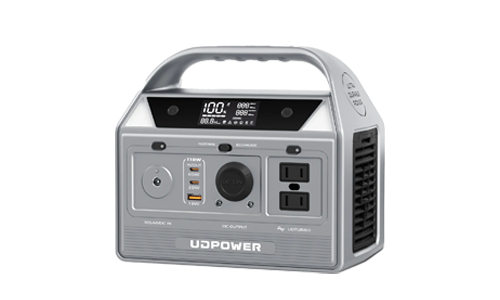
UDPOWER C600: Portable and Mini-Fridge Backup
Best for portable compressor fridges, camping refrigerators, beverage coolers and compatible mini fridges with verified startup demand.
| Battery Capacity | 596Wh LiFePO4 |
|---|---|
| Rated AC Output | 600W |
| Peak Output | 1,200W |
| Weight | 12.3 lbs |
| Estimated 60–100W Load Runtime | Approximately 5.4–8.9 hours at 90% efficiency |
The C600 is not the automatic choice for a full-size household refrigerator. Use it only after confirming that the refrigerator's startup and defrost loads remain within the unit's supported output.
View UDPOWER C600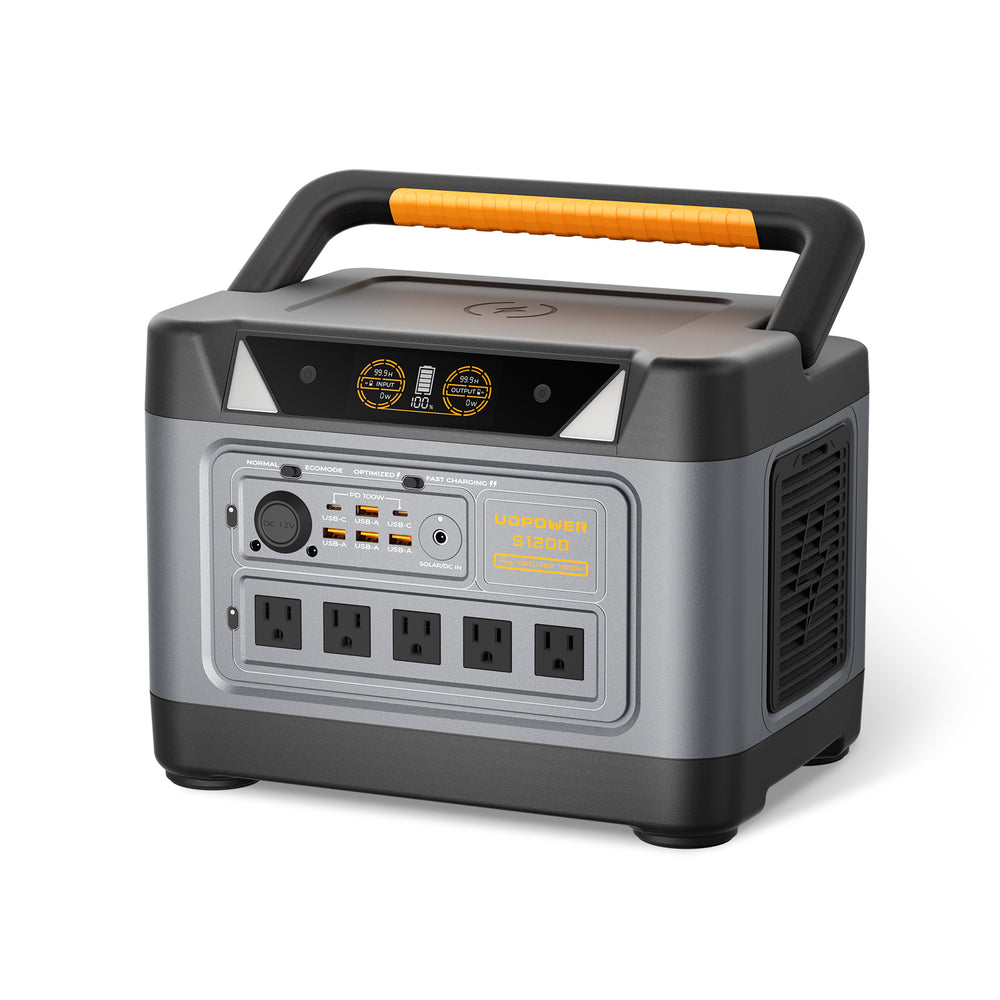
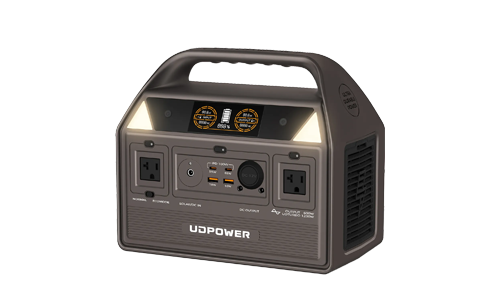
UDPOWER S1200: Practical Full-Size Refrigerator Backup
Best for many modern household refrigerators, short outages and essentials-first backup plans.
| Battery Capacity | 1,190Wh LiFePO4 |
|---|---|
| Rated AC Output | 1,200W pure sine wave |
| UDTURBO Output | Supports compatible loads up to 1,800W, with reduced conversion efficiency above the normal rated range |
| AC Outlets | 5 |
| UPS Response | Under 10 ms |
| Official Refrigerator Guidance | Approximately 10–15 hours for a standard refrigerator averaging 60–100W |
The S1200 provides a useful balance of output, capacity and portability. Its official refrigerator estimate is intentionally conservative. An efficient refrigerator with a low EnergyGuide kWh/year rating may run longer, while an older refrigerator in a hot garage may run for less time.
View UDPOWER S1200 See What a 1200W Power Station Can Run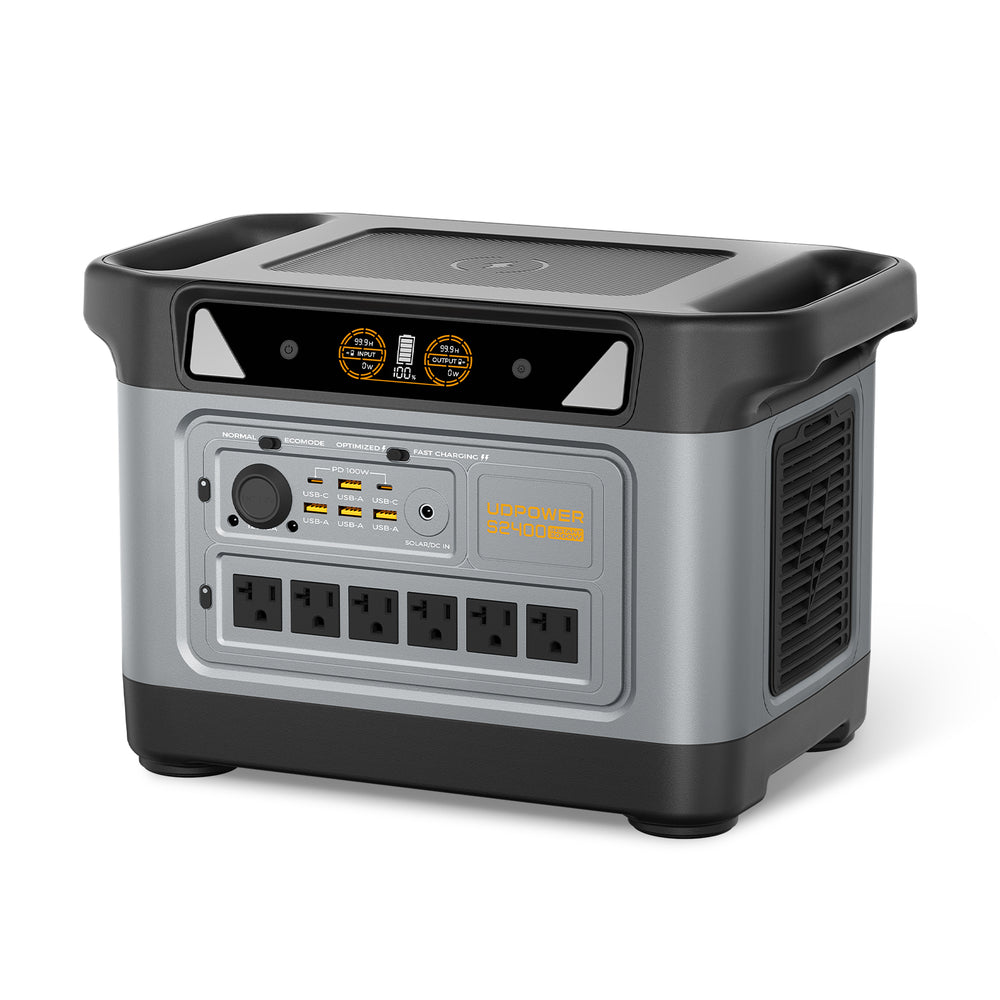
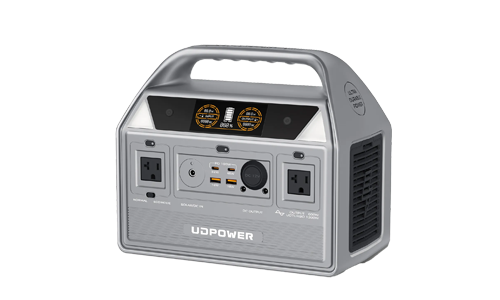
UDPOWER S2400: Longer Outages and More Startup Headroom
Best for overnight or all-day refrigerator backup, older refrigerators, garage units and refrigerator-plus-essential-device setups.
| Battery Capacity | 2,083Wh LiFePO4 |
|---|---|
| Rated AC Output | 2,400W pure sine wave |
| UDTURBO Headroom | Up to 3,000W |
| AC Outlets | 6 |
| Solar Input | Up to 400W |
| UPS Response | 10 ms or less |
| Official Refrigerator Guidance | Approximately 18–30 hours for a standard refrigerator averaging 60–100W |
The S2400 is the safer option when refrigerator backup is a serious outage priority. Its larger capacity also leaves more room for a router, lights, phone charging, a fan or selected medical equipment, provided the combined load remains within the unit's limits.
View UDPOWER S2400 View Detailed 2,000Wh Refrigerator Runtime Estimates| Use Case | Recommended Starting Point | Why |
|---|---|---|
| 12V camping fridge or portable refrigerator | C600 | Compact capacity and output for measured low-power refrigeration loads. |
| Mini fridge with verified startup demand | C600 or S1200 | S1200 provides more startup and runtime margin. |
| Modern full-size refrigerator during a short outage | S1200 | Balanced 1,190Wh capacity and 1,200W rated output. |
| Full-size refrigerator overnight or through much of a day | S2400 | Larger 2,083Wh capacity and greater output headroom. |
| Older or garage refrigerator | S2400 after testing | Higher energy use and compressor demand require more margin. |
| Refrigerator plus router, lights, fan or CPAP | S2400 | More capacity and six AC outlets for selected essentials. |
A portable power station is designed to power selected essential devices. It is not automatically a whole-home backup system. Compare current options through the UDPOWER power station comparison guide .
How Much Solar Power Does a Refrigerator Need?
A solar panel does not directly determine whether the refrigerator can start. The power station's inverter handles the appliance load. Solar panels replenish the battery during daylight.
A refrigerator using 1.2 kWh per day needs approximately 1,200Wh of replacement energy each day before allowing for charging losses, cloudy weather and other connected devices.
| Average Solar Input | Effective Sun Hours | Energy Added | Practical Meaning |
|---|---|---|---|
| 100W | 4 hours | 400Wh | Offsets part of one day's refrigerator use. |
| 150W | 4 hours | 600Wh | May replace roughly half a 1.2 kWh daily load. |
| 200W | 4 hours | 800Wh | Meaningful extension for efficient refrigerators. |
| 300W | 4 hours | 1,200Wh | May approximately offset a 1.2 kWh daily load before losses. |
| 400W | 4 hours | 1,600Wh | Provides more margin for losses and additional essentials. |
Actual panel output is affected by clouds, shading, panel angle, season, heat, wiring, charging limits and the power station's state of charge. A panel labeled 400W will not continuously produce 400W in every outdoor condition.
For multi-day backup, compare UDPOWER solar generator kits and confirm that the panel voltage, current and connector match the selected power station.
Refrigerator Power Outage and Food Safety
Refrigerator wattage matters during an outage because perishable food has a limited safe window without cooling.
FoodSafety.gov advises that an unopened refrigerator can keep food safely cold for approximately four hours. A full freezer may hold its temperature for about 48 hours, while a half-full freezer may hold it for about 24 hours when the door remains closed.
Keep the refrigerator at 40°F or below and the freezer at 0°F or below. An appliance thermometer helps determine whether food remained in a safe temperature range.
Source: FoodSafety.gov temporary power outage guidance.
Practical Refrigerator Backup Steps
- Fully charge the portable power station before severe weather arrives.
- Keep an appliance thermometer inside the refrigerator and freezer.
- Leave refrigerator and freezer doors closed as much as possible.
- Connect the refrigerator directly to a suitable AC outlet on the power station.
- Allow the refrigerator to start before adding other significant loads.
- Avoid running a microwave, coffee maker or heater during compressor startup.
- Keep the power station dry, ventilated and away from heat sources.
- Monitor live output and remaining battery percentage.
- Use solar charging outdoors in direct sunlight while keeping the power station protected and ventilated.
- Follow official food-safety guidance rather than tasting food to decide whether it is safe.
Frequently Asked Questions
How many watts does an average refrigerator use?
A modern full-size refrigerator commonly draws about 60–250W while actively cooling. Because the compressor cycles, its long-term average may be closer to 35–90W. The exact number should be calculated from the EnergyGuide kWh/year rating or measured with a plug-in electricity monitor.
How many watts does a refrigerator use in 24 hours?
Watts are an instantaneous power measurement, so daily use is better expressed in kWh. Many household refrigerators use roughly 0.8–2.2 kWh per day, although older or garage refrigerators may use more. A refrigerator consuming 1.2 kWh per day averages 50W across 24 hours.
How many watts does a mini fridge use?
Many mini fridges draw around 50–120W while cooling. Their average consumption may be much lower because the compressor cycles. Some inexpensive compact models are less efficient than their small dimensions suggest, so check the annual kWh rating.
How many starting watts does a refrigerator need?
Startup demand varies by compressor design and refrigerator model. Conventional compressors may briefly require several times their active running power. Use a meter capable of recording maximum or inrush power, or obtain startup information from the manufacturer.
Will a 1,000W generator run a refrigerator?
It may run many modern refrigerators, but the answer depends on startup demand, defrost power and other connected loads. A 1,000W output rating does not reveal battery runtime. Check both inverter output and stored capacity in Wh.
Will a 500W power station run a refrigerator?
A 500W station may run a portable fridge, mini fridge or selected efficient household refrigerator, but it may shut down when a full-size refrigerator's compressor starts. Do not rely on a 500W model without measuring startup power first.
Can the UDPOWER S1200 run a refrigerator?
Yes, the S1200 is suitable for many full-size refrigerators when their startup and operating loads are compatible. It has a 1,190Wh battery, 1,200W rated AC output and UDTURBO support for compatible loads up to 1,800W. Official guidance estimates approximately 10–15 hours for a refrigerator averaging 60–100W.
How long will the UDPOWER S2400 run a refrigerator?
UDPOWER estimates approximately 18–30 hours for a standard refrigerator averaging 60–100W. An efficient 400 kWh/year refrigerator may theoretically run for about 41 hours using a 90% efficiency calculation, while a 900 kWh/year refrigerator may run for about 18 hours. Real conditions can shorten or extend these estimates.
Why does my refrigerator wattage keep changing?
Refrigerators cycle through cooling, standby and defrost modes. Fans, ice makers, door heaters and compressor speed can also change. A live meter may therefore show several different wattage levels during the day.
Does an old refrigerator use more electricity?
Often, yes. Older refrigerators may have less efficient compressors, weaker insulation, worn door seals and older control systems. The most reliable way to determine whether replacement makes financial sense is to measure the old unit's kWh consumption and compare it with current models.
How many solar panels are needed to run a refrigerator?
Size the solar array from daily refrigerator energy use rather than running watts alone. A refrigerator using 1.2 kWh per day needs at least 1.2 kWh of daily solar production before accounting for losses and cloudy weather. An array averaging 300W for four effective sun hours produces about 1.2 kWh.
Is the refrigerator nameplate wattage accurate?
It can be useful for checking rated electrical input, but it may not represent the refrigerator's average 24-hour consumption. Use the EnergyGuide kWh/year number or a multi-day plug-in meter test for energy and runtime calculations.
Sources and Calculation Method
Refrigerator categories contain products with widely different electrical characteristics. For that reason, the article separates active running power, startup demand and long-term average consumption instead of presenting one universal wattage number.
| Source | How It Is Used |
|---|---|
| Federal Trade Commission EnergyGuide Guide | Explains annual energy-use and comparison information on EnergyGuide labels. |
| ENERGY STAR Refrigerators | Provides current efficiency guidance for certified refrigerators. |
| ENERGY STAR Product Finder | Allows comparison of model-specific annual energy consumption. |
| DOE Refrigerator Rating Search Tool | Helps locate estimated energy ratings by model and manufacturing period. |
| U.S. Energy Information Administration | Provides the May 2026 U.S. residential electricity price used in cost examples. |
| FoodSafety.gov | Provides refrigerator and freezer food-safety guidance during outages. |
| UDPOWER C600 Product Page | Source for current C600 capacity, output and product specifications. |
| UDPOWER S1200 Product Page | Source for current S1200 capacity, output, UPS and refrigerator guidance. |
| UDPOWER S2400 Product Page | Source for current S2400 capacity, output, solar input and refrigerator guidance. |
All runtime figures are estimates. EnergyGuide-based calculations describe average energy use under standardized conditions and cannot predict every compressor startup, defrost event, room temperature or household usage pattern. Test the complete backup setup before depending on it during an emergency.
Choose Refrigerator Backup Power Without Guessing
Start with the refrigerator's EnergyGuide kWh/year rating, verify compressor startup demand, decide how many outage hours you need, and then choose a power station with sufficient output and battery capacity.
View the UDPOWER Selection Guide View Portable Power Stations Get the Refrigerator Backup GuideRelated Articles


