

Joules to Watts: Formula, Calculator & Examples
Last updated: August 10, 2026
Quick Answer: How Do You Convert Joules to Watts?
To convert joules to watts, divide the energy in joules by the amount of time in seconds over which that energy is used or transferred.
For example, if 1,000 joules of energy are used in 10 seconds: 1,000 J ÷ 10 s = 100 W.
The important detail is that joules cannot be converted to a single watt value unless time is known. A joule measures energy, while a watt measures how quickly energy is being used.

Joules to Watts Calculator
Enter the amount of energy and the time over which that energy is used. You can enter time in seconds, minutes, or hours; the calculator automatically converts the value to seconds before calculating watts.
Joules to Watts Formula
The basic J to W relationship is:
Where:
- P = power in watts (W)
- E = energy in joules (J)
- t = time in seconds (s)
The relationship follows directly from the SI definition of the watt: one watt represents an energy transfer rate of one joule per second.
Measurement reference: Bureau International des Poids et Mesures (BIPM).
Example: Convert 500 Joules to Watts
Suppose 500 joules of energy are used over 5 seconds.
- Start with the formula: Watts = Joules ÷ Seconds.
- Insert the values: 500 ÷ 5.
- Calculate the result: 100 watts.
How Many Watts Is 1 Joule?
1 joule equals 1 watt only when the energy is transferred in exactly 1 second.
The time period changes the answer:
| Energy | Time | Calculation | Power | Source |
|---|---|---|---|---|
| 1 J | 1 second | 1 ÷ 1 | 1 W | BIPM SI definition |
| 1 J | 0.5 second | 1 ÷ 0.5 | 2 W | Calculated from SI definition |
| 1 J | 2 seconds | 1 ÷ 2 | 0.5 W | Calculated from SI definition |
| 1 J | 10 seconds | 1 ÷ 10 | 0.1 W | Calculated from SI definition |
This is why a question such as “how many watts is 1 joule?” is incomplete unless the time interval is included.
How Many Watts Is 1,000 Joules?
There is no single answer to 1,000 joules to watts. The result depends on how quickly those 1,000 joules are transferred.
| Energy | Time | Calculation | Equivalent Average Power | Source |
|---|---|---|---|---|
| 1,000 J | 1 second | 1,000 ÷ 1 | 1,000 W | BIPM formula basis |
| 1,000 J | 5 seconds | 1,000 ÷ 5 | 200 W | Calculated from SI definition |
| 1,000 J | 10 seconds | 1,000 ÷ 10 | 100 W | Calculated from SI definition |
| 1,000 J | 60 seconds | 1,000 ÷ 60 | 16.67 W | Calculated from SI definition |
| 1,000 J | 1 hour | 1,000 ÷ 3,600 | 0.2778 W | Calculated from SI definition |
Joules to Watts Conversion Table
The table below shows how the same amount of energy produces very different average wattage depending on the time interval.
| Energy | Over 1 Second | Over 10 Seconds | Over 60 Seconds | Over 1 Hour | Formula Source |
|---|---|---|---|---|---|
| 1 J | 1 W | 0.1 W | 0.0167 W | 0.000278 W | BIPM |
| 10 J | 10 W | 1 W | 0.1667 W | 0.00278 W | BIPM |
| 100 J | 100 W | 10 W | 1.667 W | 0.0278 W | BIPM |
| 1,000 J | 1,000 W | 100 W | 16.67 W | 0.2778 W | BIPM |
| 10,000 J | 10,000 W | 1,000 W | 166.67 W | 2.778 W | BIPM |
| 1,000,000 J | 1,000,000 W | 100,000 W | 16,666.67 W | 277.78 W | BIPM |
How to Convert Joules to Watts When Time Is in Minutes or Hours
The basic formula expects time in seconds. If your time is given in minutes or hours, convert it first.
| Time Given | Convert to Seconds | Joules to Watts Formula |
|---|---|---|
| Seconds | No conversion needed | W = J ÷ seconds |
| Minutes | Minutes × 60 | W = J ÷ (minutes × 60) |
| Hours | Hours × 3,600 | W = J ÷ (hours × 3,600) |
Example: 18,000 Joules Over 5 Minutes
First convert 5 minutes to seconds:
Then divide energy by time:
Example: 3,600 Joules Over 1 Hour
Watts to Joules: Reverse the Formula
If you know power in watts and want to calculate total energy in joules, multiply watts by time in seconds.
| Power | Time | Calculation | Energy |
|---|---|---|---|
| 100 W | 1 second | 100 × 1 | 100 J |
| 100 W | 10 seconds | 100 × 10 | 1,000 J |
| 100 W | 1 minute | 100 × 60 | 6,000 J |
| 100 W | 1 hour | 100 × 3,600 | 360,000 J |
Joules vs. Watts vs. Watt-Hours
Joules, watts, and watt-hours are closely related, but they do not measure the same thing. Mixing them up is one of the most common reasons energy calculations go wrong.
| Unit | Symbol | What It Measures | Simple Meaning | Key Relationship |
|---|---|---|---|---|
| Joule | J | Energy | Total amount of energy | 1 J = 1 W × 1 s |
| Watt | W | Power | Rate at which energy is used | 1 W = 1 J/s |
| Watt-hour | Wh | Energy | Energy from one watt used for one hour | 1 Wh = 3,600 J |
| Kilowatt-hour | kWh | Energy | 1,000 watt-hours | 1 kWh = 3,600,000 J |
If you need to move between kilowatt-hours and joules, see UDPOWER's kWh to Joules conversion guide .
You can also use the UDPOWER Battery & Power Unit Conversion Tools for common Wh, Ah, watt, amp, kW, kVA, BTU, and horsepower conversions.
What Does Converting Joules to Watts Tell You in Real Life?
A joules-to-watts calculation tells you the average rate at which energy was transferred during a particular time interval.
That distinction matters because two devices can use exactly the same total amount of energy while drawing very different amounts of power.
Example: Same Energy, Very Different Power
Consider two devices that each use 3,600 joules.
| Example | Energy | Time | Average Power |
|---|---|---|---|
| Device A | 3,600 J | 1 second | 3,600 W |
| Device B | 3,600 J | 60 seconds | 60 W |
| Device C | 3,600 J | 1 hour | 1 W |
The total energy is identical in all three cases. What changes is how quickly that energy is delivered.
Average Watts Are Not Always Instantaneous Watts
The equation J ÷ seconds gives the average power over the time period you entered. Real electrical equipment may not draw power evenly from beginning to end.
A refrigerator compressor, electric motor, power tool, heating element, or electronically controlled appliance can change its power draw during operation. If you are choosing a battery backup or portable power station, use the appliance's actual rated or measured wattage rather than assuming an average joules-to-watts result represents every instant of operation.
For a practical device-sizing walkthrough, see How to Know If a Portable Power Station Can Power Your Device .
How Joules and Watts Apply to Portable Power Stations
Portable power stations are a useful real-world example of why energy and power should not be treated as interchangeable units.
A power station normally lists at least two important specifications:
- Battery capacity in watt-hours (Wh): how much energy the battery stores.
- Rated output in watts (W): how much electrical power the inverter is designed to supply to connected loads.
Portable Power Station Capacity Expressed in Joules
Because 1 Wh = 3,600 J, battery capacities can also be expressed in joules.
| Example | Battery Capacity | Energy in Joules | Rated AC Output | Official Source |
|---|---|---|---|---|
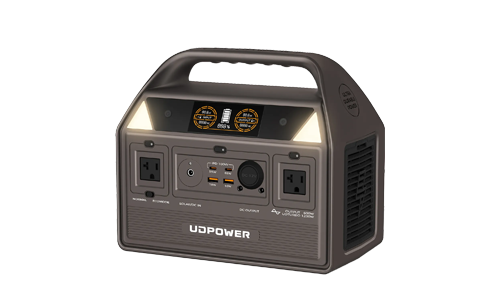
| UDPOWER S1200 | 1,190 Wh | 4,284,000 J | 1,200 W | S1200 specifications |
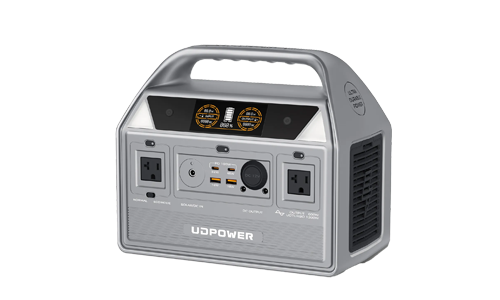
| UDPOWER S2400 | 2,083 Wh | 7,498,800 J | 2,400 W | S2400 specifications |
Notice that the S1200's approximately 4.284 million joules of stored energy does not mean it is a 4.284-million-watt power source. Its battery capacity describes energy storage, while its rated AC output describes power delivery. These are separate specifications.
From Watts to Estimated Runtime
Once you know the wattage of an appliance, battery runtime is usually easier to estimate in watt-hours rather than joules.
UDPOWER planning examples use approximately 90% conversion efficiency for practical estimates. Actual runtime can vary with load behavior, temperature, inverter consumption, battery condition, and other connected devices.
For a quick estimate, use the Portable Power Station Runtime Calculator .
UDPOWER Picks Based on the Watts You Need
If you are converting joules to watts because you are trying to choose backup power, the most important number after the conversion is the wattage of the equipment you intend to run. Compare that number with the power station's rated output, then use watt-hours to estimate runtime.

UDPOWER S1200: For Everyday Backup Loads
- Battery capacity: 1,190Wh
- Rated AC output: 1,200W pure sine wave
- Outputs: 14 total output ports
- Best suited for: refrigerators, CPAP equipment, routers, computers, TVs, lights, camping appliances, and many moderate-power household loads.
The S1200 is a practical choice when your measured or calculated load stays within its supported output range and you want a larger battery without moving to a heavier 2,000Wh-class unit.
View UDPOWER S1200
UDPOWER S2400: More Output for Higher-Wattage Loads
- Battery capacity: 2,083Wh
- Rated AC output: 2,400W pure sine wave
- Outputs: 15 total output ports
- Best suited for: larger household appliances, cooking equipment, multiple simultaneous loads, RV use, work equipment, and longer backup scenarios.
If your joules-to-watts calculation shows that a device or group of devices needs substantially more than 1,200 watts, the S2400 provides considerably more rated-output headroom and more stored battery energy.
View UDPOWER S2400Not sure which size fits your load? Compare the full UDPOWER portable power station lineup .
Common Joules-to-Watts Conversion Mistakes
1. Treating Joules and Watts as Two Units of the Same Quantity
They are not. Joules measure energy; watts measure the rate of energy transfer. A time value is required to connect the two.
2. Assuming 1 Joule Always Equals 1 Watt
That is true only when one joule is transferred in one second. If one joule is transferred in two seconds, the average power is 0.5 watt.
3. Entering Minutes Directly Into the Seconds Formula
If energy is used over 5 minutes, use 300 seconds in the formula, not 5. Otherwise, your calculated wattage will be 60 times too high.
4. Confusing Watts With Watt-Hours
Watts measure power. Watt-hours measure energy. One watt-hour equals 3,600 joules.
5. Using Average Watts as an Appliance's Maximum Power Requirement
A joules-to-watts calculation over a long interval gives an average. Some electrical equipment changes its power draw as it runs. Use the manufacturer's power rating or a suitable power meter when sizing a power source.
6. Ignoring Other Loads Connected at the Same Time
When choosing backup power, add the watts of devices that may operate simultaneously. A 900W appliance plus a 500W appliance represents a combined 1,400W load when both are drawing that power at the same time.
A Simple Way to Remember the Relationship
| If You Know | And You Want | Use This Formula |
|---|---|---|
| Joules + seconds | Watts | W = J ÷ s |
| Watts + seconds | Joules | J = W × s |
| Joules | Watt-hours | Wh = J ÷ 3,600 |
| Watt-hours | Joules | J = Wh × 3,600 |
Frequently Asked Questions About Joules to Watts
How do you convert joules to watts?
Divide energy in joules by time in seconds. The formula is Watts = Joules ÷ Seconds. For example, 600 joules used over 6 seconds equals 100 watts.
Can you convert joules directly to watts without time?
No. Joules measure energy and watts measure power, so you need to know how long the energy transfer takes. Without a time interval, there is no unique watt value.
How many watts is 1 joule?
One joule transferred in one second equals one watt. One joule transferred in two seconds equals 0.5 watt, while one joule transferred in half a second equals 2 watts.
How many watts is 1,000 joules?
It depends on time. 1,000 joules over 1 second equals 1,000 watts; over 10 seconds it equals 100 watts; over 60 seconds it equals about 16.67 watts.
Is one joule per second the same as one watt?
Yes. One joule of energy transferred per second is exactly one watt of power.
What is the J to W formula?
The J to W formula is W = J ÷ s, where J is energy in joules and s is time in seconds.
How do I convert joules per second to watts?
The numerical conversion is direct because one joule per second equals one watt. Therefore, 50 J/s equals 50 W, and 1,000 J/s equals 1,000 W.
How do you convert watts to joules?
Multiply watts by time in seconds. The formula is Joules = Watts × Seconds. A 200W device operating for 10 seconds uses 2,000 joules of energy.
How many joules are in one watt-hour?
One watt-hour equals 3,600 joules because one hour contains 3,600 seconds.
Is a watt bigger than a joule?
They cannot be compared as simply bigger or smaller because they measure different quantities. A joule measures energy, while a watt measures the rate at which energy is transferred.
Are joules or watt-hours better for battery capacity?
Both measure energy, but watt-hours are generally more convenient for consumer batteries and portable power stations. One watt-hour equals 3,600 joules.
Does converting a battery's joules to watts tell me how long it will run a device?
Not by itself. For battery runtime, it is usually easier to use the battery capacity in watt-hours and divide usable energy by the appliance's average wattage. Conversion losses and changing appliance loads also affect actual runtime.
Turn Your Watt Calculation Into a Practical Power Plan
Once you know how many watts your equipment requires, compare that load with the rated output of a portable power station and use battery capacity to estimate how long it can run.
View Portable Power Stations Calculate Your Runtime Build an Off-Grid Power PlanRelated Articles


