





Electric Chainsaw Watts: How Much Power Does an Electric Chainsaw Use?
Last updated: August 4, 2026
Most corded electric chainsaws sold for standard U.S. 120-volt outlets use approximately 600 to 1,800 watts. Compact 5-amp models are around 600 watts, 8-amp models are around 960 watts, and full-size 14- to 15-amp chainsaws are roughly 1,680 to 1,800 watts.
For a portable power station, do not choose one that merely matches the calculated wattage. A practical target is enough rated output to cover the chainsaw's nameplate demand, plus roughly 20% to 25% operating headroom for startup, heavy cuts, chain binding and brief current spikes.
As a quick rule, a small 8-amp corded saw can be paired with a 1,200-watt power station, while a 12- to 15-amp saw is better matched with a 2,400-watt unit.

How Many Watts Does an Electric Chainsaw Use?
In the United States, most corded electric chainsaws plug into a standard 120-volt outlet and are rated in amps rather than watts. Their approximate electrical demand can therefore be estimated by multiplying the stated amps by 120 volts.
| Chainsaw Type | Typical Current | Approximate Demand at 120V | Common Use |
|---|---|---|---|
| Compact corded pruning saw | 5A | 600W | Small branches, shrubs and controlled pruning |
| Light-duty corded chainsaw | 8A | 960W | Yard cleanup and small limbs |
| Mid-size corded chainsaw | 10A | 1,200W | Routine homeowner cutting |
| Medium-duty corded chainsaw | 12A | 1,440W | Storm debris, moderate limbs and light firewood |
| Full-size corded chainsaw | 14A | 1,680W | Larger limbs, logs and frequent cutting |
| High-output corded chainsaw | 14.5A | 1,740W | Full-size 16-inch models |
| High-output corded chainsaw | 15A | 1,800W | Full-size 16- to 18-inch models |
These figures are conservative sizing values rather than a promise that the saw will draw the same number of watts every second. An unloaded spinning chain may use less power. The demand rises when the chain enters dense wood, the operator pushes harder, the chain becomes dull, or the bar starts to bind.
Real Electric Chainsaw Wattage Examples
Official manufacturer specifications show how wide the range can be. The calculated values below use the standard U.S. formula of volts multiplied by amps.
| Model | Official Rating | Calculated Demand | Power Station Implication | Official Source |
|---|---|---|---|---|
| WORX WG305.1 14-Inch Corded Chainsaw | 8A, 120V | Approximately 960W | A 1,200W-rated station provides a reasonable match when no other large load is connected. | WORX product specifications |
| WORX WG303.1 16-Inch Corded Chainsaw | 14.5A | Approximately 1,740W at 120V | A 2,200W to 2,400W rated source gives more practical cutting headroom. | WORX product specifications |
| Makita UC4051A 16-Inch Electric Chain Saw | 14.5A | Approximately 1,740W at 120V | A 2,400W-class station is the safer portable-battery match. | Makita product specifications |
| Oregon CS1500 18-Inch Corded Chainsaw | 15A, 120V | 1,800W | A source rated around 2,250W or more offers useful margin above the nameplate load. | Oregon product specifications |
This is why a single statement such as “an electric chainsaw uses 1,500 watts” is not reliable enough for choosing a generator or portable power station. Two saws with similar bar lengths can have noticeably different current ratings.
How to Calculate Electric Chainsaw Watts From Amps
Check the label near the handle, motor housing or power cord. You may see information such as “120V, 60Hz, 14.5A.” Use the following calculation:
Example: 14.5-Amp Electric Chainsaw
A chainsaw labeled 120 volts and 14.5 amps has a conservative calculated demand of:
To provide 25% operating headroom:
Instead of searching for an uncommon 2,175-watt power source, round upward to a common 2,200- or 2,400-watt class.
Why the Calculation Is Sometimes Called VA Instead of Watts
Multiplying AC volts by amps technically gives volt-amperes, or VA. The real wattage of an AC motor can be lower because of its power factor. However, the inverter, generator, outlet and extension cord still have to handle the current shown on the tool's label.
For ordinary generator or portable power station sizing, using volts multiplied by nameplate amps is the safer approach. It prevents you from choosing a source based on an unrealistically low no-load watt-meter reading.
For a more detailed explanation of the relationship between voltage, current and power, see UDPOWER's volts-to-watts conversion guide .
Corded and Battery Chainsaw Watts Are Not Measured the Same Way
Corded Electric Chainsaw
A corded chainsaw draws power directly from a 120-volt outlet. The nameplate usually lists amps, so its approximate input demand can be calculated immediately.
Battery-Powered Chainsaw
A battery chainsaw is commonly marketed by battery voltage, such as 18V, 20V, 40V, 56V or 80V. Voltage alone does not tell you the motor's wattage. You would also need to know the current being drawn by the motor at that moment, and that current changes with the cutting load.
The battery label often lists amp-hours rather than motor amps. Multiplying battery voltage by amp-hours estimates stored energy in watt-hours, not motor power in watts.
A 40V, 4Ah battery contains a nominal 160Wh:
That number helps compare battery capacity, but it cannot predict exact cutting time by itself. Chain sharpness, wood diameter, species, temperature, motor efficiency and trigger use all affect the number of cuts.
Charging a Battery Chainsaw From a Power Station
When recharging a cordless chainsaw battery, use the wattage printed on the charger rather than the chainsaw's advertised battery voltage. A charger may use only a few hundred watts, making it much easier to support than a full-size corded chainsaw.
What Size Portable Power Station Will Run an Electric Chainsaw?
Match the chainsaw against the power station's rated AC output first. Then confirm that the maximum-output capability can handle startup and temporary overloads. Use a pure sine wave output for predictable operation with modern power tools and chargers.
| Chainsaw Nameplate | Calculated Demand | Suggested Output With 25% Headroom | Practical Power Station Class |
|---|---|---|---|
| 5A at 120V | 600W | 750W | 800W or larger |
| 8A at 120V | 960W | 1,200W | 1,200W or larger |
| 10A at 120V | 1,200W | 1,500W | 1,500W to 2,400W |
| 12A at 120V | 1,440W | 1,800W | 1,800W to 2,400W |
| 14A at 120V | 1,680W | 2,100W | 2,200W to 2,400W |
| 14.5A at 120V | 1,740W | 2,175W | 2,200W to 2,400W |
| 15A at 120V | 1,800W | 2,250W | 2,400W or larger |
The 25% margin is a practical sizing target, not a guarantee for every chainsaw. A dull chain, pinched bar, damaged extension cord or aggressive feeding pressure can increase the current beyond normal operation.
Why a Chainsaw Can Overload a Source Even When the Average Watts Look Acceptable
- Startup demand: The motor draws additional current while accelerating the chain.
- Cutting load: Dense or wet wood increases torque demand.
- Chain binding: A pinched bar or stalled chain can cause a sharp current rise.
- Dull chain: More pressure is required, increasing motor load and heat.
- Voltage drop: A long, undersized extension cord lowers voltage and forces the motor to work harder.
- Other devices: Every item connected to the station shares the same total output limit.
For a wider worksite planning method covering power tools, chargers and simultaneous loads, read the UDPOWER portable worksite power guide .
Recommended UDPOWER Power Stations for Electric Chainsaws
The right model depends primarily on the chainsaw's nameplate amps. Capacity determines runtime, while rated AC output determines whether the station can operate the saw reliably.
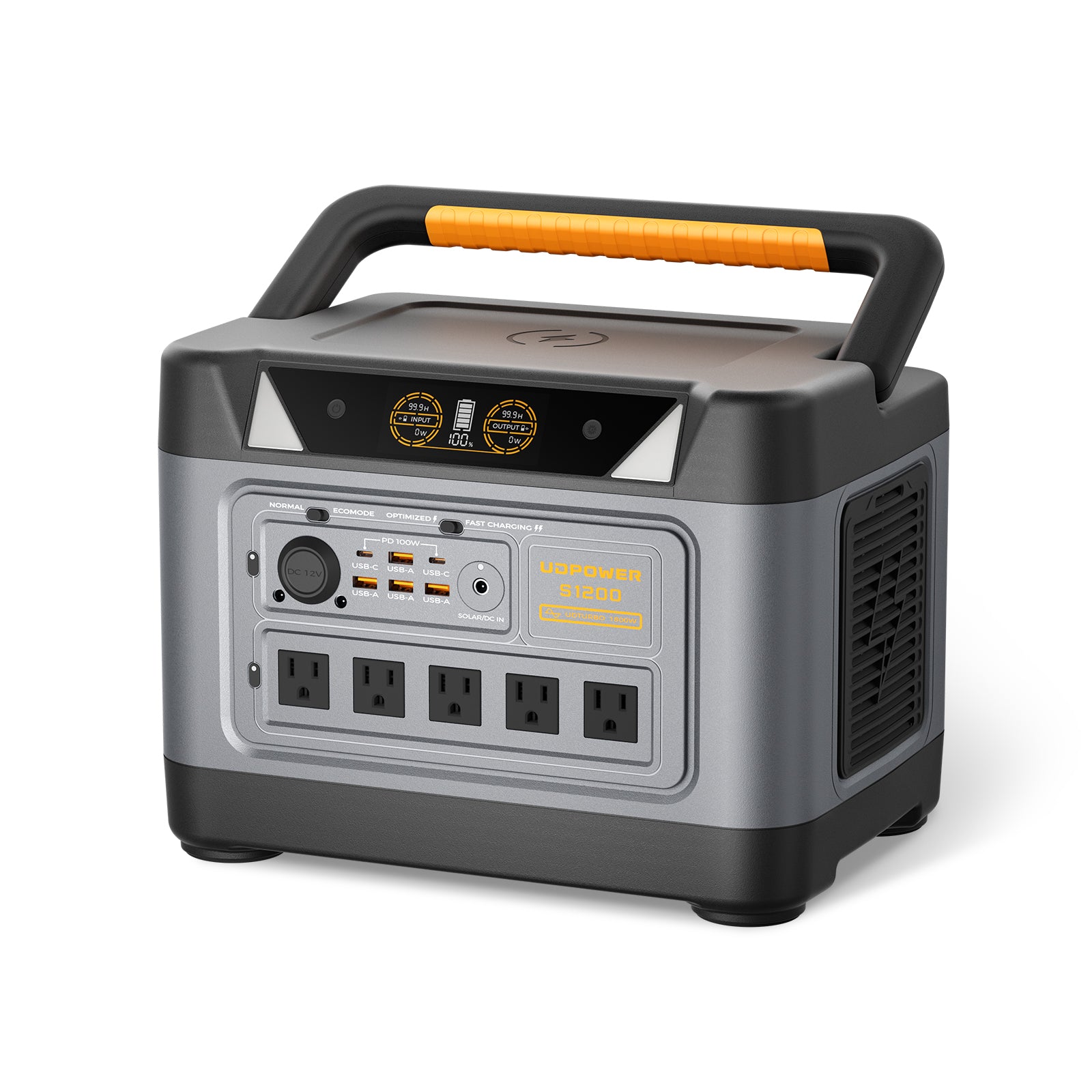
UDPOWER S1200: Best for Smaller Corded Chainsaws
The S1200 is the practical choice for compact corded chainsaws whose normal nameplate demand stays at or below approximately 1,200 watts. An 8-amp, 120-volt chainsaw calculates to about 960 watts, leaving useful rated-output headroom.
- Battery capacity: 1,190Wh
- Rated AC output: 1,200W pure sine wave
- Maximum output capability: Up to 1,800W
- Battery chemistry: LiFePO4
- Cycle life: 4,000+ cycles
- AC outlets: Five on the standard gray version
- Weight: Approximately 26 lb
A 10-amp chainsaw already calculates to 1,200 watts before additional headroom is considered. It may leave little margin for a hard start or heavy cut. For saws above 8 amps, the S2400 is generally the more conservative recommendation.
View UDPOWER S1200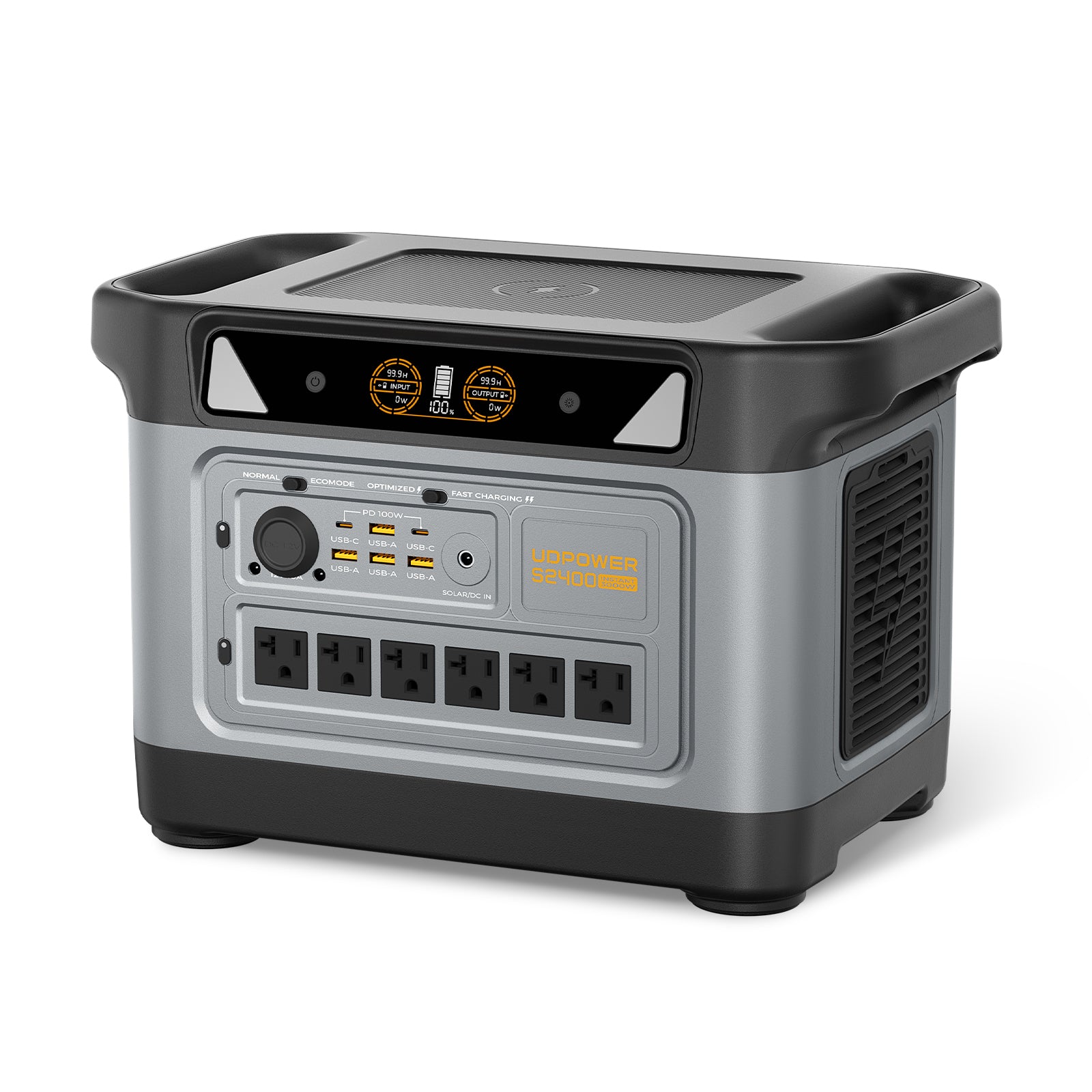
UDPOWER S2400: Best for 12- to 15-Amp Corded Chainsaws
The S2400 is the stronger match for full-size corded chainsaws. Its 2,400-watt rated pure sine wave output can cover the calculated 1,440- to 1,800-watt demand of common 12- to 15-amp models while preserving more operating margin.
- Battery capacity: 2,083Wh
- Rated AC output: 2,400W pure sine wave
- Peak capability: Up to 3,000W
- Battery chemistry: LiFePO4
- Cycle life: 4,000+ cycles
- AC outlets: Six
- Weight: 40.8 lb
For a 15-amp saw calculated at 1,800 watts, the S2400 has 600 watts of rated-output headroom. This is substantially more appropriate than trying to operate the same saw from a 1,800-watt source already at its maximum figure.
View UDPOWER S2400How Long Will a Portable Power Station Run an Electric Chainsaw?
Runtime depends on battery capacity in watt-hours, chainsaw power draw and conversion losses. The following estimates use 90% conversion efficiency.
Continuous Trigger-On Runtime
| Chainsaw Demand | Approximate Saw Rating | UDPOWER S1200 Estimate | UDPOWER S2400 Estimate |
|---|---|---|---|
| 600W | 5A at 120V | About 1 hour 47 minutes | About 3 hours 7 minutes |
| 960W | 8A at 120V | About 1 hour 7 minutes | About 1 hour 57 minutes |
| 1,200W | 10A at 120V | About 54 minutes | About 1 hour 34 minutes |
| 1,440W | 12A at 120V | Not recommended as a normal rated-output match | About 1 hour 18 minutes |
| 1,680W | 14A at 120V | Not recommended as a normal rated-output match | About 1 hour 7 minutes |
| 1,740W | 14.5A at 120V | Not recommended as a normal rated-output match | About 1 hour 5 minutes |
| 1,800W | 15A at 120V | Not recommended as a normal rated-output match | About 1 hour 2 minutes |
These estimates assume the trigger remains held continuously. That is useful for comparing batteries, but it is not how most people cut wood. During real work, the saw is repeatedly stopped while the operator repositions the log, clears branches, checks the cut or moves to the next section.
Estimated Work-Session Time With Trigger Cycling
The table below shows how trigger use changes the approximate work-session duration for an 1,800-watt chainsaw powered by the S2400.
| Trigger-On Percentage | Average Cutting Load | Approximate Session Duration | Likely Work Pattern |
|---|---|---|---|
| 25% | 450W average | About 4 hours 10 minutes | Intermittent pruning with frequent repositioning |
| 40% | 720W average | About 2 hours 36 minutes | Typical stop-and-start yard cleanup |
| 60% | 1,080W average | About 1 hour 44 minutes | Faster repetitive cutting with short pauses |
| 100% | 1,800W continuous | About 1 hour 2 minutes | Laboratory-style continuous-load comparison |
Why “Number of Cuts” Is Harder to Predict Than Runtime
A watt-hour calculation cannot accurately promise a specific number of cuts. A single cut through a dry two-inch branch uses far less energy than cutting a large, wet hardwood log. Chain condition, kerf pressure and the number of times the motor is started also matter.
For planning, use continuous runtime as a conservative energy comparison and treat work-session time as a range rather than a guarantee.
Extension Cord Size Can Change Chainsaw Performance
A power station with enough watts can still appear weak if the extension cord is too long or too thin. Resistance in the cord causes voltage drop. The motor then receives less voltage, may draw more current, cuts more slowly and produces additional heat.
| Cord Length | Practical Gauge for a High-Amp Chainsaw | Why It Matters | Reference |
|---|---|---|---|
| Up to 25 ft | 14 AWG minimum; 12 AWG preferred for high-current use | Short runs have less voltage loss, but the cord must still be outdoor-rated and undamaged. | Oregon chainsaw manuals |
| 25 to 50 ft | 14 AWG minimum for applicable models; 12 AWG provides more margin | A heavier cord reduces voltage drop during hard cuts. | Oregon chainsaw manuals |
| 50 to 100 ft | 12 AWG commonly required by high-current chainsaw manuals | Long cords create more resistance and should not be undersized. | Oregon chainsaw manuals |
| More than 100 ft | Avoid when possible | Move the power source closer or follow the exact saw manufacturer's cord table. | WORX electric chainsaw manual |
Do Not Leave the Cord Coiled Under a Heavy Load
A tightly coiled extension cord cannot release heat as effectively. Fully unroll the cord before operating a high-wattage chainsaw, and keep it behind the operator and away from the guide bar, falling branches and the cutting path.
How to Run a Corded Chainsaw From a Portable Power Station
- Read the chainsaw label. Record the voltage, amps and any listed wattage.
- Calculate the demand. For a U.S. 120V saw, multiply 120 by the nameplate amps.
- Check rated output. Make sure the power station's rated AC output covers the calculated demand.
- Preserve headroom. Aim for approximately 20% to 25% above the calculated load when possible.
- Disconnect other high-watt devices. The chainsaw should not share the station with heaters, coffee makers, air compressors or other large loads.
- Choose the correct cord. Use an outdoor-rated extension cord with the gauge specified by the chainsaw manufacturer.
- Place the power station on stable, dry ground. Keep its air vents clear and position it away from sawdust, chips, rain and the falling path of the wood.
- Turn on the station's AC output. Confirm the display is normal before connecting the chainsaw.
- Start the saw without contacting wood. Allow the chain to reach full speed before beginning the cut.
- Watch for overload symptoms. Stop if the station reports an overload, the cord becomes hot, the motor slows sharply or the saw repeatedly shuts down.
Keep the Power Station Away From the Cutting Area
Place the station behind and to the side of the operator, not next to the log. This reduces the chance of sawdust entering the vents, a branch striking the unit, or the extension cord crossing the cutting path.
Do Not Run a Corded Chainsaw in Rain
A portable power station does not make a corded chainsaw safe in wet conditions. Keep the saw, plugs, extension connections and power station dry. Follow the tool manual and local electrical-safety requirements, including GFCI protection where applicable.
Wear Proper Chainsaw Protective Equipment
Chainsaw safety guidance recommends appropriate leg protection, eye protection, hearing protection, gloves, protective footwear and head protection where falling-object hazards exist. Inspect the chain, brake, bar, cord and oil level before starting.
See the NIOSH chainsaw safety guidance for additional protective-equipment and operating recommendations.
Common Electric Chainsaw Power Mistakes
Choosing a Power Station From Bar Length Alone
A 16-inch bar does not automatically mean a specific wattage. Always use the electrical nameplate.
Comparing the Saw Only With Peak Output
Maximum output helps with temporary high demand, but rated AC output remains the better foundation for sizing a tool that may be under load for repeated cuts.
Ignoring Other Connected Loads
A 1,740-watt chainsaw and a 500-watt appliance together require approximately 2,240 watts before additional startup demand is considered. Disconnect unnecessary equipment while cutting.
Assuming the Display Must Always Show the Nameplate Wattage
The chainsaw may draw less power while free-spinning and more power when buried in wood. Power-station displays also update at intervals, so a brief current spike may not remain visible.
Using a Thin Household Extension Cord
A light indoor cord may overheat or create enough voltage drop to reduce cutting performance. Use a properly sized outdoor cord.
Expecting Solar Panels to Run the Saw Directly
A chainsaw plugs into the portable power station's AC outlet. Solar panels recharge the battery; they do not normally connect directly to the chainsaw. A 1,800-watt cutting load can also consume energy much faster than a portable 120W, 210W or 420W solar array can replace it.
Explore compatible charging packages in the UDPOWER solar generator collection.
Electric Chainsaw vs. Gas Chainsaw for Off-Grid Work
| Factor | Corded Chainsaw + Power Station | Battery Chainsaw | Gas Chainsaw |
|---|---|---|---|
| Noise | Lower than gas, although the chain still produces substantial cutting noise | Lower than gas | Usually highest |
| Local exhaust | None at the tool | None at the tool | Produces exhaust |
| Runtime | Limited by power-station capacity | Limited by tool batteries | Extended by adding fuel |
| Mobility | Restricted by extension-cord length | Highly mobile | Highly mobile |
| Maintenance | Low motor maintenance; chain and bar maintenance still required | Low motor maintenance; battery care required | Fuel, spark plug, filter and engine maintenance required |
| Best fit | Home sites, quiet work areas and planned storm cleanup | Quick pruning and mobile yard work | Long-duration, high-volume or remote cutting |
A portable power station is especially useful when you already own a corded chainsaw and need temporary power beyond the reach of a wall outlet. A gas saw may still be more practical for all-day firewood processing or remote work where recharging is unavailable.
For a broader comparison, see Is a Portable Power Station Better Than a Generator?
Electric Chainsaw Watts FAQ
How many watts does a typical electric chainsaw use?
Most U.S. corded electric chainsaws use approximately 600 to 1,800 watts based on their 5- to 15-amp nameplate ratings at 120 volts. Full-size 14- to 15-amp saws are commonly around 1,680 to 1,800 watts.
How many watts is a 15-amp electric chainsaw?
At 120 volts, a 15-amp chainsaw has a calculated demand of 1,800 watts: 120 × 15 = 1,800. A power source rated near 2,250 to 2,400 watts gives more useful operating margin.
How many watts is a 14.5-amp electric chainsaw?
A 14.5-amp chainsaw on a 120-volt supply calculates to approximately 1,740 watts. With 25% headroom, the sizing target becomes approximately 2,175 watts.
How many watts is a 12-amp electric chainsaw?
A 12-amp, 120-volt chainsaw calculates to approximately 1,440 watts. A power source rated around 1,800 watts or higher is a more comfortable match than a 1,500-watt unit.
Will a 1,000-watt generator run an electric chainsaw?
It may run a small 5- to 8-amp chainsaw, but it will not reliably support common 12- to 15-amp full-size corded saws. An 8-amp saw already calculates to about 960 watts before headroom.
Will a 1,500-watt generator run an electric chainsaw?
It can run selected smaller and mid-size chainsaws whose normal demand stays below the rated output. It is not a comfortable match for a 14.5- or 15-amp chainsaw requiring approximately 1,740 to 1,800 watts.
Will a 2,000-watt generator run a 15-amp chainsaw?
A 2,000-watt continuous source may operate a 1,800-watt chainsaw when its startup capability is sufficient and no other load is connected. However, the remaining 200 watts of headroom is limited. A 2,250- to 2,400-watt rated source is a more conservative choice.
Will a 2,400-watt power station run an electric chainsaw?
A 2,400-watt pure sine wave power station can run many U.S. corded electric chainsaws rated up to 15 amps, provided the saw's startup and stall demand remain within the station's maximum output and no other large devices are connected.
Can the UDPOWER S1200 run an electric chainsaw?
The S1200 is best matched with smaller corded chainsaws whose normal demand is at or below its 1,200-watt rated output. An 8-amp saw calculated at 960 watts is a reasonable example. Larger 12- to 15-amp saws are better paired with the S2400.
Can the UDPOWER S2400 run a 15-amp chainsaw?
A 15-amp chainsaw calculates to approximately 1,800 watts at 120 volts. The S2400 provides 2,400 watts of rated pure sine wave output and up to 3,000 watts of peak capability, making it the more appropriate UDPOWER choice for this class of saw.
How long will a 2,083Wh power station run a 1,800W chainsaw?
Using 90% conversion efficiency, the continuous trigger-on estimate is approximately 1.04 hours, or about 62 minutes. Real work-session time may be longer because the trigger is not held continuously.
Does a battery chainsaw use fewer watts than a corded chainsaw?
Not necessarily. Battery chainsaws are usually advertised by battery voltage rather than motor watts. Their instantaneous power varies with the cut. They may be more convenient, but voltage alone cannot prove that they use less power.
Can a solar panel directly power an electric chainsaw?
Normally, no. A portable solar panel charges a compatible power station, and the chainsaw plugs into the station's AC outlet. The station's inverter must provide enough rated and peak output for the saw.
Why does my chainsaw shut down a power station?
Common causes include insufficient rated output, startup demand, a pinched or dull chain, an undersized extension cord, another connected appliance, blocked station ventilation, low battery charge or a temporary overload during a heavy cut.
What extension cord should I use for a 15-amp chainsaw?
Follow the cord table in the chainsaw manual. Many high-current chainsaw manuals call for at least 14 AWG on shorter runs and 12 AWG on longer runs. Use an outdoor-rated cord, fully unroll it and inspect it before every use.
Choose a Power Station for Your Electric Chainsaw
Start with the chainsaw's voltage and amp rating. An 8-amp corded saw is generally a good match for the 1,200W S1200, while 12- to 15-amp full-size saws are better suited to the 2,400W S2400. Leave adequate output headroom and use a correctly sized outdoor extension cord.
View Portable Power Stations View the S2400 for Full-Size Chainsaws Get the Complete Worksite Power GuideRelated Articles


