

Portable Power Station for a Shed: How to Choose the Right Size
Last updated:

A 120-square-foot shed does not automatically need a smaller power station than a 300-square-foot shed.
If the small shed contains a 15A circular saw and air compressor, it can require far more electrical output than a large garden shed that only has two LED lights and a cordless-tool charger.
That is the first rule of shed power:
This guide covers storage sheds, garden sheds, backyard offices, hobby rooms and working shops. It also explains one issue that is easy to overlook: whether the battery should actually remain inside the shed year-round.
- What Size Power Station Does a Shed Need?
- The Four Numbers That Determine Shed Power
- Choose by Shed Type, Not Square Footage
- How Many Watts Do Common Shed Loads Use?
- How to Calculate Your Shed Power Station Size
- Real Shed Sizing Examples
- Sizing a Power Station for a Workshop Shed
- Tool-Battery Charging in a Shed
- Why Space Heaters Change Everything
- What About a Fridge, Pump or Compressor?
- How Much Solar Do You Need for a Shed?
- Can You Leave a Power Station in a Shed Year-Round?
- Power Station vs. Extension Cord vs. Permanent Wiring
- How to Set Up a Portable Power Station in a Shed
- Recommended UDPOWER Models for Sheds
- Common Shed Power Mistakes
- Shed Power Buying Checklist
- Frequently Asked Questions
What Size Portable Power Station Does a Shed Need?
| Shed Use | Typical Equipment | Practical Rated Output | Practical Battery Range | Main Sizing Issue |
|---|---|---|---|---|
| Storage shed | LED lights, phone charger, security camera | 200–400W | 200–300Wh | Runtime for lighting |
| Garden shed | Lights, cordless-tool chargers, fan, small pump | 400–1,200W | 300–1,200Wh | Pump startup and daily Wh |
| Hobby shed | Lights, laptop, chargers, soldering station, small tools | 400–1,200W | 500–1,200Wh | Long operating hours |
| Backyard office | Laptop, monitor, router, lights, fan | 400–600W | 600–1,200Wh+ | All-day energy use |
| Light workshop | Chargers, lights, drill, sander, small shop vacuum | 1,000–1,500W | 1,000–1,500Wh | Largest motor load |
| Corded-tool workshop | Circular saw, miter saw, shop vacuum, bench tools | 2,000–2,500W+ | 1,500–2,500Wh+ | Tool current and startup demand |
| Compressor-heavy workshop | Air compressor plus pneumatic or corded tools | Equipment-specific | Often 2,000Wh+ | Compressor manufacturer requirements |
| Heated shed | Electric space heater | Often 1,500W+ | Battery power is usually inefficient for long heating periods | Continuous energy demand |
These are planning ranges, not fixed requirements. Check the labels on the equipment you actually own before buying a power station.
A shed with cordless tools can often use a much smaller inverter than a shed built around corded tools. A backyard office may have very low peak wattage but still need a fairly large battery because the equipment runs for eight hours.
The Four Numbers That Determine the Right Shed Power Station
1. Highest Simultaneous Watts
Add the equipment that may actually operate at the same time.
If your shed has:
- 60W of lights
- a 120W battery charger
- a 900W shop vacuum
and all three run together, the combined planning load is about 1,080W.
That number determines the normal inverter output you need.
2. Hardest Startup Load
Motors can demand more power when they start or when heavily loaded.
This matters for:
- Shop vacuums
- Air compressors
- Water pumps
- Refrigerators
- Circular saws
- Miter saws
- Other motor-driven shop equipment
Do not assume every motor has the same startup multiplier. Use the tool manual, manufacturer guidance or measured data when available.
For more detail, see What Does Surge Current Mean?.
3. Total Watt-Hours Per Session or Day
Watts determine whether equipment can run. Watt-hours determine how long the battery lasts.
A 1,200W saw used for ten minutes does not use 1,200Wh.
Ten minutes is one-sixth of an hour:
That is why intermittent workshop tools can sometimes work surprisingly well from a battery even though their instantaneous wattage is high.
4. How Much Energy You Can Put Back Each Day
If the shed has no grid power, battery capacity is only half the system.
You also need to know how the power station will recharge:
- Carry it back to the house for AC charging
- Use solar panels outside the shed
- Recharge from a vehicle
- Use a generator when appropriate
If the shed uses 700Wh each day but your charging plan restores only 300Wh, the battery will eventually run empty regardless of how large it was when you started.
Choose the Power Station by Shed Type, Not Floor Area
Storage Shed
If you mainly need enough electricity to find tools after dark, charge a phone and run a small security device, there is little reason to carry a 40-pound, 2,000Wh-class battery to the shed.
A compact 200–400W station can be a better fit.
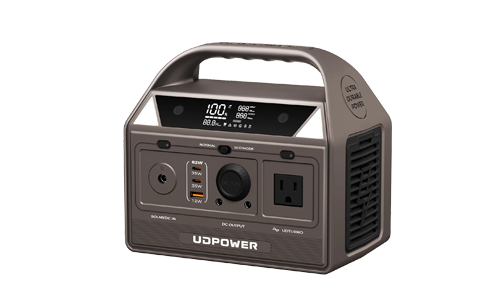
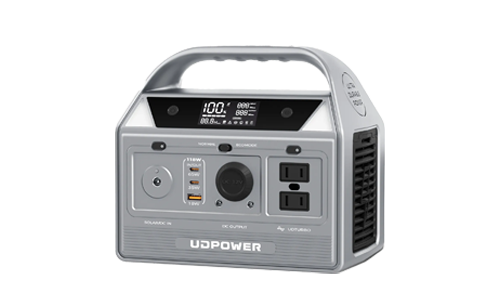
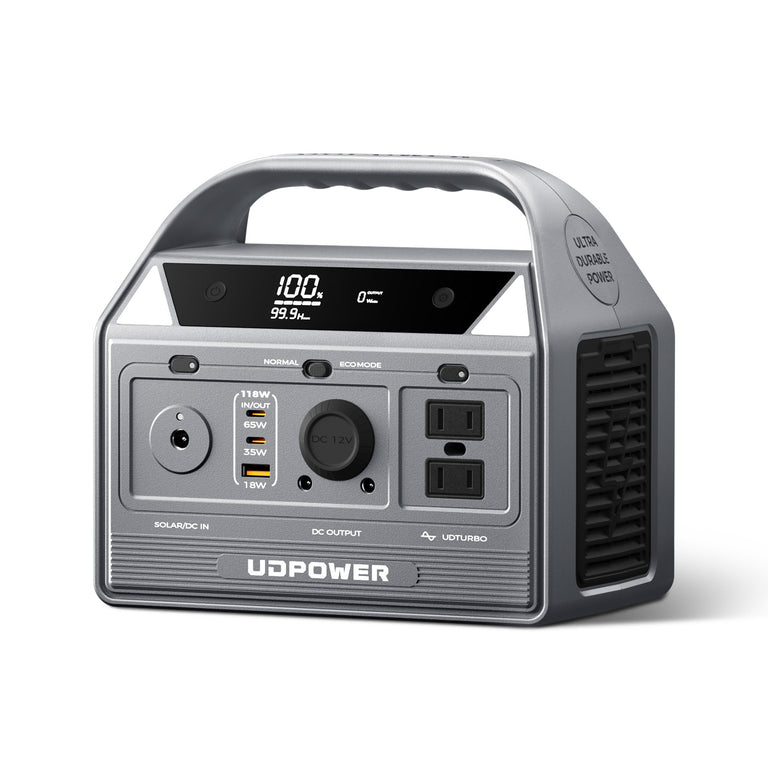
The UDPOWER C400, for example, provides 256Wh of capacity and 400W rated AC output while weighing about 6.88 lb.
Garden Shed
A garden shed may need more energy than its tool list suggests because some loads run for hours.
Typical examples include:
- LED lighting
- Battery chargers
- Small ventilation fan
- Water-transfer pump
- Irrigation controller
- Laptop or tablet
A pump deserves special attention because motor startup can determine inverter size even if it runs for only a few minutes.
Hobby Shed
For woodworking, electronics, model building, crafts or other hobbies, the load pattern is often a mix of low continuous loads and short high-power loads.
Lights may stay on all evening. A laptop may run for several hours. A sander or small saw may run for only minutes.
That makes both inverter output and battery capacity important.
Backyard Office or Studio
An office shed usually needs less inverter output than a workshop but may need more battery capacity than expected.
A laptop, monitor, Wi-Fi equipment, lighting and fan might draw only 150–250W combined, but six or eight hours of use can easily move total energy consumption above 1,000Wh.
Workshop Shed
This is where the largest tool matters more than the room itself.
A 15A, 120V corded tool gives a conservative nameplate screening value of:
For reference, DEWALT lists a 15A motor and 120V supply for its DWE575SB 7-1/4-inch corded circular saw. View DEWALT specifications.
That is already well above the rated output of many small portable power stations.
How Many Watts Do Common Shed Loads Use?
The figures below are planning examples. Your own equipment label takes priority.
| Shed Load | Planning Range or Example | Main Concern | How to Verify |
|---|---|---|---|
| LED lighting | 10–100W total depending on fixtures | Long operating time | Check fixture wattage |
| Laptop | About 45–100W in many setups | Several hours of operation | Check AC adapter rating or measure consumption |
| Small fan | About 30–100W | Long summertime use | Check fan label |
| Cordless-tool charger | Varies from compact chargers to several hundred watts | Multiple chargers may overlap | Check AC input on charger label |
| Shop vacuum example | 7.5A class ≈ 900VA screening value at 120V | Motor startup | RIDGID example |
| 15A circular saw example | 1,800VA screening value at 120V | Motor startup and cutting load | DEWALT DWE575SB |
| Air compressor example | Manufacturer may require much more than simple amp math suggests | Motor startup | California Air Tools 8010A |
| Space heater | Often around 1,500W on high | Continuous high energy consumption | Check heater label |
| Small refrigerator | Varies substantially | Compressor startup and cycling | Use EnergyGuide data or a 24-hour meter reading |
| Water pump | Varies substantially | Startup current | Use pump nameplate and manual |
How to Calculate the Right Portable Power Station Size for Your Shed
-
List everything you will plug in.
Include lights, chargers, fans, computers, pumps, refrigerators and corded tools. -
Write down the electrical rating of each device.
Use watts when provided. If only volts and amps are listed, multiply them for an initial screening value. -
Mark which devices can run at the same time.
This determines the rated inverter output you need. -
Identify every motor-driven load.
Check startup requirements for compressors, pumps, refrigerators, vacuums and saws. -
Estimate actual daily operating time.
Do not assume a saw is running for four hours just because you spend four hours in the workshop. -
Calculate the watt-hours for each load.
Multiply watts by active hours. -
Add all watt-hours together.
This gives estimated AC energy use for the session or day. -
Account for conversion loss.
This guide uses a 90% planning efficiency for UDPOWER portable power stations. -
Add a reserve.
Avoid buying a battery that only works when every assumption is perfect.
For a 15% planning reserve:
Real Shed Power Sizing Examples
Example 1: Simple Storage Shed
| Load | Power | Use | Energy |
|---|---|---|---|
| Two LED lights | 20W total | 3 hours | 60Wh |
| Phone charging | 15W | 2 hours | 30Wh |
| Small security equipment | 10W | 6 hours | 60Wh |
| Total | — | — | 150Wh |
Battery requirement using the 90% factor:
A 256Wh C400 offers enough capacity for this example with useful reserve.
Example 2: Garden or Hobby Shed
| Load | Power | Active Time | Energy |
|---|---|---|---|
| LED lighting | 40W | 4 hours | 160Wh |
| Tool-battery charger | 120W | 1.5 hours | 180Wh |
| Fan | 50W | 4 hours | 200Wh |
| Small benchtop tool | 400W | 15 minutes | 100Wh |
| Total | — | — | 640Wh |
Add a modest reserve and this moves naturally into roughly a 1,000Wh-class battery. The S1200 provides 1,190Wh.
Example 3: Working Shed With Corded Tools
| Load | Planning Power | Active Time | Energy |
|---|---|---|---|
| Shop lighting | 60W | 4 hours | 240Wh |
| Battery charger | 150W | 2 hours | 300Wh |
| 15A saw-class load | 1,800VA screening value | 15 minutes | 450Wh equivalent planning energy |
| 900VA vacuum-class load | 900VA screening value | 20 minutes | 300Wh equivalent planning energy |
| Planning total | — | — | About 1,290Wh |
The energy requirement points toward a battery larger than 1,400Wh after conversion loss. The 1,800VA saw-class load also points toward a much larger inverter than the C400 or S1200 rated output.
This is the kind of shed where the S2400 becomes the more practical UDPOWER choice.
Sizing a Portable Power Station for a Workshop Shed
Workshop sheds are different from simple garden sheds because the battery may have plenty of stored energy but still be unable to run the largest tool.
Use this order:
- Check tool voltage.
- Check rated current or watts.
- Check startup behavior.
- Add anything that must run simultaneously.
- Then calculate daily watt-hours.
A 15A Tool Is a Useful Warning Line
A 120V tool rated at 15A creates a conservative 1,800VA screening load.
That means:
- A 400W station is clearly too small as the normal source.
- A 1,200W station is below the normal rated requirement.
- A 2,400W station provides substantially more normal operating headroom.
The exact behavior still depends on the specific tool.
Do Not Size a Compressor From Running Amps Alone
The California Air Tools 8010A is a good example. Its manufacturer lists an 8.5A draw but also specifies a 2,500W minimum running generator.
View the California Air Tools 8010A specifications.
That manufacturer requirement is above the S2400's 2,400W rated AC output.
For a broader tool-sizing guide, see Portable Worksite Power Solutions: Tool Sizing Guide.
Using a Shed Power Station to Charge Cordless Tool Batteries
A cordless-tool workshop can dramatically reduce the inverter size required.
Instead of running a 1,800W corded saw directly, the shed may only need to recharge 18V, 20V or 40V tool batteries between projects.
But size from the charger's AC input, not from the voltage printed on the battery.
A 20V battery does not mean the charger draws only 20 watts.
Estimate Tool-Battery Energy
If a tool battery lists nominal volts and amp-hours:
For example, four packs storing about 100Wh each contain roughly:
The power station will need to supply more than 400Wh because the inverter and battery charger also have conversion losses.
If your shed mostly uses cordless tools, a 1,000Wh-class station can often be far more useful than its inverter wattage alone suggests.
Why a Space Heater Can Make a Battery Power Station Look Tiny
Electric resistance heating is one of the least battery-friendly shed loads.
A typical high setting of roughly 1,500W consumes:
Using a 90% AC planning factor:
- S1200 planning AC energy: about 1,071Wh
- S2400 planning AC energy: about 1,875Wh
At a true continuous 1,500W load, the S2400's simplified planning runtime is only:
The S1200's normal 1,200W rated output is below a 1,500W heater's full-power demand. UDTURBO can support selected compatible above-rated loads, but conversion efficiency decreases when operating above rated output, so a large space heater is still a poor choice for long-duration battery-powered heating.
What About a Refrigerator, Water Pump or Other Automatic Load?
Refrigerator
Do not estimate refrigerator runtime from the compressor's running watts multiplied by 24 hours. Refrigerators cycle.
A better method is to use:
- The EnergyGuide annual kWh figure
- A manufacturer daily-energy specification
- A suitable plug-in meter measured over 24 hours
The inverter must still support compressor startup separately.
Water Pump
A pump may use very little energy in a day but still require a relatively large inverter when the motor starts.
This is a classic example of why low daily Wh does not automatically mean a small power station.
Air Compressor
Compressors deserve the same caution. Tank size and maximum PSI do not tell you electrical demand. Check voltage, amps and the manufacturer's minimum supply recommendation.
How Much Solar Do You Need for an Off-Grid Shed?
Solar sizing starts with daily energy consumption, not battery size.
If the shed consumes 600Wh per day, your solar setup needs to replace roughly that energy over time if you expect the system to remain off-grid indefinitely.
A panel labeled 210W does not provide exactly 210W all day. Output changes with:
- Sun angle
- Clouds
- Shade from the shed or nearby trees
- Panel temperature
- Season
- Dirt and debris
- Cable losses
- Power station input limits
| UDPOWER Model | Battery | Solar Input | Shed Role | Official Source |
|---|---|---|---|---|
| C400 | 256Wh | Up to 150W | Lighting and light charging | C400 specifications |
| S1200 | 1,190Wh | 400W max | Garden, office, hobby and light workshop | S1200 specifications |
| S2400 | 2,083Wh | Up to 420W recommended | Higher-demand workshop shed | S2400 specifications |
Think in Daily Energy Balance
Suppose your shed consumes 500Wh per day.
If your solar setup produces only 300Wh that day, you finish the day with a 200Wh energy deficit.
If that happens for three days:
This explains why simply adding a solar panel does not make a shed power system unlimited.
For panel selection, see UDPOWER Solar Panel Pairing Guide: 120W vs. 210W vs. Multiple Panels.
You can also browse UDPOWER Portable Solar Panels.
Do You Need to Permanently Mount a Panel on the Shed Roof?
Not necessarily.
For a weekend shed, a portable foldable panel can be set up outside when you need to recharge and stored afterward.
If you want a permanently installed rooftop solar system, use components specifically designed and approved for permanent installation rather than assuming a portable folding panel should remain roof-mounted year-round.
Can You Leave a Portable Power Station in a Shed Year-Round?
Sometimes, but not every shed is a suitable battery-storage environment.
An uninsulated shed can become much hotter than the outdoor air during summer and fall below freezing for long periods in winter.
Current UDPOWER temperature specifications illustrate why that matters.
| Model | Discharging | Charging | Storage | Official Source |
|---|---|---|---|---|
| C400 | -4°F to 113°F | 32°F to 104°F | 32°F to 104°F | C400 specifications |
| S1200 | -4°F to 113°F | 23°F to 104°F | 32°F to 104°F | S1200 specifications |
| S2400 | -4°F to 113°F | 32°F to 104°F | 32°F to 104°F | S2400 specifications |
Notice that the allowed storage range is narrower than the discharge range.
That means:
- A power station may be able to operate temporarily at a temperature where it should not be stored long term.
- Do not automatically start charging a battery that has spent the night below its specified charging range.
- A closed summer shed can exceed the listed storage ceiling.
- Winter sheds in cold climates can fall below the listed storage range.
For more information about temperature and battery limitations, see Disadvantages of Portable Power Stations.
Humidity and Condensation Matter Too
A shed can be dry in the afternoon and damp the next morning.
Keep the power station:
- Off a damp concrete or dirt floor
- Away from roof leaks
- Away from watering equipment
- Out of direct rain or snow
- With ventilation openings unobstructed
- Away from heavy metal grinding sparks
- Protected from excessive sawdust buildup
Do not assume a portable power station is waterproof simply because it is designed for portable or outdoor use.
Portable Power Station vs. Extension Cord vs. Permanent Wiring for a Shed
A portable power station is useful, but it is not always the right long-term answer.
| Power Method | Best For | Main Advantage | Main Limitation |
|---|---|---|---|
| Portable power station | Weekend, seasonal or moderate off-grid shed use | No engine and no permanent branch circuit required for plug-in loads | Finite battery capacity |
| Temporary extension cord | Short-term work near an existing suitable outlet | Simple and inexpensive | Not a substitute for permanent wiring |
| Power station + portable solar | Detached shed with repeat off-grid use | Can replace part or all of daily energy consumption | Solar production varies with weather and season |
| Permanent electrical circuit | Frequently used shop, office or high-energy shed | Continuous electricity and installed receptacles | Requires proper design, installation and applicable permits/code compliance |
| Fuel generator | Remote work with sustained high energy requirements | Can continue with fuel available | Noise, fuel, maintenance and carbon-monoxide hazards |
Do Not Turn an Extension Cord Into Permanent Shed Wiring
The U.S. Consumer Product Safety Commission states that extension cords are intended for short-term use rather than as a replacement for permanent wiring.
CPSC Guide to Home Wiring Hazards
The Electrical Safety Foundation International gives the same basic advice and warns against running extension cords through walls, doors, ceilings or floors as a substitute for installed wiring.
ESFI Extension Cord Safety Tips
A Power Station Is Also Not a DIY Breaker-Panel Supply
Use the power station's AC outlets and approved outputs as intended.
Do not connect a portable power station to shed wiring by backfeeding a receptacle or improvising a breaker-panel connection.
If you want installed wall outlets, hardwired lights or a permanent branch circuit, use a qualified electrician and follow applicable local requirements.
For an explanation of portable AC outlets, see Battery Powered Outlet: What to Know Before You Buy.
When Permanent Wiring Is Probably the Better Choice
Consider proper installed electrical service if the shed:
- Is used almost every day
- Needs electric heat for long periods
- Uses several high-power tools at once
- Needs large compressors or welders
- Requires 240V equipment
- Needs permanently installed outlets and lighting
- Runs refrigeration or other equipment continuously year-round
A portable power station is strongest when the shed's electricity use is intermittent, portable or off-grid by choice.
How to Set Up a Portable Power Station in a Shed
-
Choose a dry, stable location.
Keep the station off wet ground and away from leaks, fertilizer, chemicals and watering equipment. -
Leave ventilation space.
Do not box the station inside a sealed cabinet or pile tools around cooling vents. -
Keep dust under control.
Heavy sawdust or grinding debris should not be allowed to accumulate around the station. -
Use the shortest practical cord runs.
Long undersized extension cords can create voltage drop and heat. -
Use cords rated for the environment and load.
Inspect them before use and keep outdoor connections away from standing water. -
Test the hardest-starting tool.
Do this before relying on the setup for an important project. -
Plan how the battery will recharge.
Do not wait until it reaches 0% to decide whether you are carrying it back to the house or deploying solar. -
Recheck temperature before charging.
This is especially important after a freezing winter night or extreme summer heat.
If you use extension cords with power tools, OSHA notes that flexible cords are more exposed to physical damage than fixed wiring and must be properly protected and maintained. See OSHA flexible-cord guidance.
Recommended UDPOWER Portable Power Stations for a Shed
Which Model Fits Which Shed?
| Model | Capacity | Rated AC Output | Solar Input | Weight | Best Shed Use |
|---|---|---|---|---|---|
| C400 | 256Wh | 400W | Up to 150W | 6.88 lb | Lighting, phones, laptop, light charging |
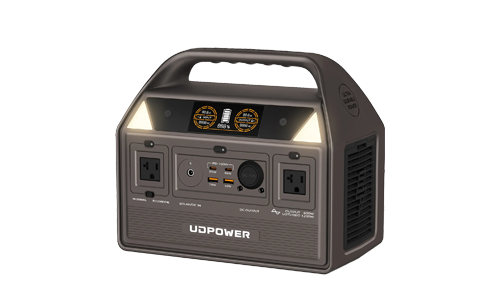
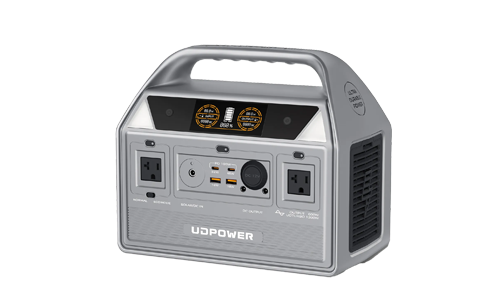
| S1200 | 1,190Wh | 1,200W | 400W max | 26.0 lb | Garden shed, hobby room, office, light workshop |
| S2400 | 2,083Wh | 2,400W | Up to 420W recommended | 40.8 lb | Corded-tool workshop and higher-load shed |
UDPOWER C400: Best for a Basic Storage or Garden Shed
- Battery capacity: 256Wh
- Rated AC output: 400W pure sine wave
- UDTURBO compatibility: up to 800W for selected compatible loads
- Maximum solar input: 150W
- Weight: approximately 6.88 lb
- Battery: LiFePO4
Best fit: LED lights, phones, cameras, laptops, small fans, routers and light charging.
The C400 makes sense when the main reason for adding power to the shed is convenience rather than running corded workshop machinery.
View UDPOWER C400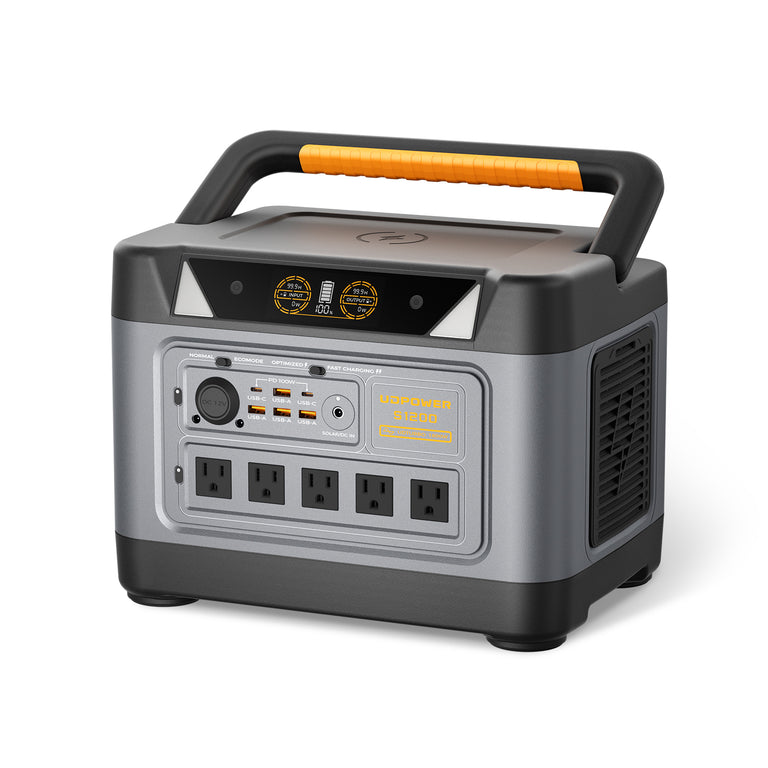
UDPOWER S1200: Best All-Around Choice for a Garden, Hobby or Office Shed
- Battery capacity: 1,190Wh
- Rated AC output: 1,200W pure sine wave
- UDTURBO: supports selected compatible higher-power loads up to 1,800W, with lower conversion efficiency above rated output
- Maximum solar input: 400W
- Weight: approximately 26.0 lb
- 5-AC version: 14 total output ports
- Battery: LiFePO4
Best fit: lighting, several cordless-tool chargers, laptop and office equipment, fans, moderate tools and longer evening or weekend use.
The S1200 is the better middle ground when a compact battery feels too limited but you do not regularly use 15A corded tools.
View UDPOWER S1200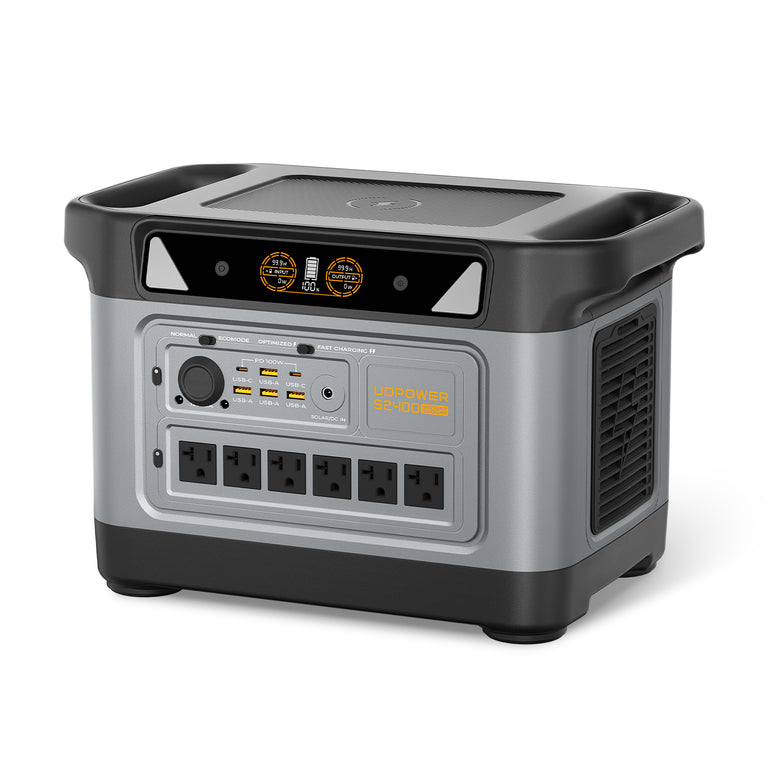
UDPOWER S2400: Best UDPOWER Choice for a Workshop Shed
- Battery capacity: 2,083Wh
- Rated AC output: 2,400W pure sine wave
- UDTURBO: supports selected compatible loads up to 3,000W in battery operation, with reduced conversion efficiency above rated output
- Maximum recommended solar input: 420W
- Weight: approximately 40.8 lb
- Total outputs: 15
- Battery: LiFePO4
Best fit: workshop lighting, tool charging, shop vacuums, saws and other higher-demand 120V shed equipment used within the station's electrical limits.
The S2400's 2,400W rated output gives significantly more workshop headroom than smaller stations, but it is not a universal replacement for installed shop power. Equipment requiring 240V or manufacturer-specified supply above the station's capabilities needs another solution.
View UDPOWER S2400For a direct specification comparison, use the UDPOWER Power Station Comparison.
Estimated Runtime at Common Shed Loads
The following estimates use the UDPOWER 90% AC conversion planning factor.
| Continuous Load | C400 256Wh | S1200 1,190Wh | S2400 2,083Wh | Example Shed Use |
|---|---|---|---|---|
| 50W | About 4.6 hours | About 21.4 hours | About 37.5 hours | Lighting or light electronics |
| 100W | About 2.3 hours | About 10.7 hours | About 18.7 hours | Laptop, fan or mixed light loads |
| 300W | About 0.8 hour | About 3.6 hours | About 6.2 hours | Charging station or hobby equipment |
| 600W | Above normal 400W rated output | About 1.8 hours | About 3.1 hours | Moderate workshop load |
| 900W | Not a normal fit | About 1.2 hours | About 2.1 hours | Shop-vacuum-class load |
| 1,200W | Not a normal fit | About 0.9 hour | About 1.6 hours | Upper S1200 rated-output range |
| 1,500W | Not a normal fit | Above normal rated output | About 1.25 hours | Space-heater-class continuous load |
These figures are useful for steady loads. A saw used in short cuts or a refrigerator that cycles requires a duty-cycle or daily-energy calculation instead.
Common Mistakes When Powering a Shed With a Portable Power Station
Buying by Wh but Ignoring Watts
A large battery does not guarantee that the inverter can start your tool.
Buying by Watts but Ignoring Wh
A powerful inverter with a small battery can run a tool but may not run it for long.
Leaving Every Charger Running While Starting a Tool
If a saw or vacuum is near the station's output limit, pause nonessential chargers while using the tool.
Trying to Heat the Shed Electrically All Day
Space heaters turn stored battery energy into heat very quickly.
Leaving the Battery in an Uninsulated Shed All Year
Check the storage range rather than assuming that outdoor-rated usage means unlimited hot or cold storage.
Treating Solar Panel Nameplate Watts as Guaranteed Output
Real solar production changes throughout the day.
Using an Extension Cord as a Permanent Electrical Installation
Temporary cords and permanent branch wiring solve different problems.
Backfeeding Shed Wiring
Do not improvise a connection from the station into installed wiring.
Ignoring 120V vs. 240V
A 2,400W 120V power station cannot run a machine that specifically requires 240V just because the wattage appears to fit.
Portable Power Station for Shed Buying Checklist
Load Check
- What is the largest single tool?
- What voltage does it require?
- What is its rated wattage or amperage?
- Does it have a motor or compressor?
- What must run at the same time?
Energy Check
- How many hours are the lights on?
- How many tool batteries do you charge?
- How long do corded tools actually run?
- Will a refrigerator, router or fan operate continuously?
- How many Wh does a typical shed day require?
Charging Check
- Will you carry the power station back to the house?
- How often can you recharge from AC?
- Will you use solar?
- How much shade falls on the solar location?
- Can daily charging replace daily consumption?
Environment Check
- How hot does the closed shed become in summer?
- Does the shed freeze in winter?
- Is condensation a problem?
- Can the battery stay dry and ventilated?
- Can it be protected from sawdust, sparks and chemical spills?
Long-Term Use Check
- Is the shed used only on weekends?
- Are you trying to avoid trenching only for occasional electricity?
- Do you need installed wall outlets?
- Will several people use high-power tools at once?
- Would permanent electrical service now make more sense?
Frequently Asked Questions
What size portable power station do I need for a shed?
A shed with only lights and small electronics may need just 200–400W of rated output and around 200–300Wh. A garden, office or hobby shed often fits better in the 600–1,200W and 600–1,200Wh range. A workshop with 15A corded tools may need roughly 2,000–2,500W of rated AC output and around 1,500–2,500Wh or more, depending on daily use.
Can a portable power station power a shed?
Yes. A portable power station can power shed lighting, electronics, battery chargers, fans and many 120V tools when its rated output, startup capability and battery capacity match the equipment. It is less suitable for long-duration electric heating, large compressors, welders, 240V machinery or several high-draw tools running at once.
How many watts do I need for a shed?
Do not calculate shed watts from floor area. Add the watts of the devices that may run at the same time and check motor startup requirements. A lights-only shed might stay below 100W, while a workshop with a 15A corded saw can approach a 1,800VA nameplate screening load from the saw alone.
Is a 300Wh power station enough for a shed?
It can be enough for a storage or garden shed used mainly for LED lights, phones, a laptop or other low-power devices. It is generally too small for long-duration workshop use or high-wattage corded tools.
Is a 1,000Wh power station enough for a shed?
For many garden, hobby and light workshop sheds, yes. Around 1,000–1,200Wh can provide useful runtime for lighting, battery charging, fans, office electronics and intermittent tools. You must still check inverter output because a 1,000Wh battery does not guarantee that a high-wattage saw or compressor can run.
Can a portable power station run power tools in a shed?
Yes, if the tool's voltage, running demand and startup behavior fit the station. A 15A, 120V corded tool has a conservative nameplate screening value around 1,800VA, so higher-output power stations are more appropriate for full-size corded workshop tools.
Can a portable power station run a shed air compressor?
Some can, but compressors need careful sizing because startup demand can be much higher than simple running-current calculations suggest. Use the compressor manufacturer's power-source requirement when available. Some common compressors specify generator requirements above 2,400W.
Can I run a space heater from a shed power station?
A sufficiently powerful station can run many space heaters, but heating drains battery capacity very quickly. A continuous 1,500W heater would consume 1,500Wh in one hour. A 2,083Wh S2400 provides about 1,875Wh of planning AC energy at 90% efficiency, which works out to only about 1.25 hours in a simplified continuous-load calculation.
Can I leave a portable power station in my shed all winter?
Only if the shed remains within the storage limits for your specific model. Current C400, S1200 and S2400 specifications list a storage range of 32°F to 104°F. An unheated shed in a cold climate can fall below that range, so bringing the station into a temperature-controlled space is often the better option.
Can I leave a portable power station in a hot shed during summer?
Not if the shed exceeds the power station's specified storage temperature. Current UDPOWER C400, S1200 and S2400 specifications list a 104°F maximum storage temperature. Closed sheds can become significantly hotter than outdoor air, so check the actual shed temperature rather than the weather forecast alone.
How much solar do I need to power a shed?
Start with the shed's daily energy use in watt-hours. Your solar system needs to replace approximately that amount of energy over time. Panel nameplate wattage alone does not determine daily production because sunlight, shading, season, panel angle and temperature all affect actual output.
Can I permanently power my shed with a portable power station?
A portable power station can be used repeatedly as an off-grid plug-in power source, especially for intermittent loads. It should not be improvised into the shed's permanent wiring or used to backfeed receptacles. If you need permanently installed outlets, hardwired lighting, 240V equipment or continuous high-power service, have a qualified electrician evaluate permanent electrical service.
Is a portable power station better than running an extension cord to a shed?
For occasional or detached off-grid use, a portable power station can be more convenient because it avoids a long temporary cord. Extension cords can be useful for short-term work when correctly rated and used safely, but CPSC and ESFI guidance states that extension cords should not substitute for permanent wiring.
Which UDPOWER power station is best for a shed?
The C400 is best suited to basic lighting and small electronics. The S1200 is the stronger all-around choice for garden sheds, hobby sheds, backyard offices and light workshops. The S2400 is the best UDPOWER starting point for workshop sheds using higher-wattage 120V corded tools.
Choose a Shed Power Station Around the Loads You Actually Use
Start with the largest tool, calculate what runs at the same time, then work out how many watt-hours you use between recharges. For a basic shed, a compact station may be all you need. For a hobby room or garden shed, move toward the S1200 class. For a true 120V workshop with corded tools, start by evaluating the S2400 class and the electrical requirements of your largest machine.
Compare Power Station Sizes View Portable Power Stations View Solar Generator KitsRelated Articles


