

Portable Power Station Tripping GFCI? Causes & Fixes
Last updated: October 19, 2026 · Reviewed for U.S. household GFCI outlets, portable power stations, AC charging, appliance loads, RV use, UPS/pass-through operation, and home backup troubleshooting.

A portable power station can be involved in a GFCI trip because of a real leakage current, moisture, a damaged cord or appliance, cumulative leakage from several electronic devices, a neutral-ground configuration problem, or an interaction involving modern inverter-based equipment.
The first step is not to assume the power station is defective. Identify what actually tripped: the wall GFCI, a GFCI breaker, a portable inline GFCI, an appliance safety plug, or the power station's own AC output protection. Those devices respond to different problems.
A true GFCI trip is also not the same as an overload. A GFCI reacts to a very small difference between current leaving and returning on the circuit. A power station may instead shut down because an appliance exceeds its output capability, especially during motor or compressor startup.
- you see sparks, smoke, melted insulation, or visible electrical damage;
- you smell burning insulation or overheated electronics;
- a plug, outlet, cord, adapter, or power station becomes abnormally hot;
- the equipment has been wet, flooded, or exposed to significant moisture;
- you feel a shock or tingling sensation from an appliance, RV frame, or metal enclosure;
- the GFCI trips repeatedly with no load connected;
- the problem involves a home's electrical panel, transfer equipment, or fixed wiring.
Do not bypass a GFCI, defeat a grounding connection, or move a questionable load to an unprotected outlet simply to stop the trip.
First: What Is Actually Tripping?
When someone says, “My portable power station keeps tripping the GFCI,” several completely different events may be hiding behind the same description.
Identifying the device that opened the circuit is the fastest way to avoid troubleshooting the wrong problem.
| What Loses Power? | What Probably Tripped? | What It Primarily Responds To | Best First Check | Reference |
|---|---|---|---|---|
| Wall receptacle shuts off and RESET button pops | GFCI receptacle | Difference between current leaving and returning | Disconnect all loads and determine whether it resets normally | ESFI GFCI guide |
| Breaker in electrical panel moves to tripped position | GFCI, AFCI, dual-function, or standard breaker | Depends on breaker type: leakage, arcing, overload, short circuit, or a combination | Read the breaker label before assuming it was a ground fault | UL breaker guidance |
| Portable power station stays on but AC output turns off | Power station inverter protection | Possible overload, short circuit, temperature protection, or another internal protection condition | Check display/error condition and connected wattage | UDPOWER surge-current guide |
| Hair dryer or appliance plug trips | Appliance-level protective device such as an ALCI | Fault or leakage associated with that appliance | Follow the appliance manufacturer's instructions | CPSC GFCI fact sheet |
| RV EMS rejects the source but nothing visibly trips | EMS compatibility check | Grounding, neutral, voltage, polarity, or source-quality checks | Read the EMS error rather than treating it as a GFCI trip | Floating vs. bonded neutral guide |
A GFCI, circuit breaker, AFCI, appliance safety plug, and inverter overload protection do not monitor the same thing. Treating all of them as a “GFCI trip” can send the diagnosis in the wrong direction.
What Does a GFCI Actually Detect?
A GFCI does not primarily measure how many watts your appliance uses. It compares the electrical current leaving through the energized conductor with the current returning through the normal return conductor.
If part of that current takes another path, the GFCI detects the imbalance and disconnects the circuit.
That alternate path could involve:
- a person;
- wet electrical parts;
- damaged insulation;
- a grounding conductor;
- an unintended neutral-ground path;
- electronic leakage through filters or other components.
UL identifies Class A GFCI protection as operating at extremely small differential-current levels, with a maximum ground-fault trip threshold of 6 mA. That is why a device can use hundreds of watts normally but still trip a GFCI because only a few milliamps are returning by an unintended path.
For an explanation of GFCI testing, see the OSHA guidance on GFCI test equipment.
Watts and leakage current answer different questions
Consider two loads:
- A 20W device can trip a GFCI if enough current leaks away from the expected path.
- A 1,000W appliance can operate normally on a GFCI-protected circuit if its current remains balanced and the circuit is otherwise properly sized.
This distinction is important when troubleshooting a portable power station. Buying a higher-output battery can solve an output-capacity problem. It does not automatically solve a ground-fault problem.
What the Timing of the Trip Tells You
The moment the trip occurs is one of the best pieces of diagnostic information you can collect.
| When It Trips | What to Suspect First | Why the Timing Matters | Recommended Next Step |
|---|---|---|---|
| Immediately when the power station is plugged into a wall GFCI for charging | Charging cord, AC input path, moisture, wiring issue, or source/load compatibility | No downstream appliance needs to be running for the problem to appear | Disconnect everything from the station and test the charging setup by itself |
| Only when one particular appliance is connected | Appliance or its cord | The fault follows a specific load | Stop using that appliance until it is checked |
| At motor or compressor startup | First determine whether this is actually a GFCI trip or inverter overload | Startup current can exceed normal running demand | Check the device that actually tripped and compare startup demand with station capability |
| After several minutes | Moisture, insulation breakdown, heater element leakage, temperature-related fault, or cycling appliance | The problem may appear only after a component heats or a compressor/heater cycles | Record the operating condition at the exact moment of the trip |
| Only after several electronic devices are connected | Cumulative leakage or high-frequency interaction | Each individual load may be acceptable while the combined differential current becomes significant | Add loads one at a time |
| Only when using an RV inlet, transfer switch, or building circuit | Neutral-ground topology or system wiring | The problem appears only after the station becomes part of a larger electrical system | Stop experimenting and have the complete configuration verified |
| Only in AC charging plus pass-through/UPS operation | Interaction involving the upstream supply, station, and downstream loads | The electrical path is different from battery-only operation | Remove downstream loads and rebuild the setup one device at a time |
8 Common Causes of Portable Power Station GFCI Tripping
1. A real ground fault or leakage current
This is the reason the GFCI exists.
Damaged insulation can allow a small amount of current to escape the intended circuit path. The appliance may still appear to work normally, but the GFCI sees the missing return current and disconnects power.
Common examples include:
- damaged power-tool cords;
- refrigerators or freezers with insulation problems;
- pumps exposed to water;
- old heating elements;
- crushed extension cords;
- damaged plugs;
- equipment that has been dropped or physically stressed.
If one appliance consistently causes the GFCI to trip while other loads work normally, treat the appliance as the primary suspect rather than trying to defeat the protection.
2. Moisture in the plug, cord, receptacle, or appliance
Water does not need to flood an outlet to create a problem. Condensation, dew, rain, damp soil, wet connectors, or moisture inside an appliance can create leakage paths.
This is especially relevant around:
- campgrounds;
- garages;
- patios;
- RV hookups;
- outdoor refrigerators;
- pumps;
- pressure washers;
- power tools;
- extension-cord connections lying on the ground.
The Electrical Safety Foundation International specifically identifies wet or damaged electrical equipment as a common ground-fault scenario.
Disconnect the equipment and allow it to be properly inspected or dried according to the manufacturer's instructions. A repeated trip around water should be treated as a safety warning, not a nuisance.
3. A damaged or inappropriate extension cord
An extension cord adds more insulation, connectors, physical exposure, and possible leakage paths between the power source and the appliance.
Look for:
- cuts or crushed sections;
- loose blades;
- burn marks;
- water inside connectors;
- multiple adapters connected in series;
- indoor cords used outdoors;
- cords that become hot during use.
A useful test is to remove the extension cord and connect a known-good compatible load directly to the portable power station or GFCI-protected source when the equipment manufacturer's instructions permit it.
4. Leakage from an appliance's electronic filters
Modern appliances often contain switching power supplies, EMI filters, variable-speed drives, inverter compressors, and other power electronics.
These components can produce small leakage or high-frequency differential currents during normal operation. One appliance may operate without trouble, while a particular combination of equipment and protective device may produce unwanted trips.
This has become important enough that UL's 2026 guidance specifically discusses high-frequency-rated GFCIs and compatibility with modern loads containing inverter and variable-speed technology.
Examples include:
- inverter refrigerators;
- variable-speed HVAC equipment;
- washing machines;
- some UPS systems;
- computer power supplies;
- chargers;
- other electronic appliances with filtering between line and ground.
This does not mean a high-frequency load should automatically be blamed whenever a GFCI trips. Real faults, moisture, damaged wiring, and incorrect system configuration should be ruled out first.
5. Cumulative leakage from several devices
This is one of the easiest causes to miss.
Suppose five electronic devices each contribute a small amount of normal leakage. None causes a trip by itself. Connect all five to a power strip, however, and the combined differential current seen by the GFCI may become much more significant.
This creates a recognizable pattern:
- Device A works alone.
- Device B works alone.
- Device C works alone.
- A + B works.
- A + B + C + several chargers trips the GFCI.
In that situation, replacing random appliances is less useful than rebuilding the setup one load at a time and recording exactly when the trip appears.
6. Neutral-ground configuration conflicts
A portable power station does not exist in isolation when it is connected to an RV electrical system, transfer equipment, or building wiring.
The location of neutral-ground bonding points and whether neutral is switched can change the path current takes through the system. An unintended parallel path can cause current to travel through a grounding conductor instead of returning entirely through the expected neutral path.
That can result in GFCI operation.
This topic needs more detail than a troubleshooting article can safely compress into a few sentences. Read Floating Neutral vs. Bonded Neutral for Portable Power Stations before attempting to diagnose an RV or home-integration problem.
Likewise, a bonded neutral is not automatically better. The complete system determines the current paths. Do not add a neutral-ground bonding plug simply because an outlet tester, EMS, or GFCI behaves differently from a normal household receptacle.
7. The GFCI device or upstream wiring has a problem
The power station may simply be the device that exposed an existing issue.
Possible upstream problems include:
- a worn or damaged GFCI receptacle;
- incorrect LINE/LOAD wiring;
- a neutral problem;
- moisture in an outdoor box;
- damaged branch-circuit wiring;
- another downstream load on the same GFCI-protected circuit.
If a wall GFCI will not reset even with the portable power station and all other accessible loads unplugged, the problem should no longer be treated as a portable-power-station troubleshooting problem.
8. It is actually an overload, not a GFCI trip
This is especially common with refrigerators, pumps, vacuums, air conditioners, power tools, compressors, and other motor-driven equipment.
The appliance may have modest running wattage but significantly higher startup demand. If the power station's inverter protection activates, users sometimes describe the event as “the GFCI tripped” even though no GFCI opened.
Read What Does Surge Current Mean? for a deeper explanation of running current, startup current, and how to size inverter output correctly.
Why Does My Power Station Trip the Wall GFCI While Charging?
This situation deserves its own diagnosis because the power station is acting as a load, not as the source supplying an appliance.
The basic setup is:
House circuit → GFCI → power station AC charging input
If the wall GFCI trips, start by removing everything connected to the output side of the station.
Test the charging path by itself
- Turn off or disconnect AC loads from the power station.
- Disconnect power strips and extension cords that are not required.
- Inspect the AC charging cable and connectors.
- Make sure the area is dry.
- Reset the GFCI once.
- Reconnect only the power station's approved AC charging setup.
If the GFCI holds under this simplified setup but trips after downstream equipment is added, the downstream loads or operating mode become much stronger suspects.
If it repeatedly trips with the station as the only load, stop repeatedly resetting it.
Try to answer these questions
| Observation | What It Tells You | Action |
|---|---|---|
| Other normal appliances also trip the same GFCI | The outlet/circuit may be the problem | Have the circuit evaluated |
| Power station trips one GFCI but charges normally from another properly functioning GFCI circuit | The first circuit deserves closer inspection | Do not assume the first GFCI is simply “too sensitive” |
| Power station trips multiple known-good GFCIs with nothing connected to its outputs | The charging system or unit requires investigation | Stop using AC charging and contact manufacturer support |
| Trip occurs only when an extension cord is added | Cord or connection becomes a major suspect | Remove and inspect the cord |
| Trip appears only outdoors or after rain | Moisture becomes a high-priority suspect | Stop use until equipment is dry and safe |
Why Does the GFCI Trip Only When the Power Station Runs an Appliance?
Now the electrical path is different:
Power station → appliance
or, in a more complex system:
Power station → protected circuit/system → appliance
If everything remains stable until one particular appliance starts, isolate that appliance first.
Use the one-load test
Disconnect everything and reconnect devices individually.
A practical sequence might look like this:
- LED lamp
- phone charger
- laptop
- router
- refrigerator
- pump or power tool
If the first four work but the refrigerator produces a trip, you now have a much smaller problem to investigate.
Next determine whether the refrigerator causes:
- an actual GFCI device to open;
- the power station's AC output to shut down;
- an overload/error indication;
- the trip only when the compressor starts;
- the trip after several minutes of operation.
Those symptoms point toward different causes.
Why Can Several Devices Cause a GFCI Trip When Each Works Alone?
Think of GFCI troubleshooting as a current-balance problem rather than a wattage problem.
Multiple electronic loads can contribute small amounts of leakage. The GFCI responds to the combined imbalance it sees on the protected circuit.
If every device works separately but the GFCI trips only after several devices are connected together, do not immediately assume the largest-wattage device is responsible. Add the devices in different orders and record the combination that produces the trip.
This is especially useful in a home-office or outage setup containing:
- desktop computers;
- monitors;
- network equipment;
- UPS units;
- chargers;
- TVs;
- refrigerators with inverter electronics;
- surge-protection equipment.
More watts and more leakage are not the same thing. A large resistive load and a group of small electronic power supplies can present very different GFCI behavior.
Why Does a GFCI Trip Only in UPS or Pass-Through Mode?
A portable power station may behave differently when:
- running from its battery inverter;
- charging from utility AC;
- supplying downstream loads while connected to AC input;
- changing between utility and battery operation.
Do not assume that the internal electrical path is identical in every mode.
If the problem appears only during AC charging plus downstream operation, simplify the system:
Test A: Wall GFCI → power station charging only
Test B: Power station on battery → one load
Test C: Power station on battery → normal group of loads
Test D: Wall AC → power station → one downstream load
The goal is not to repeatedly force the system through a trip. The goal is to determine which operating condition introduces the problem.
If the issue occurs consistently only in one operating mode, provide that information to the power-station manufacturer. It is much more useful than simply reporting “the GFCI trips.”
Why Does the GFCI Trip Only With an RV or Transfer Switch?
This is where ordinary appliance troubleshooting should stop and system-level electrical analysis begins.
Connecting a portable power station to an RV shore-power system, transfer switch, generator inlet, or home electrical system introduces additional neutral, grounding, protective-device, and wiring relationships.
A setup can appear perfectly normal when a refrigerator is plugged directly into the station but behave differently after the station is connected to a larger electrical system.
Before diagnosing the GFCI itself, verify:
- the power station's documented AC output configuration;
- whether the transfer equipment switches neutral;
- where the system neutral-ground bond is located;
- whether another bond exists downstream;
- whether the equipment was designed for the source voltage;
- whether the connection method is approved for the application;
- which protective device is actually opening.
For home backup, read Can You Connect a Portable Power Station to a Transfer Switch?.
For neutral and grounding behavior, read Floating Neutral vs. Bonded Neutral for Portable Power Stations.
A connection that stops the trip is not necessarily a safe or correct connection.
10-Step Troubleshooting Process
This process is designed for ordinary users working only with accessible plug-and-cord equipment. It does not require opening the power station, electrical panel, GFCI, transfer switch, or appliance.
Check the wall receptacle, panel breaker, power station display, appliance plug, and any inline protective device.
Was it at plug-in, when AC output was turned on, when a compressor started, after ten minutes, during charging, or after another device was added?
Remove appliances, chargers, power strips, and unnecessary adapters.
Look for water, cuts, crushed insulation, bent blades, discoloration, loose connectors, or heat damage.
If the GFCI will not reset with everything disconnected, stop. Do not repeatedly cycle it.
A small lamp can be more useful diagnostically than immediately reconnecting a refrigerator, pump, heater, or power tool.
Wait long enough for cycling appliances such as refrigerators to actually start their compressors.
If the problem disappears, inspect the removed part rather than assuming the power station fixed itself.
This tells you whether the problem depends on the upstream wall circuit.
At that point, manufacturer support, an RV technician, or a licensed electrician is more useful than further trial-and-error.
A simple troubleshooting log
| Test | Power Source | Connected Load | Extension Cord? | What Tripped? | When? |
|---|---|---|---|---|---|
| 1 | Wall GFCI | Power station charging only | No | Record result | Record timing |
| 2 | Power station battery | Small known-good load | No | Record result | Record timing |
| 3 | Power station battery | Suspected appliance | No | Record result | Record timing |
| 4 | Power station battery | Normal load group | As normally used | Record result | Record timing |
| 5 | Wall AC + station | One downstream load | No | Record result | Record timing |
This type of record is also useful when contacting support because it turns “it keeps tripping” into a reproducible symptom.
GFCI Trip vs. Power Station Overload: How to Tell the Difference
| Characteristic | GFCI Trip | Power Station Overload |
|---|---|---|
| Primary trigger | Difference between outgoing and returning current | Load exceeds inverter/output protection limits |
| Can a low-wattage device cause it? | Yes | Normally not because of wattage alone |
| Common trigger | Leakage, wet equipment, damaged insulation, unintended current path | Large heater, motor, compressor, several loads at once |
| Typical visible clue | GFCI RESET mechanism or GFCI breaker trips | Power station AC output shuts off or shows protection/error condition |
| Will buying a higher-wattage station fix it? | Not if the problem is a real ground fault | Potentially, if inadequate output capability is the actual problem |
| More information | ESFI GFCI guidance | UDPOWER surge-current guide |
Example: refrigerator shuts the system down when its compressor starts
If the wall or branch-circuit GFCI physically trips, investigate it as a GFCI event.
If the GFCI remains set but the portable power station disables AC output when the compressor starts, the issue is more likely related to the appliance's startup demand or another inverter protection condition.
A refrigerator that uses 100W during part of its operating cycle cannot be sized solely from that 100W number. For more information, see What Does Surge Current Mean?.
What About a Plug-In Outlet or GFCI Tester?
A plug-in tester can be useful in ordinary household wiring, but do not use one test result as proof that a portable inverter source is defective.
Some external GFCI testers create their test condition by intentionally sending a small amount of current from the energized conductor through the equipment-ground path. OSHA explains this testing method in its GFCI testing guidance.
A portable power source with a different neutral-ground relationship from normal household wiring may therefore cause some plug-in testers to behave differently.
The GFCI's own TEST function and a separate three-light plug-in tester should not automatically be treated as equivalent tests.
For the full explanation, see Floating Neutral vs. Bonded Neutral for Portable Power Stations.
When Should You Call an Electrician Instead of Troubleshooting?
Stop user-level troubleshooting when:
- the GFCI trips with no appliance connected;
- multiple known-good appliances cause the same circuit to trip;
- the GFCI will not reset;
- the panel breaker is involved;
- the problem involves a transfer switch or interlock;
- the problem appears only when feeding an RV electrical system;
- an outlet tester gives unexplained wiring faults in a fixed installation;
- you suspect an incorrect neutral-ground bond;
- there is heat, arcing, burning odor, shock, or visible damage.
Do not open a power station, panel, outlet, transfer switch, or appliance just to continue the troubleshooting process.
Choosing a UDPOWER Power Station: First Confirm It Is Really an Output Problem
A larger portable power station can provide more output headroom for refrigerators, tools, pumps, kitchen appliances, and combinations of multiple loads.
But there is an important limit to that recommendation:
If troubleshooting shows that the protective device opening is actually a GFCI, identify the leakage, moisture, damaged equipment, wiring, or configuration problem first. If troubleshooting instead shows that the station's own inverter protection is activating because of load demand, then output capacity becomes relevant.
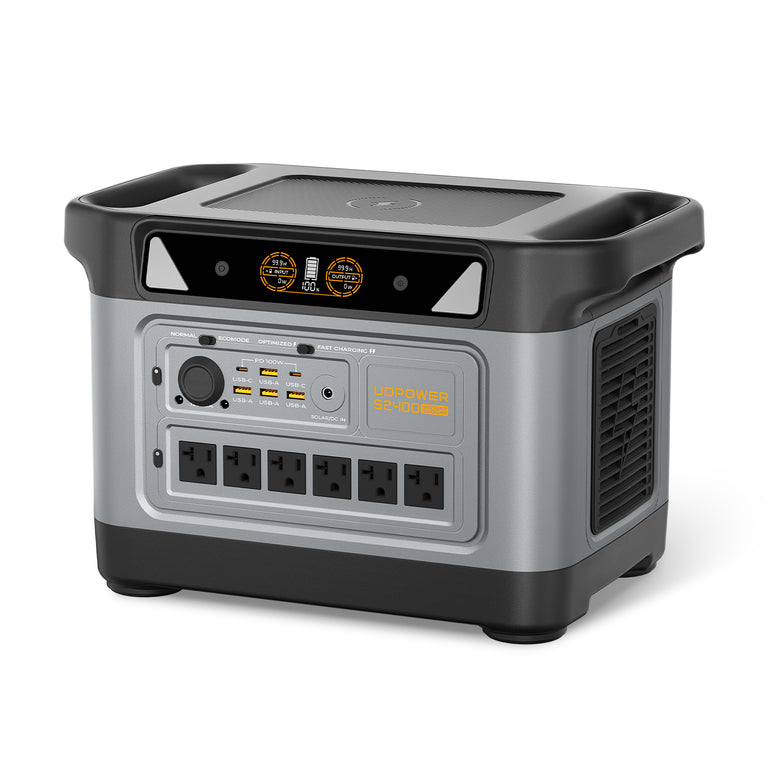
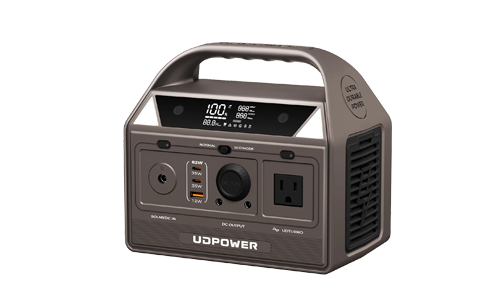
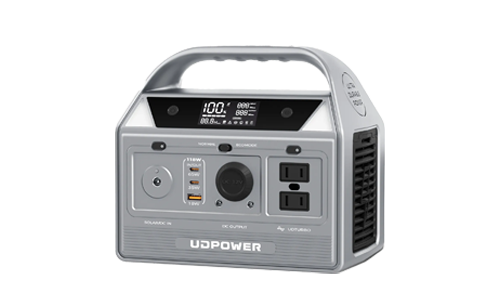
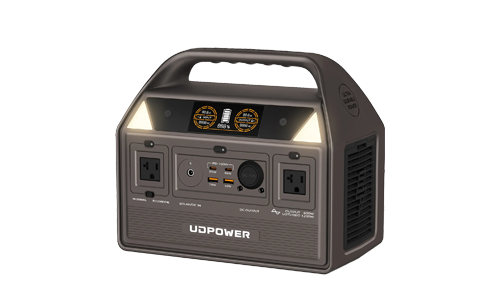
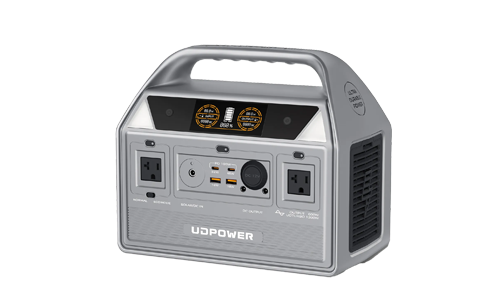
UDPOWER S2400: More Output Headroom for Larger 120V Loads
The UDPOWER S2400 is the stronger option when your diagnosis shows an inverter-capacity problem rather than a genuine GFCI fault.
- Battery capacity: 2,083Wh LiFePO4
- Rated AC output: 2,400W pure sine wave
- Higher-power UDTURBO operation: up to 3,000W for compatible loads
- AC output: 120V, 60Hz
- AC outlets: 6
- UPSPrime switching: less than 10 ms
- Solar input: up to 420W
It is well suited to direct backup of compatible 120V refrigerators, home essentials, electronics, campsite equipment, and other loads within its operating limits.
It should not be selected as a workaround for an unresolved GFCI or grounding problem.
S1200 vs. S2400 for common backup loads
| Model | Capacity | Rated AC Output | Higher-Power Capability | Best Fit | Official Product Page |
|---|---|---|---|---|---|
| UDPOWER S1200 | 1,190Wh | 1,200W pure sine wave | UDTURBO up to 1,800W for compatible loads | Refrigeration, communications, CPAP, lights, electronics, moderate 120V loads | S1200 specifications |
| UDPOWER S2400 | 2,083Wh | 2,400W pure sine wave | UDTURBO up to 3,000W for compatible loads | Larger 120V appliances, heavier backup loads, more simultaneous devices | S2400 specifications |
If you are still determining the correct size, browse the UDPOWER portable power station collection or compare models in the 1,000Wh+ portable power station category.
Related UDPOWER Guides
If your GFCI problem is part of a larger home, RV, or outage setup, these guides cover the related topics without repeating this troubleshooting process:
- Floating Neutral vs. Bonded Neutral for Portable Power Stations — understand neutral-ground behavior, outlet testers, GFCI testing, RVs, and transfer equipment.
- Can You Connect a Portable Power Station to a Transfer Switch? — understand safe home-backup integration and 120V limitations.
- What Does Surge Current Mean? — determine whether a suspected “GFCI trip” is actually an inverter output problem.
- Portable Power Station Safety Guide — charging, battery, temperature, indoor use, cords, and operating safety.
- How Many Watts Does an RV AC Use? — useful when the problem involves an RV air conditioner or compressor startup.
- 24/48/72-Hour Power Outage Checklist — build a safer home-backup plan before the next outage.
Frequently Asked Questions
Why does my portable power station trip a GFCI outlet when charging?
If the wall GFCI trips while the power station is charging, disconnect all downstream loads first. Possible causes include leakage in the charging path, a damaged charging cord, moisture, an upstream circuit problem, or an issue involving the station's AC input. If the station repeatedly trips multiple known-good GFCI circuits while it is the only connected load, stop AC charging and contact the manufacturer.
Can an overloaded portable power station trip a GFCI?
An overload and a GFCI trip are different events. A GFCI responds primarily to an imbalance between outgoing and returning current, while the portable power station's inverter protection responds to excessive load or other internal protection conditions. Check which device actually shut off before diagnosing the problem.
Does a floating neutral automatically make a GFCI trip?
No. A floating neutral by itself should not be treated as an automatic explanation for every GFCI trip. GFCI operation depends on current imbalance, while the complete neutral and grounding topology determines what current paths exist. Problems become particularly important when a portable source is connected to an RV, transfer switch, or building electrical system.
Can I use a neutral-ground bonding plug to stop a GFCI from tripping?
Do not use a bonding plug as a universal GFCI fix. Adding a neutral-ground connection in the wrong system can create unintended current paths or an additional bonding point. Use a bonding arrangement only when the equipment manufacturer and the specific electrical application explicitly support it.
Why does one appliance trip the GFCI while everything else works?
The appliance, its cord, or its operating environment becomes the leading suspect. Possible causes include insulation leakage, moisture, an internal component fault, or electronic leakage current. Stop using the appliance if the trip consistently follows it, especially if the appliance has been wet or damaged.
Why does the GFCI trip only when several devices are plugged in?
Several electronic devices can contribute small amounts of leakage current. Each may work normally alone, but the combined differential current may become large enough to operate the GFCI. Add loads one at a time and record the combination that produces the trip.
Can an extension cord cause GFCI tripping?
Yes. A damaged, wet, crushed, or deteriorated extension cord can create an unintended leakage path. Additional connectors and outdoor exposure also increase the number of places where moisture or damage can occur. Remove unnecessary extension cords during troubleshooting and never use a damaged cord.
Why does the GFCI trip only in UPS or pass-through mode?
AC charging plus downstream operation creates a different operating condition from battery-only use. Disconnect downstream loads, verify whether AC charging alone works normally, then add one load at a time. If the problem occurs consistently only in one mode, contact the power-station manufacturer with the exact setup and trip timing.
Why does my RV GFCI trip when connected to a portable power station?
An RV adds its own electrical distribution, grounding, protective devices, EMS equipment, and neutral configuration. If the station works normally with direct appliance loads but the problem begins when the RV is connected, have the RV's complete shore-power and neutral-ground arrangement checked rather than modifying the power station.
Will a larger portable power station stop GFCI tripping?
Not if the problem is a real ground fault or leakage current. A larger station helps only when the apparent “trip” is actually the power station's own output protection responding to a load that exceeds its operating capability. Identify the device that is shutting down before replacing the power source.
What should I do if the GFCI will not reset?
Disconnect accessible downstream loads and try the manufacturer's normal reset procedure once. If the GFCI still will not reset, or it immediately trips again with no load attached, stop using the circuit and have it evaluated. Do not repeatedly reset it or bypass the protection.
Should I move the power station to a non-GFCI outlet if it keeps tripping?
Do not move questionable equipment to an unprotected outlet merely to defeat the symptom. A repeated GFCI trip may be warning you about real leakage, moisture, damaged equipment, or a wiring problem. Diagnose the cause instead of removing the protective device from the equation.
Bottom Line
When a portable power station appears to trip a GFCI, begin with one question: what actually opened the circuit?
If a real GFCI tripped, think about current leakage, moisture, damaged cords or appliances, cumulative electronic leakage, and system-level neutral or grounding paths. If the power station's AC output shut down instead, investigate appliance startup demand, total load, short-circuit protection, or another inverter protection condition.
The timing of the event often tells you more than the wattage printed on the appliance. A trip at plug-in points in a different direction from a trip at compressor startup, after twenty minutes of heating, after adding a fifth electronic load, or only after connecting an RV or transfer switch.
Most importantly, do not “fix” a repeated GFCI trip by bypassing the GFCI or improvising a neutral-ground connection. Protective devices are giving you information. Use that information to isolate the real cause.
Build a Safer Backup-Power Setup
Once you have confirmed that your problem is load capacity rather than an unresolved electrical fault, compare UDPOWER portable power stations by capacity, rated AC output, and intended use.
Safety References
- Electrical Safety Foundation International — Ground Fault Circuit Interrupters
- OSHA — Field Service Memo on Electrical Testing Equipment
- UL Solutions — Circuit Breaker Marking and Application Guide
- UL Solutions — High-Frequency Ground-Fault Circuit Interrupters
- U.S. Consumer Product Safety Commission — GFCI Fact Sheet
Related Articles


