

Off-Grid Solar for Fall Projects: How Much Power Do You Need?
Last updated: October 10, 2026

As a practical starting point, a compact 256Wh-class battery works for light, intermittent loads. Around 1,000–1,200Wh is much more useful for cabins, camping, greenhouse controls, tool charging, and overnight loads. A 2,000Wh-class station provides more breathing room for higher-wattage tools, longer operating periods, poor-weather reserve, and pre-winter emergency power.
Fall also changes the solar side of the equation. Shorter days, lower sun angles, tree shadows, clouds, and leaves or debris can reduce daily solar recovery, so a system that felt generous in July may be marginal by October or November.
Fall is one of the most useful times of year for portable off-grid power. Hunting season starts, summer cabins need closing work, sheds and workshops get more evening use, property owners prepare for freezing weather, and shorter daylight hours make lighting and battery charging more important.
It is also the season when people discover that sizing a solar system from the panel label alone does not work.
A 200W panel tells you how much power the panel can produce under rated conditions. It does not tell you how much energy your cabin, camera system, greenhouse, or power tools consume in a day. It also does not tell you how much usable sunlight you will actually get in October at your location.
The better approach is to work backward from the project.
Fall Off-Grid Power Sizing at a Glance
The ranges below are practical planning ranges, not fixed appliance specifications. Actual consumption should always be checked against the labels, manuals, or measured use of the equipment you own.
| Fall Project | Planning Energy Range | Typical Peak Load Concern | Battery Starting Point | Solar Starting Point |
|---|---|---|---|---|
| Hunting cabin | 500–1,200Wh/day | Fridge, coffee maker, pump or other AC appliance | 1,000–2,000Wh | 210–400W |
| Detached shed / light workshop | 300–1,000Wh/day | Corded tools and motor startup | 1,000Wh+ | 210–400W |
| Greenhouse controls and ventilation | 300–1,200Wh/day | Fans and pumps | 1,000–2,000Wh | 240–400W |
| Remote security | 150–600Wh/day | Continuous 24-hour load | 250–1,200Wh | 120–240W |
| Outdoor lighting | 50–250Wh/day | Longer fall nights | 250Wh+ | 120W |
| Fall camping / hunting camp | 500–1,200Wh/day | Fridge, CPAP, heated gear, cooking devices | 1,000–2,000Wh | 210–400W |
| Remote property maintenance | 400–1,500Wh/day | Pumps, chargers and power tools | 1,000–2,000Wh | 210–400W |
| Electric fence / small farm charging | 100–500Wh/day | Continuous energizer plus chargers | 250–1,200Wh | 120–240W |
| Seasonal power-tool work | 300–1,500Wh/project day | High instantaneous tool wattage | 1,000–2,000Wh | 210–400W |
| Emergency power before winter | 800–2,000Wh/day | Several essential loads at once | 2,000Wh-class preferred | 400W-class recovery |
Why Fall Solar Planning Is Different
An off-grid system that works comfortably in midsummer can become much tighter later in the year even when your equipment has not changed.
The U.S. Department of Energy explains that seasonal changes in day length and solar angle have a major effect on how much solar energy reaches the ground. As the Northern Hemisphere moves from summer through fall toward winter, days become shorter and sunlight reaches the surface at a lower angle.
Source: U.S. Department of Energy — Solar Radiation Basics
For a fall project, four changes matter in practice:
- Fewer useful solar hours: your panel has less time each day to put energy back into the battery.
- Lower sun angle: panel orientation becomes more important than it may have been in summer.
- More shade: buildings, hills, and trees can cast longer shadows.
- More weather variability: several cloudy days in a row can turn an adequately sized summer setup into a battery-deficit problem.
At the same time, some loads increase. Lights stay on longer. A hunting cabin may be used after sunset. Heated gear appears at campsites. Greenhouse fans, pumps, monitoring equipment, and frost-protection systems may run differently.
How to Calculate How Much Off-Grid Power You Need
You only need three numbers to make a useful first estimate:
- How many watt-hours you use each day
- The highest wattage you may need at one time
- How many watt-hours you can realistically recover from solar each day
Step 1: Calculate daily energy
A 20W light running for five hours uses:
If you have several devices, calculate each one and add them together.
Step 2: Separate energy from peak power
Imagine a circular saw that draws 1,200W but is only used for 10 minutes.
Its energy use is relatively modest:
But your inverter still needs enough output capability to operate the saw while it is running. That is why a workshop may need a large inverter even when total daily energy consumption is not especially high.
Step 3: Estimate usable battery energy
For UDPOWER planning examples in this guide, we use a 90% usable-energy factor to account for practical conversion and operating losses.
| UDPOWER Model | Rated Capacity | 90% Planning Energy | Rated AC Output | Official Specs |
|---|---|---|---|---|
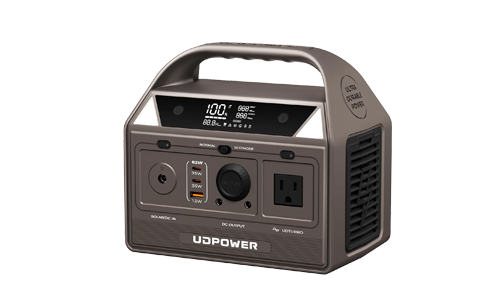
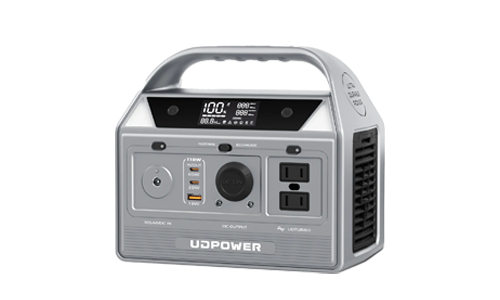
| C400 | 256Wh | About 230Wh | 400W | C400 specifications |
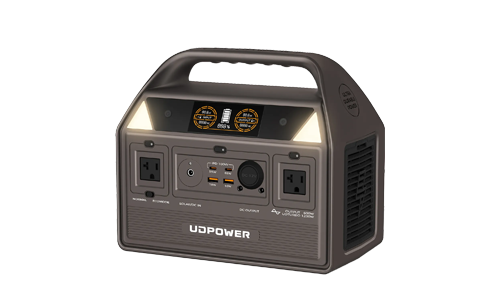
| S1200 | 1,190Wh | About 1,071Wh | 1,200W | S1200 specifications |
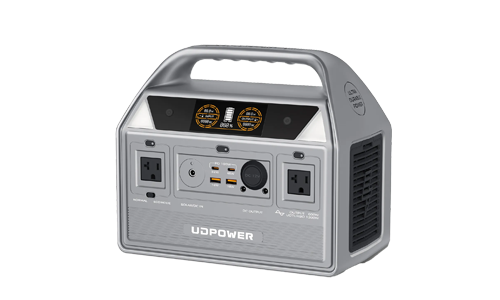
| S2400 | 2,083Wh | About 1,875Wh | 2,400W | S2400 specifications |
These planning-energy figures are estimates, not guaranteed usable capacity. Actual results depend on load type, temperature, battery state, output method, and operating conditions.
1. Hunting Cabin: Size for the Night, Not Just the Day
A hunting cabin is a good example of why daily watt-hours matter more than a simple list of appliances. Many loads are small, but they run after sunset when solar production has stopped.
Example hunting cabin energy budget
| Load | Planning Power | Daily Use | Energy |
|---|---|---|---|
| LED cabin lighting | 30W total | 5 hours | 150Wh |
| Portable compressor fridge | Use measured daily consumption | 24-hour cycling | 300Wh example |
| Laptop | 65W | 2 hours | 130Wh |
| Phones, headlamps and radio | Varies | Daily charging | 50Wh example |
| Example total | 630Wh/day |
An S1200 provides about 1,071Wh of planning energy at the 90% factor used here, so this example leaves useful reserve for one night. A C400 would be far too small for the same full-day load.
The next question is solar recovery. A 210W panel under a conservative three-peak-sun-hour fall example and 75% planning yield produces roughly 473Wh. That would not fully replace a 630Wh cabin day. A 400W-class input under the same assumptions produces about 900Wh and gives much more margin.
For a simple weekend hunting cabin, start around the S1200 class. Move toward S2400 when the cabin also needs longer refrigerator runtime, a pump, several cloudy-day reserves, or higher-wattage AC appliances.
2. Detached Shed or Workshop: The Biggest Tool Sets the Inverter Size
A shed used only for lights and battery chargers is easy to power. A workshop with a circular saw, shop vacuum, compressor, or other corded tool is a different project.
The common mistake is looking only at daily watt-hours.
A saw may only operate for a few minutes and therefore use relatively little energy, but the power station still has to support the tool's operating demand when you pull the trigger.
Example light workshop day
| Load | Example Use | Energy |
|---|---|---|
| Four LED shop lights | 40W total × 4h | 160Wh |
| Cordless tool battery charger | 120W × 1.5h | 180Wh |
| Radio | 15W × 4h | 60Wh |
| 800W corded tool | About 9 minutes total | 120Wh |
| Example total | 520Wh |
Energy-wise, 520Wh is not demanding for an S1200. The more important check is whether the largest tool stays within the station's operating limits.
For tools approaching or exceeding 1,200W, or when a shop vacuum or charger runs at the same time, S2400's 2,400W rated AC output gives substantially more headroom.
3. Greenhouse: Fans Are Manageable, Electric Heat Changes Everything
A greenhouse is one of the easiest projects to undersize because not all greenhouse loads behave the same way.
Ventilation fans, circulation fans, irrigation controls, sensors, and small pumps can fit comfortably into a portable solar setup. Resistance heating is a different category.
Example greenhouse control budget
| Load | Example Use | Daily Energy |
|---|---|---|
| Circulation fans | 40W × 12h | 480Wh |
| Controller and sensors | 8W × 24h | 192Wh |
| Small irrigation pump | 40W × 1h | 40Wh |
| Example total | 712Wh/day |
An S1200 can cover this example for roughly one day without meaningful solar input. An S2400 provides more cloudy-weather reserve.
Why electric greenhouse heating is different
A 1,500W electric heater running for eight hours uses:
That is 12kWh before other greenhouse loads are added. It is far beyond the daily energy budget of the portable systems discussed here.
4. Remote Security Cameras: Small Watts Become Big Daily Energy
Remote cameras look like tiny loads, but 24-hour operation changes the calculation.
A device using only 8W continuously consumes:
Add another camera, an LTE router, Wi-Fi bridge, network recorder, or cold-weather equipment and the total can rise quickly.
For a security system, reliability matters more than achieving the smallest possible battery size. If the property must remain monitored through two cloudy days, size battery storage for those days before worrying about the panel.
A C400 can work for a very small, low-power camera setup when the measured daily energy is comfortably below its available planning energy. For a true 24/7 multi-device site, S1200 offers much more reserve and is usually the safer starting point.
One practical detail matters with very low continuous loads: confirm that your power station's output stays active with the exact camera/router load you plan to connect. The S1200 product guidance specifically notes that very small loads may benefit from Normal Mode rather than relying on automatic energy-saving behavior.
5. Outdoor Lighting: Simple Load, Longer Fall Nights
Outdoor lighting is one of the easiest fall solar projects to size because the math is predictable.
Four 6W LED lights operating for six hours use:
That fits comfortably within a C400-class battery, even after allowing for conversion losses.
The fall catch is runtime. If the same lights were used only three hours per night during summer but six hours in late fall, their daily energy requirement doubles even though nothing about the fixtures changed.
C400 + 120W solar is a practical combination for modest LED lighting, phones, cameras, and similar low-energy property loads.
6. Fall Camping or Hunting Camp: Add the Overnight Loads First
Fall camps often use more battery energy after sunset than summer camps. Lights stay on longer, mornings are darker, and cold-weather gear can add loads that were not present in July.
Example fall basecamp
| Camp Load | Planning Energy |
|---|---|
| Portable compressor fridge | 300Wh/day example |
| LED camp lighting | 100Wh |
| Phones, GPS and headlamps | 60Wh |
| Camera and radio batteries | 60Wh |
| Low-watt heated blanket used selectively | 200Wh example |
| Example total | 720Wh/day |
S1200 is a natural starting point for this type of load. If the camp stays established for several days, has multiple people, runs a CPAP or refrigerator overnight, or expects poor solar conditions, the extra reserve of S2400 becomes useful.
For a broader campsite calculation, see the Camping Power Station Buying Guide and How to Get Power When Camping Off-Grid.
7. Remote Property Maintenance: Build Around the Workday
Fall property maintenance can mean checking pumps, clearing trails, repairing fences, charging cordless batteries, servicing a hunting cabin, installing cameras, or preparing water systems before freezing weather.
This is rarely a single continuous load. Instead, you may use several devices for short periods throughout the day.
A useful way to size the system is to create a "project day" rather than a 24-hour household budget.
| Example Task | Energy |
|---|---|
| Two cordless battery recharges | 200Wh |
| Portable work lights | 120Wh |
| Laptop / diagnostic equipment | 130Wh |
| Short pump operation | 200Wh |
| Phone, radio and camera charging | 50Wh |
| Example workday | 700Wh |
S1200 fits this type of moderate project day well. S2400 makes more sense when the same station also has to run high-wattage tools or serve as overnight cabin backup after the work is done.
8. Electric Fence and Small Farm Equipment Charging
Electric fences deserve a different kind of calculation. The joule rating of a fence energizer describes the energy of the fence pulse; it should not be treated as the device's continuous electrical power draw.
For solar sizing, use the energizer manufacturer's actual input watts, amperage, or battery-consumption specification.
Then add any other loads at the site:
- Fence energizer
- Trail or livestock cameras
- Small water pump
- Electric tool chargers
- Phone or radio charging
- LED utility lighting
A low-power fence energizer by itself may not require a large portable station. The system becomes more demanding when it is serving as the central power source for several pieces of remote farm equipment.
C400 works well when the total measured daily load is small. S1200 is more appropriate when cameras, pumps, tool chargers, or several days of weather reserve are part of the same setup.
9. Power Tools for Seasonal Property Work
Portable solar power can be very useful for seasonal work because many tools run hard but only briefly.
A 1,200W saw used for 15 minutes consumes roughly:
Energy demand is manageable. The 1,200W operating load is the more important compatibility question.
That leads to a simple rule:
An S1200 is suitable for equipment that stays within its 1,200W rated output and compatible higher-power operating mode. For heavier tools, S2400's 2,400W rated output and up-to-3,000W UDTURBO capability provide significantly more headroom.
Always check the tool rather than choosing from a generic wattage chart. Motors, compressors, and variable-speed electronics can behave differently during startup.
10. Emergency Power Before Winter
Fall is also the right time to prepare a battery system before the first winter outage rather than waiting until the power is already off.
Example essential-load day
| Essential Load | Example Daily Energy |
|---|---|
| Refrigerator | 600Wh |
| Internet router | 120Wh |
| LED lighting | 120Wh |
| Phones and small electronics | 60Wh |
| Emergency radio / small devices | 20Wh |
| Example total | 920Wh/day |
An S1200 has roughly enough planning energy for about one day of this example load before meaningful recharging. An S2400 provides roughly two days of battery energy under the same 90% planning assumption.
That is before solar is added.
For emergency use, reserve matters. If your calculated essentials total 900Wh per day, buying exactly 900Wh of nominal battery capacity leaves very little room for colder conditions, conversion losses, unexpected devices, or poor solar weather.
How Much Solar Do You Need for Fall?
The battery gets you through the night. Solar determines whether you can do it again tomorrow.
A useful planning formula is:
For a conservative portable fall setup, the examples below use three equivalent peak-sun-hours and a 75% overall planning yield.
| Effective Solar Wattage | 3 Peak Sun Hours | 75% Planning Yield | Estimated Daily Recovery |
|---|---|---|---|
| 120W | 360Wh theoretical | × 0.75 | About 270Wh/day |
| 150W | 450Wh theoretical | × 0.75 | About 338Wh/day |
| 210W | 630Wh theoretical | × 0.75 | About 473Wh/day |
| 240W | 720Wh theoretical | × 0.75 | About 540Wh/day |
| 400W | 1,200Wh theoretical | × 0.75 | About 900Wh/day |
These figures are planning examples, not solar-production promises. Your location, month, clouds, shade, panel angle, temperature, cable losses, battery state, and solar controller all affect actual input.
NREL's PVWatts calculator is useful for checking the solar resource at a specific location instead of relying on a nationwide peak-sun-hour assumption.
Solar estimation tool: NREL PVWatts Calculator
The most useful fall calculation: solar deficit
Suppose your hunting cabin uses 700Wh per day, but your solar setup is only recovering 470Wh per day.
The system may appear to work perfectly on day one. On a multi-day trip, the battery gradually drops because solar is not replacing everything you use.
This is why an off-grid setup should be evaluated as an energy cycle rather than a one-time runtime calculation.
Do not confuse rated panel watts with accepted solar input
The solar array and the portable power station both have limits. A higher-rated panel combination does not mean the power station can accept unlimited input.
Current UDPOWER specifications list:
| Model | Battery Capacity | Maximum Solar Input | Best Fall Role | Official Source |
|---|---|---|---|---|
| C400 | 256Wh | Up to 150W | Lighting, cameras, chargers, light remote loads | UDPOWER C400 |
| S1200 | 1,190Wh | Up to 400W | Cabins, camping, greenhouse controls, workshops | UDPOWER S1200 |
| S2400 | 2,083Wh | Up to 400W | Extended projects, larger tools, emergency reserve | UDPOWER S2400 |
If you want the fundamentals of panel, controller, battery, wiring, and inverter sizing rather than project-specific fall planning, see 12V Solar Panel Kit: Components, Sizing, Wiring & Battery Guide.
What About the UDPOWER 120W Portable Solar Panel?

The current UDPOWER 120W portable solar panel is a practical entry point for lighter fall loads and smaller power stations. Official specifications include:
- 120W rated power
- 21.5V open-circuit voltage
- 17.92V maximum-power voltage
- ≥22% rated cell efficiency
- IP65 weather-resistant rating
- Adjustable angle bracket
- Compatibility with current UDPOWER portable power stations, subject to each station's input limits
View the UDPOWER 120W Portable Solar Panel
Recommended UDPOWER Power Stations for Fall Off-Grid Projects
The best model is not simply the one with the largest battery. Match the station to the actual project.

UDPOWER C400: Best for Light Remote Projects
C400 makes the most sense when portability matters more than multi-day runtime.
- Capacity: 256Wh LiFePO4
- Rated AC output: 400W
- Higher-power support: up to 800W with UDTURBO for compatible loads
- Solar input: up to 150W
- Weight: approximately 6.88 lb
- 90% planning energy: about 230Wh
Best for: LED lighting, trail cameras, phone and radio charging, light security systems, small battery chargers, and short property inspections.
Not ideal for: a full hunting cabin, all-day greenhouse equipment, heavy corded tools, or a large emergency load.
View C400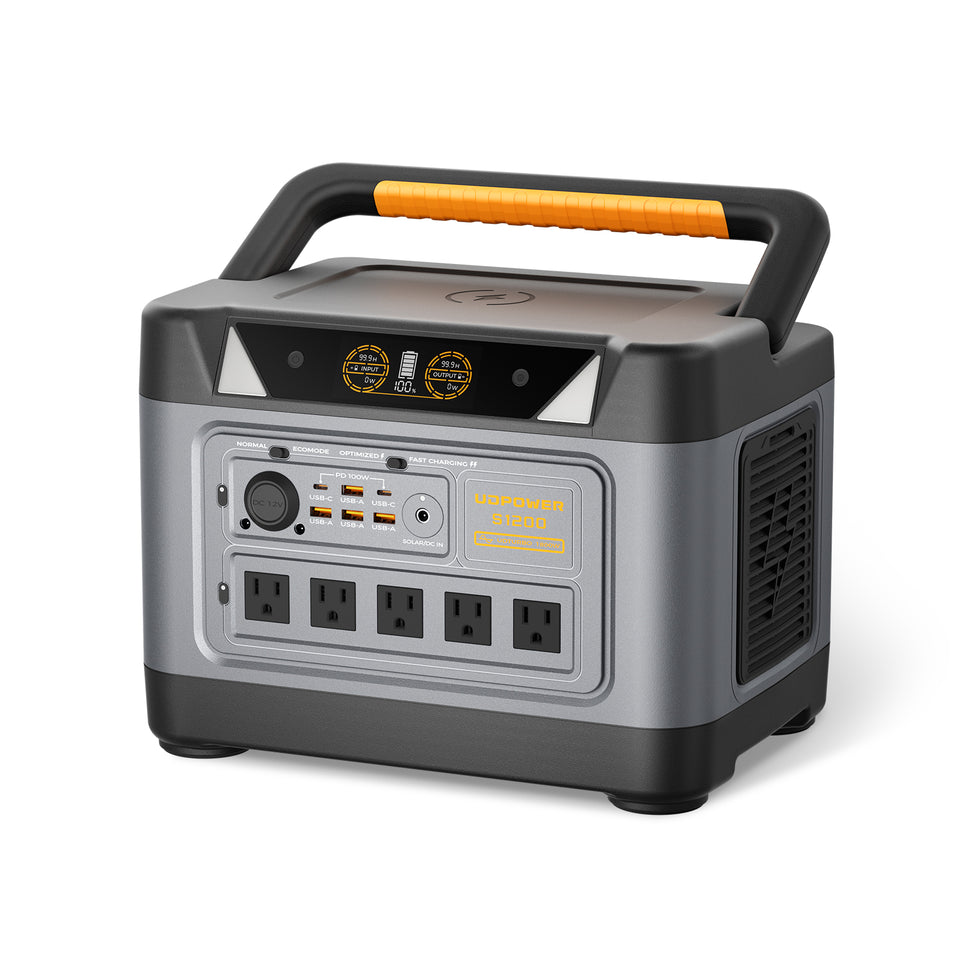
UDPOWER S1200: Best All-Around Fall Project Power Station
S1200 is the most balanced option for projects that have moved beyond phones and lights but do not require a 2,000Wh-class battery.
- Capacity: 1,190Wh LiFePO4
- Rated AC output: 1,200W pure sine wave
- UDTURBO: up to 1,800W for compatible higher-power loads
- Solar input: up to 400W
- Weight: approximately 26.0 lb
- 90% planning energy: about 1,071Wh
Best for: hunting cabins, weekend hunting camps, greenhouse controls, shed lighting and chargers, refrigerator loads, remote work, and moderate property maintenance.
A 600–700Wh project day leaves significantly more reserve than it would on a small battery, while 400W maximum solar input gives the system a realistic path to substantial daytime recovery.
View S1200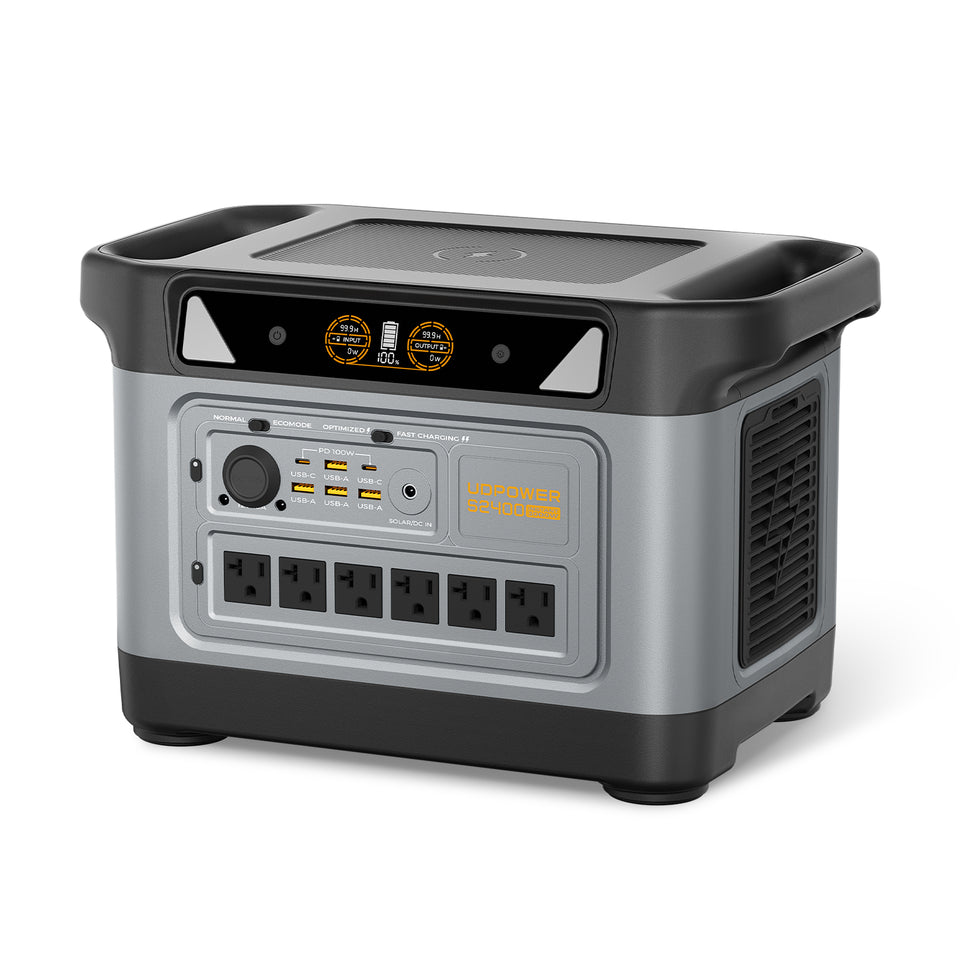
UDPOWER S2400: Best for Higher Loads and More Reserve
S2400 becomes the stronger choice when the project includes larger tools, several essential loads, multi-day use, or poor-weather reserve.
- Capacity: 2,083Wh LiFePO4
- Rated AC output: 2,400W pure sine wave
- UDTURBO: up to 3,000W constant-power capability in battery/inverter mode for compatible loads
- Solar input: up to 400W
- Weight: approximately 40.8 lb
- 90% planning energy: about 1,875Wh
Best for: larger hunting camps, higher-wattage workshop loads, extended remote property work, refrigerator plus electronics, emergency power, and projects where one cloudy day should not immediately force you to stop using equipment.
S2400 is still a portable battery system, not a replacement for a full multi-kWh off-grid building system. Large electric heaters, welders, large compressors, and continuous high-energy equipment should be sized separately.
View S2400Which UDPOWER Setup Fits Each Fall Project?
| Project | Recommended Starting Point | Why |
|---|---|---|
| Remote LED lighting | C400 + 120W solar | Low daily energy and easy portability |
| Small security camera site | C400 + 120W solar | Suitable when measured 24-hour energy is low |
| 24/7 camera + router site | S1200 + solar | More reserve for night and cloudy weather |
| Weekend hunting cabin | S1200 + 210–400W-class solar | Good balance of overnight capacity and recovery |
| Fall hunting basecamp | S1200 or S2400 | Choice depends on fridge, heated gear, CPAP and trip length |
| Greenhouse controls and ventilation | S1200 or S2400 | Continuous loads make battery reserve important |
| Shed lights + cordless charging | S1200 | Plenty of energy for moderate workshop use |
| Workshop with higher-wattage corded tools | S2400 | Higher rated AC output provides more operating headroom |
| Remote property maintenance | S1200 or S2400 | Depends on pumps and tool wattage |
| Pre-winter emergency reserve | S2400 | 2,083Wh capacity provides substantially more reserve |
See all current configurations on the UDPOWER Solar Generators page, or compare individual models in the Portable Power Stations collection.
Fall Off-Grid Solar Setup Checklist
Before taking a solar generator to a cabin, shed, greenhouse, hunting camp, or remote property, run through this checklist at home.
- List every device. Do not rely on a generic off-grid appliance chart.
- Record watts and daily hours. Convert every load to Wh/day.
- Identify the largest AC load. Confirm it stays within the station's output capability.
- Check motor-driven equipment separately. Pumps and tools can behave differently during startup.
- Build a cloudy-day reserve. A critical security or greenhouse system should not depend on one perfect solar day.
- Use your fall solar resource. Check your location and season with NREL PVWatts.
- Watch fall shadows. A location that was sunny at noon in July may be shaded by trees or structures in October.
- Angle portable panels toward the available sun. Repositioning them during the day can help when practical.
- Keep connectors dry and clean. Wet leaves, mud, frost, and debris are common fall problems.
- Keep the power station protected. Do not leave the station exposed to rain, standing water, snow, or blocked ventilation.
- Measure actual solar input. The panel label is not the same as the watts reaching the battery.
- Run a full test day before leaving. Use the same tools and appliances for the same number of hours you expect on site.
The One Number That Tells You Whether Your Fall Setup Is Sustainable
After all the appliance charts and product specifications, one calculation tells you the most:
If the number is positive, your battery can generally recover on a good day.
If it is close to zero, you have little margin for clouds, shade, colder weather, extra devices, or panel-positioning mistakes.
If it is negative, the battery will gradually discharge during a multi-day stay even though the solar panel is working perfectly.
That is the difference between a solar system that can run a project for a few hours and a system that can keep the project operating off-grid.
Frequently Asked Questions
How much solar power do I need for an off-grid shed?
Start by adding the watt-hours used by lights, chargers, tools, fans, and any other equipment during a normal day. A simple storage shed with LED lighting may need only a few hundred watt-hours, while a workshop with corded tools can require much more. The largest power tool also determines how much AC output your inverter needs.
Is 200W of solar enough for a hunting cabin?
It can be enough for a very light cabin, but it depends on daily energy use and available fall sunlight. Under an example of three peak-sun-hours and 75% overall yield, a 200W array would recover about 450Wh per day. If the cabin consumes 700Wh per day, that array would not fully replace the energy used.
How big a battery do I need for a hunting cabin?
Calculate the cabin's daily watt-hours first. If your cabin uses 600Wh per day and you want one full day of battery reserve, a battery around 1,000Wh gives much more practical margin than a 600Wh nominal battery. Refrigerator use, pumps, lighting, electronics, and the number of cloudy days all affect the final size.
Can a portable power station run a greenhouse?
Yes, for appropriately sized loads such as ventilation fans, circulation fans, sensors, controllers, cameras, and small pumps. Continuous electric greenhouse heating is much more demanding. A 1,500W heater operating for eight hours would consume 12,000Wh, which is far beyond a typical portable power station's daily energy capacity.
Can I run power tools from an off-grid solar generator?
Yes, when the tool's operating requirements stay within the power station's AC output capability. Battery capacity determines how long you can work, while inverter output determines whether the tool can operate. Motor-driven tools should also be checked for startup behavior.
How much battery power do security cameras use off-grid?
It depends on the number of cameras, recording method, network equipment, night vision, cellular router, and whether the equipment runs continuously. Even a small 8W continuous load uses 192Wh over 24 hours, so low-wattage equipment can still become a meaningful daily energy load.
Why does solar charging get worse in fall?
Days become shorter and the sun sits lower in the sky as the Northern Hemisphere moves toward winter. Longer shadows, clouds, leaves, and non-ideal panel angles can further reduce actual solar production. Local seasonal solar data is more useful than assuming summer output will continue through fall.
How much solar can an S1200 accept?
The current UDPOWER S1200 specifications list a maximum solar input of 400W. Actual charging power depends on sunlight, panel configuration, temperature, battery state, and whether the panel voltage and current stay within the station's input specifications.
How much solar can an S2400 accept?
The current UDPOWER S2400 specifications list solar input up to 400W. A solar array with a higher nominal panel rating does not mean the power station can accept more than its supported input limit.
Is the C400 large enough for a remote shed?
It can be a good fit for LED lighting, cameras, phones, radios, and other small loads when total daily consumption is comfortably below its available battery energy. A workshop with larger tools or a continuous overnight load is usually better served by a higher-capacity station.
Should I buy more battery or more solar for fall?
Battery and solar solve different problems. More battery gives you longer runtime overnight and through cloudy periods. More solar increases how quickly you can replace the energy you used. If you regularly end sunny days with an undercharged battery, you may need more solar. If your battery runs out before sunrise despite being fully charged at sunset, you need more stored energy or lower overnight consumption.
Can I leave a portable power station outside at a remote property?
A portable power station should be protected from rain, standing water, snow, excessive moisture, and blocked ventilation. A weather-resistant solar panel and the battery station do not necessarily have the same environmental protection rating, so check each product separately and keep the power station in an appropriate dry, ventilated location.
Final Recommendation
The best fall off-grid solar setup is not the kit with the biggest panel or the battery with the largest number on the front.
Start with the actual project.
If you are powering a camera and a few lights, a compact C400-class setup may be all you need. If the project is a hunting cabin, greenhouse controls, refrigerator, weekend hunting camp, or working shed, S1200 provides a much more useful energy reserve. If you need larger tools, several simultaneous loads, extended runtime, or meaningful emergency backup before winter, S2400 is the stronger starting point.
Then check whether your fall solar array can replace what you use each day.
That final energy balance matters more than any generic label such as "off-grid solar kit."
Build the Right Off-Grid Setup for Your Fall Project
Calculate your daily watt-hours, check your largest load, and choose enough battery and solar recovery for shorter fall days and changing weather.
View Solar Generator Kits Compare Power Stations Read the Solar Sizing GuideRelated Articles


