

What Size Portable Power Station Do You Need for Mobile Detailing?
Last updated:

A mobile detailer has two completely different power problems to solve.
The first is output: can the power station start and run the equipment?
The second is energy: does the battery hold enough watt-hours to finish one car, two cars, or an entire workday?
That distinction is easy to miss. A power station can have enough watts to run a pressure washer and still run out of battery halfway through the second vehicle. Or it can have plenty of battery capacity but shut down the instant a high-draw extractor or compressor starts.
This guide sizes portable power for actual mobile detailing workflows, including pressure washing, vacuuming, polishing, steaming, extraction, air tools, lighting and multi-job days.
- Mobile Detailing Power Station Size at a Glance
- Watts vs. Watt-Hours: The Two Numbers You Need
- How Much Power Does Detailing Equipment Use?
- How to Calculate the Right Power Station Size
- Which Detailing Tools Can Run Together?
- How Many Watt-Hours Does One Detail Use?
- How Many Cars Can You Detail Per Charge?
- Choose Power by the Services You Sell
- Heated Extractors Change the Sizing Completely
- What About an Air Compressor?
- Sizing for an Electric Pressure Washer
- How to Recharge Between Mobile Detailing Jobs
- Best UDPOWER Options for Mobile Detailing
- Power Station vs. Generator for Mobile Detailing
- Electrical Safety Around Water
- Mobile Detailer Buying Checklist
- Frequently Asked Questions
Mobile Detailing Power Station Size at a Glance
| Detailing Setup | Practical Rated Output Range | Practical Battery Range | Typical Equipment | Best Strategy |
|---|---|---|---|---|
| Light / rinseless setup | About 1,000–1,200W | About 1,000–1,500Wh | Vacuum, lights, chargers, small polisher | Run one high-draw tool at a time |
| Standard solo mobile detailing | About 2,000–2,500W | About 1,800–2,500Wh | Electric pressure washer, vacuum, DA polisher, lights | Sequence pressure washer, vacuum and polisher |
| Detailing with a 1,500W steamer | About 2,400–3,000W | About 2,500–3,500Wh | Steamer, vacuum, polisher, lights | Avoid vacuum + steamer overlap unless output headroom is sufficient |
| Heated extractor setup | Often 2,700W+ | Depends heavily on heater runtime | Commercial heated extractor plus support equipment | Follow the extractor manufacturer's power-source recommendation |
| Compressor-heavy interior setup | Often 2,500W+ | 2,500Wh+ depending on cycling | Air compressor, vacuum, Tornador-type tools, steamer | Compressor startup and manufacturer generator requirements control sizing |
| Two-person full-service crew | 3,500–4,500W+ can be required | 3,000–5,000Wh+ or active recharging | Two vacuums, compressor, washer, polisher, extractor | Consider a larger battery system, two power sources, or hybrid generator setup |
These ranges are planning starting points, not substitutes for your actual equipment labels. A compact vacuum and a commercial heated extractor are both “detailing equipment,” but their electrical requirements are completely different.
Watts vs. Watt-Hours: The Two Numbers That Decide the Right Size
Watts Tell You What You Can Run
The power station's rated AC output determines how much equipment it can support at the same time.
If your vacuum needs around 900W and your polisher uses 1,000W, operating both together creates a planning load around 1,900W before accounting for motor behavior or any other connected device.
A 1,200W station is therefore not a good normal configuration for that combination, even if the battery itself contains more than 1,000Wh.
Watt-Hours Tell You How Long You Can Work
Battery capacity is measured in watt-hours.
For UDPOWER AC runtime planning, use about 90% conversion efficiency:
That gives approximately:
- UDPOWER S1200: 1,190Wh × 0.90 ≈ 1,071Wh of planning AC energy
- UDPOWER S2400: 2,083Wh × 0.90 ≈ 1,875Wh of planning AC energy
Real consumption varies with tool load, temperature, inverter operation, startup events and how much time each device actually runs.
How Much Power Does Mobile Detailing Equipment Use?
Use the electrical label on your exact machine whenever possible. The table below uses real manufacturer examples to show why generic estimates can be misleading.
| Equipment Example | Manufacturer Rating | Simple Planning Load | Mobile Detailing Impact | Source |
|---|---|---|---|---|
| RIDGID HD0600 6-gal wet/dry vacuum | 7.5A | About 900VA at 120V for conservative screening | A common vacuum-class load that fits a 1,200W station by itself but leaves limited headroom | RIDGID specifications |
| Griot's Garage G9 dual-action polisher | 1,000W motor | 1,000W | Fits many mid-size stations alone but can create a large combined load with a vacuum | Griot's Garage specifications |
| RYOBI RY141802 electric pressure washer | 120V, 13A | Up to about 1,560VA for conservative screening | Usually pushes a mobile detailer toward a 2,000W+ power station | RYOBI RY141802 manual |
| McCulloch MC1385 steam system | 1,500W | 1,500W | High continuous heating load; battery capacity can disappear quickly | MC1385 specifications |
| Mytee 8070 heated extractor | 19A at 115V | About 2,185VA | Already close to the output of a 2,400W station before adding any other equipment | Mytee 8070 specifications |
| California Air Tools 8010A compressor | 8.5A, 110V | Manufacturer specifies a 2,500W minimum running generator | Compressor startup and cycling make simple amp math insufficient | California Air Tools specifications |
| LED detailing lights | Varies by fixture | Check actual label | Low instantaneous load, but several hours of use can consume meaningful Wh | Use your light's electrical label |
| Tank water pump | Varies widely | Check watts, volts/amps and startup behavior | Pump selection can materially change total power demand | Use your pump's manual or nameplate |
When a device lists volts and amps but not watts, you can use this as a conservative first-pass check:
For AC motors, volts × amps is technically apparent power rather than guaranteed real watts, so a plug-in power meter gives a better real-world number. For initial sizing, however, the nameplate calculation helps prevent underestimating a tool.
For more detail on vacuum loads, see How Many Watts Does a Vacuum Cleaner Use?.
How to Calculate the Right Portable Power Station for Your Detailing Rig
-
Write down every powered tool in your normal service package.
Include the pressure washer, vacuum, polisher, steamer, extractor, compressor, water pump, lights, battery chargers, phone charger and any POS equipment. -
Record each tool's real electrical rating.
Use watts when available. If the label gives only volts and amps, multiply them for a conservative screening value. -
Decide which tools actually run at the same time.
This determines the inverter size. Do not add every tool if your workflow guarantees they are used in different stages. -
Identify the hardest motor-start event.
Vacuums, pressure washers, pumps and compressors can need more power when starting or cycling. Check the manufacturer's recommendation instead of assuming every motor behaves the same way. -
Estimate active time per vehicle.
A 1,000W polisher used for 45 minutes consumes far less energy than the same tool running continuously for three hours. -
Add the watt-hours for every device.
Multiply watts by actual operating hours, then add the results. -
Allow for AC conversion losses.
Divide the expected AC energy by 0.90 when sizing a UDPOWER battery for planning purposes. -
Add reserve for real jobs.
A 10–20% reserve is useful for dirtier-than-expected interiors, an extra polishing section, longer vacuuming, customer delays or an additional device.
If you want a 15% operating reserve:
Which Detailing Tools Can Run Together?
This is where a well-planned workflow can save you from buying a much larger power system.
| Example Combination | Conservative Planning Load | S1200 1,200W Rated | S2400 2,400W Rated | Better Workflow |
|---|---|---|---|---|
| 900W-class vacuum alone | About 900W | Yes, if actual tool startup is compatible | Yes | No special sequencing needed |
| 1,000W polisher alone | 1,000W | Within rated output | Yes | Keep unnecessary loads off the station |
| Vacuum + 1,000W polisher | About 1,900W | No as a normal rated-load combination | Potentially, after verifying actual loads and startup behavior | For maximum battery life, run them in separate stages |
| 13A pressure washer + 80W lights | About 1,640VA screening load | Not a normal rated-output match | Reasonable class to evaluate | Switch off nonessential loads during washer startup |
| Pressure washer + 900W vacuum | About 2,460VA | No | Above S2400's normal 2,400W rated planning limit | Wash first, vacuum second |
| 1,500W steamer + 900W vacuum | About 2,400W | No | At the rated ceiling with no practical headroom | Do not design the workflow around both operating together |
| Mytee 8070 heated extractor alone | About 2,185VA | No | Mathematically close, but Mytee recommends more source headroom | Use a power source that meets the extractor maker's recommendation |
For a deeper explanation of motor starting demand, read What Does Surge Current Mean?.
How Many Watt-Hours Does One Mobile Detail Use?
There is no single answer because a maintenance wash and a paint-correction package are completely different jobs.
Here is a conservative example for one full-service vehicle using representative nameplate planning loads.
| Equipment | Planning Load | Active Time | Estimated AC Energy |
|---|---|---|---|
| Electric pressure washer | 1,560W screening value | 15 minutes | 390Wh |
| Wet/dry vacuum | 900W screening value | 25 minutes | 375Wh |
| Dual-action polisher | 1,000W | 45 minutes | 750Wh |
| LED lighting | 80W | 2.5 hours | 200Wh |
| Small chargers / electronics | 60W | 2.5 hours | 150Wh |
| Total AC energy | — | — | 1,865Wh |
Using a 90% conversion factor:
That lands almost exactly at the S2400's 2,083Wh nameplate capacity.
But this example is deliberately conservative because the amp-based pressure-washer and vacuum values are screening numbers, not measured average real watts. Your actual job may consume less.
The better professional approach is to measure your own equipment during several jobs with a plug-in power meter, record actual run time, and replace estimates with your own data.
How Many Cars Can You Detail on One Power Station Charge?
Once you know the measured energy used per job, this calculation becomes much easier.
| Measured Energy Per Detail | S1200 1,190Wh |
S2400 2,083Wh |
What It Suggests |
|---|---|---|---|
| 500Wh | About 2.1 jobs | About 3.7 jobs | Efficient maintenance or rinseless workflow |
| 750Wh | About 1.4 jobs | About 2.5 jobs | Light-to-moderate mobile detailing |
| 1,000Wh | About 1.1 jobs | About 1.9 jobs | One S1200 job or roughly two S2400 jobs before reserve |
| 1,500Wh | Less than one full job | About 1.25 jobs | Energy-intensive full-service work |
| 1,865Wh | Not enough for one modeled job | About one modeled job | Conservative example used in this guide |
These values use a 90% planning factor and assume your tools are electrically compatible with the station. They do not include an additional end-of-day reserve.
Choose Power by the Detailing Services You Actually Sell
Rinseless or Waterless Mobile Detailing
This is one of the best use cases for battery power.
If you eliminate the electric pressure washer and use cordless tools where practical, the largest loads may be the vacuum and polisher. A 1,200W-class station becomes much more realistic if those two tools are used in separate stages.
For a solo operator doing one light job before recharging, the UDPOWER S1200 can make sense.
Traditional Exterior Wash + Interior Vacuum
An electric pressure washer moves the requirement upward quickly.
A 13A, 120V pressure washer has a conservative nameplate screening value around 1,560VA. That is already above the S1200's normal 1,200W rated output.
A 2,400W-class station such as the S2400 is the more appropriate UDPOWER starting point for this type of mobile rig.
Paint Correction
A high-powered DA polisher may draw around 1,000W, but the bigger issue is how long it operates.
Two hours of actual polishing at 1,000W represents:
That alone is already more AC energy than an S2400 normally delivers from a full battery after conversion losses.
If paint correction is a major part of your business, plan around recharging between jobs, customer power, a second battery source or a larger system.
Interior-Only Detailing
Interior work can look easy electrically until you add a steamer, extractor or compressor.
A vacuum alone is manageable. A vacuum plus a 1,500W steamer can reach roughly 2,400W. A commercial heated extractor can draw more than 2,000VA by itself.
The exact interior service menu matters more than the fact that the job is “interior only.”
A Heated Extractor Can Change the Entire Power Plan
This is one of the most important things many generic mobile-detailing power guides miss.
The Mytee 8070 Lite, for example, is rated at 19A at 115V. That works out to roughly 2,185VA as a simple screening calculation.
Mytee's own generator sizing guide goes further and recommends:
See Mytee's generator sizing guidance.
This is why simply seeing “2,185” and buying a 2,400W power station is not the best sizing method.
For commercial equipment, the manufacturer's electrical requirements should override a generic wattage calculation.
What Size Power Station Do You Need for a Detailing Air Compressor?
Air compressors are another load where the motor startup can matter more than simple running amps.
For example, California Air Tools lists the 8010A at 8.5A and 110V, but the same official specification page calls for a 2,500W minimum running generator.
That published requirement is higher than the S2400's normal 2,400W rated output.
If your detailing business relies heavily on compressed-air tools, choose the power source around the exact compressor first, then add your other loads afterward.
Do not size the compressor from tank gallons or maximum PSI. Neither number tells you the electrical requirement.
What Size Power Station Do You Need for an Electric Pressure Washer?
For mobile detailing, this is often the load that moves a rig from a small station to a 2,000W-class or larger station.
The RYOBI RY141802 provides a useful real-world example:
- 120V
- 13A
- 1,800 PSI
- 1.2 GPM
Using volts × amps:
That is above the S1200's 1,200W rated output and comfortably points toward the S2400 class instead.
Do not assume every 1,800 PSI pressure washer consumes the same electricity. PSI describes water pressure, not electrical input.
Always size from the electrical label.
A Better Mobile Detailing Strategy: Separate Peak Power From Daily Energy
Instead of asking, “What is my biggest tool?” ask two separate questions.
Question 1: What Is the Highest Load I Need at One Moment?
This sets inverter size.
For example:
- Pressure washer: about 1,560VA screening load
- Lights: 80W
- Total while washing: about 1,640VA
A 2,400W station provides much more room than a 1,200W station for this work stage.
Question 2: How Much Energy Does the Entire Appointment Consume?
This sets battery size.
You may use a pressure washer for only 15 minutes but a polisher for 90 minutes. The pressure washer can determine the inverter size while the polisher determines how quickly the battery empties.
The highest simultaneous load determines watts.
The entire service workflow determines watt-hours.
How Should a Mobile Detailer Recharge Between Jobs?
If you complete multiple vehicles per day, recharge speed becomes part of the sizing decision.
AC Charging
Both the current UDPOWER S1200 and S2400 are designed for fast AC charging, with full recharge advertised at about 1.5 hours under appropriate conditions.
That makes lunch breaks, shop stops or customer-approved AC charging much more useful than relying only on the battery carried at the beginning of the day.
Vehicle Charging
Vehicle charging is useful for topping up, but it is not a fast replacement for energy-heavy detailing.
A detailer who uses 1,500Wh per appointment cannot expect ordinary vehicle charging between nearby jobs to restore all of that energy.
Solar Charging
Solar can help on long outdoor workdays, but treat it as energy recovery rather than unlimited power.
Current recommended solar input limits are:
- S1200: up to 400W
- S2400: up to 420W recommended solar input
Even at 420W of actual input, replacing 1,500Wh would take several hours of productive sunlight, and real solar production is normally below panel nameplate rating for at least part of the day.
Solar is useful for extending the day. It should not be the only plan for a high-volume detailing business unless you have measured the daily energy balance.
Which UDPOWER Power Station Is Best for Mobile Detailing?
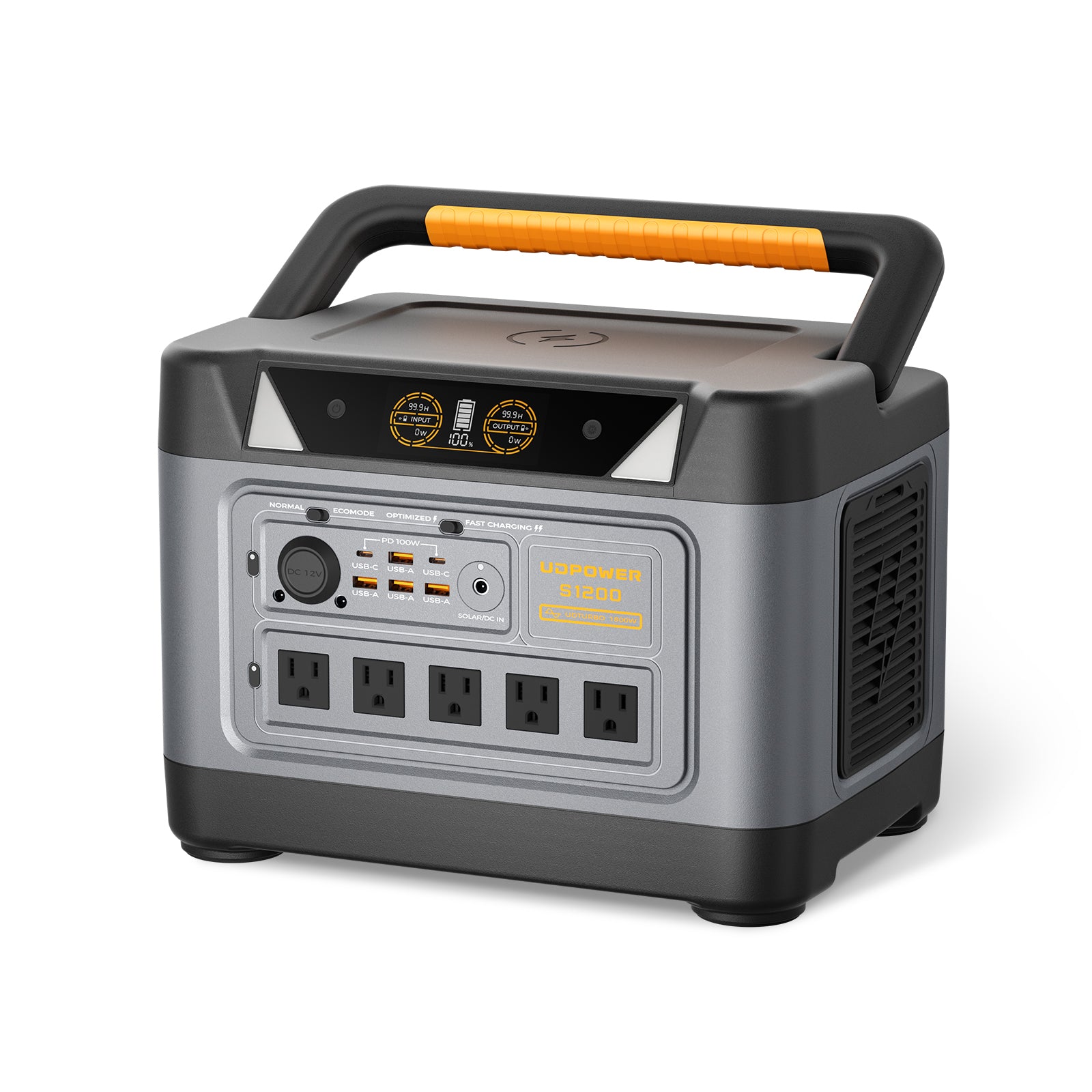
UDPOWER S1200: Best for Light or Carefully Sequenced Detailing
- Battery capacity: 1,190Wh
- Rated AC output: 1,200W pure sine wave
- UDTURBO: supports selected compatible higher-power loads up to 1,800W, with lower conversion efficiency above rated output
- Maximum solar input: 400W
- Weight: approximately 26 lb
- AC recharge: about 1.5 hours under appropriate conditions
Best mobile-detailing fit: rinseless detailing, maintenance services, interior vacuuming, polishing used separately, LED lighting, chargers and operators who deliberately avoid overlapping high-draw tools.
The S1200 is not the model I would choose as the primary battery for a typical 13A electric pressure washer. Its normal 1,200W rated output is below the conservative nameplate screening load of common 13A pressure washers.
View UDPOWER S1200
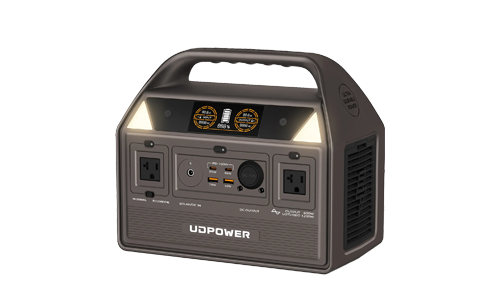
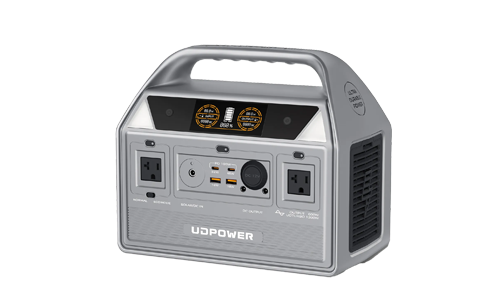
UDPOWER S2400: Best UDPOWER Starting Point for a Full Mobile Detailing Rig
- Battery capacity: 2,083Wh
- Rated AC output: 2,400W pure sine wave
- UDTURBO: supports selected compatible higher-power loads up to 3,000W, with lower conversion efficiency above rated output
- Maximum recommended solar input: 420W
- Weight: approximately 40.8 lb
- Total outputs: 15
- AC recharge: about 1.5 hours under appropriate conditions
Best mobile-detailing fit: electric pressure washers, larger vacuums, corded polishers, steamers used separately, lighting and a normal solo-detailer workflow where heavy tools are sequenced rather than all operated together.
The S2400 is much better suited than the S1200 to a self-contained mobile rig, but 2,400W should not be mistaken for unlimited professional-tool capacity. A large extractor, compressor-heavy setup or two-person crew can exceed its normal rated output.
View UDPOWER S2400| Mobile Detailing Requirement | UDPOWER S1200 | UDPOWER S2400 |
|---|---|---|
| Vacuum around 900W | Good candidate when used alone and startup is compatible | Good candidate |
| 1,000W DA polisher | Within rated output, with limited room for other AC loads | Good candidate |
| 13A / 120V pressure washer | Not the preferred normal match | Much better starting point |
| 1,500W steamer | Above normal rated output | Within rated output when used with sensible headroom |
| Vacuum + polisher together | Too much for normal rated operation | Potentially workable after checking actual loads |
| Pressure washer + vacuum together | No | Conservative example exceeds the 2,400W rated target |
| Commercial heated extractor | Generally too small | Check manufacturer requirements; some examples call for more than 2,400W |
| Main detailing battery | Light / sequenced rigs | Best UDPOWER option for most solo full-service rigs |
| Official specifications | S1200 specifications | S2400 specifications |
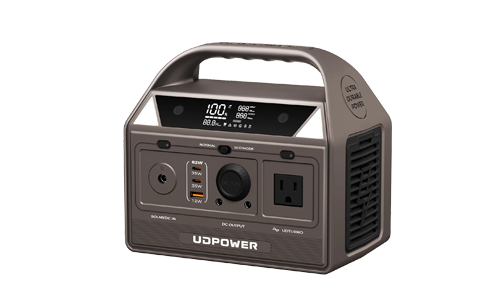
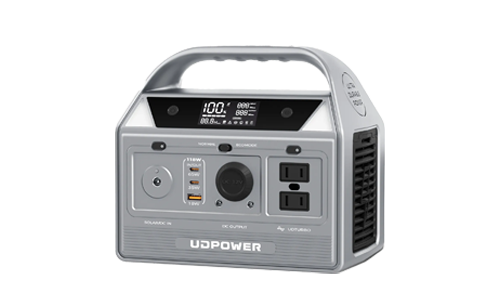
What About the C600?
The C600 is useful as an auxiliary battery for LED lighting, camera gear, chargers, laptops and other low-power equipment, but its 600W rated output is below the electrical demand of many corded vacuums, polishers, pressure washers and steamers used by mobile detailers.
For that reason, it is better treated as a support station than the primary AC source for a professional mobile detailing rig.
Compare the full lineup on the UDPOWER Power Station Comparison page.
Portable Power Station vs. Generator for Mobile Detailing
A battery power station is not automatically better than a fuel generator. The right choice depends on how much power your service menu consumes every day.
| Factor | Portable Power Station | Fuel Generator |
|---|---|---|
| Noise at residential jobs | Very low | Noticeable even with quiet inverter models |
| Local exhaust | No combustion exhaust during battery operation | Produces exhaust and carbon monoxide |
| Daily maintenance | Low | Fuel and engine maintenance required |
| Energy duration | Limited by battery Wh and recharge access | Can continue when safely refueled |
| 1,000–2,400W sequenced detailing | Strong use case | Also works |
| Large extractor / compressor / multi-tech operation | May require a larger battery system than S2400 | Often easier to size for sustained heavy demand |
| Residential client experience | Quiet operation can be a major advantage | Noise and exhaust require more careful placement |
If you use a fuel generator, it must be operated outdoors and safely away from doors, windows and other openings. Follow the generator manufacturer's instructions and current carbon-monoxide safety guidance.
For many detailers, the most flexible professional setup is not “battery or generator.” It is a battery station for normal residential jobs plus another charging or high-demand option for equipment that exceeds the battery system.
Do You Need a 3,000W or 4,000W Power Station?
You probably do not need 4,000W just because your van contains 4,000W worth of equipment.
You need that much output only when the workflow requires those loads to operate at the same time.
For example, if you:
- pressure wash first;
- vacuum after washing;
- polish after vacuuming; and
- use the steamer only when the vacuum is off;
your maximum simultaneous load may stay below 2,400W even though the total connected equipment could add up to far more.
But if two technicians work simultaneously and one is pressure washing while the other vacuums or polishes, output requirements rise immediately.
Should You Size for One Car or an Entire Day?
Size output for the hardest moment of the job.
Size battery capacity for the period between dependable recharge opportunities.
If you return to a shop after every vehicle, you may need enough battery for only one appointment.
If you leave home at 7 a.m. and complete three vehicles before returning, calculate all three jobs.
| Business Pattern | Battery Strategy |
|---|---|
| One premium detail per day | Size for one full service plus reserve |
| Several maintenance details per day | Measure Wh per vehicle, multiply by scheduled jobs and plan a recharge window |
| Return to shop between clients | Fast AC recharge can reduce required battery capacity |
| All-day route with no outlets | Carry enough Wh for the full route or add a second power source |
| Two technicians | Prioritize higher simultaneous output or split tools across two power sources |
| Correction-heavy business | Long polisher runtime can make energy capacity more important than pressure-washer peak load |
Portable Power Station Safety Around Water
Mobile detailing combines electricity and water, so placement matters.
- Keep the power station outside the pressure-washer spray zone.
- Do not place it on wet pavement or in standing water.
- Route cords where hoses, vehicles and customers will not damage them.
- Inspect plugs and cords before every workday.
- Keep ventilation openings unobstructed.
- Do not use damaged electrical equipment simply because it still powers on.
- Follow the electrical safety instructions for each tool.
If a GFCI, breaker or power station repeatedly trips, determine what protection device is actually opening before assuming the battery is undersized.
See Portable Power Station Keeps Tripping a GFCI: Causes & Troubleshooting.
Mobile Detailing Power Station Buying Checklist
Before Choosing the Power Station
- List the exact pressure washer model.
- List the exact vacuum model.
- List every corded polisher.
- Include the steamer or heated extractor.
- Include the compressor if you use air tools.
- Include the tank pump.
- Include lighting and battery chargers.
Calculate Output
- Add only the tools that really operate simultaneously.
- Check motor startup behavior.
- Use rated output as the normal sizing baseline.
- Do not design a professional workflow around running at the exact inverter ceiling all day.
Calculate Battery Capacity
- Estimate actual minutes of use for every major tool.
- Convert minutes to hours.
- Multiply watts × operating hours.
- Add all device Wh.
- Account for conversion losses.
- Add reserve.
- Multiply by the number of jobs between recharges.
Check Your Workflow
- Can pressure washing and vacuuming happen at different times?
- Can the steamer and vacuum be sequenced?
- Will two technicians work at the same time?
- Can you recharge during lunch or between clients?
- Do you have customer AC power as an approved fallback?
- Does one machine have a manufacturer power-source requirement above your station's rating?
Frequently Asked Questions
What size portable power station do I need for mobile detailing?
For a typical solo setup using an electric pressure washer, vacuum, polisher and lights, roughly 2,000–2,500W of rated AC output and around 2,000Wh of battery capacity is a useful starting range when high-draw tools are used one at a time. Lighter rinseless setups may work with about 1,200W and 1,000–1,500Wh. Heavy extractor or compressor setups can require substantially more.
Is a 1,000W power station enough for mobile detailing?
It can be enough for a light setup with LED lights, chargers, selected vacuums and lower-power tools used one at a time. It is generally too small as the main source for a conventional electric pressure washer, large steamer, heated extractor or several corded tools operating together.
Is a 2,000W power station enough for mobile detailing?
For many solo detailers, a 2,000W-class station can work when the pressure washer, vacuum and polisher are sequenced. Check the exact tool labels and motor startup requirements. Battery capacity also needs to be large enough for the number of jobs you expect to complete before recharging.
Can the UDPOWER S2400 run a mobile detailing setup?
The S2400 is the strongest UDPOWER starting point for a full solo mobile detailing setup. It provides 2,400W rated AC output and 2,083Wh capacity, which is much better suited to electric pressure washers, vacuums, polishers and steamers used in a planned sequence. Large heated extractors, compressors or multiple high-draw tools running together may require more power.
Can the UDPOWER S1200 run a car detailing vacuum?
It can run many vacuums whose actual operating and startup requirements fit within the station's capabilities. For example, a 7.5A vacuum has a conservative 120V screening load of about 900VA. Always check the exact vacuum and avoid assuming every shop vacuum has the same motor demand.
Can a portable power station run an electric pressure washer?
Yes, if the station has enough AC output and motor-start capability. A 120V, 13A pressure washer has a conservative nameplate screening value of about 1,560VA, so a 2,000W-class or larger power station is generally a more realistic starting point than a 1,000W-class unit.
Can a portable power station run a detailing polisher?
Yes. Many corded polishers fall within the output range of medium and large power stations. The Griot's Garage G9, for example, uses a 1,000W motor. Long polishing sessions can consume substantial battery energy even when the inverter has no difficulty running the tool.
Can a portable power station run a heated carpet extractor?
Some large stations may run selected extractors, but commercial heated extractors can require much more power than their category name suggests. The Mytee 8070 draws 19A at 115V, and Mytee's own sizing guide recommends approximately 2,731 running watts of generator capacity. Check the exact extractor manufacturer recommendation before choosing a battery station.
Can a portable power station run a detailing air compressor?
It depends on the compressor. Motor startup can make compressors difficult loads. For example, California Air Tools specifies a 2,500W minimum running generator for its 8010A even though the unit is listed at 8.5A. Use the manufacturer's power-source recommendation rather than amps alone.
How many watt-hours do I need for one mobile detailing job?
A light maintenance detail may use only a few hundred watt-hours, while a pressure-washer, vacuum and paint-correction workflow can exceed 1,500Wh. Measure actual tool power and operating time for your own service package. Battery capacity needed is approximately total AC watt-hours divided by 0.90 when using a 90% conversion planning factor.
How many cars can I detail with a 2,000Wh power station?
It depends on the watt-hours consumed per car. If each job uses 750Wh, a 2,083Wh S2400 provides about 1,875Wh of planning AC energy and could theoretically support about 2.5 such jobs before adding a reserve. If each job uses 1,500Wh, it is closer to one full job per charge.
Should I run my pressure washer and vacuum at the same time?
Usually there is little reason for a solo detailer to do so. Sequencing those two stages can dramatically reduce required inverter output. A 13A pressure washer plus a 900W-class vacuum can exceed the normal rated output of a 2,400W station in a conservative sizing calculation.
Is a portable power station better than a generator for mobile detailing?
A power station is especially attractive for quiet residential jobs, low maintenance and workflows where high-draw equipment is used intermittently. A fuel generator can be more practical for large heated extractors, compressors, two-person crews or long days with continuous heavy loads. Some professional detailers may benefit from a hybrid setup rather than relying on only one power source.
Build a Mobile Detailing Power Setup That Fits Your Actual Tools
Start with the electrical labels on your pressure washer, vacuum, polisher, steamer, extractor and compressor. Find the largest combination that must run at the same time, then calculate how many watt-hours your full appointment consumes. That gives you a power station sized for the way you actually detail—not a generic wattage guess.
Compare UDPOWER Models View Portable Power Stations View S2400 for Mobile DetailingRelated Articles


