How Much Energy Does a Space Heater Use?
ZacharyWilliamDirect answer: most U.S. electric space heaters use about 750W to 1,500W. A heater running at 1,500W uses 1.5 kWh per hour. Using the current U.S. residential average electricity price of 17.45¢/kWh, that works out to about $0.26 per hour, $2.09 for 8 hours, or $62.82 for 30 days at 8 hours per day.
That said, your real usage may be lower than the number on the box because many heaters cycle on and off once the room warms up. So the smart question is not just “How many watts is my heater?” It is also “How long is it actually heating at full power?”

- How much power a space heater usually draws
- How many kWh it uses per hour, day, and month
- How much it costs to run
- Why your real usage may be lower than the label
- Can a portable power station run a space heater?
- Recommended UDPOWER models for this use case
- How to lower heater energy use without freezing
- Space heater safety rules that matter
- FAQ
How much power a space heater usually draws
For most American homes, the number you will see most often is 1,500 watts. That is the standard “high” setting on many 120V plug-in space heaters. Lower settings are commonly around 750 watts, and some smaller personal heaters come in below that.
A fast way to think about it:
- 750W = lower heat setting or smaller room heater
- 1,000–1,200W = medium-output heater
- 1,500W = full-size portable heater on high
If you are checking whether a heater fits your circuit, the math is simple: 1,500W ÷ 120V ≈ 12.5A. That is why a full-power heater can take up most of a typical 15A household circuit by itself.
| Heater level | Typical wattage | Best fit | Rough room size guide | Source |
|---|---|---|---|---|
| Personal / low | 500W–750W | Desk area, under-desk use, short spot heating | About 75–100 sq. ft. | Renogy |
| Medium | 1,000W–1,200W | Bedroom, office, den | About 100–150 sq. ft. | Renogy |
| High | 1,500W | Standard full-size portable heater | About 150–200 sq. ft. | EnergySage · Renogy |
How many kWh it uses per hour, day, and month
Your electric bill is based on kilowatt-hours (kWh), not just watts. The formula is easy:
kWh = (Watts × Hours) ÷ 1,000
Here is a reader-friendly version using common heater wattages.
| Heater wattage | 1 hour | 4 hours | 8 hours | 30 days at 8 hr/day |
|---|---|---|---|---|
| 500W | 0.5 kWh | 2.0 kWh | 4.0 kWh | 120 kWh |
| 750W | 0.75 kWh | 3.0 kWh | 6.0 kWh | 180 kWh |
| 1,000W | 1.0 kWh | 4.0 kWh | 8.0 kWh | 240 kWh |
| 1,200W | 1.2 kWh | 4.8 kWh | 9.6 kWh | 288 kWh |
| 1,500W | 1.5 kWh | 6.0 kWh | 12.0 kWh | 360 kWh |
That is the cleanest answer to the original question. But if you are really asking whether a heater is “expensive,” cost matters more than kWh alone.
How much it costs to run
The table below uses the latest U.S. residential average electricity price available from the U.S. Energy Information Administration: 17.45¢ per kWh.
| Heater wattage | Cost per hour | Cost for 8 hours | Cost for 30 days at 8 hr/day | Rate used |
|---|---|---|---|---|
| 500W | $0.09 | $0.70 | $20.94 | EIA residential average, Jan 2026: 17.45¢/kWh |
| 750W | $0.13 | $1.05 | $31.41 | |
| 1,000W | $0.17 | $1.40 | $41.88 | |
| 1,200W | $0.21 | $1.68 | $50.26 | |
| 1,500W | $0.26 | $2.09 | $62.82 |
If your electric rate is higher than the national average, your actual cost will be higher too. Use this quick formula:
Running cost = kWh used × your local electricity rate
Example: a 1,500W heater running for 5 hours uses 7.5 kWh. At $0.25/kWh, that is $1.88 per day.
Why your real usage may be lower than the label
This is where many articles stop too early. A heater rated at 1,500W does not always pull 1,500W every minute of the day. Once the room warms up, the thermostat may cycle the heating element on and off. That changes your average power draw.
So instead of only looking at the box label, think in terms of duty cycle: how often the heater is actively heating.
| 1,500W heater behavior over 8 hours | Average draw | Daily energy use | Daily cost | 30-day cost |
|---|---|---|---|---|
| Runs about 30% of the time | 450W average | 3.6 kWh | $0.63 | $18.85 |
| Runs about 50% of the time | 750W average | 6.0 kWh | $1.05 | $31.41 |
| Runs about 70% of the time | 1,050W average | 8.4 kWh | $1.47 | $43.97 |
| Runs at full power the entire time | 1,500W average | 12.0 kWh | $2.09 | $62.82 |
What changes duty cycle the most?
- How cold the room is when you start
- How drafty the room is
- Whether doors are open
- Insulation quality
- Thermostat setting
- Heater type and fan behavior
Can a portable power station run a space heater?
Yes, some power stations can run some space heaters, but this is where people often size backup power the wrong way.
A space heater is a high-watt, fast-drain load. Even if a battery can run it, runtime is usually short. For outage planning, a battery is usually a much better fit for Wi-Fi, phones, lights, laptops, CPAP, and short fridge cycles than for trying to heat a room continuously.
Using UDPOWER’s own runtime planning method, a good real-world planning number for AC runtime is 0.85 efficiency, not 100% of the battery’s Wh rating.
| Power station | Capacity | Continuous AC output | Estimated runtime at 750W heater | Estimated runtime at 1,000W heater | Estimated runtime at 1,500W heater |
|---|---|---|---|---|---|
| UDPOWER S1200 | 1,190Wh | 1,200W | About 1.35 hours | About 1.01 hours | Not a safe match on typical 1,500W high mode |
| UDPOWER S2400 | 2,083Wh | 2,400W | About 2.36 hours | About 1.77 hours | About 1.18 hours |
Planning formula used: Runtime ≈ (Capacity Wh × 0.85) ÷ Load W. Always check your heater’s actual label and manual before plugging it into any backup source.
Here is the plain-English version:
- If your heater’s high mode is 1,500W, the S1200 is not the right match for that high setting because the station is rated at 1,200W continuous AC output.
- The S2400 can run a typical 1,500W heater, but not for very long. It is better suited if you only need short heat windows, not all-night room heating.
- For battery backup, the best winter strategy is usually run essentials continuously and treat heating as a separate, carefully planned load.
Recommended UDPOWER models for this use case
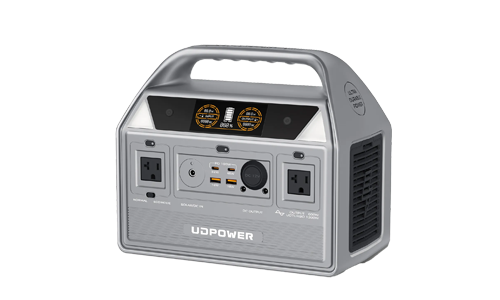
If this article is part of a buying decision, the right pick depends on how you plan to use heat. For constant room heating, a battery is rarely the most economical answer. For short heat windows plus essential backup, these are the two models that make the most sense.
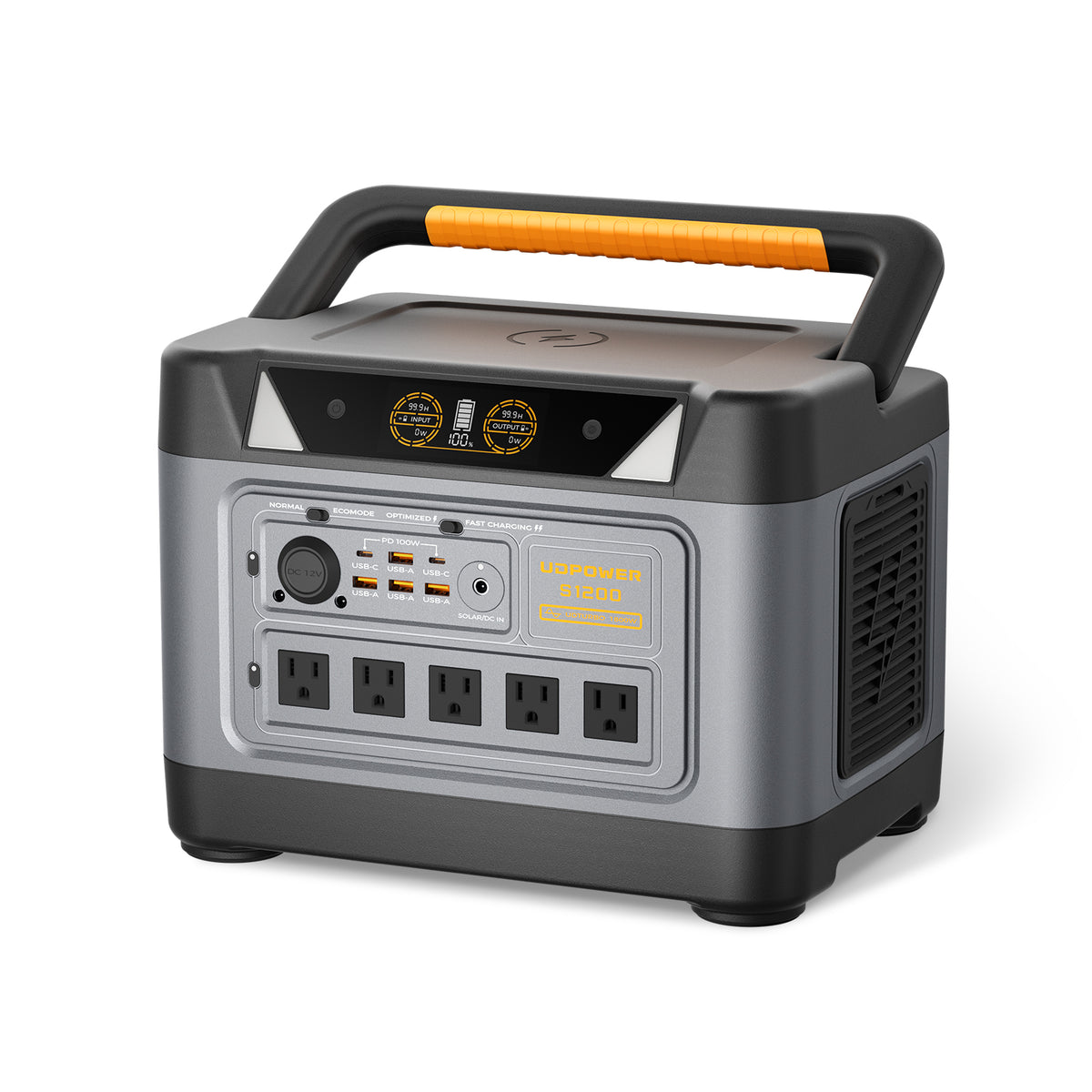
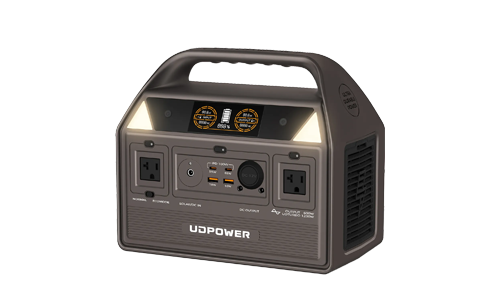
If your real goal is keeping the important stuff running during cold-weather outages—router, lights, laptop, phone charging, CPAP, and some short appliance use—the S1200 is the cleaner fit than trying to size a battery around nonstop electric heat.
- Battery: 1,190Wh LiFePO4
- Output: 1,200W rated pure sine wave AC
- Surge: up to 1,800W
- UPS-style backup: under 10ms
- Weight: about 26.0 lb

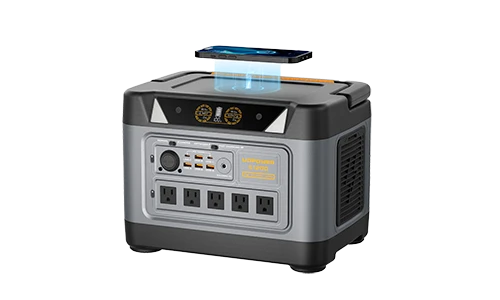
The S2400 is the stronger option if you want enough output to run a typical 1,500W heater for a short period and still have a more capable home-backup station for other loads. It is not an all-night electric-heating solution, but it gives you far more room to work with.
- Battery: 2,083Wh LiFePO4
- Output: 2,400W pure sine wave AC
- Surge support: up to 3,000W
- Solar input: up to 400W
- Ports: 6 AC outlets + 10 DC outputs
How to lower heater energy use without freezing
If you are using a space heater because one room feels cold, the goal is not always “buy a bigger heater.” Often the better move is getting the same comfort with fewer heater run-hours.
Use this order of operations
- Warm one room, not the whole house. Close the door and heat the space you actually use.
- Start with the lowest comfortable setting. Many people jump straight to high and then forget about it.
- Let the thermostat cycle. Constant full-power heating is what drives the bill up fastest.
- Block the draft. A cheap door sweep or rolled towel can reduce heater runtime more than people expect.
- Pre-warm, then step down. High for a short time, then lower heat, often uses less electricity than blasting on high for hours.
- Do not share the circuit with other heavy appliances. A heater plus coffee maker or microwave is asking for trouble.
For outage planning specifically, an even better strategy is to use battery power for communication, food protection, and lighting first, then treat electric heat as a carefully limited load. That is simply a more realistic use of stored energy.
Space heater safety rules that matter
These are the safety rules worth keeping in the article because readers actually use them.
| Safety rule | Why it matters | Source |
|---|---|---|
| Plug electric space heaters directly into a wall outlet | Reduces overload and fire risk from power strips or light-duty cords | DOE · CPSC |
| Keep the heater at least 3 feet away from bedding, drapes, furniture, and other combustibles | Helps prevent one of the most common space-heater fire scenarios | CPSC |
| Turn the heater off while sleeping | Reduces overnight fire risk and unattended operation risk | CPSC |
| Choose a model with tip-over protection | Automatically cuts power if the heater is knocked over | DOE |
One more practical point: if you are using a portable power station during an outage, always follow the heater manufacturer’s instructions. Many heater manuals are written around direct wall-outlet use. Stay within the power station’s continuous AC rating and never force a heater onto a source it was not designed to use.
FAQ
Does a space heater use a lot of electricity?
Usually, yes. Compared with routers, TVs, lights, laptops, or phone charging, a space heater is one of the highest-draw plug-in devices in a home. A full-size 1,500W heater uses 1.5 kWh every hour it runs at full output.
How much does a 1,500W space heater cost to run?
At the current U.S. residential average rate of 17.45¢/kWh, it costs about $0.26 per hour, $2.09 for 8 hours, or $62.82 for 30 days at 8 hours per day. Your local rate may be lower or much higher.
Can the UDPOWER S1200 run a space heater?
It can run lower-wattage heaters or lower heat settings that stay within its 1,200W continuous AC output. It is not the right match for a typical 1,500W heater on high mode.
Can the UDPOWER S2400 run a typical 1,500W space heater?
Yes, the S2400 has enough output to run a typical 1,500W heater. But runtime is still short because electric heating burns through battery capacity quickly. Think short heat windows, not all-night room heating.
Do oil-filled heaters use less electricity than ceramic heaters?
Not necessarily. If two electric heaters are both drawing 1,500W, they are both using electricity at the same rate while heating. The difference is usually how the heat feels, how the room warms, and how often the thermostat cycles—not magic savings from the heater label alone.
What is the best way to measure my real heater usage?
Check the label first, then use a watt meter if you want a more realistic answer. That is the easiest way to see whether your heater spends long stretches cycling below full output.
Need the right backup setup for cold-weather outages?
If your real goal is not “run a heater forever,” but “stay comfortable and keep essentials alive,” start with the right battery size and a more realistic winter load plan.
View Portable Power Stations View Solar Generator Kits Get the Runtime Guide