
Where Does 70% of U.S. Electricity Come From? | U.S. Power Sources Explained
Most U.S. electricity comes from a mix of natural gas, nuclear power, coal, and renewables. This guide explains what the “70%” figure really means, how the U.S. grid is powered, why natural gas remains the largest source, and how homeowners can use this knowledge to plan practical backup power with portable power stations and solar generator kits.
Latest Updated: June 11, 2026
Direct answer: If you are asking about the biggest sources of U.S. electricity, most of it still comes from a small group of large-scale power sources. In the latest U.S. Energy Information Administration data, natural gas, nuclear power, and coal together supplied about 76% of U.S. utility-scale electricity in 2025. Natural gas alone supplied about 41%, nuclear supplied about 18%, and coal supplied about 17%.
The exact “70%” depends on what is being grouped. Fossil fuels alone are not 70% in the latest EIA data; they are about 58%. But the traditional large power-plant mix of natural gas, nuclear, and coal is well above 70%.
Quick Conclusion
Most U.S. electricity comes from utility-scale power plants that run on natural gas, nuclear energy, coal, and renewables. The biggest single source is natural gas. The biggest low-carbon source is nuclear. The fastest-growing major category is renewables, especially wind and solar.
For households, this matters because grid electricity is not one single fuel. The power that reaches your outlet may come from gas at night, solar during the afternoon, wind during windy periods, hydro in certain regions, or nuclear and coal plants that run steadily in the background. That mixed grid is why backup power planning should focus less on the national average and more on your real outage risks, your essential devices, and how long you need to stay powered.

The Short Answer: What Makes Up the 70%?
The clearest way to answer the question is to separate three different ideas that people often mix together:
| Question People Usually Mean | Best Answer | Why It Matters | Source |
|---|---|---|---|
| Where does most U.S. electricity come from? | Natural gas is the largest source, followed by renewables, nuclear, and coal. | This explains the national grid mix at a high level. | EIA Electricity in the U.S. |
| Where does about 70% of U.S. electricity come from? | Natural gas, nuclear, and coal together made up about 76% of U.S. utility-scale electricity in 2025. | This is the closest match to the “70%” figure. | EIA 2025 generation shares |
| Do fossil fuels provide 70% of U.S. electricity? | No. Fossil fuels supplied about 58% of U.S. utility-scale electricity in 2025. | This avoids overstating coal, gas, and petroleum use. | EIA fossil fuel share |
| Are renewables replacing the entire grid? | No. Renewables are growing, but the grid is still a blend of natural gas, nuclear, coal, hydro, wind, solar, and smaller sources. | This gives a more realistic picture of how electricity reaches homes. | EPA power sector evolution |
The important takeaway: the U.S. electricity system is changing, but it is not powered by one source. Natural gas is the largest source, renewables are expanding, nuclear remains a major steady source, and coal still contributes a meaningful share in many regions.
U.S. Electricity by Source
In 2025, U.S. utility-scale electricity generation was about 4.43 trillion kilowatt-hours. Utility-scale means power plants with at least 1 megawatt of generating capacity. Smaller systems, such as many rooftop solar installations, are counted separately.
| Energy Source | Approx. Share of U.S. Utility-Scale Electricity | Approx. Generation Based on 4.43 Trillion kWh | Plain-English Meaning | Source |
|---|---|---|---|---|
| Natural Gas | 41% | About 1.82 trillion kWh | The largest U.S. electricity source; often used because plants can respond to demand changes faster than many coal and nuclear plants. | EIA |
| Renewables | 24% | About 1.06 trillion kWh | Includes wind, hydropower, solar, biomass, and geothermal. | EIA |
| Nuclear | 18% | About 0.80 trillion kWh | A major steady power source that produces electricity around the clock when plants are operating. | EIA |
| Coal | 17% | About 0.75 trillion kWh | Still important in some regions, although its national share is far below its historical peak. | EIA |
| Petroleum | 0.7% | About 31 billion kWh | A small national share, but more relevant in certain isolated grids and backup situations. | EIA |
| Other Sources | 0.2% | About 9 billion kWh | Includes miscellaneous sources such as batteries, purchased steam, hydrogen, and certain waste-derived sources. | EIA |
Percentages are rounded, so totals may not add perfectly to 100%.
Why Natural Gas Is the Largest Source of U.S. Electricity
Natural gas became the leading source of U.S. electricity because it combines large supply, flexible operation, and relatively fast power plant response. A gas-fired plant can often increase or reduce output more easily than a coal or nuclear plant, which helps the grid follow daily demand swings.
That flexibility matters because electricity demand is not flat. Homes use more power in the morning and evening. Air conditioners push demand higher during heat waves. Commercial buildings, data centers, factories, and electrified appliances all add different demand patterns. Natural gas plants are often used to balance those changes, especially when solar output drops in the evening.
Why this matters for ordinary households
Your home outlet does not tell you whether today’s electricity came from gas, wind, solar, nuclear, coal, or hydro. The grid blends available power in real time. That is why home backup planning should not depend on one national percentage. A short thunderstorm outage, a heat-wave grid emergency, a winter storm, and a wildfire-related shutoff all create different backup needs.
Why Nuclear and Coal Still Matter
Nuclear and coal are very different power sources, but both still play large roles in the U.S. grid.
Nuclear power: steady, large-scale output
Nuclear plants are designed to run continuously for long periods. They are not usually thought of as quick-start backup plants. Instead, they provide steady electricity that helps support the grid across day and night. In 2025, nuclear supplied about 18% of U.S. utility-scale electricity.
Coal power: smaller than before, but not gone
Coal’s share has fallen substantially over time, but it still supplied about 17% of U.S. utility-scale electricity in 2025. Coal is more important in some states and less important in others. That regional difference is one reason a national number can be useful but incomplete.
| Source | Strength | Limitation | Homeowner Takeaway |
|---|---|---|---|
| Natural Gas | Flexible and widely used | Still a fossil fuel; fuel supply and price can matter | Often supports the grid during demand peaks and low-renewable periods |
| Nuclear | Large, steady, low-carbon electricity | Not easy to ramp quickly; plants are expensive and complex | Helps provide steady background power |
| Coal | Dispatchable and historically widespread | Higher emissions and declining national share | Still affects the grid mix in coal-heavy regions |
Where Renewables Fit In
Renewable electricity is not one thing. It includes wind, hydropower, solar, biomass, and geothermal. In 2025, renewables supplied about 24% of U.S. utility-scale electricity.
| Renewable Source | Approx. Share of Total U.S. Utility-Scale Electricity | Best Known For | Practical Limitation | Source |
|---|---|---|---|---|
| Wind | About 11% | Large output in windy regions and seasons | Output changes with wind conditions | EIA |
| Hydropower | About 6% | Reliable regional power where water resources are available | Drought and water conditions affect production | EIA |
| Solar | About 7% | Strong daytime production, especially in sunny regions | Output drops at night and during heavy cloud cover | EIA |
| Biomass | About 1% | Uses organic material and waste streams | Feedstock supply and emissions vary by project | EIA |
| Geothermal | Less than 1% | Steady renewable power in suitable locations | Limited by geography | EIA |
Wind and solar get most of the attention because they are highly visible and have grown quickly. But hydropower is still an important renewable source, especially in regions with major rivers and reservoirs. Solar also includes utility-scale solar power plants and small-scale systems such as rooftop solar, which are tracked separately in EIA reporting.
What This Means for Your Home
Understanding where electricity comes from is useful, but the real household question is simpler: what happens when the grid goes down?
A power outage interrupts your access to the entire grid mix, whether that electricity was coming from gas, nuclear, coal, hydro, wind, or solar. During an outage, your priority is not the national percentage. Your priority is keeping essential loads running safely: phones, lights, internet, medical devices, fans, a refrigerator, or small cooking and work devices.
| Home Situation | Typical Essential Loads | What to Check First | Recommended Backup Category |
|---|---|---|---|
| Short outage under 4 hours | Phones, lights, router, laptop | Total watts and number of outlets needed | Compact portable power station |
| Overnight outage | Router, CPAP, fan, phones, small lights | Battery capacity in watt-hours | Mid-size LiFePO4 power station |
| Food protection | Refrigerator or freezer | Running watts, startup surge, and compressor cycling | 1000W-class or larger power station |
| Storm backup | Fridge, lights, phones, router, fan, medical device | Runtime target and solar recharge option | High-capacity solar-ready power station |
| RV or off-grid use | Mini fridge, lights, water pump, devices, cooking appliance | Output watts, surge watts, solar input, weight | Solar generator kit |
A good rule is to separate power from energy. Power, measured in watts, tells you whether a station can run a device. Energy, measured in watt-hours, tells you roughly how long it can run that device.
UDPOWER Backup Power Recommendations
For outage preparation, camping, RV use, and solar-ready backup, the most useful approach is to match your power station to your real devices. UDPOWER portable power stations use LiFePO4 batteries and pure sine wave output, making them practical for indoor-safe backup power when used according to the product manual.
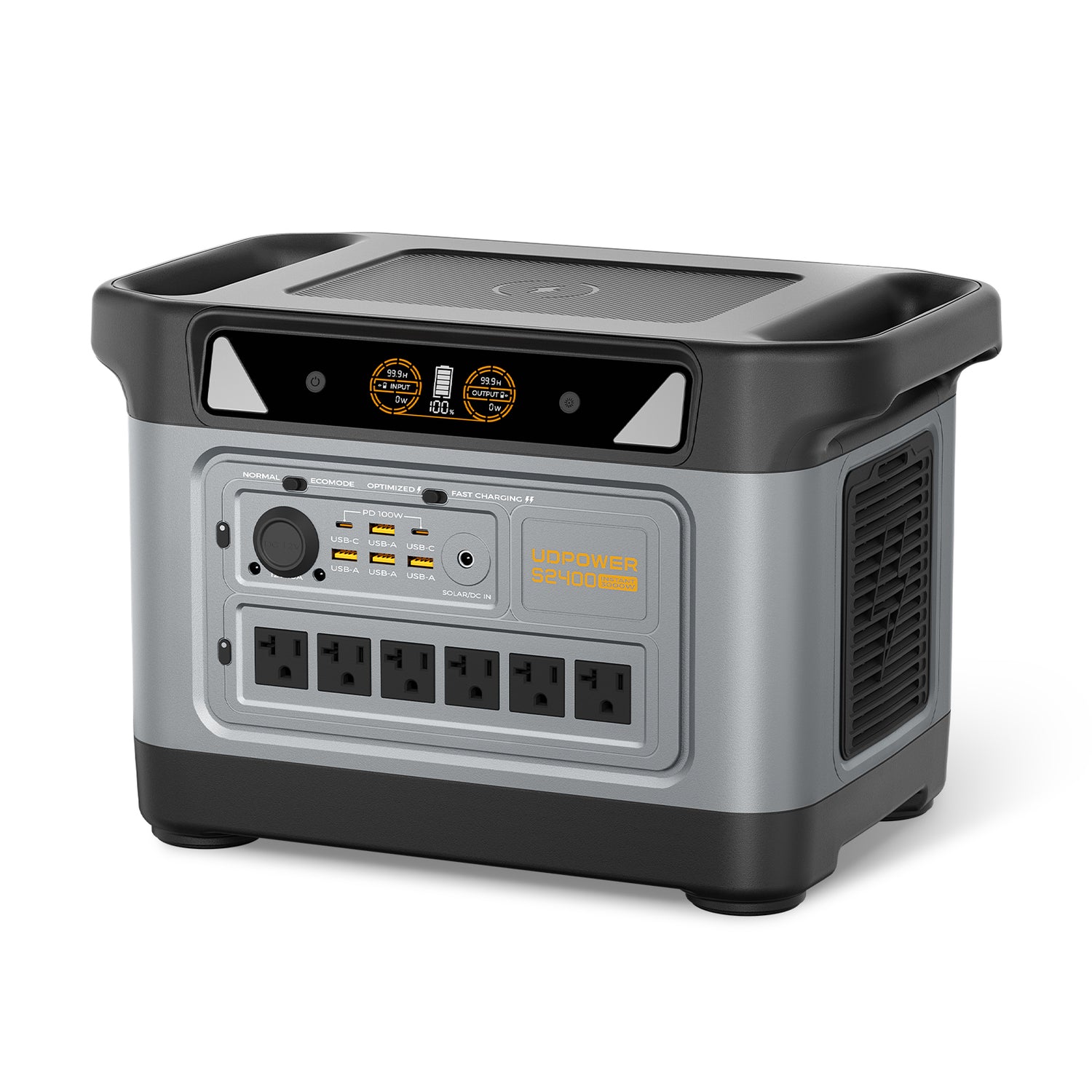
Best for Home Backup: UDPOWER S2400 Portable Power Station
2,083Wh2,400W Output3,000W SurgeUp to 400W Solar Input
The S2400 is the strongest recommendation for households that want to keep more than small electronics running. It is a better fit for refrigerators, microwaves, CPAP backup, RV appliances, and longer storm preparation than compact battery packs.
- Best fit: refrigerator backup, RV use, storm preparedness, higher-watt appliances.
- Why it matches this article: the grid is diverse, but outages are simple—you need stored energy when the outlet stops working.
- Official product page: UDPOWER S2400 Portable Power Station
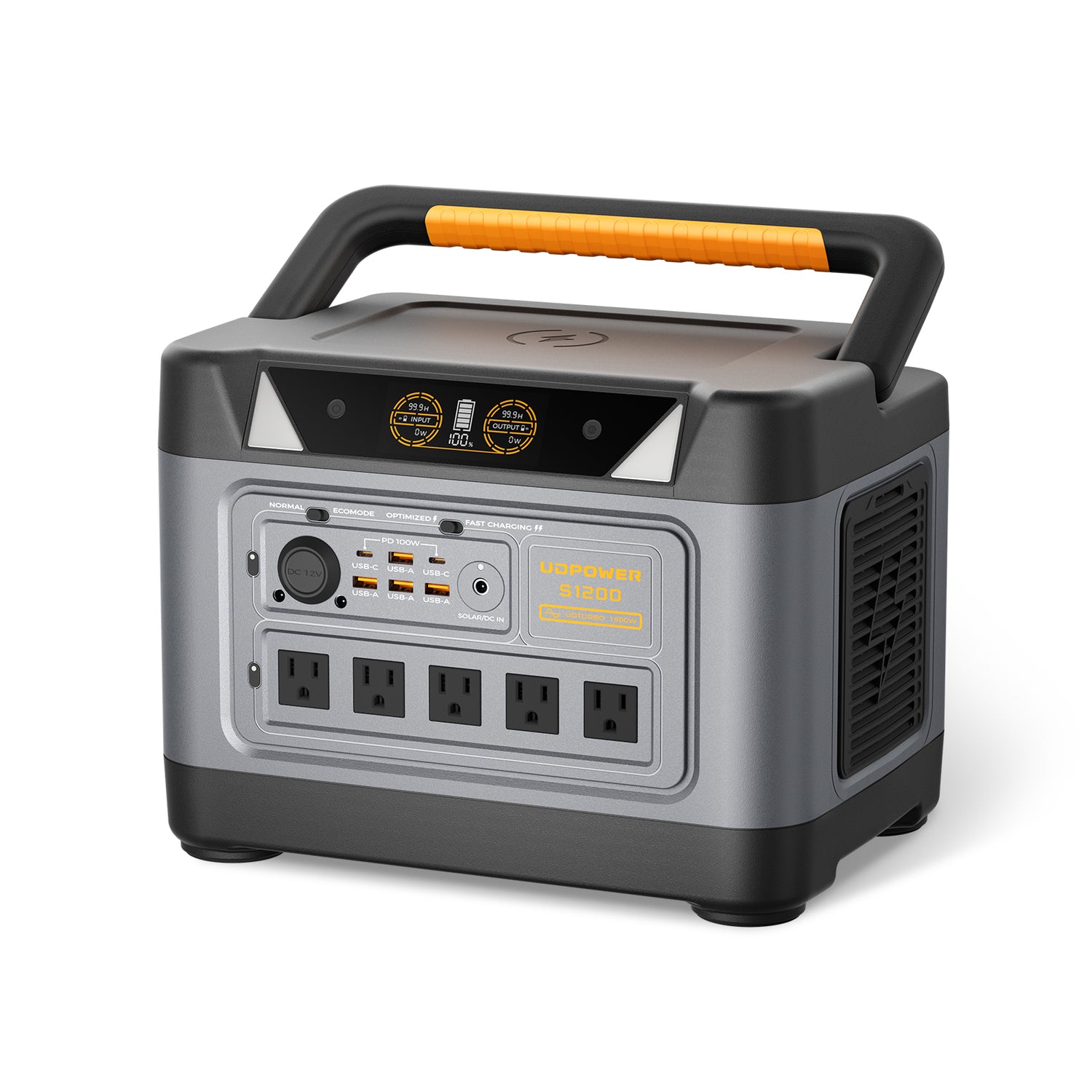
Best Balanced Choice: UDPOWER S1200 Portable Power Station
1,190Wh1,200W Output1,800W Surge1000W-Class Backup
The S1200 is a strong middle option for families who want more than phone charging but do not need the largest station. It is suitable for many refrigerators, routers, laptops, CPAP machines, lights, and camping devices when loads stay within the rated output.
- Best fit: refrigerator support, CPAP backup, router and laptop backup, camping, van life.
- Good balance: larger capacity than compact stations while staying more portable than higher-capacity home units.
- Official product page: UDPOWER S1200 Portable Power Station

Best for Light Backup and Camping: UDPOWER C600 Portable Power Station
596Wh600W Output1,200W PeakLiFePO4
The C600 is a practical light-backup choice for small refrigerators, routers, lights, phones, laptops, cameras, and camping gear. It is not meant to run a whole home, but it is much easier to carry and store than large backup systems.
- Best fit: weekend camping, router backup, fans, lighting, small electronics, mini fridge support.
- Why it works: enough capacity for essentials without the bulk of a larger home-backup station.
- Official product page: UDPOWER C600 Portable Power Station
Related UDPOWER Guides and Collections
Shop portable power stations | View solar generators | Home backup power stations | Outdoor power stations | Plug and play batteries
Runtime Examples for Outages
Runtime depends on device wattage, startup surge, battery condition, temperature, and whether a device cycles on and off. For practical estimates, use this formula:
Estimated runtime = battery capacity × 0.90 ÷ device watts
This uses a 90% usable-efficiency estimate for UDPOWER portable power stations. Real-world runtime can be shorter or longer depending on the device.
| Device / Load | Example Wattage | C600 Estimated Runtime | S1200 Estimated Runtime | S2400 Estimated Runtime | Practical Note |
|---|---|---|---|---|---|
| Wi-Fi router | 15W | About 35.8 hours | About 71.4 hours | About 125 hours | Great low-wattage backup load. |
| LED light set | 20W | About 26.8 hours | About 53.6 hours | About 93.7 hours | Use LED lighting to stretch battery life. |
| CPAP without heavy heating | 40W | About 13.4 hours | About 26.8 hours | About 46.9 hours | Heated hose and humidifier can raise power draw significantly. |
| Box fan | 50W | About 10.7 hours | About 21.4 hours | About 37.5 hours | Useful during summer outages. |
| Laptop workstation | 60W | About 8.9 hours | About 17.9 hours | About 31.2 hours | Actual use depends on charger size and workload. |
| Modern refrigerator average load | 150W | About 3.6 hours continuous | About 7.1 hours continuous | About 12.5 hours continuous | Real runtime may be longer because compressors cycle on and off. |
| Microwave | 1000W | Not ideal for long use | About 1.1 hours continuous | About 1.9 hours continuous | High-watt appliances drain batteries quickly. |
The table shows why outage planning should start with essentials. Running a router, light, and CPAP is very different from running a heater, air conditioner, or large cooking appliance. For most homes, the smarter plan is to power critical devices first and use solar charging during the day when available.
So, Is the U.S. Grid Mostly Fossil Fuel, Renewable, or Mixed?
The best answer is mixed. Fossil fuels still provide the largest combined share, but they are not the whole story. Natural gas is the largest single source. Nuclear is the largest steady low-carbon source. Wind, solar, and hydropower form the renewable backbone. Coal remains important in some regions but is no longer the dominant national source it once was.
That mixed reality is why the “70%” question needs context. If someone says “70% of electricity comes from fossil fuels,” that is outdated or imprecise based on the latest EIA utility-scale figures. If someone means “roughly 70% or more comes from natural gas, nuclear, and coal,” that is closer to the current picture.
How to Use This Information When Choosing Backup Power
For a homeowner, the grid mix helps explain the big picture, but backup power selection is personal. Ask these questions before choosing a power station:
| Question | Why It Matters | Example Decision |
|---|---|---|
| What devices must stay on? | Backup power should protect essentials first. | Router, CPAP, phone, lights, refrigerator. |
| What is the total wattage? | Output rating determines whether the station can run the load. | A 1200W station is very different from a 600W station. |
| How long do you need power? | Battery capacity determines practical runtime. | Overnight CPAP backup requires more capacity than phone charging. |
| Do you need solar charging? | Solar can extend runtime during longer outages or off-grid trips. | Choose a solar-ready model and compatible panel wattage. |
| Will it be used indoors? | Battery power stations do not create exhaust like gas generators. | Use a portable power station indoors according to the manual; operate gas generators outdoors only. |
Ready to Choose Backup Power?
The U.S. grid gets most of its electricity from a mix of natural gas, nuclear, coal, and renewables. But when a storm, blackout, or grid emergency cuts power to your home, what matters most is having enough stored energy for your real essentials.
FAQ
Where does 70% of U.S. electricity come from?
The closest current answer is natural gas, nuclear power, and coal. Together, they supplied about 76% of U.S. utility-scale electricity in 2025, according to EIA data.
Does 70% of U.S. electricity come from fossil fuels?
No. In the latest EIA data, fossil fuels supplied about 58% of U.S. utility-scale electricity. Natural gas is the largest fossil-fuel electricity source, while coal is smaller than it used to be.
What is the largest source of electricity in the United States?
Natural gas is the largest source of U.S. utility-scale electricity. It supplied about 41% in 2025.
How much electricity comes from renewable energy?
Renewables supplied about 24% of U.S. utility-scale electricity in 2025. This includes wind, hydropower, solar, biomass, and geothermal.
Is nuclear power counted as renewable?
No. Nuclear power is not usually classified as renewable because it uses mined uranium fuel. However, it is a major low-carbon electricity source.
Why does the U.S. still use coal for electricity?
Coal plants still exist across parts of the country and can provide dispatchable power. However, coal’s national share has declined because of competition from natural gas, renewables, retirements, and environmental factors.
Does my home receive electricity from one source?
Usually no. Your home receives electricity from the grid, which blends power from multiple sources. The mix changes by region, season, weather, and time of day.
Can solar panels power a home during an outage?
Solar panels alone do not always power a home during an outage unless they are connected to a system designed for backup operation. A solar generator or battery storage system can store energy and provide usable power when the grid is down.
Can a portable power station run a refrigerator?
Yes, larger portable power stations such as UDPOWER S1200 and S2400 can run many refrigerators, as long as the refrigerator’s running watts and startup surge stay within the station’s limits.
What size portable power station is best for home backup?
For phones, lights, routers, and laptops, a smaller station may be enough. For refrigerators, CPAP machines, fans, and longer outages, a higher-capacity model such as UDPOWER S1200 or S2400 is usually a better match.
Sources
- U.S. Energy Information Administration: Electricity in the United States
- U.S. Energy Information Administration: Electricity generation by energy source FAQ
- U.S. Environmental Protection Agency: Power Sector Evolution
- UDPOWER S2400 Portable Power Station
- UDPOWER S1200 Portable Power Station
- UDPOWER C600 Portable Power Station
Related Articles





