

How Many Watts Does a Window Air Conditioner Use? (2026)
Last updated: August 10, 2026
Quick answer: Most window air conditioners use roughly 400 to 1,500 watts while actively cooling, although very small, high-efficiency models may use less and large or older units may use more. A typical 5,000 BTU window AC is often in the 400–600W range, an 8,000 BTU model is commonly around 550–900W, and a 12,000 BTU unit often falls around 800–1,300W.
If you are asking how many watts does a window air conditioner use because you want to calculate electricity cost or choose backup power, do not rely on BTU alone. Check the AC's rated input watts, compressor type and actual startup behavior. A conventional fixed-speed compressor can demand considerably more power when it starts than it uses after it is running.
For the most accurate answer, use the wattage printed on your specific AC, its manufacturer's specifications, or a real power meter.

How Many Watts Does a Window Air Conditioner Use by BTU Size?
There is no single wattage for every window air conditioner. Two units with the same BTU cooling capacity can draw noticeably different power because of compressor design, efficiency, age and operating conditions.
The following table is intended for planning. It is not a substitute for the electrical rating of your own air conditioner.
| Window AC Size | Common Active-Cooling Range | Typical Use | ENERGY STAR Room-Size Guidance | What to Know |
|---|---|---|---|---|
| 5,000 BTU | About 400–600W | Small bedroom, office | 100–150 sq. ft. | One of the easiest window AC sizes to support with battery backup. |
| 6,000 BTU | About 450–700W | Bedroom, small apartment room | 150–250 sq. ft. | Efficiency differences become increasingly noticeable between models. |
| 8,000 BTU | About 550–900W | Bedroom, office, medium room | 300–350 sq. ft. | Modern variable-speed models may reduce draw substantially after the room cools. |
| 10,000 BTU | About 650–1,100W | Medium-to-large room | 400–450 sq. ft. | Startup demand becomes especially important for backup-power sizing. |
| 12,000 BTU | About 800–1,300W | Large bedroom or living area | 450–550 sq. ft. | Some high-efficiency inverter units draw far less at partial load than fixed-speed units. |
| 14,000 BTU | About 900–1,500W | Large room or open living area | 550–700 sq. ft. | Check plug type, voltage and rated input before choosing backup power. |
| 18,000 BTU | About 1,200–1,900W+ | Very large room | 700–1,000 sq. ft. | Some units may have electrical requirements beyond ordinary small backup systems. |
Room-size guidance above is based on the ENERGY STAR room air conditioner sizing guide. ENERGY STAR also recommends adjusting capacity for unusually sunny rooms, heavy shade, additional occupants and kitchens.
Do not treat the wattage ranges as equipment ratings. ENERGY STAR's current certified-product database includes window units with substantially different efficiency ratings at similar BTU capacities. Your own nameplate or manufacturer specification remains the better number for electrical and backup-power planning.
You can compare current certified models in the ENERGY STAR Room Air Conditioner Product Finder.
How to Find Your Window AC's Exact Wattage
If you already own the air conditioner, you usually do not need to guess from a generic wattage chart. Use the following order of preference.
1. Look for rated input watts
Check the label on the side, back or lower edge of the unit. Look for wording such as Rated Input, Cooling Input, Power Input or a value followed by W.
If the label says 720W, use 720W for basic running-power calculations rather than estimating from the BTU rating.
2. Check the manufacturer's specification page
Search the exact model number. Product specifications may provide cooling watts, amperage, voltage, CEER and annual energy consumption.
3. If you only have volts and amps, use them carefully
You will often see watts calculated as volts × amps. That is a useful rough estimate for many household devices, but an AC compressor is a motor load, so volts × amps does not always equal its exact real wattage.
If the manufacturer provides power factor, the more complete relationship is:
For example, a label showing 120V and 7.5A represents up to 900VA. The actual real-power draw may be lower if the power factor is below 1. For that reason, a manufacturer-listed watt rating or a real power meter is preferable.
For a broader explanation of appliance compatibility, see How to Know If a Portable Power Station Can Run Your Device .
4. Measure actual consumption
A plug-in power meter can show real-time watts and accumulated kilowatt-hours. This is especially useful because an air conditioner does not necessarily consume its rated wattage every minute it is switched on.
For a useful measurement, let the unit operate through several cooling cycles during normal summer conditions. A reading taken only during the first minute does not tell you how much energy it will use over an entire afternoon or night.
BTU, EER, CEER and Watts: What Each Number Actually Means
These ratings answer different questions.
| Rating | What It Measures | What It Does Not Mean | Best Use | Source |
|---|---|---|---|---|
| BTU/h | Cooling capacity | It is not electrical wattage. | Matching AC size to the room. | ENERGY STAR |
| Watts | Instantaneous electrical power | It does not tell you total daily energy use by itself. | Outlet, generator and power-station sizing. | U.S. Department of Energy |
| EER | Cooling output relative to electrical input under test conditions | It is not the AC's BTU rating or battery runtime. | Comparing cooling efficiency. | GE Appliances |
| CEER | Combined efficiency that also accounts for standby/off-mode energy | It should not be treated as a perfect live watt-meter reading. | Comparing overall room-AC efficiency. | ENERGY STAR Product Finder |
| kWh | Energy consumed over time | It is not instantaneous power. | Electricity-bill and battery-energy calculations. | U.S. EIA |
Can you estimate watts from BTU and EER?
Yes. When a true EER rating is available, it provides a useful rated-condition estimate:
An 8,000 BTU window AC with an EER of 12 would work out to approximately:
CEER is slightly different. The U.S. Department of Energy and ENERGY STAR define CEER as a combined efficiency metric that incorporates more than active cooling, including standby/off-mode energy. Dividing BTU by CEER can still be useful as a quick comparison, but it should not replace the manufacturer's actual rated input watts when sizing a power station.
Inverter vs. Conventional Window AC: Why Wattage Changes
One of the biggest reasons two window air conditioners with similar BTU ratings can behave differently is compressor design.
Conventional fixed-speed compressor
A conventional window AC usually operates more like an on/off switch. When the thermostat calls for cooling, the compressor starts and operates near its designed cooling output. Once the room reaches the set temperature, the compressor stops.
The cycle then repeats.
Variable-speed or inverter compressor
A variable-speed compressor can reduce its operating speed after the room approaches the target temperature instead of repeatedly switching between full output and off.
That means an inverter window AC rated for several hundred watts at heavy cooling load may run at a much lower draw while maintaining temperature.
ENERGY STAR specifically recommends considering variable-speed room air conditioners because they can continuously adjust compressor operation rather than relying solely on full-output on/off cycling. See the ENERGY STAR room AC guidance.
This matters even more on battery power. A lower average wattage can extend runtime considerably, while a softer compressor start can also make an inverter AC easier for some portable power stations to handle.
Running Watts vs. Starting Watts
Running watts tell you how much power the air conditioner needs after the compressor is operating. Starting demand describes the brief increase in electrical demand when a compressor motor starts.
This is one of the most important differences between estimating electricity cost and choosing backup power.
An AC might operate normally at 700W but still overload a battery inverter when the compressor restarts.
Why a simple "2× or 3×" rule is not enough
Generic surge multipliers can be useful for rough planning, but they should not be treated as a specification. Startup demand varies with compressor design, inverter technology, voltage, ambient temperature and the unit itself.
A variable-speed window AC may start much more gently than an older fixed-speed unit. Conversely, some conventional compressors may create a startup spike high enough to trip a power station that appears large enough based only on running watts.
The better way to check startup compatibility
- Find the AC's rated input watts.
- Check the manual for maximum current, starting current or related electrical specifications.
- Determine whether the compressor is fixed-speed or variable-speed/inverter.
- Compare the AC with the power station's rated AC output and startup capability.
- Test the combination before an outage.
- Let the compressor shut off and restart several times during the test.
That last step matters. A power station that successfully starts an already-warm AC once has not necessarily proven it can handle repeated compressor restarts.
How Much Electricity Does a Window AC Use Per Day?
Watts are only half the answer. To estimate electricity use, you also need to know how long the compressor actually operates.
If an 800W window AC actively cools for four hours:
Do not automatically use the number of hours the AC is switched on. A conventional unit may cycle its compressor off for part of that time, while a variable-speed model may reduce its power instead of shutting completely off.
| Active Cooling Power | 2 Active Hours | 4 Active Hours | 8 Active Hours | 12 Active Hours |
|---|---|---|---|---|
| 500W | 1.0 kWh | 2.0 kWh | 4.0 kWh | 6.0 kWh |
| 700W | 1.4 kWh | 2.8 kWh | 5.6 kWh | 8.4 kWh |
| 800W | 1.6 kWh | 3.2 kWh | 6.4 kWh | 9.6 kWh |
| 1,000W | 2.0 kWh | 4.0 kWh | 8.0 kWh | 12.0 kWh |
| 1,200W | 2.4 kWh | 4.8 kWh | 9.6 kWh | 14.4 kWh |
A better way to estimate overnight use
Suppose your 8,000 BTU AC draws 800W when cooling, but a power meter shows that it consumed 4.0 kWh over an eight-hour night.
Its average electrical load across the entire period was:
That 500W average is usually more useful for estimating future battery runtime than assuming the AC draws 800W continuously for all eight hours.
How Much Does a Window Air Conditioner Cost to Run?
Electricity cost depends on energy use in kWh and your utility's residential rate.
The U.S. Energy Information Administration reported an average U.S. residential electricity price of 18.44 cents per kWh for May 2026. Electricity rates vary considerably by state, utility and rate plan, so your own bill is the best rate to use. See the latest U.S. EIA residential electricity price data.
| AC Power | Active Cooling Time | Energy Used | Cost at $0.1844/kWh | 30-Day Equivalent |
|---|---|---|---|---|
| 500W | 8 hours/day | 4.0 kWh/day | About $0.74/day | About $22.13 |
| 700W | 8 hours/day | 5.6 kWh/day | About $1.03/day | About $30.98 |
| 800W | 8 hours/day | 6.4 kWh/day | About $1.18/day | About $35.40 |
| 1,000W | 8 hours/day | 8.0 kWh/day | About $1.48/day | About $44.26 |
| 1,200W | 8 hours/day | 9.6 kWh/day | About $1.77/day | About $53.11 |
These examples assume the listed wattage is being drawn for the entire eight-hour period. Actual cost can be lower when the compressor cycles or an inverter model reduces output after the room reaches its set temperature.
Room Size, BTU and Wattage: Bigger Is Not Always Better
Choosing an oversized window AC can seem like an easy way to cool a room faster, but ENERGY STAR warns that an oversized unit may cool the room before removing enough humidity. It can also cost more to buy and may operate less efficiently.
| Area to Cool | ENERGY STAR Capacity Guidance | Approximate Window AC Power Class |
|---|---|---|
| 100–150 sq. ft. | 5,000 BTU | Often around 400–600W |
| 150–250 sq. ft. | 6,000 BTU | Often around 450–700W |
| 300–350 sq. ft. | 8,000 BTU | Often around 550–900W |
| 400–450 sq. ft. | 10,000 BTU | Often around 650–1,100W |
| 450–550 sq. ft. | 12,000 BTU | Often around 800–1,300W |
| 550–700 sq. ft. | 14,000 BTU | Often around 900–1,500W |
| 700–1,000 sq. ft. | 18,000 BTU | Often around 1,200–1,900W+ |
ENERGY STAR recommends reducing capacity by about 10% for heavily shaded rooms, increasing it by about 10% for very sunny rooms, adding capacity for more than two regular occupants, and adding additional cooling capacity when the unit is used in a kitchen.
Source: ENERGY STAR Room Air Conditioners.
Can a Portable Power Station Run a Window Air Conditioner?
Yes, many portable power stations can run selected 120V window air conditioners, but wattage alone does not guarantee compatibility.
You need to check three things:
- Voltage: The AC must be compatible with the power station's AC output.
- Running demand: The power station must support the AC while it is cooling.
- Compressor startup: The power station must tolerate the AC's actual startup behavior.
You also need enough battery capacity. A station may be powerful enough to start an AC but still provide only an hour or two of continuous cooling if the air conditioner draws close to 1,000W.
For more on AC backup, see Can a Solar Generator Power an AC? and UDPOWER Solar Generator Kits .
| Window AC Scenario | Typical Active-Cooling Range | S1200 | S2400 | Practical Guidance |
|---|---|---|---|---|
| 5,000 BTU | About 400–600W | Strong starting point for many models | More output and runtime headroom | Still verify compressor startup behavior. |
| 6,000 BTU | About 450–700W | Suitable for many efficient or lower-surge models | Strong fit for many models | Conventional compressors should be tested before outage use. |
| 8,000 BTU | About 550–900W | Best evaluated case by case, especially for fixed-speed units | Better fit for many models | Variable-speed ACs are often easier backup loads. |
| 10,000 BTU | About 650–1,100W | Limited headroom; not the preferred choice for conventional high-surge units | Practical option for many units after testing | Startup demand matters more than the BTU number alone. |
| 12,000 BTU | About 800–1,300W | Generally not the preferred backup size | Possible for selected units, especially efficient low-surge designs | Confirm rated input and startup before purchase. |
Recommended UDPOWER Power Stations for Window AC Backup
For a window air conditioner, the higher-output UDPOWER S-Series models are more appropriate than compact C-Series stations. Window ACs combine substantial continuous power draw with compressor-starting demand, so both inverter output and battery capacity matter.
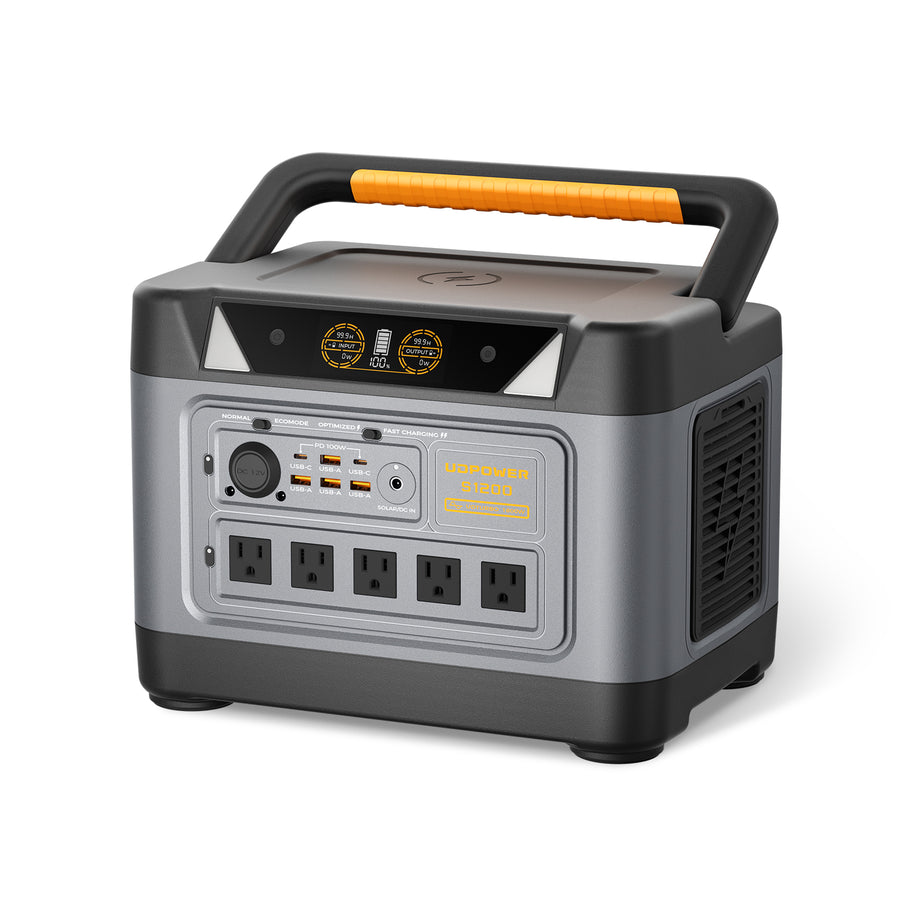
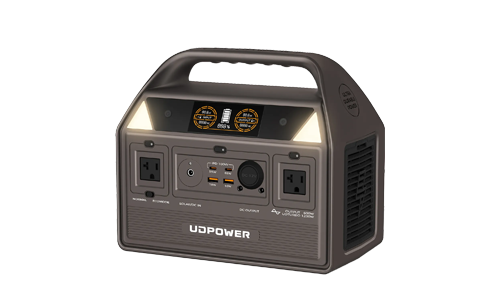
UDPOWER S1200 Portable Power Station
The S1200 is a practical starting point for small window AC backup, especially many 5,000 BTU units and selected efficient 6,000–8,000 BTU models whose startup requirements stay within the station's capability.
- Battery capacity: 1,190Wh-class LiFePO4 battery
- Rated AC output: 1,200W pure sine wave
- UDTURBO: Up to 1,800W for compatible higher-power loads
- AC outlets: 5 on the current gray version
- Total output ports: 14
- Solar input: Up to 400W
- Weight: Approximately 26.0 lb
- Battery chemistry: LiFePO4
The S1200 also leaves room for common outage essentials such as a router, phones, lights and selected refrigerators, provided the combined load remains within the station's operating limits.
View UDPOWER S1200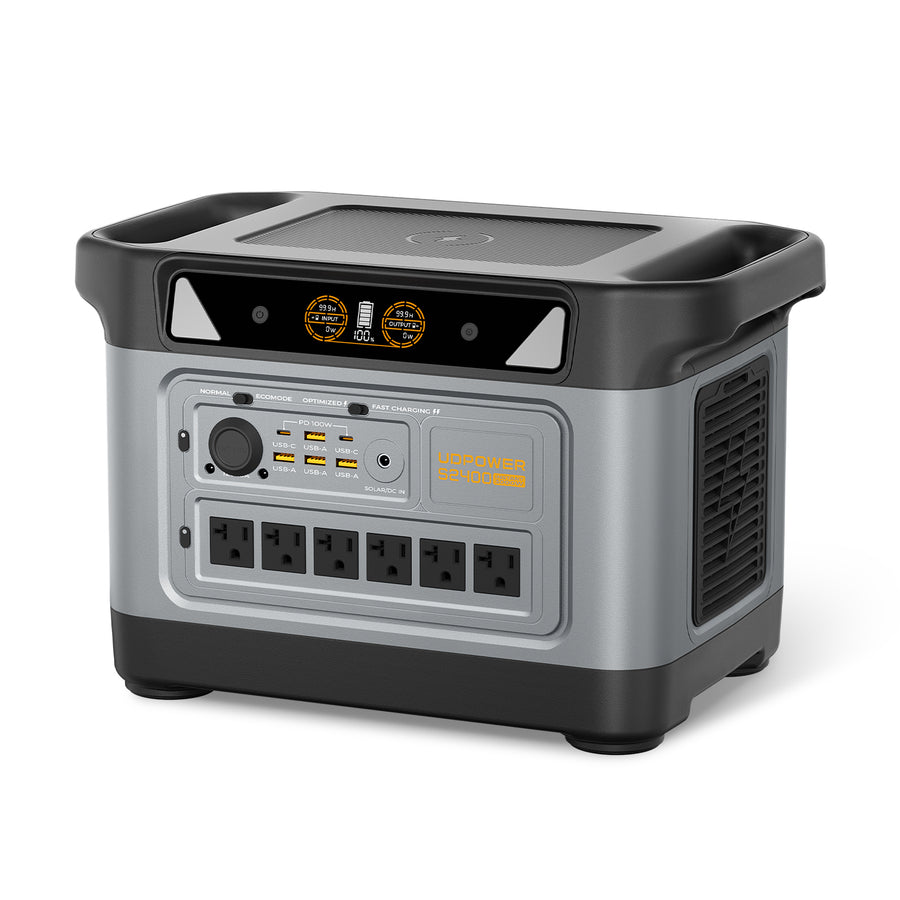
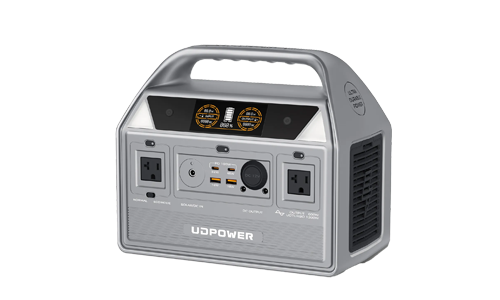
UDPOWER S2400 Portable Power Station
The S2400 is the better choice when the window AC has a higher running load, when you want more startup headroom, or when cooling time matters more than maximum portability.
- Battery capacity: 2,083Wh LiFePO4 battery
- Rated AC output: 2,400W pure sine wave
- UDTURBO startup support: Up to 3,000W
- AC outlets: 6
- Total output ports: 15
- Solar charging: Up to 400W
- Weight: Approximately 40.8 lb
- Battery chemistry: LiFePO4
For many 8,000–10,000 BTU window AC setups, the S2400 provides substantially more useful margin than a 1,200W-class station. Selected efficient or variable-speed 12,000 BTU models may also be compatible, but they should be checked and tested individually.
View UDPOWER S2400Still deciding between the two? See the detailed UDPOWER S1200 vs. S2400 comparison or browse all UDPOWER portable power stations .
How Long Can a Portable Power Station Run a Window AC?
Battery capacity is measured in watt-hours, while the AC consumes watts. For UDPOWER runtime planning, a useful estimate is:
The 90% factor allows for typical AC conversion losses. Real runtime still changes with temperature, compressor cycling, AC efficiency, battery condition and any additional devices connected to the station.
| Measured AC Load | Typical Example | S1200 Estimated Continuous Runtime | S2400 Estimated Continuous Runtime |
|---|---|---|---|
| 500W | Small efficient window AC | About 2.1 hours | About 3.7 hours |
| 650W | Small-to-medium window AC | About 1.6 hours | About 2.9 hours |
| 800W | Common medium window AC load | About 1.3 hours | About 2.3 hours |
| 1,000W | Larger window AC | About 1.1 hours* | About 1.9 hours |
| 1,200W | High-load window AC | Output/startup compatibility must be evaluated carefully* | About 1.6 hours |
*The runtime calculation only describes battery energy. It does not guarantee that the S1200 can successfully start or operate every AC at that wattage. Compressor startup and total connected load must also be compatible.
Why your real runtime may be longer than the continuous-cooling table
The table assumes the listed wattage is being drawn continuously. A real AC may reduce average consumption after the room reaches its target temperature.
For example, an inverter AC might draw 800W during initial cooling but average only 500W over the next several hours. In that situation, the 500W measured average is more useful for estimating battery duration.
Why your runtime can also be shorter
Expect higher consumption when:
- The outdoor temperature is extremely high.
- The room receives strong afternoon sun.
- Windows or doors leak hot outdoor air.
- The filter is dirty.
- The room is larger than the AC was designed to cool.
- The thermostat is set unusually low.
- Humidity is high.
- Doors are opened frequently.
- Other devices are drawing power from the same battery.
You can also use the UDPOWER Battery & Power Conversion Tools when comparing watts, watt-hours, amps and battery capacity.
How to Reduce Window AC Power Consumption
You do not necessarily need to replace the air conditioner to reduce how much electricity it consumes. In many homes, lowering the cooling load is just as important as improving the AC itself.
| Action | Why It Helps | Especially Useful For |
|---|---|---|
| Clean the air filter | Maintains airflow and helps the system operate as intended. | Older units, dusty rooms, pet households |
| Seal gaps around the AC | Reduces hot outdoor air leaking around the unit. | Older windows and temporary installations |
| Close blinds before direct sun reaches the room | Reduces solar heat entering through windows. | South- and west-facing rooms |
| Use Energy Saver or Eco mode | Can reduce unnecessary compressor and fan operation. | Overnight cooling and mild weather |
| Use a circulating fan | Moves cooled air more evenly through the room. | Rooms with poor air circulation |
| Avoid an unnecessarily low thermostat setting | Reduces the time the compressor has to work at heavy load. | Heat waves and battery backup |
| Pre-cool before a forecast outage | Starts the outage with less stored heat in the room. | Storm and emergency preparation |
| Choose a properly sized variable-speed model when replacing the AC | Can improve part-load efficiency and reduce repeated hard starts. | Frequent users and battery backup |
ENERGY STAR also recommends proper sizing, correct installation, sealing around room AC units and using a comfortable thermostat setting rather than simply buying the largest available unit. See ENERGY STAR's room AC efficiency guidance.
60-Second Window AC Backup-Power Checklist
Before buying a battery or relying on one during a summer outage, work through this checklist.
- Find the exact model number of your window AC.
- Check whether it uses 115/120V or another voltage.
- Find the rated cooling input in watts if available.
- If watts are not listed, check the manufacturer's electrical specifications.
- Determine whether the compressor is fixed-speed or inverter/variable-speed.
- Do not assume BTU directly equals electrical wattage.
- Account for compressor startup demand.
- Add the watts of any other devices you want to run at the same time.
- Estimate battery runtime using measured average watts whenever possible.
- Test the AC through several complete compressor cycles before an emergency.
Frequently Asked Questions
How many watts does a window air conditioner use?
Most window air conditioners use roughly 400 to 1,500 watts while actively cooling. Small 5,000 BTU units are often around 400–600W, while larger 12,000–14,000 BTU models may draw roughly 800–1,500W. Exact consumption depends on efficiency, compressor design, temperature and the individual model.
How many watts does a 5,000 BTU window AC use?
A 5,000 BTU window AC commonly uses about 400–600 watts while actively cooling. High-efficiency models may use less, while older or less efficient units can use more. Check the unit's rated input for the most accurate number.
How many watts does an 8,000 BTU window air conditioner use?
Many 8,000 BTU window air conditioners fall around 550–900 watts during active cooling. Modern variable-speed units may reduce their draw considerably after the room approaches the thermostat setting.
How many watts does a 10,000 BTU window AC use?
A useful planning range is approximately 650–1,100 watts while actively cooling. The exact input depends on the model's efficiency and compressor design, so use its rated wattage whenever available.
How many watts does a 12,000 BTU window AC use?
Many 12,000 BTU window units use roughly 800–1,300 watts under substantial cooling load. High-efficiency variable-speed models can operate below that range at partial load, while older units may consume more.
Does a window air conditioner use the same watts all the time?
No. Fixed-speed units cycle the compressor on and off, while variable-speed units can reduce compressor speed as cooling demand falls. Outdoor temperature, thermostat setting, humidity, sunlight and room insulation also change actual consumption.
How many watts does a window AC use per hour?
Watts measure power, while watt-hours or kilowatt-hours measure energy over time. An AC drawing 800W continuously for one hour consumes 800Wh, or 0.8kWh. If its compressor cycles or reduces speed during that hour, actual energy use will be lower.
Can a 1,000W power station run a window AC?
Sometimes. It may operate a small efficient window AC whose running and startup requirements stay within the power station's limits. However, compressor startup can exceed the normal running wattage, so a 1,000W rating alone does not guarantee compatibility.
Can the UDPOWER S1200 run a window air conditioner?
The UDPOWER S1200 is a practical option for many small 5,000 BTU window ACs and selected efficient or lower-surge 6,000–8,000 BTU models. It provides 1,200W rated AC output and UDTURBO support up to 1,800W for compatible higher-power loads. Your specific AC should still be tested before outage use.
Can the UDPOWER S2400 run a window air conditioner?
The S2400 provides 2,400W rated AC output, a 2,083Wh battery and UDTURBO startup support up to 3,000W, making it a stronger option for many 8,000–10,000 BTU window AC units. Selected efficient 12,000 BTU models may also work, but startup behavior and actual wattage must be verified.
How long will a power station run a window AC?
Runtime depends primarily on battery capacity and the AC's average wattage. Using a 90% conversion estimate, the 2,083Wh UDPOWER S2400 provides about 3.7 hours at a continuous 500W load, about 2.3 hours at 800W, and about 1.9 hours at 1,000W. Actual cooling time can be longer when the AC reduces its average load after the room cools.
Is an inverter window AC better for battery backup?
Often, yes. Variable-speed compressor technology can reduce power after the room reaches the desired temperature and may avoid the repeated hard starts associated with some conventional fixed-speed compressors. Exact behavior still varies by model.
Can solar panels run a window AC?
A practical setup normally uses solar panels to recharge or supplement a compatible power station rather than connecting a conventional window AC directly to a portable solar panel. Real solar input changes with sunlight, shade, panel temperature, angle and the power station's solar-input limit.
Why does my window AC trip my portable power station?
Compressor startup demand is a common reason. The AC may run at only several hundred watts after startup but demand considerably more power when the compressor turns on. An overloaded power station, additional connected appliances or an AC with unusually high startup current can also cause a shutdown.
Is CEER the same as window AC wattage?
No. CEER is an energy-efficiency rating, not a live wattage reading. It incorporates active cooling efficiency along with standby/off-mode energy under standardized testing. For backup-power sizing, use the AC's rated input watts or measured real power whenever possible.
Choose Backup Power Around Your Actual Window AC
Start with the AC's real wattage, confirm compressor startup behavior, then choose enough inverter output and battery capacity for the cooling time you actually need. For small window ACs, the S1200 is a practical starting point. For more output headroom and longer runtime, consider the S2400.
View Portable Power Stations View Solar Generator Kits Get the Power & Runtime GuideRelated Articles


