

How Many Watts Does a Mini Split Use?
Last updated: July 27, 2026
Direct answer: Most residential mini-split air conditioners use approximately 500 to 2,500 watts while actively cooling, although very small inverter units may fall below 500 watts after the room reaches its set temperature. Large 30,000- to 36,000-BTU systems can draw 3,000 watts or more under heavy load.
A typical 12,000-BTU mini split uses about 800 to 1,200 watts at its rated cooling condition. A high-efficiency model with a 13 EER2 rating may use about 920 watts, while a lower-efficiency model with a 10.5 EER2 rating may use approximately 1,140 watts at the same 12,000-BTU output.
The number shown on the nameplate is not necessarily what the system consumes every minute. An inverter mini split continuously changes compressor speed, so actual draw may fall to a few hundred watts in mild weather and rise close to its maximum input during very hot, humid, or cold conditions.

The most useful answer therefore depends on four numbers: the mini split's BTU capacity, electrical input rating, operating voltage, and average real-world power draw. This guide explains how to find all four and use them to estimate electricity cost, generator size, and battery runtime.
Mini-Split Wattage Chart by BTU
The chart below gives practical planning ranges for common single-zone systems. These figures describe approximate electrical input while the compressor is actively delivering substantial cooling. They are not guaranteed maximums, and they are not the minimum wattage an inverter system can reach.
| Mini-split size | Equivalent tons | Typical rated cooling input | Common U.S. voltage | Approximate current | Common application |
|---|---|---|---|---|---|
| 6,000 BTU | 0.5 ton | 400–650W | 115/120V | About 3.5–5.7A at 115V | Small bedroom, office, insulated studio |
| 9,000 BTU | 0.75 ton | 500–900W | 115/120V or 208/230V | About 4.3–7.8A at 115V, before power-factor differences | Bedroom, small living area, garage office |
| 12,000 BTU | 1 ton | 800–1,200W | 115/120V or 208/230V | About 6.7–10A at 120V or 3.5–5.2A at 230V | Bedroom suite, living room, small apartment zone |
| 18,000 BTU | 1.5 tons | 1,200–1,800W | 208/230V | About 5.2–7.8A at 230V | Large room, open-plan area, workshop |
| 24,000 BTU | 2 tons | 1,800–2,500W | 208/230V | About 7.8–10.9A at 230V | Large open area or multiple connected spaces |
| 30,000 BTU | 2.5 tons | 2,200–3,200W | 208/230V | About 9.6–13.9A at 230V | Large residential zone or light commercial space |
| 36,000 BTU | 3 tons | 2,700–4,000W | 208/230V | About 11.7–17.4A at 230V | Whole-floor zone, multi-zone system, large workshop |
Data basis: ENERGY STAR heat-pump efficiency definitions, 12,000-BTU 115V manufacturer example, 12,000-BTU rated-input example, and 23,000-BTU manufacturer example. Always use the specifications for your exact indoor/outdoor unit combination.
Why Mini-Split Wattage Constantly Changes
Most modern mini splits use an inverter-driven compressor. Instead of repeatedly switching between fully on and completely off, the system changes compressor speed to match the room's current heating or cooling demand.
That is why a 12,000-BTU unit rated near 920 watts might:
- Draw close to its rated input while cooling a hot room after startup.
- Rise above its rated input temporarily during extreme outdoor conditions, if the manufacturer's operating range allows it.
- Settle around 300–600 watts once the room approaches the thermostat setting.
- Fall near 100–300 watts during very light-load operation on some high-efficiency models.
- Increase again when a door opens, afternoon sun heats the room, humidity rises, or the thermostat is lowered.
This does not mean the manufacturer overstated or understated the wattage. Rated input, maximum input, minimum modulation, and seasonal average energy use describe different operating conditions.
Four power numbers that should not be confused
| Specification | What it means | How to use it |
|---|---|---|
| Rated power input | Electrical input under a standardized rated operating condition | Useful for comparing models and estimating normal full-load consumption |
| Maximum power input | Highest listed electrical input under the manufacturer's allowed conditions | Important for inverter, generator, breaker, and backup-power sizing |
| Rated current | Current under a rated test condition | Can help estimate watts when power input is not directly listed |
| Minimum circuit ampacity | Minimum conductor and circuit-sizing value required by electrical codes and manufacturer instructions | Use for installation planning, not as a direct estimate of everyday wattage |
| Maximum overcurrent protection | Largest permitted breaker or fuse rating | Do not multiply this number by voltage and assume the result is normal power use |
Does a Mini Split Use More Watts for Heating or Cooling?
A heat-pump mini split may use similar electrical power in moderate heating and cooling conditions. Heating consumption can rise sharply, however, as outdoor temperatures fall and the system works harder to extract heat from cold air.
| System size | Typical cooling input range | Possible heating input range | What may increase heating consumption |
|---|---|---|---|
| 9,000 BTU | 500–900W | 600–1,100W | Low outdoor temperature, high setpoint, defrost |
| 12,000 BTU | 800–1,200W | 800–1,400W | Cold-weather capacity demand and ice removal |
| 18,000 BTU | 1,200–1,800W | 1,300–2,200W | Large temperature difference and high fan demand |
| 24,000 BTU | 1,800–2,500W | 2,000–3,000W | Multiple spaces, cold outdoor coil, high heating load |
| 36,000 BTU | 2,700–4,000W | 3,000–5,000W or more on some systems | Multi-zone demand, low ambient temperature, defrost operation |
These are planning ranges rather than universal equipment specifications. A cold-climate model may maintain more heating capacity at low temperatures than a standard mini split, but doing so can require substantially more electrical input.
What happens during defrost mode?
In cold, damp weather, frost can form on the outdoor heat-exchanger coil. The system periodically reverses operation to melt that frost. During this period, indoor heating may pause, operating sound may change, and short-term power consumption may fluctuate.
Defrost does not automatically indicate a malfunction. Frequent or unusually long defrost cycles, however, may justify checking the outdoor coil, airflow, drainage, installation, and service condition.
How to Calculate Mini-Split Wattage
Method 1: Use the listed power input
The most accurate planning number is the manufacturer's listed “rated power input,” “cooling input,” “heating input,” or “maximum input power.” These may appear on the outdoor-unit label, submittal sheet, technical manual, or AHRI-certified system information.
Method 2: Calculate from volts and amps
If power factor is not available, volts multiplied by amps gives volt-amperes rather than guaranteed real watts. For a rough planning estimate, many homeowners initially use volts × amps, but the manufacturer's watt rating or a real power meter is better.
Example:
The actual wattage may be somewhat lower if the equipment's power factor is below 1. A true-power meter accounts for that difference.
Method 3: Estimate rated cooling input from EER2
EER2 compares cooling output in BTU per hour with electrical input in watts at a defined test condition.
For a 12,000-BTU mini split with an EER2 of 13:
For another 12,000-BTU mini split with an EER2 of 10.5:
This explains why two one-ton mini splits can have noticeably different electrical input even though both provide the same nominal cooling capacity.
Efficiency definition source: ENERGY STAR Heat Pump Equipment Key Product Criteria.
Why SEER2 alone cannot predict an exact hourly wattage
SEER2 is a seasonal efficiency measure. It represents cooling delivered over a standardized cooling season divided by total electrical energy consumed. It is useful for comparing seasonal efficiency, but it does not tell you exactly what the mini split will draw at 3:00 p.m. on a 100°F day.
EER2, rated input, input range, and real-time measurements are more useful when you need to size a generator, inverter, battery system, or electrical circuit.
How to Find Your Mini Split's Exact Wattage
Step 1: Identify the complete model combination
Record the model number of both the indoor unit and outdoor unit. Performance data may apply only to a specific matched combination. A wall-mounted indoor head connected to a different outdoor condenser may not have the same efficiency or power input.
Step 2: Check the outdoor-unit nameplate
Look for terms such as:
- Rated input
- Cooling input
- Heating input
- Maximum input power
- Rated current
- Maximum operating current
- Power supply
- Minimum circuit ampacity
- Maximum fuse or breaker
Step 3: Read the technical submittal, not only the sales page
A retail page may show BTU capacity, SEER2, and recommended room size while leaving out rated power input. Search the manufacturer's website for the engineering manual, submittal sheet, specification sheet, or installation manual using the exact outdoor-unit model number.
Step 4: Measure real consumption safely
A standard plug-in watt meter is appropriate only when the mini split is specifically designed and approved for cord-and-plug connection. Most larger mini splits are hardwired to a dedicated disconnect and should not be modified just to connect a household watt meter.
For a hardwired system, practical measurement options include:
- A properly installed circuit-level energy monitor.
- A whole-home energy monitor that can isolate the HVAC circuit.
- A clamp meter capable of measuring current, used by a qualified person.
- Utility interval data when the mini split is the dominant changing load.
Step 5: Measure over a full day
A five-minute reading can be misleading. To estimate daily energy use, record consumption through the hottest or coldest part of the day and overnight. The resulting kilowatt-hour total is more useful than one momentary watt reading.
How Much Electricity Does a Mini Split Use Per Day?
Watts measure instantaneous power. Your electric bill is based on kilowatt-hours, which combine power and time.
A mini split drawing an average of 750 watts for eight hours uses:
The following table uses eight equivalent full-load hours per day and the May 2026 U.S. residential average electricity price of 18.44 cents per kWh. Your local utility rate and actual average load may be very different.
| Average electrical draw | Energy used in 8 hours | Energy used in 30 days | Estimated monthly cost at $0.1844/kWh |
|---|---|---|---|
| 500W | 4 kWh | 120 kWh | About $22.13 |
| 750W | 6 kWh | 180 kWh | About $33.19 |
| 1,000W | 8 kWh | 240 kWh | About $44.26 |
| 1,500W | 12 kWh | 360 kWh | About $66.38 |
| 2,000W | 16 kWh | 480 kWh | About $88.51 |
| 2,500W | 20 kWh | 600 kWh | About $110.64 |
Electricity-price source: U.S. Energy Information Administration, May 2026 residential retail price.
How much does a 12,000-BTU mini split cost to run?
Suppose a 12,000-BTU unit averages 650 watts over ten hours:
At $0.1844 per kWh, that equals about $1.20 per day or roughly $35.96 over 30 days.
If the same unit averages 1,000 watts because of extreme heat, direct afternoon sun, poor insulation, or a low thermostat setting, ten hours would use 10 kWh and cost about $1.84 per day at the same rate.
What Affects Mini-Split Power Consumption?
1. Outdoor temperature
The larger the difference between indoor and outdoor temperature, the harder the system must work. A mini split maintaining 76°F on an 82°F day may run at low compressor speed. The same unit maintaining 70°F on a 102°F day may stay close to high output for hours.
2. Indoor humidity
Air conditioning removes both sensible heat and moisture. High humidity increases the total cooling workload even when the thermometer does not appear unusually high.
3. Room size and heat gain
Floor area matters, but it is only one part of the load. Ceiling height, window area, window direction, shade, insulation, air leakage, roof temperature, occupants, cooking, computers, and lighting all affect the cooling requirement.
4. Thermostat setting
Lowering the thermostat several degrees does not make the mini split produce “colder air faster.” It usually keeps the compressor at a higher output for longer. A moderate, stable setting generally uses less energy than repeatedly demanding large temperature changes.
5. Equipment sizing
An undersized unit may remain at maximum output without reaching the target temperature. An oversized unit may spend more time near its minimum modulation limit, cycle unnecessarily, or control humidity poorly.
Correct sizing should be based on a room-by-room cooling and heating load calculation rather than a simple square-foot rule.
6. SEER2 and EER2 efficiency
A higher-efficiency mini split can deliver the same cooling with less electrical input under comparable conditions. However, climate suitability, low-temperature heating performance, installation quality, and modulation range also matter.
7. Filter and coil condition
A clogged filter reduces indoor airflow. Dirty indoor and outdoor coils reduce heat transfer. The compressor may then operate longer or at a higher speed to deliver the same comfort.
8. Refrigerant and installation quality
Incorrect refrigerant charge, poor flare connections, restricted lines, excessive line length, inadequate evacuation, or an improperly matched system can reduce efficiency and shorten equipment life.
9. Fan mode and ventilation
The indoor fan normally uses much less power than the compressor, but continuous fan operation still adds energy consumption. Opening windows or doors while the mini split is running can add a much larger load by bringing heat and moisture indoors.
10. Number of operating zones
A multi-zone system may use relatively little power with one small indoor head operating lightly, then increase substantially when several heads simultaneously call for cooling or heating.
How Much Power Does a Multi-Zone Mini Split Use?
A multi-zone system has one outdoor unit connected to two or more indoor units. Its power consumption is determined mainly by the outdoor unit's compressor demand, the total active indoor load, outdoor conditions, and the system's modulation limits.
You should not simply add every indoor head's labeled BTU capacity and convert that total directly into watts. Indoor units may not all demand full capacity at the same time, and the outdoor unit may have a lower nominal capacity than the sum of all connected heads.
| Operating scenario | Likely power behavior | Planning implication |
|---|---|---|
| One small zone maintaining temperature | Outdoor compressor may operate near minimum speed | Actual draw can be much lower than outdoor-unit rated input |
| Two zones with moderate demand | Power rises to match the combined load | Use measured average demand for energy-cost estimates |
| All zones recovering from a large temperature setback | Compressor may approach rated or maximum input | Use maximum input and current for backup-source sizing |
| Heating in very cold weather | High compressor demand plus periodic defrost | Battery runtime may be much shorter than a mild-weather calculation |
| Only one very small zone active on a large outdoor unit | System may reach its minimum capacity and cycle | Low-load efficiency may be less favorable than expected |
For a multi-zone system, use the outdoor-unit technical data as the primary electrical reference. Indoor-head fan wattage alone does not represent total system consumption.
What Size Generator Do You Need to Run a Mini Split?
A generator must satisfy the mini split's voltage, continuous power, temporary peak demand, and connection requirements.
Generator sizing checklist
- Match the voltage. A 208/230V mini split requires a generator that provides the correct 240V-class output and connection.
- Check maximum input watts. Do not size only from the average running watts.
- Check maximum operating current. This helps identify the highest expected electrical demand.
- Allow operating headroom. Avoid planning to run the generator continuously at its absolute limit.
- Include other loads. Refrigerator, well pump, lights, battery chargers, and kitchen appliances all reduce available generator capacity.
- Use an approved connection. A hardwired mini split should be supplied through correctly rated wiring, protection, disconnects, and transfer equipment.
Do inverter mini splits need three times their running watts?
Not necessarily. Traditional fixed-speed compressors can have a large locked-rotor startup current. Inverter mini splits generally ramp compressor speed electronically, which can reduce the sharp startup surge.
That does not mean every inverter mini split has zero startup or peak demand. Controls, fans, compressor acceleration, extreme-temperature operation, and generator waveform quality still matter.
Example generator estimate
Assume a 230V mini split lists:
- Rated cooling input: 1,650W
- Maximum input: 2,400W
- Maximum operating current: 11A
A generator that only produces 1,800 running watts would be too small even if the mini split often averages less than that. A 240V generator with adequate continuous output above 2,400W, additional headroom, acceptable waveform quality, and a proper connection would be the more reasonable starting point.
Can a Portable Power Station Run a Mini Split?
It can run certain mini splits, but compatibility is much narrower than comparing watts alone.
All five conditions below must be satisfied:
- The power station must provide the exact voltage required by the mini split.
- Its continuous AC output must exceed the mini split's sustained input.
- Its surge or peak capability must handle the mini split's highest temporary demand.
- The electrical connection must be approved for both devices.
- The battery must contain enough usable watt-hours for the required cooling or heating time.
Voltage is usually the first obstacle
Many small 9,000- and 12,000-BTU mini splits are available in 115/120V versions. Most larger 18,000-, 24,000-, and 36,000-BTU systems require 208/230V.
A portable power station rated for 2,400 watts does not automatically provide 240 volts. Wattage describes power capacity; voltage describes electrical compatibility.
Read the UDPOWER guide to 120V vs. 240V power differences before choosing backup power for a hardwired HVAC system.
Connection method is the second obstacle
Many mini splits are installed on a dedicated hardwired circuit with an outdoor disconnect. They are not designed to be unplugged from a wall receptacle and moved to a portable battery outlet.
A compatible 120V power source may still require a properly designed, isolated connection reviewed by a licensed electrician. Do not change the mini split's factory-required wiring method or improvise adapters.
Battery runtime can be shorter than expected
UDPOWER runtime planning uses 90% AC conversion efficiency. Real results may be lower because of temperature, inverter self-consumption, battery condition, compressor peaks, wiring losses, and other connected devices.
Why rated wattage may underestimate or overestimate runtime
Using maximum input may produce an overly conservative runtime estimate during mild weather. Using a low momentary reading may produce an overly optimistic result during afternoon heat or cold-weather heating.
For the most useful battery calculation, measure the mini split's average wattage over a representative one- to four-hour period.
For a broader explanation of AC compatibility, see Can a Solar Generator Power an AC?
UDPOWER Backup-Power Options for Mini-Split Owners
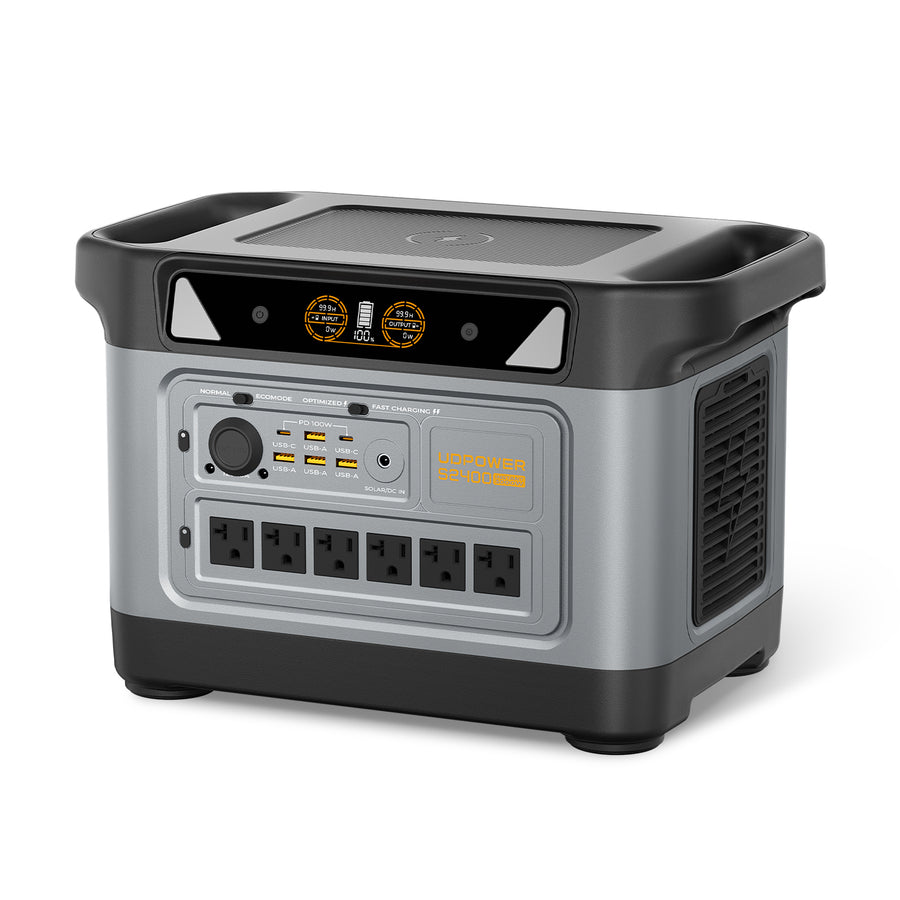
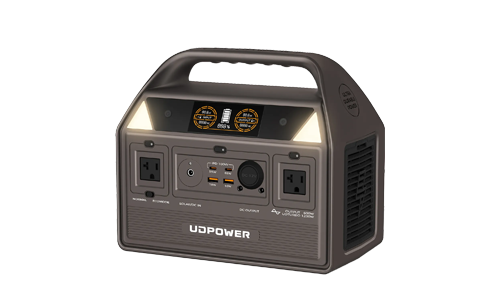
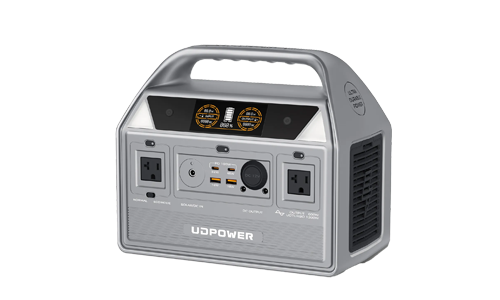
UDPOWER S2400: The Better Option for Selected 120V Mini Splits
- Battery capacity: 2,083Wh
- Rated AC output: 2,400W
- Temporary surge support: Up to 3,000W
- AC voltage: 120V, 60Hz pure sine wave
- AC outlets: Six
- Solar input: Up to 400W
- UPS response: 10 milliseconds or less
- Weight: Approximately 40.8 lb
The S2400 may support a selected small 120V inverter mini split when its running input, maximum demand, and approved connection all fall within the S2400's limits. Its 2,400W continuous output provides considerably more headroom than a 1,200W-class station.
It is not compatible with a 208/230V-only mini split. In that situation, the S2400 is better used to keep outage essentials operating, such as a refrigerator, Wi-Fi router, fans, lights, television, laptop, and CPAP machine.
View UDPOWER S2400 Explore Home Backup Power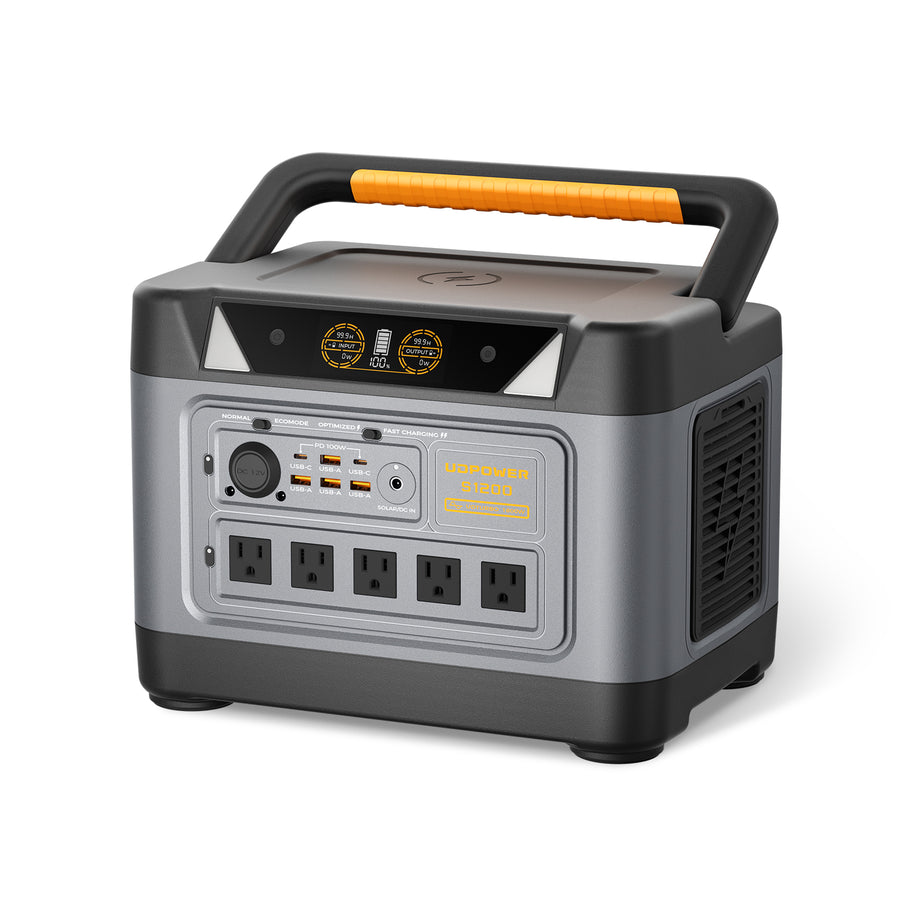
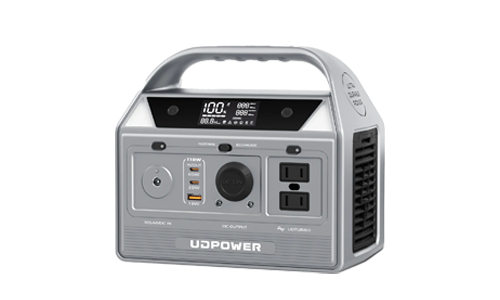
UDPOWER S1200: Only for Low-Draw 120V Equipment
- Battery capacity: 1,190Wh
- Rated AC output: 1,200W
- Temporary surge support: Up to 1,800W
- AC voltage: 120V, 60Hz pure sine wave
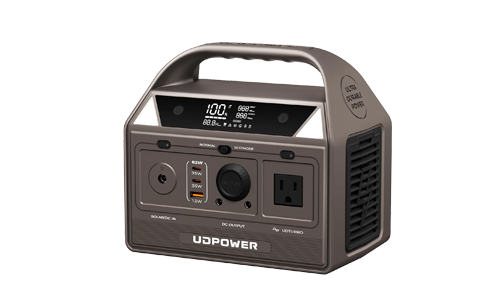
- AC outlets: Five on the primary gray version
- Weight: Approximately 26 lb
The S1200 may be considered only for a small, efficient 120V mini split whose sustained and maximum input remain within its output limits. A 12,000-BTU model drawing close to 1,200W would leave almost no operating headroom, so the S1200 should not be selected from nominal BTU size alone.
For a 240V mini split or a 120V unit that exceeds the S1200 limits, use the S1200 for lower-power emergency essentials instead of the HVAC system.
View UDPOWER S1200 Compare S1200 vs. S2400Estimated UDPOWER runtime at different average mini-split loads
The following estimates use 90% AC conversion efficiency. They assume a compatible 120V load and no other connected devices.
| Average mini-split load | S1200 estimated runtime | S2400 estimated runtime | Compatibility note |
|---|---|---|---|
| 500W | About 2.1 hours | About 3.7 hours | Possible for selected small 120V systems |
| 750W | About 1.4 hours | About 2.5 hours | Check maximum input and connection method |
| 900W | About 1.2 hours | About 2.1 hours | S1200 has limited remaining output headroom |
| 1,200W | About 0.9 hour at the rated-output ceiling | About 1.6 hours | S1200 is not recommended when normal draw reaches its full rating |
| 1,500W | Not suitable as a continuous load | About 1.2 hours | S2400 only, and only for compatible 120V equipment |
| 2,000W | Not suitable | About 0.9 hour | Very short runtime with limited remaining headroom |
Product specifications: UDPOWER S1200 official product page and UDPOWER S2400 official product page.
Can solar panels keep a mini split running indefinitely?
Usually not with a portable system of this size. The S2400 accepts up to 400W of solar input. A mini split averaging 900W consumes more than twice that amount before accounting for changing sunlight, panel angle, clouds, heat, wiring losses, and battery conversion losses.
Even if the panels deliver a strong 350W at a given moment, a 900W mini-split load still creates a net battery drain of approximately 550W, plus system losses.
Solar charging can extend runtime and recharge the battery between cooling periods, but it should not be treated as guaranteed continuous HVAC power.
View Solar Generator Options View UDPOWER Solar PanelsHow to Reduce Mini-Split Electricity Use
Use a steady, realistic thermostat setting
Large thermostat setbacks can force the compressor to operate near maximum output for a long recovery period. In many homes, a stable setting provides better comfort and predictable energy use.
Close curtains during peak sun
West- and south-facing windows can add a substantial afternoon cooling load. Exterior shade, insulated curtains, solar screens, and properly selected window coverings can reduce how hard the mini split must work.
Clean the indoor filters regularly
Check the filters monthly during heavy use. Cleaning frequency depends on pets, dust, smoke, construction activity, and indoor air quality. Follow the manufacturer's cleaning instructions.
Keep the outdoor unit clear
Remove leaves, grass, snow, and other obstructions around the outdoor coil. Do not block the discharge airflow or enclose the condenser in a tight decorative box.
Reduce air leakage
Seal gaps around doors, windows, attic penetrations, and the line-set opening. Uncontrolled outdoor air brings heat and humidity into the conditioned space.
Use ceiling and portable fans strategically
Air movement can make occupants comfortable at a slightly higher cooling setpoint. Fans cool people rather than empty rooms, so switch them off when the space is unoccupied.
Avoid unnecessary turbo operation
Turbo or powerful mode is useful for fast recovery, but it may keep the compressor at elevated output. Return to normal operation once the room is comfortable.
Do not judge efficiency from compressor runtime alone
An inverter mini split may run for long periods at low wattage. Long runtime is not automatically inefficient. Repeated hard starts, poor temperature control, unusually high energy consumption, ice buildup, or failure to reach the setpoint are more useful warning signs.
Have persistent performance problems checked
Schedule professional service when the system develops weak airflow, refrigerant-line icing, water leakage, unusual noise, frequent error codes, rising electricity use, or reduced heating and cooling performance.
Common Mistakes When Estimating Mini-Split Wattage
Mistake 1: Saying “watts per hour”
Watts already describe a rate of power. A mini split may draw 900 watts. If it does so for one hour, it uses 0.9 kilowatt-hours of energy.
Mistake 2: Treating BTU capacity as electrical input
A 12,000-BTU mini split does not consume 3,517 electrical watts merely because 12,000 BTU/h is thermally equivalent to about 3,517 watts. Heat pumps move heat rather than converting every watt of electricity directly into one watt of cooling.
Mistake 3: Using the breaker rating as normal consumption
A 20A breaker is an electrical protection and circuit-sizing specification. It does not prove that the mini split continuously draws 20 amps.
Mistake 4: Ignoring voltage
A 2,400W, 120V power station cannot directly operate a 2,000W, 230V mini split. Both wattage and voltage must match.
Mistake 5: Applying a fixed three-times startup rule to every unit
Inverter compressors often have softer startup behavior than fixed-speed compressors. Use the exact maximum-input and current specifications rather than relying only on a generic multiplier.
Mistake 6: Calculating battery runtime from the lowest observed wattage
A mini split drawing 250W overnight may rise to 900W or more during afternoon heat. Backup planning should include realistic high-load conditions.
Mistake 7: Assuming rated solar input is available all day
A 400W solar array rarely produces exactly 400W from sunrise to sunset. Shade, angle, clouds, panel temperature, season, and charging limits all affect daily energy production.
Frequently Asked Questions
How many watts does a 9,000-BTU mini split use?
A 9,000-BTU mini split commonly uses about 500 to 900 watts while delivering substantial cooling. A high-efficiency inverter model may reduce its draw to a few hundred watts after the room reaches the set temperature.
How many watts does a 12,000-BTU mini split use?
Most 12,000-BTU mini splits use approximately 800 to 1,200 watts at rated cooling conditions. For example, 12,000 BTU/h divided by an EER2 of 13 equals about 923 watts.
How many watts does an 18,000-BTU mini split use?
An 18,000-BTU mini split commonly uses about 1,200 to 1,800 watts while actively cooling. Exact input depends on efficiency, voltage, model design, room load, and outdoor conditions.
How many watts does a 24,000-BTU mini split use?
A 24,000-BTU mini split generally uses about 1,800 to 2,500 watts under substantial cooling load. Most systems of this size operate on 208/230V rather than a standard 120V outlet.
How many watts does a 36,000-BTU mini split use?
A 36,000-BTU system may use approximately 2,700 to 4,000 watts while cooling and potentially more during demanding cold-weather heating. Check the outdoor unit's maximum input specification before sizing backup power.
Does a mini split use its rated watts all the time?
No. An inverter mini split changes compressor speed as the heating or cooling load changes. It may operate near rated input during recovery and extreme weather, then reduce to a much lower draw when maintaining temperature.
Does a mini split use more electricity when heating?
It can. In moderate weather, heating and cooling input may be similar. Heating consumption often increases as outdoor temperatures fall, and defrost cycles can create additional short-term fluctuations.
How many amps does a 12,000-BTU mini split use?
A 12,000-BTU system drawing 800 to 1,200 watts would use approximately 6.7 to 10 amps at 120V or 3.5 to 5.2 amps at 230V before accounting for power-factor differences. Use the manufacturer's rated and maximum current values for electrical planning.
Can a 2,000-watt generator run a mini split?
It may run a small mini split if the generator supplies the correct voltage and the unit's maximum demand remains below the generator's continuous and surge limits. A 2,000W, 120V generator cannot directly power a 230V mini split.
Can the UDPOWER S1200 run a mini split?
Only in limited cases. The S1200 supplies 120V, 1,200W continuous output and up to 1,800W temporary surge support. It may support a low-draw 120V mini split when the connection is approved and all input limits are satisfied, but it cannot power a 208/230V unit.
Can the UDPOWER S2400 run a mini split?
The S2400 may run a selected 120V mini split whose sustained input and peak demand remain within its 2,400W continuous and 3,000W surge limits. It provides 120V output only and cannot directly power a 208/230V mini split.
How long will a 2,083Wh battery run a mini split?
Using 90% conversion efficiency, a 2,083Wh battery provides about 1,875Wh of estimated usable AC energy. That equals roughly 3.7 hours at a 500W average load, 2.1 hours at 900W, or 1.2 hours at 1,500W. Real runtime varies with compressor modulation, peaks, temperature, and battery condition.
Can a mini split run on solar panels alone?
It can in a properly designed solar system with sufficient panel output, inverter capacity, battery storage, voltage compatibility, and sunlight. A small portable solar array usually cannot provide continuous mini-split operation because HVAC demand often exceeds real-time panel production.
Is it cheaper to leave a mini split running all day?
It depends on the building, climate, thermostat setting, and how long the space is unoccupied. Inverter mini splits can maintain temperature efficiently at low speed, but cooling or heating an empty space unnecessarily still uses energy. A moderate setback is often more practical than either maximum conditioning or completely turning the system off for a short absence.
Why is my mini split using more electricity than expected?
Common causes include extreme weather, a low or high thermostat setting, dirty filters, blocked coils, air leakage, direct solar heat gain, poor insulation, multiple active zones, incorrect sizing, refrigerant problems, or an installation issue. Compare daily kWh under similar weather before concluding that the system has developed a fault.
Choose Backup Power by Voltage, Watts, and Runtime
Start with the mini split's exact voltage and maximum input rating. If it is a compatible 120V model, compare the expected average load with the power station's continuous output and usable battery capacity. For a 208/230V mini split, choose a purpose-built 240V backup solution and use a portable 120V power station for essential household devices.
View Portable Power Stations View UDPOWER S2400Related Articles


