

How Many Watts Does a Rice Cooker Use?

Appliance watts guide
Latest updated: July 6, 2026
A rice cooker looks like a small kitchen appliance, but its wattage matters when you are estimating your electric bill, choosing an inverter, or trying to cook during a blackout with a portable power station. The number on the label tells you whether your power source can handle the cooker. The cooking time tells you how much battery or grid energy one batch may use.
Quick Answer
Most household rice cookers use about 300 to 1,000 watts while cooking. Small 3-cup cookers are often around 300–500W, family-size 5.5-cup to 10-cup models often land around 600–1,000W, and premium IH or pressure rice cookers can reach about 1,000–1,300W. Larger commercial rice cookers may use 1,500W or more.
Keep-warm mode is much lower, often around 30–50W for many home models, but leaving rice warm for hours can still add up.
For battery backup, use this simple rule: watts decide whether the rice cooker can run; watt-hours decide how many batches you can cook.
Rice Cooker Wattage by Size
The fastest way to estimate rice cooker power use is by size. A larger cooker heats more rice and water, so it usually needs more watts. Smart models may also use different heating patterns, but the rated input on the product label is still the number to check before plugging it into a battery or inverter.
| Rice Cooker Type | Typical Cooking Watts | Common Capacity | Keep-Warm Draw | Best Power Station Match | Source / Checkpoint |
|---|---|---|---|---|---|
| Mini / travel rice cooker | 300–500W | 1–3 cups uncooked rice | Often 30–50W | C600 can work if the label stays under 600W; S1200 gives more headroom. | Check the label first; broad ranges align with published rice cooker wattage guides from Jackery and Crompton. |
| Standard home rice cooker | 500–800W | 3–6 cups uncooked rice | Often 30–50W | S1200 is the cleaner fit for most standard countertop models. | The current UDPOWER guide also places most countertop rice cookers around the 300–800W cooking range. |
| Family-size rice cooker | 700–1,000W | 8–10 cups uncooked rice | Varies by model | S1200 can run many models; S2400 is better if other appliances run at the same time. | Use the product plate because two cookers with the same cup rating can have different heating power. |
| IH / pressure rice cooker | 1,000–1,300W | Common in premium home models | Varies by model | S2400 is recommended for better output headroom. | Premium models can exceed the comfort zone of smaller portable batteries. |
| Large commercial rice cooker | 1,500W+ | Restaurant / catering use | Can be much higher than small home units | S2400 may handle selected models, but check the exact rated watts before use. | Large appliances should be matched by the actual nameplate, not by average online estimates. |
Best practical estimate: for a normal U.S. household rice cooker, expect 500–900W while cooking. If you are buying a rice cooker specifically for camping or emergency cooking, a smaller 300–500W model is easier to power from a battery.
How to Read the Wattage Label
Look on the bottom, back, or side of the cooker. You may see one of these formats:
| Label Example | What It Means | How to Use It |
|---|---|---|
| 120V 60Hz 700W | The cooker is designed for a standard U.S. outlet and may draw up to about 700W while cooking. | Use 700W when checking portable power station output and runtime. |
| 120V 6A | The label lists amps instead of watts. | Estimate watts as volts × amps. In this case: 120V × 6A = 720W. |
| Cooking 1000W / Keep Warm 40W | The cooker lists separate cooking and warming draw. | Use 1000W for inverter sizing. Use 40W to estimate warm-mode energy. |
A rice cooker does not always pull its maximum rated wattage every second. Many models heat strongly at first, then cycle the heating element on and off. For battery sizing, however, use the rated cooking watts. That gives you a safer estimate and helps prevent overload shutdowns.
Do not size a rice cooker by the “cup” number alone. A 5.5-cup basic cooker and a 5.5-cup pressure IH cooker can have very different wattage. The label wins.
How Much Electricity One Batch Uses
Rice cooker energy use depends on both wattage and cooking time. Use this formula:
Energy used in kWh = watts × cooking minutes ÷ 60 ÷ 1,000
The table below uses conservative “full rated power” estimates. In real cooking, some cookers cycle down after the water reaches temperature, so a meter may show a lower number.
| Rice Cooker Rating | Example Cook Time | Estimated Energy per Batch | Estimated Cost per Batch | What This Means |
|---|---|---|---|---|
| 300W | 25 minutes | 0.125 kWh | About $0.02 | Very battery-friendly for camping and small meals. |
| 500W | 35 minutes | 0.292 kWh | About $0.06 | A practical sweet spot for small households and portable power. |
| 700W | 45 minutes | 0.525 kWh | About $0.10 | Common for standard family rice cookers. |
| 1,000W | 50 minutes | 0.833 kWh | About $0.16 | Needs a stronger inverter and uses noticeably more battery. |
| 1,200W | 60 minutes | 1.2 kWh | About $0.23 | Better matched with a larger power station such as S2400 if other loads are also running. |
Cost examples use 18.83¢/kWh, the U.S. Energy Information Administration’s April 2026 residential average revenue per kWh. Your utility bill may be higher or lower, especially in states with high electricity prices. Source: U.S. EIA Electricity Monthly Update.
Can a Portable Power Station Run a Rice Cooker?
Yes, a portable power station can run a rice cooker if the cooker’s rated watts are within the station’s continuous AC output and the battery has enough usable watt-hours for the cooking cycle.
The 3-Check Rule
- Check cooking watts: your power station’s continuous AC output should be higher than the cooker’s rated input.
- Check battery capacity: watt-hours decide how long the cooker can run.
- Check what else is plugged in: a 700W rice cooker plus a refrigerator, TV, router, and chargers can push total load much higher.
For UDPOWER runtime estimates in this guide, usable battery energy is calculated at about 90% conversion efficiency:
Estimated runtime = battery capacity × 0.90 ÷ rice cooker watts
| UDPOWER Model | Official Capacity | Continuous AC Output | Estimated Usable Energy | 300W Cooker | 500W Cooker | 700W Cooker | 1,000W Cooker | Best Fit |
|---|---|---|---|---|---|---|---|---|
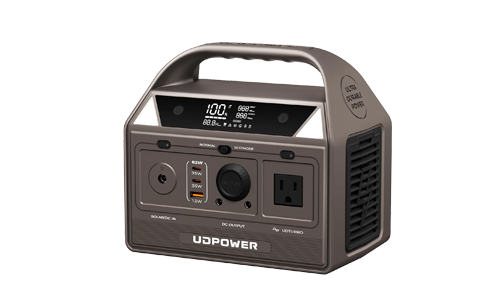
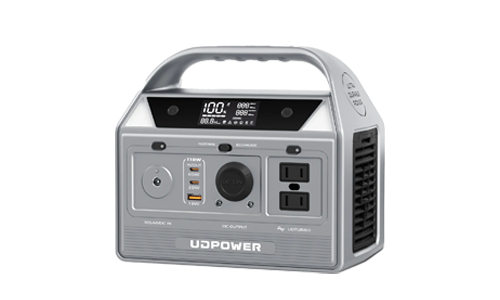
| C600 | 596Wh | 600W | About 536Wh | About 1.8 hours | About 1.1 hours | Not recommended | Not recommended | Compact 300–500W rice cookers only. |
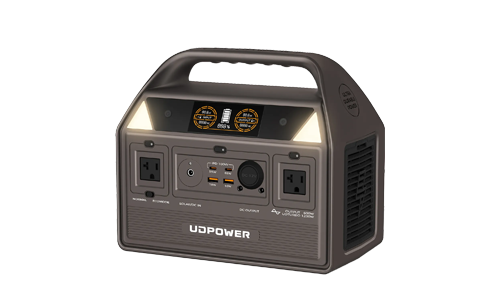
| S1200 | 1,190Wh | 1,200W | About 1,071Wh | About 3.6 hours | About 2.1 hours | About 1.5 hours | About 1.1 hours | Most standard home rice cookers. |
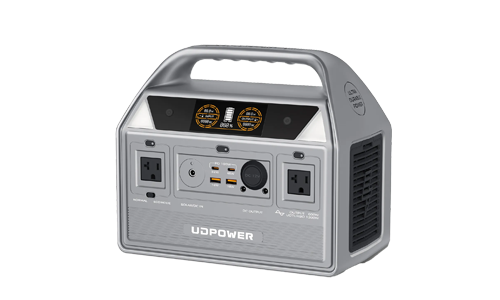
| S2400 | 2,083Wh | 2,400W | About 1,875Wh | About 6.2 hours | About 3.7 hours | About 2.7 hours | About 1.9 hours | Large rice cookers, IH/pressure cookers, and multi-appliance backup. |
These numbers are runtime estimates, not “number of batches.” If a 700W rice cooker cooks a batch in 40 minutes, it may use far less than 1.5 hours of S1200 runtime. The table is useful because it shows the available battery margin.
Planning a whole outage meal setup? Read How to Know If a Portable Power Station Can Run Your Device for the full watts, surge, and runtime method.
Recommended UDPOWER Products for Rice Cookers
The right model depends on the wattage printed on your rice cooker label. A smaller 300–500W cooker can work with a compact station, but most households will be better served by a larger unit with more AC output and battery margin.
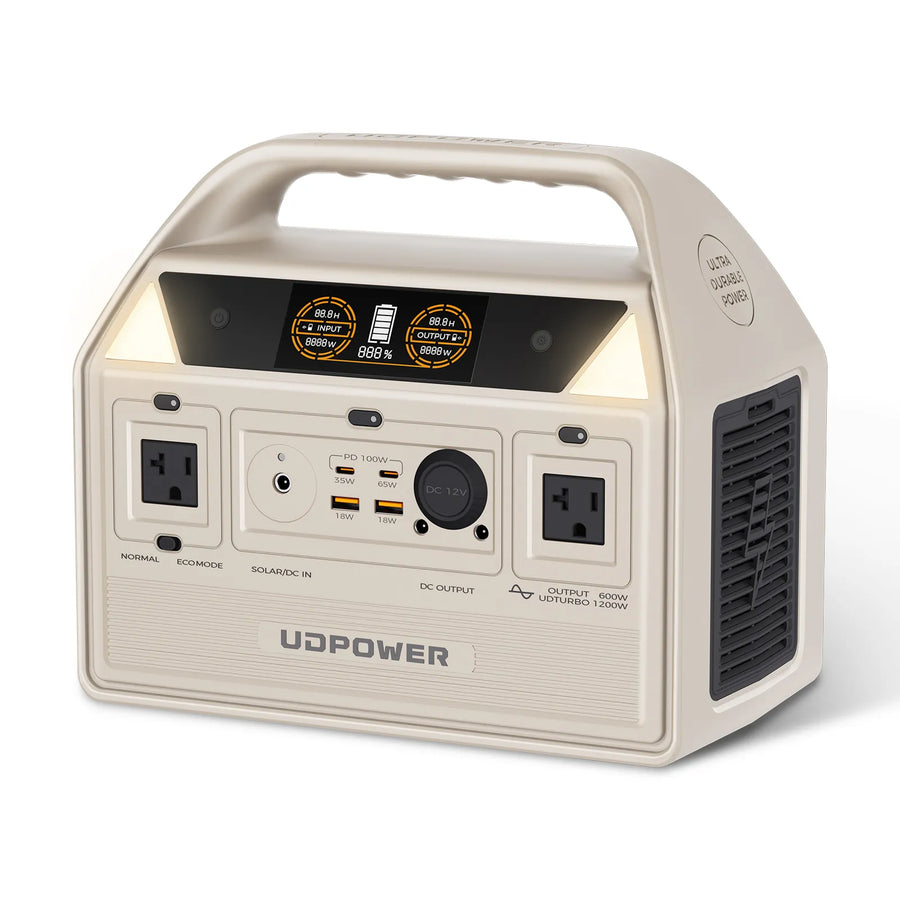
UDPOWER C600 — For Compact Low-Watt Rice Cookers
Choose the C600 only when your rice cooker label is safely under 600W. It is a practical match for small camping cookers, compact apartment cookers, and light off-grid meals where you are not trying to run a fridge or other high-watt appliance at the same time.
- Capacity: 596Wh
- AC output: 600W rated, 1,200W peak
- Battery type: LiFePO4
- Cycle life: 4,000+ cycles
- Best rice cooker range: 300–500W
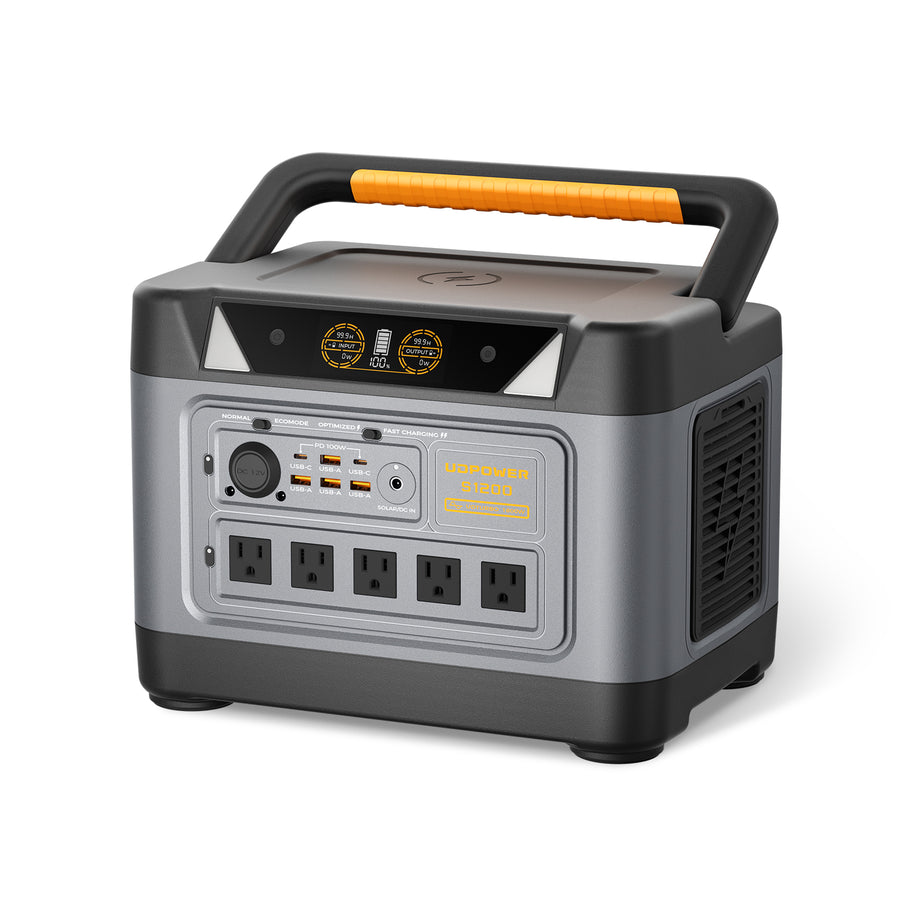
UDPOWER S1200 — Best Overall Match for Most Home Rice Cookers
The S1200 is the safer everyday recommendation for standard rice cookers because it gives you 1,200W rated pure sine wave output and a larger 1,190Wh battery. It is a better fit when you want to cook rice during a power outage and still have battery left for lights, phones, Wi-Fi, or a small fan.
- Capacity: 1,190Wh
- AC output: 1,200W pure sine wave
- Surge support: up to 1,800W
- Battery type: LiFePO4, 4,000+ cycles
- Weight: about 26.0 lb
- Best rice cooker range: most 500–1,000W home models
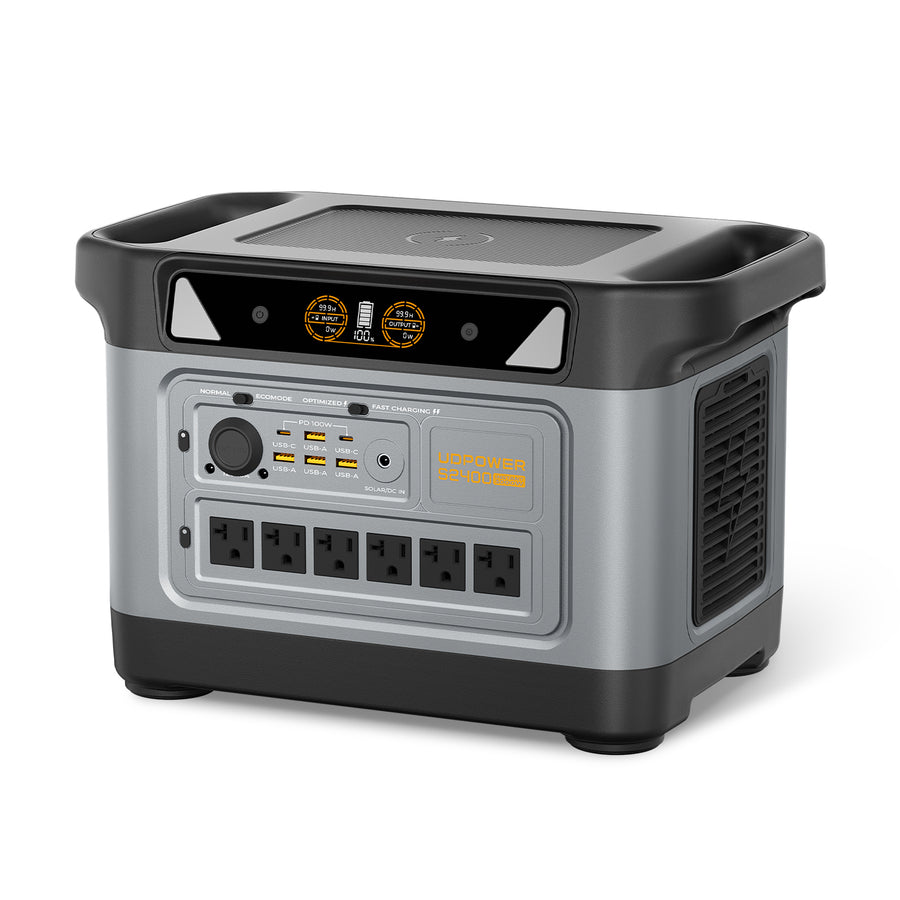
UDPOWER S2400 — Best for Large Rice Cookers and Multi-Appliance Backup
The S2400 is the better choice for large rice cookers, IH or pressure rice cookers, and outage setups where the rice cooker is not the only load. If you want to run a refrigerator, router, lights, and a kitchen appliance in the same backup plan, the higher 2,400W output and 2,083Wh capacity provide much more room.
- Capacity: 2,083Wh
- AC output: 2,400W pure sine wave
- Surge support: up to 3,000W
- Battery type: LiFePO4, 4,000+ cycles
- Weight: about 40.8 lb
- Best rice cooker range: 700–1,500W models, including many premium cookers
For a full product lineup, browse UDPOWER portable power stations. For higher-watt outdoor cooking and basecamp use, see portable power stations for outdoor use.
Rice Cooker vs. Other Kitchen Appliances
A rice cooker is usually easier to power than a microwave, air fryer, electric kettle, or induction burner. That makes it useful for emergency food prep, RV meals, and quiet indoor cooking during an outage.
| Appliance | Typical Input Watts | Battery Friendliness | Why It Matters | UDPOWER Match |
|---|---|---|---|---|
| Compact rice cooker | 300–500W | Good | Lower draw and predictable cooking cycle. | C600 or S1200 |
| Standard rice cooker | 500–1,000W | Good to moderate | Uses more battery but is still manageable for one or more meals. | S1200 or S2400 |
| Pressure / IH rice cooker | 1,000–1,300W | Moderate | Higher draw; output headroom matters. | S2400 recommended |
| Electric kettle | 1,000–1,500W | Moderate | Short runtime, but very high draw. | S2400 preferred |
| Microwave | Often 1,000–1,600W input | Moderate | Input watts are usually higher than advertised cooking watts. | S2400 preferred |
| Air fryer / toaster oven | 1,200–1,700W | Poor to moderate | High continuous heat drains batteries quickly. | S2400, only if within rating |
| Slow cooker | 100–300W | Good, but long runtime | Low watts, but it may run for many hours. | S1200 or S2400 for longer runtime |
For bigger appliance planning, the same logic applies across the whole kitchen: check running watts first, then calculate runtime. A helpful next step is What Can a 1200W Portable Power Station Run?.
How to Use Less Power When Cooking Rice
Rice cookers are already convenient, but small habits can reduce energy use and help your battery last longer.
| Tip | Why It Helps | Best Situation |
|---|---|---|
| Use the smallest cooker that fits your meal | A large cooker heating a small amount of rice wastes energy. | Daily meals for 1–3 people |
| Measure water correctly | Too much water can extend cooking time. | White rice, brown rice, mixed grains |
| Soak rice before cooking | Soaking can shorten cooking time for some rice types. | Brown rice, jasmine rice, larger batches |
| Do not open the lid repeatedly | Lost steam means the cooker has to heat again. | All rice cooker types |
| Limit keep-warm time | 30–50W for several hours can use more energy than people expect. | Battery backup, camping, RV use |
| Batch cook and reheat later | One efficient batch may use less total energy than several small cycles. | Families, meal prep, outage planning |
Additional conservation ideas are also covered by external appliance guides such as Crompton’s rice cooker wattage guide and Jackery’s rice cooker wattage guide.
Battery and Safety Checklist Before You Plug In
A rice cooker is a heating appliance, so treat it differently from a phone charger or laptop. Before using it with a power station, run through this checklist.
- Check the rice cooker label for watts or amps.
- Make sure the cooker’s rated watts are below the power station’s continuous AC output.
- Use the AC outlet on the power station, not USB, DC5521, or car output.
- Do not place the power station near steam, splashing water, or the cooker’s vent.
- Keep airflow clear around both the rice cooker and the power station.
- Avoid damaged extension cords or loose adapters.
- Do not run keep-warm mode all day on battery unless you have calculated the runtime.
- If the station overloads or shuts down, unplug the cooker, turn AC output off, wait, and restart according to the user manual.
Important: do not rely on surge rating for long cooking. Rice cookers are heating appliances, so the continuous AC output matters more than a short peak rating.
FAQ
How many watts does a small rice cooker use?
Many small 1–3 cup rice cookers use about 300–500 watts while cooking. Some travel models may be lower, but always check the label on the cooker.
How many watts does a 5.5-cup rice cooker use?
A 5.5-cup rice cooker often falls around 600–900 watts, depending on whether it is a basic model, fuzzy logic model, IH model, or pressure cooker.
How many watts does a 10-cup rice cooker use?
A 10-cup home rice cooker commonly uses about 700–1,000 watts. Premium or pressure models can be higher, so the product label is the safest source.
Does keep-warm mode use a lot of electricity?
Keep-warm mode uses much less power than cooking, often around 30–50 watts for many home cookers. The problem is time: 40W for 6 hours is 240Wh, which matters when running from a battery.
Can a 600W power station run a rice cooker?
A 600W power station can run a rice cooker only if the cooker’s rated input is below the station’s continuous AC output. It is better suited for compact 300–500W rice cookers, not family-size or pressure rice cookers.
Can the UDPOWER S1200 run a rice cooker?
Yes. The UDPOWER S1200 can run many standard household rice cookers because it provides 1,200W continuous AC output and 1,190Wh capacity. If your cooker is an IH or pressure model above 1,200W, choose a larger model such as the S2400.
Can the UDPOWER S2400 run a large rice cooker?
Yes, the S2400 is the better UDPOWER choice for large rice cookers and many premium IH or pressure models because it provides 2,400W continuous AC output and 2,083Wh capacity.
How many watt-hours does one batch of rice use?
A small batch may use around 0.1–0.3 kWh, while a larger family-size batch may use about 0.5–1.0 kWh depending on wattage and cook time. Use the formula: watts × minutes ÷ 60 ÷ 1,000.
Can I run a rice cooker directly from a solar panel?
Usually, it is better to charge a portable power station first and run the rice cooker from the station’s AC outlet. Solar panel output rises and falls with sunlight, shade, angle, and clouds, while a rice cooker needs steady AC power.
What size power station do I need for a rice cooker and refrigerator?
If you want to run a rice cooker and refrigerator in the same backup setup, choose a larger station with more output and battery capacity. The UDPOWER S2400 is the better fit for multi-appliance backup because it has 2,400W continuous output and 2,083Wh capacity.
Build a Simple Backup Cooking Setup
For most homes, the best setup is a rice cooker with a clearly labeled wattage, a pure sine wave portable power station, and enough battery capacity for cooking plus essentials such as lights, phones, and Wi-Fi.
View UDPOWER Portable Power Stations View S1200 for Standard Rice Cookers View S2400 for Larger Cooking LoadsRelated Articles


