

How Long Can a Solar Generator Run? Real Runtime for Appliances and Home Backup
For battery-only planning, I use:
Estimated runtime = battery capacity (Wh) × 0.90 ÷ average load (W)
That means a 1,000Wh solar generator has roughly 900Wh of planning energy. At a steady 100W load, that is about 9 hours. At 500W, it is about 1.8 hours.
Solar changes the answer. If your panels replace as much energy each day as your devices consume, the system can potentially keep those loads going for multiple days. If daily solar production is lower than daily consumption, the battery still drains—it just drains more slowly.

That last point is the part I see most often missed. A solar generator does not have one fixed runtime. There is a big difference between asking how long a battery lasts from one full charge and asking how long the same system can operate while solar panels are recharging it every day.
In this guide, I will separate those two questions, show the math behind both, and give you practical runtime numbers for refrigerators, CPAP machines, Wi-Fi, laptops, lights, TVs, fans, microwaves and other common outage loads.
Table of Contents
- How Long Can a Solar Generator Run?
- The Runtime Formula I Use
- Runtime by Battery Capacity
- How Long Can It Run Common Appliances?
- How Solar Charging Changes Runtime
- The Energy-Balance Rule for Multi-Day Use
- Real 24-Hour Outage Power Plans
- Planning for 24, 48 and 72 Hours
- Refrigerator Runtime Is Different
- Why Tiny Loads Can Miss the Formula
- How Battery Age Changes Runtime
- How to Make a Solar Generator Last Longer
- UDPOWER Solar Generator Recommendations
- Frequently Asked Questions
How Long Can a Solar Generator Run?
On one full battery charge, solar generator runtime can range from less than one hour to several days.
A compact 300Wh unit might run a 60W device for roughly 4.5 hours. A 1,000Wh unit under the same load works out to about 15 hours. A 2,000Wh unit works out to around 30 hours. Those are battery-only estimates using a 90% planning allowance.
| Battery Capacity | 25W Load | 60W Load | 100W Load | 500W Load |
|---|---|---|---|---|
| 300Wh | About 10.8 hrs | About 4.5 hrs | About 2.7 hrs | About 0.5 hr |
| 500Wh | About 18 hrs | About 7.5 hrs | About 4.5 hrs | About 0.9 hr |
| 1,000Wh | About 36 hrs | About 15 hrs | About 9 hrs | About 1.8 hrs |
| 1,200Wh | About 43.2 hrs | About 18 hrs | About 10.8 hrs | About 2.2 hrs |
| 2,000Wh | About 72 hrs | About 30 hrs | About 18 hrs | About 3.6 hrs |
| 3,000Wh | About 108 hrs | About 45 hrs | About 27 hrs | About 5.4 hrs |
These numbers assume a steady load. Real appliances are often more complicated. Refrigerators cycle on and off. CPAP consumption changes with humidification and heated tubing. A laptop may pull 80W while charging and less than 20W after the battery fills. A microwave may use 1,200W, but only for five minutes.
That is why the most useful question is usually not “How many watts does this appliance use?” It is “How many watt-hours will it use over the period I need to keep it running?”
The Runtime Formula I Use
Runtime in hours = Battery capacity in Wh × 0.90 ÷ average load in watts
I use 90% as a practical planning assumption for current UDPOWER runtime calculations. It gives us a useful working number without pretending every watt-hour printed on the battery label reaches an AC appliance.
For example, a 1,190Wh power station gives:
If your load averages 60W:
If it averages 500W:
For a deeper explanation of this distinction, see How to Know If a Portable Power Station Can Run Your Device.
UDPOWER Runtime by Battery Capacity
The next table uses current UDPOWER battery capacities and the same 90% planning method for every model. It is intended to show how dramatically load size changes runtime.
| Load | C400 256Wh |
S1200 1,190Wh |
S2400 2,083Wh |
Typical Use |
|---|---|---|---|---|
| 10W | 23.0 hrs | 107.1 hrs | 187.5 hrs | LED lighting or very light electronics |
| 25W | 9.2 hrs | 42.8 hrs | 75.0 hrs | Router plus light charging |
| 40W | 5.8 hrs | 26.8 hrs | 46.9 hrs | Lower-power CPAP example |
| 60W | 3.8 hrs | 17.9 hrs | 31.2 hrs | Laptop, CPAP or efficient appliance average |
| 100W | 2.3 hrs | 10.7 hrs | 18.7 hrs | TV or combined light essentials |
| 200W | 1.2 hrs | 5.4 hrs | 9.4 hrs | Multiple electronics or moderate appliance load |
| 500W | Output compatibility must also be checked | 2.1 hrs | 3.7 hrs | Higher sustained appliance load |
| 1,000W | Above rated output | 1.1 hrs | 1.9 hrs | High-draw cooking or heating load |
UDPOWER specification sources: C400, S1200, S2400, and the UDPOWER Power Station Comparison.
How Long Can a Solar Generator Run Common Appliances?
The values below are planning examples, not universal appliance specifications. Always use your appliance label, EnergyGuide label, manual or a plug-in watt meter when you have one.
| Device | Useful Planning Range | How to Think About Runtime | Best Way to Verify |
|---|---|---|---|
| Wi-Fi router / modem | About 10–20W | Usually a steady 24-hour load. Small wattage becomes meaningful over several days. | Read the adapter label or measure actual input. |
| LED light | About 8–15W each | Easy to run, but leaving many lights on all night adds up. | Check bulb wattage. |
| Phone | Roughly 10–20Wh per full charge for many phones | Usually a minor part of an emergency energy budget. | Use battery capacity and charging data for your phone. |
| Laptop | About 30–100W while operating or charging | Actual draw changes with workload, screen brightness and battery state. | Read the charger rating, then measure actual use if possible. |
| CPAP without heated humidification | Often around 10–20W for many setups | Can run much longer than the adapter's maximum rating suggests. | See UDPOWER CPAP backup guidance. |
| CPAP with humidifier / heated tube | Often around 40–90W or more | Heating can use most of the overnight energy. | Measure your normal prescribed setup over one night. |
| TV | About 50–150W | Screen size, brightness and technology matter. | Check the TV's energy label or measure it. |
| Fan | About 20–100W | Lower fan speed can make a large runtime difference. | Use nameplate wattage or watt meter. |
| Refrigerator | Calculate from daily or annual energy use | The compressor cycles, so instantaneous watts are misleading. | ENERGY STAR refrigerator guidance or the yellow EnergyGuide label. |
| Microwave | Often around 1,000–1,500W input | Heavy draw, but short use can still be practical on a sufficiently powerful station. | Check input wattage on the appliance label. |
| Space heater | Commonly 750–1,500W | One of the fastest ways to drain a portable battery. | See the heater runtime guide. |
How Solar Charging Changes Runtime
The battery-only formula is only half of the solar-generator story.
If a 2,000Wh battery is powering a 100W load, it may last around 18 hours using our planning method. But if panels are adding power while the load is running, the battery may drain much more slowly—or not drain at all during part of the day.
Solar input watts − device load watts
If your panels are delivering 250W while your connected loads are using 100W, there is roughly 150W left to charge the battery.
If your panels are delivering 80W while your loads require 100W, the battery is still supplying the missing 20W.
This is why I prefer watching the real-time solar input on the power station instead of assuming a 210W panel is continuously producing 210W. Rated panel power is measured under controlled conditions. Actual input changes with sun angle, clouds, temperature, shade, panel orientation, cable losses and the power station's input limit.
UDPOWER's current solar panel guide also notes that real-world output can be lower than rated power and recommends using the station's displayed solar input as the practical reference.
A simple solar-energy example
Suppose your panel array is rated at 420W. For an illustration, assume the station display averages about 70% of that rating for five productive hours.
That does not mean every 420W setup will produce 1,470Wh every day. It is an example showing how to convert the watts you actually see into daily energy.
| Panel Rating | Illustrative Average at 70% | Energy in 3 Productive Hours | Energy in 5 Productive Hours |
|---|---|---|---|
| 120W | 84W | 252Wh | 420Wh |
| 210W | 147W | 441Wh | 735Wh |
| 420W | 294W | 882Wh | 1,470Wh |
For location-specific solar estimates, the NREL PVWatts Calculator is a useful reference for understanding how available solar resource changes by location and season.
The Energy-Balance Rule for Multi-Day Use
If you are preparing for a multi-day outage, stop thinking only in terms of “runtime hours.” Think in terms of a daily energy budget.
Daily device energy use − daily solar energy recovered
If your essentials use 1,500Wh per day and your solar panels put 1,500Wh back into the battery each day, your energy budget is approximately balanced.
If those same loads use 1,500Wh but solar only restores 900Wh, your battery loses about 600Wh per day.
A 2,083Wh S2400 with about 1,875Wh of planning battery energy would therefore have enough stored reserve for roughly three additional days of a 600Wh daily deficit, assuming similar conditions and ignoring smaller secondary losses.
This is the reason a modest solar setup can be very valuable even when it cannot fully recharge the power station every day. It reduces the daily deficit and stretches a two-day battery plan into a much longer one.
When can a solar generator run continuously?
A solar generator can support the same group of loads day after day when three conditions are met:
- The power station can handle the devices' running and startup power.
- The battery is large enough to carry the loads through the night and poor-sun periods.
- Average solar production replaces at least as much energy as the loads consume over time.
The third condition is what turns a battery backup system into a sustainable off-grid energy plan.
Even then, I would not call the runtime “unlimited.” Two or three cloudy days can create an energy deficit even when the system balances perfectly on a sunny day.
Real 24-Hour Outage Power Plans
Instead of adding every appliance's maximum wattage together, I prefer to build an outage schedule. Most devices do not need to run at full power for 24 hours.
Plan 1: Minimal emergency essentials
| Load | Planning Use | Daily Energy |
|---|---|---|
| Router / modem | 12W × 24 hrs | 288Wh |
| Two LED lights | 18W combined × 5 hrs | 90Wh |
| Two phone charges | About 12Wh each | 24Wh |
| CPAP | 40W × 8 hrs | 320Wh |
| Total | About 722Wh/day |
At this level, an S1200's roughly 1,071Wh of planning energy can cover around a day and a half before solar recharge. An S2400 has considerably more reserve.
Plan 2: Work-from-home outage
| Load | Planning Use | Daily Energy |
|---|---|---|
| Router / modem | 12W × 24 hrs | 288Wh |
| Laptop | 60W × 8 hrs | 480Wh |
| Monitor | 30W × 8 hrs | 240Wh |
| Phone | Two charging sessions | 24Wh |
| Total | About 1,032Wh/day |
That is almost exactly one day of S1200 planning energy. A few hours of useful solar input can make a large difference here.
Plan 3: Refrigerator plus communications
| Load | Planning Use | Daily Energy |
|---|---|---|
| Refrigerator | 60W average × 24 hrs | 1,440Wh |
| Router / modem | 12W × 24 hrs | 288Wh |
| Two LED lights | 18W combined × 5 hrs | 90Wh |
| Phones | Two full charges | 24Wh |
| Total | About 1,842Wh/day |
This example shows why refrigerators change the backup equation. An S2400's approximately 1,875Wh of planning energy is close to one full day for this hypothetical setup, while the S1200 covers roughly 14 hours before additional charging.
The exact answer could be very different with your refrigerator, which is why I recommend using its annual energy figure instead of assuming every fridge averages 60W.
How to Plan for 24, 48 and 72 Hours
| Outage Length | Planning Priority | Battery Strategy | Solar Strategy |
|---|---|---|---|
| 0–4 hours | Communication, medical needs and basic lighting | Do not automatically power every appliance the moment the grid fails. | Solar may not be necessary for a short outage. |
| 4–12 hours | CPAP, router, fridge as needed, phones and lights | A 1,000–1,200Wh class system can cover many lean setups. | Use daylight charging if available. |
| 12–24 hours | Switch from watt planning to daily Wh planning | Leave a reserve for overnight operation. | Recover as much daytime energy as possible. |
| 24–48 hours | Eliminate unnecessary heating and cooking loads | Around 2kWh of storage gives more room for refrigerator-based plans. | Solar becomes increasingly important. |
| 48–72+ hours | Manage an energy budget rather than individual appliances | Preserve reserve for nights and cloudy periods. | Daily solar production needs to approach daily consumption for sustainable use. |
If you want to move beyond selected essentials and estimate larger household loads, see Can a Solar Generator Power a House?.
Why Refrigerator Runtime Needs Different Math
A refrigerator might show 120W or 180W while the compressor is running, but that does not mean it consumes that power continuously for 24 hours.
The compressor cycles. Defrost heaters operate periodically. Door openings introduce warm air. Room temperature changes the duty cycle. A refrigerator in a hot garage can use far more energy than the same unit in a climate-controlled kitchen.
The best shortcut is the yellow EnergyGuide label.
Annual kWh × 1,000 ÷ 8,760
For example, a refrigerator rated at 500kWh per year:
Now you can use 57W in the runtime formula instead of using the much higher compressor-on wattage.
A 1,190Wh S1200 at 90% planning efficiency:
Real runtime may be shorter if the room is hot, the refrigerator has warmed up before backup starts, doors are opened frequently, or another device is sharing the battery.
For a dedicated breakdown, see How Long Will a 1000W Solar Generator Run a Refrigerator?.
Why Tiny Loads Can Run Shorter Than the Formula Suggests
The basic formula becomes less precise when the AC appliance itself uses very little power.
Suppose you connect a 10W router through a power station's AC inverter. The router may only need 10W, but the inverter, control electronics, cooling system and display may also consume energy.
At a 500W appliance load, a few extra watts of station overhead are relatively small. At a 10W load, those extra watts can represent a large percentage of total consumption.
That is why a mathematical result such as “100 hours” should not automatically be treated as a promise for a tiny AC load.
Use direct DC or USB output when it makes sense
If a device can safely use a compatible USB-C, USB-A, 12V or other direct DC output, you may avoid unnecessary AC conversion.
Do not improvise voltage or connector compatibility. The output voltage, polarity and connector must match the device.
How Battery Age Changes Runtime
Battery capacity gradually declines over years of charging and discharging. That means the same appliance will not run exactly as long on an older battery as it did when the power station was new.
For UDPOWER planning, the current lifecycle reference is approximately:
- About 80% remaining capacity after 3,000 cycles.
- About 70% remaining capacity after 4,000 cycles.
Runtime changes roughly in proportion to the remaining usable capacity.
For example, a new S1200 has 1,190Wh of rated storage. At 80% remaining battery capacity, the effective rated storage would be roughly:
Using the same 90% planning efficiency:
A 60W load that worked out to about 17.9 hours when the battery was new would then work out closer to 14.3 hours.
That does not mean the power station suddenly stops working at a particular cycle number. Battery capacity declines gradually.
Temperature Also Changes Runtime
Battery systems do not behave identically at every temperature. Very cold conditions can temporarily reduce available battery performance, while excessive heat is undesirable for long-term battery health.
For emergency planning, I would not size a system so tightly that the calculation only works in perfect conditions. A battery reserve is useful for temperature, appliance variation, weather and ordinary calculation error.
How to Make a Solar Generator Last Longer
1. Measure energy, not just wattage
For devices that cycle, measure energy over time. A 24-hour kWh reading is much more useful for a refrigerator than a single instant showing 150W.
2. Separate continuous loads from occasional loads
A 12W router running all day uses 288Wh. A 1,000W microwave running for six minutes uses about 100Wh before conversion losses. High wattage does not always mean the largest daily energy use.
3. Avoid electric resistance heating when battery reserve matters
Space heaters, electric kettles, hot plates, hair dryers and similar heating devices convert large amounts of electricity into heat. They can drain even a large power station quickly.
4. Run high-draw devices in short sessions
Using a microwave for five minutes is very different from running a 1,500W heater for five hours.
5. Charge during the strongest daylight
Do not wait until sunset to discover the battery is almost empty. During an extended outage, start solar charging early and use the strongest sunlight to rebuild your nighttime reserve.
6. Watch actual solar input
Reposition portable panels as the sun moves. Keep the full panel surface out of shade. One partially shaded section can reduce output significantly.
7. Do not exceed the power station's solar input limits
More panel wattage is not automatically better. Verify voltage, current, connector type and maximum supported input before connecting panels.
8. Leave reserve for night
I would rather reach sunset with 40% battery remaining than reach sunset with a perfect daytime efficiency score and no overnight reserve.
9. Prioritize loads
A practical outage order is usually:
- Necessary medical or accessibility equipment.
- Refrigeration and food safety.
- Communication and internet.
- Lighting.
- Phones and laptops.
- Comfort and entertainment loads.
- High-wattage heating or cooking only when the energy budget allows it.
Which UDPOWER Solar Generator Fits Different Runtime Needs?
I would choose by required daily energy first, then confirm that the power station has enough output for the largest appliance you intend to connect.
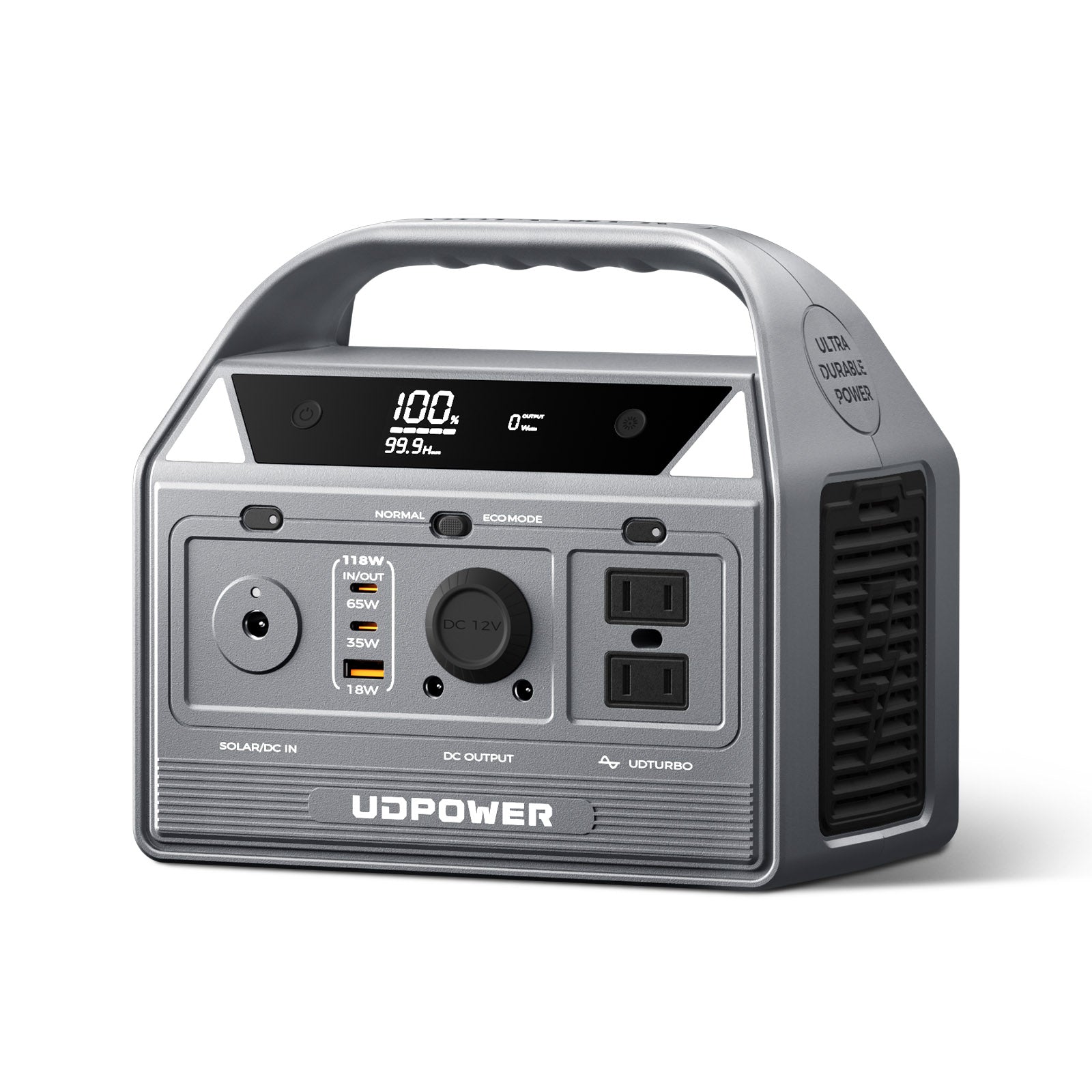
UDPOWER C400: Light Loads, Short Trips and Compact Backup
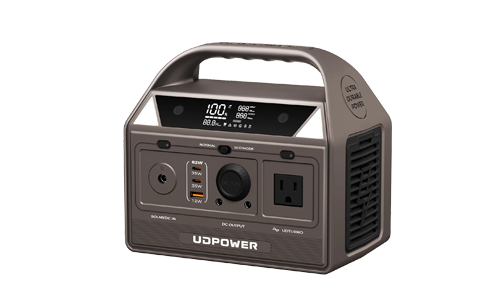
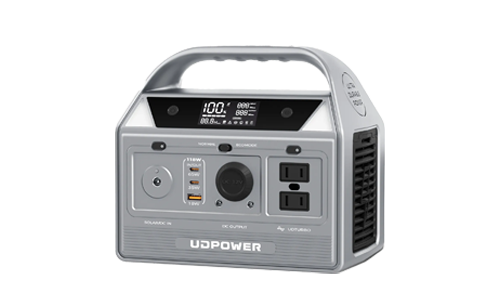
The C400 is best when portability matters more than all-day home backup. Its 256Wh battery is a good fit for phones, cameras, lights, laptops, routers and other lighter loads.
- 256Wh LiFePO4 battery capacity
- 400W rated AC output
- Up to 150W solar input
- 6.88 lb
- About 230Wh of planning energy at 90%
At a steady 25W load, the formula gives roughly 9.2 hours. At 60W, it gives around 3.8 hours.
View C400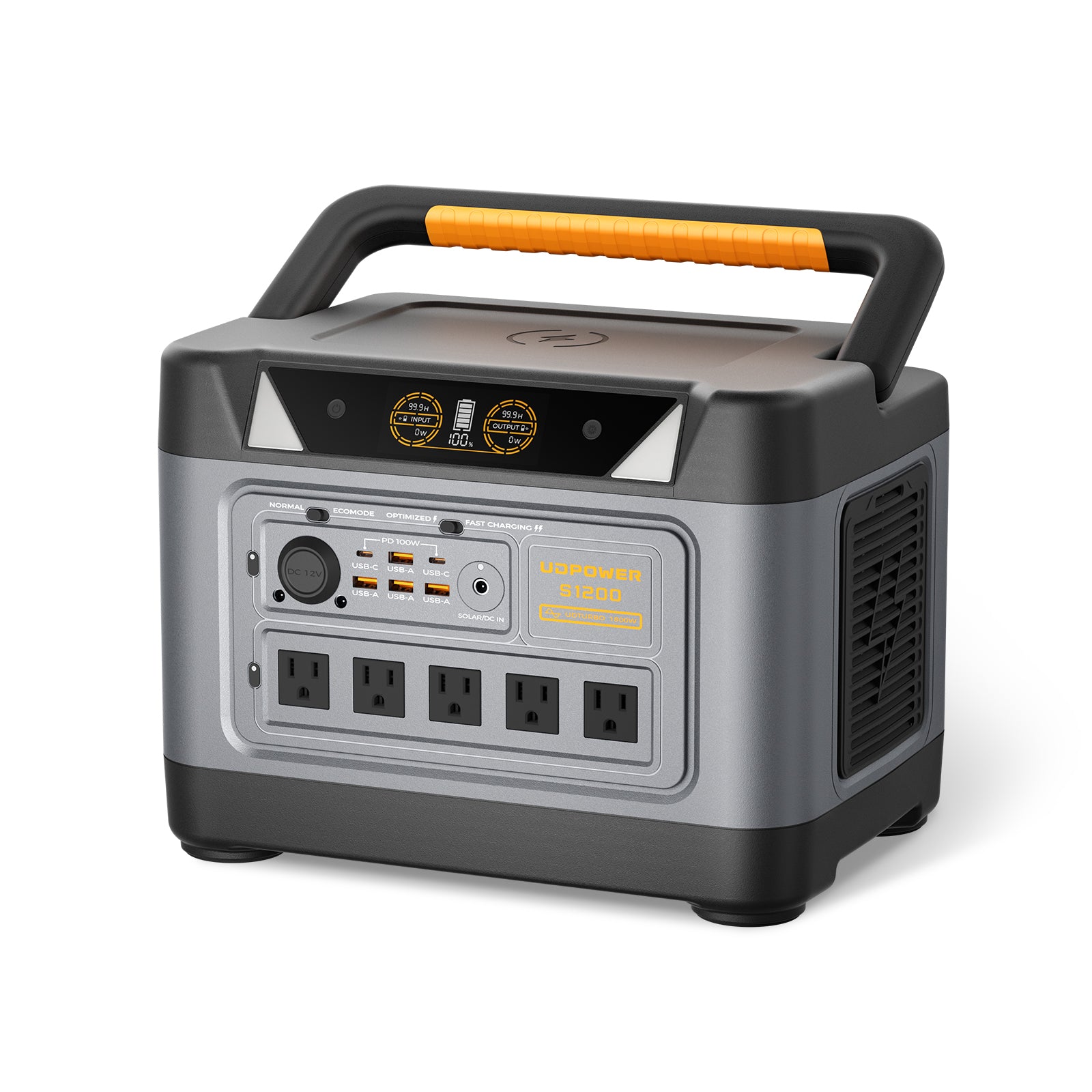
UDPOWER S1200: Best Balance for Everyday Home Essentials
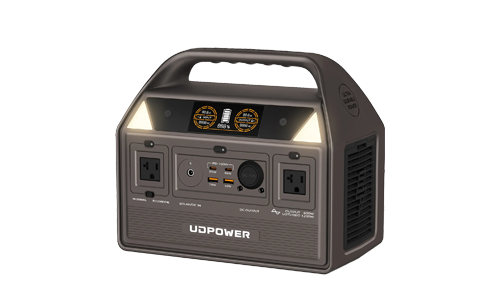
The S1200 is the model I would start with for a balanced refrigerator, CPAP, router, lighting and laptop backup plan. Its battery is large enough to make overnight backup practical without moving into a much heavier system.
- 1,190Wh LiFePO4 battery capacity
- 1,200W rated pure sine wave AC output
- UDTURBO support up to 1,800W for compatible higher-power loads
- 400W maximum solar input
- UPS switching in less than or equal to 10ms under supported conditions
- Approximately 26.0 lb
- About 1,071Wh of planning energy at 90%
That works out to about 17.9 hours at a steady 60W load, 10.7 hours at 100W, or 5.4 hours at 200W.
View S1200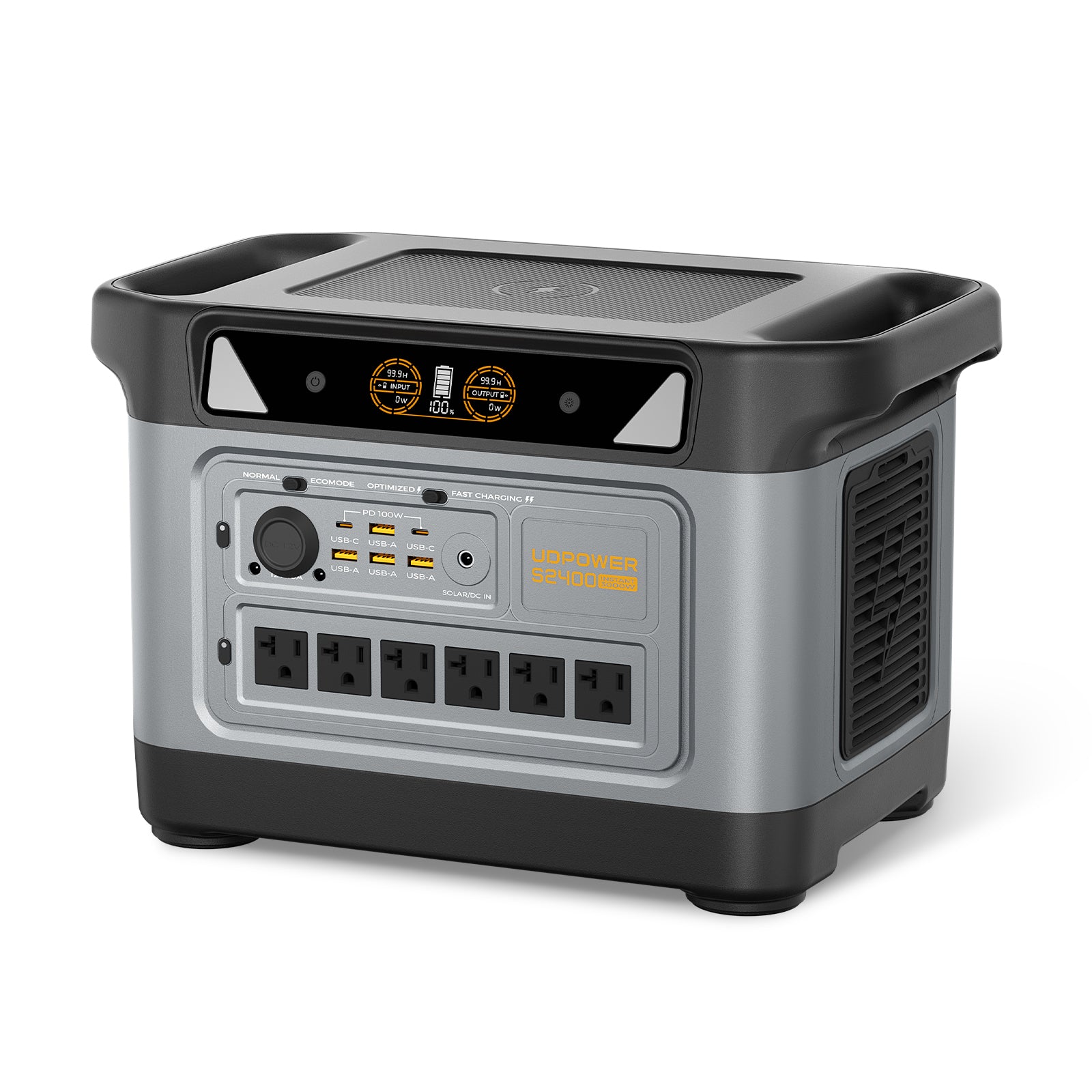
UDPOWER S2400: Longer Outages and Higher Daily Energy Use
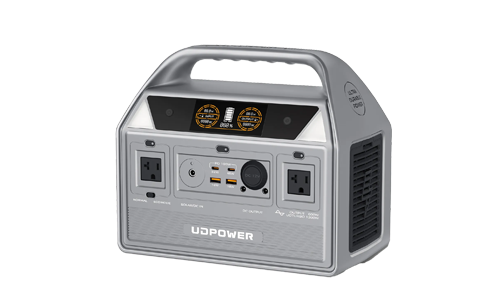
The S2400 makes more sense when a refrigerator is central to your plan, when several essentials need to run together, or when you want enough battery reserve to get through the night after a cloudy charging day.
- 2,083Wh LiFePO4 battery capacity
- 2,400W rated pure sine wave AC output
- UDTURBO support up to 3,000W for compatible higher-power loads
- Up to 420W recommended maximum solar input
- UPS switching in less than or equal to 10ms under supported conditions
- Approximately 40.8 lb
- About 1,875Wh of planning energy at 90%
The formula gives roughly 31.2 hours at 60W, 18.7 hours at 100W, 9.4 hours at 200W and 3.7 hours at 500W.
One S2400-specific point is worth knowing when planning solar charging: the unit has DC7909 and rear XT60 solar input ports, but using both simultaneously does not add their charging power together. The system uses the higher charging power from the two inputs rather than summing both inputs.
View S2400| Model | Capacity | Rated Output | Solar Input | 90% Planning Energy | Best Fit |
|---|---|---|---|---|---|
| C400 | 256Wh | 400W | Up to 150W | About 230Wh | Phones, router, lights, laptop and short trips |
| S1200 | 1,190Wh | 1,200W | 400W max | About 1,071Wh | CPAP, refrigerator, home essentials and overnight backup |
| S2400 | 2,083Wh | 2,400W | Up to 420W | About 1,875Wh | Longer outages, larger essential-load plans and heavier appliances |
You can also compare the current lineup on the UDPOWER Power Station Comparison, browse all portable power stations, or see complete solar generator kits.
How Much Solar Panel Capacity Should You Pair With the Battery?
The right solar panel size depends on how much energy you need to replace each day, not simply on the battery's capacity.
Suppose your daily essential load is 720Wh.
If your 210W panel setup actually delivers an average of 145W during five productive hours:
That is close to a balanced day.
Now suppose your refrigerator-based setup needs 1,850Wh per day. Even a 420W array averaging 294W for five hours only adds about 1,470Wh in this illustration.
The system would still last much longer than battery-only operation, but the battery would gradually decline unless you reduced consumption, captured more solar energy or used another charging source.
This daily-deficit calculation is one of the most useful ways to size an off-grid system.
Should You Buy More Battery or More Solar?
They solve different problems.
| If Your Problem Is... | More Battery Helps Because... | More Solar Helps Because... |
|---|---|---|
| You need to survive a long night | It increases stored energy after sunset. | It cannot help after sunset unless energy was stored earlier. |
| You repeatedly run out after several sunny days | It delays the problem. | It can reduce or eliminate the daily energy deficit. |
| You have several cloudy days | More reserve gives you weather tolerance. | Panel output may still be limited by weather. |
| You use most energy during daylight | Useful, but less critical. | Solar can directly offset daytime consumption while charging. |
| Your appliance exceeds inverter output | More Wh does not solve output compatibility. | More solar does not solve output compatibility. |
For most emergency systems, the best answer is enough battery to cover the overnight period plus enough solar to recover a meaningful portion of the energy during the next day.
Frequently Asked Questions
How long will a 1000Wh solar generator run?
Using a 90% planning efficiency, a 1,000Wh battery provides about 900Wh of usable planning energy. That means roughly 36 hours at 25W, 15 hours at 60W, 9 hours at 100W, 4.5 hours at 200W, or 1.8 hours at 500W. Actual runtime varies with the device, temperature, inverter overhead and battery condition.
How long will a 2000Wh solar generator run?
A 2,000Wh battery provides about 1,800Wh of planning energy at 90%. That works out to approximately 30 hours at 60W, 18 hours at 100W, 9 hours at 200W, 3.6 hours at 500W, or 1.8 hours at 1,000W.
Can a solar generator run continuously?
It can support the same loads for multiple days when average daily solar production replaces the energy those loads consume and the battery is large enough to carry them through nights and low-sun periods. It should not be considered literally unlimited because weather and seasonal solar conditions can change the energy balance.
Can a solar generator run a refrigerator overnight?
Yes, if the battery has enough capacity and the inverter can handle the refrigerator's compressor startup requirement. A refrigerator's daily energy use is more useful for runtime calculations than its compressor-on wattage. Check the EnergyGuide label or measure the refrigerator over 24 hours.
How long can a solar generator run a CPAP?
It depends heavily on humidifier and heated-tube use. A CPAP setup averaging 15W needs about 120Wh for eight hours, while a setup averaging 60W needs about 480Wh. For example, the S1200's approximately 1,071Wh planning energy works out to around 17.9 hours at a 60W load.
Does a bigger solar panel make the battery last longer?
It can, because more solar input may replace more of the energy being consumed. However, panel rating is not the same as actual input, and every power station has voltage, current and maximum wattage limits. A larger panel cannot force the station to accept more power than its input system supports.
Can I use a solar generator while the solar panels are charging it?
Many modern portable power stations support simultaneous charging and output. Whether the battery percentage rises or falls depends on the relationship between solar input and device consumption. If the station receives 200W while devices consume 120W, there is energy available to recharge the battery. If the devices consume more than the input, the battery continues to discharge.
Why does my solar generator runtime seem shorter than the formula?
Common reasons include inverter self-consumption, cooling fans, low temperatures, battery aging, inaccurate appliance wattage assumptions, refrigerator compressor cycling, high startup loads, additional connected devices and leaving the AC inverter on for very small loads.
Is 1000W the same as 1000Wh?
No. Watts measure power at a moment in time. Watt-hours measure stored energy. A 1,000W inverter rating tells you how large a load the station can supply; a 1,000Wh battery rating helps tell you how long that load can run.
How do I calculate runtime when several devices are connected?
Add the average wattage of devices that are running at the same time, then divide the battery's planning energy by that combined load. For a more accurate multi-day plan, calculate each device's watt-hours per day instead of assuming everything runs continuously.
How much battery do I need for a 24-hour outage?
Add the watt-hours required by every essential device over 24 hours, then leave additional reserve for conversion losses and unexpected use. A light router, phone, lighting and CPAP plan may stay below 1,000Wh per day, while adding a refrigerator can push the requirement toward 1,500–2,500Wh or more depending on the refrigerator and other loads.
Should I use the rated wattage of my refrigerator to calculate runtime?
Usually not by itself. Refrigerator compressors cycle on and off, so the wattage you see while the compressor is running can greatly overstate all-day average consumption. Annual kWh from the EnergyGuide label or a 24-hour watt-meter reading gives a much better estimate.
How much reserve should I leave during an outage?
There is no universal percentage, but I avoid planning a system that reaches zero battery under perfect conditions. Leaving reserve helps cover colder temperatures, unexpected appliance use, cloudy weather, battery aging and differences between estimated and real energy consumption.
Build Your Backup Around Runtime, Not Just Wattage
If you already know what you need to power, compare battery capacity, rated output and solar charging side by side before choosing a system.
Compare UDPOWER Power Stations →
View Solar Generator Kits →
Shop Portable Power Stations →
View Solar Panels →
Final Answer
A solar generator can run appliances for anywhere from less than an hour to several days. Battery capacity tells you how much stored energy you have, appliance consumption determines how quickly you use it, and solar input determines how much of that energy you can replace during the day.
For battery-only planning, a practical starting point is:
For multi-day planning, the more important calculation is:
If the deficit is zero or close to zero, your solar generator can support the same essential loads for much longer than one battery cycle. If the deficit is large, adding solar slows the discharge but does not eliminate it.
For a lightweight setup, a compact model such as the C400 can cover electronics and short backup needs. For balanced home essentials, the 1,190Wh S1200 gives substantially more overnight reserve. For refrigerator-based plans, longer outages and larger combined loads, the 2,083Wh S2400 gives more room to absorb cloudy weather, overnight use and changing appliance demand.
Related Articles


