What Can an 800 Watt Power Station Run?
ZacharyWilliamLast updated: June 15, 2026
An 800 watt portable power station can run phones, laptops, Wi-Fi equipment, LED lights, televisions, CPAP machines, fans, camera chargers, game consoles, portable refrigerators, and many other low-to-medium-power devices. It may also run selected compact kitchen appliances, provided their actual input stays below the inverter limit.
What it generally cannot run well are high-heat appliances such as hair dryers, full-size space heaters, electric kettles, air fryers, toaster ovens, and most microwave ovens. Those devices often require more than 800W continuously and can drain a medium-size battery in less than an hour.

Quick Answer: What Will an 800 Watt Power Station Run?
An 800W portable power station is best for one medium-power appliance or several small devices whose combined running wattage remains below 800W. For more reliable operation, a normal continuous load of approximately 600W to 650W or less leaves useful headroom for short power fluctuations.
- Easy loads: phones, tablets, laptops, routers, lights, fans, televisions, CPAP machines, cameras, drones, and projectors.
- Usually compatible: mini refrigerators, 12V coolers, efficient household refrigerators, desktop computers, game consoles, electric blankets, and small blenders.
- Check carefully: coffee makers, rice cookers, food processors, power tools, pumps, and compressor appliances.
- Usually unsuitable: hair dryers, space heaters, electric kettles, air fryers, toaster ovens, full-size microwaves, electric cooktops, and most air conditioners.

What Does an 800 Watt Power Station Actually Mean?
The 800W number normally describes the power station inverter's continuous AC output. It tells you how much power connected appliances can use at one time. It does not tell you how much energy the battery stores or how long the equipment will run.
| Rating | What it means | Why it matters | Practical example |
|---|---|---|---|
| Continuous output | The power the inverter can provide steadily | The combined running load must remain below this number | A 100W TV, 65W laptop, and 20W router total about 185W |
| Surge output | A brief burst of additional power | Motors and compressors may need more power when starting | A refrigerator may run at 120W but require a much higher startup burst |
| Battery capacity | The stored energy measured in watt-hours | Capacity determines whether a device runs for minutes or hours | A 1,024Wh battery lasts roughly twice as long as a 512Wh battery at the same load |
Simple rule: watts determine whether the power station can run your equipment. Watt-hours determine how long it can keep that equipment running.
Why a Device Below 800W May Still Overload the Station
Appliances with compressors, pumps, or electric motors may briefly use two or more times their normal operating wattage when they start. This applies to refrigerators, freezers, water pumps, drills, saws, and some medical or workshop equipment.
A device listed at 500W can also become a problem when other loads are already connected. For example, a 500W appliance plus a 150W television, a 100W laptop charger, and a 75W fan creates an estimated combined load of 825W.
Why You Should Not Plan Around Exactly 800W
Running an inverter at its maximum rating leaves little room for changes in appliance demand. A refrigerator may enter a defrost cycle, a laptop may begin fast charging, or a motor may restart unexpectedly.
For everyday planning, keeping sustained use near 600W to 650W gives an 800W unit a more comfortable operating margin. This is not a universal electrical requirement, but it is a practical way to reduce avoidable overload shutdowns.
What Can an 800 Watt Power Station Run? Appliance Chart
The following wattages are planning ranges rather than fixed values. Actual consumption depends on the appliance model, operating mode, temperature, brightness, motor speed, charging state, and other conditions. Always check the electrical label on your own equipment.
| Device | Typical power draw | Can an 800W station run it? | What to check | Source or guide |
|---|---|---|---|---|
| Smartphone charger | 5–25W | Yes | Use a direct USB output when available | U.S. Department of Energy |
| Tablet | 10–35W | Yes | USB-C charging usually avoids unnecessary AC conversion | Energy-use calculation guide |
| Laptop | 40–100W | Yes | Gaming laptops can draw more under heavy load | Portable power stations |
| Portable monitor | 10–30W | Yes | Brightness affects consumption | Compare UDPOWER models |
| Wi-Fi router and modem | 10–30W combined | Yes | The modem, router, and fiber terminal may all require power | Home backup power options |
| LED light | 5–15W each | Yes | Add the wattage of all lights used together | U.S. Department of Energy |
| CPAP without heated humidity | 30–60W | Yes | Pressure settings and mask leakage affect consumption | CPAP runtime guide |
| CPAP with humidifier and heated tube | 60–120W or more | Usually | Heating features may substantially reduce runtime | CPAP battery backup guide |
| LED television | 50–150W | Yes | Screen size and brightness change the load | Portable power station collection |
| Television and game console | 180–350W combined | Yes | Large screens and high-performance consoles use more | Power station comparison |
| Small fan | 25–75W | Yes | Higher speed settings shorten runtime | Backup power options |
| Electric blanket | 50–150W | Usually | Thermostatic cycling may reduce average consumption | Energy-use calculation guide |
| 12V compressor cooler | 35–70W while running | Usually | A direct 12V connection can be more efficient than AC | Camping power guide |
| Mini refrigerator | 50–120W running | Usually, if startup fits | Check compressor startup power | Refrigerator power guide |
| Full-size refrigerator | 80–250W while running | Maybe | Startup, defrost heaters, and ice makers can increase demand | ENERGY STAR refrigerator information |
| Camera battery charger | 10–30W | Yes | Multiple chargers increase the combined load | Portable power stations |
| Drone battery charger | 30–120W | Yes | Fast charging several batteries can use more | Compare output and capacity |
| Desktop computer and monitor | 150–500W | Usually | Gaming and workstation PCs can exceed this range | Portable backup power |
| Small blender | 300–600W | Often | Motor startup and other connected loads matter | Appliance energy-use guidance |
| Compact rice cooker | 300–700W while cooking | Some models | The warming mode uses less than the cooking cycle | U.S. Department of Energy |
| Low-watt coffee maker | 500–800W | Some models | Use it without other major AC loads | Compare the 1000W class |
| Standard microwave oven | 1,000–1,500W input | Usually no | Cooking output is lower than electrical input | Appliance wattage guidance |
| Hair dryer | 1,200–1,875W | No | Most heat settings exceed the inverter rating | Compare the 1200W class |
| Space heater | 750–1,500W | Not recommended | A low setting may still leave no useful headroom | 1200W power station guide |
| Electric kettle | 1,200–1,500W | No | Water heating requires high continuous power | Larger power station guide |
| Air fryer | 1,200–1,800W | No | Heating elements operate near full power | Compare UDPOWER output ratings |
Appliance wattages vary. Use the electrical input label on the appliance or measure consumption with a plug-in watt meter before relying on it during an outage.
Microwave warning: an appliance advertised as an “800-watt microwave” may provide 800W of cooking output while drawing more than 1,000W from the outlet. Check the input rating on the rear label or inside the door frame.
How Long Will an 800 Watt Power Station Run?
The inverter rating does not determine runtime. Two power stations can both supply 800W, but a model with a 1,024Wh battery will last about twice as long as a model with a 512Wh battery when powering the same equipment.
The 90% factor provides a practical allowance for conversion losses. Actual results can vary with inverter efficiency, temperature, battery condition, standby consumption, cable losses, and appliance cycling.
| Device or load | Estimated watts | 512Wh battery | 768Wh battery | 1,024Wh battery |
|---|---|---|---|---|
| Router and modem | 20W | About 23 hours | About 34.6 hours | About 46.1 hours |
| CPAP without heating | 40W | About 11.5 hours | About 17.3 hours | About 23 hours |
| Laptop | 60W | About 7.7 hours | About 11.5 hours | About 15.4 hours |
| Fan | 75W | About 6.1 hours | About 9.2 hours | About 12.3 hours |
| LED television | 100W | About 4.6 hours | About 6.9 hours | About 9.2 hours |
| Refrigerator calculated as a steady load | 150W | About 3.1 hours | About 4.6 hours | About 6.1 hours |
| TV and game console | 300W | About 1.5 hours | About 2.3 hours | About 3.1 hours |
| Small cooking appliance | 500W | About 55 minutes | About 1.4 hours | About 1.8 hours |
| Full 800W load | 800W | About 35 minutes | About 52 minutes | About 1.2 hours |
Why Refrigerator Runtime Does Not Match Simple Division
Refrigerators do not normally draw their rated running wattage every minute. The compressor turns on when cooling is needed and turns off after the target temperature is reached. A refrigerator drawing 150W while the compressor is active might average much less over a complete hour.
Door openings, room temperature, food temperature, thermostat settings, defrost cycles, and appliance condition all affect the duty cycle. For the best estimate, measure average energy use over several hours instead of relying only on a momentary watt reading.
Do Not Ignore the Power Station's Own Consumption
An inverter uses a small amount of energy whenever AC output is enabled, even when the connected load is very low. This means a 5W device may not run for exactly ten times as long as a 50W device.
For phones, tablets, USB lights, and compatible laptops, direct USB or USB-C output can reduce conversion losses because the AC inverter does not need to remain active.
Real-World Device Combinations
Most users connect several devices, so the useful question is not only “Can it run this appliance?” but also “What will be operating at the same time?”
| Use case | Example equipment | Estimated combined load | 512Wh runtime | 1,024Wh runtime |
|---|---|---|---|---|
| Remote-work backup | 65W laptop, 25W monitor, 15W router, 10W light | About 115W | About 4 hours | About 8 hours |
| Basic CPAP setup | 40W CPAP, 10W phone charging, 5W light | About 55W | About 8.4 hours | About 16.8 hours |
| Campsite essentials | 60W cooler, 40W fan, 10W lights, 10W charging | About 120W while active | About 3.8 hours | About 7.7 hours |
| Entertainment setup | 100W television, 180W console, 15W router | About 295W | About 1.6 hours | About 3.1 hours |
| Outage essentials | 100W average refrigerator load, 15W router, 10W lights | About 125W while active | About 3.7 hours | About 7.4 hours |
| Photography workstation | 65W laptop, 90W drone charger, 20W camera charger, 10W light | About 185W | About 2.5 hours | About 5 hours |
A group of small appliances drawing 120W can be more useful than a single 800W heating appliance. Lower average wattage leaves far more energy for communication, lighting, refrigeration, and medical equipment.
Recommended UDPOWER Models for 800W-Type Use Cases
UDPOWER does not currently list a standard model with exactly 800W of continuous output. The better choice depends on whether your appliances remain safely below 600W or genuinely require close to 800W.

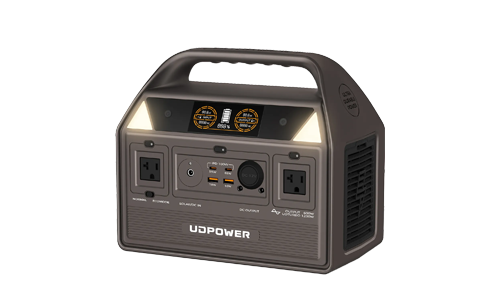
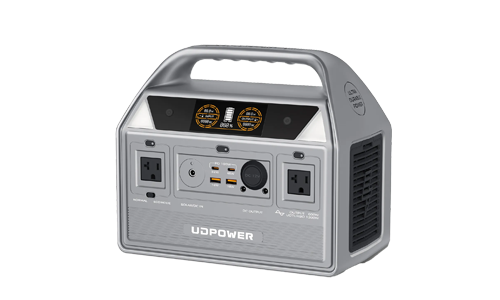
UDPOWER C600: Best When Your Load Stays Below 600W
The C600 is a practical match for laptops, routers, televisions, CPAP machines, fans, portable coolers, camera equipment, and other efficient essentials. It is not an 800W continuous-output model, so it should not be selected for an appliance that requires a steady 700W or 800W.
- 596Wh LiFePO4 battery capacity
- 600W rated AC output
- Up to 1,200W peak output
- Solar input support up to approximately 240W within the specified input range
- Two AC outlets
- USB-C, USB-A, DC, and vehicle-style output options
- Approximately 12.3 lbs
- 5-year warranty
Using 90% estimated usable efficiency, the C600 could provide approximately 8.9 hours for a 60W laptop, 5.4 hours for a 100W television, or 13.4 hours for a 40W CPAP.
View the UDPOWER C600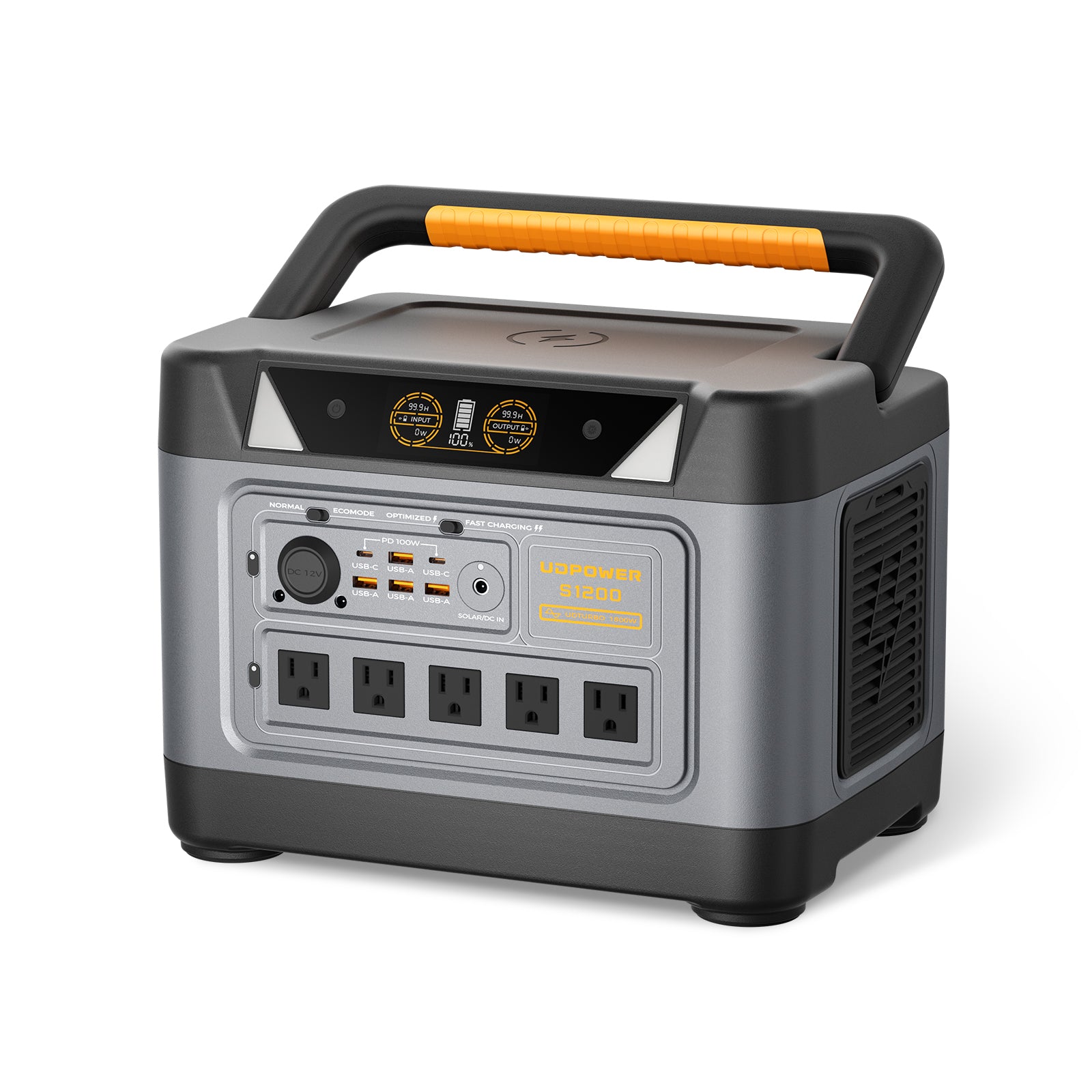
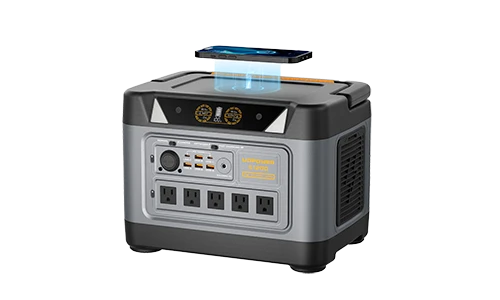
UDPOWER S1200: The Better Choice for a True 800W Load
The S1200 provides more appropriate headroom when an appliance genuinely requires close to 800W, when refrigerator startup is a concern, or when several devices will operate together. An 800W load uses about two-thirds of its 1,200W rated output instead of pushing the inverter to its maximum.
- 1,190Wh LiFePO4 battery capacity
- 1,200W rated pure sine wave AC output
- UDTURBO output support up to 1,800W for compatible loads
- Up to 400W solar input
- Five AC outlets on the current 5-outlet version
- Two USB-C outputs with up to 100W total specification
- UPS response time of 10 milliseconds or less
- Approximately 26 lbs
- 5-year warranty
Using 90% estimated usable efficiency, the S1200 could provide approximately 10.7 hours for a 100W television, 7.1 hours for a steady 150W load, or 1.3 hours for a constant 800W load.
View the UDPOWER S1200| Specification | UDPOWER C600 | UDPOWER S1200 |
|---|---|---|
| Battery capacity | 596Wh | 1,190Wh |
| Rated AC output | 600W | 1,200W |
| Peak or enhanced output | Up to 1,200W peak | UDTURBO up to 1,800W |
| Maximum solar input | Approximately 240W within supported input limits | 400W |
| Weight | Approximately 12.3 lbs | Approximately 26 lbs |
| Best use | Electronics and appliances that stay below 600W | True 800W loads, refrigerators, mixed loads, and longer backup |
| Official page | C600 specifications | S1200 specifications |
Can an 800 Watt Power Station Run a Refrigerator?
An 800W power station can run many mini refrigerators, compressor coolers, and efficient household refrigerators, but compatibility depends heavily on startup surge.
A refrigerator may use only 80W to 200W after its compressor starts, yet require a much larger burst for a fraction of a second. Defrost heaters, ice makers, and internal fans can also change the load.
Refrigerator Compatibility Checklist
- Locate the voltage, amperage, or wattage label.
- Multiply volts by amps if watts are not listed.
- Check for a listed startup, surge, or locked-rotor current.
- Compare startup demand with the station's surge rating.
- Disconnect other major appliances during the first test.
- Let the refrigerator complete at least one stop-and-restart cycle.
- Watch for a defrost cycle if the refrigerator has automatic defrost.
A refrigerator that starts successfully once may still overload the station later when the compressor restarts against pressure or when a defrost heater activates. Testing only the first few seconds is not enough.
For a complete sizing process, read Can a Portable Power Station Run Your Refrigerator?
Can an 800W Power Station Run a CPAP Overnight?
Yes. Most CPAP machines require far less than 800W, so battery capacity is usually more important than inverter output.
A CPAP averaging 40W could run for approximately 11.5 hours from a 512Wh battery or 23 hours from a 1,024Wh battery at 90% estimated usable efficiency.
Heated humidifiers and heated tubing can increase consumption substantially. Pressure settings, air leakage, altitude compensation, room temperature, and the selected power adapter can also affect the result.
Test your complete CPAP setup before depending on it overnight. Do not wait for a power outage or camping trip to discover that heating features reduce runtime below your expected sleep period.
See the detailed CPAP battery backup runtime guide for additional examples.
What Kitchen Appliances Can an 800W Power Station Run?
Kitchen appliances are difficult because many of them convert electricity directly into heat. A small appliance can require more power than a large television, refrigerator, laptop, and router combined.
| Appliance | Typical input | Compatibility | Practical advice |
|---|---|---|---|
| USB coffee grinder | 10–30W | Yes | An easy load for this power class |
| Small blender | 300–600W | Often | Start it without other large AC loads |
| Compact rice cooker | 300–700W | Some models | Check cooking wattage, not only warming wattage |
| Low-watt coffee maker | 500–800W | Some models | Use it as the only major load while brewing |
| Standard coffee maker | 800–1,200W | Usually no | A model rated at exactly 800W leaves no useful margin |
| Microwave oven | 1,000–1,500W input | Usually no | Input power is higher than cooking output |
| Electric kettle | 1,200–1,500W | No | Boiling water requires high continuous power |
| Air fryer | 1,200–1,800W | No | Most models exceed the inverter rating continuously |
| Toaster oven | 1,000–1,800W | No | Heating elements are a poor match for this class |
| Induction cooktop | 1,200–1,800W at high settings | Usually no | Low settings do not guarantee low startup demand |
During an outage or camping trip, preserving battery power for refrigeration, medical equipment, communication, and lighting is often more useful than spending most of the battery on a few minutes of electric heating.
Can an 800W Power Station Run Power Tools?
It can run selected drills, rotary tools, soldering equipment, battery chargers, and compact workshop devices. Larger saws, air compressors, grinders, shop vacuums, and pumps may exceed either the running or startup rating.
| Tool | Typical range | Likely result | Main concern |
|---|---|---|---|
| Cordless tool battery charger | 50–300W | Usually compatible | Fast chargers may draw more than standard chargers |
| Soldering iron | 40–100W | Compatible | Minimal startup demand |
| Rotary tool | 100–250W | Usually compatible | Load can increase when the tool binds |
| Small drill | 300–700W | Model dependent | Motor startup and heavy drilling load |
| Shop vacuum | 700–1,400W | Usually unsuitable | High startup and continuous motor load |
| Circular saw | 1,200–1,800W | No | Running and startup power exceed the class |
| Air compressor | 700–2,000W or more | Usually unsuitable | Very high compressor startup surge |
Do not assume a tool is compatible because it ran without cutting, drilling, pumping, or vacuuming. The load can rise sharply when the tool begins real work.
Can an 800 Watt Power Station Run an Air Conditioner?
Most window, portable, and RV air conditioners are not a reliable match for an 800W station. They combine a substantial running load with a high compressor startup surge.
Some highly efficient compact units may draw less than 800W after startup, but the starting demand can still exceed the station's surge output. Runtime is another limitation. Even a compatible 600W air conditioner would use approximately 540Wh of battery energy per hour after applying a 90% efficiency assumption.
For cooling during a short outage, a fan drawing 30W to 75W is usually a much better use of a medium-size battery than an air conditioner drawing several hundred watts continuously.
Can Solar Panels Extend 800W Power Station Runtime?
Yes. Solar panels can replace some or all of the energy used by connected devices during daylight, but the result depends on actual solar input rather than the panel's laboratory rating.
For example, if connected equipment draws 100W and the station receives a stable 150W of usable solar input, the battery may recharge gradually while the equipment operates. If the load is 300W and solar input is 150W, the battery continues to discharge, but at a slower rate.

Why a 240W Panel Does Not Produce 240W All Day
Panel angle, cloud cover, shade, temperature, time of day, cable loss, and the station's input limit all affect charging. Even a small shaded area can reduce output noticeably.
Position the panel in direct sunlight, avoid glass between the sun and the panel, and adjust its angle while watching the station's live input display.
Explore UDPOWER solar panels or compare complete solar generator kits.
How to Check Whether Your Appliance Will Work
Read the Electrical Input Label
Look for input watts, rated power, voltage, amperage, or current. Do not rely only on marketing labels such as microwave cooking output.
Convert Volts and Amps to Watts
When the label shows 120V and 4A, the basic estimate is 120 × 4 = 480W. This calculation does not include startup surge.
Add All Simultaneous Loads
Include routers, lights, chargers, screens, fans, and every appliance that may operate at the same time.
Check Startup Power
Refrigerators, pumps, compressors, and tools may briefly need much more than their normal running wattage.
Leave Practical Headroom
A sustained load near 600W to 650W provides more flexibility than planning to operate at exactly 800W continuously.
Start the Largest Device First
Start the refrigerator, cooler, pump, or tool alone. Add smaller devices only after the largest load is running normally.
Observe a Complete Operating Cycle
A refrigerator should stop and restart. A cooking appliance should reach its heating cycle. A tool should be tested under a real working load.
A device turning on successfully does not prove that it will remain compatible. Power demand may increase later when a heater, pump, compressor, or charging circuit changes operating mode.
Should You Choose 600W, 800W, 1000W, or 1200W?
| Output class | Best for | When to choose a larger model | Related guide |
|---|---|---|---|
| 600W | Laptops, routers, lights, CPAP, fans, TVs, cameras, and efficient coolers | Move up when a must-run appliance exceeds 600W or has a strong startup surge | 600W power station guide |
| 800W | Mixed electronics, mini fridges, camping equipment, and selected compact appliances | Move up when normal use regularly approaches 800W | Compare power stations |
| 1,000W | More refrigerator margin, coffee makers, larger office setups, and moderate backup | Move up for appliances above 1,000W or demanding motor startup | 1000W power station guide |
| 1,200W | Refrigerators, mixed home backup, tools, and more appliance overlap | Move up for large heaters, microwaves, air fryers, or substantial cooling loads | 1200W power station guide |
Choose output based on the highest combined wattage you expect at one time. Choose battery capacity based on how many hours you need. Buying a larger inverter without enough battery capacity solves the overload problem but may not solve the runtime problem.
Frequently Asked Questions
Will an 800 watt power station run a refrigerator?
It can run many mini refrigerators, compressor coolers, and efficient household refrigerators if its surge output can handle compressor startup. Running wattage alone does not confirm compatibility.
Can an 800W power station run a microwave?
Usually not. Most microwaves draw more than 1,000W from the outlet, even when their advertised cooking output is 700W or 800W.
Can an 800W power station run a coffee maker?
Some compact coffee makers drawing 500W to 750W may work. Models close to 800W leave little operating margin, while many standard coffee makers exceed the limit.
Can it run a CPAP machine all night?
In many cases, yes. A 512Wh battery can provide approximately 11.5 hours for a 40W CPAP at 90% usable efficiency. Heated humidity and heated tubing can reduce runtime.
Will an 800W power station run a television?
Yes. Most LED televisions draw around 50W to 150W, leaving capacity for a router, streaming device, lights, or phone chargers.
Can an 800W station run a hair dryer?
Most hair dryers require 1,200W to 1,875W and will overload an 800W inverter. A low setting may still exceed the limit.
Can it run a space heater?
A heater with a 750W low mode may technically fall below the limit, but it leaves almost no headroom and can empty a medium battery very quickly. It is not a recommended use.
How many devices can an 800W power station run at once?
There is no fixed device count. It can run several devices as long as their combined running wattage remains below the inverter limit and startup demand stays within the surge rating.
How long will it last at a full 800W load?
A 512Wh battery may provide about 35 minutes, while a 1,024Wh battery may provide about 1.2 hours. These estimates use 90% usable efficiency.
Is an 800W power station enough for camping?
Yes, for most efficient camping loads. It can support lighting, phones, laptops, fans, cameras, CPAP machines, portable monitors, coolers, and many mini refrigerators.
Can solar panels keep it running continuously?
Continuous operation is possible only when usable solar input and stored battery energy are enough to cover the load through daylight, clouds, shade, and nighttime.
Does an 800W inverter mean the battery has 800Wh?
No. Watts measure output power, while watt-hours measure stored energy. An 800W inverter may be paired with a 512Wh, 768Wh, 1,024Wh, or another battery capacity.
Can an 800W power station run a desktop computer?
Many office desktop computers and monitors will work. High-performance gaming PCs and workstations may approach or exceed the limit during demanding tasks.
Can it run a sump pump?
Most sump pumps are not a dependable match because motor startup demand can be several times higher than running power. Check the pump's starting current and use a larger inverter when necessary.
Choose a Power Station Based on Your Actual Appliances
Write down every device you need to run, add the loads that may operate simultaneously, check startup power, and calculate the battery capacity required for your target runtime. When your regular load approaches 800W, choosing a larger inverter provides more dependable headroom.
Compare UDPOWER Models View Portable Power Stations View Solar Generator Kits