What Can a 1000W Portable Power Station Run?
ZacharyWilliamPortable Power Station Guide
Last updated: June 12, 2026
Quick Answer
A 1000W portable power station can run most small and mid-size essentials, including phones, laptops, Wi-Fi routers, LED lights, fans, TVs, CPAP machines, camera chargers, small power tools, mini fridges, car fridges, and many coffee makers or small kitchen appliances used one at a time.
It is usually not the right size for high-heat appliances such as large space heaters, full-power hair dryers, air fryers, electric kettles, large microwaves, or full-size air conditioners. Those devices often need more than 1000W continuously, and some need a large startup surge.
For real-world planning, do not judge by watts alone. A 1000W rating tells you what the station can output at one time. Runtime depends on battery capacity in watt-hours. A 1000Wh battery with about 90% usable efficiency gives roughly 900Wh of usable energy. That means a 90W load may run for about 10 hours, while a 900W load may run for about 1 hour.

What 1000W Really Means
The “1000W” number is the inverter output rating. It tells you how much AC power the station can supply at one time. Think of it as the size of the outlet, not the size of the fuel tank.
| Term | What It Means | Why It Matters | Buying Tip |
|---|---|---|---|
| Watts (W) | How much power a device uses while running. | A 1000W station should not be asked to run more than 1000W at once. | Check the device label, power brick, or manual. |
| Watt-hours (Wh) | How much energy the battery stores. | Wh determines runtime. Higher Wh means longer backup time. | For real backup, compare battery capacity, not only output watts. |
| Continuous output | The steady power the station can supply. | This is the main number for normal use. | Keep your total running load below the rated output. |
| Surge power | A short burst for motors, compressors, and pumps. | Fridges and tools may fail to start if surge support is too low. | For motor loads, leave extra headroom. |
| Pure sine wave | Cleaner AC output for sensitive electronics. | Important for CPAP machines, laptops, routers, TVs, and some appliances. | Choose pure sine wave for home backup and medical-adjacent devices. |
A common mistake is assuming a 1000W portable power station can run a 1000W appliance for a long time. It can often run that appliance if the startup demand is within limits, but a 1000W load drains a 1000Wh-class battery quickly.
The Simple Runtime Formula
Use this quick estimate before you plug anything in:
Estimated runtime = battery capacity in Wh × 0.90 ÷ device watts
The 0.90 factor allows for real-world conversion loss. Actual runtime can change with temperature, battery condition, AC vs. DC output, device cycling, and whether the appliance pulls a startup surge.
| Example | Battery Assumption | Usable Energy | Load | Estimated Runtime |
|---|---|---|---|---|
| Typical 1000Wh-class station | 1000Wh | About 900Wh | 100W | About 9 hours |
| Typical 1000Wh-class station | 1000Wh | About 900Wh | 300W | About 3 hours |
| Typical 1000Wh-class station | 1000Wh | About 900Wh | 900W | About 1 hour |
| UDPOWER S1200 | 1,190Wh | About 1,071Wh | 100W | About 10.7 hours |
| UDPOWER S1200 | 1,190Wh | About 1,071Wh | 500W | About 2.1 hours |
The formula is best for steady loads such as lights, routers, laptops, TVs, and fans. Refrigerators, freezers, and some cooking devices cycle on and off, so their real runtime may be longer or shorter depending on how often the compressor or heating element runs.
What a 1000W Portable Power Station Can Run
The table below uses common U.S. household wattage ranges and assumes a 1000Wh-class battery with about 900Wh usable energy. If you use the UDPOWER S1200, runtime is usually a bit longer because it has a 1,190Wh battery and a 1,200W rated output.
| Device | Typical Running Watts | Estimated Runtime on 1000Wh-Class Station | Can a 1000W Station Run It? | Important Note | Helpful Source |
|---|---|---|---|---|---|
| Smartphone charging | 10–20W | 45–90 hours of charging time | Yes | Use USB output when possible to reduce conversion loss. | Portable power station collection |
| Laptop | 45–90W | 10–20 hours | Yes | USB-C PD is often more efficient than using the AC adapter. | 1000W runtime guide |
| Wi-Fi router and modem | 10–25W | 36–90 hours | Yes | One of the best outage loads because it uses little power. | UDPOWER models |
| LED light or lamp | 5–15W | 60–180 hours | Yes | LED lighting stretches emergency backup time dramatically. | Power station safety guide |
| CPAP without heated humidifier | 25–50W | 18–36 hours | Yes | Turn off or lower heating features when runtime matters most. | CPAP battery backup guide |
| CPAP with humidifier or heated tube | 60–100W | 9–15 hours | Usually yes | Humidifier settings can cut runtime sharply. | CPAP power consumption |
| Box fan or camping fan | 20–75W | 12–45 hours | Yes | Lower fan speed can add many hours. | Camping power guide |
| 32–55 inch LED TV | 50–150W | 6–18 hours | Yes | Brightness, screen size, and soundbar use change the load. | TV power station guide |
| Mini fridge | 40–100W average | 9–22 hours by average load | Usually yes | Compressor startup surge matters more than the average number. | Refrigerator solar guide |
| Full-size refrigerator | 80–200W average | 4.5–11 hours by average load | Often yes | Use a station with enough surge headroom. Keep the door closed during outages. | FoodSafety.gov outage guidance |
| Car fridge or 12V cooler | 35–70W average | 13–26 hours | Yes | DC output is often more efficient than AC for 12V fridges. | Shop portable power stations |
| Projector | 150–300W | 3–6 hours | Yes | Bright projectors use much more power than compact models. | 1200W device guide |
| Game console | 120–250W | 3.6–7.5 hours | Yes | Add TV wattage to get the real total. | Runtime guide |
| Coffee maker | 700–1000W while brewing | About 0.9–1.3 hours continuous | Usually yes, one at a time | Use it alone. Brewing for 5–10 minutes uses far less than running for an hour. | UDPOWER S1200 |
| Small rice cooker | 300–700W | 1.3–3 hours continuous | Usually yes | Heating cycles vary. Avoid running other major AC loads at the same time. | S1200 specs |
| Small power drill or battery charger | 100–800W | Varies widely | Often yes | Check startup surge and charger label. | Tool and appliance guide |
Real-World Combined Load Examples
Most people do not buy a power station for one device. They want to keep a small setup alive during a blackout, camping trip, RV stop, or workday. Add the watts together before you decide whether 1000W is enough.
| Use Case | Example Load | Total Running Watts | Estimated Runtime on 1000Wh-Class Station | Estimated Runtime on UDPOWER S1200 | Verdict |
|---|---|---|---|---|---|
| Work-from-home outage | Router 12W + laptop 60W + monitor 50W + LED lamp 10W | 132W | About 6.8 hours | About 8.1 hours | Good match |
| Overnight CPAP backup | CPAP 40W + phone 10W + small fan 30W | 80W | About 11.3 hours | About 13.4 hours | Good match |
| Basic storm kit | Router 12W + 2 LED lights 20W + fan 50W + phone charging 10W | 92W | About 9.8 hours | About 11.6 hours | Good match |
| Fridge protection | Full-size fridge average 120W + router 12W + LED light 10W | 142W average | About 6.3 hours by average load | About 7.5 hours by average load | Good if surge is supported |
| Camping comfort | 12V fridge 45W + fan 20W + lights 10W + camera charging 20W | 95W | About 9.5 hours | About 11.3 hours | Good match |
| Cooking burst | Coffee maker 900W for short brewing, then rice cooker 500W | 500–900W while active | Works if used one at a time | Better headroom than strict 1000W units | Use carefully |
| Too much at once | Coffee maker 900W + microwave 1000W + fridge startup | 1900W+ before surge | Not suitable | Still too much for S1200 at once | Split the loads |
A practical rule
For a 1000W-class station, build your emergency plan around low-watt essentials first: refrigerator, CPAP, router, phones, lights, fan, and laptop. Treat coffee makers, small cookers, and tools as short-use devices, not all-day loads.
What a 1000W Portable Power Station Usually Cannot Run Well
A 1000W station is very useful, but it is not a whole-house generator. The biggest problem devices are high-heat appliances and motor loads with heavy startup surge.
| Device | Typical Power Demand | 1000W-Class Verdict | Why | Better Option |
|---|---|---|---|---|
| Space heater | 750–1500W | Poor match | High heat drains battery fast and may exceed output. | Use blankets, heated clothing, or a lower-watt electric blanket. |
| Full-power hair dryer | 1200–1800W | Usually no | Often above a strict 1000W output limit. | Use low setting only if within the station rating. |
| Electric kettle | 1200–1800W | Usually no | Short runtime is not the main issue; output limit is. | Use a lower-watt kettle or a gas-free camping alternative where appropriate. |
| Air fryer | 1200–1700W | Usually no | Most models exceed 1000W while heating. | Move to a higher-output model such as a 2000W-class station. |
| Large microwave | 1000–1600W input | Borderline to no | Microwave “cooking watts” are not the same as wall input watts. | Check the input rating label, not only the front badge. |
| Window air conditioner | 500–1500W running, higher surge | Usually no | Startup surge and long runtime demand are both difficult. | Use a much larger station or dedicated backup solution. |
| Sump pump | 400–1000W running, high surge | Risky | Startup surge can be several times running watts. | Confirm pump surge rating and test before relying on it. |
If your must-run appliance is close to 1000W, choose more headroom. A station running at its limit is less comfortable than one running at 40–70% of its rated output.
Fridge, CPAP, and Outage Use: What to Know
Can a 1000W portable power station run a refrigerator?
Often yes, but you need to check two things: running watts and compressor startup surge. Many refrigerators use a modest average wattage over time, but the compressor can pull a higher burst when it starts.
Food safety still matters. During a power outage, keep refrigerator and freezer doors closed as much as possible. FoodSafety.gov states that a refrigerator can keep food safe for up to 4 hours during an outage if the door stays closed, while a full freezer can often hold temperature longer. Read the FoodSafety.gov guidance.
Can a 1000W power station run a CPAP all night?
Yes, many CPAP setups are a strong match for a 1000W-class station. The key variable is not the 1000W output rating; it is the CPAP’s actual wattage. Without heated humidification, many CPAP setups use far less power. With a heated humidifier or heated hose, runtime can drop quickly.
| Outage Priority | Best Practice | Why It Helps | Related Reading |
|---|---|---|---|
| CPAP | Lower or turn off humidifier heating when safe and comfortable. | Heating is often the biggest battery drain. | How long will a CPAP run on battery? |
| Refrigerator | Pre-cool before storms, keep doors closed, and avoid opening often. | Less compressor cycling means longer runtime. | Solar panels for refrigerator backup |
| Internet | Power only the modem/router you actually need. | Routers are low-watt loads and can run for many hours. | Portable power stations |
| Lighting | Use LED lamps and lanterns instead of high-watt bulbs. | Lighting can become nearly negligible in the power budget. | Power station safety guide |
Recommended UDPOWER Models for 1000W-Class Needs
If you are shopping for a “1000W portable power station,” the practical goal is usually not exactly 1000W. The better goal is enough output for your device plus enough battery capacity for useful runtime. That is why a 1200W-rated model can be a better fit than a strict 1000W unit.
Best 1000W-Class Pick: UDPOWER S1200 Portable Power Station
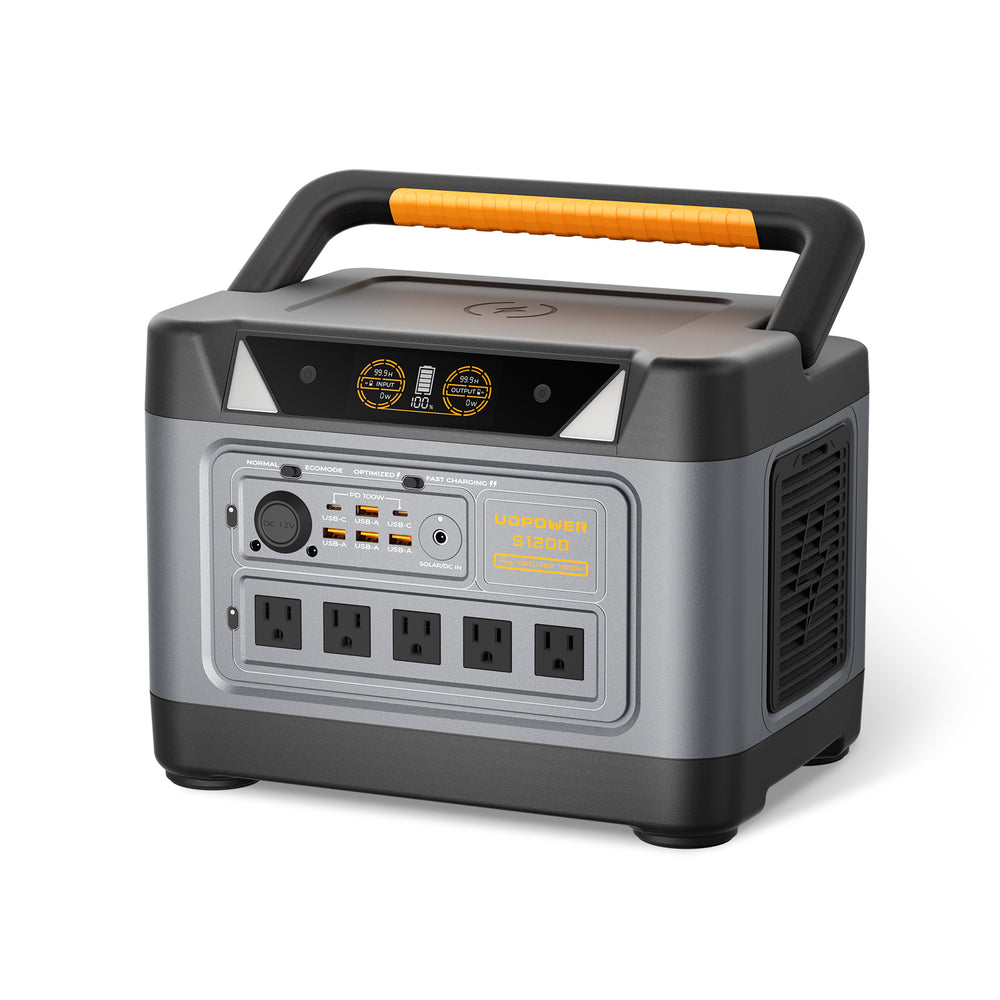
The UDPOWER S1200 is the most natural fit for readers comparing 1000W-class power stations because it gives extra headroom: 1,190Wh capacity, 1,200W rated pure sine wave AC output, up to 1,800W surge support, LiFePO4 battery chemistry, 4,000+ cycles, and about 26.0 lbs of weight.
| Spec | UDPOWER S1200 | Why It Matters | Source |
|---|---|---|---|
| Battery capacity | 1,190Wh | More runtime than many 1000Wh-class units. | Official S1200 page |
| Rated AC output | 1,200W | More headroom for coffee makers, tools, and mixed essentials. | Official S1200 page |
| Surge support | Up to 1,800W | Helpful for compressor and motor startup loads. | Official S1200 page |
| Battery type | LiFePO4, 4,000+ cycles | Long cycle life for frequent backup, camping, and RV use. | Official S1200 page |
| Weight | About 26.0 lbs | Still portable for home, camping, and vehicle use. | UDPOWER comparison page |
| Solar input | Up to 400W max | Useful for camping and outage recharge planning. | UDPOWER comparison page |
Best for: fridge backup, CPAP, Wi-Fi, lights, laptops, TV, fan, camera charging, short cooking bursts, RV essentials, camping power, and emergency kits.
Upgrade Pick: UDPOWER S2400 Portable Power Station
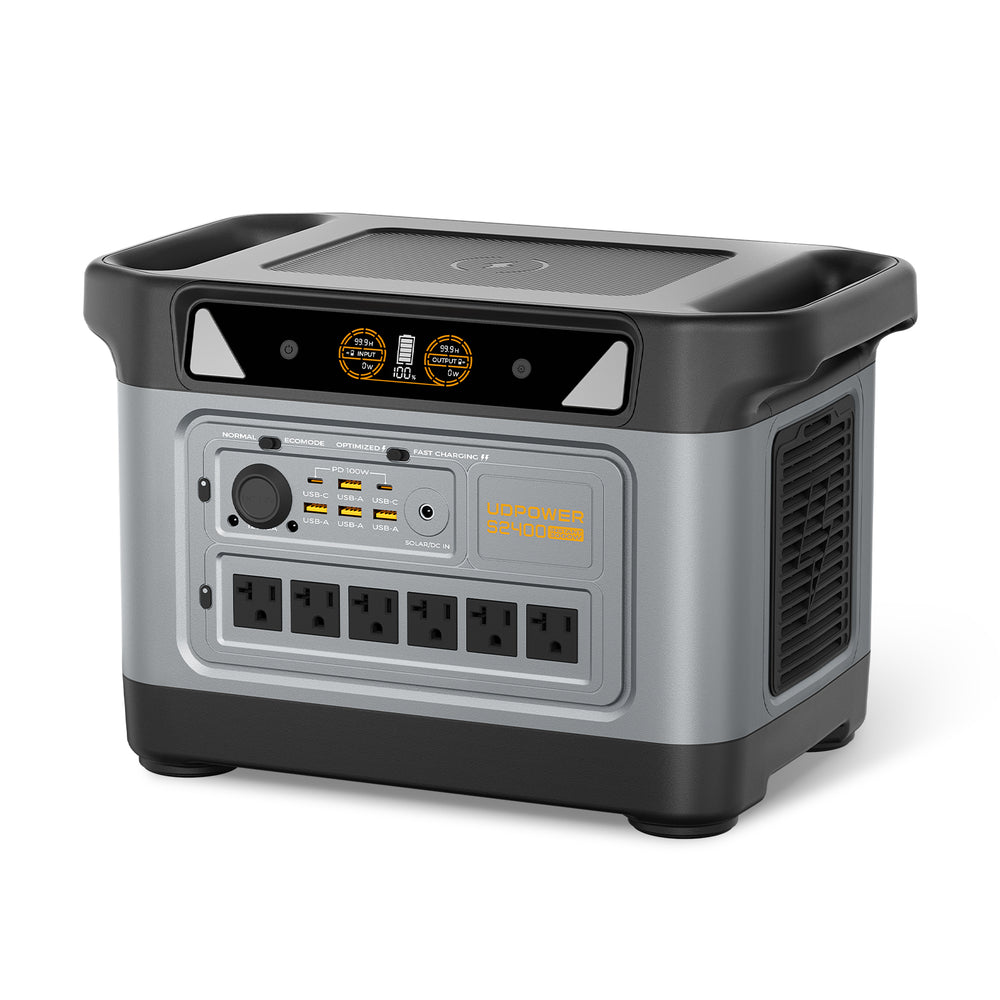
Choose the UDPOWER S2400 if your actual use case is bigger than a 1000W station should handle. It offers 2,083Wh capacity, 2,400W rated pure sine wave output, 3,000W surge support, LiFePO4 battery chemistry, and about 40.8 lbs of weight.
| Spec | UDPOWER S2400 | Why It Matters | Source |
|---|---|---|---|
| Battery capacity | 2,083Wh | Much longer runtime for outages and RV use. | UDPOWER comparison page |
| Rated AC output | 2,400W | Better for microwave, higher-watt tools, and multi-device setups. | Official S2400 page |
| Surge support | 3,000W | More startup headroom for demanding appliances. | Official S2400 page |
| Weight | 40.8 lbs | Still portable, but better treated as a serious backup unit. | Official S2400 page |
Best for: longer outages, refrigerator plus CPAP, RV use, microwave support, multiple household essentials, and users who do not want to manage loads as tightly.
How to Check Your Own Appliance Before Plugging In
Device labels are not always easy to read, but a two-minute check can prevent overloads and unrealistic runtime expectations.
- Find the input label. Look on the device, power adapter, back panel, or manual.
- Look for watts. If it says 600W, compare that directly with the station’s output rating.
- If it lists amps instead of watts, estimate watts. For U.S. AC devices, use 120V × amps. A 5A device is roughly 600W.
- Add everything you want to run at the same time. A 700W coffee maker plus a 400W appliance is already over 1000W.
- Leave headroom for surge. Refrigerators, pumps, and power tools may need extra startup power.
- Estimate runtime. Battery Wh × 0.90 ÷ total watts gives a realistic planning number.
- Test before an emergency. Run your actual setup at home and watch the display, not just the spec sheet.
If the device is critical, such as a CPAP machine or refrigerator, test it before storm season. Do not wait for an outage to discover that the plug, surge demand, or runtime does not match your plan.
1000W vs. Other Power Station Sizes
A 1000W portable power station is a strong middle ground, but it is not always the best fit. Smaller units are easier to carry. Larger units give more freedom and longer runtime.
| Power Class | Best For | Common Limits | Related UDPOWER Reading |
|---|---|---|---|
| 200W–400W | Phones, tablets, lights, cameras, small laptops, short camping trips. | Not enough for most kitchen appliances or refrigerators. | Shop compact power stations |
| 600W–800W | Fans, routers, laptops, CPAP, small coolers, light outage comfort. | Limited for coffee makers, tools, and fridge surge. | 800W guide |
| 1000W–1200W | Fridge planning, CPAP, router, lights, laptop, TV, fan, short cooking bursts. | High-heat appliances still drain fast or exceed limits. | 1200W guide |
| 2000W+ | Longer outages, microwave, refrigerator plus multiple essentials, RV use, heavier tools. | Heavier and more expensive, but much more flexible. | 2000W guide |
| 3000W class | More demanding appliance plans and larger backup setups. | Still not the same as a permanently installed whole-home generator. | 3000W guide |
FAQ: What Can a 1000W Portable Power Station Run?
Can a 1000W portable power station run a refrigerator?
Yes, many 1000W-class power stations can run a refrigerator if the refrigerator’s running watts and startup surge stay within the station’s limits. Runtime depends on compressor cycling, room temperature, fridge size, and how often the door is opened.
Can a 1000W power station run a microwave?
Sometimes, but many microwaves are not a good match. A microwave advertised as 700W or 1000W cooking power may draw more than that from the wall. Always check the input wattage label before using it with a 1000W station.
Can a 1000W portable power station run a CPAP all night?
Usually yes. Many CPAP machines use far less than 100W, especially without heated humidification. Heated humidifiers and heated tubes can reduce runtime significantly, so test your exact setup before relying on it overnight.
Can a 1000W power station run a coffee maker?
Often yes, if the coffee maker is under the station’s output rating and used by itself. Coffee makers use high power while brewing, but only for a short time. Do not run other major appliances at the same time.
Can a 1000W power station run a TV?
Yes. Most modern LED TVs are a good match for a 1000W power station. Add the wattage of any soundbar, game console, streaming box, or router to calculate the real total load.
Can a 1000W portable power station run a space heater?
It is usually a poor match. Many space heaters use 750W to 1500W and drain battery capacity very quickly. For battery backup, an electric blanket or heated clothing is usually a more efficient way to stay warm.
How long will a 1000W power station last?
It depends on battery capacity and device wattage. A simple estimate is battery Wh × 0.90 ÷ load watts. A 1000Wh-class battery may run a 100W load for about 9 hours or a 900W load for about 1 hour.
Is 1000W enough for home backup?
It is enough for essential backup, not whole-home backup. A 1000W-class station can support routers, phones, lights, laptops, CPAP machines, fans, TVs, and many refrigerators, but not central AC, large heaters, electric ranges, or multiple high-watt appliances at once.
Is a 1200W station better than a 1000W station?
For many people, yes. A 1200W station gives more headroom for real appliances, especially when startup surge or mixed loads are involved. The UDPOWER S1200 is a practical 1000W-class upgrade because it combines 1,190Wh capacity with 1,200W rated output.
Should I choose S1200 or S2400?
Choose S1200 for portable essential backup: CPAP, refrigerator, router, lights, laptop, TV, fan, camping, and RV basics. Choose S2400 if you need longer runtime, more outlets, higher-watt appliances, microwave support, or multiple home essentials at the same time.
Choose Your Backup Power Setup
If your goal is to run essentials without overbuying, start with the UDPOWER S1200. It gives the practical headroom many shoppers expect from a 1000W-class station, while staying portable enough for home, RV, camping, and outage use.
If you want more runtime and fewer load-management decisions, step up to the UDPOWER S2400.
Related Reading
- How Long Will a 1000W Power Station Run?
- What Can a 1200W Portable Power Station Run?
- What Can a 2000W Portable Power Station Run?
- How Long Will a CPAP Run on a Battery Backup?
- How Many Solar Panels Do I Need to Run a Refrigerator?
- Portable Power Station vs Generator for Camping
- Power Station Safety Guide
- Compare UDPOWER Portable Power Stations