Things You Should Know About LFP Batteries
ZacharyWilliamIf you are shopping for a portable power station, solar generator, RV battery backup, or home outage setup, you will see two names everywhere: LFP and LiFePO4. They mean the same battery chemistry: lithium iron phosphate.
LFP has become popular in portable power stations because it is usually a strong fit for people who want long cycle life, safer everyday handling, and a battery that can be charged and discharged often. But “LFP” by itself does not guarantee a good purchase. The power station’s battery management system, charging temperature range, solar input limits, inverter size, warranty, and real-world capacity matter just as much.
Quick answer: is an LFP battery worth it?
Yes, LFP is usually worth it if you want a power station for outage backup, camping, RV use, solar charging, CPAP backup, or frequent everyday use. Its biggest advantages are long cycle life, strong thermal stability, and better long-term durability than many older battery options. The tradeoff is that LFP can be heavier than higher-energy lithium chemistries, and it still needs proper charging and storage habits.
The smartest way to shop is simple: confirm the power station uses LFP, then compare capacity in watt-hours, AC output in watts, solar input limits, charging temperature, cycle-life wording, and support terms.
What an LFP battery actually is
LFP stands for lithium iron phosphate. LiFePO4 is the chemical name. It is part of the lithium-ion battery family, but it uses a phosphate-based cathode instead of the nickel- or cobalt-heavy chemistries often used in high-energy battery packs.
In plain English, LFP is not chosen because it is always the smallest or lightest battery. It is chosen because it usually holds up well under repeated charging, has a strong safety reputation, and works well in energy-storage products that may sit in a garage, RV, cabin, or emergency closet for years.

Mobile tip: swipe sideways to view the full table.
| LFP fact | What it means for a buyer | Typical reference point | Source |
|---|---|---|---|
| LFP is a lithium-ion chemistry | It still needs a BMS, correct charger, correct cables, and safe handling. | LiFePO4 / lithium iron phosphate | Battery University |
| Lower nominal cell voltage | This is normal for LFP and does not mean the battery is weak. | About 3.2–3.3V per cell | Battery University |
| Long cycle-life potential | Better fit for repeated use than batteries designed mainly for low weight. | Often thousands of cycles, depending on cell quality and use conditions | Battery University |
| Strong thermal stability | One reason LFP is common in backup and energy-storage products. | Known for good thermal stability compared with many other Li-ion types | Battery University |
| Still a high-energy battery | Damage, overheating, wrong charging, or poor storage can still create risk. | Use common lithium-ion battery safety habits | OSHA lithium-ion safety guidance |
Why buyers like LFP for power stations
For a power station, the battery is not just a spec line. It decides how the product ages, how it handles repeat charging, and how confident you feel storing it for emergency use. Here is why LFP has become a common choice for modern portable power stations.
1. It is built for repeat use
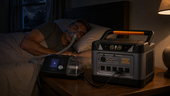
A power station may be used for camping weekends, storm prep, CPAP backup, router backup, tailgating, garage work, and solar charging. That means it can see far more charge-discharge cycles than a battery that sits unused most of the year. LFP’s long cycle-life potential is one of its biggest practical advantages.
2. It makes sense for outage backup
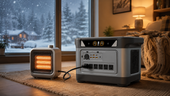
Home backup is not just about how many watts a station can output for one exciting demo. It is about whether the battery can sit ready, be recharged, run essential loads, and still feel dependable after years of seasonal use. That is where LFP usually fits very well.
3. It is usually a better everyday value than lead-acid
Lead-acid batteries can still be useful in some fixed, low-budget systems, but they are heavy and usually do not offer the same repeated deep-cycling experience. For portable power stations, LFP often delivers a better balance of usable capacity, weight, lifespan, and convenience.
4. It pairs well with solar charging
Solar charging can turn a power station from a one-time battery into a more flexible off-grid system. LFP’s long cycle-life profile makes it a good match for people who charge during the day and use power at night. The catch is that the solar panel setup still has to stay inside the power station’s voltage, current, and wattage limits. For safe panel matching, read UDPOWER’s solar charging voltage safety guide.
Tradeoffs you should not ignore
LFP is a strong battery chemistry, not a magic label. Many weak buying decisions happen when shoppers see “LiFePO4” and stop reading the rest of the spec sheet.
Mobile tip: swipe sideways to view the full table.
| Tradeoff | What you may notice | How to make a smarter decision | Useful source |
|---|---|---|---|
| Lower energy density than some lithium chemistries | An LFP station may be heavier than a similar-capacity station using a higher-energy chemistry. | Compare total weight, capacity, output, cycle life, and safety features together. | Battery University |
| Cold-weather charging limits | The unit may refuse to charge or should not be charged when the pack is too cold. | Read the published charging temperature range. Warm the unit before charging in winter. | NREL battery temperature research |
| Upfront price can be higher than lead-acid | The sticker price may look higher at checkout. | Think in lifetime cycles, usable energy, portability, and replacement frequency. | Battery University |
| State of charge can be harder to read by voltage alone | LFP voltage can stay fairly flat through much of the discharge curve. | Use the station’s display and watt-hour planning instead of guessing by voltage. | Battery University |
| Quality varies by brand and pack design | Two products can both say “LFP” but perform very differently. | Check certifications, BMS protections, warranty, input limits, and support quality. | UL portable power pack testing |
Buyer takeaway
Do not buy a power station only because it says LFP. Buy it because the full system fits your load: battery capacity, inverter output, surge support, solar input, charging speed, temperature range, safety certification, and warranty.
LFP vs lithium-ion vs lead-acid
One common confusion: LFP is lithium-ion. “Lithium-ion” is a family, not one single chemistry. When shoppers compare LFP to “lithium-ion,” they usually mean LFP versus other lithium chemistries such as NMC or NCA.
Mobile tip: swipe sideways to view the full table.
| Battery type | Typical strengths | Typical weaknesses | Best fit | Buyer note |
|---|---|---|---|---|
| LFP / LiFePO4 | Long cycle life, strong thermal stability, good for frequent use | Usually heavier than high-energy lithium chemistries for the same energy | Portable power stations, solar storage, RV backup, home essentials backup | Great when durability matters more than minimum weight. |
| NMC / NCA lithium-ion | Higher energy density, often lighter for the same capacity | Usually more tradeoff on lifespan and heat tolerance than LFP | Weight-sensitive products where compactness is a priority | Useful when light weight matters more than long-term cycling. |
| Lead-acid / AGM | Low upfront cost, familiar technology | Heavy, bulkier, shorter practical cycle life, less convenient for portable use | Legacy systems, budget fixed installations, simple low-use setups | Sticker price can be attractive, but lifetime value may be weaker. |
If your main goal is a dependable power station for outages, camping, RV weekends, router backup, CPAP backup, or solar recharging, LFP is usually a strong choice. If your main goal is the lightest possible battery for the smallest possible bag, compare weight carefully before deciding.
What cycle life really means
Cycle life is one of the most important LFP specs, but it is also one of the easiest to misunderstand.
A “cycle” usually means using and recharging a battery by an amount equal to one full charge. It does not always mean you drained it from 100% to 0% in one sitting. For example, using 50% today and 50% tomorrow can count as roughly one full cycle.
Read cycle-life claims this way
- “4,000+ cycles” is a useful headline, but it is not the whole story.
- “80%+ capacity after 3,000 cycles” is more specific because it tells you the retained capacity point.
- Temperature, charging speed, storage habits, and depth of discharge can all affect real lifespan.
- The inverter and electronics also matter. A long-life battery still needs a well-built power station around it.
For example, UDPOWER product pages list LiFePO4/LFP batteries and show cycle-life language such as 4,000+ cycles or 80%+ capacity after 3,000 cycles, depending on the model page and spec section. When comparing power stations, treat the detailed retained-capacity number as the more useful buying signal.
Cold weather, heat, and storage rules
LFP batteries are durable, but temperature still matters. Many buyers think “safe chemistry” means “no rules.” That is wrong. The easiest way to protect your battery is to follow the published operating temperature range for your specific product.
Cold weather: discharging and charging are not the same
A power station may be able to run devices in cold weather, but charging a lithium battery when it is too cold can damage the pack or trigger a protective shutdown. If your station has been sitting in a freezing garage, car, shed, or RV bay, bring it into a warmer space before charging.
Mobile tip: swipe sideways to view the full table.
| Situation | Practical move | Why it matters | Helpful source |
|---|---|---|---|
| Cold morning after a winter outage | Run essential devices if the unit is within its discharge range, but warm the station before charging. | Cold charging can contribute to lithium plating and capacity loss. | NREL temperature research |
| Solar charging in winter | Check both battery charging temperature and solar input voltage limits. | Cold weather can affect batteries and can also raise solar panel open-circuit voltage. | UDPOWER solar voltage guide |
| Hot garage or direct sun | Keep the unit shaded, ventilated, and away from heat buildup. | Heat accelerates battery aging and can stress electronics. | OSHA lithium-ion safety guidance |
| Long storage | Store partially charged in a cool, dry place and top up occasionally. | Leaving a battery empty for a long time can make recovery harder. | Battery University storage guidance |
Simple storage habit
If the station will sit unused after camping season or storm season, do not store it empty. Leave it partially charged, keep it in a dry room-temperature location, and check it every few months. For a full winter-use explanation, read UDPOWER’s How Cold Is Too Cold for a Solar Generator?
How to read an LFP power station spec sheet
Most bad power station purchases happen because the buyer looks at only one number. Battery chemistry matters, but it is only the starting point.
Mobile tip: swipe sideways to view the full table.
| Spec to check | What you want to see | Why it matters | Question to ask before buying |
|---|---|---|---|
| Battery chemistry | LFP / LiFePO4 clearly listed | Confirms the chemistry, but not the full quality of the system. | Does the product clearly say LFP or LiFePO4? |
| Capacity | Watt-hours, not just watts | Wh tells you how much energy the station stores. | How many Wh do my devices need per day? |
| AC output | Continuous wattage and surge wattage | Determines whether it can run your appliance without overloading. | Is my highest device below the continuous output limit? |
| Cycle life | Retained capacity after a stated cycle count | Better than vague “long life” claims. | Does it say 80% capacity after X cycles? |
| Charging temperature | Published charge and discharge ranges | Critical for winter storage, solar charging, and RV use. | Can I charge it safely where I plan to keep it? |
| Solar input | Voltage range, current limit, and max solar input | Prevents panel mismatch and over-voltage mistakes. | Do my panel Voc and wiring stay under the station’s limit? |
| UPS / pass-through details | Clear explanation of whether it supports UPS-style backup | Important for routers, workstations, CPAP, and brief outages. | Do I need fast switchover, or just portable power? |
| Certifications | UL2743, FCC, ROHS, UN38.3, or other relevant listings | Shows the product has been designed around recognized safety requirements. | Are the certifications listed on the product page? |
| Warranty and returns | Clear support terms from the brand | A power station is a long-term purchase, not a disposable accessory. | Who supports me if something goes wrong? |
Need help turning watts into runtime? Use UDPOWER’s Battery Runtime Basics: Watts to Watt-hours guide before choosing a model.
Recommended UDPOWER LFP power stations
If you are choosing inside the UDPOWER lineup, start with your load. A small laptop-and-phone kit does not need the same battery as a microwave, fridge, or longer home outage setup.
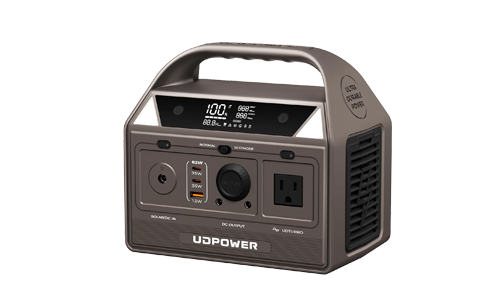
Best compact LFP pick: UDPOWER C400

Best for: day trips, laptop charging, light backup, emergency car kit, small electronics, and buyers who want LFP in a small package.
- Capacity: 256Wh
- AC output: 400W pure sine wave, 800W surge
- Battery: LFP, listed 80%+ capacity after 3,000 cycles
- Weight: approximately 6.88 lb
- Solar input: 150W max, 11–28V input range
- Notable feature: 12V vehicle jump-start port
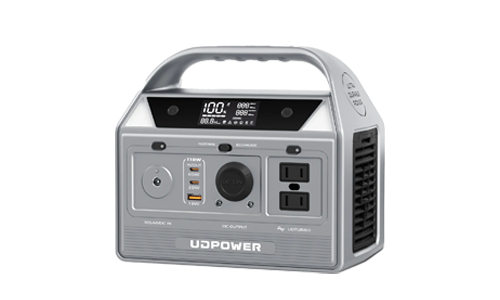
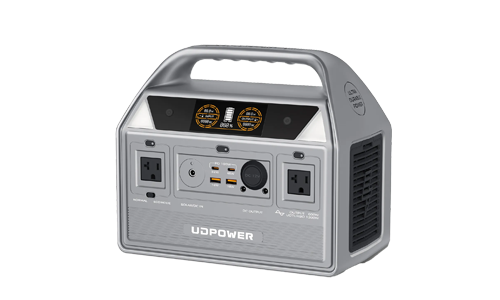
Best camping middle ground: UDPOWER C600

Best for: camping, overnight essentials, cameras, routers, lights, small projectors, portable coolers, and lighter backup plans.
- Capacity: 596Wh
- AC output: 600W pure sine wave, 1200W max/surge
- Battery: LFP, listed 80%+ capacity after 3,000 cycles
- Weight: 12.3 lb
- Solar input: 240W max, 11–28V input range
- Notable note: C600 is not designed as a fast-transfer UPS; choose S-Series if UPS-style switchover matters.
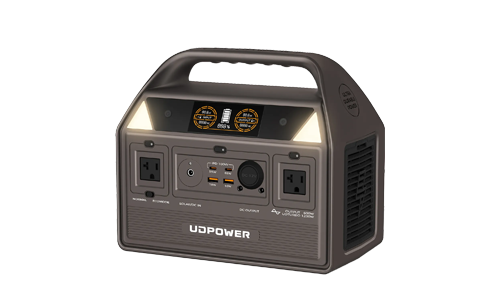
Best all-around home and RV pick: UDPOWER S1200

Best for: home essentials, RV weekends, longer camping trips, routers, lights, CPAP support, small appliances within limits, and buyers who want UPS-style backup.
- Capacity: 1191Wh in the official spec section
- AC output: 1200W pure sine wave, 1800W surge
- Battery: brand-new LiFePO4, listed 80%+ capacity after 3,000 cycles
- Weight: about 26.0 lb
- Solar charging input: 12–75V, 12A, 400W max
- UPS Prime: response time ≤10ms
- Variant note: the 3-AC white version and 5-AC version share core performance; the difference is appearance and output-port count.
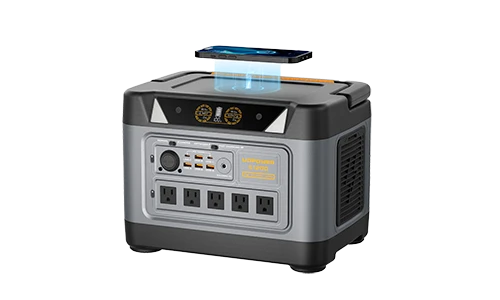
Best larger backup pick: UDPOWER S2400

Best for: bigger outage loads, longer refrigerator support, microwave-ready planning, coffee makers within limits, higher-watt appliances, and more serious home backup needs.
- Capacity: 2083Wh
- AC output: 2400W pure sine wave, UDTURBO surge up to 3000W
- Battery: brand-new LFP, listed 80%+ capacity after 3,000 cycles
- Weight: approximately 40.8 lb
- Solar input: 12–50V, 10A max; product page lists up to 400W solar charging
- UPS Prime: response time ≤10ms
- Ports: 6 AC outlets plus DC/USB outputs and 15W wireless charging
Mobile tip: swipe sideways to view the full comparison table.
| Model | Capacity | Output | Weight | Solar input | Best fit | Official page |
|---|---|---|---|---|---|---|
| UDPOWER C400 | 256Wh | 400W, 800W surge | Approx. 6.88 lb | 150W max, 11–28V | Compact backup, car kit, laptops, small devices | C400 page |
| UDPOWER C600 | 596Wh | 600W, 1200W max/surge | 12.3 lb | 240W max, 11–28V | Camping, overnight essentials, light backup | C600 page |
| UDPOWER S1200 | 1191Wh | 1200W, 1800W surge | About 26.0 lb | 400W max, 12–75V, 12A | Home essentials, RV, UPS-style backup | S1200 page |
| UDPOWER S2400 | 2083Wh | 2400W, 3000W surge | 40.8 lb | 12–50V, 10A max; product page lists up to 400W solar charging | Bigger appliances, longer outage backup, fridge planning | S2400 page |
How to choose fast
Choose C400 if portability comes first. Choose C600 if you want a more useful camping size. Choose S1200 if you want a balanced home/RV backup station with UPS-style support. Choose S2400 if your load list includes larger appliances or you want more battery capacity for longer outages.
Common LFP battery mistakes
LFP is forgiving compared with many battery types, but it is not foolproof. These mistakes create most of the real-world complaints around power stations.
Mobile tip: swipe sideways to view the full table.
| Mistake | What can go wrong | Better move |
|---|---|---|
| Buying only by the word “LFP” | You may end up with the wrong capacity, wrong inverter size, or weak solar input. | Match Wh, W, surge, temperature, and solar input to your actual use. |
| Charging in freezing conditions | Cold charging can damage lithium batteries or trigger protection. | Warm the unit first and follow the published charging temperature range. |
| Leaving the station empty in storage | Deep self-discharge can make recovery harder and shorten useful life. | Store partially charged and check it every few months. |
| Ignoring solar input voltage | Over-voltage can damage the input stage or prevent charging. | Check panel Voc, wiring method, connector, polarity, current, and wattage limit. |
| Confusing watts with watt-hours | You may buy a unit that can start a device but cannot run it long enough. | Use watts for output and watt-hours for runtime planning. |
| Expecting rated solar watts all day | Real-world solar input is usually below panel nameplate rating. | Plan for sun angle, shade, clouds, heat, season, and cable setup. |
| Blocking vents during high-load use | Heat buildup can reduce performance and stress components. | Keep vents clear and use the station in a dry, ventilated space. |
| Using damaged batteries or cables | Physical damage, wrong polarity, or bad cables can create safety risks. | Inspect the unit and accessories before use. Stop using damaged gear. |
FAQ
Is LFP the same as LiFePO4?
Yes. LFP is the short name, and LiFePO4 is the chemical formula for lithium iron phosphate.
Are LFP batteries safer than other lithium batteries?
LFP is known for strong thermal stability and is widely used in power stations and energy-storage products. Still, no battery is risk-free. Damage, heat, incorrect charging, blocked ventilation, and poor-quality electronics can still create problems.
Do LFP batteries last longer than lead-acid batteries?
Usually yes in repeated cycling. LFP batteries are commonly chosen for long service life and better deep-cycle usability, while lead-acid batteries are heavier and often less convenient for portable power use.
Can I charge an LFP battery below freezing?
Do not assume you can. Always follow the power station’s published charging temperature range. Charging a lithium battery when it is too cold can damage the battery or trigger protective shutdown.
Should I store an LFP power station at 100%?
For long storage, it is usually better to store the station partially charged in a cool, dry place instead of leaving it completely full or completely empty. Check and top it up occasionally.
Why are LFP power stations heavier than expected?
LFP usually has lower energy density than some other lithium chemistries. That means a similar-capacity LFP pack may weigh more, but the tradeoff is often longer cycle life and stronger durability for backup-power use.
What matters more: LFP chemistry or capacity?
Both matter. LFP tells you the chemistry. Capacity in watt-hours tells you how much energy the station stores. Output in watts tells you what devices it can run. A good purchase needs all three to match your use case.
Is a 4,000-cycle LFP battery always better than a 3,000-cycle one?
Not automatically. Look for the retained-capacity wording, such as “80%+ capacity after 3,000 cycles,” and compare the full system: inverter, BMS, temperature range, warranty, ports, and charging design.
Can LFP power stations run refrigerators?
Yes, if the power station has enough continuous output, surge support, and battery capacity for that specific refrigerator. A small refrigerator and a full-size refrigerator can behave very differently. Use the appliance wattage and estimated duty cycle to calculate runtime.
Can I connect any solar panel to an LFP power station?
No. The panel setup must stay within the station’s solar input voltage range, current limit, watt limit, connector type, and polarity. Panel open-circuit voltage is especially important in cold weather.
Bottom line
LFP batteries are a strong choice for most portable power station buyers because they usually offer long service life, durable everyday performance, and a better safety profile than many older or higher-energy battery options. But the chemistry label is only the beginning.
Before buying, check the capacity, continuous output, surge support, cycle-life wording, solar input limits, charging temperature range, warranty, and the loads you actually need to run.
View UDPOWER Portable Power Stations Get the Runtime Planning Guide Build an Outage Load PlanSources and useful references
- Battery University: Types of Lithium-ion
- Battery University: Charging Lithium Iron Phosphate
- Battery University: How to Prolong Lithium-based Batteries
- OSHA: Lithium-ion Battery Safety
- NREL: Temperature Extremes and Lithium-ion Batteries
- UL: Portable Power Pack Testing
- UDPOWER C400 official product page
- UDPOWER C600 official product page
- UDPOWER S1200 official product page
- UDPOWER S2400 official product page