

Portable Power Station for Tailgating: How Much Power Do You Really Need?
Last updated: August 12, 2026
The biggest mistake is choosing only by watts. For tailgating, you need to check both output watts and battery watt-hours: watts determine what can run at the same time, while watt-hours determine whether the party makes it to kickoff.
- What size portable power station do you need for tailgating?
- The two-budget method: watts and watt-hours
- Tailgating appliance wattage chart
- A realistic 4-hour tailgate power plan
- Tailgate runtime estimates
- How to power a TV while tailgating
- Cooking appliances: where batteries disappear fast
- Recommended UDPOWER tailgate power stations
- Portable power station vs. generator for tailgating
- How to set up your tailgate power station
- Stadium and parking-lot rules
- Tailgate electrical safety
- FAQ

A modern tailgate can have more electrical gear than some campsites: a 55-inch TV showing the early games, a portable refrigerator keeping drinks cold, a speaker running for four hours, half a dozen phones charging, lights after sunset, and maybe a coffee maker, blender, slow cooker, or electric griddle.
That is why choosing a portable power station for tailgating is not simply a matter of buying the highest wattage you can fit in the trunk. The right setup depends on what stays on continuously, what runs for only a few minutes, and how much reserve you want left when the game starts.
What Size Portable Power Station Do You Need for Tailgating?
For most people, tailgate setups fall into three practical groups.
| Tailgate Type | Typical Gear | Suggested Output | Suggested Battery Capacity | Best For |
|---|---|---|---|---|
| Lightweight | Small TV, speaker, phones, LED lights | 300–600W+ | 400–600Wh | 2–4 hour pregame setup |
| Standard | TV, speaker, phones, cooler or mini fridge, lights, occasional blender or coffee maker | 1,000–1,500W+ | 900–1,300Wh | Most family and group tailgates |
| Large / All-Day | Large TV, refrigeration, sound system, multiple chargers, countertop cooking appliances | 2,000–2,500W+ | 1,800–2,200Wh+ | Large groups, longer events, higher-power cooking |
If your goal is mainly a tailgate TV power supply, you usually do not need a 2,000W generator. A modern TV often uses surprisingly little power compared with cooking appliances. The battery capacity becomes more important than maximum output.
UDPOWER's current guide to TV power consumption shows that a typical 55-inch TV often falls around 70–120W, while many 65-inch TVs are around 90–160W.
The Two-Budget Method: The Best Way to Size a Tailgate Power Station
Tailgating gets much easier to plan when you separate your electrical needs into two budgets.
Budget 1: Your Power Ceiling in Watts
First, add the wattage of everything that may run at the same time.
For example:
- TV: 90W
- Portable cooler: 45W average while running
- Bluetooth speaker: 30W
- Phones and USB devices: 20W combined average
- LED lights: 15W
That is roughly 200W of normal running load.
A 600W power station can handle that load easily. But if you suddenly plug in a 1,000W coffee maker or a 1,500W griddle, your power requirement changes completely.
Budget 2: Your Energy Budget in Watt-Hours
Next, calculate how long each device will actually be used:
Energy used (Wh) = device watts × hours of use
This is the number that tells you whether the battery will still have power at kickoff.
Tailgating Appliance Wattage Chart
These are practical planning ranges rather than guaranteed numbers. Check the electrical label or power adapter on your own device before game day.
| Tailgate Device | Typical Planning Range | Usage Pattern | Power-Station Consideration | Source / Further Reading |
|---|---|---|---|---|
| 32-inch LED TV | 30–50W | Continuous | Very easy load for most stations | UDPOWER TV wattage guide |
| 55-inch TV | 70–120W | Continuous | Excellent match for battery power | UDPOWER TV wattage guide |
| 65-inch TV | 90–160W | Continuous | Brightness and HDR can raise consumption | UDPOWER TV wattage guide |
| Bluetooth speaker | 10–50W | Continuous or rechargeable | USB charging is preferable when supported | UDPOWER 500W appliance guide |
| 12V compressor cooler | 40–70W while compressor runs | Cycling | 12V DC operation can avoid unnecessary AC conversion | UDPOWER appliance guide |
| Mini fridge | About 50–120W while cooling | Cycling with startup surge | Check compressor startup, not only running watts | UDPOWER refrigerator wattage guide |
| Slow cooker | About 150–300W for many common models | Long-duration cooking | Low watts but potentially high total Wh | UDPOWER Crock Pot guide |
| Coffee maker | About 600–1,500W | Short heating cycle | Check output compatibility before plugging in | UDPOWER coffee maker guide |
| Blender | About 300–1,200W | Very short use | Motor startup can be higher than steady draw | UDPOWER 1200W appliance guide |
| Air fryer | About 800–1,800W | High-power heating cycles | Usually better suited to a higher-output station | UDPOWER air fryer guide |
A Realistic 4-Hour Tailgate Power Plan
Generic wattage charts are useful, but a tailgate does not run every device at full power for four hours. A better approach is to build the day backward from kickoff.
Consider this fairly typical four-hour pregame setup:
| Device | Planning Load | Time Used | Estimated Energy |
|---|---|---|---|
| 55-inch TV | 90W | 4 hours | 360Wh |
| Bluetooth speaker | 35W | 4 hours | 140Wh |
| 12V cooler | 45W average planning load | 4 hours | 180Wh |
| LED lights | 15W | 2 hours | 30Wh |
| Four phones | 60W combined while actively charging | About 1.5 hours total | 90Wh |
| Blender | 500W | 3 minutes | 25Wh |
| Total | — | — | About 825Wh |
Add a 15% reserve for heat, inverter losses, unexpected charging, extra TV brightness, and longer-than-planned use, and the target rises to roughly 950Wh.
That is why a roughly 1,000Wh-class battery is such a useful middle ground for tailgating.
How Long Will a Tailgate Power Station Last?
For the estimates below, we use a conservative planning factor of approximately 90% usable battery energy for UDPOWER power-station runtime calculations. Real runtime can change with temperature, inverter load, compressor cycling, device efficiency, and whether a device uses AC, USB, or DC.
| Example Tailgate Load | Approx. Load | UDPOWER C600 596Wh |
UDPOWER S1200 1,190Wh |
UDPOWER S2400 2,083Wh |
|---|---|---|---|---|
| 55-inch TV only | 90W | About 6.0 hr | About 11.9 hr | About 20.8 hr |
| TV + speaker + phone charging | 140W | About 3.8 hr | About 7.7 hr | About 13.4 hr |
| TV + 12V cooler + speaker + phones | 185W | About 2.9 hr | About 5.8 hr | About 10.1 hr |
| TV + mini fridge + speaker + phones | 220W planning load | About 2.4 hr | About 4.9 hr | About 8.5 hr |
These are planning estimates, not guaranteed runtimes. Refrigerator and cooler compressors cycle on and off, so actual average power can differ substantially from their active running wattage.
How to Power a TV While Tailgating
If your main goal is finding out how to power a TV while tailgating, a battery power station is one of the simplest solutions. Plug the TV into a pure sine wave AC outlet, place the station in a dry and shaded location with good airflow, and calculate runtime from the TV's actual electrical input.
1. Check the TV's Real Wattage
Do not estimate from screen size alone. Check the label on the back of the TV or use a plug-in power meter before game day.
As a general planning range, the UDPOWER TV wattage guide puts many 55-inch models around 70–120W and many 65-inch models around 90–160W.
2. Add the Rest of the Entertainment Setup
A "90W TV" can become a 140–200W entertainment system once you include:
- Bluetooth or powered speakers
- Streaming stick or media player
- Phone hotspot
- Game console
- LED lighting
- Phone charging
Plan for the whole setup, not only the screen.
3. Reduce Outdoor Screen Power When You Can
Outdoor viewing often encourages people to run a TV at maximum brightness. If your screen remains visible at a lower setting, reducing brightness can extend battery runtime. Positioning the TV out of direct glare can help as well.
4. Do Not Rely on Your Vehicle's Starter Battery
A small vehicle inverter may run a TV, but keeping entertainment equipment powered for hours with the engine off can discharge the starter battery. A dedicated tailgate power station keeps the entertainment load separate from the battery you need to drive home.
The Tailgating Battery Trap: Cooking Appliances
The TV is usually not what empties a tailgate battery. Electric heating appliances are.
Compare these examples:
| Device | Example Use | Energy Used | What That Means |
|---|---|---|---|
| 55-inch TV | 90W for 4 hours | 360Wh | Reasonable continuous entertainment load |
| Coffee maker | 1,000W for 10 minutes | About 167Wh | High power, but short cycle |
| Blender | 500W for 3 minutes | About 25Wh | High instantaneous power but tiny energy use |
| Slow cooker | 200W for 4 hours | 800Wh | Low wattage can still become a major battery load |
| Electric griddle | 1,500W for 30 minutes | 750Wh | Half an hour can consume more energy than hours of TV viewing |
A 1,500W griddle used for 30 minutes consumes roughly the same energy as a 90W TV running for more than eight hours. That single comparison can completely change how you plan a tailgate battery.
For more appliance sizing examples, see What Can a 1200W Portable Power Station Run?
Recommended UDPOWER Portable Power Stations for Tailgating
The best choice depends more on your actual game-day setup than on group size alone. Here are three practical levels using current UDPOWER specifications.
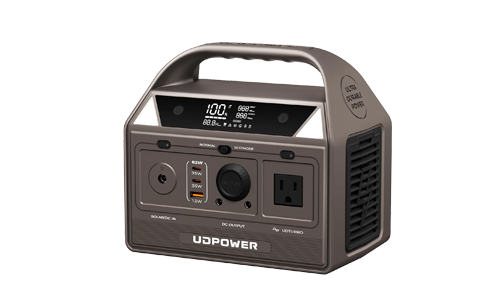
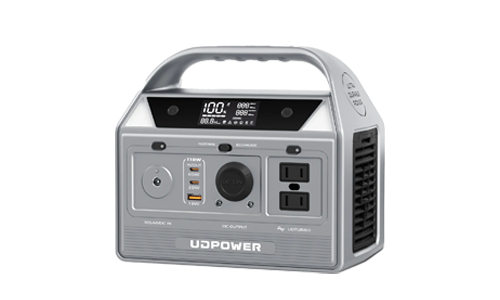
UDPOWER C600 — For TV, Speakers, Phones and Lights

- Battery capacity: 596Wh
- Rated output: 600W
- UDTURBO: up to 1,200W for compatible loads
- Battery: LiFePO4
- Cycle life: 4,000+ cycles
- Weight: about 12.3 lb
- Output ports: 9
The C600 makes sense when your tailgate is centered on a TV, speaker, phone charging and lights. At an example 140W entertainment load, our 90%-efficiency planning estimate is about 3.8 hours.
It is not the best choice if a full-size coffee maker, large blender or electric cooking appliance is a major part of your setup.
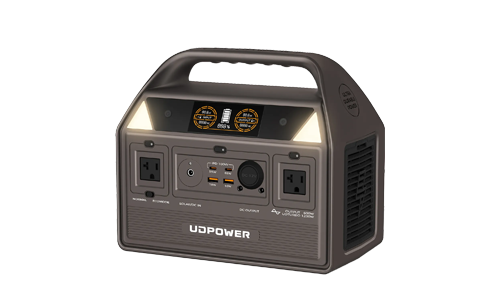
UDPOWER S1200 — The Practical Game-Day Sweet Spot
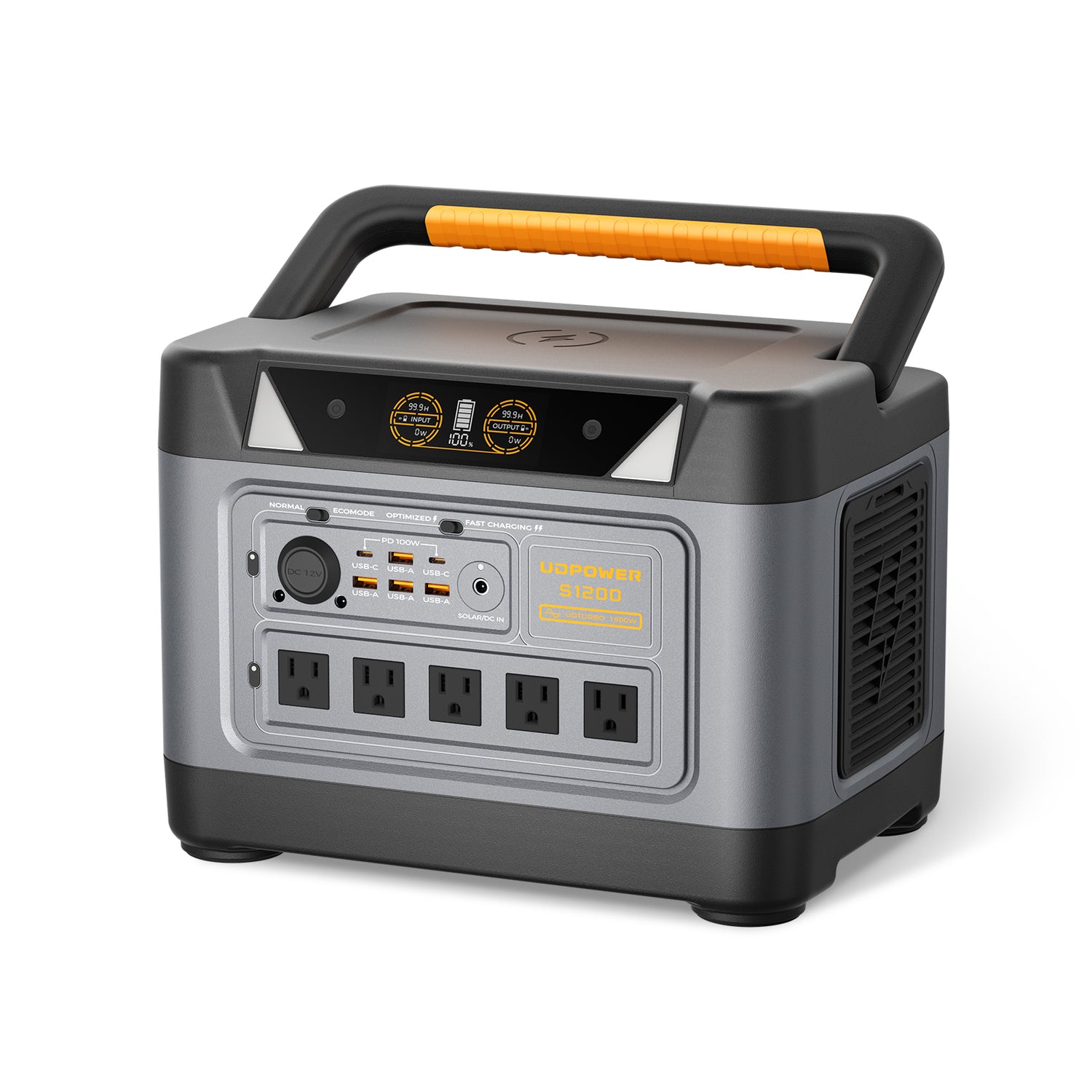
- Battery capacity: 1,190Wh
- Rated AC output: 1,200W pure sine wave
- UDTURBO: up to 1,800W for compatible higher-power devices
- Weight: 26.0 lb
- Output ports: 14 total — 5 AC plus 9 DC/USB outputs
- Fast charging: about 1.5 hours under rated charging conditions
- Battery: LiFePO4, 4,000+ cycles
For a standard tailgate with a TV, portable cooler, speaker and phones drawing around 185W, the S1200 works out to roughly 5.8 hours using the same conservative planning method.
Its bigger advantage is output headroom. You can use more powerful appliances than you could on a 600W-class station, while still keeping the unit manageable enough to move from an SUV or pickup to the parking spot.
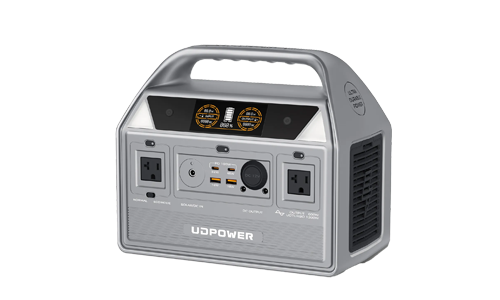
UDPOWER S2400 — For Bigger Groups and High-Wattage Appliances
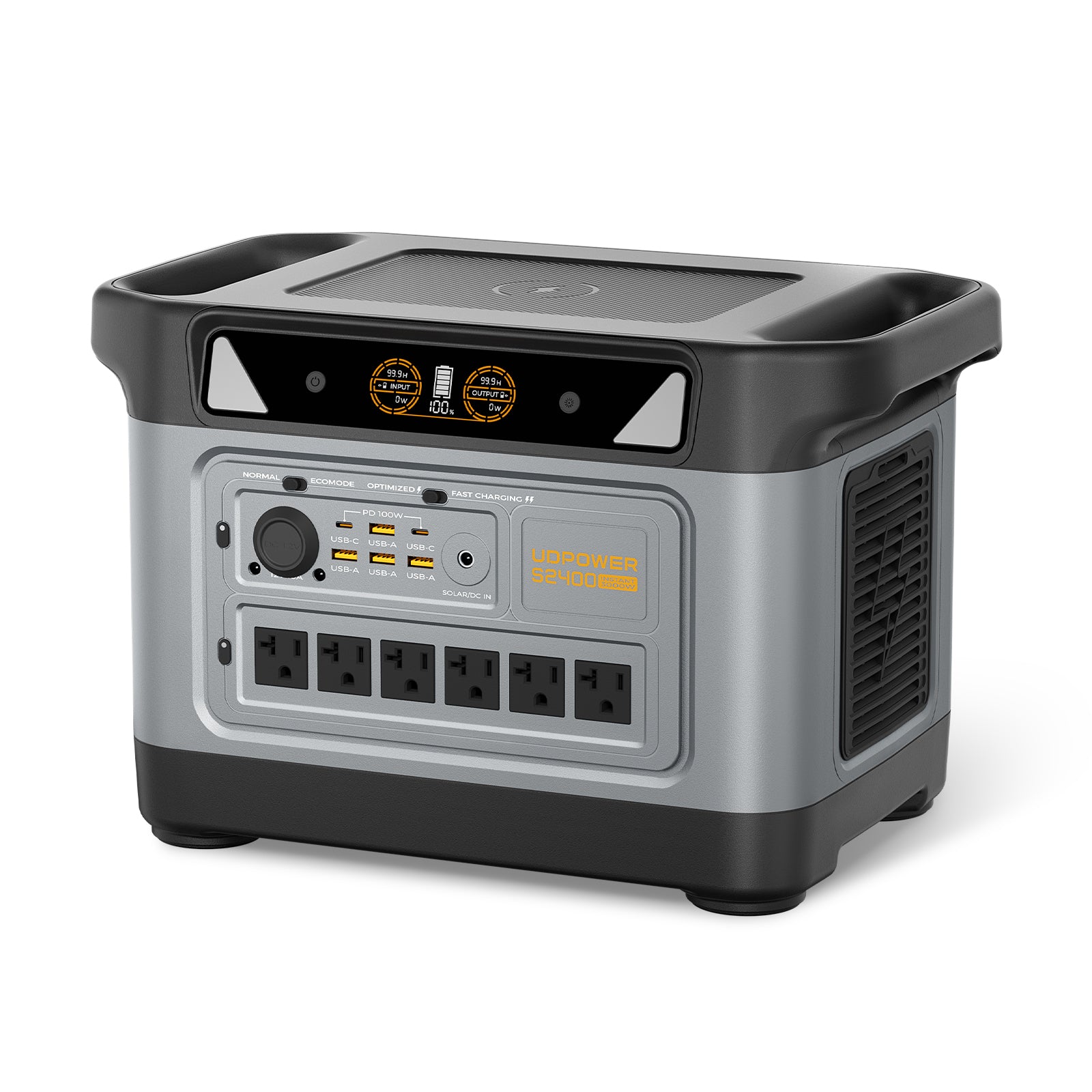
- Battery capacity: 2,083Wh
- Rated AC output: 2,400W pure sine wave
- UDTURBO: up to 3,000W for compatible higher-power loads
- Weight: approximately 40.8 lb
- Output ports: 15 total, including 6 AC outlets
- Fast charging: about 1.5 hours under rated charging conditions
- Battery: LiFePO4, 4,000+ cycles
The S2400 is the better fit when the same station has to handle refrigeration, a TV, sound, phones and larger countertop appliances. A 220W entertainment-and-cooling load works out to roughly 8.5 hours using a 90% planning factor.
More importantly, its 2,400W rated output gives significantly more room for common 1,500W-class heating appliances. Those devices still consume battery energy quickly, so capacity planning remains just as important as output wattage.
You can compare the broader lineup on the UDPOWER portable power station collection or browse portable power stations for camping and outdoor use.
Portable Power Station vs. Generator for Tailgating
People searching for a generator for tailgating often mean any portable source of 120V power. Battery power stations and engine-driven generators can both do that, but the game-day experience is different.
| Factor | Battery Portable Power Station | Gas / Fuel Generator |
|---|---|---|
| Noise | Usually very quiet except for cooling fans under load | Engine runs while producing power |
| Exhaust | No combustion exhaust at the point of use | Produces exhaust including carbon monoxide |
| Fuel | No gasoline or propane to transport for operation | Fuel storage and refueling required |
| Setup | Charge, place safely, turn on output and plug in | Fuel, engine startup and exhaust placement required |
| Runtime | Limited by stored Wh unless recharged | Can continue with additional fuel |
| High continuous loads | Depends heavily on inverter output and battery capacity | Large inverter generators can support substantial loads |
| Venue considerations | Still check venue rules | Fuel, exhaust and noise rules may apply |
For a deeper comparison, see Portable Power Station vs. Generator for Camping . Many of the same noise, fuel, portability and runtime considerations apply to tailgating.
How to Set Up a Tailgate Power Station Without Wasting Battery
1. Fully Charge Before Leaving Home
Starting at 80% instead of 100% can remove an hour or more of useful runtime from a larger entertainment setup. Charge the station the night before and verify that the AC and DC outputs work before loading the vehicle.
2. Set Up in Shade
A blacktop parking lot can become extremely hot even when the air temperature seems manageable. Keep the station out of direct sun when possible and do not place it inside a sealed cooler, storage box, or bag while operating. The cooling vents need airflow.
3. Put the Continuous Loads on First
Start with the equipment you expect to run for most of the tailgate:
- Cooler or refrigerator
- TV
- Speaker
- Lighting
- Phone and USB charging
Watch the displayed output after everything is connected. That gives you a much more useful number than a generic appliance chart.
4. Use High-Wattage Appliances One at a Time
If the TV, cooler and speakers are already running, do not automatically add a coffee maker, air fryer and griddle together. Temporarily turning off optional loads gives a high-watt appliance more output headroom.
5. Prefer Direct USB and DC Connections When Practical
If a phone can charge directly from USB-C, there is little reason to plug its wall adapter into an AC outlet. Likewise, a compatible 12V compressor cooler can often use the station's 12V output directly. Keeping the setup simple also reduces cable clutter around the vehicle.
6. Build in a Postgame Reserve
Your battery may be more useful after the game than before it. Saving some capacity means you still have lighting and phone power while waiting for the parking lot to clear.
Check Stadium and Parking-Lot Rules Before You Pack
There is no single generator rule that applies to every NFL or college parking lot. Venue policies can differ on generators, fuel, tents, grills, parking-space boundaries and tailgating hours.
For example, the Minnesota Vikings tailgating policy specifically addresses portable generators, while the Washington Commanders tailgating policy publishes its own parking-lot rules and permitted tailgating hours.
The NFL also recommends checking the individual team's website for stadium-specific requirements: NFL stadium guidance.
Tailgate Power Safety Checklist
- Keep the power station dry and away from standing water.
- Do not block cooling vents.
- Do not leave the station baking in direct sun when shade is available.
- Check cords for cuts, loose plugs or heat damage before use.
- Use outdoor-rated cords outdoors.
- Make sure extension cords are rated for the appliance load.
- Avoid routing cords through walking or vehicle traffic areas.
- Do not daisy-chain multiple extension cords or power strips.
- Plug large heating appliances directly into an appropriate power-station outlet when possible.
- Keep drinks, melting ice and coolers away from electrical connections.
The Electrical Safety Foundation International recommends matching extension-cord ratings to the connected appliance, avoiding overloads and using cords specifically marked for outdoor use when operating outside. See ESFI extension-cord safety guidance.
How to Choose Between 600Wh, 1,000Wh and 2,000Wh for Game Day
If you are still deciding, use this shortcut:
| If Your Tailgate Looks Like This... | Start Around... | UDPOWER Example |
|---|---|---|
| One TV, speaker, phones, a few lights | 500–600Wh | C600 |
| TV, cooler or mini fridge, sound, phones, lights, occasional small appliance | About 1,000Wh+ | S1200 |
| Large group, long event, refrigeration and regular high-wattage cooking | About 2,000Wh+ | S2400 |
If you need more help estimating capacity, the UDPOWER watt-hour planning guide explains how to turn individual appliance loads into a complete outdoor power budget.
Frequently Asked Questions
What size portable power station is best for tailgating?
For a typical setup with a TV, speaker, phones, lights and portable refrigerator or cooler, roughly 1,000Wh of battery capacity and 1,000–1,500W of output is a practical starting point. Smaller setups can use 500–600Wh, while large all-day tailgates may benefit from 2,000Wh or more.
Can a 600W power station run a TV at a tailgate?
Yes. Most modern TVs use far less than 600W. A 55-inch TV often uses roughly 70–120W, leaving plenty of output capacity for phones, lights and a small speaker. Battery runtime, rather than inverter output, is usually the bigger consideration.
How long will a portable power station run a TV?
It depends on TV wattage and battery capacity. Using a 90W TV and a 90% planning factor, a 596Wh C600 is roughly a 6-hour estimate, a 1,190Wh S1200 about 11.9 hours, and a 2,083Wh S2400 about 20.8 hours if the TV is the only load.
What is the best way to power a TV while tailgating?
A charged portable power station with pure sine wave AC output is one of the easiest options. Check the TV's actual wattage, plug it directly into the station, keep the battery shaded and dry, and include speakers and streaming equipment in your runtime calculation.
Can a portable power station run a mini fridge at a tailgate?
Often, yes. Many mini fridges use roughly 50–120W while the compressor is running, but startup demand can be higher. Make sure the station can handle both the normal load and compressor startup.
Can I run an electric griddle from a portable power station?
Yes if the station's output supports the griddle's input wattage, but battery consumption can be substantial. A 1,500W griddle operating for 30 minutes uses about 750Wh before conversion losses, so frequent electric cooking favors a larger-capacity station.
Is a portable power station better than a generator for tailgating?
For TVs, phones, refrigerators, speakers and smaller appliances, a battery power station is often easier because it does not require fuel and does not produce combustion exhaust at the point of use. A fuel generator may be better for very long events or sustained high loads if venue rules allow it. Always check the specific stadium or parking-lot policy.
Do stadiums allow portable generators for tailgating?
Rules vary by venue. Some parking lots permit certain portable generators subject to safety and noise rules, while others impose different equipment or fuel restrictions. Check the official stadium or team tailgating policy before game day.
Can I leave a portable power station in the car during the game?
Avoid leaving a battery station in extreme heat or direct sun for long periods. Vehicle interiors can become much hotter than the outdoor air. Follow the storage temperature limits listed in your power station's manual.
Should I buy more watts or more watt-hours for tailgating?
You need enough of both. Watts determine whether your connected appliances can operate at the same time. Watt-hours determine how long they can operate. Once your output requirement is comfortably covered, additional battery capacity usually gives a tailgater more practical value than unused inverter wattage.
Final Takeaway
A good tailgate power station should disappear into the background of game day. You should not be constantly switching things off, worrying about fuel or discovering at halftime that the battery is nearly empty.
Start by separating your plan into maximum simultaneous watts and total watt-hours. A simple TV-and-speaker setup may need only a 500–600Wh battery. A typical group running a TV, cooler, phones and sound is better served by roughly 1,000Wh. If electric cooking becomes part of the plan, moving toward a 2,000Wh-class station can make a major difference.
Most importantly, calculate the devices you will actually bring instead of buying from a generic wattage recommendation. Five minutes with the appliance labels before leaving home can save hours of frustration in the parking lot.
Build Your Game-Day Power Setup
Compare UDPOWER portable power stations for lightweight tailgates, family game days and larger all-day setups.
View Portable Power StationsRelated Articles


