

What Is a Prepaid Meter? How Pay-As-You-Go Electricity Works
Last updated: September 24, 2026
Quick answer: A prepaid electricity meter or prepaid electric service lets you pay for electricity before you use it instead of receiving a bill after a monthly billing cycle. You add money to an account, the meter records your electricity use, and your provider deducts applicable energy charges and other account charges from that prepaid balance.
When the balance gets low, many providers send a text, email, app, or account notification. If the balance reaches the provider's disconnection threshold, service may be shut off until enough money is added to restore the required balance.
One important point often missed in prepaid-meter explanations is that a prepaid meter is not necessarily a special type of meter. In many U.S. programs, prepaid electricity is a billing arrangement running on an advanced or smart meter. The same basic smart-meter technology can also be used for normal postpaid service.

What Is a Prepaid Meter?
A prepaid meter is an electricity metering and billing setup in which you purchase electricity service before using it. It is also commonly called a prepayment meter, pay-as-you-go electricity meter, PAYG meter, or simply prepaid electricity.
The easiest comparison is a prepaid phone account. Instead of using electricity for several weeks and then receiving a bill, you maintain money in the account first. As electricity is consumed and account charges are applied, that balance declines.
However, there is an important U.S.-specific distinction. A household may have prepaid electric service without having the old-style key, card, or token meter often associated with prepaid energy in other countries. In Texas, for example, prepaid electric service can use advanced-meter data and remote communication systems. Middle Tennessee Electric also states that an Advanced Meter Infrastructure, or AMI, meter is required for its Prepay service.
| Term | What It Actually Means | Does It Describe the Meter or the Billing Method? |
|---|---|---|
| Prepaid electricity | You fund the electricity account before using the electricity. | Primarily a billing and payment method. |
| Postpaid electricity | You use electricity first and are billed afterward. | Billing and payment method. |
| Smart meter / AMI meter | An advanced meter capable of recording detailed usage and communicating data with the utility. | Metering technology. |
| Traditional prepaid key or card meter | A meter that receives prepaid credit through a physical key, card, token, or similar mechanism. | Specific meter and payment implementation. |
The U.S. Energy Information Administration reported more than 123 million residential Advanced Metering Infrastructure meters in 2024. That does not mean those customers are all on prepaid plans. It shows why the words smart meter and prepaid meter should not be treated as synonyms.
Source: U.S. Energy Information Administration — Advanced Metering Count
How Does Pay-As-You-Go Electricity Work?
The basic process is simple, but the exact timing differs among utilities.
Step 1: You Put Money Into the Electricity Account
You add money through one of the payment methods approved by your provider. Depending on the program, that may be a website, smartphone app, automated phone system, utility office, retail payment location, physical meter key, card, or another authorized system.
Step 2: The Meter Records How Much Electricity You Use
Your home continues to consume electricity normally. The meter records that consumption in kilowatt-hours, or kWh.
Modern U.S. prepaid programs often rely on an AMI meter that can send consumption information back to the utility without someone visiting your home to read the meter.
Step 3: Your Provider Calculates the Charges
The provider applies the rate and other applicable account charges to the measured usage. The amount is then deducted from your prepaid balance.
This is one of the biggest differences between how prepaid electricity is often described and how an actual U.S. utility program may work. Your app may feel close to real time, but the billing calculation itself can still be based on daily or periodic meter data.
Step 4: Your Balance Falls as Charges Are Applied
If you start with $50 of credit and your account is charged an average of $5 per day, the balance will decline by roughly $5 each day unless you add more money.
That does not necessarily mean $5 represents energy consumption alone. Depending on your provider and plan, the debit can also include customer charges, delivery charges, fees, taxes, or repayments tied to the account.
Step 5: You Receive Low-Balance Alerts
Many programs let customers receive notifications through text, email, an app, or an online portal. The provider may establish a warning threshold, or you may be able to choose your own alert level.
Consumers Power, for example, says it sends a disconnect warning when the prepaid account drops below a $20 credit balance. Middle Tennessee Electric says participants are notified through its system when the account falls below $25.
Step 6: Service Can Be Disconnected if the Balance Gets Too Low
If you do not add money, the meter or utility system may remotely disconnect service when the account reaches its specified cutoff point.
Exactly when that happens is provider-specific. Some programs disconnect at zero, some at a negative balance, some protect certain days, and others explicitly state that weekends or bad weather do not stop prepaid disconnection.
Step 7: You Add More Credit to Restore Service
After a payment brings the account back to the required balance, many smart prepaid systems can reconnect automatically without a technician visiting the property.
Consumers Power says service is typically restored within about 15 minutes after adequate payment is made. Indian Electric Cooperative also states that power should normally return within approximately 15 minutes once the required positive balance is restored. These are examples, not universal reconnection times.
How Is Prepaid Electricity Credit Deducted?
A common misconception is that buying $50 of prepaid electricity means purchasing a fixed block of electricity that always represents the same number of kWh. In many programs, what you actually maintain is a dollar balance.
Your usage is measured in kWh, but the account converts that usage into charges based on your tariff.
Daily kWh used × electricity rate + applicable fixed charges + delivery charges + fees/taxes + account-specific adjustments
Suppose a home uses 20 kWh in one day and the energy portion of the rate is $0.15 per kWh. The energy component would be approximately $3 for that day:
But if the plan also applies a customer charge, delivery charge, debt repayment, or other fee, the actual reduction in prepaid credit could be higher than $3.
This is why the most useful number for a prepaid customer is often not simply the electric rate. It is the average number of dollars being deducted from the account each day.
If you want to understand whether your household's electricity consumption is high or low before evaluating your prepaid balance, see UDPOWER's How Many kWh Per Day Is Normal in the U.S.? guide.
How Do You Top Up a Prepaid Meter?
The correct method depends entirely on your electricity provider. Never send a payment to a third-party website or enter a meter code from an unofficial seller just because it appears in a search result or advertisement.
| Top-Up Method | How It Usually Works | Where It Is Common | What to Check |
|---|---|---|---|
| Utility app | Add money with a saved or new payment method and receive electronic confirmation. | Common with smart prepaid programs. | Confirm the account and service address before paying. |
| Utility website | Log in, select the prepaid account, and purchase additional credit. | Common in U.S. prepaid programs. | Use the provider's official website. |
| Automated phone payment | Call the provider's official payment number and follow the prompts. | Offered by many U.S. cooperatives. | Check when the payment will post. |
| Retail payment location | Pay cash or another accepted method through an authorized payment partner. | Available with selected utilities and electricity retailers. | Keep the receipt until the balance is confirmed. |
| Utility office | Make a payment directly through a local office. | Available with some cooperatives and municipal utilities. | Office hours may affect when credit posts. |
| Physical key, card, or token | Purchase credit and transfer or enter it into the meter. | More common in traditional prepaid systems outside the U.S. | Follow the meter supplier's exact instructions. |
After You Make a Payment
Confirm that the payment was accepted and that the prepaid balance actually increased. If electricity had already been disconnected, switch off unnecessary appliances before service is restored so that large loads do not all restart simultaneously.
If the provider says reconnection should happen automatically but the power does not return within its stated time window, check whether the payment successfully posted, whether the account meets the required minimum balance, and whether your neighborhood is experiencing a utility outage.
Do not open the meter enclosure, remove a utility seal, or attempt to bypass the meter.
What Happens When Prepaid Electricity Runs Out?
There is no single nationwide answer. The most accurate answer is: your provider follows the disconnection threshold and reconnection rules in your prepaid service agreement.
The table below shows why that distinction matters.
| U.S. Example | Low/Zero-Balance Rule | Reconnection Requirement | Important Detail | Source |
|---|---|---|---|---|
| Middle Tennessee Electric | Account is subject to disconnection when the balance reaches zero or becomes negative. | Payment must process sufficiently to restore service. | No monthly paper bill; account is calculated daily. | MTE PrePay |
| Consumers Power, Inc. | Automatic disconnection when the account reaches a negative balance. | Account must be restored to at least a $25 credit balance, including applicable fees. | Its published policy says disconnections do not occur on Thursday, Friday, weekends, or holidays. | CPI Prepay |
| South Plains Electric Cooperative | Service may automatically disconnect if funds fall to a negative balance. | Outstanding balance must be paid and a minimum positive credit restored. | Its published policy says holidays, weekends, and inclement weather do not automatically prevent prepaid termination. | SPEC PrePay |
| Texas competitive retail prepaid service | Customers receive electronic balance and disconnection information under state prepaid-service rules. | Requirements depend on the Retail Electric Provider and plan. | Texas describes prepaid service as electricity purchased before it is used and requires an advanced metering system for these plans. | Public Utility Commission of Texas |
Does the Power Come Back Immediately After You Recharge?
Sometimes it comes back within minutes, but not always. Remote reconnection still depends on the payment being posted, the required balance being reached, communications with the meter working correctly, and there being no separate grid outage or electrical problem.
Consumers Power advises customers to contact the utility if service has not automatically returned within 30 minutes after payment. Your provider may specify a different window.
What Is Emergency Credit on a Prepaid Meter?
Emergency credit is temporary electricity credit that some providers make available when a prepaid balance becomes very low or is exhausted. Think of it as borrowed utility credit rather than free electricity.
If you use emergency credit, the amount normally has to be repaid from a future top-up.
Emergency credit is strongly associated with prepaid electricity markets such as Great Britain. Ofgem explains that prepayment customers may be able to obtain temporary credit when they cannot top up, while individual suppliers set the amount and activation process.
Source: Ofgem — Get Help With Your Prepayment Meter
Is Emergency Credit Available on U.S. Prepaid Electricity?
Do not assume it is.
U.S. prepaid programs often focus on low-balance alerts, positive-balance requirements, scheduled disconnection rules, remote reconnection, or provider-specific customer protections instead of using a universal feature called “emergency credit.”
One provider may allow the balance to move slightly below zero before disconnection. Another may disconnect as soon as its threshold is reached. Another may delay disconnection on selected days. These mechanisms are not necessarily the same as formal emergency credit.
| Feature | What It Means | Do You Repay It? | Is It Universal? |
|---|---|---|---|
| Emergency credit | Temporary provider credit after normal prepaid funds become low or depleted. | Generally yes. | No. |
| Friendly-hours credit | Service may remain available during protected nights, weekends, or holidays under some systems. | Usually yes if energy is used on credit. | No. |
| Negative-balance allowance | The account may continue briefly below zero before the provider's disconnect event. | Yes. | No. |
| Low-balance alert | A notification that tells you to add funds before the cutoff threshold is reached. | Not applicable. | Common, but details vary. |
If emergency credit matters to you, ask the provider directly: “What happens if my prepaid balance reaches zero, and do you offer emergency credit, a protected period, or another temporary-credit option?”
Prepaid vs. Postpaid Electricity: What's the Difference?
The difference is primarily when you pay, but that timing changes how you manage the account.
| Feature | Prepaid Electricity | Traditional Postpaid Electricity |
|---|---|---|
| When you pay | Before or as electricity is consumed. | After electricity has already been consumed. |
| Monthly bill | May not receive a traditional monthly bill. | Usually receives a regular billing statement. |
| Account balance | You monitor remaining prepaid credit. | You monitor the amount owed. |
| Deposit | Some programs reduce or eliminate a traditional security deposit, although initial funding may still be required. | A deposit may be required depending on provider rules and credit history. |
| Risk when funds run out | Service can be disconnected once the prepaid cutoff condition is reached. | Disconnection usually follows unpaid-bill procedures and applicable notices. |
| Usage awareness | Often encourages frequent checking because remaining dollars are visible. | Usage may still be highly visible if the customer has a smart-meter portal. |
| Payment frequency | Can involve frequent smaller payments. | Usually one regular billing cycle, although other payment arrangements may exist. |
| Price | Depends on the prepaid tariff, fees, and provider. | Depends on the postpaid tariff, fees, and provider. |
Neither payment method automatically makes a home more energy efficient. A refrigerator using 1 kWh still uses 1 kWh whether the electricity was prepaid yesterday or billed next month.
Prepaid Meter vs. Smart Meter: They Are Not the Same Thing
This is one of the most important distinctions in the entire topic.
Prepaid describes how you pay for electricity. Smart meter describes what the meter can measure, record, and communicate.
The U.S. Department of Energy describes Advanced Metering Infrastructure as a system involving advanced meters, data systems, and communications that can support two-way communication between the utility and customer systems.
Source: U.S. Department of Energy — Advanced Metering Infrastructure
| Question | Prepaid Service | Smart Meter |
|---|---|---|
| What is it? | A payment arrangement. | A metering and communications technology. |
| Do you pay before use? | Yes. | Not necessarily. |
| Can it send usage data remotely? | Depends on the meter used. | Typically yes as part of the advanced-meter system. |
| Can it be postpaid? | No, by definition prepaid service is funded in advance. | Yes. Most smart meters do not require prepaid billing. |
| Can a prepaid account use one? | Yes. | Yes. Many modern prepaid programs rely on smart/AMI meters. |
If your goal is broader visibility into household demand rather than changing the way you pay your electric bill, see Smart Home Energy Management: Save Energy & Plan Backup.
Advantages and Disadvantages of Prepaid Electricity
Prepaid service is neither automatically better nor automatically worse than postpaid electricity. Its usefulness depends on the provider's rates and rules and on how you prefer to manage household spending.
| Potential Advantage | Why It Can Help | Trade-Off to Check |
|---|---|---|
| Visible account balance | You can see money leaving the account as electricity is used. | A dollar balance is not always updated in real time. |
| Smaller, more frequent payments | Some households find smaller top-ups easier to budget than a large monthly bill. | You must remember to keep the account funded. |
| Potentially lower deposit requirement | Some utilities use prepayment instead of a conventional security deposit. | Initial account funding or setup charges may still apply. |
| Daily usage feedback | Frequent balance changes make high-consumption days easier to notice. | Weather can make the balance decline much faster than expected. |
| No large surprise bill at the end of the month | Costs are deducted as the account operates. | The consequence of not keeping enough money in the account can be faster disconnection. |
| Remote payment and reconnection | Smart prepaid systems may restore service without a technician visit. | Payment processing or meter communications can still delay reconnection. |
Who May Find Prepaid Electricity Useful?
It can make sense for households that prefer to see electricity spending continuously, want to divide utility costs into smaller payments, or qualify for a prepaid program that avoids a conventional deposit.
Who Should Look Closely at the Rules Before Enrolling?
Households that rely on continuous electricity for medically necessary equipment should pay particular attention to eligibility restrictions and disconnection protections.
For example, Middle Tennessee Electric excludes accounts on its medical necessity or Life Support program from Prepay. The Public Utility Commission of Texas states that prepaid service is not available to Critical Care or Chronic Condition residential customers under the rules described in its consumer prepaid-electric-service guidance.
Does a Prepaid Meter Save Money?
A prepaid meter does not automatically reduce the amount of electricity your appliances use.
If your air conditioner consumes 30 kWh over a period of hot weather, changing the account from postpaid to prepaid does not make those 30 kWh disappear.
Prepaid service may still change household behavior because the financial feedback is more visible. Seeing a $30 balance fall to $23 after a high-use day can make energy consumption feel more immediate than waiting several weeks for a bill.
Whether the plan actually costs less depends on the full tariff:
The number that matters is the total amount you pay for the electricity and associated service over time, not simply whether the meter says “prepaid.” Compare the energy rate, delivery charges, customer charges, payment fees, connection requirements, and any other charges in the agreement.
The Public Utility Commission of Texas specifically advises prepaid customers to review their Prepaid Disclosure Statement and Terms of Service for plan fees and charges.
Source: Public Utility Commission of Texas — Prepaid Electric Service
For a broader explanation of what actually affects residential electricity consumption, see Electricity Saving Box: Does It Really Lower Your Electric Bill?.
How Long Will Your Prepaid Electricity Balance Last?
You do not need to guess based only on your cents-per-kWh rate. For most households, a better approach is to calculate the actual rate at which dollars have been leaving the prepaid account.
Method 1: Use Your Real 7-Day Account History
(Starting balance + top-ups − ending balance) ÷ number of days
Imagine your balance was $40 seven days ago. You added $20 during the week, and today you have $25 remaining.
If your current balance is $18 and your recent usage pattern stays similar:
This method is especially useful because it automatically reflects most charges that are actually hitting your account rather than relying on energy rate alone.
Method 2: Estimate From kWh
Daily kWh × electricity rate
If your household uses 25 kWh per day at an energy rate of $0.16/kWh, the energy portion would be about $4 per day before any additional account charges.
If you do not know your normal daily electricity consumption, check your utility portal or use your monthly kWh. UDPOWER's U.S. daily kWh guide explains how to calculate it from an electric bill.
Why Your Balance Can Suddenly Drain Faster
A balance that normally lasts six days might last only three during a heat wave or cold snap. Air conditioning, electric resistance heating, heat pumps using auxiliary heat, electric water heaters, clothes dryers, EV charging, pool equipment, and other high-energy loads can change daily consumption dramatically.
If you are trying to understand the difference between energy consumption and instantaneous electrical demand, see How Many Watts Does a House Use?.
No Credit or Power Outage? How to Tell the Difference
When the lights suddenly go out in a prepaid home, the prepaid balance is only one possible cause.
| What You See | More Likely Cause | What to Check |
|---|---|---|
| Account shows zero or negative balance and nearby homes still have power | Prepaid-service disconnection | Top up through the provider's approved channel and confirm the required reconnect balance. |
| Neighbors and streetlights are also out | Utility grid outage | Check the utility outage map or outage phone line. |
| Only one room or group of outlets is off | Possible breaker, GFCI, or household electrical issue | Check the electrical panel only if it is safe to do so. |
| Balance is positive but the entire home is off | Grid outage, reconnect delay, meter communication issue, or another service problem | Check outage information and contact the provider if needed. |
| Payment was made but service has not returned | Payment not posted, minimum balance not met, reconnect delay, or separate outage | Confirm payment status and the provider's reconnect requirement. |
Never attempt to diagnose a prepaid problem by opening the utility meter or bypassing its wiring. If the account is funded and your main breaker appears normal but the home remains without electricity, contact the utility or electricity provider.
What Happens to a Prepaid Meter During a Power Outage?
A prepaid meter does not generate electricity. If the utility grid goes down, having $10, $100, or $500 of prepaid credit cannot keep the house powered.
This is the key difference between an account disconnection and a grid outage.
| Situation | Why Power Stops | Will Adding Credit Fix It? |
|---|---|---|
| Prepaid balance exhausted | The provider disconnects service under the prepaid account rules. | Usually, once the required balance is restored and reconnection completes. |
| Utility grid outage | The electrical distribution system supplying the property has lost power. | No. |
| Household breaker or electrical problem | The problem is on the home's electrical system. | No. |
| Payment/reconnection communication problem | The provider or meter has not completed the reconnect process. | Not necessarily; contact the provider if the payment is already confirmed. |
When the grid returns, a prepaid account that remains in acceptable status should normally be able to receive grid electricity again. If power is restored to your neighbors but not your home, check your prepaid-account status and contact the provider.
Any fixed account charges that apply while little or no electricity is being consumed depend on the specific tariff, so check your provider's agreement rather than assuming the prepaid balance remains completely unchanged during an outage.
Can a Portable Power Station Help With Prepaid Electricity Interruptions?
A portable power station does something completely different from a prepaid electricity meter.
The meter controls and measures electricity coming from the utility. A portable power station stores electricity in a battery and can independently power compatible devices plugged directly into it.
That makes a portable power station useful during a genuine utility outage and potentially useful for keeping selected essentials operating during a short account-service interruption while you resolve a prepaid balance problem.
For a small emergency setup, the priority is usually not running the entire home. It is keeping a few essential loads operating: a refrigerator, phone chargers, Wi-Fi equipment when internet service remains available, lights, laptops, small fans, or compatible medical equipment.
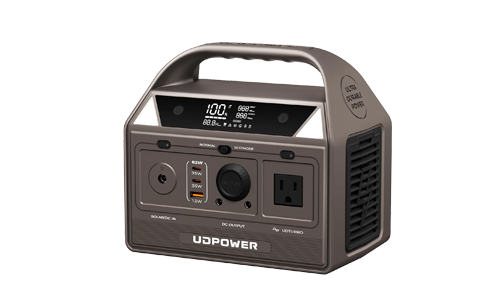
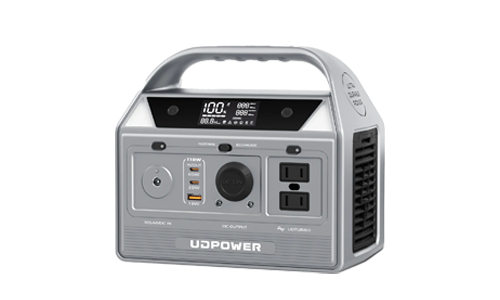
UDPOWER S1200: A Practical Essential-Load Backup
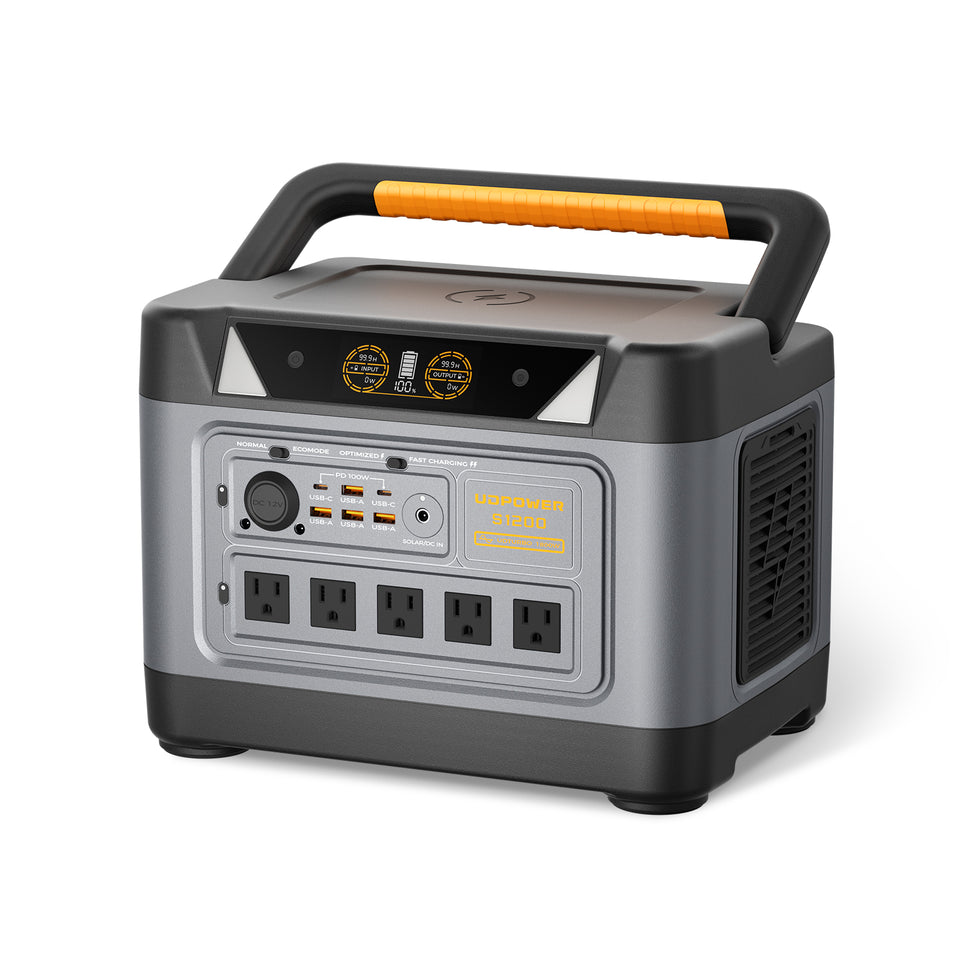
UDPOWER S1200 Portable Power Station
The S1200 is the more compact choice for keeping a selected group of essential devices operating during a temporary power interruption. According to the current UDPOWER product specifications, it provides 1,190Wh capacity and 1,200W rated AC output, weighs approximately 26 lb, uses a LiFePO4 battery, supports up to 400W solar input, and includes UPSPRIME backup switching of up to 10 ms for compatible equipment.
| S1200 Specification | Current Official Specification |
|---|---|
| Battery capacity | 1,190Wh |
| Rated AC output | 1,200W pure sine wave |
| AC outlets | 5 on the current 5-AC version |
| Weight | Approximately 26.0 lb |
| Solar input | Up to 400W |
| UPS switching | ≤10 ms |
| Warranty | 5 years |
| Official product page | View S1200 |
For battery-runtime planning, UDPOWER generally uses a 90% conversion-efficiency assumption. A roughly 100W continuous group of loads would therefore have a first-pass estimate of about:
Actual runtime changes with inverter overhead, appliance cycling, temperature, battery state, and the exact load.
View UDPOWER S1200UDPOWER S2400: More Capacity for Longer Interruptions
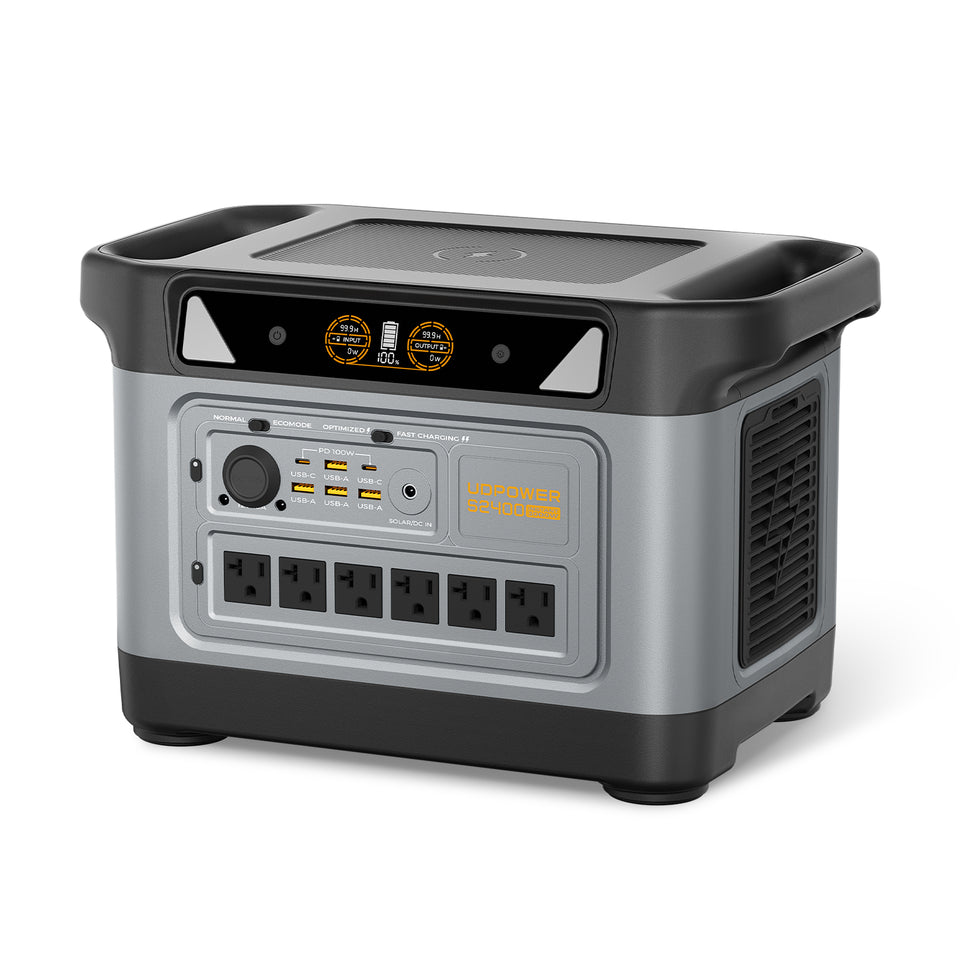
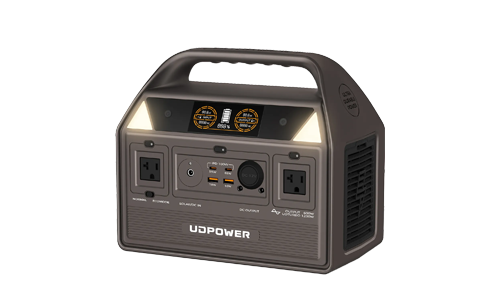
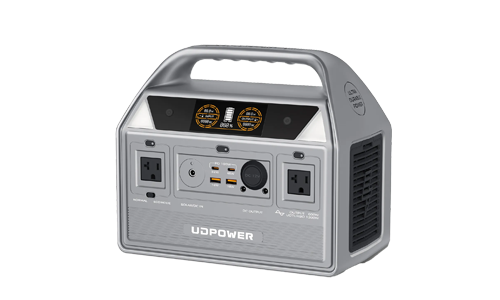
UDPOWER S2400 Portable Power Station
The S2400 provides more battery capacity and higher rated output for households that want to support additional essential devices or extend backup time. The current official specification lists 2,083Wh capacity, 2,400W rated pure sine wave AC output, six AC outlets, approximately 40.8 lb weight, and UPSPRIME switching of up to 10 ms.
| S2400 Specification | Current Official Specification |
|---|---|
| Battery capacity | 2,083Wh |
| Rated AC output | 2,400W pure sine wave |
| AC outlets | 6 |
| Weight | Approximately 40.8 lb |
| Solar charging | Up to 400W |
| UPS switching | ≤10 ms |
| Warranty | 5 years |
| Official product page | View S2400 |
Using the same 90% planning factor, a roughly 100W continuous group of loads would have a first-pass estimate of:
This is an estimate rather than a guaranteed runtime. Refrigerators and other compressor appliances cycle on and off, while actual inverter losses and operating conditions change the result.
View UDPOWER S2400If you are comparing additional sizes and capacities, see the complete UDPOWER Portable Power Station collection or the Portable Power Stations for Home Backup collection.
What Should You Check Before Choosing Prepaid Electricity?
Do not choose a prepaid plan based only on a claim such as “no deposit” or “pay only for what you use.” Ask enough questions to understand how the account behaves on an ordinary Tuesday and what happens when something goes wrong.
| Question to Ask | Why It Matters |
|---|---|
| What is the actual electricity rate? | A prepaid payment structure does not tell you whether the tariff itself is competitive. |
| What fixed or recurring charges are deducted? | Your balance may fall even when daily kWh use is low. |
| How often is my balance recalculated? | Some programs use daily readings rather than true real-time billing. |
| At what balance do you send an alert? | You need enough warning to recharge before disconnection. |
| At what balance can service be disconnected? | The cutoff may be zero, negative, or another plan-defined amount. |
| Are nights, weekends, holidays, or severe weather protected? | Policies vary substantially among utilities. |
| Do you offer emergency credit or another temporary-credit option? | Do not assume a feature common in another region or utility applies to your plan. |
| How much must I pay to reconnect? | Some utilities require more than simply bringing the balance back to $0. |
| How long should reconnection take? | A remote smart-meter reconnect can be fast, but it may not be instantaneous. |
| What payment methods work after business hours? | A top-up method that posts slowly may be a problem after disconnection. |
| Can I use payment-assistance programs? | Eligibility and processing may differ for prepaid accounts. |
| Are medical or life-support customers eligible? | Some prepaid programs specifically exclude these accounts. |
| Can I switch back to postpaid service? | The provider may require a deposit or settlement of the account before switching. |
Keep a copy of the prepaid service agreement. The rules in that document matter more than general advice found online because they determine how your specific account is funded, disconnected, and reconnected.
Frequently Asked Questions About Prepaid Meters
What is a prepaid electricity meter?
A prepaid electricity meter or prepaid electric service requires you to fund the account before electricity is consumed. As the meter records usage and the provider applies applicable charges, money is deducted from the prepaid balance.
Is a prepaid meter the same as a smart meter?
No. Prepaid describes the payment arrangement, while a smart meter describes the metering technology. A smart meter can support either prepaid or postpaid electricity. Many modern U.S. prepaid programs use smart or AMI meters.
How do I add money to a prepaid electricity meter?
Use a payment channel approved by your provider. Depending on the utility, this may include an app, website, automated phone system, utility office, authorized retail location, or a physical key or card. Always verify that the payment was applied to the correct account.
What happens when a prepaid meter runs out of credit?
Your electricity may be disconnected once the account reaches the provider's cutoff threshold. The exact threshold and timing vary. Some programs disconnect at zero, some when the balance becomes negative, and some have protected periods or other rules.
How quickly does electricity come back after I top up?
Some smart prepaid systems can reconnect within minutes after sufficient payment posts, but there is no universal reconnection time. The account must meet the provider's required balance, the payment must be processed, and there must not be a separate grid or electrical problem.
Do prepaid meters have emergency credit?
Some do, but emergency credit is not universal. It is common in certain prepaid energy markets outside the U.S. U.S. utilities may instead use low-balance alerts, limited negative balances, protected disconnection periods, or other provider-specific rules. Check your own prepaid agreement.
Does prepaid electricity save money?
Not automatically. Prepayment changes when you pay, not how many kWh an appliance consumes. It may make energy spending easier to monitor, but the actual cost depends on the electricity rate, delivery charges, fixed charges, fees, taxes, and your household consumption.
Does a prepaid meter work during a power outage?
The meter may retain account information, but it cannot supply electricity when the utility grid is down. Adding prepaid credit will not restore a grid outage. Check your utility's outage information if the account has credit but the neighborhood has lost power.
How can I estimate how many days of prepaid electricity I have left?
Divide your current balance by your recent average daily account deduction. For a more realistic estimate, calculate the average from several days of actual prepaid-account history because that can include charges beyond the energy rate alone.
Can I switch from prepaid electricity back to postpaid service?
Often yes, but the rules are provider-specific. You may need to settle the prepaid account, meet eligibility requirements, or pay a traditional security deposit before moving back to conventional postpaid service.
Is prepaid electricity a good choice if someone relies on medical equipment?
Check the utility's rules before enrolling. Some U.S. prepaid programs exclude customers enrolled in medical-necessity, life-support, Critical Care, or Chronic Condition programs. Households with medically necessary equipment should also have an appropriate emergency plan for utility outages.
The Bottom Line
A prepaid meter changes the timing of your electricity payment: fund the account first, use electricity second. That can make daily spending easier to see and may reduce the need for a conventional deposit, but it also means the household has to monitor its balance more actively.
The most important lesson is that prepaid electricity rules are not standardized across the United States. One utility may calculate the balance once per day. Another may provide more frequent information. One may delay certain disconnections; another may disconnect even on weekends or during severe weather. Emergency credit may exist in one program and not in another.
Before choosing prepaid service, look beyond the word “prepaid.” Check the full rate, account fees, calculation frequency, low-balance threshold, disconnect rules, reconnection requirement, payment methods, medical-account eligibility, and whether any temporary-credit protection exists.
And remember that prepaid credit and backup electricity solve different problems. Credit keeps your utility account funded. A properly sized portable power station provides stored electricity for selected devices when utility power itself is unavailable.
Prepare for the Power Interruptions a Meter Can't Prevent
If your goal is to keep essential devices running when grid electricity goes down, compare portable battery capacities and rated output based on the appliances you actually need to support.
View Portable Power Stations Explore Home Backup Options View UDPOWER S1200 View UDPOWER S2400Related Articles


