

How Many Watts Are in a Megawatt?
Latest updated: June 12, 2026
A megawatt sounds like a power-plant number, but the math is simple: it is just watts scaled up by one million. The part that usually confuses people is not the conversion itself. It is the difference between watts, kilowatts, megawatts, watt-hours, kilowatt-hours, and megawatt-hours.
Quick Answer: 1 Megawatt Equals 1,000,000 Watts
1 megawatt (MW) = 1,000,000 watts (W). It also equals 1,000 kilowatts (kW).
Use megawatts for large-scale power, such as power plants, utility solar farms, commercial energy systems, and grid reports. Use watts or kilowatts for home appliances, portable power stations, RV equipment, power tools, and everyday backup power planning.

Megawatt to Watt Conversion
A watt measures the rate at which electricity is being used or produced at a specific moment. A megawatt is one million of those watts. The prefix “mega” means one million, so the conversion is direct.
For example, a 2 MW system is 2,000,000 watts. A 0.5 MW system is 500,000 watts. A 0.0024 MW output is 2,400 watts, which is the AC output class of a large portable power station such as the UDPOWER S2400.
Watts, Kilowatts, Megawatts, and Gigawatts Table
The table below gives you the fast conversion ladder. On mobile, slide the table left and right to view all columns.
| Unit | Abbreviation | Equals in watts | Equals in smaller unit | Where you usually see it | Source |
|---|---|---|---|---|---|
| Watt | W | 1 W | Base unit | Phone chargers, LED bulbs, routers, laptops, fans | EIA electricity measurement |
| Kilowatt | kW | 1,000 W | 1 kW = 1,000 W | Microwaves, heaters, EV charging, small solar systems | EIA unit equivalents |
| Megawatt | MW | 1,000,000 W | 1 MW = 1,000 kW | Power plants, utility solar farms, large commercial loads | EIA electricity measurement |
| Gigawatt | GW | 1,000,000,000 W | 1 GW = 1,000 MW | Regional grids, very large generation fleets, national energy reports | EIA unit equivalents |
The jump between each major unit is 1,000. Watts become kilowatts. Kilowatts become megawatts. Megawatts become gigawatts.
Megawatt vs. Megawatt-Hour: The Difference That Actually Matters
This is where many people get stuck. A megawatt is power. A megawatt-hour is energy over time.
| Term | What it measures | Simple meaning | Example |
|---|---|---|---|
| MW | Power | How fast electricity is being used or produced right now | A 1 MW generator can deliver up to 1,000,000 W at a given moment. |
| MWh | Energy | How much electricity is used or produced over time | A 1 MW generator running for 1 hour produces 1 MWh. |
| kW | Power | Useful for appliance size and inverter output | A 1.2 kW appliance draws 1,200 W while running. |
| kWh | Energy | Useful for electricity bills and battery storage | A 100 W device running for 10 hours uses 1 kWh. |
If a 1 MW load runs for 1 hour, it uses 1 MWh. If the same 1 MW load runs for 30 minutes, it uses 0.5 MWh. If it runs for 10 hours, it uses 10 MWh.
What Does 1 Megawatt Look Like in Real Life?
One megawatt is far beyond the power level of most individual home appliances. The table below is only a scale comparison. It does not mean all devices should be run from the same circuit, generator, battery, or power station.
| Example load | Approx. watts per device | How many equal 1 MW at the same moment? | Practical takeaway |
|---|---|---|---|
| LED bulb | 10 W | 100,000 bulbs | Small loads add up slowly. |
| Wi-Fi router | 12 W | About 83,333 routers | Internet backup is a low-watt use case. |
| Laptop | 60 W | About 16,667 laptops | Laptops are usually easy for portable power stations. |
| Refrigerator running average | 100 W | 10,000 refrigerators at 100 W average | Startup surge and compressor cycling still matter. |
| Microwave input | 1,000 W | 1,000 microwaves | Heating appliances move quickly into kilowatt territory. |
| 2,400 W power station output class | 2,400 W | About 417 units at full rated output | Even a large portable station is still a kilowatt-scale device, not a megawatt-scale device. |
The most useful way to think about 1 MW is this: it is a utility-scale or commercial-scale number. A home backup buyer usually needs to think in hundreds or thousands of watts, not millions.
Simple Conversion Formulas
Convert megawatts to watts
Example: 3 MW × 1,000,000 = 3,000,000 W.
Convert watts to megawatts
Example: 2,400 W ÷ 1,000,000 = 0.0024 MW.
Convert kilowatts to megawatts
Example: 500 kW ÷ 1,000 = 0.5 MW.
Convert megawatts to kilowatts
Example: 1.5 MW × 1,000 = 1,500 kW.
Product Bridge: If You Are Comparing Watts for Backup Power, Think Smaller Than a Megawatt
Most shoppers who ask about megawatts are really trying to understand whether a power source can run a refrigerator, CPAP, laptop, fan, microwave, power tool, or RV appliance. For that, the two numbers that matter are:
- Output watts: whether the power station can start and run the device.
- Battery watt-hours: how long the device can run.
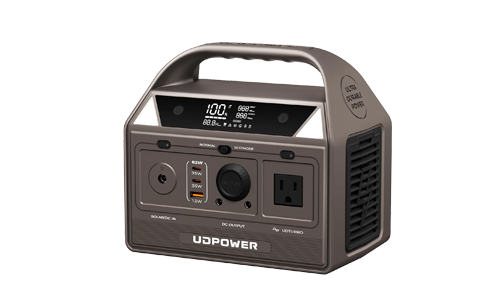
UDPOWER portable power stations are designed for watt- and kilowatt-scale backup power. They are not megawatt systems, and that is exactly why they are portable enough for home backup, camping, RV use, short trips, and emergency essentials.

UDPOWER C400 — Best for light backup, travel, and small devices
The C400 is a compact 400W portable power station with a 256Wh LiFePO4 battery. It is a practical match for phones, laptops, small fans, lights, camera gear, emergency charging, and roadside use.
- Capacity: 256Wh
- Rated AC output: 400W
- Surge support: 800W
- Best fit: small electronics, light camping, emergency charging
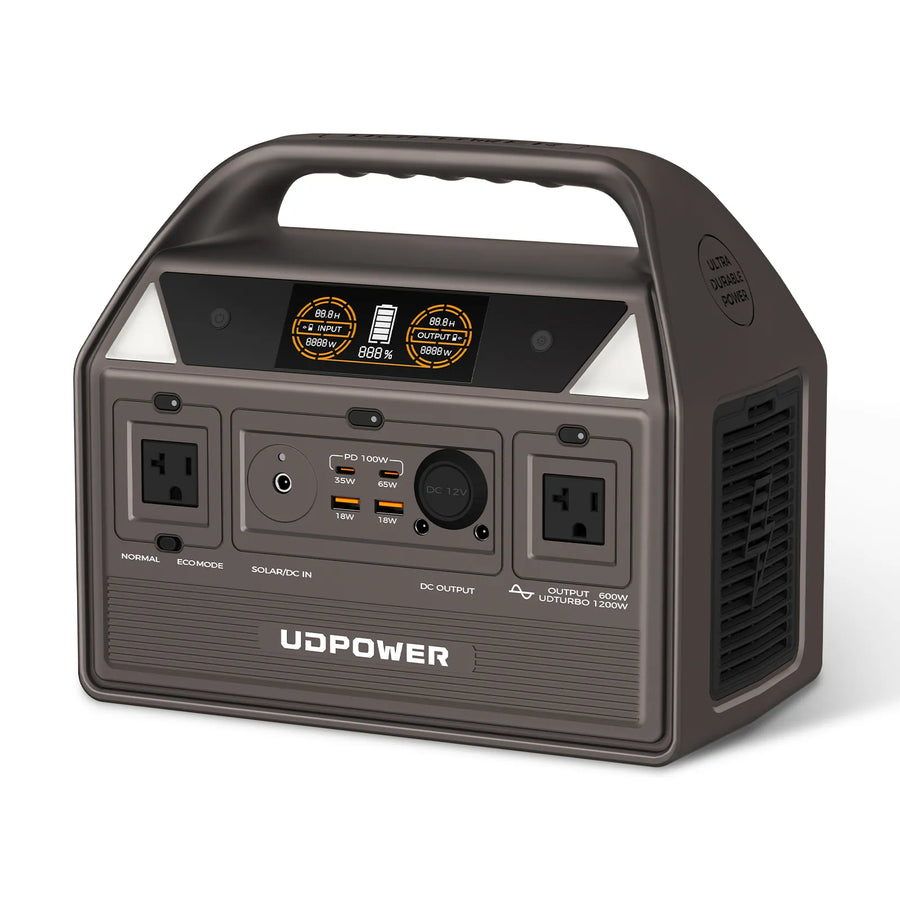
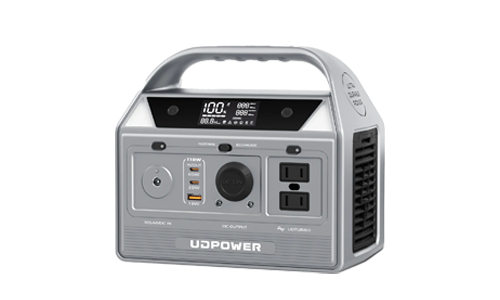
UDPOWER C600 — Best for road trips, mini fridges, and longer small-load runtime
The C600 steps up to 600W rated output and a 596Wh LiFePO4 battery, giving more breathing room for mini fridges, laptops, routers, lighting, fans, and multi-device camping setups.
- Capacity: 596Wh
- Rated AC output: 600W
- Peak output: 1200W
- Best fit: road trips, van life, mini fridge backup, campsite power
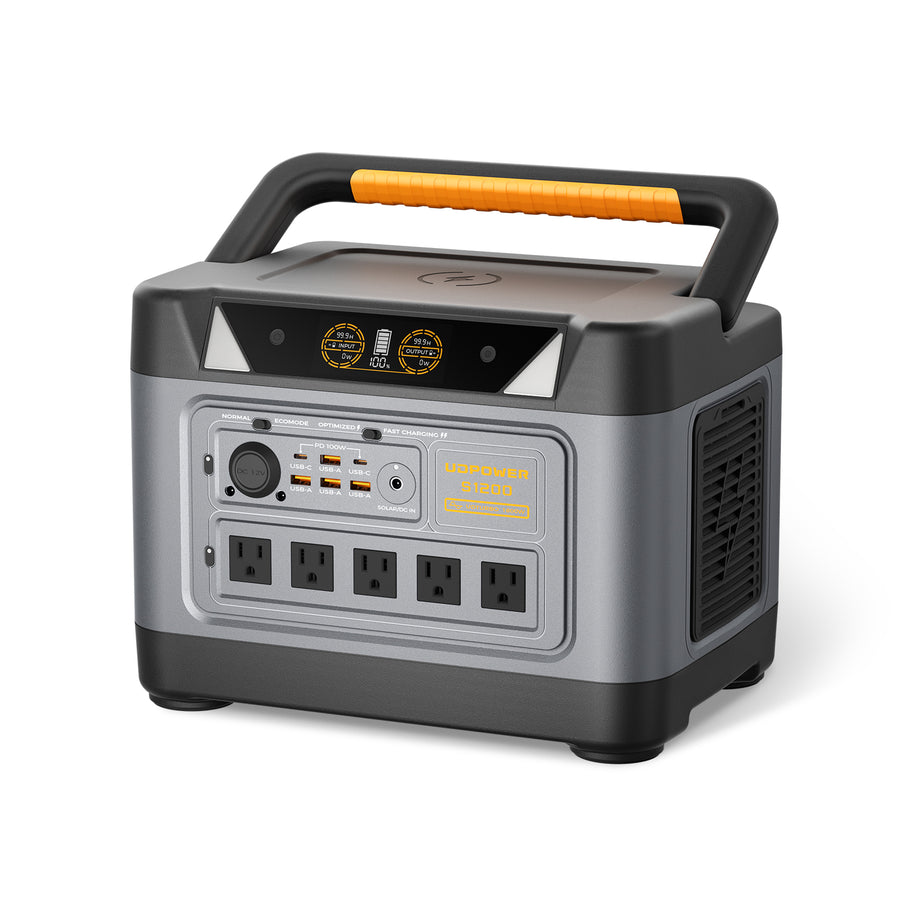
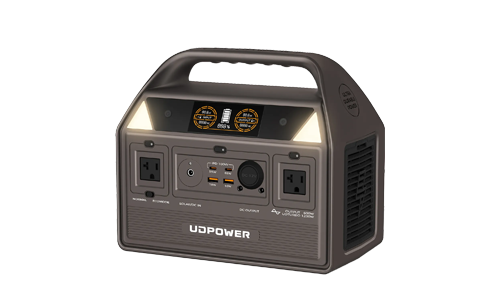
UDPOWER S1200 — Best for home essentials, refrigerators, and CPAP backup
The S1200 is a 1000W-class backup power station with 1,190Wh capacity and 1,200W rated output. It is built for people who need more than phone charging: refrigerators, CPAP machines, routers, lights, TVs, and emergency home backup essentials.
- Capacity: 1,190Wh
- Rated AC output: 1,200W
- UDTURBO surge support: up to 1,800W
- Best fit: refrigerator backup, CPAP backup, home outage essentials
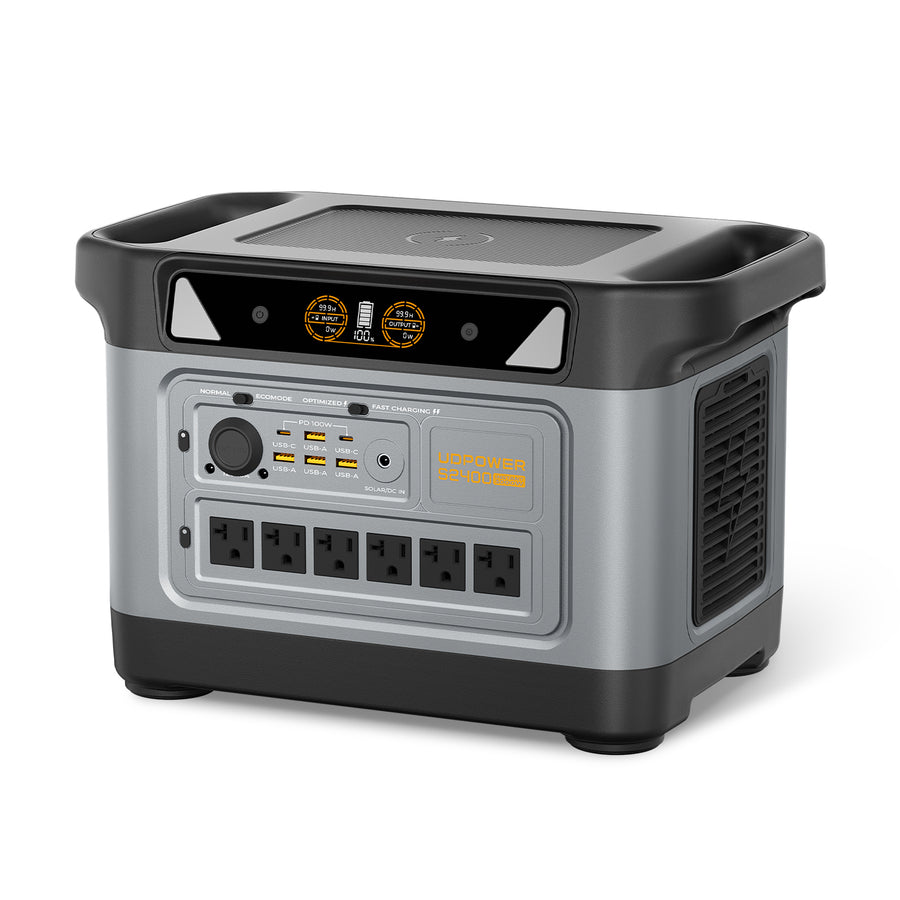
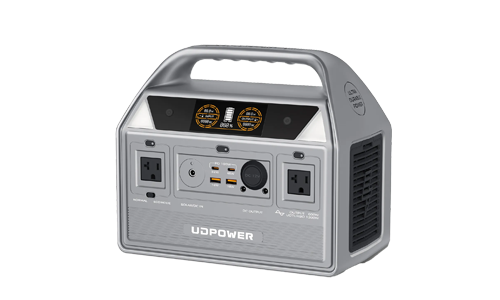
UDPOWER S2400 — Best for higher-watt appliances and heavy backup needs
The S2400 is a 2000W-class portable power station with 2,083Wh capacity and 2,400W rated AC output. It gives more headroom for microwave use, power tools, RV loads, and multi-device emergency backup.
- Capacity: 2,083Wh
- Rated AC output: 2,400W
- UDTURBO surge support: up to 3,000W
- Best fit: larger home backup loads, RV power, microwave, tools
| UDPOWER model | Capacity | Capacity in MWh | Rated AC output | Output in MW | Best use case | Product source |
|---|---|---|---|---|---|---|
| C400 | 256Wh | 0.000256 MWh | 400W | 0.0004 MW | Phones, laptops, fans, lights, emergency charging | UDPOWER C400 |
| C600 | 596Wh | 0.000596 MWh | 600W | 0.0006 MW | Road trips, mini fridge, router, lights, van life basics | UDPOWER C600 |
| S1200 | 1,190Wh | 0.00119 MWh | 1,200W | 0.0012 MW | Refrigerator, CPAP, TV, router, home backup essentials | UDPOWER S1200 |
| S2400 | 2,083Wh | 0.002083 MWh | 2,400W | 0.0024 MW | Microwave, tools, RV loads, heavier emergency backup | UDPOWER S2400 |
Need a broader model comparison? Start with the UDPOWER portable power station collection, then narrow by scenario: home backup, outdoor power, or short trips.
Runtime Examples: Why Watt-Hours Matter More Than Megawatts for Home Backup
Runtime depends on battery capacity, device wattage, inverter loss, temperature, battery condition, and whether a device cycles on and off. For simple planning with UDPOWER portable power stations, use this estimate:
| Model | Battery capacity | Example load | Estimated runtime | What this means in real use |
|---|---|---|---|---|
| UDPOWER C400 | 256Wh | 50W fan | About 4.6 hours | Good for short cooling, campsite airflow, or emergency comfort. |
| UDPOWER C400 | 256Wh | 60W laptop | About 3.8 hours | Useful for remote work or short outage productivity. |
| UDPOWER C600 | 596Wh | 50W fan | About 10.7 hours | Better for overnight airflow or longer camping use. |
| UDPOWER C600 | 596Wh | 100W TV/router setup | About 5.4 hours | Enough for a basic evening backup setup. |
| UDPOWER S1200 | 1,190Wh | 40W CPAP without heated humidifier | About 26.8 hours | Strong fit for optimized CPAP backup during outages. |
| UDPOWER S1200 | 1,190Wh | 150W refrigerator running draw | About 7.1 continuous hours | Real refrigerator runtime may be longer because compressors cycle. |
| UDPOWER S2400 | 2,083Wh | 100W average refrigerator load | About 18.7 hours | Useful for longer fridge backup when actual average draw is modest. |
| UDPOWER S2400 | 2,083Wh | 1,000W microwave input | About 1.9 continuous hours | Microwaves run in short sessions, so output wattage matters more than all-day runtime. |
Why Energy Reports Use Megawatts
Energy agencies and utilities use megawatts because the scale is too large for watts to be readable. The U.S. Energy Information Administration describes utility-scale electricity generation as generation from power plants with at least 1 megawatt, or 1,000 kilowatts, of electricity-generation capacity.
| Scale | Common unit | Why that unit is used | Example context | Reference |
|---|---|---|---|---|
| Single device | W | Small enough to compare directly | 60W laptop, 100W TV, 1,200W appliance | EIA measuring electricity |
| Home or RV backup | W, kW, Wh, kWh | Best for output and runtime planning | 1.2kW output, 1.19kWh battery capacity | UDPOWER portable power stations |
| Commercial or utility-scale generation | MW | Large systems are easier to read in millions of watts | 1 MW and above electricity-generation capacity | EIA generation capacity |
| Regional or national grid scale | GW | Megawatts become too small for very large totals | Large generating fleets and regional capacity reporting | EIA unit equivalents |
Common Mistakes When Converting Megawatts
1. Confusing MW with MWh
MW is power. MWh is energy. A battery is usually described by Wh or kWh because storage is about total energy. A generator or inverter is usually described by W, kW, or MW because output is about power rate.
2. Thinking one megawatt is a normal home backup number
A megawatt equals one million watts. Most home appliances draw tens, hundreds, or a few thousand watts. For home backup, you normally choose between hundreds of watts and a few kilowatts.
3. Ignoring startup surge
Refrigerators, pumps, compressors, and some tools may briefly need more power to start than they use while running. Always compare both running watts and startup watts before choosing backup power.
4. Treating solar panel watts as guaranteed output
A 200W solar panel does not produce 200W every minute of the day. Real output changes with sun angle, shading, temperature, clouds, panel direction, wiring, and the power station’s input limit.
5. Using megawatts when kilowatts would be clearer
You can technically say a 1,200W device is 0.0012 MW, but that makes the number harder for normal readers. Use watts for appliances and kilowatts for larger household loads.
Sources and Data Notes
The conversion data in this guide uses publicly available electricity measurement references, and the product specifications are taken from UDPOWER product pages at the time of the latest update.
| Source | What it supports | Link |
|---|---|---|
| U.S. Energy Information Administration | 1 MW = 1,000 kW = 1,000,000 W; watts vs watt-hours | Measuring electricity |
| U.S. Energy Information Administration | Electricity unit equivalents including kW, MW, GW, and TW | Unit of measure equivalents |
| U.S. Energy Information Administration | Utility-scale generation threshold of at least 1 MW | Generation capacity and sales |
| UDPOWER | Portable power station model specifications and product images | Portable power station collection |
FAQ: Watts and Megawatts
How many watts are in a megawatt?
There are 1,000,000 watts in 1 megawatt. There are also 1,000 kilowatts in 1 megawatt.
How many kilowatts are in a megawatt?
There are 1,000 kilowatts in 1 megawatt. To convert megawatts to kilowatts, multiply by 1,000.
Is 1 MW the same as 1 MWh?
No. MW measures power at a moment in time. MWh measures energy over time. A 1 MW load running for 1 hour uses 1 MWh.
How do I convert watts to megawatts?
Divide watts by 1,000,000. For example, 500,000 watts equals 0.5 MW.
How do I convert megawatts to watts?
Multiply megawatts by 1,000,000. For example, 2 MW equals 2,000,000 watts.
Why do power plants use megawatts instead of watts?
Power plants and utility-scale projects are very large, so megawatts make the numbers easier to read. Writing 1 MW is clearer than writing 1,000,000 W.
Is a portable power station measured in megawatts?
Usually no. Portable power stations are normally measured in watts for output and watt-hours for battery capacity. For example, a 1,200W station is 0.0012 MW.
What is more important for backup power: watts or watt-hours?
Both matter. Watts tell you whether the power station can run the device. Watt-hours tell you how long the device can run.
Can a 1 MW system power a house?
A 1 MW system is far larger than a normal single-home backup setup. Homes usually plan backup power in watts, kilowatts, watt-hours, and kilowatt-hours.
What size UDPOWER model should I choose if I only know my appliance watts?
Choose a model with rated AC output higher than your device’s running watts and enough surge headroom for startup loads. Then use battery Wh × 0.90 ÷ device watts to estimate runtime.
Related Reading
Ready to Choose the Right Backup Power Size?
You do not need a megawatt for everyday backup. Start with the devices you actually want to run, check their watts, estimate runtime, and choose a portable power station with enough output and battery capacity.
View Portable Power Stations Shop Home Backup Power Explore Outdoor PowerRelated Articles


