120V vs 240V Power Differences
What is the difference between 120V and 240V power? This practical guide explains how voltage, amperage, wattage, frequency, and other alternating current units work in U.S. homes. It compares common outlets and appliances, explains why 240V can deliver more power at lower current, and shows why voltage does not determine electricity consumption by itself.
You will also learn how to identify whether an appliance requires 120V or 240V, avoid unsafe adapters and wiring mistakes, calculate appliance power requirements, and choose a compatible backup power source. The guide also clarifies why a 2,400W portable power station is not necessarily a 240V power supply and compares suitable UDPOWER options for standard 120V household devices.
Last updated: July 24, 2026
The direct answer: 120V is the standard voltage used by most plug-in household devices in the United States, while 240V is generally reserved for appliances that need substantially more power, such as electric dryers, ranges, water heaters, central HVAC equipment and Level 2 EV chargers.
The voltage itself is not the same thing as power. Voltage is measured in volts, current is measured in amps and electrical power is measured in watts. At the same amperage, a 240V circuit can deliver twice the wattage of a 120V circuit. For the same wattage, a 240V appliance draws roughly half the current.
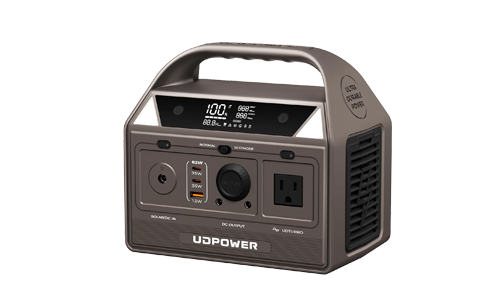
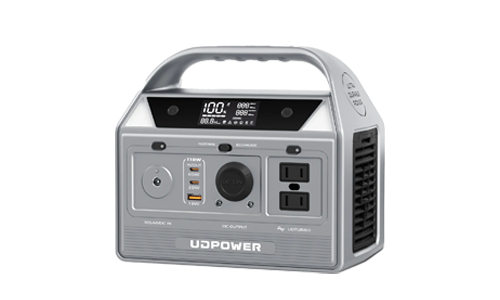
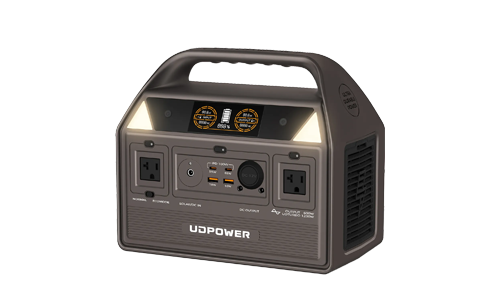
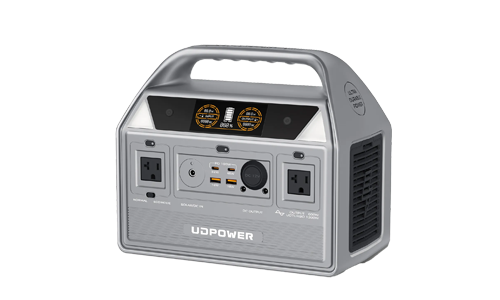
For portable backup power, check voltage before checking battery capacity. A power station rated at 2,400 watts is not automatically a 240V power source. For example, the UDPOWER S2400 supplies up to 2,400W through standard 120V~60Hz AC outlets; it does not produce 240V split-phase power.

120V vs 240V: Quick Comparison
| Comparison | 120V power | 240V power |
|---|---|---|
| Typical U.S. use | General-purpose outlets, lighting and common plug-in devices | Dedicated circuits for high-demand appliances and equipment |
| Connection in a U.S. split-phase home | One hot conductor to neutral | Hot conductor to the second hot conductor |
| Frequency in the United States | 60Hz | 60Hz |
| Common outlet examples | NEMA 5-15 and NEMA 5-20 | NEMA 6-series and 14-series configurations, depending on amperage and neutral requirements |
| Power at 15 amps | 1,800W arithmetic maximum: 120V × 15A | 3,600W arithmetic maximum: 240V × 15A |
| Current required by a 1,500W load | Approximately 12.5A | Approximately 6.25A |
| Typical devices | TVs, laptops, routers, refrigerators, CPAP machines, coffee makers and many microwaves | Electric dryers, ranges, water heaters, central air conditioners, welders and Level 2 EV chargers |
| Portable power availability | Common on portable power stations and small generators | Usually requires a specialized split-phase system, compatible generator or professionally installed home-backup system |
| Main buying advantage | Broad compatibility with everyday plug-in devices | More available power at a given current and support for dedicated high-power equipment |
Background sources: U.S. Department of Energy Electricity 101, DOE residential 120/240V power guidance and NEMA wiring-device information.
What Is the Correct Alternating Current Unit?
The phrase alternating current unit can be misleading because AC is not measured with just one unit. Alternating current describes the way electrical current repeatedly changes direction. Several measurements are needed to describe an AC supply or appliance.
| Electrical quantity | Unit | Symbol | What it tells you |
|---|---|---|---|
| Voltage | Volt | V | The electrical potential or “pressure” supplied to the appliance |
| Current | Ampere | A | How much electrical current is flowing |
| Power | Watt | W | How quickly the appliance uses or receives electrical energy |
| Energy | Watt-hour or kilowatt-hour | Wh or kWh | How much energy is used or stored over time |
| Frequency | Hertz | Hz | How many AC cycles occur each second |
| Resistance | Ohm | Ω | How strongly a material or load resists current flow |
| Apparent power | Volt-ampere | VA | A rating often used for inverters, UPS systems, transformers and equipment with reactive loads |
Therefore, neither “120V” nor “240V” tells you the complete power capability of a circuit. You also need the available amperage. When evaluating a battery backup, you must additionally check watt-hours because watt-hours determine approximate runtime.
For a more detailed explanation, see Volts vs Amps: What’s the Difference? and the UDPOWER volts-to-watts conversion guide.
How U.S. Homes Receive Both 120V and 240V
Most detached homes in the United States receive single-phase, three-wire, 120/240V electrical service. A center-tapped utility transformer supplies two hot conductors and one neutral conductor.
The two hot legs are opposite one another in the AC cycle. Measuring from either hot leg to neutral provides about 120V. Measuring between both hot legs provides about 240V.
This arrangement lets the same home support standard 120V receptacles and dedicated 240V appliances without requiring two separate utility services.
Why some appliance labels say 120/240V
An appliance marked 120/240V may use both voltages internally. A common example is an electric dryer: its heating element may operate at 240V while controls, lights or a motor may use 120V. Such an appliance may require two hot conductors, a neutral and an equipment-grounding conductor.
That does not mean the appliance can be plugged into either a regular 120V outlet or a 240V outlet. Follow the exact nameplate, installation manual, circuit and receptacle requirements.
The Power Math That Explains 120V vs 240V
For a simple resistive load, multiplying voltage by current provides the approximate wattage. Some AC motors, compressors, transformers and electronic equipment also involve power factor, so the manufacturer’s watt or amp rating remains the better planning number.
How much power can the same current provide?
| Available current | Power at 120V | Power at 240V | Difference |
|---|---|---|---|
| 5A | 600W | 1,200W | 240V provides twice the wattage |
| 10A | 1,200W | 2,400W | 240V provides twice the wattage |
| 15A | 1,800W | 3,600W | 240V provides twice the wattage |
| 20A | 2,400W | 4,800W | 240V provides twice the wattage |
| 30A | 3,600W | 7,200W | 240V provides twice the wattage |
| 50A | 6,000W | 12,000W | 240V provides twice the wattage |
How much current does the same load require?
| Appliance load | Approximate current at 120V | Approximate current at 240V |
|---|---|---|
| 500W | 4.17A | 2.08A |
| 1,000W | 8.33A | 4.17A |
| 1,500W | 12.5A | 6.25A |
| 2,400W | 20A | 10A |
| 3,600W | 30A | 15A |
| 4,800W | 40A | 20A |
Does a 240V appliance use half as much electricity?
No. Lower current does not automatically mean half the energy use.
A 1,500W appliance running for one hour uses approximately 1.5kWh whether it receives 1,500W through a 120V design or a 240V design. Its current differs, but the wattage and operating time determine the energy consumed.
A 240V version may still perform more efficiently in a particular application because it can use lower current, reduce conductor losses, start a motor more effectively or complete a heating task faster. Those advantages depend on equipment design and operating conditions—not on voltage alone.
Seven Practical Differences That Matter
1. 240V can deliver more power without proportionally increasing current
This is the central advantage of 240V. High-power heating elements, compressors, pumps and EV chargers can receive substantial wattage without requiring the extremely high current that the same load would draw at 120V.
2. A 240V circuit usually uses a double-pole breaker
A standard 120V branch circuit typically connects to one hot leg and neutral. A 240V circuit generally connects to both hot legs through a common-trip, double-pole breaker. The exact wiring depends on whether the appliance also needs a neutral.
3. The outlets and plugs are intentionally different
Different receptacle configurations help prevent equipment from being connected to the wrong voltage or current rating. A normal NEMA 5-15 household plug should not fit a 240V receptacle.
Do not modify plug blades, replace a cord with an incompatible type or use an improvised adapter to defeat this protection.
4. Watt rating and voltage rating are separate specifications
A device labeled “2,400W” is not necessarily a 240V device. Wattage tells you how much power it can supply or consume. Voltage tells you the electrical system with which it is compatible.
This distinction is especially important when comparing portable power stations. A 2,400W, 120V power station can support a large combination of 120V loads but still cannot operate a 240V dryer, well pump or central air conditioner.
5. Startup power can matter more than running power
Refrigerators, freezers, pumps, compressors and power tools may draw a short burst of extra current when starting. A source may have enough continuous watts for the running load but still shut down when the motor starts.
Check both continuous output and startup or surge capability. Do not assume a surge rating can support an appliance that continuously exceeds the source’s rated output.
6. Lower current can reduce conductor heating and voltage drop
Electrical losses in conductors rise sharply as current increases. Supplying the same wattage at 240V instead of 120V approximately halves the current, which can reduce voltage drop and resistive heating when the equipment and circuit are correctly designed.
7. 240V is not automatically the better choice
For phones, computers, TVs, routers, CPAP machines, lights and most outage essentials, 120V is convenient and widely compatible. Installing or carrying a 240V system adds little value when every device you plan to run already uses standard 120V power.
Which Appliances Use 120V or 240V?
The table below provides practical planning ranges for U.S. equipment. Actual input varies by size, efficiency, operating mode and manufacturer. The appliance nameplate and manual always take priority.
| Device or appliance | Common U.S. voltage | Broad planning range | What to verify |
|---|---|---|---|
| Phone charger | 120V input; many chargers accept 100–240V | 5–50W | Input range printed on the charger |
| Laptop charger | 120V input; many accept 100–240V | 30–240W | Maximum input and USB-C PD requirement |
| Wi-Fi router and modem | 120V adapter | 10–40W combined | Adapter input and DC output ratings |
| LED television | 120V | 50–250W | Nameplate wattage or amperage |
| CPAP machine | Usually a 120V adapter | Approximately 30–100W, often higher with heat | Humidifier and heated-tube consumption |
| Household refrigerator | 120V | Approximately 60–200W while running | Compressor startup demand and cycling |
| Coffee maker | 120V | 600–1,500W | Heating wattage and warming-plate use |
| Microwave | Usually 120V | Approximately 1,000–1,800W input | Input wattage, not only advertised cooking watts |
| Portable space heater | Usually 120V | Often up to approximately 1,500W | Continuous output requirement |
| Portable or window air conditioner | 120V or 240V, depending on size | Varies widely | Voltage, running amps and compressor surge |
| Electric clothes dryer | Usually 240V | Approximately 4,000–6,000W | Receptacle type, circuit amperage and neutral requirement |
| Electric range or wall oven | Usually 240V | Several thousand watts; total rating can exceed 10,000W | Hardwired or dedicated-circuit requirements |
| Electric tank water heater | Usually 240V | Approximately 3,500–5,500W for many residential models | Element rating and breaker requirement |
| Level 1 EV charging | 120V | Commonly around 1.4–1.9kW | EVSE current and continuous circuit capacity |
| Level 2 EV charging | 240V | Often approximately 3.8–11.5kW or more | Vehicle limit, EVSE rating and dedicated circuit |
| Central air conditioner or heat pump | Usually 240V | Varies significantly | Running load, locked-rotor amps and approved starting equipment |
| Deep-well pump | Often 240V | Varies by horsepower and depth | Voltage, running amps and motor-starting demand |
EV charging reference: U.S. Department of Energy EV Charging Guide. All appliance ranges are general planning estimates; verify the actual product label before connecting backup power.
Can a 120V Appliance Run on 240V?
A 120V-only appliance should not be connected to 240V. Doing so can destroy power supplies, burn out heating elements, damage motors, create a fire hazard or expose the user to electric shock.
Likewise, a 240V-only appliance generally will not operate correctly from a 120V source. It may fail to start, operate at severely reduced performance or overheat, depending on its design.
The important exception: dual-voltage equipment
Many laptop, phone and camera chargers are marked with an input such as:
Input: 100–240V~ 50/60Hz
A correctly labeled dual-voltage power supply may accept either voltage within that range. You still need a suitable plug, grounding arrangement and compliant adapter for the location.
Never assume equipment is dual voltage because it contains electronics or because another version of the same product is sold internationally. Read the label on the exact unit.
What about a transformer?
A correctly selected step-up or step-down transformer can change voltage for certain loads, but it must be sized for continuous wattage, startup current, frequency, grounding and equipment type. A transformer also does not turn a single 120V source into true U.S. 120/240V split-phase service.
For large motors, heating appliances, hardwired equipment or home-panel connections, consult a qualified electrician rather than improvising a conversion.
120V vs 240V Generators and Portable Power Stations
Voltage is one of four separate checks you must complete when choosing backup power:
- Voltage: Does the source produce the voltage the appliance requires?
- Continuous watts: Can the source sustain the running load?
- Surge watts: Can it start motors or compressors?
- Watt-hours or fuel supply: How long can it keep running?
Passing three checks but failing the voltage check still means the source is incompatible.
When a 120V portable power station is usually enough
A standard 120V portable power station is often the most practical choice when your backup list includes:
- Phones, tablets and laptops
- Wi-Fi modem and router
- LED lights
- CPAP equipment
- Televisions and communication devices
- Many refrigerators and freezers
- Small kitchen appliances within the station’s output limit
- 120V camping and RV accessories
- Power tools that use standard household plugs
When you may need true 240V output
A specialized 240V source may be necessary when the required appliance is specifically labeled for 208V, 220V, 230V or 240V operation, including:
- Central air-conditioning condensers
- Electric ranges and ovens
- Electric clothes dryers
- Hardwired water heaters
- Many deep-well pumps
- Large shop compressors and welders
- Level 2 EV charging equipment
- Whole-home transfer equipment serving both legs of a residential panel
A 2,400W power station is not necessarily a 240V power station
This is one of the most costly backup-power misunderstandings. The number before “W” is wattage, not voltage.
A 120V power station with a 2,400W inverter may deliver up to 20 amps of 120V power across its outlets, subject to the unit’s design and total output limit. It still cannot supply a 240V-only appliance because the required voltage and split-phase connection are missing.
Learn more in Best Portable 120V Power Supply and How to Know If a Portable Power Station Can Run Your Device.
Recommended UDPOWER Products for 120V Backup Power
UDPOWER’s U.S. portable power stations provide pure sine wave 120V~60Hz AC output. They are designed to power selected plug-in devices directly—not 240V household circuits or an entire electrical panel.
Choose between the S1200 and S2400 by comparing your total running wattage, highest startup surge and desired runtime. Do not choose the S2400 because “2400” looks similar to “240V.”
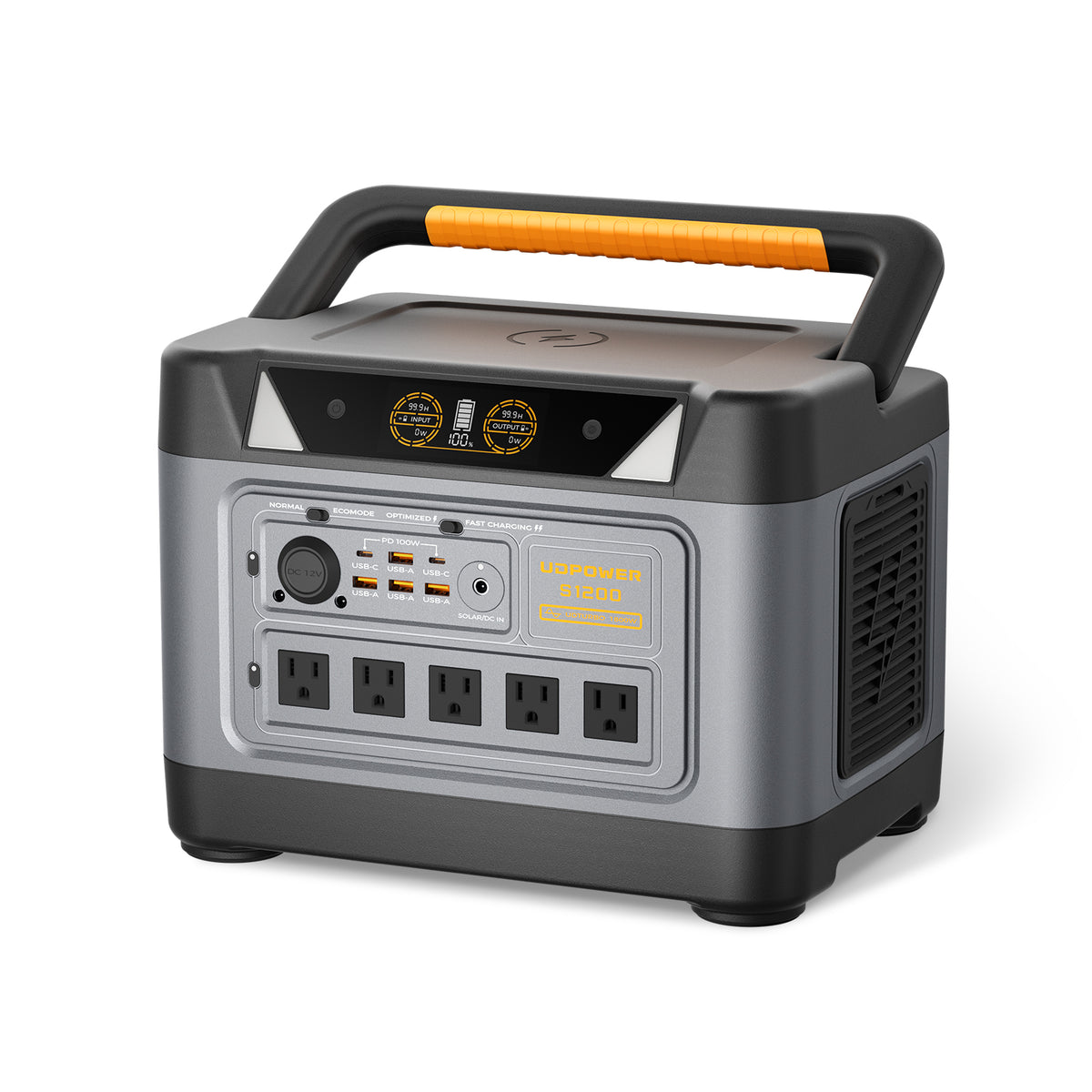
UDPOWER S1200: Best for Essential 120V Home Backup
- AC output: Pure sine wave, 120V~60Hz
- Rated output: 1,200W
- Maximum output: Up to 1,800W for supported higher-startup loads
- Battery capacity: 1,191Wh
- AC outlets: 5
- UPS response: 10 milliseconds or less
- Weight: Approximately 26.0 lb
The S1200 is a practical match for users prioritizing refrigerators, CPAP machines, Wi-Fi, lights, computers, televisions and moderate 120V appliances. Its 1,200W continuous limit means it is not intended to sustain a 1,500W heater, large microwave or similarly heavy load at full power.
Voltage limitation: The S1200 provides 120V output only. It cannot power a 240V dryer, range, well pump, central air conditioner or Level 2 EV charger.
View UDPOWER S1200
UDPOWER S2400: Best for Heavier and Multiple 120V Loads
- AC output: Pure sine wave, 120V~60Hz
- Rated output: 2,400W
- Startup surge: Up to 3,000W
- Battery capacity: 2,083Wh
- AC outlets: 6
- UPS response: 10 milliseconds or less
- Weight: Approximately 40.8 lb
The S2400 provides more output headroom for higher-wattage 120V devices and combinations such as a refrigerator, router, lights, television and selected kitchen appliances. It is also better suited to tools and appliances whose startup demand exceeds the S1200’s capability.
Voltage limitation: “S2400” and “2,400W” do not mean 240V. The unit provides U.S.-standard 120V~60Hz AC output and does not produce 240V split-phase power.
View UDPOWER S2400Estimated runtime at common continuous loads
The estimates below use 90% AC conversion efficiency. They are planning estimates, not guaranteed operating times. Device cycling, startup demand, temperature, battery condition and simultaneous loads can change the result.
| Continuous load | S1200 estimated runtime | S2400 estimated runtime |
|---|---|---|
| 100W | About 10.7 hours | About 18.7 hours |
| 500W | About 2.1 hours | About 3.7 hours |
| 1,000W | About 1.1 hours | About 1.9 hours |
| 1,200W | About 0.9 hours at the rated-output limit | About 1.6 hours |
| 1,500W | Not suitable as a continuous load because it exceeds the 1,200W rating | About 1.2 hours |
How to Choose Between 120V and 240V Backup Power
- Read the appliance nameplate. Find the required input voltage, frequency, watts and amps. Do not rely on the plug appearance alone.
- Confirm whether the appliance is cord-connected or hardwired. Portable stations are generally intended for cord-and-plug devices. Hardwired equipment requires an approved connection method.
- Match the voltage exactly. A 120V-only source is not suitable for a 240V-only load, regardless of watt rating.
- Add the running watts of every device used at the same time. The total must remain below the power source’s continuous AC output.
- Identify the largest startup surge. Refrigerators, pumps, air conditioners and tools may briefly demand much more than their normal running watts.
- Estimate runtime using watt-hours. Use battery capacity × usable efficiency ÷ average load. Remember that watts determine whether a device can run, while watt-hours estimate how long it runs.
- Leave operating headroom. Avoid planning a system that requires the inverter, generator or circuit to remain at its absolute limit for the entire job.
Real-Life 120V vs 240V Scenarios
Scenario 1: Refrigerator, router, lights and phones during an outage
These are normally 120V loads. A high-quality 120V portable power station is often the simplest solution. The key questions are combined running watts, refrigerator startup demand and desired runtime—not whether the system can produce 240V.
A model such as the UDPOWER S1200 may be sufficient for an essentials-first setup. The S2400 offers more runtime and more room for overlapping appliances.
Scenario 2: Electric range and water heater
These are commonly 240V, high-wattage, dedicated-circuit appliances. A standard 120V portable station cannot operate them, even when its battery capacity appears large.
During an outage, it is usually more practical to use lower-power 120V alternatives, such as an electric kettle or compact cooking appliance that remains within the station’s continuous rating.
Scenario 3: Workshop tools
Hand drills, chargers, sanders and smaller saws often use 120V. Larger compressors, cabinet saws, welders and dust-collection systems may require 240V.
Check every tool individually. A workshop can contain both voltage classes even when the equipment looks similar.
Scenario 4: Window air conditioner versus central air conditioner
Many smaller window and portable air conditioners run on 120V. Larger window units and most central condensers use 240V.
Air conditioners also have compressor-starting demand. A source that matches the voltage may still be too small to start the compressor. Verify rated current, startup specifications and manufacturer requirements.
Scenario 5: EV charging
Level 1 charging generally uses 120V and is relatively slow. Level 2 charging uses 240V and can deliver substantially more charging power.
A large 120V portable station may provide a limited emergency top-up through a compatible Level 1 charger, but its stored energy is small compared with an EV traction battery. It should not be treated as a primary EV-charging solution.
Scenario 6: RV and campsite power
Many RV accessories and campsite devices use 120V, but RV electrical systems vary. A 30-amp RV service is not the same as a standard household receptacle, and a 50-amp RV connection can involve two 120V legs.
Match the RV inlet, adapter, grounding arrangement and appliance load carefully. Never assume that a physically compatible adapter changes voltage or increases the power station’s output.
Explore UDPOWER portable power stations for camping and RV use.
Scenario 7: Well pump backup
Many residential well pumps operate at 240V and can have substantial startup demand. A standard 120V portable station will not run a 240V pump.
Pump backup requires the exact voltage, horsepower, running amperage, locked-rotor or startup demand, control-box design and connection method. This is a situation where professional system sizing is especially important.
Common 120V and 240V Mistakes
| Mistake | Why it is wrong | Better approach |
|---|---|---|
| Assuming 2,400W means 240V | Watts and volts measure different electrical properties | Read the AC output line for both voltage and wattage |
| Choosing by battery capacity alone | A large Wh rating cannot overcome a voltage or inverter-output mismatch | Check voltage, rated watts, surge watts and Wh separately |
| Using a plug adapter as a voltage converter | Most adapters change only the plug shape | Use equipment rated for the available voltage or a properly engineered conversion system |
| Treating surge watts as continuous watts | Surge capability is normally available only briefly | Keep normal operating load within the continuous rating |
| Checking only running watts on a motor | The motor may demand substantially more power during startup | Verify startup, locked-rotor or compressor-surge requirements |
| Assuming every 240V outlet is interchangeable | Receptacles differ by amperage, grounding, neutral and application | Match the exact approved NEMA configuration and circuit rating |
| Backfeeding a wall outlet | It can energize wiring unexpectedly and create electrocution or fire hazards | Power devices directly or use professionally installed listed transfer equipment |
| Ignoring frequency | Some motors, clocks and transformers are frequency-sensitive | Match both voltage and hertz to the equipment label |
| Believing 240V automatically cuts the electric bill in half | Energy cost is based mainly on kilowatt-hours, not current alone | Compare actual wattage, efficiency and operating time |
Electrical Safety Rules for 120V and 240V Power
- Do not connect a generator or portable power station to a wall outlet to energize household wiring.
- Do not use a male-to-male “suicide cord.”
- Do not remove or defeat a grounding pin.
- Do not force a plug into an incompatible receptacle.
- Do not use damaged, overheated or undersized extension cords.
- Keep electrical connections dry and protected from physical damage.
- Follow the appliance, generator, inverter and power-station manuals.
- Use a licensed electrician for transfer equipment, hardwired appliances and panel connections.
The U.S. Consumer Product Safety Commission warns against connecting a generator directly to a building’s electrical system unless a qualified electrician has installed the correct transfer equipment. See the CPSC portable-generator safety guidance.
UDPOWER portable stations are intended to power selected devices directly through their outlets. They should not be used to backfeed a home panel or wall receptacle.
Frequently Asked Questions
Is 240V twice as powerful as 120V?
At the same amperage, 240V can provide twice the wattage. For example, 10 amps at 120V equals approximately 1,200W, while 10 amps at 240V equals approximately 2,400W. Actual circuit and appliance limits still apply.
Does 240V use less electricity than 120V?
Not automatically. A 1,500W load uses approximately the same energy per hour whether the appliance is designed for 120V or 240V. The 240V version draws less current, but electricity consumption is based mainly on watts and operating time.
Is 220V the same as 240V?
In casual U.S. usage, people often say 220V, 230V and 240V when referring to the same general class of household circuit. However, always use the appliance’s actual permitted input range rather than assuming every nominal voltage is interchangeable.
Is 110V the same as 120V?
“110V” and “115V” are still commonly used informal terms for standard U.S. household power, but the modern nominal supply is generally described as 120V. Appliance labels may use a range of related ratings.
Can I plug a 120V appliance into a 240V outlet?
No, unless the appliance is specifically labeled for an input range that includes 240V and the connection method is suitable. Supplying 240V to a 120V-only appliance can cause immediate damage, electric shock or fire.
Can a 240V appliance run from a 120V outlet?
A 240V-only appliance generally cannot operate correctly from 120V. It may fail to start, produce inadequate heat, overheat or damage its motor or controls.
Can an adapter convert 120V to 240V?
A basic plug adapter normally changes only the physical connection. Changing voltage requires appropriate electrical equipment, and creating true U.S. split-phase 240V involves more than using a simple plug adapter.
What is the alternating current unit?
Alternating current does not have only one unit. Voltage is measured in volts, current in amps, power in watts, energy in watt-hours or kilowatt-hours and frequency in hertz.
Can a 2,400W portable power station run a 240V appliance?
Only when the power station specifically produces compatible 240V output. A 2,400W rating by itself describes wattage, not voltage. A 2,400W station with 120V outlets cannot directly operate a 240V-only appliance.
Does the UDPOWER S2400 provide 240V output?
No. The UDPOWER S2400 provides pure sine wave 120V~60Hz AC output with a 2,400W rated capacity and up to 3,000W startup surge. Its model name and watt rating do not indicate 240V output.
Can a U.S. house have both 120V and 240V?
Yes. Most U.S. detached homes receive 120/240V split-phase service. Standard circuits use one hot leg and neutral for 120V, while many high-power appliances use both hot legs for approximately 240V.
Why do electric dryers usually use 240V?
An electric dryer’s heating element requires several thousand watts. Supplying that power at 240V keeps the required current considerably lower than an equivalent 120V design.
Is 240V more dangerous than 120V?
Both voltages can be deadly. Higher voltage can drive current through resistance more readily, but 120V must never be treated as safe to touch or work on while energized.
How do I know whether my appliance is 120V or 240V?
Read the nameplate or power label on the appliance, motor, charger or power adapter. Look for “Input,” “Voltage,” “VAC” or a range such as “100–240V~ 50/60Hz.” Consult the manual when the label is unclear.
Choose Backup Power by Voltage, Watts and Runtime
Start with the voltage printed on your appliance. Then compare continuous watts, startup demand and battery capacity. For standard 120V household essentials, explore UDPOWER’s LiFePO4 portable power stations.
View All Portable Power Stations Compare the S1200 and S2400 Get the Device Compatibility GuideRelated Articles