





How Many Watts Does a 4 Ton AC Use?
Last updated: July 27, 2026
Quick Answer
A 4-ton central air conditioner typically uses about 3,500 to 5,000 watts while the compressor is actively cooling. A high-efficiency system may stay near the lower end under favorable conditions, while an older, less efficient, or heavily loaded unit may draw 5,000 to 6,000 watts.
A 4-ton rating means the system can remove approximately 48,000 BTU of heat per hour. It does not mean the AC consumes 48,000 electrical watts.
- Typical active-cooling draw: 3.5–5.0 kW
- Possible older-system draw: 5.0–6.0 kW
- Cooling capacity: 48,000 BTU/hr
- Typical supply: 208/230–240V on a dedicated circuit
- Startup demand: Much higher than normal running demand
- Best way to confirm: Check EER2, nameplate data, and measured current

The exact number cannot be determined from “4 ton” alone. Two systems with the same cooling capacity may use noticeably different amounts of electricity because of efficiency, compressor design, outdoor temperature, airflow, duct condition, installation quality, and operating stage.
This guide shows how to estimate the running watts, read the condenser label, calculate electricity cost, evaluate startup demand, and decide what kind of backup power is realistic.
How Many Watts Does a 4 Ton AC Use on Average?
For practical planning, use 4,000 to 5,000 running watts as a reasonable starting range for a conventional 4-ton central AC system. That number describes the power being used while the compressor and indoor blower are operating—not the average over an entire day.
| 4-Ton AC Scenario | Approximate Active-Cooling Power | What to Expect |
|---|---|---|
| High-efficiency variable-speed system at partial load | May operate below 3,500W | Power changes continuously as the compressor adjusts to the cooling load. |
| Modern efficient system at high cooling output | About 3,500–4,500W | Common planning range for an efficient matched system. |
| Conventional single-stage system | About 4,000–5,000W | Compressor usually operates near full output whenever cooling is called. |
| Older or lower-efficiency system | About 5,000–6,000W | Actual draw may rise further if airflow, refrigerant charge, or equipment condition is poor. |
| Compressor off, indoor blower running | Often a few hundred watts | Depends on blower type, airflow setting, duct pressure, and fan speed. |
Do not describe a 4-ton AC as using “4,000 watts per hour.” Watts already measure the rate of power use. If a 4,000W system runs for one hour, it consumes 4 kilowatt-hours (4 kWh) of electrical energy.
What Does a 4 Ton AC Rating Mean?
In HVAC terminology, “ton” describes cooling capacity rather than physical weight. One ton of cooling equals approximately 12,000 BTU per hour, so:
The 48,000 BTU/hr figure describes how much heat the system is designed to remove. It is not the amount of electricity entering the unit.
Air conditioners move heat instead of converting electricity directly into an equal amount of cooling. That is why a 48,000 BTU/hr system can deliver that cooling capacity while consuming roughly 3,500 to 5,000 electrical watts.
For a detailed explanation of the difference between thermal capacity and electrical input, see the UDPOWER guide to converting watts and BTU .
How to Calculate 4 Ton AC Watts With EER or EER2
EER and EER2 compare cooling output with electrical input under defined test conditions. Because a 4-ton unit has a nominal capacity of 48,000 BTU/hr, the basic calculation is:
For example, a 4-ton system rated at an EER of 11 would have an estimated full-load input of:
| EER or EER2 | Calculation | Estimated Full-Load Input | Efficiency Interpretation |
|---|---|---|---|
| 8 | 48,000 ÷ 8 | 6,000W | Low efficiency |
| 9 | 48,000 ÷ 9 | 5,333W | Older or less efficient equipment |
| 10 | 48,000 ÷ 10 | 4,800W | Moderate peak efficiency |
| 11 | 48,000 ÷ 11 | 4,364W | Common real-world planning example |
| 12 | 48,000 ÷ 12 | 4,000W | Efficient full-load operation |
| 13 | 48,000 ÷ 13 | 3,692W | Higher peak efficiency |
| 14 | 48,000 ÷ 14 | 3,429W | Very efficient peak operation |
| 15 | 48,000 ÷ 15 | 3,200W | High-efficiency matched system |
These figures are estimates. Published efficiency applies to a specific combination of outdoor condenser, indoor coil, air handler or furnace, and airflow setting. Changing the matched components can change both capacity and efficiency.
The U.S. Department of Energy defines EER as cooling capacity in BTU per hour divided by electrical input in watts. You can review the DOE central air conditioner efficiency explanation .
Why You Should Not Estimate Peak Watts From SEER2 Alone
SEER2 is a seasonal efficiency rating. It represents performance across a range of test conditions, including milder temperatures and periods when the system is not operating at maximum output.
EER2 is more useful for estimating power under high cooling demand because it focuses on performance under a defined peak-load test condition.
| Rating | What It Describes | Best Use | Not Ideal For |
|---|---|---|---|
| SEER2 | Seasonal cooling efficiency over multiple operating conditions | Comparing annual efficiency and expected seasonal energy use | Predicting maximum instantaneous watts or startup demand |
| EER2 | Cooling output relative to electrical input at a defined high-load condition | Estimating full-load running power | Predicting exact daily kWh without considering cycling and weather |
| Measured watts | Actual electrical input in your home | Backup sizing, troubleshooting, and operating-cost analysis | Predicting performance under conditions that have not yet occurred |
The Department of Energy describes SEER2 in BTU per watt-hour and explains how it is used for residential central air conditioners. See the DOE central air conditioner efficiency guide .
How to Read a 4 Ton AC Nameplate
The outdoor condenser nameplate provides valuable electrical information, but several fields are frequently misunderstood.
| Nameplate Term | Meaning | What It Does Not Mean |
|---|---|---|
| Voltage | The electrical supply required by the equipment, commonly 208/230V or 240V. | It does not show actual power consumption by itself. |
| RLA | Rated load amperage for the compressor under specified conditions. | It is not guaranteed to equal the exact current measured at your home. |
| LRA | Locked rotor amperage, indicating very high compressor current under a locked-rotor condition. | It is not a direct, exact “starting watts” number. |
| FLA | Full-load amperage for a fan or other motor. | It does not necessarily equal normal average current. |
| MCA | Minimum circuit ampacity used to size conductors. | It is not the unit’s normal running amperage. |
| MOCP or maximum fuse/breaker | The largest permitted overcurrent-protection device. | Breaker size should not be multiplied by voltage to estimate actual AC watts. |
Real 4-Ton Equipment Example
One published Goodman 4-ton condenser specification provides a useful example of why tonnage, running current, locked-rotor current, and breaker size should not be treated as the same thing.
| Specification | Published Value | How to Interpret It |
|---|---|---|
| Nominal cooling capacity | 48,000 BTU/hr | Confirms the 4-ton nominal size. |
| Efficiency | 13 SEER / 11 EER | 48,000 ÷ 11 gives an estimated 4,364W at the EER condition. |
| Supply | 208/230V, single phase | Requires a compatible 240V-class circuit and power source. |
| Compressor RLA | 19.9A | Useful compressor electrical rating, but not a complete whole-system watt measurement. |
| Compressor LRA | 109A | Shows why compressor startup can be difficult for a limited generator or inverter. |
| Minimum circuit ampacity | 26.1A | Used for conductor sizing, not normal consumption. |
| Maximum overcurrent protection | 45A | The allowed breaker or fuse limit, not the unit’s running draw. |
| Source | Goodman VSX13 product specifications | |
The indoor air handler or furnace blower may be on a separate circuit and may have its own nameplate. For complete system power, both the outdoor and indoor equipment must be considered.
Running Watts Versus Startup Demand
A conventional central AC compressor may require a brief surge of current when it starts. This event is one of the main reasons a generator that appears large enough based on running watts can still stall, trip, or produce an unacceptable voltage drop.
| Electrical Demand | Duration | Why It Matters |
|---|---|---|
| Normal running power | While the compressor and blower operate | Determines continuous generator or inverter capacity and energy consumption. |
| Compressor startup demand | Usually a brief event | May overload a generator even when its continuous watt rating looks adequate. |
| Locked-rotor current | Represents a severe motor condition | Provides a conservative indication of motor-starting difficulty but is not directly equal to true starting watts. |
| Blower startup | Brief motor-start event | Usually smaller than the compressor surge but still adds to total demand. |
Why LRA × Voltage Is Not Exact Starting Watts
Multiplying volts by locked-rotor amps gives apparent power in volt-amperes, not necessarily true watts. Motor power factor, voltage sag, compressor condition, generator response time, and the length of the startup event all affect what the power source actually experiences.
This distinction matters when a 4-ton compressor has an LRA above 100 amps. The number signals a demanding motor start, but it does not automatically mean the generator must continuously deliver more than 20,000 watts.
Does a Soft Starter Reduce Running Watts?
A properly selected soft starter can reduce compressor startup current and make the AC easier to start from a generator or inverter. It does not turn a 4,500W running load into a 2,000W running load.
The running demand after startup remains largely determined by compressor output, system efficiency, temperature, airflow, and equipment condition.
How Much Electricity Does a 4 Ton AC Use?
To estimate energy consumption, multiply the active running power in kilowatts by the number of hours the compressor operates.
A 4,000W AC is a 4kW load. If the compressor operates for six total hours during the day:
| Compressor-On Time | Energy at 4,000W | Daily Cost at $0.16/kWh | 30-Day Cost |
|---|---|---|---|
| 2 hours per day | 8 kWh | $1.28 | $38.40 |
| 4 hours per day | 16 kWh | $2.56 | $76.80 |
| 6 hours per day | 24 kWh | $3.84 | $115.20 |
| 8 hours per day | 32 kWh | $5.12 | $153.60 |
| 10 hours per day | 40 kWh | $6.40 | $192.00 |
| 12 hours per day | 48 kWh | $7.68 | $230.40 |
Replace $0.16 with the rate shown on your electricity bill. Also remember that thermostat runtime is not always equal to compressor runtime. A variable-speed system may operate for a long time at reduced output, while a single-stage unit cycles between full output and off.
Cost Formula
Example for a 4,500W system running for five compressor-hours at $0.20 per kWh:
What Changes the Actual Wattage of a 4 Ton AC?
1. Outdoor Temperature
As outdoor temperature rises, the condenser must reject heat into hotter air. Compressor pressure and electrical demand may increase, especially during long periods of extreme heat.
2. Indoor Temperature and Humidity
A hot, humid house creates a heavier cooling load. The system may run longer and, with variable-capacity equipment, increase compressor speed.
3. Compressor Type
A single-stage compressor normally runs near full output whenever it is on. Two-stage and variable-speed systems can reduce output when full capacity is unnecessary, lowering instantaneous power during part-load operation.
4. EER2 and Matched-System Efficiency
Higher peak-load efficiency means the system can provide the same cooling capacity with less electrical input. Published ratings apply to specific matched components, not just the outdoor condenser.
5. Airflow
A clogged filter, dirty evaporator coil, closed registers, restrictive ductwork, or incorrect blower setting can reduce heat transfer. Poor airflow may increase runtime, reduce comfort, and contribute to icing or equipment stress.
6. Refrigerant Charge
Incorrect refrigerant charge can reduce cooling performance and change compressor operating conditions. Refrigerant diagnosis and charging should be handled by a qualified HVAC technician.
7. Duct Leakage and Insulation
Leaky ducts in an attic or crawlspace can waste cooled air before it reaches the rooms. The AC may not draw dramatically more watts at a single moment, but it can consume far more kWh by operating longer.
8. Thermostat Settings
Lower temperature settings create longer compressor runtime. Large thermostat setbacks can also make a system operate at high output for an extended recovery period.
9. Equipment Condition
Dirty condenser coils, failing capacitors, worn motors, damaged fan blades, and other faults can reduce performance. An unusual increase in current, runtime, noise, or electricity use deserves professional inspection.
Can a Generator Run a 4 Ton AC?
It is possible to run some 4-ton central air conditioners from a properly sized generator, but generator selection cannot be based on the 3,500–5,000W running estimate alone.
A compatible setup must account for all of the following:
- A true 120/240V output compatible with the home’s electrical system.
- Enough continuous power for the condenser, indoor blower, and other connected loads.
- Enough motor-starting capability for the compressor.
- Acceptable voltage and frequency during compressor startup.
- A listed transfer switch or approved interlock installation.
- Correct grounding, neutral, overcurrent protection, wiring, and load management.
| Generator Feature | Why It Matters |
|---|---|
| 120/240V split-phase output | Most residential 4-ton central AC condensers require a 208/230–240V supply. |
| Continuous watt rating | Must support the AC after startup plus every other load operating at the same time. |
| Surge or motor-starting capacity | Determines whether the generator can start the compressor without stalling or severe voltage drop. |
| Fuel-specific rating | Some generators produce less power on natural gas or propane than on gasoline. |
| Load management | Can prevent the water heater, dryer, well pump, and AC from starting together. |
| Soft-starter compatibility | May reduce compressor startup current but does not eliminate the continuous running load. |
Will a 5,000W Generator Run a 4 Ton AC?
A 5,000W generator may appear close to the running demand of an efficient 4-ton system, but it usually leaves little or no capacity for compressor startup, the indoor blower, voltage drop, or other household loads. It may also provide only 120V, making it electrically incompatible.
Will a 10,000W Generator Run a 4 Ton AC?
Some 10,000W-class generators may be able to run certain 4-ton systems, particularly when the generator supplies 240V and the AC has manageable starting current or a compatible soft starter. That is not a universal guarantee.
The safest process is to provide the generator installer with the AC model number, RLA, LRA, indoor blower data, fuel type, and list of other intended loads.
Generator manufacturers also advise users to account for the starting demand of the largest motor and then add the running watts of other connected loads. See this Generac portable-generator sizing guidance .
How Large a Battery Is Needed to Run a 4 Ton AC?
Even after startup is solved, a 4-ton AC is a major energy load. A battery system must provide the required voltage, continuous inverter power, surge capacity, and enough kilowatt-hours for the desired runtime.
The table below assumes a constant 4,000W load and 90% usable conversion efficiency. It is a planning illustration rather than a promise of actual runtime.
| Desired Compressor Runtime | AC Energy Required | Approximate Nominal Battery at 90% Efficiency | Solar Needed to Replace Energy in 5 Peak-Sun Hours* |
|---|---|---|---|
| 2 hours | 8 kWh | About 8.9 kWh | About 2 kW of solar |
| 4 hours | 16 kWh | About 17.8 kWh | About 4 kW of solar |
| 8 hours | 32 kWh | About 35.6 kWh | About 8 kW of solar |
| 12 hours | 48 kWh | About 53.3 kWh | About 12 kW of solar |
*Solar examples assume five peak-sun hours and approximately 80% overall collection and system efficiency. Weather, shading, panel temperature, orientation, inverter losses, and household loads can change the required array size.
These numbers explain why running whole-home central air for many hours normally requires an installed home battery and substantial solar array rather than a small portable power station.
Learn more about voltage, startup power, and AC compatibility in Can a Solar Generator Power an AC? and 120V vs. 240V Power Differences .
A More Practical UDPOWER Backup Plan During an AC Outage
Current UDPOWER portable power stations provide standard 120V AC output. They are not designed to run a hardwired 240V 4-ton central air conditioner or connect directly to a whole-home AC circuit.
Their practical role during a summer outage is to keep selected essentials operating while central air is unavailable: fans, a refrigerator, Wi-Fi, phones, lights, a television, laptops, CPAP equipment, and certain compatible 120V room air conditioners.
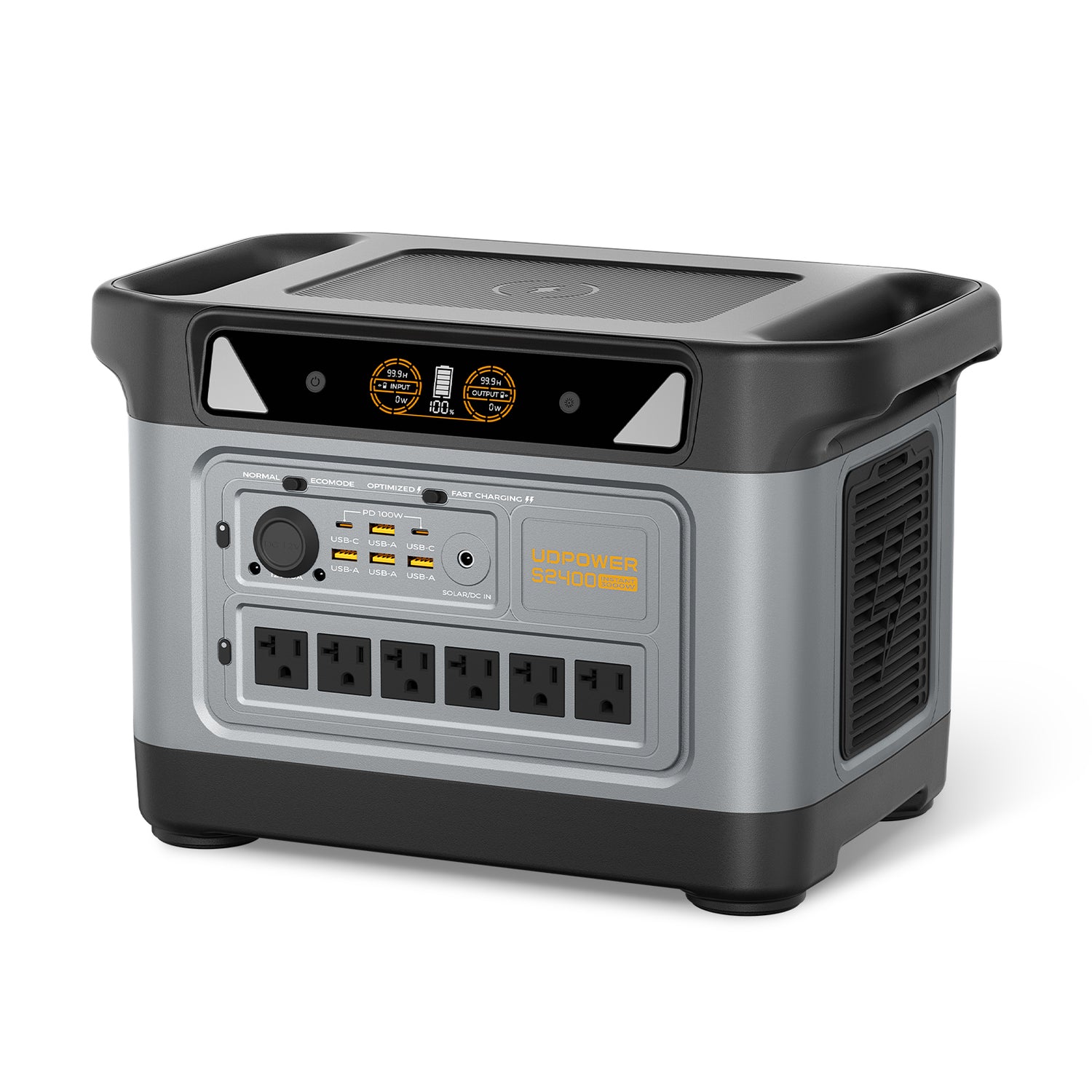
UDPOWER S2400: Higher-Capacity Essential-Load Backup
- Battery capacity: 2,083Wh
- Rated AC output: 2,400W pure sine wave
- Surge support: Up to 3,000W
- AC voltage: 120V, 60Hz
- AC outlets: 6
- Battery chemistry: LiFePO4
- Approximate weight: 40.8 lb
The S2400 is the stronger UDPOWER option for running several critical 120V devices at once. It can help maintain refrigeration, airflow, communications, lighting, and charging during an outage, but it cannot supply the 240V split-phase power required by most central AC systems.
View the UDPOWER S2400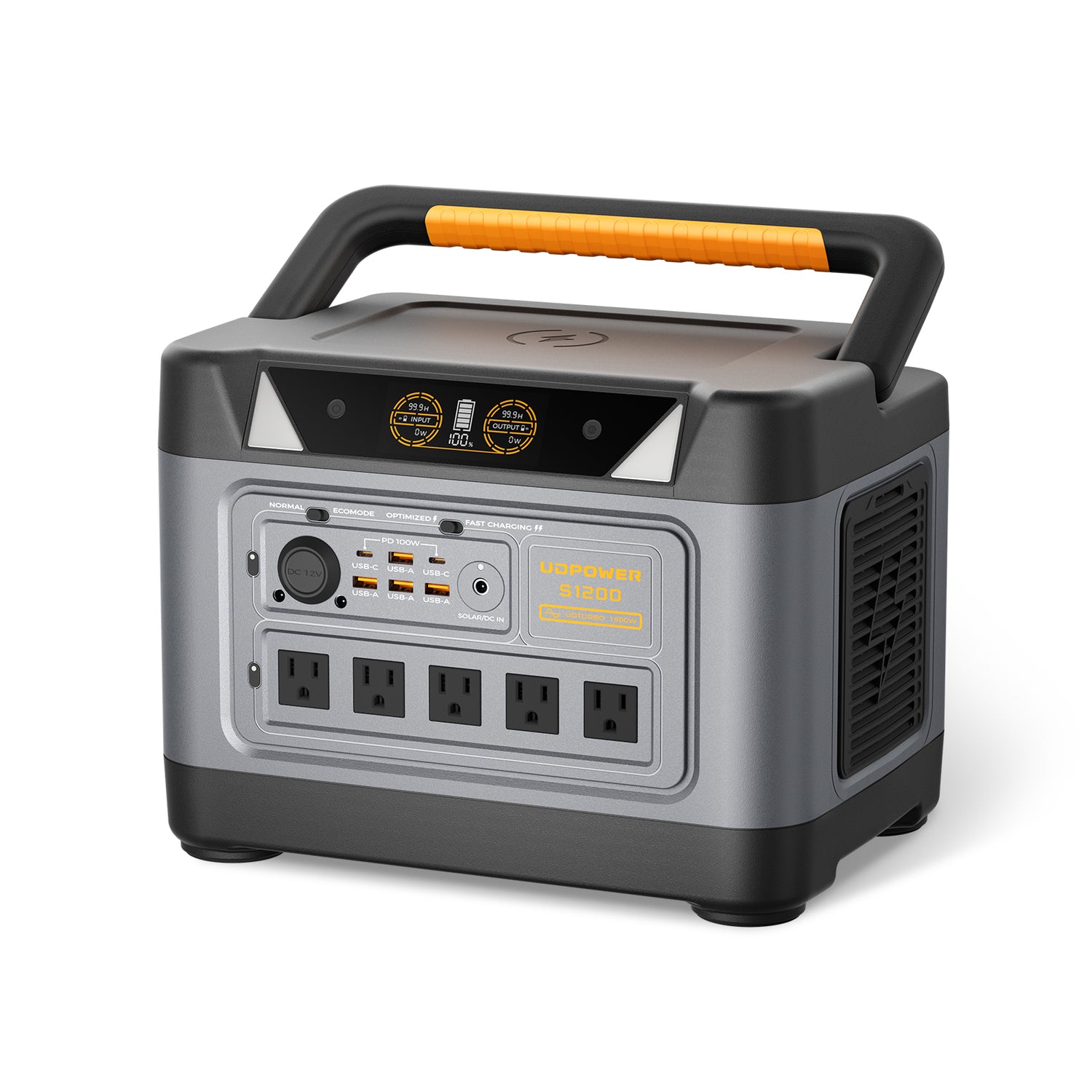
UDPOWER S1200: Lighter Home-Essential Backup
- Battery capacity: 1,190Wh
- Rated AC output: 1,200W pure sine wave
- Surge support: Up to 1,800W
- AC voltage: 120V, 60Hz
- AC outlets: 5 on the primary version
- Battery chemistry: LiFePO4
- Approximate weight: 26 lb
The S1200 is a more portable choice for a refrigerator, fan, Wi-Fi router, phones, lights, laptops, CPAP equipment, and other moderate 120V loads. It is not intended for a 4-ton central air conditioner.
View the UDPOWER S1200Estimated Essential-Load Runtime
The following estimates use 90% conversion efficiency. Actual runtime changes with compressor cycling, device startup, battery condition, ambient temperature, and load variation.
| Emergency Load Plan | Estimated Combined Load | S1200 Estimate | S2400 Estimate |
|---|---|---|---|
| 60W fan + 15W router + 20W charging | 95W | About 11.3 hours | About 19.7 hours |
| 100W average refrigerator + 60W fan + 15W router + 20W lights | 195W | About 5.5 hours | About 9.6 hours |
| Compatible 900W 120V window AC | 900W | About 1.2 hours | About 2.1 hours |
Window AC compatibility also depends on startup surge. Always verify the air conditioner’s running watts, voltage, plug type, and compressor-start behavior before use.
Compare All UDPOWER Portable Power StationsHow to Find the Exact Wattage of Your 4 Ton AC
Method 1: Find the Model Number and Matched-System Rating
Record the model numbers from the outdoor condenser, indoor coil, and furnace or air handler. Search the manufacturer’s product data or AHRI-rated combination to find cooling capacity, EER2, SEER2, and electrical specifications.
Method 2: Use the EER2 Formula
Divide the rated cooling capacity by EER2. For a nominal 48,000 BTU/hr system rated at 12 EER2:
This is useful for planning but does not replace an actual measurement under your home’s operating conditions.
Method 3: Have an Electrician Measure the Circuit
A licensed electrician or qualified HVAC technician can measure voltage, current, power factor, startup current, and operating behavior with appropriate instruments.
Method 4: Use a Professionally Installed Energy Monitor
A whole-home or circuit-level energy monitor can show compressor cycles and estimate actual kWh over time. Monitoring several hot days provides a better picture than one short measurement.
Method 5: Review Utility Interval Data
Some utilities provide hourly or shorter-interval usage data. Compare similar days with the AC operating and not operating, while accounting for other major household loads.
Do Not Use the Breaker Size as the AC Wattage
A 40A breaker on a 240V circuit does not prove the AC normally uses 9,600W. The breaker is selected to protect the circuit while allowing normal motor startup. Actual running power is usually much lower than breaker amps multiplied by voltage.
How to Reduce the Electricity Used by a 4 Ton AC
Replace or Clean the Filter
Follow the equipment manufacturer’s filter schedule and inspect it more often during heavy summer use, construction, wildfire smoke, or high indoor dust.
Keep the Outdoor Coil Clear
Remove nearby leaves and debris without damaging the coil fins. Maintain the clearance specified by the manufacturer so condenser air can move freely.
Seal Duct Leaks
Repairing leaks in unconditioned attics, garages, and crawlspaces can reduce cooling loss and shorten compressor runtime.
Reduce Afternoon Solar Heat
Close blinds or curtains on sun-facing windows, use exterior shading where practical, and improve attic insulation and air sealing.
Use Ceiling or Portable Fans
Air movement can improve comfort without lowering the thermostat as far. Turn fans off in unoccupied rooms because fans cool people, not empty spaces.
See How Many Watts Does a Fan Use? for fan wattage and backup-runtime examples.
Avoid Extremely Low Thermostat Settings
Setting the thermostat far below the current indoor temperature does not make a conventional single-stage AC cool faster. It normally causes the system to run longer.
Schedule Service When Performance Changes
Longer runtime, weak airflow, unusual noise, icing, short cycling, rising electricity use, or difficulty maintaining temperature can signal a problem that should be diagnosed rather than masked with a lower thermostat setting.
Confirm the Unit Is Correctly Sized
Oversized equipment may short-cycle and control humidity poorly. Undersized equipment may run continuously during design conditions. Correct sizing, duct design, and installation quality are as important as the efficiency rating printed on the brochure.
Related UDPOWER Guides
Frequently Asked Questions
How many watts does a 4 ton central AC use?
Most 4-ton central air conditioners use approximately 3,500 to 5,000 watts while actively cooling. Older or less efficient systems may use around 5,000 to 6,000 watts. The exact number depends on EER2, operating conditions, compressor type, airflow, and equipment condition.
How many amps does a 4 ton AC draw?
Many 4-ton condensers operate in a broad range of roughly 15 to 25 amps at 208/230–240V, but nameplate values vary. The indoor blower may be on a separate circuit. Check the condenser RLA, fan FLA, indoor equipment data, and actual measured current.
Does a 4 ton AC use 48,000 watts?
No. The 48,000 figure refers to BTU per hour of cooling capacity. A typical 4-ton system uses roughly 3,500 to 5,000 electrical watts while cooling.
How many kWh does a 4 ton AC use per hour?
A 4,000W system uses 4 kWh for each full hour the compressor operates. A 4,500W system uses 4.5 kWh per compressor-hour. Daily consumption depends on cycling, compressor stage, weather, thermostat settings, and the home’s cooling load.
How much does it cost to run a 4 ton AC for one hour?
Multiply the system’s kilowatts by your electricity rate. At 4kW and $0.16 per kWh, one compressor-hour costs about $0.64. At 5kW and the same rate, it costs about $0.80.
Can a 5,000 watt generator run a 4 ton AC?
It is generally not a dependable choice. Even when the running load is below 5,000W, the generator may not provide enough startup capacity, voltage stability, or additional power for the indoor blower. It must also provide a compatible 240V supply.
Can a 10,000 watt generator run a 4 ton AC?
It may run some 4-ton systems when it supplies 120/240V, has sufficient motor-starting capacity, and is not overloaded by other appliances. A compatible soft starter may help, but the system must be sized from actual nameplate and startup data.
Will a soft starter lower the running watts of my AC?
A soft starter primarily reduces the brief current surge when the compressor starts. It does not substantially reduce the continuous watts required after the compressor reaches normal operating speed.
Can a portable power station run a 4 ton central AC?
Most portable power stations cannot. A typical 4-ton central AC requires 208/230–240V, several thousand running watts, and a substantial compressor-starting surge. Current UDPOWER portable models provide 120V output and are intended for selected essential devices, not hardwired central air conditioning.
How large a battery is needed to run a 4 ton AC for eight hours?
At a constant 4,000W load, eight hours requires 32 kWh of AC energy. At 90% conversion efficiency, the nominal battery capacity would be approximately 35.6 kWh before allowing for reserve capacity, battery aging, extreme temperatures, startup demand, and other loads.
Does a 4 ton heat pump use the same watts in cooling mode?
A 4-ton heat pump in cooling mode may have power consumption similar to a comparable 4-ton central air conditioner. Heating-mode consumption varies with outdoor temperature and equipment performance. Electric auxiliary heat can add a much larger resistance-heating load.
What is the most accurate way to determine my AC wattage?
Use the matched-system EER2 rating for an estimate, then have a qualified technician or electrician measure actual voltage, current, power factor, and startup behavior. Include both the outdoor condenser and indoor blower when calculating whole-system demand.
Final Takeaway
A realistic planning estimate for a 4-ton central air conditioner is 3,500 to 5,000 running watts, with older or less efficient units potentially reaching 5,000 to 6,000 watts. The system will normally require a 208/230–240V supply and may create a much higher brief demand when the compressor starts.
For electricity-cost planning, start with EER2 and compressor runtime. For generator or battery sizing, use the actual model data, startup current, indoor blower load, power-source voltage, and all other connected appliances.
A portable power station is generally not a substitute for the installed backup equipment needed to operate a 4-ton central AC. It can still provide valuable emergency power for fans, refrigeration, communications, medical devices, lighting, and selected 120V cooling options.
Build a Practical Summer Outage Backup Plan
Start by prioritizing refrigeration, airflow, communications, lighting, charging, and medical equipment rather than trying to place every household load on one portable battery.
View Portable Power Station Options View the UDPOWER S2400 Get the Power Outage Planning GuideData Sources and Methodology
Wattage ranges in this guide are planning estimates based on the 48,000 BTU/hr nominal capacity of a 4-ton system, EER/EER2 calculations, published manufacturer electrical data, and standard motor-starting considerations. Actual equipment should always be verified by model number and measurement.
- U.S. Department of Energy: Energy-Efficient Residential Central Air Conditioners
- U.S. Department of Energy: EER and Central AC Efficiency Definitions
- ENERGY STAR: Central Air Conditioner Size and Savings Tool
- Goodman: Published 4-Ton Condenser Specifications
- Micro-Air: Residential AC Soft-Starter Information
- Generac: Generator Motor-Starting and Load-Sizing Guidance
- UDPOWER S2400 Official Product Specifications
- UDPOWER S1200 Official Product Specifications
Related Articles


