





How Long Can a Fridge Be Off For?
Food Safety + Backup Power Guide
Quick Answer
An unopened refrigerator can usually stay off for up to 4 hours during a power outage if the door stays closed. After that, perishable food becomes risky unless the refrigerator or the food is still at 40°F or below. A full freezer can usually hold a safe temperature for about 48 hours; a half-full freezer is closer to 24 hours.
- 0–4 hours off: keep the fridge closed and check temperature when power returns.
- Over 4 hours off: discard high-risk perishables if they have been above 40°F for 4 hours or more.
- Unknown outage length: use a thermometer, look for ice crystals in frozen food, and do not taste food to test safety.
- Empty refrigerator: it can stay unplugged much longer if cleaned, dried, and left slightly open to prevent odor and mold.

The 4-Hour Rule for a Refrigerator That Is Off
If your fridge loses power, the first rule is simple: do not keep opening the door. A closed refrigerator warms much more slowly than one that is repeatedly checked. For food safety, the important number is not only how long the fridge has been off, but how long perishable food has been above 40°F.
According to U.S. food safety guidance, refrigerated food is generally safe for up to 4 hours during a power outage when the refrigerator door remains closed. After that, meat, poultry, seafood, milk, eggs, leftovers, cooked rice, cooked pasta, soft cheeses, and other perishable foods should be treated carefully.
The safest habit is to keep an appliance thermometer in both the refrigerator and freezer. If the refrigerator is still at 40°F or below when power returns, you have a much clearer decision.
Fridge and Freezer Power Outage Timeline
Use this timeline when the power goes out at home, during a storm, or while you are away and need to decide what can stay and what should go.
| Appliance / Situation | How Long It Can Usually Stay Off | Best Action | Source |
|---|---|---|---|
| Refrigerator, door kept closed | Up to 4 hours | Keep the door closed. Check the refrigerator or food temperature when power returns. | FoodSafety.gov |
| Refrigerated perishables above 40°F | Discard if above 40°F for 4 hours or more | Throw away high-risk foods such as meat, poultry, fish, eggs, milk, and leftovers. | FDA |
| Full freezer, door kept closed | About 48 hours | Keep closed. Food may be refrozen if it still has ice crystals or is 40°F or below. | FoodSafety.gov |
| Half-full freezer, door kept closed | About 24 hours | Group frozen items together to help them stay cold longer. | FoodSafety.gov |
| Empty refrigerator that is unplugged | Indefinitely, if cleaned and dried | Remove food, wipe moisture, and leave the door cracked open to prevent mildew and odor. | Appliance storage best practice |
What Food Should You Throw Away After a Fridge Has Been Off?
If your refrigerator was off for more than 4 hours and you do not know whether the food stayed at 40°F or below, use a conservative approach. The cost of replacing food is frustrating, but foodborne illness is worse.
| Food Type | Throw Away If Above 40°F Too Long | Usually Safer to Keep | Practical Tip |
|---|---|---|---|
| Meat, poultry, seafood | Raw or cooked meat, fish, seafood, deli meat, bacon, sausage, meat salads | None in this group after unsafe temperatures | When in doubt, discard. Do not rely on smell. |
| Dairy | Milk, cream, sour cream, yogurt, eggnog, soft cheeses, shredded cheeses | Butter, margarine, hard cheeses may often be kept | Soft cheese is higher risk than hard cheese. |
| Eggs and prepared foods | Shell eggs, egg dishes, custards, quiche, casseroles, soups, stews, leftovers | None if held too warm | Leftovers warm quickly because containers often trap heat unevenly. |
| Fruits and vegetables | Cut fruit, cut vegetables, pre-cut greens, cooked vegetables, tofu, potato salad | Uncut fresh fruit, uncut vegetables, dried fruit | Cut produce has more exposed surface area and moisture. |
| Condiments and pantry-style foods | Creamy dressings, opened spaghetti sauce, fish sauce, oyster sauce | Peanut butter, jelly, mustard, ketchup, relish, pickles, vinegar-based dressings | Check labels. “Keep refrigerated” items vary by ingredients. |
| Bread, grains, desserts | Cooked rice, cooked pasta, cooked potatoes, cheesecake, cream-filled pastries | Bread, rolls, muffins, tortillas, fruit pies | Cooked starches are often overlooked but should not sit warm too long. |
For a deeper food-by-food chart, check the official FoodSafety.gov power outage chart.
What to Do During the First 10 Minutes of a Power Outage
Most people waste the first few minutes by opening the fridge, checking every shelf, and letting cold air escape. A better plan is simple and fast.
Every door opening lets warm air in and cold air out. Decide what you need before opening, and open only once if necessary.
Use your phone notes, a sticky note, or a marker on the fridge. The 4-hour timeline only helps if you know when the outage began.
If you have a cooler with ice packs, move baby formula, medication that must stay cold, or essential perishables first. Do not reorganize the entire fridge unless the outage is expected to be long.
A portable power station is most useful before the fridge warms up. Keeping the compressor cycling normally is easier than trying to cool a warm refrigerator later.
If the refrigerator is 40°F or below, your decision is easier. If food has been above 40°F for 4 hours or more, discard high-risk perishables.
How to Keep a Fridge Running During an Outage
A refrigerator does not usually draw its maximum wattage nonstop. It cycles on and off. That is why runtime planning should use average running watts, not only the starting surge. However, the backup power source still needs enough output to handle the compressor startup.
Simple Runtime Formula
Estimated runtime = battery capacity × usable efficiency ÷ average fridge watts
For UDPOWER runtime planning, this guide uses 90% usable efficiency. Real runtime can change with room temperature, fridge age, door openings, thermostat setting, battery age, and whether other devices are plugged in.
How to Find Your Fridge’s Average Watts
If your refrigerator has an EnergyGuide label, use this quick method:
Average watts = annual kWh ÷ 365 × 1000 ÷ 24
Example: a refrigerator rated at 600 kWh per year averages about 68 watts over a full day. It may still surge much higher for a moment when the compressor starts.
| Fridge Type | Typical Planning Watts | What It Means for Backup Power |
|---|---|---|
| 12V car fridge / portable cooler | 35–50W average | Easy load for most mid-size power stations. |
| Mini fridge | 40–70W average | Good match for compact backup power. |
| Efficient full-size refrigerator | 60–100W average | Best planned with a 1000W-class or higher power station. |
| Older garage refrigerator | 100–150W average | Needs more battery capacity, especially in hot garages. |
| Fridge plus Wi-Fi, lights, phone charging | Fridge watts + 20–80W | Add every device. Small extras can shorten runtime overnight. |
Recommended UDPOWER Backup Power Options
If your goal is to protect food during a short outage, focus on the refrigerator first. Do not plug in the microwave, air fryer, coffee maker, and space heater at the same time. Heat-producing appliances drain batteries fast and are not the priority when the fridge is the main concern.

UDPOWER S1200 Portable Power Station
The S1200 is the practical choice for many households that want quiet refrigerator backup without using a gas generator indoors. It is strong enough for most standard refrigerators and gives enough battery capacity for short outages, overnight protection, and storm-season peace of mind.
- Capacity: 1,190Wh LiFePO4 battery
- AC Output: 1,200W pure sine wave
- Surge Support: up to 1,800W
- Weight: about 26.0 lbs
- Ports: 5 AC outlets + multiple DC outputs, USB-A, USB-C, car port
- Best for: standard refrigerator backup, router, phones, lights, CPAP without heavy heating accessories, and camping fridge use
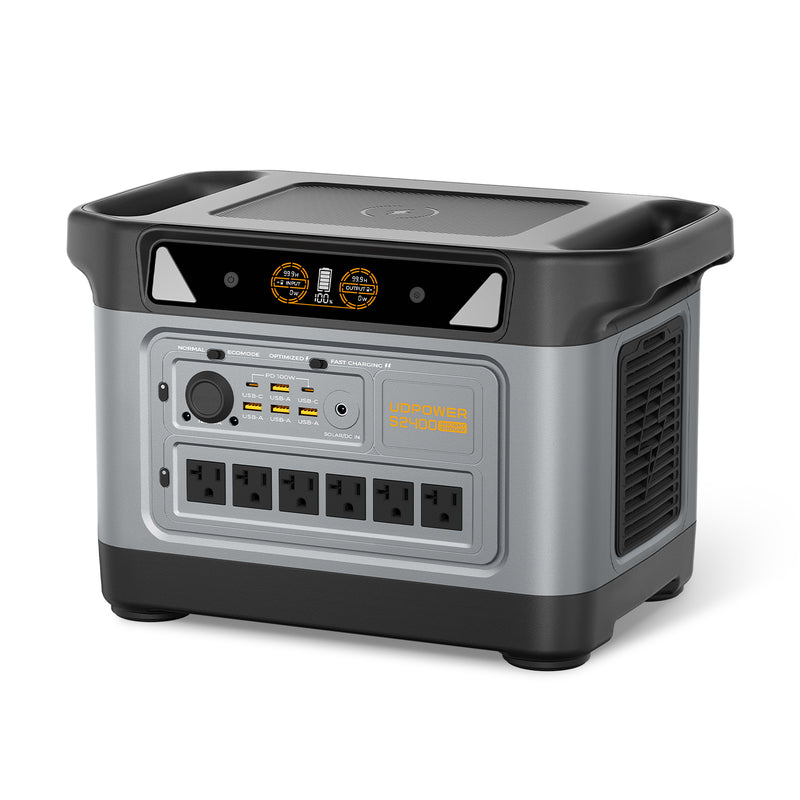
UDPOWER S2400 Portable Power Station
The S2400 is a better fit when you want longer runtime, more output headroom, or several essential devices running beside the refrigerator. It is also a stronger choice for homes where the fridge is older, the garage gets hot, or the outage may last well beyond a few hours.
- Capacity: 2,083Wh LiFePO4 battery
- AC Output: 2,400W pure sine wave
- Surge Support: up to 3,000W
- Weight: about 40.8 lbs
- Ports: 6 AC outlets + multiple DC outputs, USB-A, USB-C, car outlet
- Best for: longer refrigerator backup, fridge + freezer planning, RV use, emergency home essentials, and solar generator kits
Need solar charging for longer outages? Compare UDPOWER solar generator kits or browse UDPOWER solar panels.
Fridge Runtime Estimates with UDPOWER
The table below uses 90% usable efficiency and average fridge wattage. It is for planning, not a guarantee. A refrigerator in a hot garage, a fridge with dirty coils, or a unit opened often will use more energy.
| Load Scenario | Average Watts Used for Estimate | UDPOWER S1200 Estimated Runtime | UDPOWER S2400 Estimated Runtime | Best Fit |
|---|---|---|---|---|
| 12V fridge / car cooler | 45W | About 23.8 hours | About 41.7 hours | Camping, road trips, short outages |
| Mini fridge | 60W | About 17.9 hours | About 31.2 hours | Dorm, office, bedroom, medicine mini fridge |
| Efficient full-size refrigerator | 80W | About 13.4 hours | About 23.4 hours | Most home outage planning |
| Standard refrigerator under heavier use | 100W | About 10.7 hours | About 18.7 hours | Storm outage, warm kitchen, frequent door openings |
| Older garage fridge | 120W | About 8.9 hours | About 15.6 hours | Hot garage, older compressor, higher cycling |
| Fridge + Wi-Fi router + phone charging | 110W | About 9.7 hours | About 17.0 hours | Basic home essentials |
For more device examples, read What Can a 1200W Portable Power Station Run? and What Can a 2000W Power Station Run?.
How Long Can an Empty Fridge Be Off?
If there is no food inside, the question changes from food safety to appliance storage. An empty fridge can stay off for days, weeks, or even longer as long as it is clean, dry, and ventilated.
Before Leaving a Fridge Off for Storage
- Remove all food, ice, and loose packaging.
- Turn the appliance off and unplug it.
- Wipe shelves, drawers, door seals, and the drain area.
- Dry the interior completely.
- Leave the doors slightly open so moisture cannot build up.
- Do not seal the doors shut with tape while the inside is damp.
If the refrigerator was moved on its side, check the manufacturer’s manual before restarting. Some refrigerators need to sit upright before being plugged in again so compressor oil can settle.
Related UDPOWER Resources
- Portable Power Stations — shop quiet, indoor-safe LiFePO4 backup power.
- Solar Generators — power station + solar panel kits for outages, camping, and RV use.
- Solar Panels — add daytime recharging for longer outages.
- UDPOWER S1200 — practical 1000W-class refrigerator backup.
- UDPOWER S2400 — longer runtime and more output headroom.
Keep the Fridge Running Before Food Becomes the Problem
If your main concern is a refrigerator during storms or rolling outages, start with a backup power station sized for the fridge first. Add phones, Wi-Fi, lights, or medical devices only after the refrigerator load is covered.
View Portable Power Stations | View Solar Generator Kits | Get a Runtime Guide
FAQ: How Long Can a Fridge Be Off For?
How long can a fridge be off before food goes bad?
A closed refrigerator can usually keep food safe for up to 4 hours during a power outage. After that, discard perishable food if it has been above 40°F for 4 hours or more.
Is food safe if the power was out for 3 hours?
Usually, yes, if the refrigerator door stayed closed and the fridge or food temperature remained at 40°F or below. Still check temperature when power returns.
What should I throw away after a refrigerator power outage?
Throw away high-risk perishables such as meat, poultry, seafood, milk, eggs, soft cheeses, cooked leftovers, cooked rice, cooked pasta, cut fruit, cut vegetables, and creamy dressings if they were above 40°F too long.
How long can a freezer be off?
A full freezer can usually hold a safe temperature for about 48 hours if the door stays closed. A half-full freezer is usually closer to 24 hours.
Can I refreeze food after a power outage?
Frozen food may often be refrozen if it still contains ice crystals or is at 40°F or below. Quality may change, but temperature is the key safety factor.
Should I open the fridge during a power outage?
Avoid opening it unless necessary. Opening the door lets cold air escape and shortens the safe window.
Can a portable power station run a refrigerator?
Yes, if the power station has enough AC output for compressor startup and enough battery capacity for your target runtime. For many home refrigerators, UDPOWER S1200 or S2400 are more practical choices than small battery packs.
How big of a battery backup do I need for a fridge?
Use average fridge watts to estimate runtime. A 60W mini fridge may run much longer than an older 120W garage fridge. For standard home refrigerators, a 1000W-class or 2000W-class portable power station gives better output headroom.
Can an empty fridge stay unplugged for a long time?
Yes. If it is empty, cleaned, dried, and left slightly open, it can remain unplugged for a long time without food safety concerns.
What is the safest first step when the power goes out?
Keep the refrigerator and freezer doors closed, note the outage start time, and start backup power early if available.
Sources Used for Food Safety Guidance
Related Articles


