

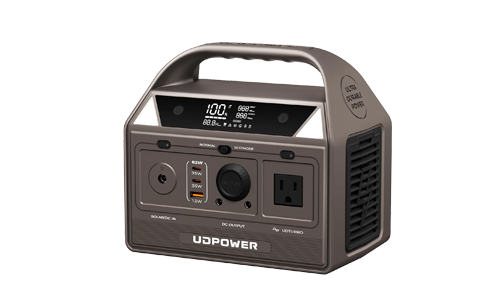
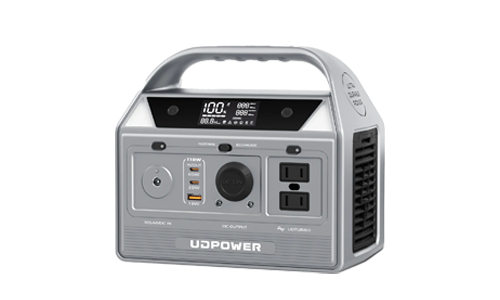
How Does a Portable Power Station Work? Complete Guide
Last updated: August 7, 2026
A portable power station stores electricity in a rechargeable battery and releases that energy when you need it. Inside the unit, a battery management system watches the battery, DC electronics regulate power for USB and 12V devices, and an inverter converts the battery's DC electricity into the 120V AC electricity used by common U.S. appliances.
In simple terms, the process is charge → store → control → convert → power your device. Wall power, a vehicle outlet, or compatible solar panels refill the battery; the power station then sends that stored energy through the correct electrical path for your refrigerator, laptop, CPAP, phone, lights, or other equipment.
The two numbers that matter most are different: watts (W) determine what the power station can run, while watt-hours (Wh) largely determine how long it can run it.

What Exactly Is a Portable Power Station?
A portable power station is an all-in-one rechargeable energy storage system. Instead of carrying a separate battery, charger, inverter, charge controller, wiring, and outlets, those parts are packaged into one portable enclosure.
You charge it ahead of time, store that electricity in its internal battery, and later use built-in AC outlets, USB ports, or DC outputs to power your equipment.
That makes a portable power station fundamentally different from a gasoline generator. A gas generator creates electricity while its engine is running. A battery power station primarily stores electricity that was generated somewhere else.
If solar panels are connected, the combination is commonly called a solar generator. The panels collect solar energy; the portable power station stores, regulates, and distributes it.
If you're starting from the basics, see What Is a Portable Power Station? A Beginner's Guide.
| Power Source | What It Actually Does | Where Energy Comes From | Indoor Use | Refueling / Recharging | Source |
|---|---|---|---|---|---|
| Portable power station | Stores electricity and supplies it later | Wall outlet, vehicle, solar, or compatible generator | No combustion exhaust during normal battery operation; still follow ventilation, moisture, and operating instructions | Recharge the battery | UDPOWER Portable Power Stations |
| Gas generator | Produces electricity while an engine burns fuel | Gasoline, propane, or other fuel | Never operate indoors because of carbon monoxide risk | Add fuel | CDC Generator Safety |
For a deeper side-by-side comparison, read Inverter Generator vs. Portable Power Station.
What's Inside a Portable Power Station?
A portable power station may look like a battery with outlets on the front, but several electrical systems are working together inside it. Understanding those systems makes specifications such as Wh, W, pure sine wave, BMS, and solar input much easier to understand.
| Component | Main Job | What It Means to You |
|---|---|---|
| Battery cells | Store electrical energy as DC | Battery capacity in Wh largely determines runtime |
| Battery Management System (BMS) | Monitors battery voltage, current, temperature, charging, discharging, and other operating conditions | Helps protect the battery and can shut the system down if conditions move outside its limits |
| Inverter | Converts DC battery power into 120V AC | Allows household appliances to use the stored battery energy |
| DC-DC converters | Raise or lower DC voltage to the level needed by individual outputs | Feeds USB, USB-C, 12V, and other DC equipment efficiently |
| Charge controller | Controls incoming power from compatible charging sources | Determines how quickly and safely energy can enter the battery |
| Solar / MPPT control | Adjusts the solar operating point as sunlight and panel voltage change | Helps extract useful charging power from compatible solar panels |
| Control board and display | Measures input, output, battery state, protection events, and operating modes | Provides the watt readings and battery information you see on the screen |
| Cooling system | Moves heat away from power electronics when necessary | Fans may turn on under high load or fast charging even when the battery itself is not hot |
How Electricity Moves Through a Portable Power Station
The easiest way to understand a power station is to follow the electricity from the charging source to your appliance.
Energy arrives from a wall outlet, vehicle charging cable, compatible solar panel, or another supported charging source.
The charging system adjusts incoming voltage and current so the battery can be charged within its operating limits.
Battery capacity is expressed in watt-hours. A 1,190Wh battery stores substantially more energy than a 256Wh battery.
Voltage, current, battery condition, temperature, and other operating limits are monitored while the station charges or discharges.
DC devices use regulated DC outputs. Household AC appliances send the battery's DC electricity through the inverter first.
The power station continues monitoring the load until the device is disconnected, the output is switched off, the battery reaches its discharge limit, or a protection condition occurs.
This is why describing a portable power station as simply a "big battery" is only partly correct. The battery stores the energy, but the inverter, charge controller, BMS, DC converters, thermal system, and output electronics determine how that energy can actually be used.
Why AC, DC, and USB Outputs Use Different Power Paths
The battery inside a portable power station stores DC electricity. Not every device needs that DC power converted into household AC first.
| Output Type | Typical Power Path | Common Devices | Practical Effect |
|---|---|---|---|
| 120V AC outlet | Battery DC → inverter → AC | Refrigerator, TV, coffee maker, CPAP AC adapter, household appliances | Very flexible, but the inverter itself consumes some energy |
| USB-C | Battery DC → DC-DC conversion → USB-C | Laptop, phone, tablet, camera | Avoids the AC inverter when the device supports direct USB-C charging |
| USB-A | Battery DC → DC regulation → USB | Phones, lights, small electronics | Good for low-power electronics |
| 12V car outlet / DC output | Battery DC → regulated DC | 12V refrigerator, lights, automotive accessories | Often makes more sense than converting DC to AC and then back to DC through an appliance adapter |
What Happens When You Plug an Appliance Into a Power Station?
Consider a refrigerator connected to an AC outlet. Several things happen almost instantly.
- You switch on the AC output, which activates the inverter.
- The inverter creates 120V AC electricity from the battery's DC power.
- The refrigerator requests power when its compressor or electronics need it.
- The inverter supplies the load while the control system watches voltage and current.
- If the compressor starts, its power demand may briefly or temporarily rise well above normal running consumption.
- The station continues operating if that demand remains within its supported operating range.
- The battery's remaining energy decreases according to the appliance's real energy consumption—not simply the wattage printed on its label.
This explains one of the most common portable-power mistakes: choosing a station solely because a refrigerator "only uses 100 watts."
A refrigerator might draw relatively little power after it starts, yet its compressor can require substantially more power during startup. At the same time, refrigerators cycle on and off, so they generally do not consume their running wattage every minute of the day.
For refrigerator-specific sizing, see Can a Portable Power Station Run Your Refrigerator?
Watts and Watt-Hours Do Two Completely Different Jobs
This distinction is the key to understanding how a portable power station actually performs.
| Specification | What It Measures | Question It Answers | Example |
|---|---|---|---|
| Watts (W) | Power at a given moment | "Can this station run my appliance?" | A 1,200W AC output can continuously supply loads within its rated operating limit |
| Watt-hours (Wh) | Stored energy | "How long can it run?" | A 1,190Wh battery stores roughly twice the energy of a 596Wh battery |
| Solar input (W) | Maximum or supported charging power from solar | "How quickly can solar refill it under good conditions?" | A station supporting up to 400W solar input can accept substantially more solar charging power than a 150W-input model |
| UPS transfer time | Time needed to move from grid power to battery backup | "How large is the interruption when utility power fails?" | UDPOWER S1200 and S2400 specify sub-10 ms UPSPRIME transfer |
Before buying, check all three power requirements: normal running wattage, higher-power startup or operating demand, and the number of watt-hours you need. The detailed process is covered in How to Know If a Portable Power Station Can Power Your Device.
How Does a Portable Power Station Charge?
AC Wall Charging
Wall charging starts with 120V AC electricity from your home. The station's charging electronics convert and regulate that incoming electricity into DC suitable for charging the internal battery.
Charging does not necessarily continue at maximum wattage all the way to 100%. Battery management and thermal controls can reduce charging power as the battery approaches a full charge or when operating conditions require it.
12V Vehicle Charging
Vehicle charging sends DC electricity from the vehicle's accessory system into the power station. Because a standard vehicle outlet generally provides much less power than a fast wall charger, car charging is usually best viewed as a way to recharge or top up while driving rather than the fastest way to refill a large battery.
Solar Charging
Solar panels generate DC electricity. That power enters the station through its compatible solar/DC input, where the charging controller manages changing solar voltage and current before the energy reaches the battery system.
A "400W solar panel setup" does not guarantee 400W will appear on the display all day. Real input changes with sunlight intensity, clouds, shade, panel direction, panel angle, temperature, cable losses, and the power station's own input limit.
The National Renewable Energy Laboratory notes that shading reduces solar-panel output, which is why a partially shaded campsite can produce dramatically different charging results from an open field. See NREL solar performance guidance.
How Battery Capacity Becomes Real Runtime
A power station's full rated capacity is not delivered to your appliance with zero loss. Inverter conversion, DC regulation, cooling fans, control electronics, cables, battery conditions, and the load itself all affect usable energy.
For practical UDPOWER planning, this guide uses a 90% conversion-efficiency estimate:
Estimated runtime = Battery capacity (Wh) × 0.90 ÷ Device power (W)
For example, the 1,190Wh S1200 gives a planning value of:
1,190Wh × 0.90 = approximately 1,071 usable Wh
A continuous 100W load would therefore have a simple estimated runtime of:
1,071Wh ÷ 100W ≈ 10.7 hours
| Continuous Load | S1200 — 1,190Wh | S2400 — 2,083Wh | Typical Example |
|---|---|---|---|
| 10W | ~107.1 hr | ~187.5 hr | Very low-power networking or lighting load |
| 40W | ~26.8 hr | ~46.9 hr | Low-power CPAP operating example |
| 65W | ~16.5 hr | ~28.8 hr | Laptop charger |
| 100W | ~10.7 hr | ~18.7 hr | TV, fan, or continuous-equivalent refrigerator example |
| 300W | ~3.6 hr | ~6.2 hr | Moderate continuous appliance load |
| 600W | ~1.8 hr | ~3.1 hr | Higher continuous load |
| 1,200W | ~0.9 hr | ~1.6 hr | Heavy continuous AC load |
If you want to understand why "1000W" does not tell you runtime, read How Long Does a 1000W Power Station Last?. For larger batteries, see How Long Will a 2000Wh Power Station Last?.
Why a Refrigerator May Run Longer Than the Simple Wattage Formula Suggests
A refrigerator is a good example of why portable-power math must reflect how the appliance actually works.
Suppose a refrigerator draws 150W while its compressor is running. It usually does not consume 150W continuously for 24 hours. After the interior reaches the desired temperature, the compressor shuts off and later restarts.
As a result, the refrigerator's average energy use over a day may be considerably lower than its running wattage would suggest.
For refrigerators, the yellow EnergyGuide label's annual kWh figure can therefore provide a more useful long-duration estimate than simply dividing battery Wh by compressor running watts.
Read the full method in UDPOWER's refrigerator backup guide.
Which UDPOWER Portable Power Station Fits the Job?
Once you understand the battery, inverter, charging system, and runtime relationship, choosing a model becomes much simpler. The question is not "Which power station has the biggest number?" It is "Which one has enough output for my highest load and enough stored energy for the time I need?"
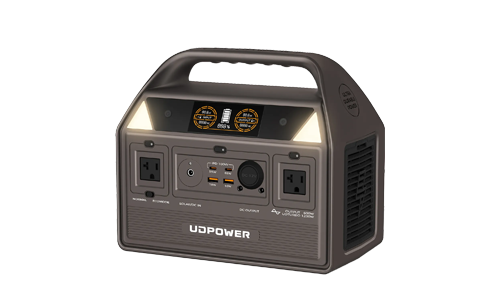
UDPOWER S1200 — Balanced Home Backup, RV, and Camping Power

The S1200 makes sense when you need substantially more capability than a small camping battery without moving all the way to a 2kWh-class system. Its 1,190Wh battery provides useful overnight backup capacity while its 1,200W rated AC output covers many common household, camping, RV, CPAP, refrigerator, and electronics loads.
- Battery capacity: 1,190Wh LiFePO4
- Rated AC output: 1,200W pure sine wave
- UDTURBO: Supports compatible higher-power loads up to 1,800W; conversion efficiency may decrease when operating above rated output
- Output ports: 14 total — 5 AC outlets + 4 USB-A + 2 USB-C + 2 DC5521 + 1 car outlet
- Battery life: 4,000+ cycles
- Fast charging: approximately 1.5 hours under specified charging conditions
- Solar input: up to 400W
- UPSPRIME: less than 10 ms transfer
- Weight: approximately 26.0 lb
- Warranty: 5 years
Best fit: refrigerators, CPAP backup, routers, laptops, TVs, camping appliances, RV use, and households that want a portable emergency battery without the weight of a larger 2kWh-class unit.
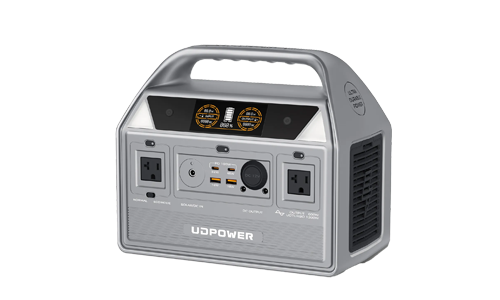
View UDPOWER S1200UDPOWER S2400 — More Capacity for Heavier Backup Loads

The S2400 moves into a different use category. Its 2,083Wh battery stores about 75% more energy than the S1200, while its 2,400W rated output gives considerably more room for appliances, tools, kitchen equipment, and multiple essential loads operating together.
- Battery capacity: 2,083Wh LiFePO4
- Rated AC output: 2,400W pure sine wave
- UDTURBO: Supports compatible higher-power loads up to 3,000W; conversion efficiency may decrease when operating above rated output
- Output ports: 15 total — 6 AC outlets + 4 USB-A + 2 USB-C + 2 DC5521 + 1 car outlet
- Battery life: 4,000+ cycles
- Fast charging: approximately 1.5 hours under specified charging conditions
- Solar input: up to 400W
- UPSPRIME: less than 10 ms transfer
- Weight: approximately 40.8 lb
- Warranty: 5 years
Best fit: longer refrigerator backup, microwave and kitchen loads, power tools, RV use, extended outages, and households that want to power several essentials from one station.
View UDPOWER S2400| Specification | UDPOWER S1200 | UDPOWER S2400 | Why It Matters | Source |
|---|---|---|---|---|
| Capacity | 1,190Wh | 2,083Wh | More Wh generally means longer runtime at the same load | S1200 / S2400 |
| Rated output | 1,200W | 2,400W | Determines the normal AC load range | S1200 / S2400 |
| UDTURBO range | Up to 1,800W for compatible loads | Up to 3,000W for compatible loads | Provides additional appliance compatibility above the normal rated output; efficiency may be lower in this mode | S1200 / S2400 |
| Total output ports | 14 | 15 | Useful when several essentials need power at the same time | S1200 / S2400 |
| Solar input | Up to 400W | Up to 400W | Determines the station's supported solar charging rate | S1200 / S2400 |
| UPSPRIME | <10 ms | <10 ms | Reduces interruption when utility power fails | S1200 / S2400 |
| Weight | 26.0 lb | 40.8 lb | The S1200 is easier to move; the S2400 trades portability for more energy and output | UDPOWER Comparison |
How Does UPS Mode Work in a Portable Power Station?
A UPS-capable portable power station adds another useful power path.
In a typical setup, the station is connected to utility power while your essential device is connected to the station. When grid electricity is available, the system manages incoming power and maintains the battery. If utility power fails, the station changes to battery-backed output.
UDPOWER S1200 and S2400 use UPSPRIME technology with a specified transfer time of less than 10 milliseconds.
Wall power → power station → connected equipment
Battery → inverter → connected equipment
This can be useful for routers, computers, networking equipment, selected CPAP setups, and other electronics where a long manual switchover would be inconvenient.
Device compatibility should still be checked. A portable power station is not automatically equivalent to every specialized or medical-grade UPS system.
For CPAP runtime planning, see How Long Will a CPAP Run on a Battery Backup?.
Can You Use a Power Station While It Is Charging?
Many modern portable power stations support powering devices while the battery is being charged. This is often called pass-through operation.
However, "charging while using" does not mean the battery must always gain charge.
Imagine your solar panels are delivering 250W while the connected equipment is consuming 400W. The solar input is helping, but the system still has a 150W deficit before conversion losses are considered. Battery state of charge will continue to decrease, only more slowly.
| Incoming Power | Connected Load | Likely Result |
|---|---|---|
| 400W | 100W | Enough incoming power is available to support the load and continue charging, subject to system limits and losses |
| 250W | 250W | Battery level may change slowly because system losses also consume energy |
| 250W | 400W | The battery supplies the remaining demand, so charge level continues falling |
What Happens When a Portable Power Station Is Overloaded?
Running out of battery and exceeding the inverter's output limit are two different problems.
If the battery still shows 80% but the connected appliance asks for more power than the station can support, the station may shut down the AC output or trigger an overload warning even though plenty of stored energy remains.
Think of battery capacity as the size of a water tank and inverter output as the size of the pipe. A large tank does not help if you try to force more water through the pipe than it can safely deliver at once.
| What You See | Possible Reason | What to Check |
|---|---|---|
| Battery has charge but AC suddenly shuts off | Load or startup demand exceeded the supported output range | Check appliance running watts and startup demand |
| Station powers a lamp but not a refrigerator | Refrigerator compressor requires more startup power | Check startup watts, LRA, or measure with a suitable watt meter |
| USB works but AC outlets do not | AC output may be switched off or a protection event occurred | Check AC-output control and display warnings |
| Station stops during very heavy use | Overload, thermal protection, low battery, or another protection condition | Disconnect loads, allow cooling if necessary, and follow the model manual |
Why Doesn't the Power Station Display Match Simple Math?
Owners sometimes expect a perfectly fixed relationship between battery percentage, displayed watts, and remaining hours. Real systems are more complicated.
1. The inverter and electronics use power too
If your appliance consumes 100W, the battery may need to provide more than 100W because converting DC into AC is not 100% efficient.
2. Some appliances constantly change their power draw
Refrigerators, compressors, power tools, laptop chargers, and devices with thermostats do not necessarily draw one fixed wattage.
3. Estimated remaining time is based on current conditions
If you turn on a 1,000W appliance, the estimated remaining runtime may fall sharply. Turn it off and connect a 20W router, and the estimate can rise dramatically.
4. Solar input changes constantly
A passing cloud or a narrow tree shadow can change charging power within seconds.
5. Charging usually slows near full
The maximum charging rate shown in specifications should not be interpreted as a perfectly constant rate from 0% through 100%.
Why Leaving the AC Output On Can Reduce Runtime
The inverter needs energy to remain ready to create 120V AC, even when the appliance connected to it is using little or no power.
That idle consumption may seem small compared with a refrigerator or microwave, but it matters much more when the actual load is tiny.
For example, if your only task is charging a USB-C laptop, using the station's USB-C port instead of turning on the AC inverter and plugging in the laptop's wall charger can avoid an unnecessary conversion step.
This is one reason runtime is not simply "battery Wh divided by device watts" in every situation.
Does a Solar Generator Work Differently?
Electrically, the portable power station still works in essentially the same way. The difference is where the charging energy comes from.
A solar generator is normally:
Solar panels + compatible portable power station.
The solar panel converts sunlight into DC electricity. The station manages that incoming DC power, stores energy in the battery, and later supplies AC or DC power to your devices.
The important limitation is that solar does not make the battery unlimited. If your campsite consumes 1,500Wh each day but your panels only collect 800Wh, the battery will eventually run down.
For multi-day off-grid trips, think in terms of an energy budget:
Energy collected each day ≥ energy consumed each day
This matters especially for dispersed camping, where there may be no electrical hookup available to rescue an undersized setup.
How to Choose a Portable Power Station Based on How It Works
Instead of buying by one headline number, work through the system in the same order electricity moves through it.
- List everything you want to power. Include refrigerators, CPAP machines, routers, lights, laptops, cooking appliances, tools, and anything that might run simultaneously.
- Check normal running watts. This tells you the basic inverter requirement.
- Check higher startup or operating demand. Motors, compressors, pumps, and heating equipment can require substantially more power than small electronics.
- Calculate how many watt-hours you need. Multiply your real power consumption by the number of hours you expect to run each device.
- Add conversion losses. Do not assume 100% of the battery's rated Wh reaches the appliance.
- Check how you will recharge. A large battery is only useful for repeated off-grid use if your wall, vehicle, solar, or generator recharge plan can restore the energy you consume.
- Choose the outputs you actually need. USB-C laptops, 12V refrigerators, and AC appliances may use different power paths.
- Consider weight. More battery capacity usually means more weight. A station that never leaves your garage can prioritize capacity differently from one you carry to a campsite.
| Use Case | Main Priority | Suggested UDPOWER Class | Helpful Reading |
|---|---|---|---|
| Phones, cameras, small electronics | Low weight and efficient DC charging | Compact C-Series | Compare all models |
| Weekend camping | Portability, solar recharge, lights, laptop, small fridge | C400 / C600 or S1200 for more capacity | Dispersed Camping 101 |
| CPAP backup | Nighttime runtime and dependable power | C600 / S1200 depending on power draw and number of nights | CPAP Runtime Guide |
| Home refrigerator backup | Compressor startup plus longer Wh capacity | S1200 or S2400 | Refrigerator Backup Guide |
| Kitchen appliances and heavier loads | Higher rated output and additional capacity | S2400 | 2000Wh Runtime Guide |
| Multi-day off-grid use | Daily Wh consumption plus a realistic recharge plan | Depends on daily energy budget | Solar Generator Kits |
Common Mistakes That Make a Power Station Feel Smaller Than It Is
Buying by output watts instead of battery capacity
A 2,000W label does not mean the battery can deliver 2,000W for several hours. Output power and stored energy are separate specifications.
Ignoring compressor startup
A refrigerator, freezer, pump, or motor can look compatible based on running watts but fail at startup if the power station does not have enough headroom.
Running everything through AC
Phones, laptops, and 12V equipment may have a more direct DC power path available.
Expecting rated solar wattage all day
A 210W panel is rated under defined test conditions. Your real campsite input can be lower because of clouds, panel angle, heat, haze, trees, or partial shade.
Planning only for battery size and not for recharging
A 2kWh battery can be extremely useful in an outage, but an extended outage becomes an energy-management problem. Once the stored electricity has been consumed, you need a practical way to replace it.
Assuming every appliance uses its label wattage continuously
Thermostatically controlled and variable-power equipment can consume far less—or occasionally more—than a simple label-based estimate suggests.
Portable Power Station Operation: A Real-World Example
Imagine an S1200 sitting fully charged before a power outage.
- The grid goes down.
- You connect your refrigerator to an AC outlet.
- The battery supplies DC electricity to the inverter.
- The inverter produces 120V pure sine wave AC.
- The refrigerator compressor starts and the power station handles its higher startup demand.
- Once the compressor is running, consumption drops.
- When the refrigerator reaches temperature, its compressor turns off and the load drops again.
- You charge a phone through USB rather than the AC inverter path.
- During daylight, compatible solar panels add energy back into the system.
- If the solar panels collect less energy than the refrigerator and other devices consume, battery percentage continues to fall.
That single example brings together almost every important part of how a portable power station works: battery capacity, inverter output, startup demand, duty cycle, DC outputs, charging input, conversion loss, and energy balance.
Frequently Asked Questions
Does a portable power station generate electricity?
Not by itself. A portable power station primarily stores electricity and supplies it later. It must first be charged from a wall outlet, vehicle, compatible solar panels, or another supported source. When paired with solar panels, the panels generate electricity while the power station stores and distributes it.
Why does a portable power station need an inverter?
The internal battery stores DC electricity, while normal U.S. household appliances expect approximately 120V AC. The inverter converts battery DC into usable AC power for those appliances.
What is more important: watts or watt-hours?
Both are important for different reasons. Watts tell you whether the station can supply enough power to run a device. Watt-hours tell you how much energy is stored and therefore largely determine how long the device can run.
Does a portable power station lose energy during conversion?
Yes. Inverters, DC converters, fans, electronics, cables, and battery conditions all introduce some loss. That is why this guide uses a 90% usable-efficiency estimate rather than assuming every rated watt-hour reaches the connected device.
Can I use a portable power station while it is charging?
Many models support pass-through operation. Whether the battery actually gains charge depends on how much power is entering compared with how much the connected devices are consuming, along with normal system losses.
Can solar panels power devices while charging the power station?
On compatible systems that allow charging while in use, solar input can offset part or all of the connected load. If your devices consume more energy than the panels supply, the battery will continue to discharge, just more slowly.
What happens if I plug in an appliance that is too powerful?
If the load exceeds the station's supported output range, overload protection may shut down the AC output even when the battery still has plenty of charge. Check both normal running demand and higher startup or operating requirements.
Why is pure sine wave AC important?
Pure sine wave inverters produce AC electricity that more closely resembles normal household utility power. It is the preferred type for appliances with motors, compressors, electronic controls, laptops, TVs, CPAP equipment, and other sensitive electronics.
Why does my refrigerator run longer than battery Wh divided by its running watts?
Refrigerators normally cycle their compressors on and off. A refrigerator that draws 150W when its compressor is active does not necessarily consume 150W continuously for every hour. Its average energy consumption over a day can therefore be significantly lower.
Does leaving the AC output on use battery power?
Yes. The inverter and control electronics require some energy even when the connected AC load is very small. When possible, using a direct USB-C or DC connection for low-power equipment can reduce unnecessary conversion.
Can a portable power station be used indoors?
Battery-operated portable power stations do not burn gasoline or produce combustion exhaust during normal operation, which makes them suitable for many indoor backup applications when used according to the manufacturer's instructions. Keep the unit dry, maintain required ventilation, and follow its temperature and load limits. Gas generators are different and must never be operated indoors because of carbon monoxide risk.
How do I know what size portable power station I need?
First determine the running and higher startup power requirements of your devices. Then calculate how many watt-hours they will consume during the number of hours you need backup. Finally, add conversion losses and enough safety margin for real-world conditions.
Related UDPOWER Guides
- Shop & Compare Portable Power Stations
- What Is a Portable Power Station? Beginner's Guide
- How to Know If a Portable Power Station Can Power Your Device
- What Can a 1000W Portable Power Station Run?
- How Long Does a 1000W Power Station Last?
- How Long Will a 2000Wh Power Station Last?
- Can a Portable Power Station Run Your Refrigerator?
- How Long Will a CPAP Run on a Battery Backup?
- Inverter Generator vs. Portable Power Station
- Dispersed Camping 101
Ready to Choose the Right Portable Power Station?
Start with the devices you actually need to power. Check their wattage, estimate the hours you need them to run, and then choose enough battery capacity and output headroom instead of buying by one headline specification.
View Portable Power Stations View UDPOWER S1200 View UDPOWER S2400 View Solar Generator KitsRelated Articles


