Common Microwave Wattages: What 700W, 1000W, 1200W, and Input Watts Actually Mean
ZacharyWilliamMicrowave Wattage Guide
Latest update: May 11, 2026 · Reviewed by UDPOWER Editorial Team
Quick answer
Most home microwaves in the U.S. are advertised somewhere between 600W and 1,200W cooking power. The most common shopping range is 900W to 1,200W, and many recipes are written around a 1,000W microwave.
The catch: the wattage printed on the front of a microwave is usually cooking output, not the real electrical draw from the wall. A microwave sold as “1,000W” or “1,100W” may draw around 1,500W to 1,550W input power while running. That is the number that matters for breakers, extension cords, generators, and portable power stations.
- Best everyday cooking wattage: 1,000W to 1,200W output.
- Best compact/dorm wattage: 600W to 900W output.
- Best number for backup power sizing: rated input watts on the label or manual.
- Best UDPOWER fit for normal microwave backup: S2400, because most full-size microwaves draw more than 1,200W input.

Common microwave wattages by type
If you are shopping online, the wattage you see in the title or product card is usually cooking power. That number helps you compare cooking speed, but it does not tell you exactly how much electricity the microwave pulls from a 120V outlet.
Use this table as a practical map of what is normal in U.S. homes.
| Microwave type | Common advertised cooking watts | Where you usually see it | Best for | What to check before backup power | Helpful source |
|---|---|---|---|---|---|
| Compact countertop | 600W–900W | Dorm rooms, offices, small apartments, RV kitchens | Leftovers, drinks, popcorn, small frozen meals | Find the input watts on the rating label. Small cooking watts can still draw more than expected. | KitchenAid wattage guide |
| Standard countertop | 900W–1,200W | Most family kitchens and apartment kitchens | Everyday cooking, reheating, defrosting, larger portions | Many 1,000W–1,100W cooking-power models draw roughly 1,500W input in real manuals. | Maytag microwave wattages |
| Over-the-range microwave | Often 900W–1,200W | Kitchens where the microwave is mounted above the range | Saving counter space, daily reheating, family meals | Do not assume it uses less power just because it is built in. Check the model label or manual. | Whirlpool wattage ranges |
| Built-in microwave | Often 900W–1,200W | Renovated kitchens, wall cabinets, trim-kit installs | Clean built-in look and regular home cooking | Confirm whether it is a standard microwave or a convection combo before sizing power. | KitchenAid built-in context |
| Convection / air-fry / grill combo | 1,000W–1,700W+ | Premium kitchens and multifunction appliances | More than reheating: crisping, baking, broiling, roasting, air frying | These can have extra heating elements. Read the manual before using any portable backup source. | Whirlpool higher-wattage category |
The wattage tiers you will see most often
Microwave listings tend to repeat a few common numbers. The table below shows what those numbers usually mean in real use.
| Advertised cooking watts | How common it is | Real-life cooking feel | Best use case | Time vs a 1,000W recipe | Backup power note |
|---|---|---|---|---|---|
| 600W | Compact / budget | Slowest common home tier | Drinks, leftovers, small snacks | About 1.67× longer | May be easier to power, but still check input watts. |
| 700W | Very common compact tier | Works, but frozen meals and larger portions take patience | Dorms, offices, occasional use | About 1.43× longer | Still not the same as 700W input. |
| 800W | Common | Usable for everyday reheating | Small households and simple meals | About 1.25× longer | Check whether input exceeds 1,000W. |
| 900W | Very common | Good balance for budget countertop models | Most reheating and basic cooking | About 1.11× longer | Often needs more than a small power station. |
| 1,000W | Recipe baseline | Most packaged-food directions make sense here | Everyday cooking, defrosting, family use | Same as recipe | Example manuals show 1,000W output can be 1,500W input. |
| 1,100W | Very common full-size tier | Faster reheating and better large-portion performance | Busy kitchens and frequent microwave use | About 0.91× the recipe time | Example manuals show 1,100W output can be 1,550W input. |
| 1,200W | Common higher-performing tier | Fast and convenient, especially for families | Larger plates, frozen meals, frequent use | About 0.83× the recipe time | Often too much for 1,200W-class stations after input watts are checked. |
| 1,300W–1,700W+ | Premium / multifunction | Fast, feature-rich, and usually more power-hungry | Convection, crisping, grilling, larger households | Shorter than baseline, but model-dependent | Use only with a higher-output backup source and confirmed input rating. |
Output watts vs input watts: the mistake that causes most sizing problems
A microwave has two wattage numbers that sound similar but do different jobs.
- Output watts are cooking power. This is the number most shoppers see first.
- Input watts are the power drawn from the wall outlet. This is the number that matters for circuits, generators, and portable power stations.

Here are two real manual examples that show why this matters:
| Manual example | Rated output power | Rated input power | What it means for backup power | Source |
|---|---|---|---|---|
| Toshiba EM131A5C-SS | 1,100W cooking output | 1,550W input | A buyer may think “1,100W microwave,” but a backup power source must handle about 1,550W while it is running. | Toshiba manual PDF |
| Farberware FMO11AHTBKB | 1,000W cooking output | 1,500W input | A 1,000W cooking-power microwave can still exceed the continuous output of many smaller power stations. | Farberware manual PDF |
Where to find your microwave’s real input watts
Look for a rating label around the door frame, inside the door, on the back of the unit, or in the user manual. The wording may be “Rated Input Power,” “Input,” “Power Consumption,” or a rated current such as amps. If the label gives amps instead of watts, use the simple 120V estimate below.
Watts ≈ Volts × Amps
For a normal U.S. outlet, that usually means watts ≈ 120 × amps.
How to adjust cooking time when your microwave is not 1,000W
Many recipes and frozen-food directions assume a 1,000W microwave. If yours is lower, add time. If yours is higher, shorten time and check early.
The easy rule:
| Your microwave output | Recipe says 1 minute | Recipe says 3 minutes | Recipe says 5 minutes | How to use this safely |
|---|---|---|---|---|
| 700W | About 1 min 26 sec | About 4 min 17 sec | About 7 min 9 sec | Stir and check more often; compact microwaves heat less evenly. |
| 800W | About 1 min 15 sec | About 3 min 45 sec | About 6 min 15 sec | Good for small portions, but frozen meals may need extra standing time. |
| 900W | About 1 min 7 sec | About 3 min 20 sec | About 5 min 33 sec | Close enough for many recipes, but check doneness. |
| 1,000W | 1 minute | 3 minutes | 5 minutes | This is the common recipe baseline. |
| 1,100W | About 55 sec | About 2 min 44 sec | About 4 min 33 sec | Start slightly shorter, then add time if needed. |
| 1,200W | About 50 sec | About 2 min 30 sec | About 4 min 10 sec | Use shorter bursts for liquids and small portions. |
Microwave amps and kitchen circuits
Most U.S. household microwaves use 120V power. To estimate amps, divide input watts by 120V.
If your microwave label says 1,500W input, the running current is about 12.5A. If it says 1,550W input, the running current is about 12.9A.
| Microwave input rating | Estimated amps at 120V | What it usually means | Power planning note |
|---|---|---|---|
| 900W input | 7.5A | Small compact model or low-power setting draw | Usually easier to support, but do not run other heat appliances at the same time. |
| 1,000W input | 8.3A | Compact to small countertop load | May fit a 1,200W power station if startup behavior is normal. |
| 1,200W input | 10.0A | Upper end for a small microwave draw | Right at the limit for a 1,200W-class station. Use as the only AC load. |
| 1,350W input | 11.3A | Common mid-size draw | Better matched with a larger power station. |
| 1,500W input | 12.5A | Common for a 1,000W cooking-power microwave | Too high for many 1,200W stations; use a higher-output model. |
| 1,550W input | 12.9A | Common for a 1,100W cooking-power microwave | Choose a power station with comfortable continuous headroom. |
| 1,700W input | 14.2A | Large or feature-heavy microwave load | Do not share the same backup output with another high-draw appliance. |
Microwave “power level” settings do not always reduce the peak draw the way shoppers expect. Many microwaves lower average cooking energy by cycling the magnetron on and off. GE Appliances explains this as a percentage of time, such as 70% on-time at power level 7.
Source: GE Appliances microwave power levels.
Can a portable power station run a microwave?
Yes, but microwave backup is a “minutes, not hours” use case. A microwave draws a lot of power while it is running, but it usually runs for short bursts. That makes it different from a refrigerator, CPAP, Wi-Fi router, or fan.
The 3-check rule before plugging in a microwave
- Check input watts: use the microwave label, not just the cooking wattage on the front.
- Check continuous output: the power station’s continuous AC output should be higher than the microwave input draw.
- Use one heavy load at a time: do not run a microwave, coffee maker, toaster oven, or space heater together from the same power station.
| Microwave input watts | Typical microwave class | S2400 estimated total cooking minutes | S1200 estimated total cooking minutes | Practical recommendation |
|---|---|---|---|---|
| 1,000W input | Small / efficient compact model | About 106 minutes | About 61 minutes | Both may work if the label confirms the input rating and no other AC loads are running. |
| 1,200W input | Upper end of compact input draw | About 89 minutes | About 51 minutes | S1200 is at its continuous output limit; S2400 has better headroom. |
| 1,350W input | Common mid-size draw | About 79 minutes | Not recommended | Choose S2400 for normal headroom. |
| 1,500W input | Common 1,000W cooking-power microwave example | About 71 minutes | Not recommended | S2400 is the better match. |
| 1,550W input | Common 1,100W cooking-power microwave example | About 69 minutes | Not recommended | S2400 is the better match. |
| 1,700W input | Large or multifunction microwave | About 63 minutes | Not recommended | Use S2400 only if the actual label stays within the 2,400W continuous output rating. |
Runtime estimates above use usable AC energy after normal inverter losses. Real results vary by model, battery temperature, battery age, cooking cycles, and whether other devices are plugged in.
Best UDPOWER picks for microwave backup
For microwave use, the inverter output matters more than the battery size at first. A small power station can have enough watt-hours on paper but still fail if the microwave input watts exceed its continuous AC output.

Best overall for normal microwave backup: UDPOWER S2400
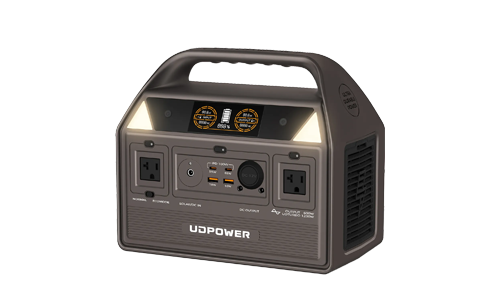
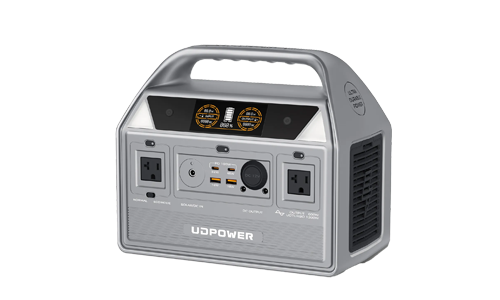
The UDPOWER S2400 Portable Power Station is the strongest fit for common full-size microwaves because it gives more continuous output headroom than a 1,200W-class unit.
- Capacity: 2,083Wh
- AC output: 2,400W pure sine wave, 120V~60Hz
- Surge support: up to 3,000W for startup surges
- Battery type: LiFePO4 / LFP, 80%+ capacity after 3,000 cycles
- Useful for: microwave bursts, refrigerator, Wi-Fi, lights, laptop, TV, CPAP, and selected outage essentials

For compact microwaves only: UDPOWER S1200
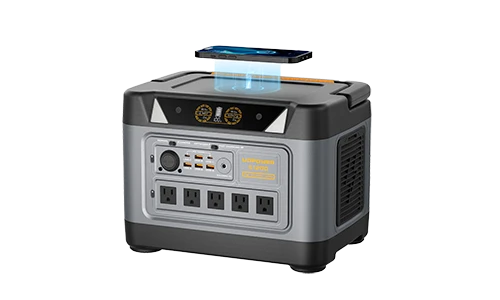
The UDPOWER S1200 Portable Power Station can be considered only when the microwave’s real input rating is within the unit’s continuous output. It is a strong match for essentials and smaller appliances, but many standard 1,000W–1,100W cooking-power microwaves draw more than 1,200W from the wall.
- Capacity: 1,191Wh
- AC output: 1,200W pure sine wave, 120V~60Hz
- Maximum listed AC output: 1,800W max
- UPS Prime: response time ≤10ms
- Best use: compact microwave models with verified input at or below 1,200W, plus refrigerator, CPAP, router, lights, and phone/laptop charging
What about C600, C400, or C200?
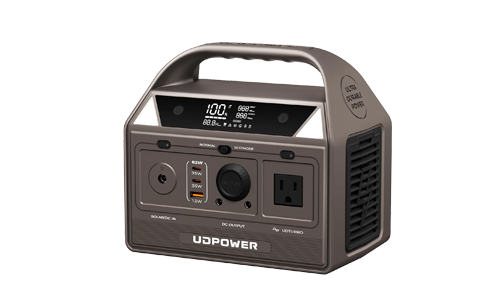
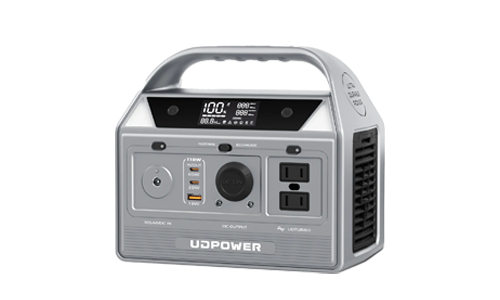
For standard microwaves, they are usually not the right choice. The UDPOWER C600 has a 600W AC output and is better for laptops, phones, lights, small fridges, cameras, and road-trip gear. A common 1,000W cooking-power microwave may draw around 1,500W input, which is far beyond what smaller stations are designed to run continuously.
Microwave wattage buying checklist
Use this checklist before buying a microwave, replacing an old one, or planning backup power.
| Question | Best answer for most U.S. homes | Why it matters |
|---|---|---|
| What cooking wattage should I buy? | 1,000W to 1,200W output for everyday kitchens | Fast enough for most recipes without moving into specialty appliance territory. |
| Is 700W enough? | Yes for light use, no for fast family cooking | It works, but recipes take longer and larger portions heat less evenly. |
| Is 900W enough? | Usually yes for basic household reheating | It is a reasonable budget tier and easier to live with than 600W–700W. |
| Is 1,200W better than 1,000W? | It is faster, but not always necessary | For most kitchens, 1,000W already matches recipe assumptions well. |
| What number matters for a power station? | Rated input watts | Input watts determine whether the inverter can actually run the microwave. |
| Should I run a microwave and coffee maker together? | No, not from the same portable station unless the total load is confirmed safe | Kitchen heat appliances stack watts very quickly. |
| What UDPOWER model should I start with? | S2400 for normal microwave backup; S1200 only for verified low-input compact microwaves | Most full-size microwaves need more continuous output headroom than 1,200W. |
Common mistakes to avoid
- Mistake 1: Buying backup power from cooking watts. A “1,000W microwave” may draw around 1,500W input.
- Mistake 2: Thinking lower power level always solves overload. Many microwaves cycle full power on and off instead of lowering peak draw smoothly.
- Mistake 3: Running multiple kitchen appliances at once. Microwave plus coffee maker plus toaster oven can overload a circuit or backup source fast.
- Mistake 4: Ignoring the label. The manual and rating plate beat any rule of thumb.
- Mistake 5: Expecting all-day microwave runtime. Microwaves are useful for short heating bursts during an outage, not continuous cooking.
FAQ
What is the most common microwave wattage?
The most common practical range is about 900W to 1,200W cooking power, with 1,000W often treated as the recipe baseline. Compact models may be 600W to 800W, while premium or multifunction models can go higher.
Is a 700W microwave good?
A 700W microwave is fine for light use, dorm rooms, offices, drinks, popcorn, and small meals. It is slower than a 1,000W model, so frozen meals and larger plates usually need more time.
Is 900W enough for a microwave?
Yes. A 900W microwave is a workable everyday choice for many households. It is not as fast as 1,000W or 1,200W, but it is much more practical than the lowest compact tiers.
Why do recipes usually mention 1,000W?
Many packaged-food directions and microwave recipes use 1,000W as the baseline because it is a common middle range for home cooking. If your microwave is lower or higher, adjust the time and check food early.
Does a 1,000W microwave use only 1,000 watts from the wall?
Not necessarily. That 1,000W number is usually cooking output. A real manual example shows a 1,000W output microwave with 1,500W input power. Always check the input rating for electrical planning.
Can a 1,200W portable power station run a microwave?
Sometimes, but only if the microwave’s real input rating is at or below the station’s continuous AC output. Many full-size microwaves draw 1,350W to 1,550W input, which is too high for a 1,200W continuous output station.
Can UDPOWER S2400 run a microwave?
In many cases, yes. The UDPOWER S2400 provides 2,400W continuous pure sine wave AC output, which gives better headroom for common microwave input ratings. Still, check your microwave’s label before use.
Can UDPOWER S1200 run a microwave?
It can run some compact or lower-input microwaves if the rated input stays within 1,200W continuous output. For common full-size 1,000W–1,100W cooking-power microwaves that draw around 1,500W input, the S1200 is not the best choice.
Are C600, C400, or C200 good for microwaves?
No for standard microwaves. Those models are better for smaller loads such as phones, laptops, lights, fans, routers, small fridges, cameras, and camping electronics.
How many amps does a microwave use?
Use input watts divided by 120V. A 1,500W input microwave uses about 12.5 amps, while a 1,550W input microwave uses about 12.9 amps. For a detailed amp chart, see UDPOWER’s guide: How Many Amps Does a Microwave Use?
Sources used in this guide
External source links are included for reader verification. Always confirm your exact microwave’s label or manual before sizing backup power.
Choose a backup power setup with enough microwave headroom
For normal home microwaves, start with the real input watts on the microwave label. If the label is around 1,350W to 1,700W, choose a higher-output power station rather than forcing a smaller unit to run at its limit.