

Solar Panel kWh Calculator: Estimate Daily Solar Energy Production
Last updated: September 10, 2026
Quick Answer: How Many kWh Does a Solar Panel Produce?
A solar panel's watt rating tells you its maximum power under standardized test conditions, but kWh tells you how much energy it produces over time. To estimate daily solar production, multiply the panel wattage by the number of panels, your location's peak sun hours, and a real-world output factor, then divide by 1,000.
Daily solar energy (kWh) = Panel watts × Number of panels × Peak sun hours × Real-world output factor ÷ 1,000
For example, one 400W solar panel receiving 4.5 peak sun hours with an 80% planning factor would produce about 1.44 kWh per day. A 210W panel under the same conditions would produce about 0.76 kWh per day, while a 120W panel would produce about 0.43 kWh per day.
Those are planning estimates rather than guaranteed outputs. Clouds, shade, heat, panel angle, dirt, wiring, charge-controller behavior, battery state of charge, and the receiving device's solar input limit can all change the energy you actually collect.

Solar Panel kWh Calculator
Use this calculator to estimate how many kilowatt-hours your solar panel or solar array can generate per day, average month, and year. You can also enter a portable power station's maximum solar input to see whether the receiving device may limit the amount of panel capacity you can use at one time.
This quick calculator is best used for planning and comparisons. For a fixed rooftop system, use NREL's PVWatts Calculator for a location-based model that considers solar-resource data and additional system variables.
How to Calculate Solar Panel kWh
The basic calculation is straightforward once you separate power from energy.
Suppose you have four 400W panels, your site receives 5 peak sun hours, and you use an 80% real-world output factor:
The four panels form a 1,600W, or 1.6kW, array. The 1.6kW figure describes the system's rated power. The 6.4kWh figure describes the estimated energy produced across the day.
For a rough annual estimate:
That annual calculation assumes the same average solar conditions every day. Real production changes by month, so it is better to use historical solar-resource data when annual accuracy matters.
How Many kWh Can a Solar Panel Produce Per Day?
The table below shows quick planning estimates using an 80% output factor. It demonstrates why there is no single answer to “how many kWh does a solar panel produce?” The panel wattage and available solar resource both matter.
| Panel / Array Rating | 3 Peak Sun Hours | 4 Peak Sun Hours | 5 Peak Sun Hours | 6 Peak Sun Hours |
|---|---|---|---|---|
| 100W | 0.24 kWh/day | 0.32 kWh/day | 0.40 kWh/day | 0.48 kWh/day |
| 120W | 0.29 kWh/day | 0.38 kWh/day | 0.48 kWh/day | 0.58 kWh/day |
| 200W | 0.48 kWh/day | 0.64 kWh/day | 0.80 kWh/day | 0.96 kWh/day |
| 210W | 0.50 kWh/day | 0.67 kWh/day | 0.84 kWh/day | 1.01 kWh/day |
| 300W | 0.72 kWh/day | 0.96 kWh/day | 1.20 kWh/day | 1.44 kWh/day |
| 400W | 0.96 kWh/day | 1.28 kWh/day | 1.60 kWh/day | 1.92 kWh/day |
| 430W | 1.03 kWh/day | 1.38 kWh/day | 1.72 kWh/day | 2.06 kWh/day |
| 500W | 1.20 kWh/day | 1.60 kWh/day | 2.00 kWh/day | 2.40 kWh/day |
| 1,000W / 1kW | 2.40 kWh/day | 3.20 kWh/day | 4.00 kWh/day | 4.80 kWh/day |
Calculation method: panel wattage × peak sun hours × 0.80. For location-specific solar production modeling, see NREL PVWatts. For PV performance under real operating conditions, see the U.S. Department of Energy PV performance guidance.
kW vs. kWh: The Difference That Causes Most Solar Output Confusion
Questions such as “how many kilowatts does a solar panel produce?” and “how many kWh does a solar panel generate?” sound similar, but they ask about two different things.
| Unit | What It Measures | Solar Example | Why It Matters |
|---|---|---|---|
| Watt (W) | Instantaneous power | A panel rated at 400W | Shows the panel's rated power capability |
| Kilowatt (kW) | 1,000 watts of instantaneous power | Ten 400W panels = 4kW array | Used to describe system size |
| Watt-hour (Wh) | Energy accumulated over time | 100W for 3 hours = 300Wh | Useful for batteries and smaller solar systems |
| Kilowatt-hour (kWh) | 1,000Wh of energy | 400W panel producing 1.44kWh in a day | Useful for daily, monthly and yearly production |
A 400W panel is a 0.4kW panel. That does not mean it produces 0.4kWh per day. If it averaged its full 400W output for one hour, it would produce 0.4kWh during that hour. Daily energy depends on how much usable sunlight it receives across the entire day.
What Are Peak Sun Hours?
Peak sun hours are not the number of hours between sunrise and sunset. They represent the day's solar radiation converted into the equivalent number of hours at approximately full solar irradiance.
A location might have 12 hours of daylight but only 4.5 peak sun hours. Early morning, late afternoon, haze, cloud cover, season, and the sun's angle all affect how much solar energy actually reaches the panels.
This is why multiplying a 400W panel by 12 daylight hours would dramatically overestimate production. A location-specific solar resource tool such as NREL PVWatts is much more useful than guessing from daylight length.
Why Peak Sun Hours Change Through the Year
Even at the same address, peak sun hours can vary substantially between summer and winter. Shorter days, a lower solar angle, clouds, snow, storms, and seasonal weather patterns all change the energy available to the panel.
If solar power is important for emergency backup or off-grid living, size your system around the weaker season rather than only the best summer month. A system that comfortably replaces your daily energy use in June may not do the same in December.
Why Doesn't a Solar Panel Produce Its Rated Wattage All Day?
The number printed on a solar panel is not an all-day production guarantee. Solar module ratings are measured under controlled conditions. The U.S. Department of Energy notes that standard test conditions use 1,000W/m² of irradiance and a 25°C cell temperature, while real operating conditions often have lower sunlight intensity and higher module temperatures.
That difference matters because a panel sitting in direct summer sun can become much hotter than the surrounding air. Higher cell temperatures generally reduce voltage and output.
| Factor | How It Changes Production | What You Can Do | Source |
|---|---|---|---|
| Clouds and solar intensity | Less solar radiation reaches the cells | Use location and seasonal solar-resource data for planning | NREL PVWatts |
| Panel temperature | Hotter cells generally produce less power than under standard test conditions | Allow airflow around portable panels and avoid unnecessary heat buildup | U.S. DOE |
| Shade | Partial shading can cause a substantial reduction in output | Keep the entire active panel surface clear of tree branches, buildings and equipment | NREL PVWatts Manual |
| Soiling | Dust, pollen and dirt reduce available light | Keep the panel surface clean according to manufacturer instructions | NREL PVWatts Manual |
| Wiring and connections | Electrical resistance creates losses between the panel and receiving equipment | Use suitable cables and properly seated connectors | NREL PVWatts Manual |
| Panel angle and orientation | A poor angle reduces the solar energy reaching the module surface | Adjust portable panels toward strong direct sunlight during the day | U.S. DOE |
NREL's PVWatts methodology includes system-loss categories such as soiling, shading, mismatch, wiring, connections, nameplate rating, age, and availability. A quick calculator cannot model all of those conditions individually, which is why its result should be treated as an estimate.
Portable Solar Panel Output Is Different From Rooftop Solar Production
A common mistake is applying the same expectation to every type of solar system. A fixed rooftop array and a foldable panel charging a portable power station use the same photovoltaic principle, but the way they are installed and used is different.
A rooftop system is normally mounted in a fixed location with a known tilt and orientation, and its production can be modeled using long-term weather data. Portable panels may be moved several times during the day, placed on uneven ground, partially shaded by a tent or vehicle, or packed away before sunset.
Portable solar therefore has one major advantage and one major weakness: you can move it to improve exposure, but its daily production depends heavily on how you actually deploy it.
If you are using solar for camping, RV travel, or backup power, the more useful question is often not “What is the panel's maximum wattage?” but:
That is the number that determines whether your battery energy budget is sustainable over multiple off-grid days.
For a deeper explanation of this type of setup, see How to Get Power When Camping Off-Grid and Can You Charge a Portable Power Station With a Solar Panel?.
How Much Solar Energy Can a Portable Power Station Actually Capture?
This is where a basic solar-panel calculator can give a misleading answer.
Imagine you connect 600W of solar panels to a portable power station that can accept only 400W of solar input. The array may have 600W of nameplate capacity, but the power station cannot necessarily take all of that power when the panels are capable of producing it.
That is why the calculator above includes an optional power station solar input limit. It gives portable-power users a more useful planning number than panel wattage alone.
The simple input-limit calculation is still not a full electrical simulation. Solar output rises and falls across the day, so clipping normally occurs only when available panel power exceeds the receiving device's limit. But checking the input ceiling prevents the more serious mistake of assuming that every additional watt of panel nameplate capacity becomes charging power.
Battery State of Charge Matters Too
Even with strong sunlight, the battery system may reduce charging power as it approaches full charge or when battery-management and temperature protections require it. If your battery becomes full at noon, the panel may have several productive hours left, but that unused solar resource will not become stored energy unless another load can consume it.
For multi-day off-grid planning, think in terms of an energy balance:
If your campsite uses 1.2kWh per day but your solar system replaces only 0.7kWh per day, the battery is losing roughly 0.5kWh of stored energy each day. A large battery may delay the problem, but it does not eliminate the daily energy deficit.
Solar Panel kWh Calculation Examples
Example 1: How Much Energy Does a 100W Solar Panel Produce?
With 5 peak sun hours and an 80% planning factor:
That equals about 400Wh per day.
Example 2: How Much Energy Does a 120W Solar Panel Produce?
At 4.5 peak sun hours and an 80% factor:
That is approximately 432Wh of daily solar energy under the assumptions used.
Example 3: How Many kWh Does a 210W Solar Panel Produce?
Using the same 4.5 peak sun hours:
That is about 756Wh per day. With 5 peak sun hours, the estimate rises to about 0.84kWh per day.
Example 4: How Much Does a 400W Solar Panel Produce?
At 4.5 peak sun hours:
Using the same average every day, that would equal roughly 43.8kWh per average month and 525.6kWh per year. Actual monthly production will rise and fall seasonally.
Example 5: How Many kWh Will a 1kW Solar Array Produce?
A 1kW array with 5 peak sun hours and an 80% output factor would produce:
If the same array receives only 3 equivalent peak sun hours, the estimate falls to 2.4kWh per day.
UDPOWER Solar Options for Portable Energy Storage
If your goal is not just producing electricity but storing it for camping, RV use, or outages, the solar panel and portable power station need to be treated as one system. Panel voltage, current, connector type, station input range, battery capacity, and daily energy use all matter.
Choose the Solar Setup by the Energy You Need to Recover Each Day

UDPOWER 120W Portable Solar Panel
The 120W model is the lighter solar option for users who prioritize portability or use smaller portable power stations.
- Rated power: 120W
- Open-circuit voltage: 21.5V
- Operating voltage: 17.92V
- Running current: 5.582A
- Panel conversion efficiency: ≥22%
- IP65 weather-resistant design
- Foldable portable format
At 4–5 peak sun hours and an 80% planning factor, a 120W panel works out to roughly 0.38–0.48kWh of solar energy per day. Real collected energy varies with conditions.
For the C600, follow UDPOWER's current compatibility guidance and use the recommended lower-voltage 120W panel rather than assuming a higher-voltage panel is interchangeable.
View the UDPOWER 120W Solar Panel
UDPOWER 210W Portable Foldable Solar Panel
The 210W panel is better suited to users who want more daily energy recovery and have a compatible higher-capacity power station.
- Rated power: 210W
- Open-circuit voltage: 48.0V
- Operating voltage: 40.0V
- Running current: 5.00A
- Panel conversion efficiency: ≥22%
- IP65 weather-resistant design
- 15.32 lb listed weight
At 4–5 peak sun hours and an 80% planning factor, one 210W panel gives a rough estimate of 0.67–0.84kWh per day.
View the UDPOWER 210W Solar Panel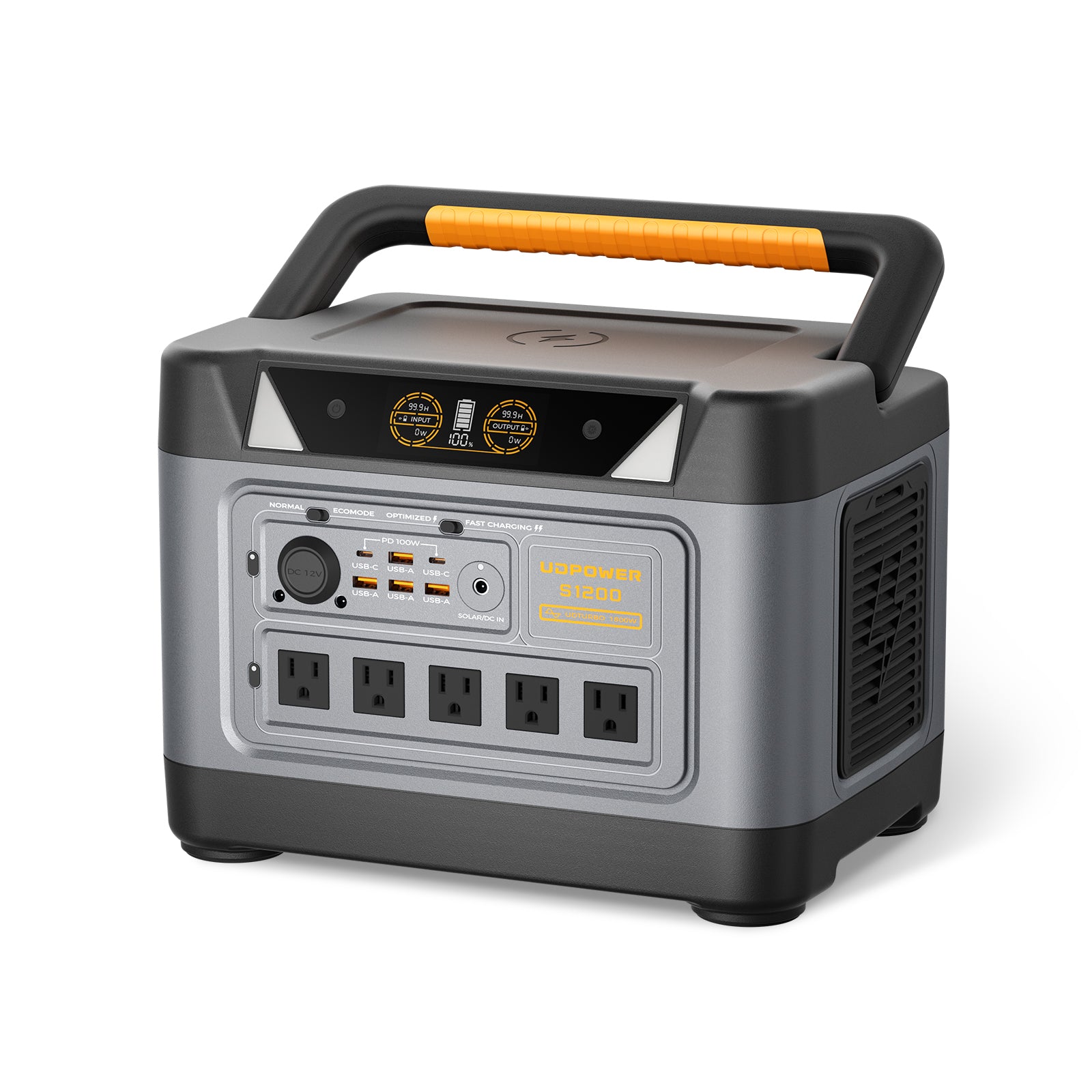
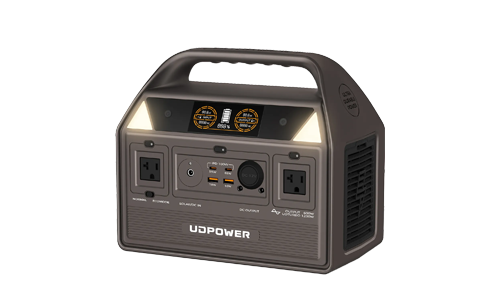
UDPOWER S1200 Portable Power Station
The S1200 is a practical middle ground for users who want enough stored energy for meaningful backup use without moving to a larger 2kWh-class unit.
- Battery capacity: 1,190Wh
- Rated AC output: 1,200W
- UDTURBO support up to 1,800W for compatible higher-power loads
- Solar input: up to 400W
- LiFePO4 battery
- 5-year power station warranty
A 210W panel can provide a useful daytime recharge source, while a larger compatible solar configuration can increase daily recovery when conditions and input specifications allow.
View the UDPOWER S1200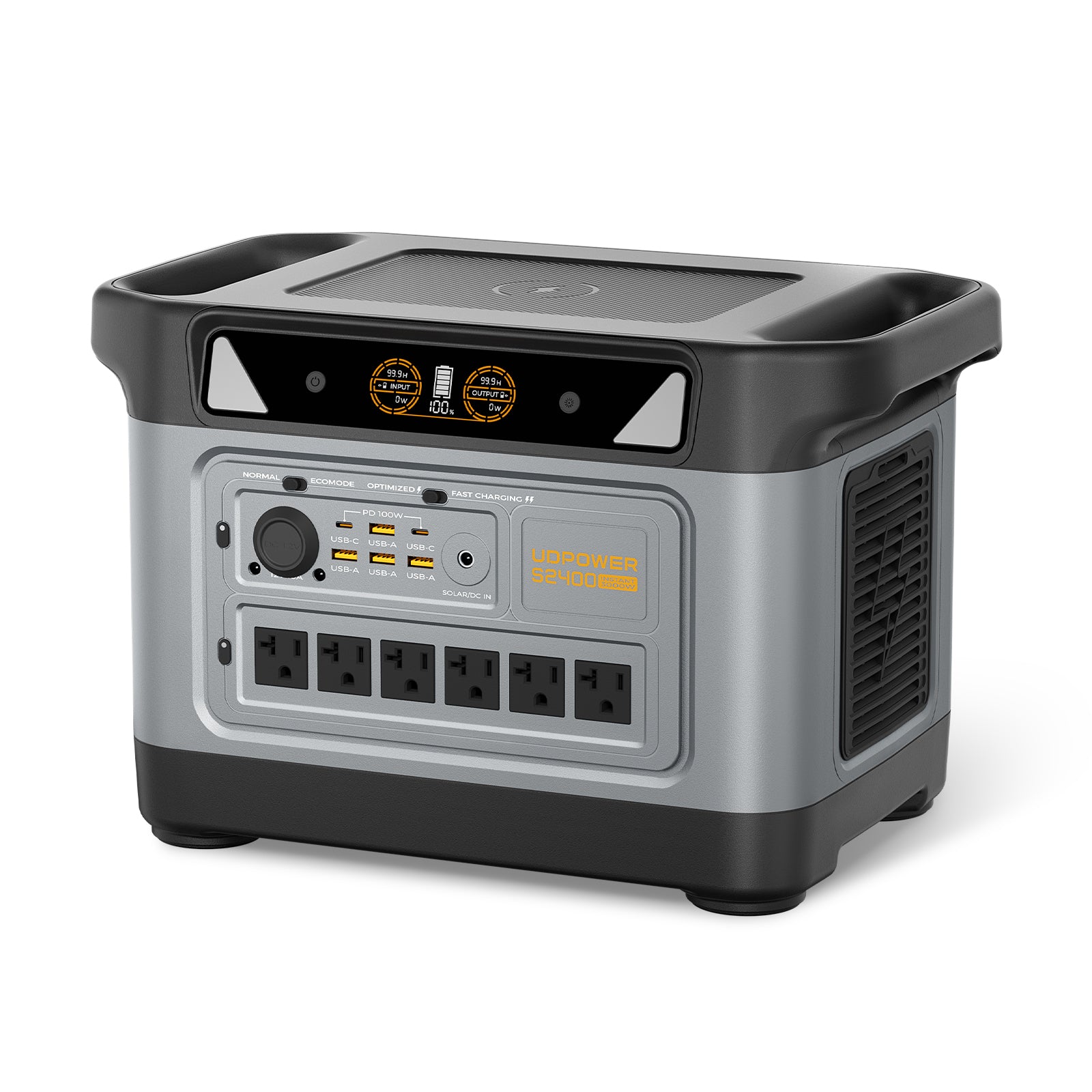
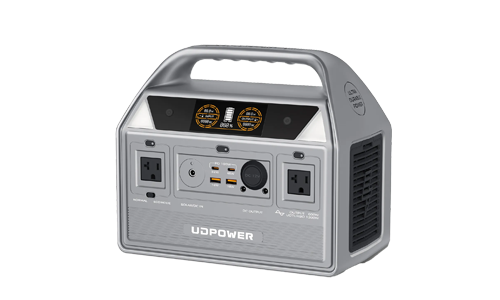
UDPOWER S2400 Portable Power Station
The S2400 is better suited to longer backup periods, RV use, larger energy budgets, and users who need more stored energy between solar-charging windows.
- Battery capacity: 2,083Wh
- Rated AC output: 2,400W
- UDTURBO support up to 3,000W for compatible higher-power loads
- LiFePO4 battery
- 6 AC outlets plus DC and USB outputs
- 5-year power station warranty
With larger batteries, daily solar production becomes especially important. A 2,083Wh battery can hold a significant amount of energy, but the panel system still needs enough sunlight and charging time to replace what you use.
View the UDPOWER S2400Browse all UDPOWER solar panels, compare solar generator packages, or view the full portable power station collection.
If you are mixing panels, cables, or third-party equipment, do not choose components by wattage alone. Check voltage, current, polarity and connector requirements first. See our Solar Panel Connector Types Guide for more detail.
How to Get More kWh From the Same Solar Panel
Buying a higher-wattage panel is not the only way to increase your daily solar harvest. Setup quality can make a large difference, especially with portable panels.
- Keep the entire panel in direct sunlight. Do not assume that a small patch of shade is harmless.
- Adjust the panel direction and angle. With portable panels, repositioning them during the day can improve exposure.
- Watch live input watts. When charging a power station, its input display gives immediate feedback while you reposition the panel.
- Keep the solar surface clean. Dust, pollen and debris reduce the light reaching the cells.
- Avoid unnecessary heat buildup. Allow reasonable airflow behind foldable panels rather than pressing them against a very hot surface.
- Verify electrical compatibility. A connector that physically fits does not prove that panel voltage and current are safe for the receiving device.
- Check the power station's solar input limit. A larger array does not guarantee equally larger charging power if the receiver clips the input.
- Plan for the weak season. If solar is essential to your backup plan, calculate around winter or poor-weather production rather than only perfect summer conditions.
A Better Way to Size Solar for a Battery: Start With Daily kWh
For battery-based solar systems, starting with panel wattage can lead you in the wrong direction. Start with how much energy you consume each day.
Suppose your essential devices use:
| Device | Example Energy Use |
|---|---|
| Wi-Fi and communication equipment | 0.20 kWh/day |
| Lights and phone charging | 0.15 kWh/day |
| Laptop and electronics | 0.25 kWh/day |
| Other essential loads | 0.40 kWh/day |
| Total example demand | 1.00 kWh/day |
If you need to replace approximately 1kWh per day and expect 4.5 peak sun hours with an 80% planning factor, reverse the formula:
In practice, you would normally leave additional margin because weather changes and daily use is rarely identical. This reverse calculation is still more useful than choosing a panel simply because “200W sounds large enough.”
Frequently Asked Questions About Solar Panel kWh Production
How many kWh can a solar panel produce per day?
It depends on panel wattage, peak sun hours and real-world operating conditions. As a quick example, a 400W panel receiving 4.5 peak sun hours with an 80% planning factor would produce about 1.44kWh per day.
How many kWh does a 400W solar panel produce?
Using an 80% planning factor, a 400W panel would produce about 1.28kWh with 4 peak sun hours, 1.60kWh with 5 peak sun hours, or 1.92kWh with 6 peak sun hours per day.
How much electricity does a 100W solar panel produce?
At 5 peak sun hours with an 80% output factor, a 100W panel would produce about 400Wh, or 0.40kWh, per day.
How many kilowatts does one solar panel produce?
Divide the panel's watt rating by 1,000. A 400W panel is rated at 0.4kW, a 500W panel is 0.5kW, and a 210W panel is 0.21kW. Kilowatts measure power, while kWh measure energy over time.
Is solar panel kW the same as kWh?
No. kW measures instantaneous power or system size. kWh measures how much electrical energy is produced or consumed over time.
What are peak sun hours?
Peak sun hours express daily solar radiation as the equivalent number of hours at full-strength solar irradiance. They are not the same as total daylight hours.
Do solar panels still produce electricity on cloudy days?
Yes, photovoltaic panels can still generate electricity when light reaches them, but output usually falls because available solar radiation is lower. Cloud type, density and local weather determine how much production drops.
Why is my solar panel producing fewer watts than its rating?
The rating is measured under standardized test conditions. Real sunlight intensity, high panel temperatures, shade, angle, dirt, wiring losses and the receiving equipment can all reduce observed output.
Will adding twice as many solar panels always double my battery charging speed?
No. It can increase available solar energy, but the battery or portable power station may have a maximum solar input wattage, voltage or current limit. Once the receiving equipment reaches its allowable input, additional panel capacity may not translate into equal additional charging power.
How many solar panels do I need to generate 1kWh per day?
At 4.5 peak sun hours and an 80% planning factor, you would need about 278W of panel capacity mathematically. Because real conditions vary, a practical system would normally include additional margin rather than being sized exactly to that number.
How can I get a more accurate solar production estimate for my location?
Use historical solar-resource data rather than a generic peak-sun-hour assumption. NREL's PVWatts Calculator is designed to estimate photovoltaic energy production using location and system information.
Bottom Line
The easiest way to estimate how much energy a solar panel can produce is:
But that formula is only the beginning. For a useful real-world estimate, also consider seasonal sunlight, shade, panel temperature, orientation, wiring losses, and—when charging a battery—the maximum input that the receiving device can accept.
The most important distinction is simple: panel watts tell you how powerful the solar hardware is; daily kWh tell you how much useful energy you may actually collect. If you are planning an off-grid or emergency system, daily kWh is usually the number that deserves the most attention.
Build a Solar Setup Around Your Real Daily Energy Needs
Estimate your daily kWh first, then choose a solar panel and portable power station that can both produce and store enough energy for your camping, RV, or backup-power plan.
View UDPOWER Solar GeneratorsOr compare portable solar panels and portable power stations separately.
Related Articles


