





California Wildfires 2026: Fire Updates, Smoke Safety & Power Backup Guide
California fires, smoke, evacuation and outage preparedness
Last updated: July 17, 2026
California wildfire conditions can change in a matter of hours. This guide combines the latest statewide 2026 statistics with practical steps for checking active fires, responding to smoke, preparing for an evacuation and keeping essential equipment running during a wildfire-related outage.
The direct answer
As of July 17, 2026, CAL FIRE's statewide archive showed 3,473 wildfires and 102,918 acres burned during 2026. The preliminary statewide totals also listed 41 structures destroyed and no confirmed civilian fatalities.
That is a lower year-to-date fire count and substantially lower burned acreage than the same period in 2025. It does not mean the rest of the 2026 California wildfire season will remain mild. Official seasonal outlooks anticipate increasing large-fire potential through the summer, especially as vegetation dries, temperatures rise and periods of low humidity or strong wind develop.
Anyone near a current California fire should rely on live incident and county alerts rather than statewide totals. Check the CAL FIRE incident map, the AirNow Fire and Smoke Map and instructions from the local sheriff, fire department or emergency management agency.

California wildfires 2026: statewide snapshot
Statewide statistics help show the scale of a fire season, but they do not describe the immediate risk in one neighborhood. A relatively small wind-driven fire near homes can demand faster action than a much larger incident burning in a remote area.
| Comparison period | Wildfires | Acres burned | What the comparison shows | Source |
|---|---|---|---|---|
| 2026 year to date | 3,473 | 102,918 | Current preliminary statewide total used as the baseline for this article. | CAL FIRE 2026 incident archive |
| Comparable period in 2025 | 3,938 | 182,197 | The 2026 fire count was about 11.8% lower, while burned acreage was about 43.5% lower. | CAL FIRE statistics |
| Five-year year-to-date average | 4,647 | 201,371 | The 2026 fire count was about 25.3% below the five-year average, and acreage was about 48.9% lower. | CAL FIRE statistics |
CAL FIRE identifies statewide incident and damage figures as preliminary. Totals may change as new fires are reported, mapping improves and damage inspections are completed.
Major active California fires on July 17, 2026
The following table is a dated snapshot of larger incidents displayed by CAL FIRE when this article was updated. Acreage and containment can change several times in one day. An incident that is not listed here may still be important to your community.
| Incident | County or area | Start date | Reported acres | Containment | Live source |
|---|---|---|---|---|---|
| Elephant Fire | Sierra County | July 11, 2026 | 13,476 | 77% | CAL FIRE current incidents |
| Summit Fire | Los Angeles County | July 10, 2026 | 2,690 | 95% | CAL FIRE current incidents |
| Thorn Fire | San Diego County | July 15, 2026 | 1,234 | 45% | CAL FIRE current incidents |
| 3-1 Pit Fire | Lassen County | July 7, 2026 | 1,055 | 95% | CAL FIRE current incidents |
| Loomis Fire | Lassen County | July 10, 2026 | 656 | 50% | CAL FIRE current incidents |
| Twain Fire | Plumas County | July 11, 2026 | 276 | 85% | CAL FIRE current incidents |
| 3-6 Fire | Lassen County | July 16, 2026 | 100 | 0% | CAL FIRE current incidents |
| Cotton Fire | Kern County | July 16, 2026 | 80 | 0% | CAL FIRE current incidents |
Are California wildfires worse in 2026?
Not by statewide year-to-date acreage as of mid-July. California had recorded fewer fires and fewer burned acres than both the comparable 2025 period and the five-year average. That is useful context, but it is not a forecast for August, September or October.
CAL FIRE's 2026 seasonal outlook indicates that fire potential is expected to increase as summer progresses. The National Interagency Coordination Center also identified above-normal significant fire potential in parts of northeastern California during July.
Several conditions can turn a quieter first half of the year into a difficult late season:
- Vegetation continues losing moisture during prolonged summer heat.
- Dry grass can carry fire rapidly between shrubs, trees and structures.
- Low humidity can make vegetation easier to ignite.
- Strong winds can carry embers well ahead of the visible flame front.
- Lightning can start multiple incidents during the same operational period.
- Smoke from distant fires can affect communities that face no direct flame threat.
Review the latest CAL FIRE 2026 outlook and incident archive and the National Significant Wildland Fire Potential Outlook for updated regional projections.
Where to find reliable California fire information
During a fast-moving incident, different sources answer different questions. No single map should be used for every decision.
| Your question | Best starting source | What it provides | How to use it |
|---|---|---|---|
| Is there a wildfire near me? | CAL FIRE Current Incidents | Incident name, location, acreage, containment and agency updates. | Check the incident page, but confirm evacuation instructions through your county's official alert system. |
| Where is smoke moving? | AirNow Fire and Smoke Map | Air-quality monitors, temporary sensors, smoke layers and fire locations. | Check the current AQI and the trend. Smoke conditions can change even when the nearest fire is far away. |
| Am I under an evacuation order? | County sheriff, fire department or emergency management agency | Official evacuation zones, road closures and shelter information. | Enroll in local alerts before an emergency and follow the newest time-stamped instruction. |
| What is happening nationally? | National Interagency Fire Center maps | National fire activity, significant incidents and planning maps. | Use for regional context rather than neighborhood-level evacuation decisions. |
| How should my household prepare? | CAL FIRE Ready for Wildfire | Evacuation planning, go-bag preparation and household readiness. | Complete the checklist before smoke or flames are visible. |
Social media can provide eyewitness information, but posts may be old, mislocated or missing context. Verify urgent claims against an official agency update before changing routes or returning to an evacuated area.
A better way to prepare: watch three wildfire clocks
Most wildfire guides focus on the flame front alone. A household may, however, be affected by smoke or electricity loss before it faces a direct evacuation threat. Treat these as three separate clocks.
1. The fire clock
This measures how quickly the incident, evacuation zones and road closures are changing. Wind-driven fires can reduce decision time quickly. Your response should be based on official warnings and orders, not on how close the flames appear from your home.
2. The smoke clock
Smoke can arrive hours before a nearby fire, remain after flames move away or travel from a distant incident. The smoke clock determines when to close windows, run a portable air cleaner, reduce outdoor activity and relocate someone with elevated health risk.
3. The power clock
Electricity may fail because equipment is damaged, demand is disrupted or a utility initiates a Public Safety Power Shutoff. The power clock determines how long refrigerated food, communications, lighting, air cleaning and medical devices can operate.
What to do during an evacuation warning or order
California counties commonly use terms such as “Evacuation Warning” and “Evacuation Order,” although wording and zone systems can vary. Read the entire local notice rather than relying only on a color or map boundary.
| Condition | What it means | What to do next |
|---|---|---|
| No active local warning | No immediate evacuation instruction, but seasonal risk may be elevated. | Keep the vehicle fueled or charged, maintain a go bag, enroll in alerts and confirm two exit routes. |
| Red Flag or severe fire-weather conditions | Weather may support rapid fire ignition and spread. | Charge essential devices, bring pets close, avoid risky outdoor activities and monitor local alerts more frequently. |
| Evacuation warning | A threat may require evacuation soon. | Load the vehicle, dress for evacuation, place mobility equipment by the door and consider leaving early. |
| Evacuation order | Local officials have determined that the area should be evacuated. | Leave immediately using the instructed route. Do not wait to see flames or finish household tasks. |
Your 15-minute evacuation sequence
- Confirm the order and zone. Read the newest official alert and identify the instructed route, closure or shelter information.
- Gather every person and pet. Account for children, older adults, neighbors who depend on you and animals that may hide when stressed.
- Take the prepared go bags. Prioritize medication, identification, water, communication devices, pet supplies and mobility aids.
- Disconnect only what is safe and immediate. Do not spend evacuation time shutting down nonessential equipment or moving outdoor furniture.
- Leave using the official route. Keep windows closed, use vehicle air recirculation if smoke is present and avoid roads reserved for emergency crews.
- Check in from a safe location. Tell your out-of-area contact that you have left and where you are going.
People who should consider leaving during a warning
Leaving early may be safer when a household includes:
- Someone who uses oxygen, a powered medical device or refrigerated medication.
- A person who cannot tolerate smoke exposure.
- Older adults or children who need additional travel time.
- Someone who uses a wheelchair or other mobility equipment.
- Large animals, multiple pets or animals that are difficult to load.
- A household with only one narrow or congestion-prone exit route.
CAL FIRE provides additional evacuation preparation through its Get Set and Get Ready to Go resources.
Wildfire smoke safety: what the AQI means at home
Wildfire smoke contains fine particles that can travel deep into the lungs. You do not need to see flames—or even smell smoke strongly—for air quality to become unhealthy.
Check the current Air Quality Index before outdoor exercise, opening windows or deciding whether a household member should relocate.
| AQI | Category | Practical household response |
|---|---|---|
| 0–50 | Good | Normal outdoor activity is generally appropriate. Continue watching conditions if smoke is forecast. |
| 51–100 | Moderate | People who are unusually sensitive should watch for symptoms and reduce prolonged outdoor exertion if needed. |
| 101–150 | Unhealthy for sensitive groups | Children, older adults, pregnant people and those with heart or lung conditions should reduce prolonged outdoor activity. |
| 151–200 | Unhealthy | Move activities indoors, close windows and run effective filtration. Everyone should reduce prolonged outdoor exertion. |
| 201–300 | Very unhealthy | Avoid outdoor activity when possible. Use a cleaner indoor space or relocate to a filtered public facility. |
| 301–500 | Hazardous | Treat exposure as an emergency condition. Stay in filtered air and follow public-health instructions. |
How to create a cleaner-air room
- Choose a room with few windows and exterior doors.
- Close windows and doors without blocking an evacuation exit.
- Run a correctly sized portable HEPA air cleaner continuously.
- Set central HVAC to recirculate if the system supports that setting.
- Avoid candles, smoking, frying and activities that create indoor particles.
- Check and replace filters according to the equipment instructions.
- Keep medication, water, phone chargers and masks in the room.
A well-fitting N95 or P100 respirator can reduce particle exposure when you must go outdoors. Cloth face coverings and loose disposable masks do not provide the same level of filtration for wildfire particles.
For health guidance, review the CDC wildfire safety recommendations and the AirNow Fire and Smoke Map.
California wildfire power outages and PSPS events
Electricity may be interrupted by fire damage, damaged transmission equipment, emergency repairs or a Public Safety Power Shutoff. During a PSPS, a utility temporarily de-energizes selected lines when weather and vegetation conditions create a heightened wildfire risk.
Factors considered by utilities can include strong winds, low humidity, dry vegetation, observed damage and field conditions. A shutoff may affect a location that is not under an evacuation warning.
Southern California Edison explains its process on the official PSPS information page. Residents should also check the outage and notification pages of their own electricity provider.
What to do in the first 10 minutes of an outage
- Confirm whether evacuation instructions have changed. A wildfire-related outage may occur at the same time as road or zone updates.
- Preserve phone power. Lower screen brightness, close unneeded apps and use text messages instead of long calls when networks are congested.
- Keep refrigerator and freezer doors closed. Do not repeatedly open the door to check the temperature.
- Connect only essential loads. Prioritize medical equipment, communications, air cleaning and refrigeration before comfort appliances.
- Check on household members and nearby neighbors. Confirm whether anyone depends on powered mobility or medical equipment.
Food safety during an outage
| Appliance | Approximate safe holding period | Conditions | Source |
|---|---|---|---|
| Refrigerator | About 4 hours | The door remains closed and the appliance was cold when power failed. | FoodSafety.gov |
| Full freezer | About 48 hours | The door remains closed. | FoodSafety.gov outage guidance |
| Half-full freezer | About 24 hours | The door remains closed. | FoodSafety.gov outage guidance |
These time windows are general guidance, not a substitute for checking actual food temperature. When in doubt, discard food that may have been held at an unsafe temperature.
Fuel generator and battery power station safety
| Backup source | Safe placement | Main hazard | Important rule |
|---|---|---|---|
| Gasoline, propane or diesel generator | Outdoors, at least 20 feet from the home when possible, with exhaust directed away from windows and doors. | Carbon monoxide, fire, fuel storage and hot exhaust. | Never operate it in a home, garage, carport, shed or enclosed porch. |
| Portable battery power station | In a dry location with ventilation clearance specified by the manufacturer. | Overloading, blocked ventilation, moisture, damaged cables or improper charging. | Do not connect it to a wall outlet to backfeed household wiring. Use approved transfer equipment installed by a qualified electrician when powering circuits. |
Read Where Should You Not Put a Portable Generator? for a more detailed placement and carbon-monoxide safety guide.
How to calculate a wildfire outage power budget
A portable power station should be sized around essential loads, not every appliance in the house. Start with the devices that protect health, communication, food and visibility.
Step 1: list the devices that must keep running
A practical priority order is:
- Powered medical equipment and refrigerated medicine.
- Phones, emergency radios and internet equipment.
- A portable HEPA air cleaner for one cleaner-air room.
- Refrigeration for food or medication.
- Efficient lighting.
- Fans or other limited comfort loads if capacity remains.
Step 2: calculate energy instead of looking only at watts
Watts describe how much power a device needs at one moment. Watt-hours estimate how much energy it uses over time.
Required watt-hours = device watts × hours of operation
For example, an 80-watt air cleaner running for 10 hours requires about 800 watt-hours before conversion losses and reserve capacity are added.
Step 3: add conversion loss and a reserve
Battery capacity is not identical to usable AC energy. This article uses a 90% planning efficiency for UDPOWER runtime estimates:
Estimated runtime = battery capacity × 0.90 ÷ average load
For wildfire planning, avoid designing a system that reaches zero percent under ideal assumptions. Retain a reserve for changing conditions, startup surges, colder temperatures and unexpected delays.
| Essential device | Planning wattage | Daily use | Estimated daily energy | Planning note |
|---|---|---|---|---|
| Internet modem and router | 15 watts | 12 hours | 180 Wh | Local internet service may still fail even when your equipment has power. |
| Two phone recharges | Approximately 15 Wh each | One full recharge each | 30 Wh | Actual energy depends on phone battery capacity and losses. |
| Portable HEPA air cleaner | 80 watts | 10 hours | 800 Wh | Lower fan settings use less power but may also reduce cleaning performance. |
| LED lighting | 20 watts total | 5 hours | 100 Wh | Use only the rooms needed for safety. |
| Refrigerator | 100-watt average planning load | 10 hours | 1,000 Wh | Compressor startup power may be much higher than average operating consumption. |
| Example total | — | — | 2,110 Wh | This example would require load reduction, scheduled use, recharging or a larger system. |
Portable backup power for wildfire-related outages
A battery power station can support essential equipment during a PSPS event or a temporary outage without producing engine exhaust. It is not a whole-home replacement, and it should never be treated as a reason to remain inside an evacuation zone.
The two UDPOWER options below are best understood by the size of the essential-load plan they support.
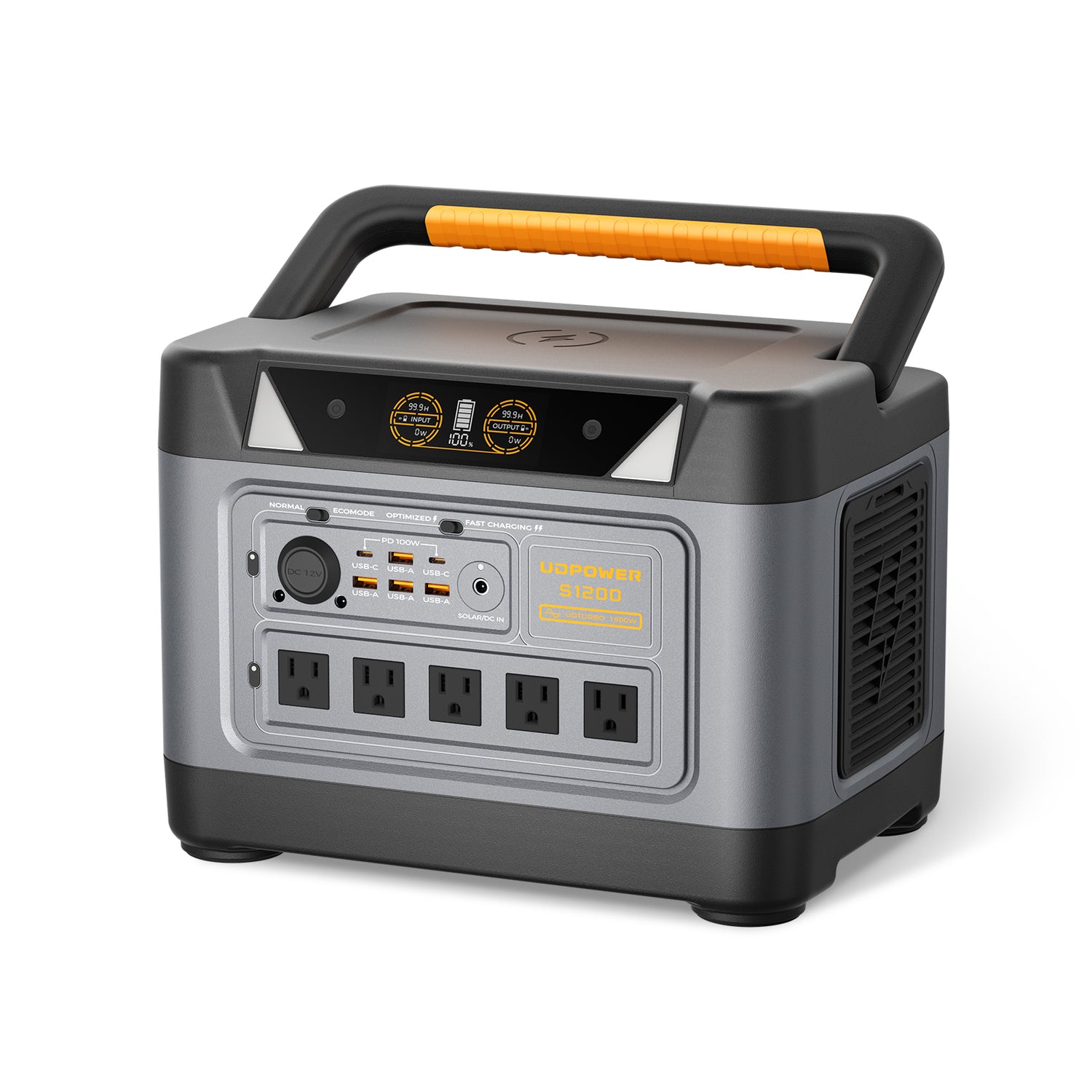
UDPOWER S1200: focused backup for essential devices
The S1200 is suited to households prioritizing communications, lighting, a CPAP machine, a compact air cleaner or short-term refrigerator support.
- Battery capacity: 1,190Wh
- Rated AC output: 1,200W pure sine wave
- Surge output: 1,800W
- Battery chemistry: LiFePO4
- Cycle life: 4,000+ cycles
- UPS transfer time: less than 10 milliseconds
- Outputs: 5 AC outlets and 10 DC outputs
- Weight: approximately 26 pounds
- Charging: approximately 1.5-hour AC fast charging under stated conditions
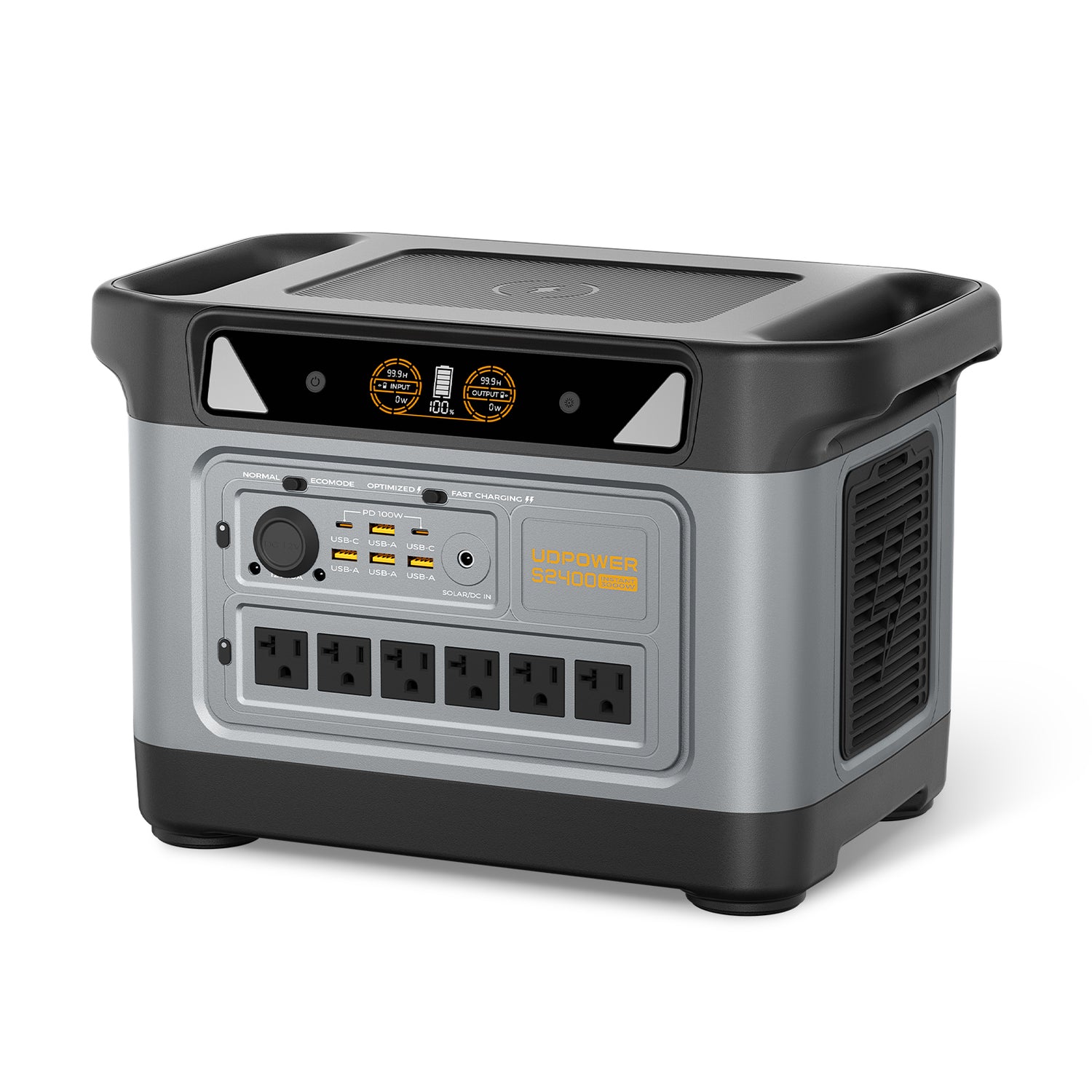
UDPOWER S2400: longer runtime and heavier essential loads
The S2400 provides more capacity and inverter output for households combining refrigeration, communication equipment, lighting and a portable air cleaner.
- Battery capacity: 2,083Wh
- Rated AC output: 2,400W pure sine wave
- UDTURBO output: up to 3,000W for supported loads
- Battery chemistry: LiFePO4
- Cycle life: 4,000+ cycles
- UPS transfer time: less than 10 milliseconds
- Outputs: 6 AC outlets and 10 DC outputs
- Weight: approximately 40.8 pounds
- Solar input: up to 400W under supported conditions
Estimated runtime for common emergency load levels
| Average continuous load | Example use | S1200 estimated runtime | S2400 estimated runtime |
|---|---|---|---|
| 35W | Router, phone charging and limited LED lighting | About 30.6 hours | About 53.6 hours |
| 80W | Efficient portable air cleaner or similar light load | About 13.4 hours | About 23.4 hours |
| 100W | Planning average for a cycling refrigerator | About 10.7 hours | About 18.7 hours |
| 150W | Mixed communications, lighting and air-cleaning loads | About 7.1 hours | About 12.5 hours |
| 300W | Heavier mixed essential loads | About 3.6 hours | About 6.2 hours |
Estimates use 90% conversion efficiency. Actual runtime depends on temperature, battery condition, device cycling, startup demand, power mode and the combination of connected loads.
Compare portable power stations Explore home backup options View foldable solar panelsCan solar panels recharge a power station during a wildfire?
Solar charging may extend backup time during a multi-day outage, but it should not be the only charging plan. Smoke, ash, clouds, shorter daylight hours and poor panel orientation can sharply reduce solar input.
Use solar charging as one layer of a backup plan:
- Fully charge the power station before severe fire weather arrives.
- Test the panel, cable and input connection before an emergency.
- Place panels in direct sunlight only when outdoor conditions are safe.
- Keep connectors dry and protect cables from vehicles and foot traffic.
- Watch actual input wattage rather than assuming rated panel output.
- Stop using outdoor equipment when evacuation instructions change.
Learn more in Can a Solar Generator Power a House? or view UDPOWER solar generator options.
A practical 72-hour California wildfire kit
A wildfire kit should be divided into three groups: items that leave with you, items that support a home outage and items that stay in the vehicle. This prevents critical documents and medication from being buried under bulky supplies.
| Kit location | Essential contents | Why it matters |
|---|---|---|
| Grab-and-go bag | Identification, medication, N95 masks, water, phone cable, flashlight, cash, keys, paper contact list, basic first aid, clothing and copies of critical documents. | Contains the items that must leave with you even when evacuation time is short. |
| Pet evacuation bag | Carrier, leash, food, water, medication, vaccination records, waste bags, recent photo and familiar bedding. | Animals may become harder to locate or handle when smoke, alarms and vehicle activity increase. |
| Home outage supply | Drinking water, shelf-stable food, battery power, radio, filtration equipment, spare filters, sanitation supplies and battery-operated lighting. | Supports sheltering during an outage when the home is outside an evacuation zone. |
| Vehicle kit | Printed maps, water, sturdy shoes, blanket, charging cable, flashlight, first aid kit and roadside safety equipment. | Cellular navigation and familiar roads may be unavailable during closures or congestion. |
| Medical power kit | Device instructions, backup battery, approved cables, medication list, provider contact details and a relocation plan. | A battery alone is not a complete plan if an outage lasts longer than expected. |
CAL FIRE's emergency supply guidance recommends preparing nonperishable food, water, medication, maps, documents, first-aid supplies, lighting, communication equipment and pet supplies. Review the complete Ready for Wildfire emergency supply kit.
What to complete before the next Red Flag Warning
- Enroll every adult phone in county emergency alerts.
- Write down the evacuation zone name or number.
- Drive two evacuation routes during normal conditions.
- Identify a meeting point outside the neighborhood.
- Choose an out-of-area family contact.
- Keep the vehicle above half a tank or maintain an adequate EV charge.
- Photograph important rooms and property for insurance records.
- Store documents in a protected physical and digital location.
- Test smoke alarms, carbon-monoxide alarms and fire extinguishers.
- Measure the real power consumption of critical appliances.
- Charge and test backup batteries at regular intervals.
- Confirm that pets can be loaded quickly into carriers or vehicles.
- Discuss early evacuation needs with older adults and disabled household members.
Returning home after a California wildfire
Return only after the responsible agency has reopened the area. A change in visible smoke or flame activity does not mean roads, utilities and structures are safe.
Before entering the property
- Follow road closures and law-enforcement instructions.
- Watch for unstable trees, damaged poles, downed lines and hot spots.
- Do not touch fallen electrical equipment.
- Keep children and pets away from ash and debris.
- Use protective footwear, gloves and respiratory protection appropriate for the conditions.
Before using electrical equipment
- Inspect cords, plugs and devices for heat, water or impact damage.
- Do not recharge a damaged battery or power station.
- Allow equipment exposed to moisture to be inspected before use.
- Do not energize household wiring that may have been damaged.
- Use a qualified electrician when the electrical system's condition is uncertain.
Document damage before cleanup
Take wide photos, close-up photos and video before moving damaged items when it is safe to do so. Save receipts for temporary lodging, emergency supplies, cleanup and replacement purchases. Follow the documentation process provided by your insurer or assistance program.
California wildfires 2026 FAQs
How many California wildfires have occurred in 2026?
CAL FIRE's statewide 2026 archive showed 3,473 wildfires and 102,918 acres burned when this article was updated on July 17, 2026. The totals are preliminary and continue changing throughout the year.
Are California fires worse in 2026 than in 2025?
Not by the year-to-date statewide numbers available in mid-July. The 2026 fire count was approximately 11.8% lower than the comparable 2025 period, while burned acreage was approximately 43.5% lower. Conditions can still worsen later in the season.
What was the largest active California wildfire on July 17, 2026?
The Elephant Fire was the largest incident shown in the CAL FIRE snapshot used for this article, at 13,476 acres and 77% containment. Check the current incident map because acreage and containment change frequently.
What is the best map for current California wildfires?
Start with the CAL FIRE Current Incidents map for incident details. Use the AirNow Fire and Smoke Map for smoke and air quality. Evacuation decisions should be based on official county alerts.
Does 100% containment mean a wildfire is out?
No. It means crews have established control lines around the perimeter that are expected to stop additional spread. Fire, heat and smoke may remain inside the perimeter while crews continue suppression and monitoring.
What is the difference between an evacuation warning and an order?
A warning generally means there is a potential threat and residents should prepare to leave. An order means residents should leave immediately. Terminology may vary, so follow the exact instructions issued by the local agency.
Can wildfire smoke be dangerous inside a closed home?
Yes. Fine particles can enter through doors, windows, ventilation systems and small gaps. Closing the home, using recirculation and operating a correctly sized portable HEPA air cleaner can reduce indoor exposure.
Should I wear an N95 mask for wildfire smoke?
A well-fitting N95 or P100 respirator can reduce exposure to fine particles when outdoor exposure cannot be avoided. It does not remove gases and works best only when it seals properly to the face.
Why do utilities shut off power during high fire risk?
A Public Safety Power Shutoff may be used to reduce the chance that energized electrical equipment starts a wildfire during severe wind, low humidity and dry vegetation conditions.
Can a portable power station run a refrigerator during a PSPS event?
It can when the refrigerator's running wattage and startup demand are within the power station's output limits. Runtime depends on the refrigerator's real average energy use, ambient temperature and how frequently the door is opened.
Can a portable power station be used indoors?
A battery power station does not produce combustion exhaust like a fuel generator. It should still be kept dry, undamaged and properly ventilated according to its manual. Never operate a gasoline, propane or diesel generator indoors.
Can solar panels charge a battery through wildfire smoke?
They may still produce some power, but smoke and ash can significantly reduce solar input. Actual production depends on sunlight, panel angle, temperature, smoke density and surface cleanliness.
How long will refrigerated food stay safe after the power goes out?
An unopened refrigerator generally keeps food cold for about four hours. A full closed freezer may maintain temperature for about 48 hours, while a half-full freezer may last about 24 hours.
Should I wait for my power station to finish charging before evacuating?
No. Disconnect it only when doing so is immediate and safe. Never delay an evacuation to finish charging, pack equipment or recover solar panels.
Official sources and live resources
Build your wildfire outage plan before the next alert
List your essential devices, measure their real energy consumption and choose enough capacity for the loads that protect health, communication, air quality and refrigerated supplies.
View backup power sizing options View portable power stations Get the essential-load sizing guideEmergency power equipment supplements—not replaces—official evacuation instructions, local emergency services or a medically appropriate outage plan.
Related Articles


