

How Many Watts Does an Oxygen Concentrator Use?
Last updated: July 24, 2026
Quick Answer
Most oxygen concentrators use anywhere from about 40 watts to 600 watts, depending on whether the machine is portable or stationary, its oxygen output, the prescribed setting, and whether an internal battery is charging.
- Portable pulse-dose concentrators: commonly about 40–130 watts.
- Portable units connected to AC power: some published examples use about 120–150 watts, especially while charging.
- Stationary 5-liter concentrators: commonly about 200–350 watts, although certain efficient models can draw less at lower settings.
- Stationary 10-liter concentrators: commonly about 500–600 watts.
Do not choose backup power from the category average alone. Check the label or manual for your exact model, measure its real AC draw at the prescribed setting, and calculate how many hours of backup you actually need.

Medical safety comes first: Never lower a prescribed oxygen flow setting merely to extend battery runtime. Work with your oxygen supplier and healthcare provider to maintain backup cylinders, charged portable batteries, transportation options, and an outage plan. A portable power station can provide valuable bridge power, but it should not be the only emergency oxygen arrangement.
See the American Lung Association power outage guidance and Ready.gov power outage planning guidance.
Oxygen concentrator power use is not a single fixed number. A lightweight portable concentrator may draw less power than a laptop, while a high-output 10-liter home machine can consume about as much electricity as several refrigerators running at the same time.
That difference matters when estimating electric bills, selecting a generator, or choosing a battery backup. A power source that can run a portable pulse-dose unit overnight may operate a large stationary machine for only a few hours.
Typical Oxygen Concentrator Wattage by Type
| Concentrator type | Typical published power range | Common oxygen delivery | What the range means for backup power | Reference |
|---|---|---|---|---|
| Portable oxygen concentrator | About 40–130W | Most commonly pulse-dose | Lower energy demand makes longer battery operation more practical. | WHO/PATH technical specifications |
| Portable unit operating or charging from AC | About 120–150W in published Philips examples | Pulse-dose or limited continuous flow, depending on model | Charging the internal battery can raise the draw seen by the external backup source. | Philips SimplyGo Mini specifications; Philips SimplyGo specifications |
| Stationary 5-liter concentrator | Commonly about 200–350W | Continuous flow up to 5 LPM | A 1,000Wh-class battery usually provides a few hours rather than all-day operation. | CAIRE Companion 5 specifications; CAIRE IntenOxy 5 specifications |
| Stationary 10-liter concentrator | Commonly about 500–600W | Continuous flow up to 10 LPM | Requires both higher AC output and substantially more battery capacity. | React Health Platinum 10L manual |
These ranges are planning references, not substitutes for the specifications of the machine supplying your prescribed oxygen.
Real Oxygen Concentrator Power Consumption Examples
The following manufacturer-published figures show why broad estimates can be misleading. Machines with similar portability or flow labels can have noticeably different electrical requirements.
| Model | Machine type | Published power figure | Important context | Official source |
|---|---|---|---|---|
| Inogen At Home | Stationary continuous-flow concentrator | 275W AC power supply | Up to 5 LPM continuous flow. | Inogen product sheet |
| CAIRE Companion 5 | Stationary 5-liter concentrator | 280W at 2 LPM; 350W maximum | Actual consumption changes with the selected flow setting. | CAIRE product sheet |
| CAIRE IntenOxy 5 | Stationary 5-liter concentrator | Less than 350W at 5 LPM | The specification states power at the maximum 5 LPM flow. | CAIRE product sheet |
| React Health Phoenix 5 | Stationary 5-liter concentrator | 328W | A useful middle-of-the-range example for battery planning. | React Health product sheet |
| React Health Platinum 10L | Stationary 10-liter concentrator | 585W typical | Designed for 2–10 LPM continuous flow. | React Health owner manual |
| Philips SimplyGo | Portable concentrator with pulse and continuous-flow modes | 120W while not charging; 150W while charging | The external source must cover the higher charging condition when applicable. | Philips specifications |
| Philips SimplyGo Mini | Portable pulse-dose concentrator | 120W while charging | The published wattage describes the AC charging condition, not necessarily average battery-mode draw. | Philips specifications |
These figures should not be interpreted as interchangeable medical performance. Oxygen delivery method, maximum flow, oxygen concentration, alarms, portability, and battery operation differ by model. Select the concentrator based on the prescription and medical provider guidance first; size the backup power around that approved machine second.
Why Oxygen Concentrator Wattage Varies
1. Portable and stationary machines serve different jobs
Most small portable concentrators conserve battery energy by delivering oxygen in pulses as the user inhales. Many home concentrators provide continuous oxygen flow and must keep their compressor and molecular sieve system working steadily. That normally requires more electricity.
2. A higher maximum flow usually requires more power
A 10-liter machine must process more air than a typical 5-liter machine. That is why a 10 LPM concentrator may use close to 600 watts while many 5 LPM models remain near or below 350 watts.
3. The prescribed setting can change real consumption
Certain machines draw less power at a lower flow setting and more at a higher one. The CAIRE Companion 5, for example, publishes one figure at 2 LPM and a higher maximum figure. Use the setting prescribed for the individual user when testing power consumption.
4. Charging an internal battery adds load
A portable concentrator connected to AC may be operating the oxygen system and charging its battery at the same time. The Philips SimplyGo specification illustrates this difference: 120 watts while not charging and 150 watts while charging.
5. Nameplate input and normal running watts are not always the same
A label may show the maximum electrical input the device or adapter is designed to accept. The machine may draw less during normal use. For realistic runtime planning, measure the actual draw while the concentrator is operating under the intended conditions.
6. Accessories can increase total energy use
Approved humidification equipment, battery chargers, heated accessories, alarms, and other connected equipment can add to the total load. Add every device that will share the backup source instead of calculating the concentrator alone.
How to Find the Exact Wattage of Your Oxygen Concentrator
For a broader explanation of matching appliance wattage with battery output, see How to Know If a Portable Power Station Can Power Your Device .
How Much Electricity Does an Oxygen Concentrator Use Per Day?
Continuous operation changes the picture dramatically. Even a machine with a moderate wattage can consume substantial energy when it runs 24 hours a day.
| Average running load | Energy for 8 hours | Energy for 24 hours | 30-day energy at 24 hours per day | Example monthly cost at $0.18/kWh |
|---|---|---|---|---|
| 40W | 0.32 kWh | 0.96 kWh | 28.8 kWh | $5.18 |
| 85W | 0.68 kWh | 2.04 kWh | 61.2 kWh | $11.02 |
| 120W | 0.96 kWh | 2.88 kWh | 86.4 kWh | $15.55 |
| 275W | 2.20 kWh | 6.60 kWh | 198.0 kWh | $35.64 |
| 328W | 2.62 kWh | 7.87 kWh | 236.2 kWh | $42.51 |
| 350W | 2.80 kWh | 8.40 kWh | 252.0 kWh | $45.36 |
| 585W | 4.68 kWh | 14.04 kWh | 421.2 kWh | $75.82 |
The cost column is only an example. Multiply monthly kWh by the energy rate shown on your own utility bill. Taxes, delivery charges, tiered pricing, and time-of-use rates may change the final amount.
How Long Will a Battery Run an Oxygen Concentrator?
Portable power stations are rated in watt-hours, abbreviated Wh. Watt-hours represent stored energy. Watts represent how quickly the concentrator is using that energy.
The 0.90 factor accounts for an estimated 90% AC conversion efficiency. Actual efficiency varies with load, temperature, inverter behavior, battery condition, cable losses, and the power station itself.
Example: 350W concentrator with a 1,190Wh battery
For emergency planning, it is wise not to treat the last percentage point on the display as guaranteed medical runtime. Keeping a 20% planning reserve would reduce the target operating window in this example to about 2.4 hours.
The 20% reserve is not a medical standard or a promise of performance. It is a practical buffer for delayed utility restoration, battery aging, unplanned loads, and differences between a laboratory specification and the actual setup.
Estimated Oxygen Concentrator Runtime by Battery Size
The table below uses each UDPOWER model’s official battery capacity, a 90% conversion factor, and no additional devices connected. It shows mathematical estimates rather than guaranteed medical backup times.
| Measured concentrator load | Possible use case | C600 596Wh |
S1200 1,190Wh |
S2400 2,083Wh |
|---|---|---|---|---|
| 50W | Lower-power portable operation | About 10.7 hours | About 21.4 hours | About 37.5 hours |
| 85W | Mid-range portable load | About 6.3 hours | About 12.6 hours | About 22.1 hours |
| 120W | Portable concentrator on AC or charging | About 4.5 hours | About 8.9 hours | About 15.6 hours |
| 275W | Efficient stationary 5-liter example | About 2.0 hours | About 3.9 hours | About 6.8 hours |
| 350W | Higher end of many 5-liter specifications | About 1.5 hours | About 3.1 hours | About 5.4 hours |
| 585W | 10-liter concentrator example | About 0.9 hour | About 1.8 hours | About 3.2 hours |
A conservative plan with a 20% reserve would be shorter. For example, the estimated S2400 planning window becomes about 17.6 hours at 85W, 5.5 hours at 275W, 4.3 hours at 350W, or 2.6 hours at 585W.
UDPOWER Options for Oxygen Concentrator Backup
The right model depends on two separate requirements:
- Output: The AC inverter must safely support the concentrator’s highest operating requirement.
- Capacity: The battery must contain enough watt-hours for the required bridge time.
A high output rating does not automatically mean long runtime. Likewise, a large battery is not useful if its inverter cannot support the connected equipment.

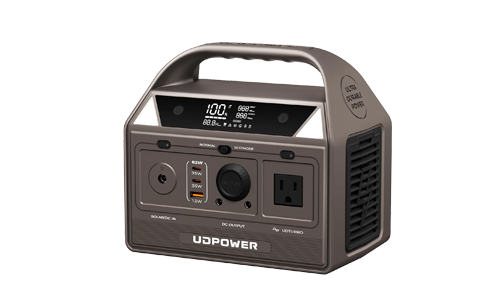
UDPOWER C600
The C600 is most relevant to lower-wattage portable oxygen concentrators and short-duration bridge power. Its compact capacity makes it easier to carry, but it is not the strongest choice for long stationary-concentrator outages.
- 596Wh LiFePO4 battery
- 600W rated AC output
- 1,200W peak output
- 4,000+ battery cycles
- Two AC outlets
- Official weight: 12.3 lb
Estimated examples: About 6.3 hours at 85W, 4.5 hours at 120W, 2.0 hours at 275W, or 1.5 hours at 350W before adding a reserve.
Best fit: A portable concentrator, travel backup, or enough time to move to a location with power. Verify that the exact concentrator remains within the C600’s output limit under every intended operating condition.
View the UDPOWER C600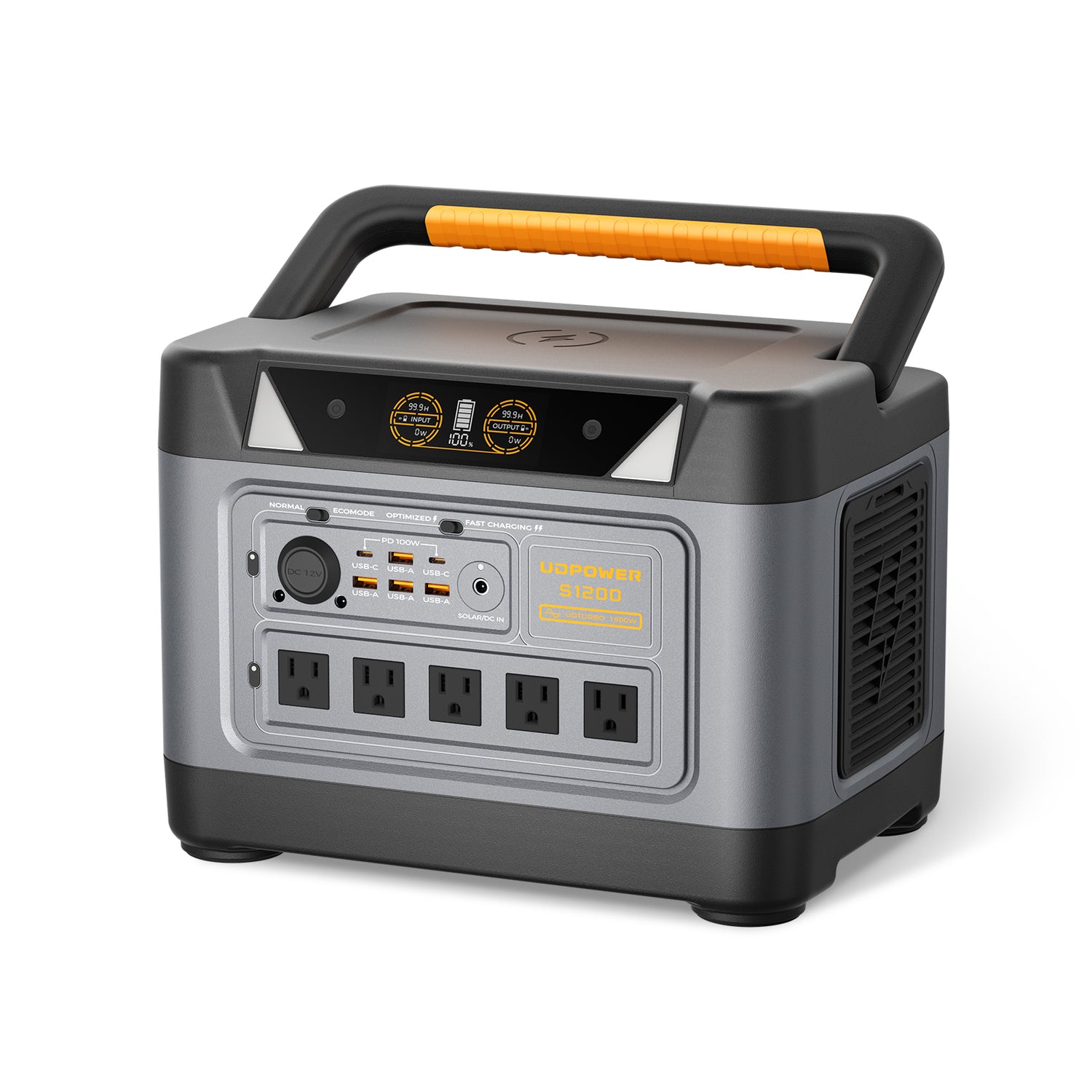
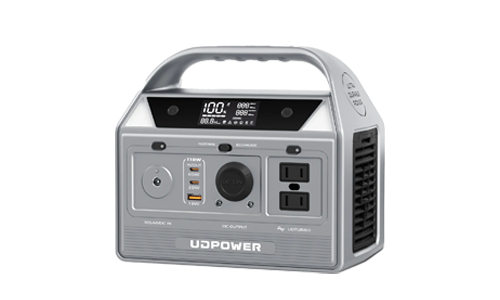
UDPOWER S1200
The S1200 offers a stronger balance of battery capacity, AC output, and portability. It can be a practical short-outage bridge for many 5-liter stationary concentrators after the exact machine has been tested.
- 1,190Wh LiFePO4 battery
- 1,200W rated AC output
- 1,800W surge output
- 4,000+ battery cycles
- Five AC outlets and ten DC outputs
- UPSPrime transfer time below 10 milliseconds
- Up to 400W solar input
- Official weight: 26 lb
Estimated examples: About 12.6 hours at 85W, 8.9 hours at 120W, 3.9 hours at 275W, 3.1 hours at 350W, or 1.8 hours at 585W before adding a reserve.
Best fit: Longer portable-concentrator operation or several hours of bridge power for many 5-liter home machines. It should not be assumed to cover an overnight or all-day outage without calculating the exact load.
View the UDPOWER S1200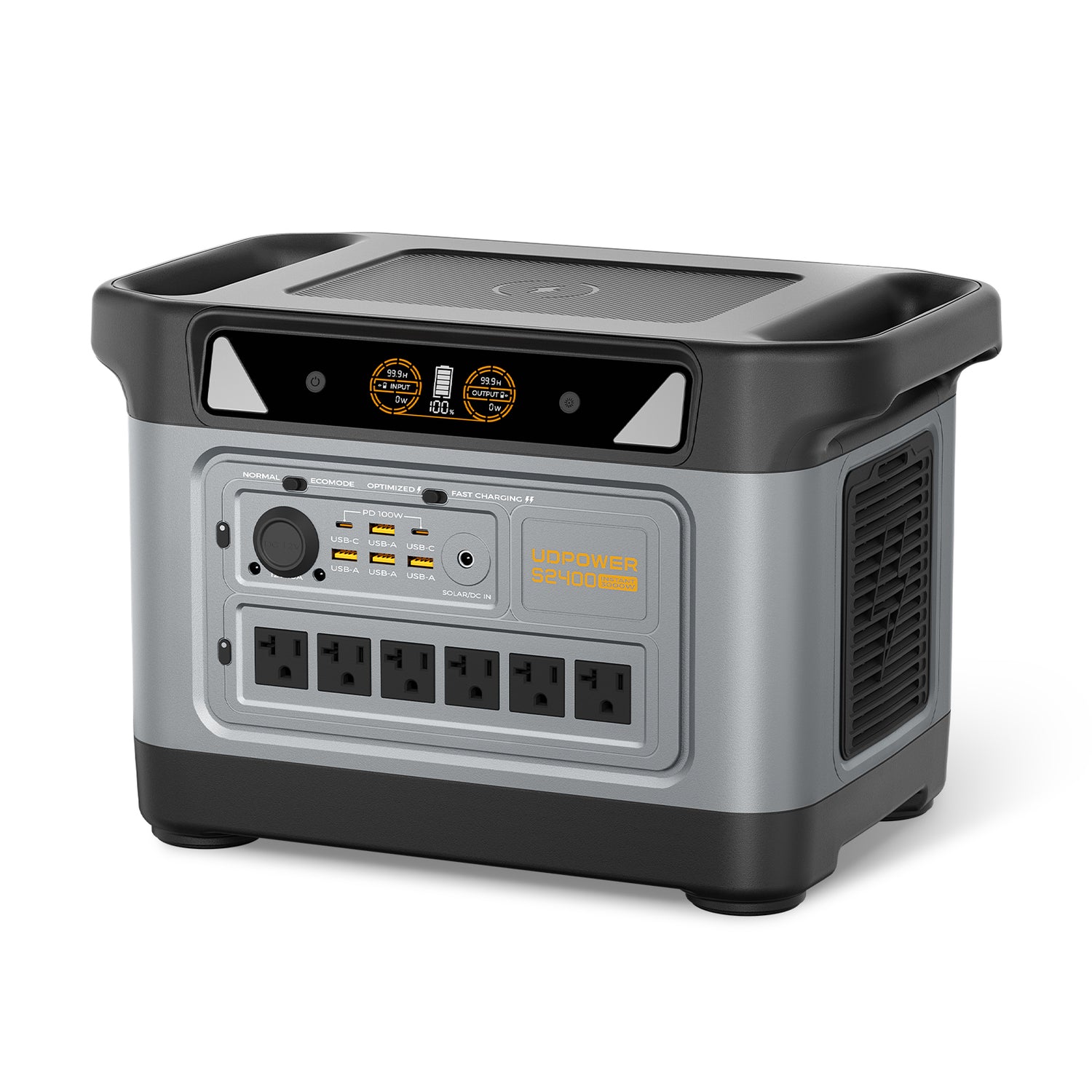
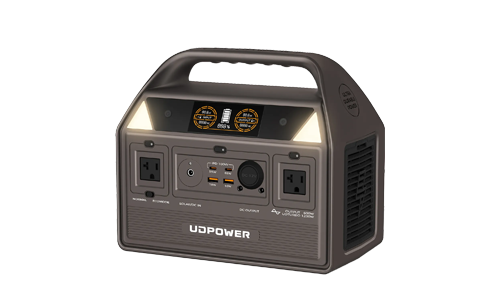
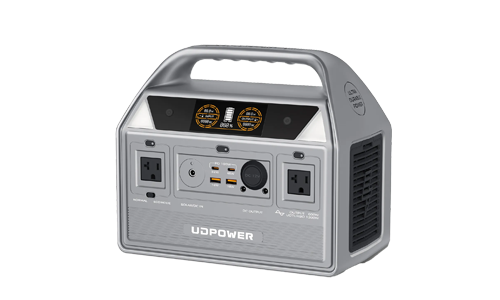
UDPOWER S2400
The S2400 provides the longest runtime of these three options and more output headroom for larger stationary concentrators. It is the better starting point when a measured load is near the upper end of the 5-liter range or when a longer bridge period is required.
- 2,083Wh LiFePO4 battery
- 2,400W rated AC output
- 3,000W surge output
- 4,000+ battery cycles
- Six AC outlets and ten DC outputs
- UPSPrime transfer time below 10 milliseconds
- Up to 400W solar input on the official product specification
- Official weight: 40.8 lb
Estimated examples: About 22.1 hours at 85W, 15.6 hours at 120W, 6.8 hours at 275W, 5.4 hours at 350W, or 3.2 hours at 585W before adding a reserve.
Best fit: The longest bridge time among these models, higher-output stationary concentrators, or an outage setup that also needs limited communication and lighting loads. Every extra device reduces oxygen-concentrator runtime.
View the UDPOWER S2400Can a Portable Power Station Run an Oxygen Concentrator for 24 Hours?
Sometimes, but only for a sufficiently low-wattage portable concentrator or with a much larger and rechargeable energy system. For most stationary 5-liter and 10-liter machines, a single portable power station is better understood as bridge power than 24-hour backup.
| Continuous load | Energy needed for 24 hours | S2400 estimated runtime | Practical interpretation |
|---|---|---|---|
| 85W | 2.04 kWh | About 22.1 hours mathematically | Close to a full day before adding reserve, battery aging, or charging losses beyond the estimate. |
| 120W | 2.88 kWh | About 15.6 hours | Useful extended bridge power, but not a complete 24-hour supply. |
| 275W | 6.60 kWh | About 6.8 hours | Substantial gap remains between one battery charge and all-day operation. |
| 350W | 8.40 kWh | About 5.4 hours | Best planned as time to restore power, use prescribed backup oxygen, or relocate. |
| 585W | 14.04 kWh | About 3.2 hours | A large 10-liter machine can exhaust a portable battery quickly despite adequate inverter output. |
For long outages, combine several layers: portable power, charged concentrator batteries, prescribed backup cylinders, utility notification, transportation, a powered destination, and a properly installed generator solution where appropriate.
Can Solar Panels Keep an Oxygen Concentrator Running?
Solar panels can extend runtime, but the answer depends on the concentrator’s daily energy use, weather, season, shade, charging limits, and the number of useful sunlight hours.
| Concentrator load | Energy used in 8 hours | Energy used in 24 hours | What portable solar can realistically do |
|---|---|---|---|
| 85W | 680Wh | 2,040Wh | A favorable use case for extending runtime, especially when the battery begins the day fully charged. |
| 120W | 960Wh | 2,880Wh | Solar can replace part of the daily energy, but weather and charging losses matter. |
| 275W | 2,200Wh | 6,600Wh | A single portable panel setup is unlikely to replace a full day of consumption. |
| 350W | 2,800Wh | 8,400Wh | Solar is more useful for slowing battery depletion than achieving indefinite operation. |
| 585W | 4,680Wh | 14,040Wh | A substantially larger energy system and recharge strategy would be required. |
Even a 400W solar array receiving five equivalent peak-sun hours would have a theoretical collection ceiling of about 2,000Wh before real-world panel, controller, temperature, angle, shading, and battery losses. That can be meaningful for a portable concentrator, but it is far below the daily demand of many continuously operated stationary machines.
Keep the power station charged from the wall before severe weather rather than depending on sunshine after the outage begins. For additional planning, read:
- Can You Recharge a Portable Power Station With Solar During an Outage?
- Solar Charging Voltage and Compatibility Safety
A Safer Oxygen Concentrator Power Outage Plan
Backup equipment works best as part of a written plan rather than as an unopened battery stored in a closet. Review the plan with the oxygen supplier, household members, caregivers, and healthcare provider.
Before an outage
- Confirm the concentrator’s prescribed operating mode and flow setting.
- Record the exact model number, rated power, and measured running watts.
- Test the concentrator on the intended backup source before an emergency.
- Confirm that normal alarms remain audible and visible during backup operation.
- Keep the power station and portable concentrator batteries charged.
- Maintain prescribed backup oxygen cylinders and know how to use them.
- Ask the utility whether it maintains a medical-needs or priority-restoration registry.
- Identify at least one powered location and a transportation plan.
- Keep supplier, healthcare provider, utility, emergency, and caregiver numbers available on paper.
During the first few minutes
- Confirm that oxygen delivery continues normally.
- Check the concentrator display and listen for alarms.
- Verify that the power station shows a stable AC load and reasonable remaining runtime.
- Disconnect lights, televisions, kitchen appliances, and other nonessential loads.
If the outage may last for hours
- Contact the utility and obtain the best available restoration estimate.
- Contact the oxygen supplier according to the emergency plan.
- Prepare prescribed backup oxygen before the battery reaches a critical level.
- Move to the planned powered location while transportation and road conditions remain safe.
- Do not wait until the battery display reaches zero before taking the next step.
A useful prioritization guide is available at What to Run First During a Power Outage .
Oxygen Concentrator Backup Power Selection Checklist
- Exact running watts: Use the manual and a real watt-meter test rather than relying only on an internet average.
- Highest operating condition: Include internal battery charging and every approved accessory that will remain connected.
- AC output: Select an inverter rating comfortably above the measured load.
- Battery capacity: Calculate watt-hours from the required bridge time.
- Reserve: Leave usable energy for a longer-than-expected outage.
- Waveform and compatibility: Follow the concentrator manufacturer’s electrical requirements and test the complete setup.
- Transfer behavior: Do not assume every concentrator will respond the same way to an automatic transfer function. Conduct a supervised compatibility test.
- Recharge plan: Decide how the battery will be restored from wall, vehicle, solar, or another safe source.
- Port access: Keep the concentrator on a dedicated outlet when possible and avoid unnecessary shared loads.
- Placement: Keep both devices dry, ventilated, accessible, and away from heat sources or blocked air vents.
- Medical backup: Maintain the supplier-approved secondary oxygen plan even after buying a power station.
Frequently Asked Questions
How many watts does a 5-liter oxygen concentrator use?
Many stationary 5-liter concentrators use approximately 200–350 watts. Published examples include 275 watts for the Inogen At Home power supply, 328 watts for the React Health Phoenix 5, and up to 350 watts for the CAIRE Companion 5 and IntenOxy 5. Check the exact model because power use can change with the flow setting.
How many watts does a 10-liter oxygen concentrator use?
A 10-liter stationary concentrator commonly uses about 500–600 watts. The React Health Platinum 10L manual, for example, lists 585 watts as typical consumption.
How many watts does a portable oxygen concentrator use?
Portable oxygen concentrators commonly fall in an approximate 40–130W range, although the power adapter may draw more while the internal battery is charging. Philips publishes 120W while charging for the SimplyGo Mini and 150W while charging for the SimplyGo.
Can a 300W portable power station run an oxygen concentrator?
It may run some lower-power portable concentrators, but it is not sufficient for every oxygen concentrator. A stationary machine that uses 328W or 350W already exceeds a 300W continuous output rating. Capacity would also determine how long a compatible lower-wattage machine runs.
Can a 500W power station run a 5-liter oxygen concentrator?
A 500W inverter may support certain 5-liter concentrators whose maximum electrical requirement remains below 500W, but compatibility must be confirmed with the exact machine. The battery’s watt-hour capacity then determines whether runtime is measured in one hour or several hours.
Can a 500W power station run a 10-liter oxygen concentrator?
It should not be assumed. A 10-liter model using 585W exceeds a 500W continuous inverter rating. Choose from the measured load and manufacturer requirements, not the “10-liter” label alone.
Does an oxygen concentrator have startup surge?
A compressor-based machine may draw differently during startup than during steady operation, but the size and duration vary by model. Check the manufacturer documentation and test the actual concentrator with the intended backup source instead of applying a generic surge multiplier.
Can an oxygen concentrator be connected to a UPS?
Only when the UPS output, battery capacity, waveform, transfer behavior, and manufacturer requirements are compatible with that concentrator. Many computer UPS units provide only a short operating window. A larger portable power station can offer more capacity, but it still requires a supervised compatibility test.
Is a portable power station the same as a medical backup system?
No. A consumer portable power station supplies electricity but does not replace prescribed backup oxygen, professional medical planning, supplier support, or emergency procedures. Treat it as one layer in a broader outage plan.
Can I lower the oxygen setting to make the battery last longer?
Do not change a prescribed flow setting to conserve battery power unless a qualified healthcare provider has specifically directed that change. Use the prescribed backup oxygen plan or move to a powered location instead.
How long will a 1,000Wh battery run a 350W oxygen concentrator?
Using a 90% conversion estimate, the mathematical runtime is approximately 2.6 hours: 1,000Wh × 0.90 ÷ 350W. A conservative emergency plan should allow less time because actual performance varies and reserve energy may be needed.
How long will the UDPOWER S1200 run a 5-liter oxygen concentrator?
Runtime depends on the model’s measured draw. An S1200 is estimated at about 3.9 hours for a 275W load, 3.3 hours for a 328W load, or 3.1 hours for a 350W load. A plan retaining a 20% reserve would target a shorter operating window.
How long will the UDPOWER S2400 run a 10-liter oxygen concentrator?
At a constant 585W load, the mathematical estimate is about 3.2 hours using 90% conversion efficiency. Retaining a 20% planning reserve reduces that target to approximately 2.6 hours. Measure the actual machine before relying on the estimate.
Can solar panels run an oxygen concentrator all day?
Solar may extend operation for a lower-wattage portable unit, but a single portable array will not normally replace the full daily consumption of a 275–585W stationary concentrator. Weather, panel angle, charging limits, and daylight make solar production variable, so begin an outage with the battery fully charged.
How This Guide Was Checked
Wattage examples were reviewed against oxygen concentrator manufacturer specifications and the WHO/PATH technical reference available on July 24, 2026. UDPOWER battery capacity, AC output, surge output, cycle-life, port, weight, transfer-time, and solar-input figures were checked against the corresponding official UDPOWER product pages.
Runtime estimates use the formula “battery capacity × 90% ÷ load watts.” They are planning calculations rather than guaranteed operating times. Actual results depend on the exact concentrator, prescribed setting, battery condition, temperature, inverter efficiency, connected accessories, and equipment compatibility.
Build the Backup Plan Before the Power Goes Out
Start with the concentrator’s exact measured wattage, determine how many hours of bridge power are needed, and keep the supplier-approved backup oxygen plan ready. Then compare battery capacity rather than shopping by output watts alone.
Compare Backup Power Options View All Portable Power Stations Get the Power Outage ChecklistRelated Articles


