

What Is Portable Clean Energy? Meaning, Uses & 2026 Guide
Last updated: October 30, 2026
Quick answer: Portable clean energy is a practical way to generate, store, carry, and use electricity with little or no combustion at the point where the power is used. In everyday life, it usually means a rechargeable portable power station paired with charging sources such as solar panels, wall power, or a vehicle.
A battery power station itself does not create energy. It stores electricity and makes that energy available through AC, USB, or DC outputs. Solar panels can supply renewable electricity to recharge it. How “clean” the overall system is depends on where the electricity came from, how efficiently it is used, how long the equipment lasts, and what happens to the battery and panels at the end of their useful life.
I think that distinction matters because “portable clean energy” is often used too loosely. A battery sitting in a power station is not automatically renewable energy, and calling every battery product “zero-emission” ignores the electricity used to charge it and the impact of manufacturing it.
The useful idea is simpler: portable battery systems let you move electricity to places where a wall outlet is unavailable, and when they are charged from solar or other low-emission sources, they can become a practical part of a cleaner portable-energy setup.

Table of Contents
- What Does Portable Clean Energy Mean?
- Clean Energy vs. Renewable Energy
- How Portable Clean Energy Works
- Main Portable Clean Energy Technologies
- Portable Power Station vs. Solar Generator vs. Power Bank
- How Clean Is a Portable Power Station Really?
- Portable Clean Energy vs. Gas Generator
- How to Size a Portable Clean Energy System
- How Much Solar Do You Need?
- Where Portable Clean Energy Makes the Most Sense
- UDPOWER Portable Clean Energy Options
- Common Misunderstandings
- Frequently Asked Questions
What Does Portable Clean Energy Mean?
There is not one consumer product that defines portable clean energy. I use the term as an umbrella description for portable systems that let you generate, store, or use electricity while reducing reliance on small combustion engines and fuel-powered generators.
The U.S. Environmental Protection Agency describes clean energy broadly as including renewable energy, energy efficiency, and efficient energy technologies. In a portable setting, that idea usually comes together through three parts:
- An energy source such as sunlight, utility electricity, or vehicle charging.
- An energy-storage system such as a LiFePO4 portable power station.
- A way to deliver that energy through AC outlets, USB-C, USB-A, 12V DC, or other regulated outputs.
A solar panel can generate renewable electricity but cannot normally store it by itself. A portable power station can store electricity but does not generate it by itself. Put the two together and you have what the market commonly calls a solar generator.
The simplest way to think about it: solar creates electricity, the battery stores electricity, and the power station delivers electricity to your devices.
Clean Energy and Renewable Energy Are Not Exactly the Same Thing
This is one of the most important distinctions in this topic.
Renewable energy describes energy sources that are naturally replenished, such as sunlight and wind.
Clean energy is a broader term usually associated with reducing pollution and environmental impact. Renewable sources often fall into that category, but the concepts are not identical.
A portable battery charged from solar has a direct renewable input. The same battery charged from a household outlet is using electricity from whatever mix of sources supplies the local grid.
| Setup | Where the Energy Comes From | Combustion Exhaust During Use | Renewable? | Practical Description |
|---|---|---|---|---|
| Portable power station charged from solar | Sunlight | No combustion exhaust from the power station | Yes, for the solar input | Strong example of portable renewable energy plus battery storage |
| Portable power station charged from the grid | Local electricity grid | No combustion exhaust from the power station | Depends on grid generation mix | Portable battery storage with clean point-of-use operation |
| Portable power station charged from a vehicle | Vehicle electrical system | No combustion at the battery during discharge | Not necessarily | Convenient mobile energy storage, but not automatically renewable |
| Gas generator | Gasoline, propane, or other fuel | Yes | No for fossil fuels | Portable electricity generation through combustion |
That is why I prefer saying a battery power station has no combustion exhaust at the point of use instead of claiming the entire product is completely emission-free.
How Does Portable Clean Energy Work?
A typical portable solar-and-battery system follows a simple energy path.
Solar panel, wall outlet, vehicle charging system, or another approved charging source.
The power station controls incoming voltage and current and safely charges the battery.
Electrical energy is stored in the internal battery, commonly measured in watt-hours.
The inverter creates household-style AC power when required, while USB and DC outputs may supply devices more directly.
Phones, laptops, routers, CPAP machines, lights, refrigerators, camping equipment, tools, or other compatible loads.
The U.S. Department of Energy describes energy storage as capturing energy when it is available and releasing it later when it is needed. A portable power station is simply a much smaller, mobile version of that storage principle.
If you want a deeper explanation of the battery, inverter, charging controller, BMS, and outputs inside the unit, read How Does a Portable Power Station Work?
What Technologies Are Used in Portable Clean Energy?
Portable Power Stations
A portable power station combines a rechargeable battery, inverter, charging electronics, battery-management system, and multiple outputs in one enclosure.
The battery stores energy in watt-hours. The inverter determines how much AC power the station can deliver at one time. These are different specifications.
A 2,000Wh battery does not automatically mean the station can run a 2,000W appliance, and a 2,000W inverter does not tell you how many hours the battery will last.
A useful shortcut is:
LiFePO4 Batteries
LiFePO4, also called LFP or lithium iron phosphate, has become widely used in modern portable power stations because of its thermal stability and long cycle life.
UDPOWER currently uses LiFePO4 batteries in its portable power station lineup. For long-term planning, UDPOWER's current battery-life standard is approximately 80% remaining capacity after 3,000 cycles and approximately 70% remaining capacity after 4,000 cycles.
A battery reaching those cycle counts is not suddenly unusable. Cycle-life ratings describe gradual capacity retention. A station that originally stored 1,000Wh will simply store less energy as the battery ages.
For more detail, see the complete LiFePO4 battery guide.
Portable Solar Panels
Portable solar panels convert sunlight directly into DC electricity. Foldable designs make them practical for camping, RV travel, temporary outage charging, field work, and other situations where permanent rooftop solar is not available.
A panel does not normally store energy. It sends electricity to a compatible battery system or charge controller.
The most important compatibility specifications are:
- Open-circuit voltage, or Voc
- Operating voltage
- Operating current
- Maximum solar input voltage of the power station
- Maximum input current
- Supported solar wattage
- Connector type and polarity
A physically compatible plug does not guarantee electrical compatibility. Read Can You Charge a Portable Power Station With a Solar Panel? before connecting third-party panels.
Wall and Vehicle Charging
Solar is not the only way to use portable battery storage. Wall charging is normally the fastest and most predictable way to prepare before an outage or trip, while vehicle charging can help restore energy during travel.
This flexibility matters because a good off-grid power system should not depend on perfect weather.
Portable Power Station vs. Solar Generator vs. Power Bank
These terms are often mixed together, but they do not mean exactly the same thing.
| Term | What It Usually Means | Stores Energy? | Creates Electricity? | Typical Use |
|---|---|---|---|---|
| Portable power station | Rechargeable battery with inverter and AC/DC/USB outputs | Yes | No | Camping, home backup, RV, remote work |
| Solar generator | Portable power station used with compatible solar panels | Yes | The panels generate electricity | Off-grid and renewable charging |
| Portable solar panel | Photovoltaic panel that converts sunlight into DC electricity | No | Yes, in sunlight | Recharging batteries and power stations |
| Power bank | Smaller rechargeable battery, usually focused on USB devices | Yes | No | Phones, tablets, small electronics |
| Gas generator | Engine-driven electrical generator | Normally no significant battery storage | Yes | Long-duration or high-power backup |
This is why the term “solar generator” can be confusing. The battery box does not create solar electricity. The solar panels do.
UDPOWER therefore defines its solar generator kits as a portable power station paired with solar panels.
How Clean Is a Portable Power Station Really?
This is where I think a useful guide has to be more careful than marketing copy.
A portable power station does have a major practical environmental advantage over a small combustion generator when it is supplying electricity: it does not burn gasoline or propane while discharging, so there is no engine exhaust at the point of use.
But batteries, electronics, aluminum, plastics, solar cells, copper, transportation, and manufacturing all have environmental impacts.
So I would judge a portable clean-energy system using five questions rather than a single “zero emissions” claim.
| Question | Why It Matters | Better Practice |
|---|---|---|
| Where did the electricity come from? | Solar charging and grid charging can have very different generation sources. | Use renewable charging when practical, but do not avoid reliable grid charging when preparing for emergencies. |
| How long will the battery last? | A longer service life spreads manufacturing impact across more years and uses. | Choose durable battery chemistry and avoid unnecessary extreme heat. |
| Did you buy the right size? | Oversizing adds battery material, weight, and cost that may never be used. | Calculate actual wattage and runtime requirements before buying. |
| Are you using energy efficiently? | Every conversion loses some energy. | Use efficient appliances and direct USB-C or DC output when appropriate. |
| What happens at end of life? | Batteries should not simply enter ordinary household waste streams. | Follow local battery recycling and manufacturer disposal guidance. |
My practical view: the cleanest portable power system is not automatically the largest battery with the most solar panels. It is the system that is correctly sized, lasts a long time, uses energy efficiently, and replaces combustion where battery power makes sense.
Portable Clean Energy vs. a Gas Generator
A battery power station and a gas generator solve overlapping problems, but they behave very differently.
| Factor | Battery Power Station | Gas Generator |
|---|---|---|
| Energy source | Stored electricity | Fuel |
| Combustion exhaust during operation | No | Yes |
| Indoor use | Generally suitable when used according to product instructions, kept dry, and properly ventilated | Combustion generators must be operated outdoors according to safety guidance |
| Noise | Normally much quieter; cooling fans may still operate | Engine noise while running |
| Routine maintenance | Relatively low | Fuel, oil, engine and storage maintenance |
| Energy replenishment | Wall, vehicle, compatible solar or other approved input | Refuel with compatible fuel |
| Very long high-power outage | Limited by stored energy and charging availability | Can continue while fuel remains available |
| Short outage and indoor electronics | Very convenient | Usually less convenient |
A battery power station can replace a small generator for many routers, phones, laptops, lights, refrigerators, CPAP machines, TVs, camping equipment, and selected appliances.
It is not automatically better when you need very high continuous power for several days and have no realistic way to recharge.
For a detailed comparison, read Portable Power Station vs. Generator: Which Is Better?
How Do You Size a Portable Clean Energy System?
The biggest mistake is starting with a product and then trying to make your needs fit it.
I start with the loads.
Step 1: Find the watts of each device
Check the device label, AC adapter, manual, or use a power meter.
If several devices will run at once, add their watts together.
Step 2: Calculate daily energy use
Suppose your basic outage plan is:
| Device | Planning Load | Use Time | Energy Needed |
|---|---|---|---|
| Router and modem | 20W | 12 hours | 240Wh |
| Laptop | 60W | 4 hours | 240Wh |
| LED lighting | 20W | 5 hours | 100Wh |
| Total | — | — | 580Wh |
Step 3: Account for conversion losses
For UDPOWER runtime planning, I use approximately 90% conversion efficiency as a practical starting point.
For the 580Wh example:
I would still leave additional reserve rather than buying a battery rated at exactly 644Wh. Appliance consumption changes, batteries age, and real outages rarely follow a perfect calculation.
Step 4: Check inverter output separately
Battery capacity determines runtime. The inverter determines whether the appliance can run at all.
A refrigerator may average relatively little energy over a day but require significantly more power when its compressor starts. Microwaves, coffee makers, kettles, tools, and heaters can require high continuous wattage even when used briefly.
Use the portable power station sizing guide if you need to calculate running watts, startup demand, and runtime together.
How Much Solar Do You Need for Portable Clean Energy?
Solar sizing should begin with how much energy you need to replace each day, not simply how large a panel looks.
A useful planning estimate is:
The 0.70 factor is only a conservative planning allowance for real-world losses and changing conditions. It is not a guaranteed efficiency number.
For example, a 210W panel with five equivalent peak-sun hours might provide roughly:
Actual energy can be considerably higher or lower depending on clouds, temperature, panel angle, shade, season, cable loss, battery state of charge, and the power station's own input limit.
| UDPOWER Model | Battery Capacity | Solar Input | Practical Role | Official Source |
|---|---|---|---|---|
| C200 | 192Wh | Up to 150W | Compact solar charging for travel and light electronics | C200 Specifications |
| C400 | 256Wh | Up to 150W | Camping and portable everyday power | C400 Specifications |
| S1200 | 1,190Wh | Up to 400W | Home essentials, camping, RV and longer off-grid use | S1200 Specifications |
| S2400 | 2,083Wh | Up to 420W recommended solar setup | Higher daily energy demand and longer backup | S2400 Specifications |
Do not size solar by wattage alone. A 420W solar array is not automatically compatible with every power station rated around 400W. Voltage, current, connector type, polarity, and wiring configuration must all stay within the manufacturer's limits.
For current compatible options, see UDPOWER foldable solar panels and UDPOWER solar generator kits.
Where Does Portable Clean Energy Make the Most Sense?
Camping
Camping is one of the most natural uses because the loads are usually manageable: lights, phones, cameras, laptops, fans, CPAP machines, portable refrigerators, and small electronics.
Solar also makes sense when a trip lasts several days and utility charging is unavailable.
Home Power Outages
A battery power station is useful for keeping selected essentials running without operating an engine indoors. Typical priorities include internet equipment, lights, phones, laptops, CPAP equipment, televisions, and refrigerators.
The key word is selected. A portable 120V power station is not automatically a whole-home backup system.
CPAP Backup
CPAP machines are relatively modest loads compared with kitchen appliances, but they operate for many hours. That makes battery capacity more important than simply buying the highest-watt inverter.
Heated humidifiers and heated tubing can significantly increase energy use, so size from your own machine and settings.
Remote Work and Photography
Laptops, cameras, drones, network equipment, chargers, monitors, and lighting are well suited to portable batteries because their energy demand is predictable and their total wattage is usually much lower than heavy household appliances.
RV and Overland Travel
Portable batteries can supplement an RV electrical system without requiring the engine or generator to run every time you need power. Solar can recover some of the daily energy while parked.
The useful question is not only “How big is the battery?” but also “Can I replace tomorrow what I use today?”
Mobile Work and Tools
Charging cordless-tool batteries is relatively easy. Running saws, compressors, pumps, or other motor loads directly requires much more inverter headroom.
For work applications, always check both normal operating watts and startup demand.
Which UDPOWER Products Fit a Portable Clean Energy Setup?
The best model depends more on what you need to power than on whether the unit is labeled “clean energy” or “solar generator.”
| Model | Capacity | Rated AC Output | Weight | Solar Input | Best Fit |
|---|---|---|---|---|---|
| C200 | 192Wh | 200W | Approx. 5.4 lb | Up to 150W | Phones, cameras, lights, short trips and compact backup |
| C400 | 256Wh | 400W | Approx. 6.88 lb | Up to 150W | Camping, laptops, travel, fans and mobile electronics |
| S1200 | 1,190Wh | 1,200W | Approx. 26 lb | Up to 400W | CPAP, refrigerator, home essentials, RV and longer camping |
| S2400 | 2,083Wh | 2,400W | Approx. 40.8 lb | Up to 420W recommended setup | Longer backup, microwave, coffee maker, tools and multiple appliances |

UDPOWER C200
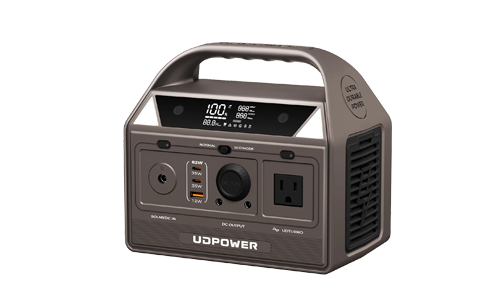
C200 is the practical choice when the goal is simply to carry electricity for small electronics without hauling a large battery. Its 192Wh LiFePO4 battery and 200W rated AC output are better suited to phones, cameras, routers, lights, small fans, and short laptop use than to major household appliances.
- 192Wh LiFePO4 battery
- 200W rated pure sine wave AC output
- Approximately 5.4 lb
- Up to 150W solar input
- AC, USB and DC outputs
Best for: short trips, emergency communication, photography, light camping, and compact solar setups.

UDPOWER C400
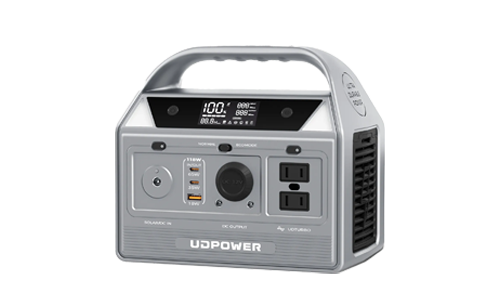
C400 moves beyond basic phone charging without becoming difficult to carry. Its 400W rated AC output gives more flexibility for laptops, fans, campsite electronics, routers, camera equipment, and other moderate loads.
- 256Wh LiFePO4 battery
- 400W rated pure sine wave AC output
- Approximately 6.88 lb
- Up to 150W solar input
- USB-C, USB-A, AC and 12V outputs
Best for: weekend camping, mobile work, vehicle kits, laptop charging, and portable solar setups where low weight still matters.

UDPOWER S1200
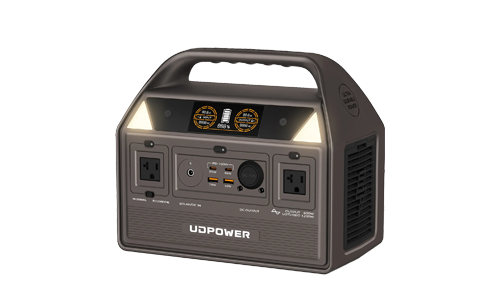
S1200 is where portable battery storage becomes much more useful for household backup. With 1,190Wh of capacity and 1,200W rated AC output, it can cover loads such as refrigerators, CPAP machines, routers, televisions, laptops, lights, and many camping or RV essentials when their requirements remain within specification.
- 1,190Wh LiFePO4 battery
- 1,200W rated pure sine wave AC output
- UDTURBO capability up to 1,800W for compatible higher-power loads
- Approximately 26 lb
- Up to 400W solar input
- UPSPrime transfer time of 10ms or less
Best for: refrigerator support, CPAP backup, longer camping, RV essentials, internet backup, and selected household loads.
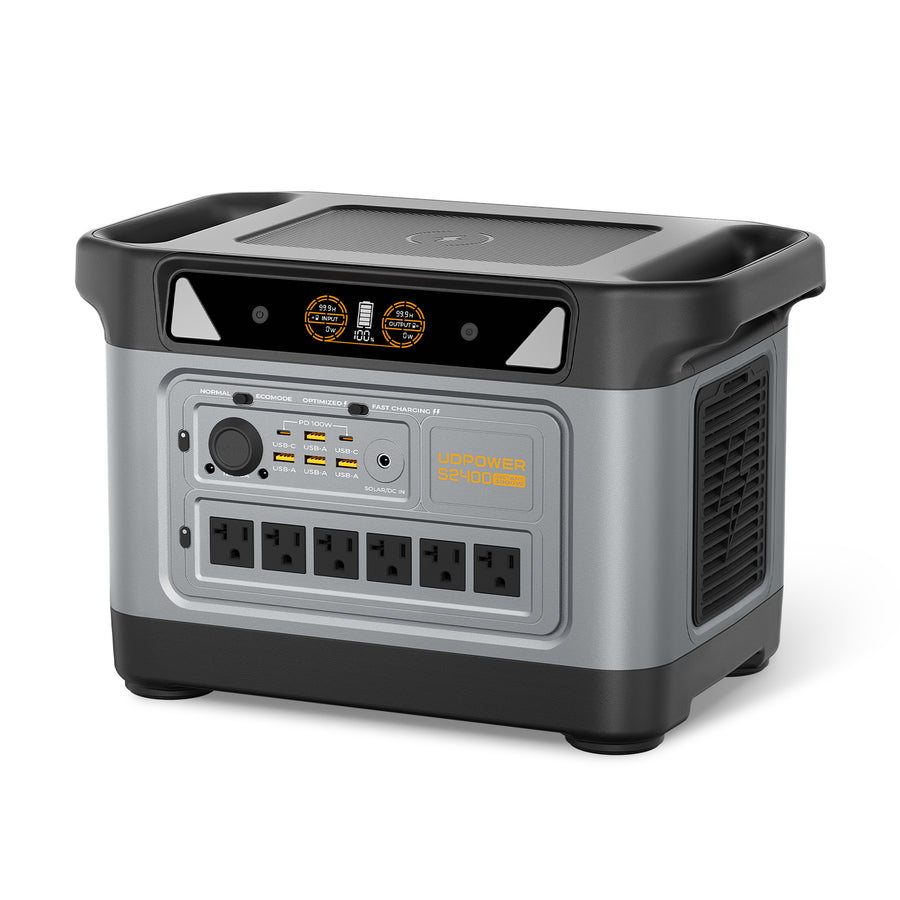
UDPOWER S2400
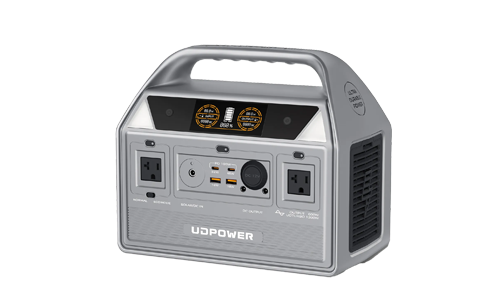
S2400 is the better fit when portable clean energy also needs to handle serious appliance wattage. Its 2,083Wh battery gives substantially more stored energy, while the 2,400W rated inverter provides enough headroom for many microwaves, coffee makers, power tools, refrigeration loads, and multiple devices.
- 2,083Wh LiFePO4 battery
- 2,400W rated pure sine wave AC output
- UDTURBO capability up to 3,000W
- Approximately 40.8 lb
- Up to 420W recommended solar setup
- 6 AC outlets plus USB and DC outputs
- UPSPrime transfer time of 10ms or less
Best for: longer outages, RV and basecamp power, high-wattage appliances, workshops, and multi-device backup.
How Much Runtime Can Portable Battery Power Provide?
For UDPOWER models, a useful first estimate is:
| Load | C200 192Wh |
C400 256Wh |
S1200 1,190Wh |
S2400 2,083Wh |
|---|---|---|---|---|
| 20W | Approx. 8.6 hr | Approx. 11.5 hr | Approx. 53.6 hr | Approx. 93.7 hr |
| 40W | Approx. 4.3 hr | Approx. 5.8 hr | Approx. 26.8 hr | Approx. 46.9 hr |
| 100W | Approx. 1.7 hr | Approx. 2.3 hr | Approx. 10.7 hr | Approx. 18.7 hr |
| 500W | Above normal rated output | Above normal rated output | Approx. 2.1 hr | Approx. 3.7 hr |
| 1,000W | Not suitable | Not suitable | Approx. 1.1 hr | Approx. 1.9 hr |
These are mathematical steady-load estimates, not guaranteed runtimes. Refrigerators cycle, laptops change power consumption, inverter self-consumption matters at very low loads, and efficiency can decrease under heavier operating conditions.
Common Misunderstandings About Portable Clean Energy
Myth 1: A portable power station generates electricity
It does not. It stores electricity. Solar panels, the utility grid, a vehicle electrical system, or another charging source supplies the energy.
Myth 2: A battery is automatically renewable energy
A battery is energy storage. Whether the stored electricity is renewable depends on how it was charged.
Myth 3: Solar means unlimited power
Your battery still has a finite capacity, and your panels have a finite daily energy harvest. If you consume 1,500Wh each day but recover only 500Wh, the battery will eventually run down.
Myth 4: A 200W solar panel always produces 200W
Rated panel wattage is measured under standardized conditions. Real output changes continuously with clouds, sun angle, shade, temperature, season, panel orientation, cable losses, and the receiving power station.
Myth 5: More battery capacity is always better
A 2,000Wh power station is excellent when you need 2,000Wh-class backup. It is unnecessary weight and cost if your entire trip consists of charging a phone, camera, and laptop.
Myth 6: Peak output and battery capacity are the same thing
They solve completely different problems. Output determines appliance compatibility. Capacity determines runtime.
Myth 7: Portable clean energy replaces every gas generator
Battery power is excellent for quiet indoor backup and moderate-duration loads. A fuel generator may still be more practical when sustained high output is required for several days and recharging is unavailable.
Myth 8: Solar input wattage is the only compatibility specification
It is not. Voltage, current, connector, polarity, and wiring configuration can be more important for safety than the headline wattage.
How to Build a Better Portable Clean Energy Setup
- Start with the devices. Write down what you actually need to power.
- Measure or verify their wattage. Do not rely only on generic online charts.
- Calculate daily Wh. Watts multiplied by hours gives the energy requirement.
- Leave conversion headroom. Do not assume 100% of rated battery capacity reaches the appliance.
- Check startup requirements. Refrigerators, pumps and motor loads can demand more power when starting.
- Choose the smallest practical battery. Enough reserve is good; unnecessary capacity is not automatically better.
- Plan how you will recharge. Wall charging is predictable; solar becomes especially valuable when grid power is unavailable for multiple days.
- Match solar electrically. Verify voltage, current, connector and supported panel configuration.
- Use efficient outputs. USB-C or DC may reduce conversion losses for some devices.
- Test before an emergency. Do not discover during an outage that your refrigerator startup demand or CPAP runtime calculation was wrong.
Sources and Further Reading
Frequently Asked Questions
What does portable clean energy mean?
Portable clean energy generally refers to electricity that can be generated, stored, transported, and used away from fixed infrastructure while reducing reliance on combustion at the point of use. In everyday consumer use, it commonly means a rechargeable portable power station combined with solar panels or another charging source.
Is a portable power station clean energy?
A portable power station is an energy-storage device rather than an energy source. It produces no combustion exhaust while discharging, but how clean the overall energy is depends partly on how the battery was charged. Solar-charged electricity is renewable, while grid-charged electricity reflects the generation mix of the local grid.
Is portable clean energy the same as solar power?
No. Solar power is one possible source of portable clean energy. A complete portable system may include solar panels, battery storage, wall charging, vehicle charging, an inverter, and AC or DC outputs.
What is the difference between a solar generator and a portable power station?
A portable power station is the battery and power-conversion system. A solar generator usually refers to a portable power station paired with compatible solar panels. The panels generate electricity and the power station stores and delivers it.
Does a portable power station generate electricity?
No. A portable power station stores electricity supplied by a wall outlet, solar panel, vehicle, or another approved source. It then converts and distributes that stored energy through AC, USB, or DC outputs.
Can portable clean energy replace a gas generator?
It can replace a gas generator for many moderate loads such as lights, routers, phones, laptops, CPAP machines, televisions, refrigerators, and camping equipment when the battery is correctly sized. Gas generators can still be more practical for very long outages with sustained high-power demand when fuel is available.
Can I use a portable power station indoors?
Battery power stations do not burn fuel while operating and therefore do not create generator-style combustion exhaust. Use the station according to its instructions, keep it dry, maintain airflow around cooling vents, stay within approved temperature limits, and do not use damaged equipment.
What battery chemistry is best for portable clean energy?
LiFePO4 is widely used because of its thermal stability and long cycle life. UDPOWER currently uses LiFePO4 batteries across its portable power station lineup, with approximately 80% remaining capacity after 3,000 cycles and approximately 70% after 4,000 cycles under the current cycle-life standard.
How big should a portable clean energy system be?
Add the watt-hours required by your devices, account for conversion losses, and then choose enough battery capacity for the runtime you need. Separately, make sure the inverter's rated output can handle the devices that will operate at the same time and any startup demand.
How much solar do I need to recharge a portable power station?
Start with your daily energy use and determine how much of that energy you want to replace during available sunlight. Actual solar production depends on panel wattage, peak sun hours, shade, angle, temperature, weather, electrical losses, and the power station's input limits.
Can I use any solar panel with a portable power station?
No. The panel or panel array must stay within the power station's supported voltage, current, wattage, connector, polarity, and wiring requirements. Matching the advertised wattage alone does not prove compatibility.
Does solar charging work on cloudy days?
Solar panels can still produce electricity under some cloudy conditions, but output may be substantially lower than under strong direct sunlight. A reliable off-grid plan should allow for variable weather and may include wall or vehicle charging as backup.
What devices are best suited to portable clean energy?
Phones, laptops, routers, cameras, drones, LED lights, fans, CPAP equipment, TVs, refrigeration, camping electronics, and selected appliances are common uses. Higher-wattage devices require a larger inverter and usually a larger battery.
Is portable clean energy completely emission-free?
No energy system is impact-free across its entire life cycle. Battery power stations create no combustion exhaust while supplying power, but manufacturing, transportation, charging electricity, battery materials, solar-panel production, and end-of-life handling all contribute to the system's overall environmental footprint.
What UDPOWER model is best for portable clean energy?
C200 is best for very light portable use, C400 for compact camping and travel, S1200 for CPAP, refrigerators and home essentials, and S2400 for longer backup and higher-wattage appliances. The right model should be chosen from your actual wattage, runtime, portability, and charging requirements.
Build the Right Portable Power Setup
Start with what you actually need to run, calculate your energy requirement, and then choose the smallest system that gives you enough output, runtime, and recharge capability. For off-grid use, add solar only after confirming the power station's electrical input limits.
Related Articles


