

Electricity Saving Box: Does It Really Lower Your Electric Bill?
Latest update: October 13, 2026

Products sold as electricity saving boxes, power saver plugs, watt savers, energy optimizers, power factor savers, or voltage stabilizers often claim that one small device can cut a home's electricity bill by 20%, 30%, 40%, or more. For a typical residential customer, those claims do not match how electricity is measured and billed.
A device may alter current or power factor measurements without meaningfully reducing the real electrical energy your appliances consume. The National Institute of Standards and Technology specifically explains that capacitor-type power-factor correction devices do not reduce a typical household electric bill.
If your goal is a lower bill, focus on actual kilowatt-hour consumption, HVAC, water heating, insulation, appliance runtime, lighting, and your utility rate plan. If your goal is keeping essential equipment running during an outage, that is a separate problem where a properly sized portable power station can make sense.
Table of Contents
- What Is an Electricity Saving Box?
- Does an Electricity Saving Box Actually Work?
- Why Power Factor Claims Sound Convincing
- What Your Electric Bill Actually Measures
- What a 20%–40% Savings Claim Would Really Mean
- Power Saver Box vs. Real Electrical Products
- How to Spot a Misleading Power Saver
- How to Test an Electricity Saver Yourself
- What Actually Reduces an Electric Bill?
- A 7-Day Home Electricity Audit
- Where Portable Power Stations Fit In
- UDPOWER Backup Power Recommendations
- Related UDPOWER Guides
- Frequently Asked Questions
What Is an Electricity Saving Box?
An electricity saving box is usually a small device that plugs directly into a standard wall outlet. The same category is advertised under many names, including:
- electricity saving box
- power saver box
- electricity saver plug
- watt saver
- energy optimizer
- power factor saver
- voltage stabilizer
- energy saving device
- power efficiency box
The advertisements often say that the device “stabilizes voltage,” “balances current,” “reduces reactive power,” “cleans dirty electricity,” or “optimizes power factor.” Those phrases sound technical because some of the electrical concepts behind them are real.
The problem is the jump from a real electrical concept to an unsupported household savings claim.
| Claim in an Ad | Is the Electrical Concept Real? | Does It Mean Your Home Uses Fewer kWh? | What a Homeowner Should Know |
|---|---|---|---|
| “Improves power factor” | Yes | Usually no for normal residential billing | Power factor correction can matter in commercial or industrial electrical systems, but NIST says it does not reduce a typical household bill. |
| “Reduces current” | Possible | Not necessarily | A lower amp reading by itself does not prove lower real energy consumption. |
| “Stabilizes voltage” | Voltage regulation is real | Not automatically | A small plug-in box should not be confused with professionally designed voltage-regulation equipment. |
| “Protects all appliances” | Electrical protection is real | No | Surge protection and bill reduction are different functions. |
| “Cuts electricity bills 30%–50%” | The claim requires evidence | Highly doubtful for a generic plug-in box | A savings claim this large should be visible directly in long-term kWh readings, not only in an amp display or testimonial. |
Source: National Institute of Standards and Technology: Power Factor Correction Devices
Does an Electricity Saving Box Actually Work?
For the purpose most consumers buy one for—meaning a noticeable reduction in a normal household electricity bill—the answer is no.
Your air conditioner still has to move heat out of the house. Your electric water heater still has to heat water. Your clothes dryer still has to evaporate moisture. Your refrigerator still has to run its compressor. A small device plugged into a separate wall outlet does not remove those energy requirements.
NIST evaluated the physics behind capacitor-type residential power factor correction devices and concluded that they have no effect on a typical household electric bill. The device can reduce current drawn from the line while power factor rises at the same time, leaving the bill-relevant real power essentially unchanged.
Watts × hours ÷ 1,000 = kilowatt-hours (kWh)
If a 1,500W appliance operates continuously for one hour, it uses about 1.5 kWh. To meaningfully lower the energy portion of the bill, something must reduce the appliance's actual power use, reduce how long it runs, improve the efficiency of the work it performs, or shift its use to a cheaper period under a time-of-use rate.
Sources: U.S. Energy Information Administration: Measuring Electricity and NIST Power Factor Explanation
Why Power Factor Claims Sound Convincing
Power factor is not fake. It describes how effectively alternating-current electrical power is being converted into useful work. Motors, compressors, transformers, and certain other loads can create a difference between apparent power and real power.
That is why power factor correction equipment is used in some factories, commercial buildings, workshops, and other facilities with large inductive loads.
But that does not mean a homeowner will save money by correcting power factor at one wall outlet.
| Situation | Can Power Factor Matter? | Could Correction Affect the Bill? |
|---|---|---|
| Typical home billed mainly for kWh | Power factor exists electrically | Generally no meaningful residential bill reduction from a plug-in correction box |
| Commercial facility with large motors | Yes | Possibly, depending on the utility tariff |
| Industrial customer with reactive-power or power-factor penalties | Yes | Potentially yes when engineered correctly |
| Homeowner seeing a lower amp reading after plugging in a capacitor | Yes, the reading may change | A lower current reading alone does not demonstrate lower kWh consumption |
The practical rule is simple: do not use amps alone to judge whether a device saves electricity. Look at watts and, more importantly, accumulated kWh over a controlled period.
What Your Electric Bill Actually Measures
A household electric bill can contain several separate charges. Understanding them makes it easier to see why a universal “plug this in and save 40%” promise is unrealistic.
| Part of the Bill | What It Means | Can a Generic Power Saver Box Change It? | What Can Change It? |
|---|---|---|---|
| kWh consumption | The real electrical energy used over time | Not in the way advertised | Efficiency, reduced runtime, lower loads, behavior changes |
| Electricity rate | Price charged per kWh | No | Your utility tariff or retail electricity plan where applicable |
| Time-of-use pricing | Electricity costs more during some hours and less during others | No | Moving flexible loads to cheaper periods |
| Demand charge | A charge tied to your highest rate of electricity use during a billing interval on plans that use one | Not reliably | Load management and the exact utility tariff |
| Fixed customer charge | A recurring charge that may apply regardless of electricity consumption | No | Usually little or no household control |
| Taxes, riders and other fees | Utility- and location-specific charges | No | Depends on the utility and jurisdiction |
The U.S. Energy Information Administration reports that the year-to-date average residential electricity price through July 2026 was about 18.19 cents per kWh nationwide. Your actual rate can be much higher or lower depending on your state, utility, season, rate plan, and local fees.
Sources: EIA Electric Power Monthly and EIA Electricity Prices and Factors Affecting Prices
What a 20%–40% Electricity Savings Claim Would Really Mean
One of the easiest ways to evaluate a power saver advertisement is to translate its percentage claim into actual kilowatt-hours.
EIA data indicate that an average U.S. household uses roughly 10,500 kWh of electricity per year, or about 875 kWh per month. Individual homes can be far above or below that figure, so the following table is an illustration rather than a prediction for your house.
| Advertised Savings | Energy That Would Have to Disappear From a 875 kWh Month | Approximate Monthly Value at 18.19¢/kWh | What That Means |
|---|---|---|---|
| 10% | 87.5 kWh | About $15.92 | This is already large enough to show clearly in properly controlled meter data. |
| 20% | 175 kWh | About $31.83 | A device would need to eliminate substantial real energy use every month. |
| 30% | 262.5 kWh | About $47.75 | This is not a subtle electrical effect; it would represent a major household energy reduction. |
| 40% | 350 kWh | About $63.67 | A reduction this large should be unmistakable in long-term utility kWh data. |
This is a useful reality check. If an inexpensive plug-in device truly removed hundreds of kilowatt-hours of monthly household consumption while the homeowner changed nothing else, the result would be straightforward to demonstrate with utility-grade energy measurements.
Instead, advertisements often focus on a moving amp meter, voltage reading, glowing LED, or unexplained before-and-after bill screenshot. None of those is a substitute for controlled kWh data.
Sources: EIA: Electricity Use in Homes and EIA 2026 Residential Electricity Price Data
Electricity Saving Box vs. Real Electrical Products
Some confusion comes from the fact that electricity saving boxes are advertised using words associated with legitimate electrical products. They are not interchangeable.
| Device | Main Job | Can It Lower Electricity Use? | What It Does Not Do |
|---|---|---|---|
| Plug-in electricity saving box | Usually marketed as automatic bill reduction | No credible reason to expect large residential savings | It does not make major appliances perform the same work with dramatically less real energy. |
| Smart plug with energy monitoring | Measures and controls compatible plug-in devices | Indirectly, if it helps you find or switch off unnecessary loads | It cannot measure most hardwired whole-home loads by itself. |
| Surge protector | Helps protect compatible equipment against certain transient overvoltage events | No | It is not an energy-saving device. |
| Voltage regulator | Maintains voltage within a designed range | Application dependent | It should not be confused with a universal household bill-reduction plug. |
| Power factor correction equipment | Improves power factor in an electrical system | Potentially valuable in certain commercial or industrial applications | NIST says residential capacitor-type correction does not reduce a typical household bill. |
| Portable power station | Stores electricity for later use | Not simply by being plugged in | It is backup energy storage, not a magic electricity saver. |
| Solar panels | Generate electricity from sunlight | They can reduce grid electricity purchased when properly designed and used | Solar production depends on sunlight, system design, location and other conditions. |
How to Spot a Misleading Power Saver Before You Buy
You do not need an electrical engineering degree to identify a weak claim. Start with the sales page.
- A guaranteed percentage reduction that supposedly works in every home.
- Claims such as “the utility company does not want you to know this.”
- A dramatic percentage with no independent test protocol.
- Current or amp readings presented as proof of lower kWh consumption.
- Technical phrases such as “dirty electricity” with no explanation of how real household energy use is reduced.
- No manufacturer model number or traceable company information.
- No credible safety certification that can be independently verified.
- Fake news-style pages, copied celebrity endorsements, countdown timers, or repeated “today only” discounts.
- No clear return address or refund terms.
- Claims that one outlet protects or optimizes an entire home regardless of panel layout or load.
Do not trust a safety logo by itself
If a product claims UL certification, look for the manufacturer, model or certification identifier and verify it through UL Solutions' certification database rather than relying only on a logo printed on a package or sales page.
Verification resource: UL Solutions Product iQ certification database
Safety rule: stop using an unknown plug-in device if it becomes unusually hot, smells burnt, buzzes, arcs, has loose prongs, causes an outlet to discolor, or repeatedly trips a breaker. Electrical safety is more important than trying to prove whether the device saves a few watts.
How to Test an Electricity Saving Box Yourself
If you already own one, test the claim using the measurement your electric bill actually cares about: energy over time.
Method 1: Test a Controlled Plug-In Load
| Step | What to Do | What to Record | Why It Matters |
|---|---|---|---|
| 1 | Choose a repeatable plug-in load such as a fan, TV, computer setup or other device whose operation can be kept consistent. | Device, operating mode and normal wattage | A changing load makes comparison unreliable. |
| 2 | Connect the appliance through a reputable plug-in energy meter. | Watts and accumulated kWh | kWh is more useful than amperage alone. |
| 3 | Run the appliance for a meaningful period without the power saver. | Total operating time and kWh | This creates a baseline. |
| 4 | Repeat under the same operating conditions with the saving box connected as directed. | Total operating time and kWh | The test needs comparable conditions. |
| 5 | Compare accumulated kWh rather than only amps or volts. | Percentage difference | A lower amp reading is not enough to prove lower billed energy. |
Method 2: Use Your Utility's Interval Data
If your utility provides daily or hourly smart-meter data, use that data to understand your whole-home energy pattern. Compare similar days rather than one random day before and one day after plugging in the box.
Control as many variables as possible:
- outdoor temperature
- air-conditioning or heating settings
- number of people at home
- EV charging
- laundry and dryer use
- electric water heating
- oven or range use
- pool or spa equipment
- vacations or unusually long periods away
Whole-home energy can change substantially from one day to the next. A single utility bill is therefore weak evidence by itself.
Three Measurements That Matter More Than an Amp Demo
| Measurement | What It Tells You | Usefulness for Checking Bill Savings |
|---|---|---|
| Watts | Real power being consumed at that moment | High |
| Operating time | How long that power draw continues | High |
| kWh | Total electrical energy consumed over time | Highest |
| Amps by itself | Current flowing in the circuit | Insufficient by itself |
| Volts by itself | Electrical potential | Insufficient by itself |
What Actually Reduces an Electric Bill?
The most effective strategy is to find the loads that consume the most real energy and work on those first.
EIA data show that air conditioning, space heating and water heating are among the largest electricity uses in U.S. homes. That is why lowering HVAC demand or water-heating demand can matter far more than chasing tiny plug loads.
If you want to see which appliances deserve attention first, read Which Appliances Use the Most Electricity?.
| Action | Why It Works | Best For | Effort / Cost | Source |
|---|---|---|---|---|
| Adjust heating and cooling schedules | Reduces the hours your HVAC system must maintain the most energy-intensive indoor temperature. | Homes with significant heating or cooling use | Low | U.S. DOE |
| Seal obvious air leaks | Reduces unwanted heat movement and HVAC runtime. | Drafty homes, older doors and windows | Low to medium | U.S. DOE |
| Improve insulation where appropriate | Reduces heat transfer through the building envelope. | Homes with poor attic, wall or floor insulation | Medium to high | U.S. DOE |
| Replace heavily used inefficient bulbs with LEDs | Produces similar light with much lower electrical input than old incandescent lighting. | Lights used for many hours each day | Low | ENERGY STAR |
| Wash clothes with cold water when suitable | Reduces energy used to heat wash water. | Households doing frequent laundry | Free | ENERGY STAR |
| Use smart strips or switches for unnecessary standby loads | Disconnects electronics that continue consuming power when idle. | Entertainment centers and home offices | Low | ENERGY STAR |
| Check your utility's rate plan | Some households can lower cost by shifting flexible consumption away from expensive periods. | Customers on or eligible for time-of-use rates | Free | EIA |
| Perform a home energy assessment | Helps identify where the building is wasting the most energy before spending money on upgrades. | Homes with unusually high bills or comfort problems | Low to professional-service cost | U.S. DOE |
Start With Dollars per Month, Not Just Watts
An appliance can have a high wattage but run only a few minutes per day, while another appliance may use fewer watts but run for hundreds of hours per month.
Appliance watts × hours used per day × days per month ÷ 1,000 = monthly kWh
Estimated monthly electricity cost:
Monthly kWh × your electricity rate
Example: a 100W load running 24 hours per day for 30 days uses about 72 kWh. At 18.19 cents per kWh, that is roughly $13.10 in energy charges before any additional utility-specific charges.
That is why measuring duration matters as much as looking at the wattage label.
A 7-Day Home Electricity Audit That Is More Useful Than a Power Saver Box
Day 1: Read Three Recent Utility Bills
Ignore the dollar total for a moment. Write down total kWh for each month, the rate plan name, billing days and any on-peak/off-peak categories.
Day 2: Identify Your Major Loads
Start with central air conditioning, electric heating, water heating, dryer, range, pool equipment, EV charging, refrigerators, freezers and dehumidifiers.
Day 3: Check Heating and Cooling
Look at thermostat schedules, dirty filters, blocked vents, doors left open, drafty windows and areas that are difficult to heat or cool.
Day 4: Measure Plug-In Loads
Use an energy meter on devices that operate for many hours, such as entertainment systems, computers, dehumidifiers, mini fridges and networking equipment.
Day 5: Find Loads Running When Nobody Needs Them
Check lights, fans, entertainment equipment, office gear, chargers, heated accessories and other equipment that remains on unnecessarily.
Day 6: Check Your Rate Plan
If your utility uses time-of-use pricing, identify flexible loads that could move to cheaper periods without disrupting your day.
Day 7: Separate “Lower My Bill” From “Keep My House Running During an Outage”
These are two different goals. Energy efficiency reduces consumption. Backup batteries provide stored electricity when grid power is unavailable.
For a broader system-level approach, see UDPOWER's Smart Home Energy Management Guide.
Where Portable Power Stations Fit In
A portable power station should not be presented as an electricity saving box. Its main job is to store electricity and make that stored energy available when and where you need it.
That distinction matters because people searching for ways to lower electric bills often have a second concern: what happens when the grid goes down?
| Your Goal | Electricity Saving Box | Portable Power Station | Better Starting Point |
|---|---|---|---|
| Reduce monthly kWh | Not a dependable solution | Does not inherently reduce consumption | Energy efficiency and load management |
| Keep Wi-Fi running during an outage | No | Yes, when properly sized | Battery backup or UPS depending on continuity needs |
| Keep phones and laptops charged | No | Yes | Portable power station |
| Run a refrigerator during a blackout | No | Yes, with enough output, capacity and startup headroom | Properly sized portable power station |
| Power CPAP equipment overnight | No | Yes, when sized to the actual CPAP setup | Battery backup sized by watts and required hours |
| Protect equipment from very short power interruptions | No | Some power stations provide UPS-style operation | Dedicated UPS or suitable power station depending on equipment |
| Use stored solar energy | No | Yes, with a compatible solar charging setup | Solar-compatible battery storage |
For a detailed comparison of continuity backup and long-runtime battery storage, read Portable Power Station vs. UPS for Home Backup.
UDPOWER Backup Power Recommendations
These products are recommended for outage preparedness, portable power and selected backup loads—not as devices that magically reduce your electric bill.

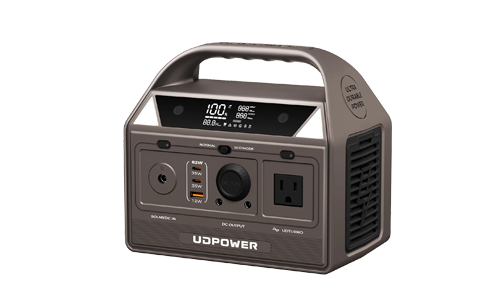
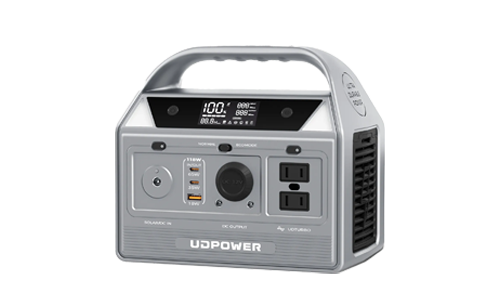
UDPOWER C400: Best for Small Essential Loads
The C400 is the practical choice when the outage plan is mostly phones, a router, laptops, lights, small fans and similar lower-power equipment.
- Battery capacity: 256Wh LiFePO4
- Rated AC output: 400W pure sine wave
- UDTURBO / supported high-power range: up to 800W for compatible loads
- Maximum solar input: 150W
- Weight: approximately 6.88 lb
- Best fit: phones, router/modem, laptop, lighting, small electronics and lightweight emergency kits
The C400 is not the right choice for large heaters, central cooling, whole-home backup or other heavy household loads.
View UDPOWER C400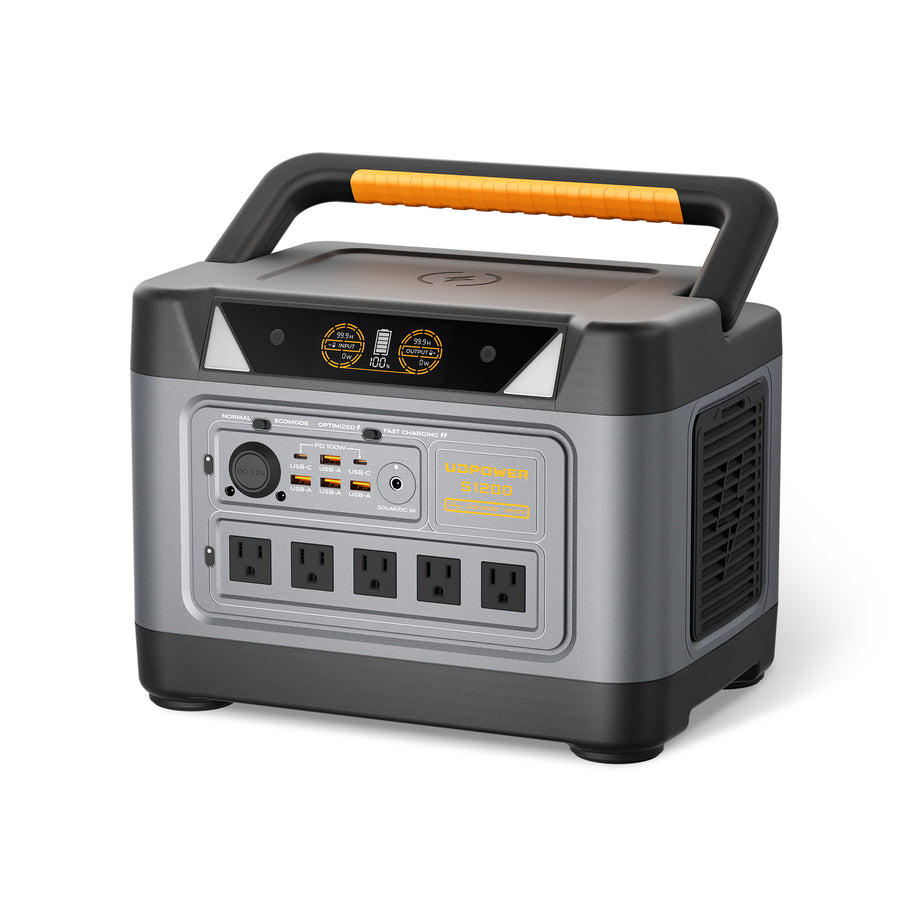
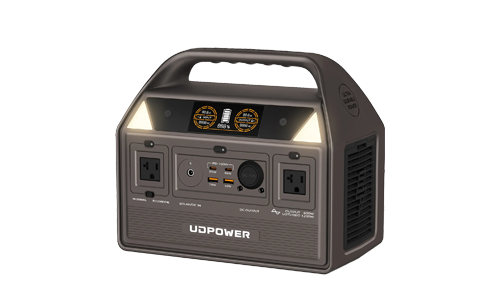
UDPOWER S1200: Best Balance of Capacity, Output and Portability
The S1200 moves into meaningful home-essential backup territory without becoming a very large battery system. It is suited to refrigeration, CPAP equipment, internet hardware, laptops, lighting, TVs, fans and other compatible household or RV loads.
- Battery capacity: 1,190Wh LiFePO4
- Rated AC output: 1,200W pure sine wave
- UDTURBO: supports compatible higher-power loads up to 1,800W; conversion efficiency may decrease above rated output
- Maximum solar input: up to 400W
- UPSPRIME transfer: less than 10ms
- Weight: approximately 26 lb
- Best fit: refrigerator backup, CPAP, Wi-Fi, electronics, RV trips, camping and selected home essentials
Available S1200 configurations can differ in the number of AC and DC/USB outputs, so check the selected version on the product page before ordering.
View UDPOWER S1200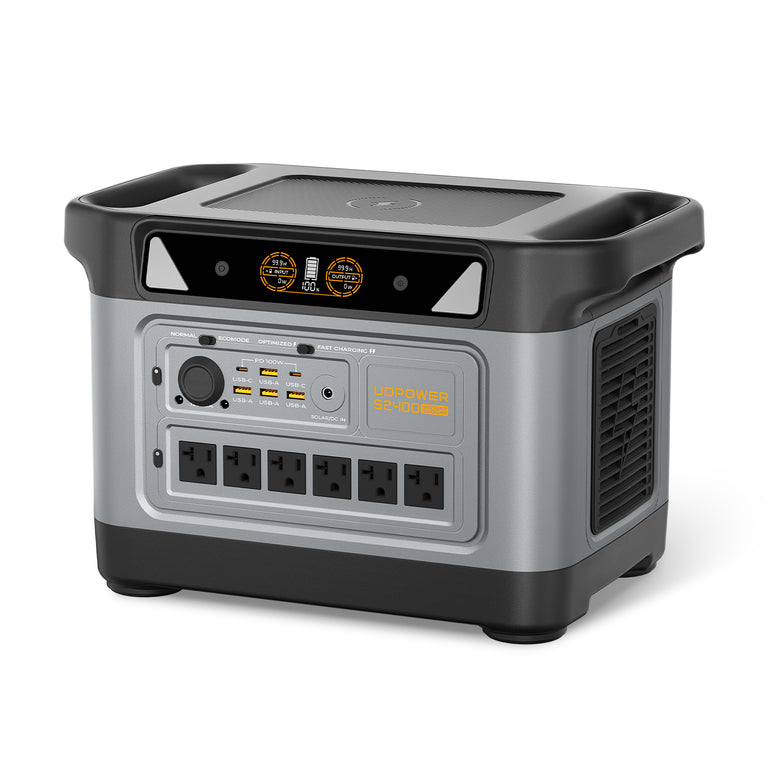
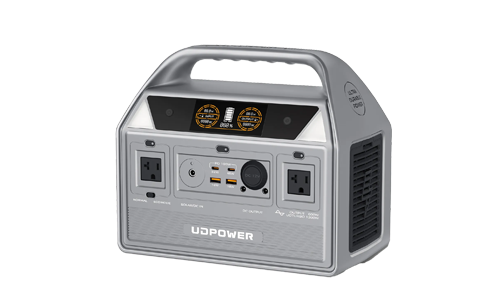
UDPOWER S2400: Better for Larger and Longer Backup Loads
The S2400 is a stronger fit when your emergency plan includes a refrigerator plus several other devices, higher-wattage kitchen equipment within specification, larger work setups, tools or longer outage coverage.
- Battery capacity: 2,083Wh LiFePO4
- Rated AC output: 2,400W pure sine wave
- UDTURBO: supports compatible higher-power loads up to 3,000W; conversion efficiency may decrease above rated output
- Maximum solar input: up to 400W under the supported input specifications
- UPSPRIME transfer: less than 10ms
- Weight: approximately 40.8 lb
- Best fit: larger home essentials, longer refrigerator backup, RV loads, kitchen appliances within specification and multi-device emergency setups
The S2400 is still a portable 120V backup power station. It is not a whole-home 240V battery system and should not be treated as a replacement for an electrical panel, central air-conditioning system or other large hardwired loads.
View UDPOWER S2400Quick UDPOWER Backup Power Comparison
| Model | Capacity | Rated AC Output | Higher-Power Capability | Solar Input | Best Match |
|---|---|---|---|---|---|
| C400 | 256Wh | 400W | Up to 800W for compatible loads | 150W max | Phones, router, laptop, lighting, small loads |
| S1200 | 1,190Wh | 1,200W | UDTURBO up to 1,800W for compatible loads | Up to 400W | Refrigerator, CPAP, Wi-Fi, home essentials, RV and camping |
| S2400 | 2,083Wh | 2,400W | UDTURBO up to 3,000W for compatible loads | Up to 400W | Larger loads, longer outages and multi-device backup |
For current availability, configurations and live pricing, see the UDPOWER Portable Power Station Collection.
How to Choose Backup Power Without Repeating the “Power Saver” Mistake
Do not replace one vague marketing claim with another. Choose a portable power station from measurable requirements.
- List the devices you actually need during an outage.
- Find their running wattage.
- Add devices that may operate at the same time.
- Check high-power and compressor loads against the station's supported output.
- Estimate runtime from watt-hours rather than output watts.
- Allow for conversion losses.
- Plan how you will recharge during a long outage.
Battery capacity in Wh × 0.90 ÷ appliance watts = approximate runtime in hours
For example, the S1200 has 1,190Wh of rated capacity. Using a 90% planning efficiency estimate gives approximately 1,071Wh of usable AC energy before considering factors such as battery condition, temperature, appliance cycling and unusually high loads.
A 100W steady load would therefore have a simple planning estimate of about 10.7 hours. A refrigerator is more complicated because the compressor cycles rather than drawing the same wattage continuously.
For refrigerator-specific sizing, read Refrigerator Power Backup: What Size Battery Do You Need?.
Final Verdict: Should You Buy an Electricity Saving Box?
Not if your reason for buying it is the promise of dramatically lower household electricity bills.
Power factor, voltage, current and reactive power are real electrical concepts, but using real technical terminology does not prove that a small wall-plug device will reduce the number of kilowatt-hours your home consumes.
A better decision framework is:
- Want a lower electric bill? Measure kWh, find large loads, improve HVAC efficiency, reduce unnecessary runtime and check your rate plan.
- Want to know what is wasting electricity? Use utility interval data and energy meters.
- Have a real voltage or electrical problem? Contact your utility or a qualified electrician.
- Want surge protection? Buy equipment specifically designed and certified for surge protection.
- Want power during an outage? Choose backup storage based on watts, watt-hours and required runtime.
- Want to reduce grid electricity with solar? Use a properly designed solar generation and storage setup rather than a plug-in “optimizer.”
The key question is always the same: what physical source of energy consumption is being reduced? If a product cannot answer that clearly and prove it with real kWh measurements, do not let a percentage on an advertisement make the decision for you.
Frequently Asked Questions About Electricity Saving Boxes
Do electricity saving boxes really work?
Not as a reliable way to significantly lower a normal household electricity bill. Some devices may change electrical measurements such as current or power factor, but that does not mean they reduce the real kilowatt-hours consumed by household appliances.
Can a power saver box reduce my electricity bill by 30%?
A universal 30% household savings claim should be treated skeptically. For a home using 875 kWh per month, a true 30% reduction would mean eliminating about 262.5 kWh every month. That is a very large change and should be obvious in controlled kWh data.
Do power factor correction devices save electricity at home?
NIST explains that capacitor-type power factor correction devices do not reduce a typical household electric bill. Power factor correction can be useful in some commercial and industrial settings where the electrical loads and utility tariffs are different.
Why does the amp reading go down when a power saver is plugged in?
Current is only one part of the electrical picture. NIST explains that current can decrease while power factor increases, leaving the bill-relevant result essentially unchanged. A lower amp reading by itself is therefore not proof of lower energy consumption.
What should I measure to know whether I am actually saving electricity?
Measure watts and accumulated kilowatt-hours over time. For whole-home savings, use your utility's smart-meter or billing data and compare similar periods while accounting for weather, occupancy, HVAC use, EV charging and other major changes.
Are electricity saving boxes dangerous?
Quality varies. Any unknown device connected directly to household mains electricity deserves caution. Stop using a device if it overheats, smells burnt, buzzes, arcs, has loose prongs or causes outlet or breaker problems. Claims of UL certification should be independently verified rather than accepted from a logo alone.
Is an electricity saving box the same as a surge protector?
No. A surge protector is designed for electrical protection against specified transient overvoltage conditions. An electricity saving box is normally marketed around energy or bill reduction. Do not assume a product provides surge protection unless it is specifically designed and certified for that purpose.
Is an electricity saving box the same as a smart plug?
No. A smart plug may measure electricity consumption and allow compatible equipment to be scheduled or switched off. That can help reduce waste because you are actually changing equipment runtime. A generic power saver box usually claims savings without requiring that kind of load reduction.
Can a portable power station lower my electricity bill?
Not simply by being connected to your home. A portable power station stores electricity rather than creating free electricity. Its main benefits are backup power, portable power and the ability to store energy from compatible charging sources such as solar panels.
Can charging a portable power station off-peak save money?
Potentially, but only under the right electricity rate plan and usage pattern. If your utility charges substantially less during off-peak hours, shifting some energy use may reduce cost. Battery conversion losses must also be considered, so the economics depend on the actual rate difference and system efficiency.
What is the fastest way to find out why my electric bill is high?
Compare monthly kWh rather than only the dollar amount, check whether your rate changed, review heating and cooling usage, identify major electric loads, inspect water heating and laundry habits, and use an energy meter or utility interval data to investigate equipment that runs for long periods.
Which household appliances should I check first?
Start with central air conditioning, electric space heating, electric water heating, clothes dryers, electric ranges, pool and spa equipment, EV charging, dehumidifiers, refrigerators and freezers. The largest source varies by home, climate and equipment.
Which UDPOWER model is suitable for basic outage backup?
The C400 is suitable for small loads such as phones, routers, laptops and lighting. The S1200 is a better all-around option for longer backup and many refrigerator, CPAP and home-essential scenarios. The S2400 provides more capacity and output for larger combined loads and longer outages.
Can the UDPOWER S2400 power an entire house?
No. The S2400 is a portable 120V power station designed for selected appliances and essential devices. It is not a whole-home 240V battery system and is not intended to directly power an entire household electrical panel, central air conditioner or other large hardwired 240V loads.
What is the best alternative to an electricity saving box?
If your goal is savings, the best alternative is not another box. Start by measuring actual electricity consumption, then address the largest avoidable loads through efficiency, maintenance, insulation, air sealing, thermostat control and better usage habits. If your separate goal is outage protection, choose a properly sized battery backup system.
Build a Smarter Home Power Plan
Lower your electricity use with real efficiency improvements. Protect essential devices during outages with backup power sized from actual watts and runtime—not vague savings promises.
Related Articles


1 comment
The electric company is a rip off. Just keep claiming it costs more and that’s not true. Scam