

RV Shore Power: 30 Amp vs. 50 Amp, How It Works & Backup Options
Quick Answer: What Is RV Shore Power?
RV shore power is outside AC electricity supplied to your RV through a campground pedestal, home outlet, generator, or another compatible external AC source. In a typical U.S. RV, that incoming electricity powers the 120V AC system and also feeds a converter that supplies the RV's 12V DC system and charges the house battery.
A 30-amp RV connection is a single 120V circuit with roughly 3,600 watts available at 120V. A 50-amp RV connection uses two 120V hot legs, each rated for 50 amps, giving the RV up to approximately 12,000 watts total across both legs.
The biggest practical rule is simple: an adapter can change which plug fits the pedestal, but it cannot create more electrical capacity. A 50A RV connected to a 30A pedestal is still limited by that 30A source.
If campground power fails, a portable power station, RV battery/inverter system, or generator can keep selected loads running. A portable battery should be treated as backup for essential devices rather than an automatic replacement for an entire 30A or 50A pedestal.

How Does RV Shore Power Work?
When you pull into a full-hookup campsite and connect the RV's electrical cord to the pedestal, the pedestal becomes the RV's external AC power source. From there, electricity normally moves through several layers of protection and distribution before it reaches an appliance.
- Campground pedestal: Supplies the external 120V or 120/240V service available at the campsite.
- Shore cord and RV inlet: Carry electricity from the pedestal into the RV. Some RVs have a permanently attached cord; others use a detachable locking inlet.
- Transfer equipment, if fitted: Motorhomes and RVs with built-in generators or inverter systems may use an automatic transfer switch to select the active power source.
- Main AC breaker panel: Protects and distributes incoming AC power to branch circuits.
- 120V appliances and outlets: Air conditioners, microwave ovens, household-style receptacles, electric water-heater elements and other AC loads receive power through their individual breakers.
- Converter/charger: Uses some of the incoming AC electricity to supply the RV's 12V DC system and recharge the house batteries.
- 12V systems: Lights, water pumps, vent fans, furnace controls, refrigerator electronics and many other RV functions continue operating from the DC system.
This is why plugging an RV into shore power does more than make the wall outlets work. It normally supports both sides of the RV electrical system at once.
If your lights and water pump work but the regular wall outlets do not, the 12V side may still be operating from the battery while the 120V AC side has lost power. If the outlets work but the battery keeps discharging and the 12V lights become weak, the problem may instead involve the converter, its breaker, a fuse or the battery connection.
30 Amp vs. 50 Amp RV Shore Power
The difference between 30A and 50A service is much larger than the numbers make it sound. A 50A RV does not simply get 20 extra amps.
| Feature | 30A RV Service | 50A RV Service | Why It Matters | Source |
|---|---|---|---|---|
| Common plug | NEMA TT-30 | NEMA 14-50 | The plugs are physically different and electrically different. | Eaton TT-30 / Leviton 14-50 |
| Nominal supply | 120V | 120/240V split-phase supply | Most RV loads on a 50A coach are divided between two 120V legs. | Leviton |
| Hot conductors | 1 | 2 | A 50A RV has two separate 120V legs rather than one larger 120V leg. | KOA |
| Neutral | 1 | 1 | The neutral carries the appropriate return current from the AC system. | KOA |
| Equipment ground | 1 | 1 | Ground is a safety conductor, not a normal current-carrying conductor. | Eaton |
| Maximum current | 30A total | 50A on each of two legs | This is why 50A service offers far more capacity. | KOA |
| Approximate maximum power at 120V | 3,600W | 12,000W total across both legs | A 50A connection offers more than three times the total power of a 30A connection. | KOA |
| Typical RV use | Travel trailers, smaller fifth wheels and many Class C RVs | Larger fifth wheels and many Class A motorhomes | Larger RVs often need enough capacity for multiple air conditioners and other major loads. | KOA |
Why a 50A RV Can Have About 12,000 Watts
This is the part that frequently causes confusion.
A 30A RV has one 120V leg:
A 50A connection has two 120V legs, with each leg capable of supplying up to 50 amps:
That does not mean every appliance in a 50A RV receives 240V. In a conventional RV electrical panel, most everyday circuits are 120V circuits distributed between the two legs. There is approximately 240V between the two hot legs, but whether an RV actually contains any 240V appliance depends on the specific coach.
One 50A Leg Can Still Be Overloaded
A second point that is often missed is that 12,000 watts is the combined theoretical capacity. The two legs are still separately protected.
If several large appliances happen to be connected to circuits on the same leg, that leg can reach its limit even while the other leg still has capacity available. The owner normally does not rearrange this at the campground; the RV's distribution panel determines which circuits are on each leg.
That is one reason a 50A RV can occasionally experience a breaker problem that seems inconsistent with the total number of appliances running.
RV Pedestals, Plugs and Adapters
The 30A TT-30 Plug
The standard 30A RV connection is normally a NEMA TT-30. It is a 125V, 30A connection with a hot conductor, neutral and equipment ground.
A TT-30 RV connection is a 120V-class connection. Older dryer receptacles and other high-current household outlets may use very different wiring and voltage. Never connect an RV through a homemade or questionable adapter simply because the plug can be made to fit.
The 50A NEMA 14-50 Plug
A standard 50A RV shore connection normally uses a NEMA 14-50 configuration with two hot conductors, a neutral and a ground. The receptacle is rated 50A at 125/250V.
The RV panel typically distributes 120V circuits between the two hot legs. Larger coaches use this extra capacity to support combinations such as two or three air conditioners, a microwave, electric water heater, residential refrigerator and other loads.
What Does a Dogbone Adapter Actually Do?
An RV dogbone adapter changes the physical connection and routes the available source power to a compatible RV input. It does not turn a low-capacity pedestal into a higher-capacity electrical service.
| RV | Available Source | What an Appropriate Adapter Can Do | What It Cannot Do |
|---|---|---|---|
| 30A RV | 50A pedestal | Allow the 30A RV cord to connect to the appropriate 50A receptacle. | It does not turn the RV into a 50A RV. The coach's 30A main protection still limits the RV. |
| 50A RV | 30A pedestal | Allow the 50A RV to receive 120V power from the available 30A source through a properly designed RV adapter. | It does not provide 12,000W. The campsite source is still limited to approximately 3,600W at 120V. |
| 30A RV | 15A or 20A household outlet | Useful for light loads, battery charging and storage when the circuit and adapter are appropriate. | It does not provide 30A capacity. Large loads can trip the household circuit. |
| 50A RV | 15A or 20A household outlet | May support light RV loads through an appropriate adapter. | It cannot support normal 50A-service expectations such as multiple air conditioners. |
What Happens When a 50A RV Uses a 30A Pedestal?
A common 30A-to-50A RV adapter supplies the coach from the single available 120V source. The coach may still have power on circuits associated with both sides of its panel, depending on the adapter and RV design, but everything is ultimately drawing through the same 30A pedestal supply.
That means your practical budget is around 3,600 watts, not 12,000 watts.
This is the situation where load management matters most. One roof air conditioner may be practical while the electric water heater, microwave and other large appliances need to be managed carefully.
How to Connect RV Shore Power Safely
A reliable hookup routine prevents a surprising number of campground electrical problems.
- Confirm the RV service type. Know whether your RV has a 30A or 50A shore connection before choosing the pedestal outlet.
- Inspect the pedestal before plugging in. Look for cracked receptacles, discoloration, burned plastic, loose components, water intrusion or obvious damage.
- Turn the pedestal breaker off. Do not insert or remove a high-current RV connector while it is carrying a large load.
- Turn off major RV loads. Air conditioners, electric water heating, microwave ovens and other heavy loads should not all start the moment power is applied.
- Connect your RV electrical management system or surge protector if you use one. Allow it to check the pedestal before the RV is energized.
- Connect the shore cord securely. If the RV has a detachable inlet, fully seat and secure the connector according to the RV and cord manufacturer's instructions.
- Turn the pedestal breaker on.
- Wait for any EMS or transfer-switch delay. Some systems intentionally wait before passing power to the RV.
- Confirm power inside the RV. Check the monitor panel and a known AC outlet before starting large appliances.
- Add major loads one at a time. This avoids unnecessary simultaneous startup demand.
How to Disconnect
Reverse the process: turn off large RV loads, switch the pedestal breaker off, disconnect the RV cord and store the cable clean and dry.
Disconnecting a heavily loaded shore plug while current is flowing can create arcing at the connector. Turning the load and breaker off first is a simple habit that reduces stress on the receptacle and plug contacts.
How Much Can You Actually Run on RV Shore Power?
The most useful way to manage RV electricity is to stop thinking only in amps and start thinking in total watts being used at the same time.
The following ranges are planning examples, not universal appliance specifications. Always check the data label or manual for your equipment.
| RV Load | Typical Planning Range | What to Watch |
|---|---|---|
| 13,500–15,000 BTU rooftop air conditioner | Often roughly 1,300–1,800W while running | Compressor startup demand can be substantially higher than running watts. |
| Electric water-heater element | Often about 1,200–1,500W | Easy to forget because it may cycle automatically. |
| Microwave | Often around 1,000–1,600W input | The cooking wattage printed on the front may be lower than actual electrical input. |
| Coffee maker | About 800–1,500W | High draw, but usually for a short period. |
| Portable electric heater | Often up to approximately 1,500W | A major continuous load on a 30A connection. |
| Residential-style refrigerator | Varies widely; compressor cycles on and off | Startup draw and duty cycle matter more than one instant watt reading. |
| Converter/charger | Highly variable | Charging a depleted house battery can become a meaningful hidden AC load. |
| TV, laptops, chargers and electronics | Usually far below heating and cooling appliances | Many smaller devices together can still add up. |
A Realistic 30A Example
Imagine a hot afternoon when the following loads are operating:
- Roof A/C: 1,500W
- Electric water heater: 1,400W
- Microwave: 1,400W
The combined demand is approximately:
That is already beyond the approximate 3,600W capacity of a 30A/120V source, without counting the converter, refrigerator, TV, battery chargers or anything else.
If the water heater is switched to propane where the appliance and campground rules permit it, the same example drops to about 2,900W while the microwave is operating. That is why experienced 30A RV owners think in terms of which large loads can run together, rather than simply whether each appliance works individually.
For a more detailed look at air-conditioner loads and startup demand, see How Many Watts Does an RV AC Use?
RV Converter vs. Inverter: They Do Opposite Jobs
The names are similar enough that RV owners regularly mix them up.
| Device | Power Direction | Main Job | Example | Reference |
|---|---|---|---|---|
| Converter | 120V AC → 12V DC | Supplies DC loads and commonly charges the house battery when external AC is available. | Shore power runs lights, pump controls and battery charging through the converter. | PowerMax |
| Inverter | Battery DC → 120V AC | Allows selected AC appliances to operate from the battery system when shore power is unavailable. | The battery powers a TV, outlet or microwave through a properly sized inverter system. | Camping World |
| Inverter/charger | Both directions, depending on mode | Combines battery charging and inverter functions in one system. | Common in larger RV electrical systems and upgraded lithium installations. | Camping World |
What Happens When Shore Power Fails?
If the RV has no inverter, most normal household-style outlets stop working when shore power disappears, even though 12V lights and other DC systems may continue to operate from the house battery.
If the RV has an inverter, only the circuits designed to receive inverter power will remain active unless the system was specifically built as a whole-coach inverter setup.
This explains a common situation where the RV appears partly alive after a campground outage: the lights work, the water pump works, but the microwave and some wall outlets are dead.
Common RV Shore Power Problems and What to Check
Start with symptoms rather than replacing parts. Many electrical failures can be narrowed down quickly by asking whether the problem affects the whole RV, only 120V loads, only 12V loads or one branch circuit.
| Symptom | Likely Area to Check | First Safe Checks | When to Stop |
|---|---|---|---|
| Nothing in the RV has shore power | Pedestal, EMS, shore cord, inlet, transfer switch or main breaker | Check pedestal breaker, EMS display, cord connection and RV main breaker. | If the pedestal, plug or inlet shows heat damage, stop using it. |
| Lights work but normal outlets do not | 120V AC side | Check shore power, main AC breaker, branch breakers and GFCI receptacles. | Stop if a breaker immediately trips repeatedly. |
| Outlets work but battery is discharging | Converter/charger or battery path | Check converter breaker, battery disconnect and accessible converter fuses. | Seek service if charging voltage or wiring requires electrical diagnosis. |
| Pedestal breaker trips when microwave or A/C starts | Overload or startup demand | Turn off another major appliance and retry only if there are no other fault signs. | Do not repeatedly reset a breaker that trips with a modest load. |
| One group of outlets is dead | Branch breaker or GFCI | Check the applicable breaker and upstream GFCI outlet. | Do not bypass GFCI protection. |
| Plug, adapter or inlet is unusually hot | Loose, worn or high-resistance connection | Turn the load off and disconnect power. | Do not continue using a scorched, melted or loose connection. |
| Power seems unstable on a 50A connection | Pedestal wiring, neutral or supply problem | Disconnect large loads and check the EMS for a fault indication. | Abnormal bright/dim behavior or suspected neutral problems should be treated as an electrical service issue. |
| Power returns after an outage but the RV remains off briefly | EMS or transfer-switch delay | Wait for the system's normal protection delay before resetting anything. | If power never returns, continue diagnosis after the expected delay has passed. |
Why a Hot Shore Plug Is a Warning Sign
A slightly warm connection under heavy load is different from a plug, receptacle or adapter that becomes painfully hot, discolored or smells like overheated plastic.
Heat at a connection can indicate excessive resistance caused by worn contacts, loose terminals, corrosion or a damaged receptacle. High current through a poor connection creates more heat, which can further damage the connection.
If a shore connector is becoming abnormally hot, reducing the appliance load may reduce current temporarily, but it does not repair the underlying connection.
Why an Open Neutral Is Especially Serious on 50A Service
The neutral has an important role in a 50A RV's split-phase electrical system. A damaged or open neutral can allow voltage across the two 120V sides to become badly unbalanced depending on the connected loads.
That can expose equipment to abnormal voltage. If you see unusual voltage readings, lights becoming unexpectedly bright or dim, an electrical management system reporting a neutral fault, or unexplained behavior across multiple circuits, disconnect from the pedestal rather than continuing to test appliances.
What Should You Do During a Campground Power Outage?
A campground outage does not automatically mean you need to reproduce the entire electrical capacity of the pedestal. In most cases, the smarter approach is to identify the few loads that actually matter until grid power returns.
First Five Minutes
- Confirm whether the outage affects only your site, your loop or the entire campground.
- Turn off roof A/C units, electric heaters, electric water heating and other large AC loads.
- Leave the RV's house battery available for the 12V systems that need it.
- Check whether refrigerator operation can safely continue on an alternate supported mode.
- Preserve battery energy until you know whether the outage will last five minutes or five hours.
If the Outage Lasts Longer
Prioritize loads by consequence rather than convenience. A practical order is often:
- Medical or sleep equipment such as a compatible CPAP.
- Refrigeration and food preservation.
- Phone and communication charging.
- Lighting and ventilation.
- Laptops, internet equipment and essential work devices.
- Short-duration cooking or coffee-making if your backup source can support the load.
- Air conditioning only if the backup system has enough continuous output, startup capability and battery capacity.
Campground Outage Backup Options Compared
| Backup Method | Best For | Main Advantage | Main Limitation |
|---|---|---|---|
| Portable power station | Fridge, CPAP, fans, electronics and selected AC appliances | Quiet, no gasoline engine and simple to deploy. | Stored energy is finite and output is much lower than full 30A or 50A pedestal capacity. |
| RV house battery + inverter | Built-in off-grid operation | Can integrate directly with selected RV circuits when properly designed. | Runtime depends heavily on battery-bank size and inverter load. |
| Built-in RV generator | Higher sustained loads | Often designed specifically for the coach electrical system. | Fuel, noise, exhaust, campground generator-hour restrictions and maintenance. |
| Portable generator | Longer outages and higher continuous demand | Can continue operating as long as fuel is safely available. | Must remain outdoors with safe exhaust placement; noise rules may restrict use. |
| Solar panels | Recharging batteries or power stations during daylight | Quiet and useful for extending off-grid duration. | Solar is a charging source, not guaranteed instant replacement for a campground pedestal. |
Ask, “Which devices must stay powered until the campground service returns, what is their combined wattage, and how many watt-hours will they consume?” That produces a much smaller and more realistic backup-power requirement.
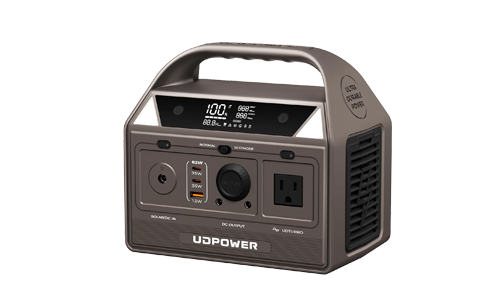
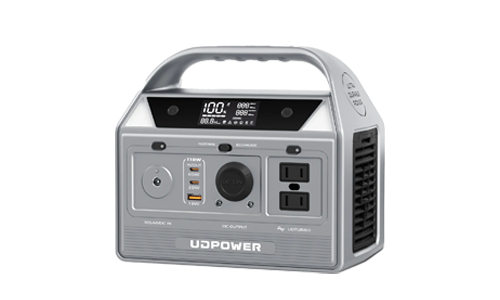
UDPOWER Backup Options for RV Camping
Portable power stations are most useful during an RV shore-power outage when they are treated as a separate reserve for selected essential loads. They are not a substitute for the full 3,600W capacity of a 30A pedestal or the roughly 12,000W combined capacity of 50A shore service.
The two UDPOWER models below make the most sense when the goal is meaningful RV backup rather than just charging phones.
UDPOWER S1200: Lighter Backup for Core RV Essentials
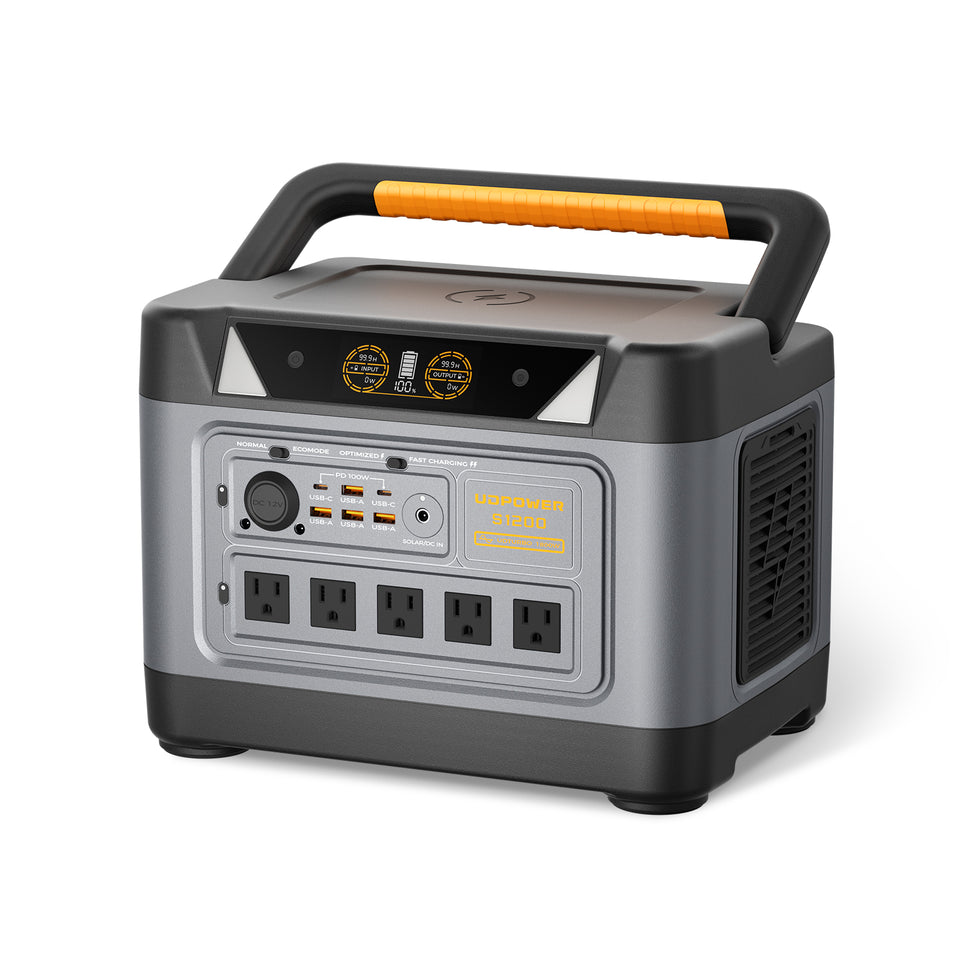
The S1200 is a practical choice when the backup plan centers on refrigeration, a CPAP, lights, fans, internet equipment, laptops and other moderate loads rather than trying to run the entire coach.
- Battery capacity: 1,191Wh LiFePO4
- Rated AC output: 1,200W pure sine wave
- UDTURBO: Supports compatible higher-power loads up to 1,800W; efficiency may decrease above rated output
- AC outlets: 5
- Solar input: Up to 400W
- Weight: Approximately 26 lb
- UPSPRIME: Less than 10 ms transfer under specified conditions
Good RV use case: Keep the refrigerator, communications, CPAP, fan and charging devices operating while the campground pedestal is down.
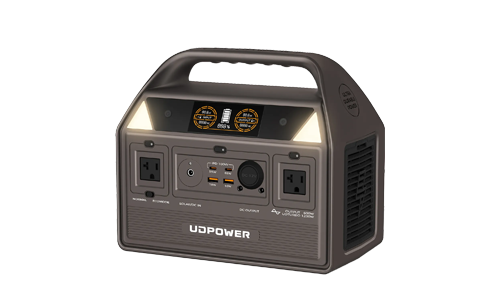
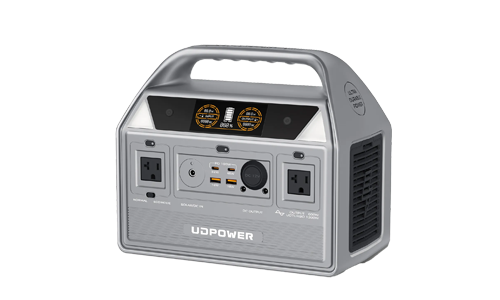
View S1200UDPOWER S2400: More Capacity and Output for a Larger RV Backup Plan
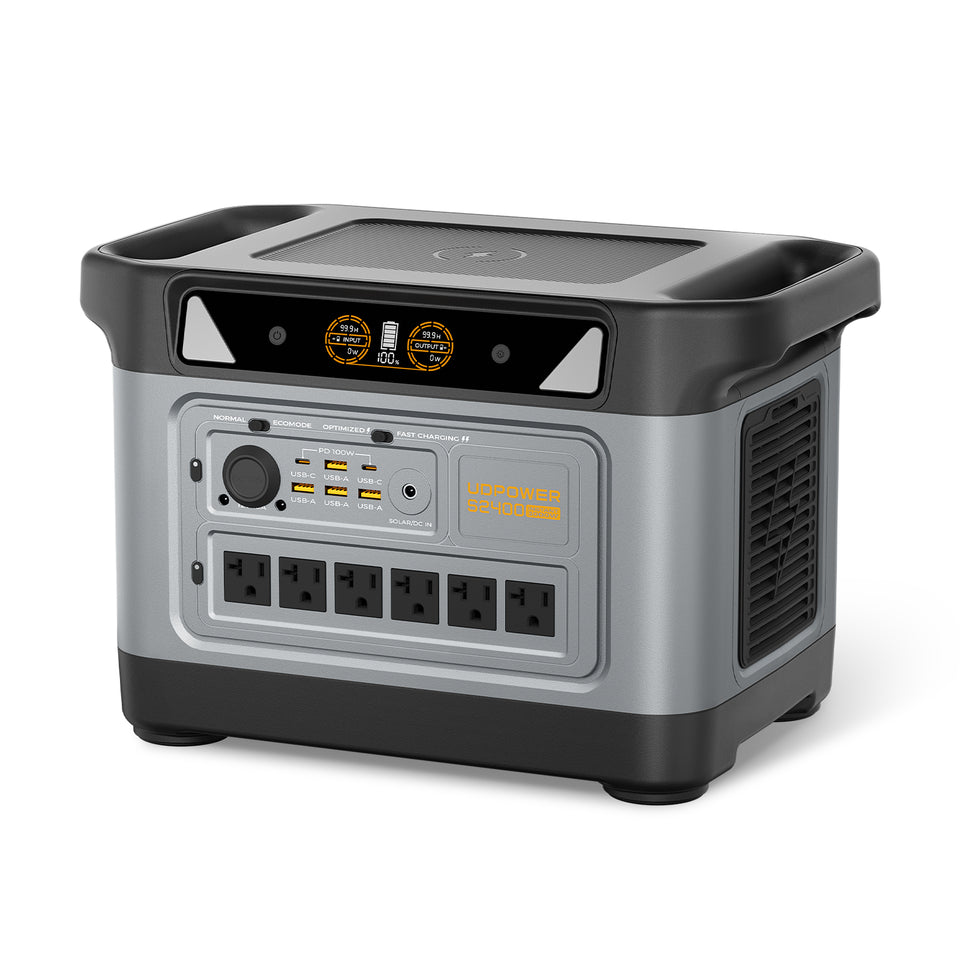
The S2400 offers substantially more headroom for RV owners who want to run several essentials at once or use higher-wattage appliances for short periods during an outage.
- Battery capacity: 2,083Wh LiFePO4
- Rated AC output: 2,400W pure sine wave
- UDTURBO: Supports compatible higher-power loads up to 3,000W; efficiency may decrease above rated output
- AC outlets: 6
- Solar input: Up to 400W
- Weight: Approximately 40.8 lb
- UPSPRIME: 10 ms or less under specified conditions
Good RV use case: Longer refrigeration backup, multiple electronics, CPAP equipment, a microwave or other compatible kitchen appliance used selectively, and a larger reserve for extended campground outages.
View S2400S1200 vs. S2400 for RV Backup
| Specification | UDPOWER S1200 | UDPOWER S2400 | RV Relevance | Official Source |
|---|---|---|---|---|
| Capacity | 1,191Wh | 2,083Wh | More watt-hours generally means longer backup at the same load. | S1200 / S2400 |
| Rated AC output | 1,200W | 2,400W | Determines how much normal AC load the station can support. | S1200 / S2400 |
| Higher-power support | Up to 1,800W for compatible loads | Up to 3,000W for compatible loads | Useful for appliances with demand above the normal rated-output range, subject to compatibility. | S1200 / S2400 |
| AC outlets | 5 | 6 | Useful when several independent RV essentials need backup. | S1200 / S2400 |
| Solar input | Up to 400W | Up to 400W | Solar can extend off-grid operation when enough sunlight is available. | S1200 / S2400 |
| Weight | About 26 lb | About 40.8 lb | S1200 is easier to move; S2400 trades weight for more capacity and output. | S1200 / S2400 |
Estimated RV Backup Runtime
A useful first estimate for AC loads is:
The 90% factor allows for normal conversion losses. Real runtime may be shorter because of inverter overhead, appliance cycling, temperature, startup demand, battery state and other devices operating at the same time.
| Average Backup Load | Example Use | S1200 Estimated Runtime | S2400 Estimated Runtime | Source |
|---|---|---|---|---|
| 40W | Low-power CPAP or small electronics setup | About 26.8 hours | About 46.9 hours | S1200 specs / S2400 specs |
| 80W | Efficient cycling refrigerator average or mixed light loads | About 13.4 hours | About 23.4 hours | S1200 specs / S2400 specs |
| 100W | Fridge, networking equipment or small mixed load | About 10.7 hours | About 18.7 hours | S1200 specs / S2400 specs |
| 150W | Multiple electronics plus ventilation | About 7.1 hours | About 12.5 hours | S1200 specs / S2400 specs |
| 300W | Larger mixed essential load | About 3.6 hours | About 6.2 hours | S1200 specs / S2400 specs |
| 600W | Heavier continuous appliance load | About 1.8 hours | About 3.1 hours | S1200 specs / S2400 specs |
| 1,000W | High-power AC appliance operating continuously | About 1.1 hours | About 1.9 hours | S1200 specs / S2400 specs |
A refrigerator or air conditioner does not necessarily run continuously at its nameplate wattage, so real-world runtime should be estimated from average consumption over time whenever possible.
You can learn more about calculating capacity, inverter losses and runtime in How Does a Portable Power Station Work?
Can You Connect a Portable Power Station to an RV Shore Power Inlet?
Sometimes, but this requires more care than plugging an appliance directly into the power station.
The simplest backup arrangement is usually to power selected devices directly from the portable power station's AC or DC outputs. This keeps the power station separate from the RV's shore-power distribution system and makes the load easy to understand.
If you are considering supplying the RV's shore inlet from a portable power station, first confirm that the RV manufacturer and the power-source manufacturer permit that type of use.
You also need to understand several limitations:
- A 1,200W or 2,400W power station does not become a 30A or 50A campground pedestal simply because an adapter fits.
- The RV must be disconnected from the campground pedestal before another source is used unless the RV has approved transfer equipment specifically designed to manage multiple sources.
- Large loads such as roof air conditioning, electric water heating and space heating can quickly exceed the station's output or drain the battery.
- The RV converter may begin charging the house battery whenever the RV sees external AC power, creating an additional load on the portable power station.
- Some portable power sources use a floating-neutral configuration. Certain RV electrical management systems may identify this as a wiring fault.
- Do not bypass an EMS, ground-fault device or other electrical protection simply to make an incompatible power source appear acceptable.
- Do not use a homemade neutral-ground bonding solution unless the specific equipment manufacturers and applicable electrical requirements explicitly call for that arrangement.
- Never backfeed electricity through a receptacle or use improvised male-to-male wiring.
The campground pedestal, generator, inverter and portable power station should only be interconnected through equipment specifically designed to select or transfer between those sources. If you do not know how your RV's transfer system is configured, powering critical devices directly from the backup station is the simpler approach.
RV Shore Power Details That Are Easy to Miss
1. An Adapter Changes Compatibility, Not Capacity
A 50A RV plugged into a 30A pedestal is still a 30A campsite as far as available power is concerned. A 30A RV connected to a 50A pedestal does not suddenly become capable of using 50 amps.
2. Low Voltage Can Be a Bigger Problem Than a Complete Outage
An outage is obvious. Low voltage may not be. On a heavily loaded campground loop, supply voltage can sag as more RVs run air conditioners.
Motors and compressors are particularly sensitive to poor supply conditions. An electrical management system that monitors voltage can therefore provide protection that a basic surge-only device may not.
3. A Converter Can Be a Hidden Load
After arriving with a depleted house battery, the converter/charger may draw meaningful AC power while recharging the battery. If you are on a limited 15A, 20A or 30A source, that charging load competes with the microwave, water heater and A/C.
4. A 50A RV Can Lose Half Its AC System
Because a 50A coach uses two hot legs, a problem affecting one leg can leave some circuits operating while others are dead. That symptom is very different from a complete loss of shore power.
5. Solar Does Not Automatically Replace Shore Power
A solar panel produces variable charging power. Clouds, shade, sun angle, temperature and the receiving battery's charge state all affect input.
The most practical RV solar strategy is normally:
- Solar panels produce electricity during usable daylight.
- The solar charge system stores that energy in the RV battery or portable power station.
- The stored energy supplies devices when needed, including after sunset.
See How to Get Power When Camping Off-Grid for a broader solar and battery planning guide, or browse UDPOWER portable solar panels.
6. Your A/C May Fit the Wattage Math but Still Fail to Start
A compressor can demand much more power during startup than while running. That matters with a small generator, inverter or portable power station because its continuous rating is only part of the compatibility question.
Before planning battery-powered RV cooling, verify the actual A/C running draw, startup behavior and the backup source's supported output. A soft-start device can change startup behavior on compatible air conditioners, but it does not reduce the energy required to run the compressor for hours.
7. Energy and Power Are Not the Same Thing
Watts tell you whether a source can operate an appliance at a given moment. Watt-hours tell you roughly how long the stored battery energy can support it.
A 2,000Wh-class battery with a 2,400W inverter may be capable of starting a large appliance, but continuously operating a high-wattage load can empty the battery quickly.
Before Your Next RV Trip: Shore Power Checklist
- Know whether your RV is 30A or 50A.
- Carry only properly rated RV adapters that you actually need.
- Inspect the shore cord, plug blades and RV inlet for heat damage.
- Know where the RV main breaker and GFCI outlets are located.
- Understand whether your RV has an inverter, converter, inverter/charger or automatic transfer switch.
- Know which appliances create the largest AC loads.
- Test your backup power before a trip rather than during the first campground outage.
- Charge portable backup batteries before departure.
- If carrying solar, confirm the panels, connectors, voltage and current are compatible with the receiving power station.
- Keep power stations, plugs and electrical connections protected from rain and standing water.
- Do not use damaged campground equipment just because it is the only pedestal available at the site.
Frequently Asked Questions About RV Shore Power
Is RV shore power 120V or 240V?
A 30A RV connection is a 120V supply. A standard 50A RV connection is a 120/240V split-phase supply with two 120V hot legs. Most circuits inside a typical 50A RV use 120V, although the electrical service itself provides approximately 240V between the two hot legs.
How many watts does a 30 amp RV have?
Using 120V as the planning voltage, 30 amps × 120 volts equals approximately 3,600 watts. Actual operating conditions and voltage can vary.
How many watts does a 50 amp RV have?
A 50A RV receives two 120V legs rated for up to 50 amps each. That provides approximately 12,000 watts total across both legs: 50A × 120V × 2.
Can I plug a 50 amp RV into a 30 amp campsite?
Yes, when an appropriate RV adapter is used and the RV equipment supports the connection. The important limitation is that the RV is still being supplied by a 30A source, so the available power is roughly 3,600 watts rather than the normal 50A capacity.
Can I plug a 30 amp RV into a 50 amp pedestal?
Yes, with a properly rated RV adapter. The 30A RV does not gain 50A capacity; its onboard 30A protection and wiring remain the limiting factors.
Does a 30-to-50 amp adapter give me more power?
No. An adapter changes the physical and electrical connection so compatible equipment can connect to the available source. The pedestal, breaker, cord and RV electrical system still determine the real capacity.
Should I turn off the campground breaker before plugging in my RV?
It is a good hookup practice to have the pedestal breaker off while connecting or disconnecting the RV shore cord, then energize the circuit after the connection is secure and major RV loads are off.
Why do my RV lights work when the outlets do not?
Many RV lights operate from the 12V house battery system, while normal receptacles require 120V AC. The battery can therefore keep the lights operating even if shore power, an AC breaker, GFCI circuit or inverter-fed outlet has lost power.
What is the difference between an RV converter and an inverter?
A converter changes incoming AC shore power into DC power for the RV's 12V system and usually helps charge the house battery. An inverter works in the opposite direction, converting battery DC into 120V AC for compatible appliances.
Why does my RV breaker trip when I run the microwave and air conditioner together?
The combined load may exceed the capacity of the shore connection or an individual branch circuit. This is especially common on 30A service when an air conditioner, electric water heater, microwave and converter are operating at the same time.
Can a portable power station replace 30 amp RV shore power?
Not automatically. Full 30A shore service can provide about 3,600 watts at 120V. A portable power station with lower rated output should be treated according to its own wattage limit. It can still be very useful for selected essential RV loads during an outage.
Can a portable power station replace 50 amp RV shore power?
A typical portable power station does not reproduce the approximately 12,000 watts available from full 50A RV service. Battery backup is better used for selected circuits or individual appliances rather than attempting to recreate full 50A campground capacity.
Can I run an RV air conditioner from a portable power station?
Possibly, but compatibility depends on the air conditioner's running wattage, startup demand and the power station's supported output. Battery runtime can also be short because rooftop air conditioners are high-energy loads. Check the actual A/C specifications rather than relying only on BTU size.
Can solar panels keep my RV powered during a campground outage?
Solar panels can recharge a compatible battery or portable power station and extend backup time, but solar output changes throughout the day. They should normally be considered a recharge source rather than a guaranteed direct substitute for shore power.
Why is there a delay before power comes back after a campground outage?
An RV electrical management system, surge protector or transfer system may intentionally delay reconnection after power returns. This can protect compressors and electrical equipment from unstable power immediately after an outage.
Bottom Line
RV shore power becomes much easier to manage once you separate three ideas: source capacity, appliance wattage and stored battery energy.
A 30A RV has roughly 3,600 watts available from a normal 120V shore connection. A 50A RV uses two 120V legs and can access roughly 12,000 watts total. Adapters let different RV and pedestal configurations connect, but they never manufacture additional electrical capacity.
Inside the RV, the converter uses shore power to support the 12V system and charge the battery, while an inverter does the reverse when you need AC power from stored battery energy.
And when the campground goes dark, you usually do not need to recreate the entire pedestal. Keeping the refrigerator, medical equipment, phones, lights, fans and communication devices running can require only a fraction of full RV service. That is where a properly sized portable power station can be much more practical than trying to power every circuit in the coach.
Build an RV Backup Power Plan Before the Next Outage
Start with the appliances you actually need, add their running wattage, estimate how many hours they must operate, and then choose a battery with enough output and capacity for that load.
Compare Portable Power Stations View S1200 View S2400 View Solar PanelsRelated Articles


