





12V Fridge vs. 120V Refrigerator: Which Is Better for RVs and Camping?
Last updated: October 10, 2026
A 120V refrigerator can still be the better choice if you spend most of your time connected to campground shore power, already have a large inverter and battery bank, or need the greater capacity and wider selection available from residential-style refrigerators.
The most important number is not the voltage printed on the fridge. It is how many watt-hours the refrigerator consumes in a full day and how many of those watt-hours your battery and solar system can replace.
If you only compare the plug on a refrigerator, the choice looks simple: a 12V fridge plugs into DC power and a 120V refrigerator plugs into an AC outlet. For an RV or campsite, however, the real difference happens behind that plug.
Your battery stores DC electricity. A 12V compressor refrigerator can use that DC energy directly. A 120V refrigerator normally requires an inverter to turn the battery's DC electricity into 120V AC first. That extra step changes runtime, battery sizing, inverter requirements, and how much solar you need to get through another day.
This guide focuses on electric compressor refrigerators. Traditional propane absorption RV refrigerators are a separate category and are not directly equivalent to either a modern 12V compressor fridge or a residential 120V compressor refrigerator.
What Is a 12V Fridge?
A 12V fridge is a refrigerator designed to operate from a low-voltage DC electrical supply, commonly the 12V electrical system found in cars, vans, boats, travel trailers, and RVs.
For camping, the most useful type is the 12V compressor refrigerator. Portable chest fridges, dual-zone fridge/freezers, and built-in RV refrigerators increasingly use compressor cooling instead of thermoelectric or absorption cooling.
A typical 12V compressor fridge may connect to:
- An RV house battery bank
- A vehicle 12V accessory outlet
- A fused dedicated 12V circuit
- A portable power station's regulated 12V car outlet
- A 24V electrical system if the refrigerator supports both 12V and 24V input
How Does a 12V Compressor Fridge Work?
A compressor fridge moves refrigerant through a sealed cooling loop. The compressor raises refrigerant pressure, the condenser releases heat outside the cabinet, the refrigerant expands, and the evaporator absorbs heat from inside the refrigerator.
The compressor does not normally run nonstop. Once the fridge reaches its target temperature, it switches off and restarts when the cabinet warms again. That cycling behavior is why refrigerator power calculations based only on "running watts" are often misleading.
A real example makes this easier to see. Dometic lists the CFX5 45 portable compressor cooler with a rated 12V DC input current of 9.4A, but under its published test condition of 90°F/32°C ambient temperature and 39°F/4°C internal temperature, its average energy consumption is listed as only 0.76Ah per hour.
That does not mean every 12V refrigerator uses 219Wh per day. Fridge size, insulation, ambient temperature, freezer settings, ventilation, door openings, food temperature, and compressor design all matter. It does demonstrate why daily energy consumption is more useful than simply multiplying the maximum current by 24 hours.
Source: Dometic CFX5 45 official specifications
12V vs. 120V Refrigerator: Main Differences

| Factor | 12V Compressor Fridge | 120V Refrigerator |
|---|---|---|
| Power source | 12V DC battery or regulated DC output | 120V AC shore power, generator, or inverter |
| Off-grid battery path | Battery → DC output → fridge | Battery → inverter → 120V AC → fridge |
| AC inverter required off-grid? | Usually no | Yes |
| Inverter conversion loss | Avoids the DC-to-AC inverter stage | Present whenever running from battery power |
| Inverter standby draw | Not required just for the fridge | Can matter because the inverter may remain on between compressor cycles |
| Typical use | Camping, van life, overlanding, RV boondocking | Homes, RVs with shore power, larger motorhomes |
| Portable options | Excellent | More limited |
| Large-capacity selection | Available, but fewer choices | Much wider residential selection |
| Battery-system simplicity | Usually simpler | Requires correct inverter sizing |
| Best fit | Battery- and solar-dependent travel | Frequent hookups or large inverter/battery systems |
Does a 12V Fridge Use Less Power Than a 120V Refrigerator?
Not automatically. Voltage alone does not determine refrigerator efficiency.
A highly efficient 120V refrigerator can consume less energy than a poorly insulated 12V fridge. Likewise, a well-designed 12V compressor fridge can consume dramatically less energy than a large residential refrigerator.
For battery-powered travel, however, a 12V fridge has an important system-level advantage: it can avoid the DC-to-AC conversion stage entirely.
The fairest comparison is therefore:
For a 12V refrigerator, use the manufacturer's Ah/day, Ah/hour, or Wh/day figure if one is available.
For a 120V refrigerator, the EnergyGuide label or ENERGY STAR annual kWh figure is often much more useful than the wattage printed on the back.
Convert annual refrigerator energy use into daily Wh
For example, a refrigerator rated at 195kWh/year works out to:
ENERGY STAR's current refrigerator database shows that compact refrigerators can vary significantly. Examples in the database range from roughly 100kWh/year for some highly efficient compact models to around 200kWh/year or more for other units. Capacity, configuration, freezer design, and test category differ, so compare the actual label of the refrigerator you plan to use rather than relying on a generic "mini fridge" number.
Source: EPA ENERGY STAR refrigerator database
A better way to compare two refrigerators
| What to Check | Why It Matters |
|---|---|
| Wh/day or kWh/year | Shows actual energy demand better than running watts alone |
| Interior capacity | A 45L portable fridge should not be compared directly with a 10 cu. ft. residential fridge |
| Fridge-only or fridge/freezer | Freezer compartments usually increase energy demand |
| Ambient test temperature | Cooling requires more energy as outside temperature rises |
| DC or AC measurement | Battery-side energy can be higher than appliance-side energy because of conversion losses |
| Startup requirements | Determines whether your inverter or DC outlet can actually start the compressor |
Why Inverter Conversion Losses Matter
This is where a 12V refrigerator becomes particularly attractive for off-grid use.
An RV battery bank and the battery inside a portable power station store DC electricity. If you connect a 120V refrigerator, the power station or RV inverter has to convert that DC electricity into AC electricity before the refrigerator can use it.
The energy path becomes:
A 12V fridge can instead use:
No electrical system is completely lossless. A direct DC setup can still lose energy through wiring, connectors, voltage regulation, and the refrigerator's own electronics. But it removes the dedicated DC-to-AC inverter stage.
What does that mean in real numbers?
Suppose a 120V refrigerator actually consumes 400Wh at the appliance during a day. Using a 90% battery-to-AC planning efficiency:
That is about 44Wh of additional battery demand before considering inverter standby consumption.
Now consider what happens after the compressor shuts off. The refrigerator may be drawing almost nothing for part of its cycle, but the inverter can still remain powered and consume energy simply because the AC circuit must stay ready for the next compressor start.
If an inverter hypothetically consumed 6W while left on for 24 hours:
That 6W figure is only an example, not a universal inverter specification. Some systems use less, some use more, and some have effective low-power modes. The point is that low continuous overhead becomes important when the refrigerator itself is a relatively small cycling load.
Startup Surge: Running Watts Are Not Enough
Refrigerators are compressor loads, so you should check more than average wattage.
A 120V refrigerator that averages relatively little power may briefly demand substantially more power when the compressor starts. Older fixed-speed compressors can have a much larger starting demand than their normal running load. Modern variable-speed or inverter-driven refrigerators may start more gently.
That means a refrigerator showing 80W or 100W during normal operation should not automatically be paired with an 80W or 100W inverter.
For a 120V fridge, check:
- Normal operating watts
- Maximum or startup watts if the manufacturer provides them
- The power station's continuous AC output
- The power station's higher-load or peak capability
- Whether the AC output is pure sine wave
For a 12V fridge, the same principle appears as current rather than AC watts. Check the refrigerator's required DC current against the maximum current of the 12V outlet.
For example, the Dometic CFX5 45 official specifications list a rated current of 9.4A at 12V. That is very different from its 0.76Ah/hour average energy-use figure. One number helps determine whether the circuit can supply the refrigerator; the other helps determine how long the battery lasts.
| Number | What It Tells You | Use It For |
|---|---|---|
| Rated/max amps | How much current the fridge may demand while operating | DC outlet, fuse and wiring compatibility |
| Running watts | Power while compressor is operating | Basic inverter/load compatibility |
| Startup watts | Short higher-power compressor-start demand | AC inverter sizing |
| Ah/day or Wh/day | Total energy consumed over time | Battery and solar sizing |
How Fast Will a 12V or 120V Fridge Drain a Battery?
Start with watt-hours, not watts.
If your refrigerator is rated in Ah/day:
If it is rated in kWh/year:
Once you know daily energy use:
For UDPOWER runtime planning, a conservative 90% usable-energy factor provides a more realistic estimate than simply dividing the battery's label capacity by the appliance wattage.
Example runtime using daily refrigerator energy
| Daily Fridge Consumption | 596Wh Battery | 1190Wh Battery | 2083Wh Battery | Typical Interpretation |
|---|---|---|---|---|
| 220Wh/day | About 2.4 days | About 4.9 days | About 8.5 days | Efficient portable 12V compressor-fridge territory |
| 400Wh/day | About 1.3 days | About 2.7 days | About 4.7 days | Useful mid-range planning example |
| 600Wh/day | About 0.9 day | About 1.8 days | About 3.1 days | Higher-use fridge or hotter operating conditions |
These are planning estimates using battery capacity × 0.90. They do not include incoming solar energy and are not guaranteed runtimes. Temperature, battery condition, fridge settings, DC or AC output path, compressor cycling, and other connected devices will change the result.
For a deeper refrigerator-runtime calculation, see How to Power a Camping Fridge: Battery, Solar & Runtime Guide.
Do not confuse Ah with Wh
RV batteries are often advertised in amp-hours, while portable power stations are normally advertised in watt-hours.
A nominal 12.8V 100Ah LiFePO4 battery contains approximately:
That does not mean every 100Ah battery provides exactly 1,280Wh of usable energy. Battery chemistry, BMS limits, recommended depth of discharge, temperature, wiring and conversion losses all affect what reaches the refrigerator.
When comparing an RV house battery with a portable power station, converting both to watt-hours makes the comparison much easier.
Will a 12V Fridge Work With an RV House Battery?
Usually yes, as long as the electrical system is properly sized.
You need to verify four things:
- Voltage: The fridge must support the battery system voltage.
- Current: The circuit, fuse and outlet must handle the refrigerator's maximum current.
- Energy capacity: The battery must store enough Wh for the number of hours or days you plan to camp.
- Charging: Solar, alternator, shore power or another source must eventually replace the energy the refrigerator consumes.
The overlooked problem: voltage drop
One of the most frustrating 12V fridge problems is a refrigerator shutting down even though the RV battery monitor still shows plenty of charge.
The cause can be voltage drop between the battery and refrigerator.
At 12V, even a modest voltage loss matters. A long cable that is too small, a poor connector, a worn accessory socket, or a loose connection can cause the voltage measured at the refrigerator to fall when the compressor starts. The fridge's low-voltage protection may then shut it down to protect the battery.
If a 12V fridge repeatedly cuts out:
- Measure voltage at the refrigerator while the compressor is running, not only at the battery.
- Inspect the plug and accessory outlet for looseness or heat damage.
- Use the cable gauge recommended by the refrigerator manufacturer.
- Avoid unnecessarily long DC cable runs.
- Check the refrigerator's selectable low-voltage cutoff setting if it has one.
Can a Portable Power Station Run Both Types?
Yes. A portable power station can be particularly useful because many models provide both a regulated 12V DC car outlet and 120V AC outlets.
For a 12V fridge
Whenever the fridge and power station are electrically compatible, using the regulated 12V output is generally the more direct path:
Check:
- DC output voltage
- Maximum DC current
- Maximum DC wattage
- Plug compatibility
- Whether the output remains active continuously
- The fridge's low-voltage cutoff behavior
For a 120V refrigerator
The power path becomes:
Check both output power and battery capacity. A power station can have enough watt-hours for many hours of cooling but still be unable to start the compressor if its AC output is too low.
Pure sine wave output is preferable for compressor motors and modern refrigerator electronics.
For more detail, read Can a Portable Power Station Run Your Refrigerator?.
Can Solar Keep a 12V Fridge Running Continuously?
It can, but the correct question is not "How many watts is my solar panel?" It is:
How many watt-hours can the solar system put back into the battery during a real day?
A refrigerator operates through the night, while solar panels only produce meaningful energy when sunlight is available. The battery therefore acts as the buffer between daytime production and 24-hour refrigerator consumption.
Simple solar planning formula
For example, using a conservative 75% planning yield:
If the refrigerator consumes 300Wh/day, that solar setup has theoretical room to recover the fridge's daily energy and contribute additional energy to the battery. If the refrigerator consumes 600Wh/day, the same setup is close to break-even and leaves much less margin for clouds, shade, poor panel angle, charging losses, or other equipment.
The 75% figure above is a planning assumption rather than a guaranteed solar yield. Real photovoltaic output changes continuously. NREL's PVWatts model accounts for factors such as solar resource, temperature, wiring, soiling, mismatch and other system losses when estimating solar production.
Solar modeling reference: NREL PVWatts Calculator
Solar array sizing examples
| Panel Rating | 4 Peak-Sun-Hour Example at 75% | Fridge Use Case |
|---|---|---|
| 120W | About 360Wh/day | Potentially enough for a very efficient small 12V fridge under favorable conditions |
| 210W | About 630Wh/day | More practical margin for a portable fridge plus small electronics |
| 300W | About 900Wh/day | Useful for higher fridge consumption or additional campsite loads |
| 400W | About 1,200Wh/day | Better suited to extended RV or multi-device off-grid use |
These are mathematical planning examples, not predicted production for a specific campsite. Use local solar conditions and the input limits of your power station when sizing panels.
Explore UDPOWER portable solar panels if you want to build a rechargeable camping-fridge setup.
12V or 120V: Which Is Better for Your Type of Travel?
Weekend tent or car camping
A portable chest-style 12V refrigerator works naturally with a vehicle or portable power station, avoids requiring AC power continuously, and is easy to move between the campsite and vehicle.
Van life
Van electrical systems live on a limited energy budget. Eliminating an unnecessary always-on AC inverter is valuable, and 12V fridges are available in both chest and built-in upright designs.
Small travel trailer
A modest house battery and solar system pair well with an efficient 12V refrigerator. If almost every trip is spent connected to campground power, the electrical-efficiency advantage becomes less important.
Large fifth-wheel or motorhome
A large 120V residential refrigerator can make sense when the RV already has a large battery bank, substantial inverter, generator and frequent shore-power access. Off-grid travelers should calculate the fridge's daily kWh before assuming the existing battery system is large enough.
Overlanding and multi-day boondocking
The ability to run directly from DC, recharge while driving, and recover daily consumption with portable solar makes 12V compressor refrigeration particularly well suited to this use.
Campground-only RV use
If shore power is available almost all the time, inverter loss and battery runtime are no longer the deciding factors. Refrigerator size, price, layout and food capacity may matter more.
Decision Table: Pick the Fridge Based on the Power System You Already Have
| Your Setup | Better Starting Point | Why |
|---|---|---|
| Small battery + portable solar | 12V fridge | Minimizes unnecessary conversion stages |
| Portable power station only | 12V fridge when compatible | Can use the station's DC output instead of keeping AC inverter active |
| 100Ah-class RV battery | 12V fridge | Battery reserve is limited, making daily Wh important |
| Large LiFePO4 bank + large inverter | Either | System may comfortably support a residential fridge |
| Campground hookups most nights | 120V is practical | Battery efficiency matters much less on shore power |
| Van life / overlanding | 12V fridge | Efficient use of limited mobile energy |
| Need maximum refrigerator capacity | Often 120V | Much wider large residential selection |
| Multi-day off-grid stay | 12V fridge + adequate solar | Easier to design around a daily energy budget |
A Better Way to Size Your Fridge Battery
Instead of asking, "Can a 1,000W power station run my refrigerator?" use this sequence:
- Find the refrigerator's daily Wh consumption.
- Multiply it by the number of days between reliable charging opportunities.
- Add all other devices you will use during the same period.
- Allow margin for conversion losses and changing conditions.
- Check maximum watts or amps separately to make sure the system can start and run the compressor.
- Subtract realistic daily solar recovery if you will recharge during the trip.
Example:
For a two-day trip without meaningful recharging:
That is why a power station that looks oversized when judged only by refrigerator running watts may actually be appropriately sized once you consider a full day of food cooling, lights, phones, fans and laptops.
For a complete campsite calculation, read the Camping Power Station Buying Guide or How Many Wh Do I Need for Camping?.
Recommended UDPOWER Power Stations for Camping Refrigerators
For refrigerator use, battery capacity is often more important than headline inverter wattage. The refrigerator is usually a long-duration load, so the best choice depends on how many watt-hours you need between charging opportunities.
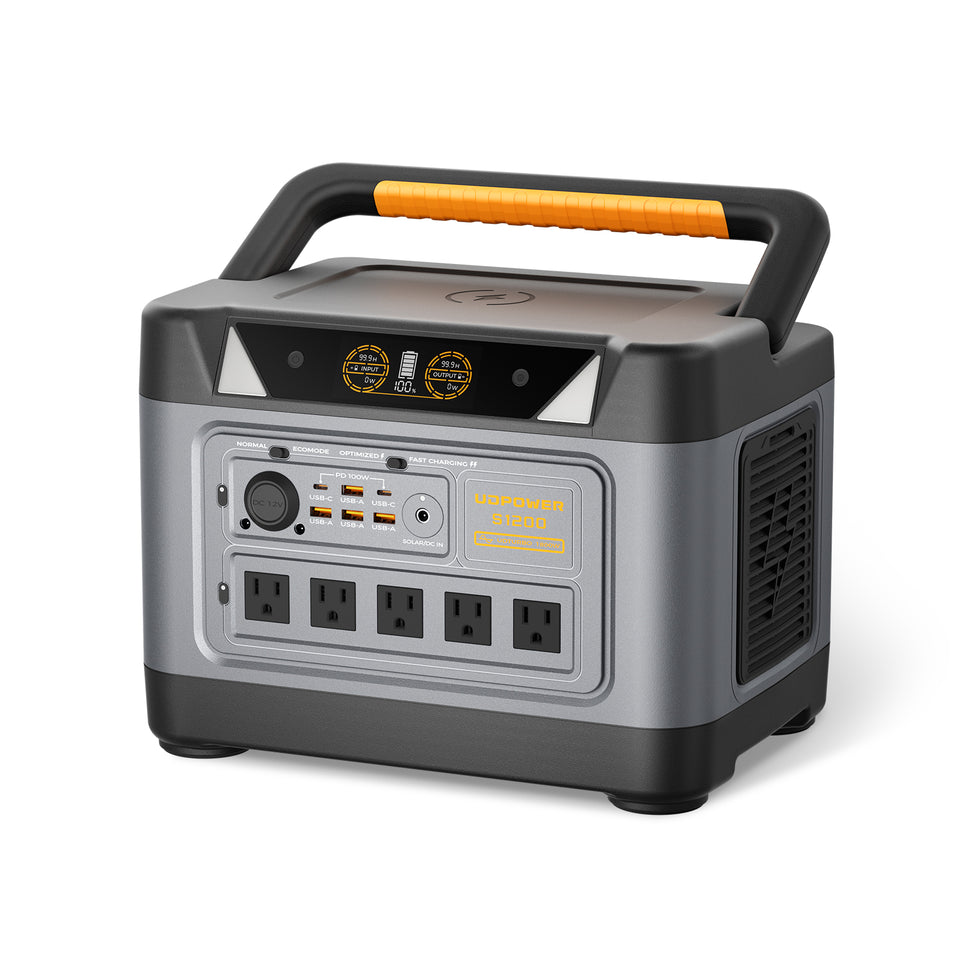
UDPOWER S1200: Best All-Around Choice for Camping and RV Fridges
The S1200 is the more balanced choice for weekend camping, family trips, travel trailers, vans, and refrigerator setups where you also need power for phones, laptops, lights or a CPAP.
- Battery capacity: 1190Wh
- Rated AC output: 1200W pure sine wave
- Higher-load capability: up to 1800W with UDTURBO
- 12V car outlet: 12V, up to 12A / 144W
- Solar input: up to 400W
- Battery chemistry: LiFePO4
Using UDPOWER's conservative 90% planning factor gives about 1,071Wh of usable planning energy. A fridge consuming 350Wh per day would therefore represent roughly three days of fridge-only energy before accounting for solar or other loads.
A compatible 12V fridge can use the DC car outlet, provided its maximum voltage/current requirements stay within the outlet specification. A 120V refrigerator can instead use the S1200's pure sine wave AC output, provided its operating and starting requirements are compatible.
View UDPOWER S1200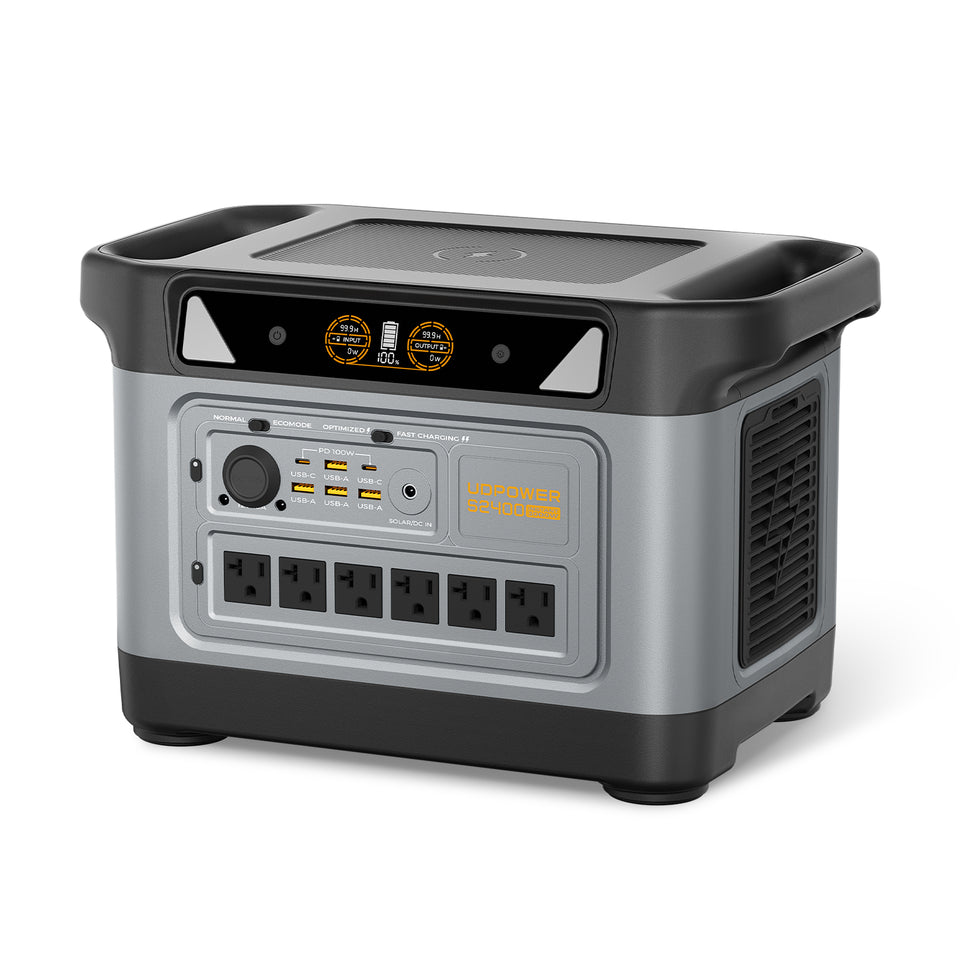
UDPOWER S2400: Better for Extended RV and Off-Grid Trips
The S2400 makes more sense when refrigerator runtime is only part of the load. It offers substantially more stored energy for larger RV setups, multi-day camps, overlanding, laptops, cooking appliances and other equipment.
- Battery capacity: 2083Wh
- Rated AC output: 2400W pure sine wave
- UDTURBO/peak capability: up to 3000W
- 12V car outlet: 12V, up to 10A
- Solar input: up to 400W
- Battery chemistry: LiFePO4
At a 90% planning factor, the 2083Wh battery provides about 1,875Wh of usable planning energy. With a 350Wh/day refrigerator, that represents more than five days of theoretical fridge-only energy before other loads or solar input are considered.
The larger battery is especially useful when several cloudy days, overnight CPAP use, laptops or other campsite equipment share the same energy reserve.
View UDPOWER S2400UDPOWER product specifications above were checked against the official product pages on October 10, 2026. Runtime examples are planning estimates and will vary with refrigerator behavior, temperature, output method, battery condition, solar input and other connected loads.
12V Fridge vs. 120V Refrigerator: Final Verdict
For off-grid camping, van life and battery-dependent RV travel, a 12V compressor fridge is usually the more efficient and straightforward choice.
The advantage is not that "12 volts magically uses less electricity." The advantage is the electrical architecture. Your battery already stores DC power, so supplying a DC refrigerator directly avoids running that energy through a 120V inverter first.
A 120V refrigerator remains a sensible choice when you have regular shore power, need a large residential-style fridge, or already have a sufficiently large battery and inverter system.
The best way to make the decision is to ignore voltage for a moment and write down four numbers:
- Refrigerator Wh/day
- Maximum starting or operating load
- Usable battery Wh
- Realistic solar Wh/day
If those four numbers work together, the refrigerator will work with your camping style. If they do not, changing from 120V to 12V alone will not solve the underlying energy shortage.
Frequently Asked Questions
Is a 12V fridge better than a 120V fridge for camping?
Usually, yes. A 12V compressor fridge can run directly from a compatible battery or portable power station DC output, so you do not need to keep a 120V inverter operating solely for the refrigerator. That generally makes a 12V fridge a better fit for off-grid camping, overlanding and van life.
Does a 12V fridge use less electricity than a 120V fridge?
Not necessarily. Refrigerator efficiency depends on cabinet size, insulation, compressor design, temperature and usage. The main off-grid advantage of a 12V fridge is that it can avoid the additional DC-to-AC inverter conversion required by a 120V refrigerator.
How many watts does a 12V fridge use?
It varies by model. More importantly, a compressor refrigerator cycles on and off, so running watts do not tell you how much energy it will consume over 24 hours. Look for Ah/day, Ah/hour or Wh/day data from the manufacturer whenever possible.
How many amp-hours does a 12V refrigerator use per day?
There is no single number for every 12V refrigerator. As one real example, Dometic publishes 0.76Ah/hour for the CFX5 45 under a specified 32°C ambient and 4°C internal test condition, which equals about 18.2Ah over 24 hours under those conditions. Larger units, freezer settings and hotter weather can require considerably more energy.
Can I plug a 12V fridge into a portable power station?
Yes, if the power station's DC output voltage, maximum current, connector and continuous-output behavior are compatible with the fridge. Do not check voltage alone. A refrigerator that requires more current than the DC port can supply may shut down or trigger the power station's protection system.
Can I run a 120V refrigerator from a portable power station?
Yes, provided the power station has enough continuous AC output to run the refrigerator, enough higher-load capability for compressor starting, and enough battery capacity for the required runtime. Battery capacity in Wh determines runtime; inverter wattage determines whether the refrigerator can operate.
Should I use the 12V or AC outlet for a dual-voltage camping fridge?
When both the fridge and power station support a compatible 12V connection, the DC outlet is generally the better off-grid choice because it avoids powering the AC inverter just for the refrigerator. Actual efficiency still depends on the specific fridge and power station.
Will a 100Ah battery run a 12V refrigerator overnight?
In many cases it can, but the correct calculation depends on battery voltage, chemistry, usable depth of discharge and the refrigerator's actual overnight energy consumption. A nominal 12.8V 100Ah battery stores about 1,280Wh before considering usable-capacity limits or system losses.
Can a solar panel run a 12V fridge all day and night?
A solar panel does not normally power the refrigerator directly through the entire day and night. The usual system uses solar to charge a battery during daylight, while the battery powers the refrigerator continuously. For sustainable operation, average daily solar energy production needs to replace at least the refrigerator's daily energy consumption plus system losses and any other loads.
How much solar do I need for a camping refrigerator?
Start with the fridge's Wh/day figure. A 300Wh/day fridge requires at least 300Wh of recovered energy just to break even, and real systems need additional margin for weather, charging losses, panel angle, shade and other devices. A 200W panel receiving the equivalent of four peak-sun-hours at a 75% planning yield would produce roughly 600Wh in that example day.
Is a 12V fridge better for boondocking?
Usually. Boondocking places more emphasis on battery efficiency and solar recovery because shore power is unavailable. A 12V compressor fridge removes the need to run an AC inverter solely for refrigeration and is therefore a natural fit for battery-based RV systems.
Should I replace my 120V RV refrigerator with a 12V model?
Not automatically. First compare your existing refrigerator's daily kWh, available battery capacity, inverter setup, solar production, cabinet dimensions and how often you use shore power. If you already have a large battery bank and spend most nights plugged in, replacing a working 120V fridge may offer little practical benefit. For frequent off-grid travel with limited battery capacity, a 12V compressor model can make much more sense.
Build a Refrigerator Power Setup That Matches Your Trip
Start with your refrigerator's daily watt-hours, then choose enough battery capacity and solar recovery to keep it cold through the night, hot weather and cloudy days.
Find a Camping Power Station View Portable Power Stations Read the Camping Power GuideRelated Articles


