





How Many Amps Does a Small Fridge Draw?
Last updated: August 19, 2026
Quick Answer: How Many Amps Does a Small Fridge Use?
Most small 120V refrigerators and mini fridges draw roughly 0.4 to 1.5 amps while the compressor is actively running. Very efficient compact models may run below that range, while larger beverage coolers, older compact refrigerators, or units operating in a hot garage may approach 2 amps or more.
That running number is only part of the story. A compressor can briefly demand much more current when it starts, while its average power use over 8 or 24 hours can be much lower because the compressor cycles on and off.
If you are sizing a breaker, inverter, generator, or portable power station, check three separate numbers whenever possible: running current, startup demand, and energy used over time.

Small Fridge Amp Draw Chart
“Small fridge” covers several very different appliances. A 1.7-cu.-ft. dorm fridge, a 4.4-cu.-ft. compact refrigerator, an under-counter beverage cooler, and a 12V camping refrigerator should not all be assigned the same amperage.
The following numbers are practical planning ranges for common U.S. 115–120V AC compressor refrigerators. Your refrigerator's rating plate remains the best source for its exact electrical requirements.
| Small fridge type | Typical planning running power | Approx. current at 120V | What can push use higher? | Best way to verify |
|---|---|---|---|---|
| Very small dorm / countertop fridge | 40–80W | About 0.33–0.67A | Freezer compartment, warm room, frequent door opening | Rating plate + plug-in energy meter |
| 2.5–4.5 cu. ft. mini fridge | 50–120W | About 0.42–1.0A | Compressor design, thermostat setting, poor ventilation | Rating plate + 8–24 hour meter test |
| Compact fridge with separate freezer | 60–150W | About 0.5–1.25A | Freezer load, defrost behavior, ambient temperature | Manufacturer specifications |
| Small beverage cooler | 60–180W | About 0.5–1.5A | Glass door, lighting, frequent opening, warm beverages | Nameplate + real energy measurement |
| Older or heavily loaded compact fridge | 100–240W | About 0.83–2.0A | Worn seals, dirty condenser, hot garage, aging compressor | Measure instead of assuming |
These are planning ranges rather than universal appliance specifications. For comparison, an official Arctic King/Midea 4.4-cu.-ft. compact refrigerator is rated at 50W on 115V power. See the manufacturer specifications. Danby likewise advises owners to use the rating plate on the appliance for model-specific watts and amps: Danby compact refrigerator guidance.
Amps vs. Watts: One Detail Most Fridge Guides Miss
You will often see a simple formula:
For a simple resistive load, watts and VA can be nearly the same. A refrigerator, however, contains a compressor motor. With AC motor loads, power factor can make actual watts different from volts × amps.
In other words, if a refrigerator label says 120V and 1A, multiplying them gives 120VA. It is useful as a quick electrical loading estimate, but it does not automatically mean the refrigerator is consuming exactly 120 real watts at every moment.
Fluke explains that apparent power is calculated from voltage × current while real working power also depends on power factor. You can read its power factor explanation here.
| Current at 120V | Voltage × current | What it tells you |
|---|---|---|
| 0.25A | 30VA | Very light running electrical load |
| 0.5A | 60VA | Common efficient compact-fridge territory |
| 0.75A | 90VA | Moderate compressor running load |
| 1.0A | 120VA | Useful conservative sizing number |
| 1.5A | 180VA | Higher compact-fridge running load |
| 2.0A | 240VA | High for many mini fridges; verify the actual model |
If the refrigerator gives you a watt rating directly, use that number for normal power calculations. If you are estimating battery runtime, an even better number is the refrigerator's measured average watts over several hours.
For a deeper explanation of the electrical terms, see Volts vs. Amps: Differences, Formula and Examples .
Why a 12V Fridge Can Show More Amps Than a 120V Mini Fridge
This causes a lot of confusion in RV, van-life, and camping discussions. Amperage cannot be compared fairly unless voltage is also known.
A 60W refrigerator powered from a 120V AC outlet needs far fewer amps than a roughly 60W refrigerator operating from a 12V DC supply.
| Approx. power | Current at 120V | Current at 24V | Current at 12V |
|---|---|---|---|
| 40W | 0.33A | 1.67A | 3.33A |
| 60W | 0.50A | 2.50A | 5.00A |
| 90W | 0.75A | 3.75A | 7.50A |
| 120W | 1.00A | 5.00A | 10.00A |
That does not mean the 12V fridge is necessarily less efficient. It simply operates at a much lower voltage, so more current is required for the same approximate power.
How to Find Your Small Fridge's Real Amp Draw
1. Start with the refrigerator rating plate
Look inside the cabinet, around the door opening, on a side wall, or on the back of the refrigerator. Depending on the model, you may find voltage, frequency, watts, rated current, or other electrical information.
| Label item | What it means | How to use it |
|---|---|---|
| 115V / 120V | Designed supply voltage | Use it together with current or wattage |
| A / Amps / Rated Current | Electrical current specified by the manufacturer | Useful for circuit and inverter planning |
| W / Watts | Real power rating | Better than estimating watts from amps when available |
| Hz | AC frequency | Most U.S. household refrigerators use 60Hz |
| LRA | Locked-rotor current associated with motor startup conditions | Do not confuse it with normal running current |
| kWh/year | Estimated annual electricity use | Excellent for estimating long-duration battery needs |
2. Measure watts and kWh with a plug-in energy meter
A plug-in energy monitor is much more useful than looking at one instant watt reading. Refrigerators cycle. You may look at the display when the compressor is off and see almost nothing, then look again during active cooling and see a much larger load.
For a useful backup-power test:
- Place the fridge where you normally use it.
- Let the refrigerator reach its normal operating temperature.
- Connect a plug-in energy meter.
- Record total kWh for at least 8 hours; 24 hours is better.
- Keep door-opening behavior reasonably close to real use.
- Repeat the test if you expect much hotter summer conditions.
3. Convert measured kWh into average watts
Example: your mini fridge uses 0.22 kWh in 8 hours.
That 27.5W average is far more useful for battery runtime than assuming the refrigerator draws its compressor running wattage continuously.
Running Amps, Startup Amps, and Average Draw Are Three Different Things
A refrigerator presents three separate electrical questions:
| Number | When it matters | What it helps you choose | Best measurement |
|---|---|---|---|
| Running current | While the compressor is operating normally | Circuit and steady-load sizing | Nameplate or current meter |
| Startup / inrush current | As the compressor starts | Inverter or power-station output headroom | Inrush-capable meter or manufacturer data |
| Average watts | Across hours of cycling | Battery capacity and runtime | kWh meter over 8–24 hours |
Compressor motors can briefly draw substantially more current during startup than during normal operation. Fluke provides a useful explanation of inrush current and how it is measured.
This is why a refrigerator that runs at only 70W or 100W can still trip an undersized inverter when the compressor starts.
Use the EnergyGuide Number to Estimate Real Daily Fridge Energy
Refrigerators covered by the EnergyGuide program may display estimated annual electricity consumption in kWh/year. The Federal Trade Commission explains the EnergyGuide label here.
For battery sizing, annual kWh can be converted into average watts and approximate daily watt-hours.
| EnergyGuide use | Average watts across the year | Average energy per day | Battery capacity needed for 24 hr at 90% conversion efficiency |
|---|---|---|---|
| 150 kWh/year | 17.1W | 411Wh/day | About 457Wh |
| 200 kWh/year | 22.8W | 548Wh/day | About 609Wh |
| 250 kWh/year | 28.5W | 685Wh/day | About 761Wh |
| 300 kWh/year | 34.2W | 822Wh/day | About 913Wh |
| 350 kWh/year | 40.0W | 959Wh/day | About 1,065Wh |
This table explains why battery runtime can look surprisingly long compared with the refrigerator's compressor running wattage. A compressor may draw 70–120W while cooling, but the fridge does not necessarily run the compressor continuously.
ENERGY STAR also maintains searchable refrigerator efficiency data, including compact refrigerator categories.
How Long Can a Portable Power Station Run a Small Fridge?
For the UDPOWER examples below, runtime is estimated with a 90% conversion-efficiency planning factor:
The important word is average. If your refrigerator draws 90W when its compressor is running but averages 30W over an entire day, use something close to 30W when estimating energy capacity.
| UDPOWER model | Capacity | 25W average fridge | 40W average fridge | 60W average fridge | 80W average fridge | 100W average fridge |
|---|---|---|---|---|---|---|
| C400 | 256Wh | 9.2 hr | 5.8 hr | 3.8 hr | 2.9 hr | 2.3 hr |
| C600 | 596Wh | 21.5 hr | 13.4 hr | 8.9 hr | 6.7 hr | 5.4 hr |
| S1200 | 1,190Wh | 42.8 hr | 26.8 hr | 17.9 hr | 13.4 hr | 10.7 hr |
Estimates are planning figures, not guaranteed runtimes. Refrigerator cycling, startup behavior, ambient temperature, battery state, thermostat settings, door openings, inverter idle consumption, and other connected devices change the result.
A better real-world runtime example
Suppose your meter records 0.22 kWh over 8 hours. That equals an average load of 27.5W.
- A 596Wh C600 at 90% conversion efficiency: 596 × 0.90 ÷ 27.5 ≈ 19.5 hours.
- A 1,190Wh S1200: 1,190 × 0.90 ÷ 27.5 ≈ 38.9 hours.
That calculation is much more useful than dividing capacity by the highest wattage you happened to see when the compressor was running.
For a dedicated refrigerator runtime guide, see How Long Can a Portable Battery Run a Refrigerator? .
Which UDPOWER Power Station Fits a Small Fridge?
A mini fridge usually does not need an extremely high continuous AC output. Capacity and compressor startup headroom are usually more important once the basic output requirement has been met.

UDPOWER C600 — Good Balance of Size and Runtime
The UDPOWER C600 Portable Power Station is a sensible starting point for many dorm fridges, beverage coolers, camping refrigerators, and other compact refrigeration loads.
- 596Wh LiFePO4 battery capacity
- 600W pure sine wave AC output
- 1200W max AC capability
- 2 AC outlets
- About 12.3 lb
- Up to 240W solar charging input
A fridge averaging 40W would have an estimated runtime of about 13.4 hours using the 90% planning assumption.
View UDPOWER C600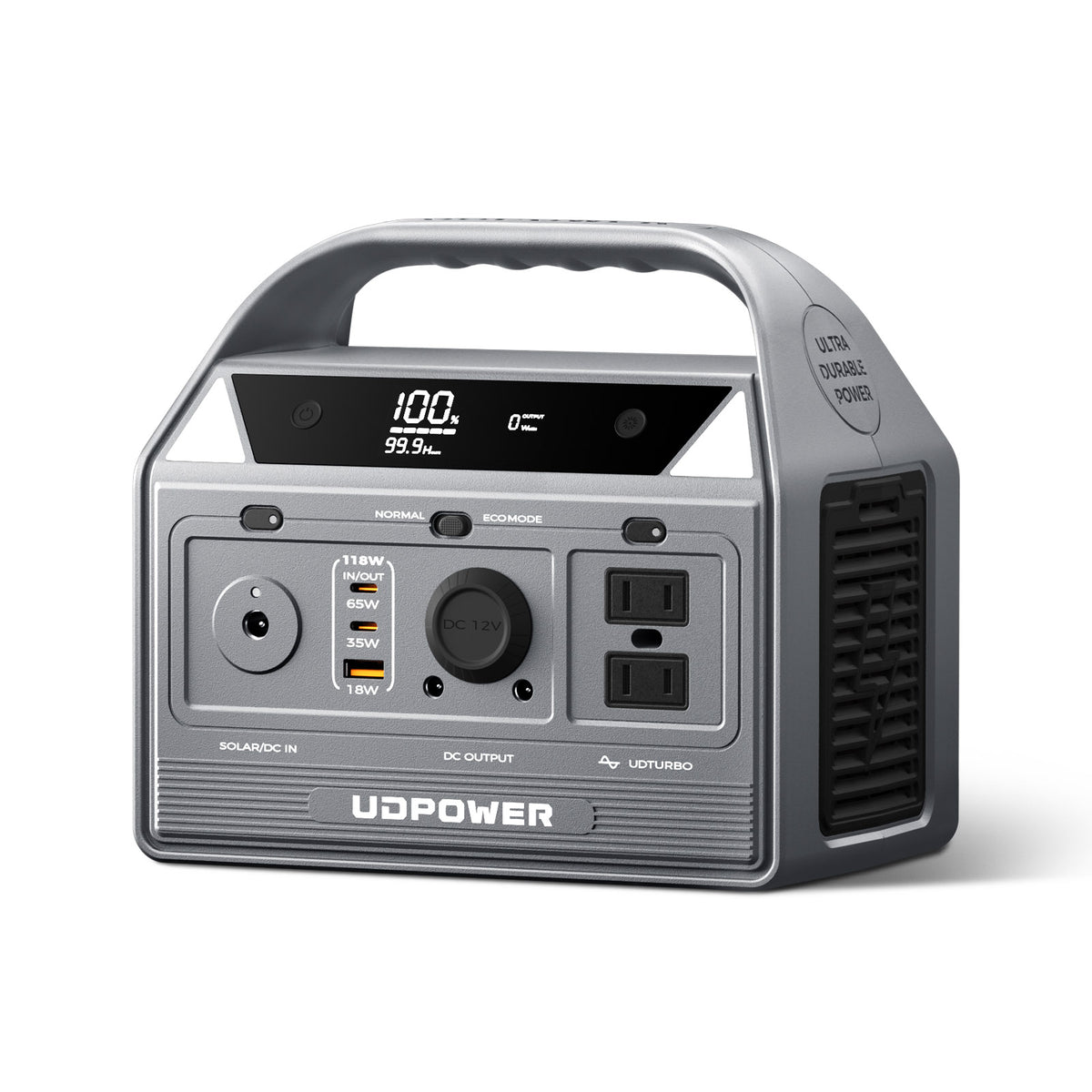
UDPOWER C400 — Better for Short Cooling Windows
The UDPOWER C400 makes more sense when portability matters and you only need a short backup window.
- 256Wh LiFePO4 battery
- 400W pure sine wave AC output
- 800W surge
- 2 AC outlets
- About 6.88 lb
- Up to 150W solar charging input
It can work well with an efficient mini fridge if the refrigerator's startup requirement is within the station's output capability, but its smaller battery means it is not the best choice for long overnight outages.
View UDPOWER C400Need overnight backup or want to run more than the fridge?
The UDPOWER S1200 moves up to about 1,190Wh capacity, 1,200W AC output, and 1,800W max output. It gives substantially more energy reserve for a compact fridge plus essentials such as a router, lights, laptop, or CPAP.
| Model | Capacity | AC output | Startup / max capability | Best fit for a small fridge | Official specifications |
|---|---|---|---|---|---|
| C400 | 256Wh | 400W | 800W surge | Short backup, travel, efficient mini fridge | View C400 |
| C600 | 596Wh | 600W | 1200W max | Mini fridge, beverage cooler, camping fridge | View C600 |
| S1200 | Approx. 1,190Wh | 1,200W | 1,800W max | Longer fridge backup plus other essentials | View S1200 |
Does a Small Fridge Need a 15-Amp Circuit?
This is where “fridge amps” and “circuit amps” are often confused.
A mini fridge may use far less than 15 amps while running, but the branch circuit serving the refrigerator can still be protected by a 15A or 20A breaker.
GE Appliances recommends a properly grounded 115V or 120V branch circuit protected by a 15A or 20A circuit breaker or time-delay fuse for refrigerators and recommends a dedicated circuit for best performance. See GE refrigerator electrical requirements.
What Makes a Small Fridge Use More Electricity?
The refrigerator's instantaneous compressor current may not change dramatically every time conditions change. What often changes more is how long and how often the compressor has to run.
| Condition | What usually happens | Effect on battery runtime |
|---|---|---|
| Hot garage or RV | Compressor runs longer to reject heat | Runtime decreases |
| Frequent door openings | Warm air repeatedly enters the cabinet | Runtime decreases |
| Warm food or drinks added | Fridge must remove more heat | Temporary energy use rises |
| Poor ventilation around the fridge | Heat cannot escape as easily | Compressor may run longer |
| Damaged or dirty door seal | Cold air leaks out | Daily Wh use rises |
| Lower thermostat setting | More cooling may be required | Runtime can decrease |
| Clean coils and good airflow | Heat transfer is easier | Can reduce unnecessary compressor runtime |
This is especially important when comparing a dorm room with a garage. A fridge that performs comfortably in a 72°F room may consume substantially more energy when surrounded by hot summer air.
Simple Small-Fridge Backup Sizing Rule
If you do not want to work through every electrical detail, use this order:
- Check the fridge voltage. Most household mini fridges are around 115–120V AC.
- Find running watts or amps. Use the appliance rating plate instead of a generic internet number.
- Allow for compressor startup. Make sure your inverter or power station has enough output headroom.
- Measure kWh over time. This gives the best number for battery capacity.
- Decide how many hours you actually need. Four-hour backup, overnight backup, and multi-day outage planning require very different battery capacities.
| Your goal | Practical starting point | Main thing to check |
|---|---|---|
| Short cooling window | 250Wh-class battery | Startup compatibility |
| Several hours of mini-fridge backup | 500–600Wh class | Measured average watts |
| Overnight backup | 1,000Wh+ class | Daily kWh and other connected loads |
| Extended outage with daytime recharge | Large battery plus compatible solar | Daily fridge energy vs. daily solar harvest |
If solar charging is part of your plan, read How Many Solar Panels Do I Need to Run a Refrigerator? .
Frequently Asked Questions About Small Fridge Amps
How many amps does a mini fridge use?
Many 115–120V mini fridges fall around 0.4–1.5 running amps, although efficient models can use less and larger or older compact refrigerators can use more. Always verify your model's nameplate.
Is 1 amp equal to 120 watts on a refrigerator?
Not necessarily. At 120V, 1A equals 120VA of apparent power. Because a refrigerator compressor is an AC motor load, real watts can differ because of power factor. If the appliance provides a watt rating, use that value.
Does a mini fridge draw its rated amps all day?
No. The compressor normally cycles on and off. The fridge may draw its higher running current during active cooling and very little when the compressor is off. That is why kWh measured over time is better for battery runtime calculations.
Why does my fridge trip an inverter even though its running watts are low?
The compressor may require a much larger brief startup current than it needs once running. An inverter can therefore be large enough for the running load but still fail during compressor startup.
How many amps does a 60W mini fridge use?
On a simple 120V calculation, 60W corresponds to about 0.5A. On 12V, approximately the same power would correspond to about 5A. Actual current depends on the appliance and operating conditions.
Can a mini fridge run on a 15-amp circuit?
Most household mini fridges use far less than 15A while running. Refrigerator manufacturers commonly specify a properly grounded 15A or 20A branch circuit, and a dedicated circuit may be recommended.
How do I calculate mini fridge amps from watts?
For a quick 120V planning estimate, divide watts by 120. For example, 90W ÷ 120V equals about 0.75A. Remember that AC compressor power factor can make volts × amps different from actual watts.
How many amps does a 12V camping fridge use?
It depends on the refrigerator. A 12V appliance can show several amps even when its total wattage is modest because current increases as voltage decreases. For example, 60W at 12V is approximately 5A.
What size power station do I need for a mini fridge?
A 250Wh-class station can be useful for short backup, while a 500–600Wh model gives more practical runtime. Around 1,000Wh or more is easier to justify for longer or overnight backup. Confirm compressor startup requirements before choosing solely by battery capacity.
Should I use running watts or average watts to calculate fridge runtime?
Use measured average watts or kWh over several hours for battery runtime. Use running and startup electrical requirements to determine whether the inverter can successfully power the refrigerator.
Will a mini fridge use more power in a garage?
Often yes, especially in hot weather. The compressor may need to run for longer periods because the refrigerator must reject heat into warmer surrounding air. Measure the fridge in the environment where you actually plan to use it.
Can solar panels run a small fridge?
A practical setup is to use solar panels to recharge a compatible power station while the power station supplies stable power to the refrigerator. Solar production varies with sunlight, clouds, shade, panel angle, and time of day, so battery storage remains important.
Sources and Related Reading
External sources
- Federal Trade Commission — How to Use the EnergyGuide Label
- ENERGY STAR — Refrigerator Efficiency Data
- Fluke — How and Why to Measure Inrush Current
- Fluke — Power Factor: What It Is and How to Calculate It
- GE Appliances — Refrigerator Electrical Requirements and Breaker Size
- Midea / Arctic King — 4.4 Cu. Ft. Compact Refrigerator Specifications
- Danby — Compact Refrigerator Rating-Plate Guidance
Related UDPOWER guides
Keep Your Small Fridge Running During the Next Outage
Start with your refrigerator's real electrical data. Check the nameplate, confirm startup demand, and measure kWh over time if you want a realistic runtime estimate. Then choose battery capacity based on how many hours of refrigeration you actually need.
View Portable Power Stations Read the Refrigerator Runtime Guide Plan a Solar Backup SetupRelated Articles


