

Advantages and Disadvantages of Solar Energy: A Practical 2026 Guide
Last updated: July 30, 2026
Bottom line: The main advantages of solar energy are that sunlight is renewable, solar panels require no fuel while operating, systems can be scaled from a small portable panel to a large rooftop array, and a properly sized system can reduce dependence on utility electricity.
The main disadvantages are variable output, upfront equipment and installation costs, site and space requirements, lower production during poor weather, and the need for batteries or another power source when sunlight is unavailable.
Solar energy is usually most valuable when the system is matched to a clear goal. A rooftop system may be chosen to reduce long-term electricity purchases. A solar-plus-battery system may prioritize outage resilience. A portable solar generator may be more useful for camping, RV travel, remote work, or keeping essential devices running during an emergency.

Solar energy is no longer a niche electricity source. The U.S. Energy Information Administration reports that utility-scale solar supplied about 6.7% of U.S. utility-scale electricity generation in 2025. Small-scale solar systems, including rooftop installations, generated an additional estimated 93 billion kilowatt-hours.
Growth does not mean solar is automatically the right answer for every home, business, campsite, or backup-power plan. The real question is not simply whether solar energy is “good” or “bad.” It is whether the advantages solve your specific problem strongly enough to justify the disadvantages.
Solar Energy Pros and Cons at a Glance
| Decision Area | Solar Energy Advantage | Solar Energy Disadvantage | What It Means in Practice |
|---|---|---|---|
| Energy source | Sunlight is renewable and does not require purchased fuel. | Sunlight is not available at night and changes with weather and season. | Solar works best with load planning, grid access, batteries, or another backup source. |
| Operating impact | Photovoltaic panels produce electricity without combustion, exhaust, or direct operating emissions. | Manufacturing, transportation, installation, and recycling still have environmental impacts. | Solar is low-emission over its operating life, but it is not impact-free. |
| Electricity costs | A suitable system can reduce the amount of electricity purchased from a utility. | Savings depend on installation cost, financing, sunlight, electricity rates, and export-credit rules. | A quote should include a site-specific production estimate and realistic payback calculation. |
| Scalability | Solar can range from a small foldable panel to a whole-roof or utility-scale system. | Adding more panels does not help if roof area, battery capacity, or input limits are reached. | Every component must be sized as one system rather than selected by wattage alone. |
| Maintenance | Solar panels have no fuel engine and relatively few moving parts. | Inverters, batteries, wiring, roof penetrations, and connectors may still require service. | Maintenance is usually lower than a combustion generator, but it is not zero. |
| Backup power | Solar can recharge a compatible battery during extended outages. | Solar panels alone do not provide stable nighttime power or automatic backup. | Outage protection normally requires compatible storage, controls, and safe transfer equipment. |
| Noise | Solar panels operate silently. | Inverters and battery systems may use cooling fans under heavier loads. | Solar-battery systems are generally much quieter than gasoline generators. |
| Location | Solar can generate power at homes, campsites, RVs, remote work areas, and off-grid locations. | Shade, poor orientation, limited space, snow, dust, and local weather reduce output. | A site assessment is more useful than relying on a national average. |
General benefits and limitations are consistent with information published by the U.S. Energy Information Administration and the U.S. Department of Energy.
What Is Solar Energy?
Solar energy is energy obtained from sunlight. For most homes and portable power systems, the relevant technology is photovoltaic solar, commonly called solar PV.
A photovoltaic panel contains solar cells that convert sunlight into direct-current electricity. That electricity can be used in several ways:
- Sent through an inverter to power AC household equipment.
- Used directly by compatible DC equipment.
- Stored in a battery for later use.
- Exported to the utility grid when local rules and equipment permit it.
- Used to recharge a portable power station during camping or an outage.
Large power plants may also use concentrating solar power, which uses mirrors to concentrate heat. However, rooftop panels, portable panels, and most consumer solar generators use photovoltaic cells.
Advantages of Solar Energy
1. Solar Energy Uses a Renewable Resource
Solar panels do not consume sunlight in the way a gasoline generator consumes fuel. As long as suitable daylight reaches the panel, electricity can be produced without buying, transporting, or storing combustible fuel.
This is particularly useful in remote locations. A camper, RV owner, field worker, or homeowner dealing with a long outage may be able to recharge a battery during daylight without making repeated fuel runs.
The limitation is that renewable does not mean continuously available. Solar generation follows daylight, weather, location, and season.
2. Solar Panels Produce Electricity Without Combustion
Photovoltaic panels do not burn gasoline, propane, diesel, coal, or natural gas while generating electricity. That means no exhaust pipe, direct carbon dioxide emissions, fuel odor, or carbon monoxide from the panel during normal operation.
This makes solar especially valuable when paired with a battery power station for quiet applications such as:
- Charging phones and laptops at a campsite.
- Running a CPAP machine overnight.
- Keeping a Wi-Fi router and communication devices powered.
- Supporting lights, cameras, radios, or small refrigerators.
- Recharging equipment near homes, tents, and work areas where engine noise is undesirable.
Solar panels are not completely impact-free. Energy and materials are required to manufacture, ship, install, and eventually recycle or dispose of panels. The environmental advantage comes primarily from avoiding fuel combustion during decades of electricity production.
3. Solar Can Reduce Dependence on Purchased Electricity
A rooftop solar system can reduce how much electricity a household purchases from the grid. The financial value is usually greatest when the home uses solar electricity as it is generated, especially in areas where utilities provide limited compensation for exported power.
Savings depend on more than panel wattage. Important variables include:
- Local electricity rates.
- Available sunlight and roof orientation.
- Shade from trees, buildings, vents, and chimneys.
- Cash purchase, loan, lease, or power purchase agreement terms.
- Utility export-credit or net-metering rules.
- Maintenance, insurance, roof, and inverter costs.
- How much solar energy is used directly rather than exported.
Solar does not guarantee a zero utility bill. Many customers still pay connection fees, minimum charges, taxes, demand charges, or for electricity used when solar production is insufficient.
4. Solar Systems Are Modular
Solar can be deployed at very different scales. That flexibility is one of its strongest advantages.
| Solar Scale | Typical Purpose | Main Advantage | Main Limitation |
|---|---|---|---|
| Small portable panel | Phones, cameras, portable power stations, camping, emergency charging | Easy to transport and set up without permanent installation | Limited daily energy production |
| RV or van solar | Refrigeration, lights, fans, electronics, small appliances | Generates energy while traveling or camping away from hookups | Roof space and battery storage are limited |
| Residential rooftop solar | Offsetting household electricity purchases | Uses existing roof area and can produce energy for decades | Requires a suitable roof, permits, interconnection, and significant investment |
| Community solar | Bill credits without panels on the customer's roof | Can serve renters or homes with unsuitable roofs | Availability, savings, subscription rules, and cancellation terms vary |
| Utility-scale solar | Supplying electricity to the power grid | Produces large amounts of electricity without on-site fuel combustion | Requires land, transmission access, grid management, and large capital investment |
5. Solar Panels Generally Require Limited Routine Maintenance
Solar panels have no engine oil, spark plugs, carburetor, fuel tank, or exhaust system. Fixed rooftop panels also have few moving parts.
Routine care may include inspecting the system, monitoring production, removing heavy debris, and addressing excessive dirt, snow, damaged wiring, loose connectors, or vegetation that causes new shade.
The panels may last longer than some supporting components. The U.S. Department of Energy states that residential solar modules are expected to last 25 years or more while still producing a substantial portion of their original power.
Inverters, batteries, roof materials, disconnects, and electrical components may have different service lives and should be included in long-term cost planning.
6. Solar Can Support Energy Resilience When Paired With Storage
Solar panels can recharge a battery during the day. Stored energy can then be used after sunset, during passing clouds, or when utility power is unavailable.
This is different from simply owning grid-tied rooftop panels. Many standard grid-connected solar systems shut down during a utility outage to prevent electricity from being sent onto power lines where crews may be working.
Backup power normally requires a system designed for that purpose, such as:
- A compatible battery.
- An inverter that supports backup operation.
- An automatic or manual transfer device.
- A protected backup-load panel or approved connection system.
- Enough solar input and battery capacity for the intended loads.
7. Solar Can Be Useful Where Grid Power Is Inconvenient
Portable solar is often valuable even when it does not provide the lowest possible cost per kilowatt-hour. Its value may come from convenience, silence, mobility, and access to power in places where an outlet is unavailable.
Examples include remote campsites, outdoor photography, field inspections, disaster preparation, mobile workstations, RV travel, boating, temporary communications, and keeping a small battery topped up during an extended outage.
8. Solar Generation Can Be Matched to Daytime Loads
Solar production is naturally concentrated during daylight. Households and businesses can improve the value of solar by shifting flexible loads into higher-production hours.
Depending on system capacity and local rules, daytime scheduling may include:
- Running a dishwasher or washing machine.
- Charging batteries, tools, laptops, or an electric vehicle.
- Pre-cooling a building before evening.
- Operating pool pumps or water-treatment equipment.
- Recharging a portable power station before nighttime use.
Using energy while it is being generated can reduce conversion losses and may be more valuable than exporting energy at a low utility credit.
Disadvantages of Solar Energy
1. Solar Output Is Variable
A solar panel does not produce the same amount of power all day. Output changes with:
- Time of day.
- Cloud cover and haze.
- Season and latitude.
- Panel direction and angle.
- Shade from even a small obstruction.
- Panel temperature.
- Dirt, pollen, snow, and leaves.
- Cable and conversion losses.
- The receiving battery's input limit and state of charge.
Rated wattage is measured under controlled test conditions. A 210W panel may briefly approach its rated output in strong, well-aligned sunlight, but it should not be expected to produce 210W continuously from sunrise to sunset.
2. Solar Does Not Generate Power at Night
Nighttime energy must come from the utility grid, a battery, a generator, or another energy source. This makes storage important for off-grid operation, but batteries increase system cost, weight, complexity, and conversion losses.
Off-grid systems must be sized for more than an average sunny day. They also need a plan for consecutive cloudy days, seasonal reductions, unexpected loads, and battery reserve.
3. The Upfront Cost Can Be Significant
Rooftop solar costs include more than the panels. A complete project may include:
- Solar modules.
- Inverters or microinverters.
- Racking and roof attachments.
- Electrical wiring and disconnect equipment.
- Permitting and inspection.
- Utility interconnection.
- Engineering and labor.
- Roof work or electrical-panel upgrades.
- Battery storage and transfer equipment.
- Financing charges.
A low monthly payment does not necessarily mean the system has a low total cost. Before signing, compare the cash price, financed price, interest rate, dealer fees, escalation clauses, warranty responsibilities, and transfer requirements if the home is sold.
4. Not Every Roof or Property Is Suitable
A roof may be a poor candidate because of excessive shade, limited usable area, structural concerns, complex roof shapes, poor orientation, or an approaching roof replacement.
The Department of Energy's homeowner guide recommends considering tree cover, roof size, shape, slope, orientation, and roof age before installing solar.
Renters and owners of unsuitable properties may still have alternatives, including community solar, ground-mounted systems where permitted, or portable solar for limited off-grid needs.
5. Partial Shade Can Cause a Disproportionate Output Loss
Shade does not have to cover the entire panel to create a meaningful reduction. A tree branch, roof vent, railing, antenna, tent line, vehicle shadow, or nearby panel can reduce output.
Bypass diodes, microinverters, and optimizers may reduce the effect of partial shading, but they cannot create sunlight where none is reaching the cells.
6. High Temperatures Can Reduce Solar Output
Bright sunlight is helpful, but excessive panel temperature can reduce electrical efficiency. A hot panel in direct summer sun may produce less than the same panel under equally bright but cooler conditions.
Airflow behind rooftop or portable panels helps dissipate heat. Portable panels should generally be placed in open sunlight rather than flat against a surface that traps heat.
7. Battery Storage Adds Cost and Energy Losses
Batteries make solar energy available when the sun is not shining, but they introduce several trade-offs:
- Additional purchase cost.
- Limited storage capacity.
- Charging and inverter conversion losses.
- Battery aging and eventual replacement.
- Temperature-related charging limitations.
- Weight and installation requirements.
- Maximum output and startup-load limits.
A battery should be sized according to watt-hours of energy needed, inverter output, startup requirements, solar recharge capability, and desired reserve. Choosing a battery only by the number of outlets can lead to disappointing runtime.
8. Solar Manufacturing and End-of-Life Management Have Environmental Costs
Solar panels require glass, aluminum, silicon, conductors, electronics, transportation, and manufacturing energy. Some panel types or components may contain materials that require controlled end-of-life handling.
The U.S. Environmental Protection Agency states that solar panels commonly have service lives exceeding 25 years, but they still need to be safely managed when they become waste.
Recycling can recover aluminum, glass, metals, and other materials, although recycling access, cost, and local regulations vary. Buyers should ask installers and manufacturers what end-of-life programs are available before the panels reach retirement.
9. Policies and Utility Rules Can Change the Financial Outcome
Solar economics depend partly on rules that the panel owner does not control. Utility export rates, fixed charges, net-metering policies, permitting requirements, insurance rules, and local incentives can change.
A system designed around generous export credits may become less attractive if exported electricity is compensated at a lower rate. This is one reason self-consumption, load scheduling, and battery economics deserve separate analysis.
10. Portable Solar Has Strict Energy and Input Limits
Portable solar is convenient, but a small foldable panel cannot replace a large rooftop array or utility connection. A 120W panel may be suitable for charging electronics or slowly replenishing a compact power station, but it is not designed to provide continuous whole-home electricity.
A larger panel also does not automatically produce faster charging. The power station must support the panel's voltage, current, connector, and wattage. If a station accepts only 150W of solar input, connecting substantially more panel wattage will not make the station accept unlimited power.
Advantages and Disadvantages by Solar System Type
Many online comparisons treat all solar systems as though they solve the same problem. They do not. The advantages and disadvantages change depending on whether the goal is lower utility bills, outage backup, renter access, or portable power.
| System Type | Strongest Advantage | Biggest Disadvantage | Best Fit | Key Question Before Buying |
|---|---|---|---|---|
| Grid-tied rooftop solar without battery | Can offset daytime grid electricity with a relatively simple system. | Usually does not provide usable power during a grid outage. | Homeowners primarily focused on long-term electricity savings. | What is the utility's current export-credit policy? |
| Rooftop solar with home battery | Can shift daytime solar into the evening and support selected loads during outages. | Higher cost and more complex installation. | Homes that value both energy management and backup power. | Which circuits will the battery support, and for how long? |
| Community solar | No suitable roof or home ownership is required. | Availability, contract terms, savings, and transfer rules vary. | Renters, apartment residents, and shaded properties. | Can the subscription be canceled or transferred without a large fee? |
| Portable solar panel plus power station | Mobile, quiet, easy to deploy, and useful without permanent installation. | Limited daily production and battery capacity. | Camping, RV travel, remote work, apartments, and essential-load backup. | Are the panel voltage, current, connector, and wattage compatible with the station? |
| Off-grid fixed solar system | Can supply electricity where grid service is unavailable. | Must be sized for poor-weather periods, seasonal changes, and battery reserve. | Remote cabins, agricultural sites, and specialized installations. | What is the backup plan after several low-solar days? |
Will Solar Energy Actually Save Money?
Solar can save money, but savings should be calculated from the complete system and local utility rules—not from panel price or advertised wattage alone.
A simplified cash-purchase payback calculation is:
For example, a system with a net cost of $16,000 and estimated annual savings of $2,000 would have a simple eight-year payback. That calculation does not automatically include financing interest, inverter replacement, insurance changes, maintenance, utility-policy changes, panel degradation, or the time value of money.
| Payback Factor | Usually Improves the Economics | Usually Weakens the Economics | What to Verify | Source |
|---|---|---|---|---|
| Electricity price | High utility rates and expected long-term increases | Low utility rates | Current rate structure, time-of-use periods, fixed charges | U.S. Department of Energy |
| Solar production | Strong sunlight, good orientation, minimal shade | Heavy shade, poor roof area, frequent obstruction | Annual production estimate in kWh, not only system kW | NREL PVWatts |
| Self-consumption | Using solar electricity as it is generated | Exporting most production at a low credit | Hourly load pattern and utility export rate | DOE Homeowner's Guide |
| Financing | Cash purchase or low-cost financing without large dealer fees | High interest, long loan term, or inflated financed price | Cash price, financed total, APR, fees, early payoff rules | U.S. Department of Energy |
| Roof condition | Newer roof with long remaining service life | Roof replacement needed soon after installation | Roof inspection and removal/reinstallation costs | U.S. Department of Energy |
| Incentives | Current state, local, or utility incentives | Calculations based on expired credits | Eligibility dates, ownership requirements, taxable treatment | IRS / DSIRE |
| Battery storage | High value placed on backup or strong time-of-use savings | Battery added without a clear backup or rate-management need | Usable capacity, output, supported circuits, warranty, replacement plan | U.S. Department of Energy |
Questions to Ask Before Accepting a Solar Savings Estimate
- Is the production estimate based on my address, roof, orientation, and shade?
- Does the proposal show estimated annual kilowatt-hours, not only panel capacity?
- What electricity-rate inflation assumption was used?
- What export-credit or net-metering rate was assumed?
- Does the total price include financing fees and interest?
- Were expired federal incentives removed from the 2026 calculation?
- What happens if the roof needs repair?
- Who pays to remove and reinstall the panels?
- Which components are covered by labor, equipment, and production warranties?
- What are the lease, PPA, loan-transfer, or early-payoff terms?
How Much Energy Can Solar Panels Produce?
Solar panel wattage measures maximum power under specified test conditions. Household and battery runtime, however, depends on energy measured in watt-hours or kilowatt-hours.
A useful planning estimate is:
The following examples use four peak-sun hours and a conservative 75% real-world system factor. They are planning examples, not guaranteed daily production.
| Nominal Panel Capacity | Planning Calculation | Illustrative Daily Energy | Possible Uses | Important Limitation |
|---|---|---|---|---|
| 120W | 120W × 4 hours × 0.75 | About 360Wh per day | Phones, cameras, laptops, lights, partial power-station recharge | Clouds, shade, heat, angle, and input limits may reduce production |
| 210W | 210W × 4 hours × 0.75 | About 630Wh per day | Camping refrigerator, electronics, larger battery top-ups | Requires compatible voltage, current, and connector |
| 400W | 400W × 4 hours × 0.75 | About 1,200Wh per day | Higher-capacity battery recharge and multiple essential loads | The battery system must accept the available solar input |
Use NREL's PVWatts Calculator for a location-based estimate. Portable panels can vary more because users frequently reposition them and because panel angle, temporary shade, cable layout, and battery input limits change throughout the day.
Why a 400W Panel Does Not Produce 400W All Day
Morning and evening sunlight reaches the panel at a lower angle. Midday heat can reduce efficiency. Passing clouds cause immediate fluctuations. The receiving battery may also reduce charging power as it approaches full charge or if its temperature moves outside the preferred charging range.
For realistic planning, use average daily energy rather than multiplying rated wattage by every daylight hour.
Where Portable Solar Energy Makes Sense
Portable solar is not a smaller version of a complete rooftop system. It solves a different problem: generating a useful amount of electricity without permanent installation, fuel, or grid access.

Portable Solar Is Usually a Good Fit When You Need:
- Quiet daytime recharging at a campsite.
- A fuel-free way to replenish an emergency battery.
- Power for phones, laptops, cameras, lights, routers, or CPAP equipment.
- A movable panel that can be repositioned as the sun changes.
- A solution for an apartment, rental home, vehicle, or temporary location.
- A backup charging method when utility power is unavailable.
Portable Solar Is Usually a Poor Fit When You Expect:
- Continuous whole-home power from one small panel.
- Reliable charging in deep shade.
- Full rated wattage throughout the entire day.
- Fast recharging during storms or heavy cloud cover.
- Direct, stable operation of large AC appliances without a battery and inverter.
- Unlimited power without managing daily energy consumption.
For a complete setup guide, read Can You Charge a Portable Power Station With a Solar Panel?
To compare portable panel trade-offs, see Are Foldable Solar Panels Worth It?
UDPOWER Solar-Ready Product Recommendations
The best portable solar setup is determined by two separate numbers:
- Output watts: The maximum appliance load the power station can support.
- Battery watt-hours: How much energy the station can store for runtime.
Solar input is a third limit. A panel must match the station's supported voltage, current, wattage, polarity, and connector. A physically fitting plug does not by itself prove electrical compatibility.
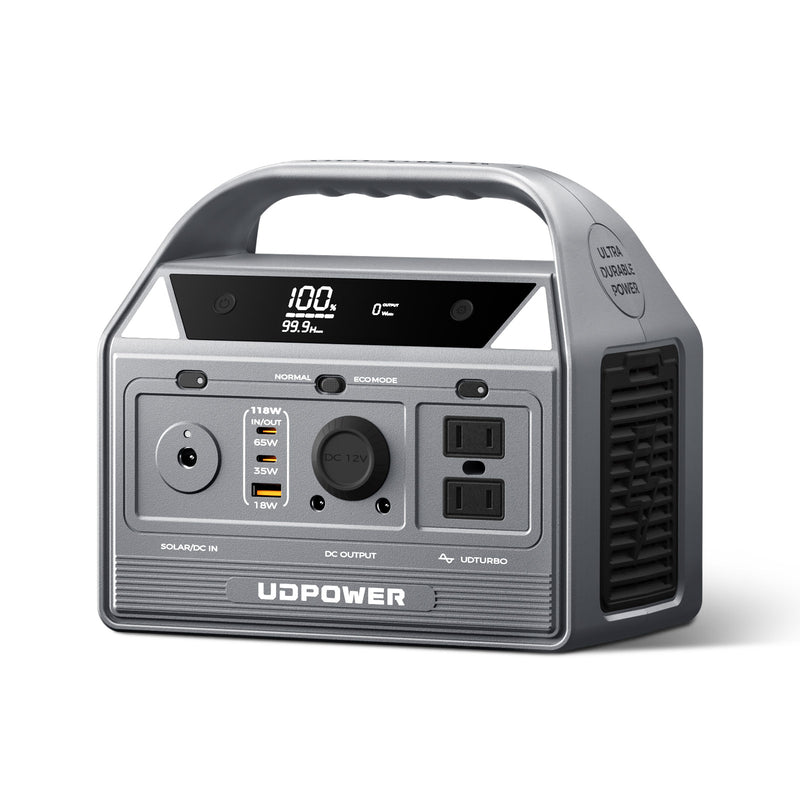
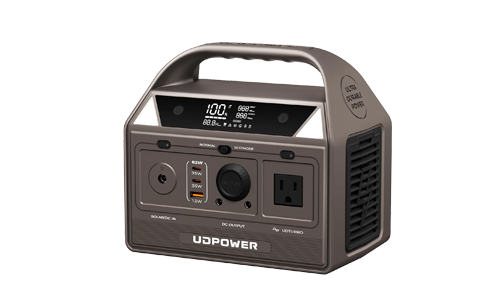
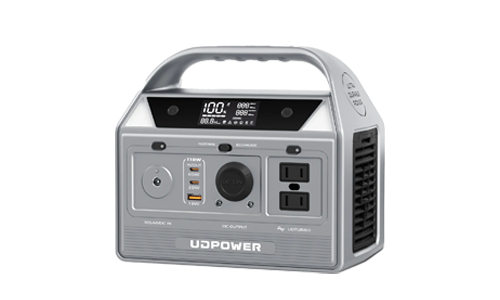
UDPOWER C400: Best for Lightweight Portable Solar
The C400 is a compact option for short trips, vehicle emergency kits, laptop charging, lights, phones, cameras, CPAP use, and other lower-power loads.
- Battery capacity: 256Wh
- Rated AC output: 400W
- Maximum solar input: 150W
- Battery chemistry: LiFePO4
- Cycle rating: 4,000+ cycles
- Weight: Approximately 6.88 lb
- Best use: Short trips, electronics, car kits, light camping loads
The C400 pairs naturally with a portable panel such as the UDPOWER 120W panel. It is not intended to run high-watt heating appliances, central air conditioning, electric ovens, or an entire home.
View UDPOWER C400
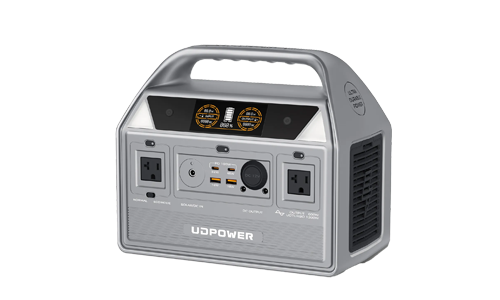
UDPOWER S1200: Best Balance for Camping and Home Essentials
The S1200 provides substantially more stored energy than a compact travel station while remaining portable enough for RV trips, camping, CPAP backup, refrigerators, communications, lights, and selected household appliances.
- Battery capacity: 1,190Wh
- Rated AC output: 1,200W
- Maximum solar input: Up to 400W
- Battery chemistry: LiFePO4
- Cycle rating: 4,000+ cycles
- Weight: Approximately 26 lb
- AC outlets: Five on the current gray version
- Best use: Home essentials, RV trips, CPAP, refrigeration, longer camping trips
The S1200 is a practical choice when a small battery would run out too quickly but a heavier 2,000Wh-class unit is more than the user wants to carry. Actual runtime depends on the combined load, appliance duty cycle, inverter losses, and remaining battery charge.
View UDPOWER S1200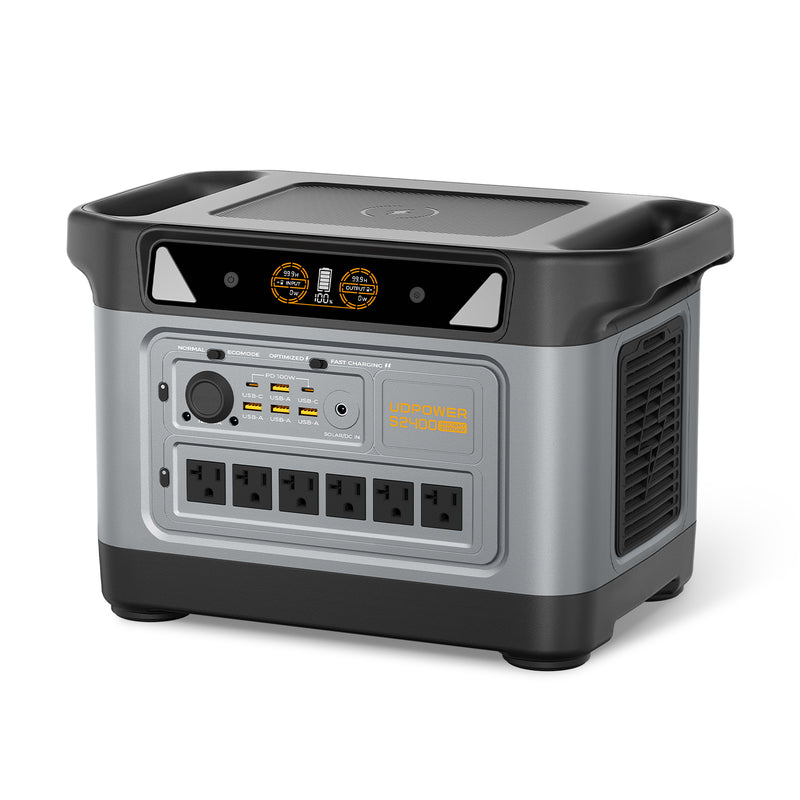
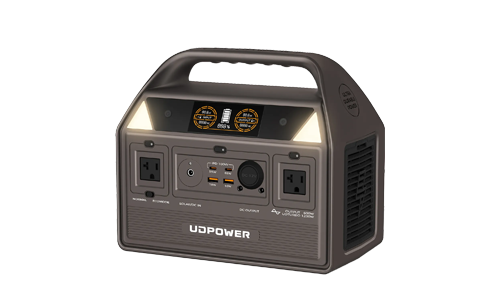
UDPOWER S2400: Best for Larger Loads and Longer Backup
The S2400 is better suited to users who need more battery capacity, more AC output, and support for several essential devices at the same time.
- Battery capacity: 2,083Wh
- Rated AC output: 2,400W
- Maximum solar input: Up to 400W
- Battery chemistry: LiFePO4
- Cycle rating: 4,000+ cycles
- Weight: Approximately 40.8 lb
- AC outlets: Six
- Best use: Refrigeration, multiple essentials, RVs, work equipment, heavier backup loads
Although the S2400 can support much larger loads than a compact station, it should still be treated as a finite battery. High-watt appliances can consume 2,083Wh quickly, and the solar array must produce enough daily energy to replace what is used.
View UDPOWER S2400UDPOWER Solar-Ready Power Station Comparison
| Model | Battery Capacity | Rated AC Output | Maximum Solar Input | Weight | Best Match | Official Page |
|---|---|---|---|---|---|---|
| UDPOWER C400 | 256Wh | 400W | 150W | Approximately 6.88 lb | Short trips, electronics, car kits, light camping | View C400 |
| UDPOWER S1200 | 1,190Wh | 1,200W | Up to 400W | Approximately 26 lb | Home essentials, CPAP, RVs, refrigerators, camping | View S1200 |
| UDPOWER S2400 | 2,083Wh | 2,400W | Up to 400W | Approximately 40.8 lb | Multiple essential loads, heavier appliances, longer backup | View S2400 |
How to Decide Whether Solar Energy Is Right for You
Step 1: Define the Goal
Start with the problem you are trying to solve. Common goals include:
- Reduce monthly electricity purchases.
- Keep selected devices running during outages.
- Power an off-grid cabin or worksite.
- Recharge a battery while camping.
- Reduce generator fuel use.
- Gain access to renewable energy as a renter.
Different goals require different systems. A grid-tied rooftop array is not automatically an outage system, and a portable solar generator is not automatically a whole-home system.
Step 2: Measure Your Energy Use
Review utility bills for monthly kilowatt-hour use. For backup planning, make a separate list of essential devices and record:
- Running watts.
- Startup or compressor demand.
- Hours used per day.
- Whether the appliance cycles on and off.
- Whether it requires 120V or 240V power.
A portable solar generator can often support selected essentials, but central air conditioning, electric heating, electric water heaters, dryers, ranges, large well pumps, and Level 2 EV charging may require a much larger system.
Read What Appliances Cannot Be Used With Solar Power? for a practical load-planning guide.
Step 3: Evaluate the Solar Resource
Check roof direction, shade, seasonal sun, nearby trees, available ground space, and local weather. For portable panels, identify whether you will have a safe, open area where the entire panel can receive direct sunlight.
Do not plan around the single best hour of the year. Use annual production estimates for rooftop solar and conservative daily estimates for emergency or off-grid planning.
Step 4: Decide How Much Storage Is Necessary
Storage is not required for every grid-tied solar system, but it is usually necessary when the goal includes nighttime use, off-grid operation, or outage backup.
Size storage around the essential loads, not the total number of appliances in the home. Keeping a refrigerator, router, lights, phones, and a CPAP running requires far less energy than operating central air conditioning, an electric water heater, and a clothes dryer.
Step 5: Compare Total Cost, Not Only Equipment Price
Include installation, financing, permits, roof work, electrical upgrades, storage, maintenance, insurance, replacement components, and end-of-life handling.
For portable solar, include the power station, panel, approved cables, adapters, storage case, and any parallel-connection hardware required by the manufacturer.
Step 6: Verify Current Incentives and Utility Rules
Ask the utility for current interconnection requirements, export rates, fixed charges, and time-of-use periods. Check state and local programs through DSIRE.
For U.S. projects started in 2026, confirm tax treatment directly with the IRS or a qualified tax professional rather than relying on older advertisements.
Step 7: Plan for the Worst Reasonable Day
A system that works perfectly on a clear spring afternoon may underperform during a hot summer day, winter storm, smoky period, or several cloudy days in a row.
Emergency plans should include reserve capacity, reduced-load operation, wall charging before severe weather, and another charging method when solar production is insufficient.
Common Solar Energy Myths
Myth: Solar Panels Always Work During a Power Outage
Standard grid-tied solar systems commonly shut down during an outage. Backup operation requires compatible equipment designed to isolate the home from the utility grid and safely power selected loads.
Myth: A 400W Solar Panel Produces 400W Every Daylight Hour
Rated output is measured under test conditions. Real-world production changes continuously with sun intensity, panel angle, shade, temperature, cable losses, and the receiving device's input limit.
Myth: Solar Panels Do Not Work on Cloudy Days
Solar panels can generate electricity from diffuse daylight, but output may be significantly lower. Heavy cloud cover can turn a short charging estimate into an all-day or multi-day process.
Myth: A Battery Creates More Solar Energy
A battery shifts energy from one time to another. It cannot create electricity and introduces charging and conversion losses. Its value is availability, not additional generation.
Myth: More Panel Wattage Always Means Faster Charging
Charging speed is limited by the receiving device. A power station with a 150W solar-input limit will not accept unlimited power simply because a larger array is connected.
Myth: Solar Energy Is Completely Free
Sunlight has no fuel charge, but panels, inverters, batteries, installation, financing, maintenance, roof work, and replacement components have costs.
Myth: Portable Solar Is the Cheapest Way to Power a Home
Portable systems trade lower total capacity for mobility and simple setup. Their value is often convenience and emergency access, not the lowest cost per kilowatt-hour for everyday whole-home electricity.
Frequently Asked Questions
What are the five main advantages of solar energy?
The main advantages are renewable sunlight, no fuel combustion during operation, potentially lower utility electricity purchases, low routine panel maintenance, and the ability to scale systems from portable panels to large rooftop arrays.
What are the five main disadvantages of solar energy?
The main disadvantages are variable production, no nighttime generation, upfront system cost, location and space requirements, and the additional cost and complexity of battery storage when power is needed after sunset or during outages.
Is solar energy reliable?
Solar technology is reliable, but sunlight is variable. A grid connection, battery, generator, load-management plan, or combination of these is needed when electricity must remain available regardless of weather or time of day.
Do solar panels work at night?
No. Solar panels require light to generate electricity. Nighttime power must come from a battery, the utility grid, or another power source.
Do solar panels work on cloudy days?
Yes, but usually at reduced output. The amount of reduction depends on cloud density, panel technology, location, temperature, shade, and panel angle.
Can solar energy power an entire house?
A properly designed fixed solar-plus-storage system can power a house, but the required size depends on daily energy use, high-watt appliances, 120V and 240V loads, local sunlight, battery capacity, and how many low-solar days must be covered. One portable solar generator is usually intended for selected essentials rather than normal whole-home operation.
Will rooftop solar panels power my home during an outage?
Not necessarily. Many grid-tied systems shut down during an outage for utility-worker safety. Backup operation requires a compatible inverter, storage or backup controls, isolation equipment, and an approved connection method.
Is solar energy completely pollution-free?
Solar panels do not create combustion emissions while generating electricity, but manufacturing, mining, transportation, installation, and end-of-life processing still have environmental impacts. Solar is low-emission in operation, not impact-free across its entire lifecycle.
How long do solar panels last?
Many solar panels are designed to operate for 25 years or longer, although their output gradually declines. Inverters, batteries, roof materials, and other system components may require repair or replacement sooner.
Is portable solar energy worth it?
Portable solar can be worth it for camping, RV travel, remote work, emergency preparation, and recharging a compatible power station away from the grid. It is less suitable when the goal is continuous operation of large appliances or an entire home from a small panel.
What is the biggest hidden cost of residential solar?
The biggest overlooked cost depends on the property. Common examples include financing fees, interest, roof replacement, panel removal and reinstallation, electrical-panel upgrades, inverter replacement, insurance changes, and low utility compensation for exported electricity.
Is the federal residential solar tax credit available for new 2026 expenditures?
Under current IRS guidance, the Residential Clean Energy Credit is not available for expenditures made after December 31, 2025. State, local, and utility incentives may still be available. Tax situations differ, so verify current eligibility with the IRS or a qualified tax professional.
Can I connect any solar panel to a portable power station?
No. The panel must match the power station's accepted voltage range, current limit, wattage limit, polarity, and connector. An adapter can change the physical connector but cannot correct an unsafe electrical mismatch.
Are solar panels better than a gasoline generator?
Solar panels and battery power stations are quieter, require no fuel combustion during use, and are suitable for many indoor-safe battery applications. Gasoline generators can provide higher continuous energy as long as fuel is available, but they create noise, exhaust, carbon monoxide, and ongoing fuel requirements. The better choice depends on load size, outage duration, location, weather, and fuel access.
Final Verdict: Do the Advantages of Solar Energy Outweigh the Disadvantages?
For many suitable locations and use cases, the advantages of solar energy outweigh the disadvantages. Solar can reduce purchased electricity, provide quiet off-grid charging, and support backup power without consuming fuel every time electricity is generated.
However, solar should not be sold as an unlimited or automatic power source. Production varies, batteries have finite capacity, rooftop economics depend on local utility rules, and a grid-tied array does not necessarily provide outage power.
The strongest solar plans begin with actual energy use. Measure the load, evaluate the site, check current policies, choose compatible equipment, and include a realistic plan for nighttime and poor weather.
A homeowner focused on long-term bill reduction may benefit from a professionally designed rooftop system. A renter may be better served by community solar. A camper or outage-prepared household may gain more immediate value from a portable panel and power station.
Solar energy is not the complete answer to every power problem. Used in the right system, it is one of the most flexible tools available.
Trusted Sources and Further Reading
- U.S. Energy Information Administration: Solar Explained
- U.S. Electricity Generation and Solar Capacity Data
- U.S. Department of Energy: Solar Energy
- U.S. Department of Energy: Homeowner's Guide to Solar
- U.S. Department of Energy: Will I Save Money With Solar Energy?
- National Renewable Energy Laboratory: PVWatts Calculator
- U.S. EPA: End-of-Life Solar Panel Management
- Internal Revenue Service: Residential Clean Energy Credit
- Database of State Incentives for Renewables and Efficiency
Choose a Solar Setup Based on the Power You Actually Need
Compare battery capacity, output wattage, solar-input limits, appliance requirements, and expected daily solar production before choosing a system.
View UDPOWER Solar Generator Kits Explore Portable Solar Panels Compare Portable Power Stations Read the Solar Generator Sizing GuideRelated Articles


