

Nebulizer Power: How Many Watts Does a Nebulizer Use?
A nebulizer does not usually need a large power source, but choosing backup power by wattage alone can leave you without enough treatments during an outage. The key is to check both the nebulizer's operating watts and the battery's usable watt-hours.
Last updated:
Direct Answer: How Much Power Does a Nebulizer Need?
Most plug-in compressor nebulizers in the official examples reviewed for this guide use approximately 80 to 140 watts. Some compact or portable mesh nebulizers run from disposable batteries or an internal rechargeable battery and use far less electricity from the wall.
For a standard home compressor nebulizer, a 400-watt pure sine wave portable power station is usually sufficient when the nebulizer is the only appliance connected. However, the power station's watt-hour capacity determines how many treatments it can provide.
Always check the electrical label on your own nebulizer or its AC adapter. The manufacturer's listed input voltage, frequency, watts, amps, and VA rating take priority over general estimates.

What Does “Nebulizer Power” Mean?
People searching for nebulizer power are usually trying to answer one of three questions:
- Operating power: How many watts the nebulizer needs while producing medication mist.
- Power source: Whether it can run from a wall outlet, rechargeable battery, vehicle, inverter, or portable power station.
- Backup capacity: How many complete treatments can be performed before the backup battery needs recharging.
These measurements are related, but they are not interchangeable. Watts tell you whether a power source can operate the nebulizer. Watt-hours tell you how long that power source can keep operating it.
Compressor, Mesh, and Ultrasonic Nebulizers
Nebulizers can use different aerosol-producing technologies. According to MedlinePlus, common types include compressor or jet nebulizers, mesh nebulizers, and ultrasonic nebulizers.
| Nebulizer Type | Typical Power Arrangement | Backup-Power Consideration | Best Practice |
|---|---|---|---|
| Compressor or jet nebulizer | Usually plugs into a 115V or 120V AC outlet | Requires an inverter-based power source with enough continuous output and startup headroom | Check the watts or VA rating on the device label |
| Portable mesh nebulizer | May use AA batteries, a rechargeable internal battery, USB power, or an AC adapter | Usually needs much less stored energy but may depend on a proprietary charging method | Carry charged batteries and the correct charging cable |
| Ultrasonic nebulizer | Varies by model and intended use | Power requirements cannot be assumed from the technology name alone | Follow the model-specific manual and label |
How Many Watts Does a Nebulizer Use?
Plug-in home nebulizers do not all draw the same amount of power. Official specifications from several compressor nebulizer models show a practical range of approximately 80 to 140 watts.
| Example Nebulizer | Type | Official Electrical Rating | Planning Value | Official Source |
|---|---|---|---|---|
| Drive PulmoNeb LT | Compressor nebulizer | 80W maximum | Use 80W for runtime estimates | Drive Medical specification |
| Philips InnoSpire Essence | Compressor nebulizer | 110W | Use 110W for runtime estimates | Philips product catalog |
| Drive Compact Compressor Nebulizer | Compressor nebulizer | 120VAC, 60Hz, 110W maximum | Use 110W for runtime estimates | Drive Medical specification |
| Drive DeVilbiss Pulmo-Aide Compact | Compressor nebulizer | 115VAC, 60Hz, 140W maximum | Use 140W for runtime estimates | Drive Medical specification |
| OMRON MicroAir NE-U100 | Portable mesh nebulizer | Battery-operated portable design | Plan around battery life rather than AC running watts | OMRON product page |
| Philips InnoSpire Go | Portable mesh nebulizer | Rechargeable battery; up to 120 minutes of use per charge | Recharge before an outage and carry the approved charger | Philips product page |
This table is useful for establishing a realistic range, but it should not replace the specification printed on your own device. A smaller-looking compressor is not automatically a lower-wattage machine.
How to Read Your Nebulizer's Electrical Label
Before purchasing a backup battery, look on the bottom or rear of the nebulizer, the power adapter, or the electrical section of the user manual. Record the following information.
| Label Item | Example | What It Tells You | How to Use It |
|---|---|---|---|
| Input voltage | 115V AC or 120V AC | The voltage required by the nebulizer | Use a power source with a compatible US AC outlet |
| Frequency | 60Hz | The required AC frequency | Verify that the power station or inverter provides 60Hz output |
| Watts | 110W | The listed operating or maximum input power | Choose continuous AC output comfortably above this number |
| Current | 1.0A | The rated current draw | Estimate watts with volts × amps when watts are not shown |
| VA | 180VA | Apparent power rather than the same thing as real watts | Do not automatically treat VA as an exact watt reading; follow manufacturer guidance and allow output headroom |
| Adapter output | 12V DC, 1.5A | The low-voltage power delivered from the adapter to the device | Use only a manufacturer-approved adapter or a confirmed compatible cable |
Estimating Watts From Volts and Amps
Example: 120V × 1.0A = 120W
This formula is a practical estimate when a label lists volts and amps but not watts. Motor-driven AC equipment can have a power factor and a brief startup demand, so the result should not be treated as a laboratory measurement.
For a more detailed explanation, see the UDPOWER volts-to-watts conversion guide.
How Much Electricity Does One Nebulizer Treatment Use?
A nebulizer may draw around 80 to 140 watts while running, but it normally runs for only part of an hour. MedlinePlus notes that a treatment can take approximately 5 to 20 minutes depending on the medicine and device. The National Heart, Lung, and Blood Institute provides an example treatment process lasting about 10 minutes.
Example: 110W × 15 minutes ÷ 60 = 27.5Wh
| Nebulizer Power | 5-Minute Treatment | 10-Minute Treatment | 15-Minute Treatment | 20-Minute Treatment |
|---|---|---|---|---|
| 80W | 6.7Wh | 13.3Wh | 20Wh | 26.7Wh |
| 110W | 9.2Wh | 18.3Wh | 27.5Wh | 36.7Wh |
| 140W | 11.7Wh | 23.3Wh | 35Wh | 46.7Wh |
Even a 140W compressor uses less than 50Wh during a 20-minute session. That is why a relatively compact battery can often provide several treatments even though the nebulizer's instantaneous wattage appears much higher.
How to Calculate Nebulizer Backup Runtime
Portable power station capacity is listed in watt-hours. Not every stored watt-hour reaches the AC outlet because the inverter and internal electronics consume energy. For practical planning, the estimates below use 90% conversion efficiency.
Estimated treatments = battery capacity × 0.90 ÷ watt-hours per treatment
Estimated Complete Treatments by Nebulizer Power
| Power Station | 80W Nebulizer, 10 Minutes | 110W Nebulizer, 10 Minutes | 140W Nebulizer, 10 Minutes | 110W Nebulizer, 15 Minutes |
|---|---|---|---|---|
| UDPOWER C400, 256Wh | About 17 treatments | About 12 treatments | About 9 treatments | About 8 treatments |
| UDPOWER C600, 596Wh | About 40 treatments | About 29 treatments | About 22 treatments | About 19 treatments |
| UDPOWER S1200, 1,190Wh | About 80 treatments | About 58 treatments | About 45 treatments | About 38 treatments |
The table assumes the battery starts fully charged, the nebulizer is the only connected load, and the AC output is switched off between sessions. Results can be lower because of battery age, temperature, inverter standby consumption, treatment length, and actual device load.
Example: Planning for a Three-Day Outage
Suppose a 110W nebulizer is used for 15 minutes, four times per day:
- One treatment uses approximately 27.5Wh.
- Four treatments use approximately 110Wh per day.
- Three days require approximately 330Wh of AC-delivered energy.
- Allowing for conversion losses and reserve capacity, a 596Wh-class station provides a more comfortable three-day plan than a 256Wh model.
The smaller battery may still operate the nebulizer, but it offers less reserve for unexpectedly long treatments, phone charging, lighting, or delayed recharging.
UDPOWER Backup Power Options for a Nebulizer
All three options below provide pure sine wave AC output and substantially more continuous wattage than the 80W to 140W compressor nebulizers used in this guide. Choose capacity according to the number of treatments, outage duration, portability needs, and whether other essential devices will share the battery.

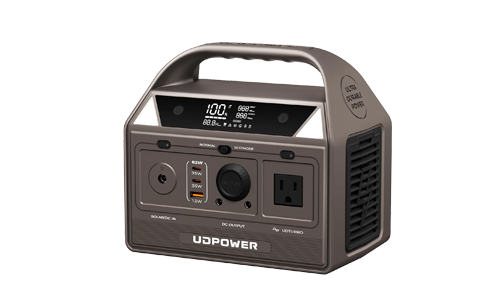
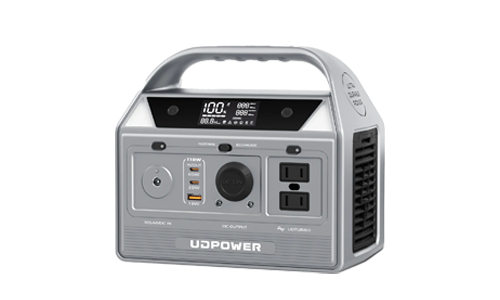
UDPOWER C400: Compact Backup for Short Outages and Travel
- Battery capacity: 256Wh
- AC output: 400W continuous, up to 800W surge
- AC waveform: Pure sine wave
- AC outlets: 2
- Weight: Approximately 6.88 lb
- Estimated 110W, 15-minute treatments: About 8 before applying an emergency reserve
The C400 is the most portable choice in this comparison. It is appropriate when the main goal is to power one compressor nebulizer for several sessions, recharge a portable mesh nebulizer, or create a compact vehicle and travel backup kit.
View UDPOWER C400
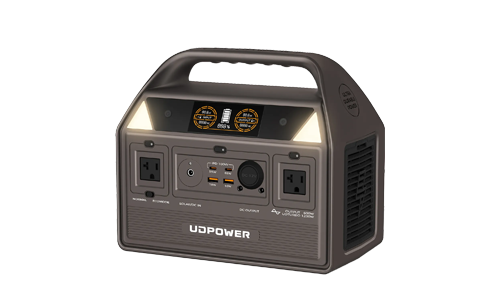
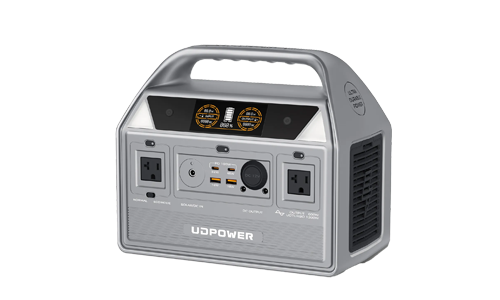
UDPOWER C600: Balanced Capacity for Multi-Day Backup
- Battery capacity: 596Wh
- AC output: 600W continuous, up to 1,200W surge
- AC waveform: Pure sine wave
- AC outlets: 2
- Weight: Approximately 12.3 lb
- Estimated 110W, 15-minute treatments: About 19 before applying an emergency reserve
The C600 provides a stronger balance between portability and stored energy. It is the more practical option for repeated daily treatments during a multi-day outage or for operating a nebulizer while also reserving some capacity for phones and basic lighting.
View UDPOWER C600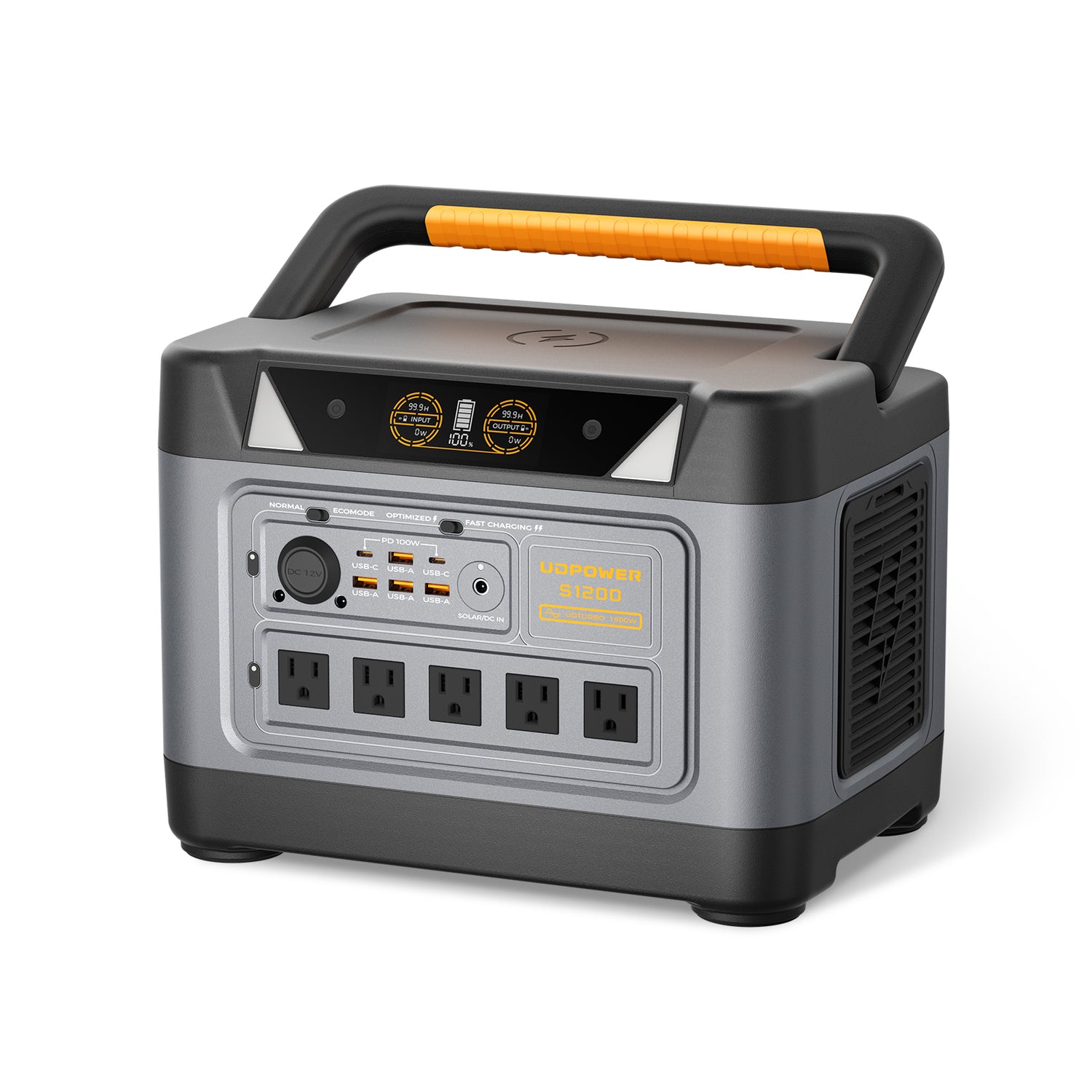
UDPOWER S1200: Extended Home-Outage Reserve
- Battery capacity: 1,190Wh
- AC output: 1,200W continuous, up to 1,800W surge
- AC waveform: Pure sine wave
- AC outlets: 5
- Weight: Approximately 26 lb
- Estimated 110W, 15-minute treatments: About 38 before applying an emergency reserve
The S1200 is designed for a longer outage plan, households that want a larger safety reserve, or users who need to power additional low-wattage essentials. Its larger capacity also reduces how frequently the station must be recharged.
Although the S1200 includes a fast transfer feature, no portable power station should automatically be treated as a certified medical UPS. Confirm your nebulizer manufacturer's power recommendations and maintain a separate emergency plan.
View UDPOWER S1200Quick Product Comparison
| Model | Capacity | Continuous AC Output | Weight | 110W Nebulizer for 15 Minutes | Best Fit |
|---|---|---|---|---|---|
| C400 | 256Wh | 400W | About 6.88 lb | About 8 treatments; plan around 6 with a 20% reserve | Travel, vehicle kit, short outage, single user |
| C600 | 596Wh | 600W | About 12.3 lb | About 19 treatments; plan around 15 with a 20% reserve | Multi-day use and moderate emergency reserve |
| S1200 | 1,190Wh | 1,200W | About 26 lb | About 38 treatments; plan around 30 with a 20% reserve | Longer outages and several essential loads |
What Size Power Station Do You Need for a Nebulizer?
The correct size depends less on whether the unit can start the nebulizer and more on how many treatments must be available before recharging.
| Use Scenario | Suggested Capacity Range | Why | Suitable UDPOWER Option |
|---|---|---|---|
| One or two backup treatments | About 150Wh to 300Wh | Provides several sessions without carrying a large battery | C400 |
| Travel or overnight backup | About 250Wh to 600Wh | Adds reserve for schedule changes, charging a phone, or longer treatment time | C400 or C600 |
| Several treatments per day for two to three days | About 500Wh to 700Wh | Supports repeated compressor use without depending on immediate recharging | C600 |
| Extended outage with a large reserve | About 1,000Wh or more | Allows more treatments and limited use of other essential electronics | S1200 |
| Nebulizer plus oxygen concentrator or another continuous medical device | Calculate each device separately | The second device may dominate both output and battery-capacity requirements | Use the combined-load formula before selecting a model |
Use This Five-Step Sizing Method
- Find the nebulizer's rated watts or electrical input information.
- Record the normal length of one treatment.
- Multiply treatments per day by the number of days you want to cover.
- Calculate total watt-hours and account for conversion losses.
- Add an emergency reserve instead of choosing a battery that reaches exactly zero.
For more choices, visit the UDPOWER portable power station collection or the battery-powered outlet collection.
Which Power Sources Can Run a Nebulizer?
| Power Source | Can It Run a Nebulizer? | Main Advantage | Main Limitation |
|---|---|---|---|
| Household wall outlet | Yes, when voltage and frequency match | Simple and does not depend on battery capacity | Unavailable during a power outage |
| Pure sine wave portable power station | Usually, when continuous output exceeds the nebulizer's requirement | Indoor-safe, portable, quiet, and rechargeable | Runtime is limited by stored watt-hours |
| Portable nebulizer battery | Yes, for a device specifically designed for battery operation | Lightweight and convenient away from home | May support fewer sessions and can use a proprietary battery or charger |
| Vehicle inverter | Possibly | Can provide temporary AC power while traveling | Must have enough continuous and startup output; can drain the vehicle battery |
| Gasoline generator | Yes, with compatible output | Can operate larger loads for extended periods when fuel is available | Produces carbon monoxide and must never be operated indoors, in a garage, or near open windows |
| Ordinary USB power bank | Usually not for an AC compressor nebulizer | Useful for supported USB-powered or rechargeable mesh models | Does not normally provide a 120V AC outlet or motor startup capacity |
Why Pure Sine Wave Output Is the Safer General Choice
Compressor nebulizers contain a small motor. A pure sine wave power station produces AC power that more closely resembles a household outlet than a basic modified sine wave inverter. This can reduce the risk of unusual motor noise, excess heat, or unreliable starting.
The nebulizer manual remains the final authority. If the manufacturer prohibits inverter use or requires a particular power accessory, follow those instructions.
How to Prepare Nebulizer Power for an Outage
Backup equipment is useful only when it is charged, accessible, tested, and paired with the correct cables. The CDC recommends planning backup power for medical equipment, while the FDA provides a home medical-device power-outage checklist.
Before the Outage
- Photograph the nebulizer's electrical label and keep the manual available offline.
- Calculate the number of treatments needed for at least the planned outage period.
- Fully charge the portable power station before severe weather arrives.
- Perform a normal treatment test using the backup source before an emergency.
- Confirm that the compressor starts normally and does not sound unusually slow, strained, or irregular.
- Store the original AC adapter, mask or mouthpiece, tubing, medication cup, and approved medication together.
- Keep extension cables short and appropriately rated.
- Identify a second charging option, such as a vehicle charger or compatible solar panel.
- Write down the equipment provider, clinician, pharmacy, and emergency contact information.
During the Outage
- Use the nebulizer according to the prescribed schedule and device instructions.
- Connect only necessary equipment to the backup battery.
- Turn off the power station's AC output after the session to reduce inverter standby consumption.
- Check the battery percentage after each treatment and record remaining capacity.
- Recharge before the battery reaches the emergency reserve level whenever a safe power source becomes available.
- Keep the power station dry, ventilated, and away from bedding or anything that could block cooling vents.
Common Nebulizer Backup-Power Mistakes
Choosing by Output Watts Alone
A 400W station may easily operate a 110W nebulizer, but a 400W output rating does not tell you how many sessions the battery can provide. Check watt-hours as well as watts.
Assuming Every Nebulizer Uses the Same Power
Official compressor examples range from 80W to 140W, while portable mesh models can be battery-operated. Use your own device label rather than selecting a battery from a generic average.
Using the Maximum Battery Capacity as Usable AC Energy
A 256Wh battery does not normally deliver all 256Wh through its AC outlets. Inverter losses, internal electronics, temperature, and battery condition reduce usable energy.
Leaving the AC Inverter On Between Treatments
The inverter consumes power even when the nebulizer is not running. Switching off unused outputs helps preserve capacity for the next session.
Ignoring Startup Headroom
Compressor motors may briefly demand more power when they start. Choose a power source with continuous and surge output comfortably above the label rating instead of matching it exactly.
Confusing VA With Watts
VA measures apparent power and is not automatically identical to real watts. When the label lists only VA, follow the manufacturer's guidance and select an inverter with sufficient headroom.
Powering Several Devices Without Recalculating
Phones, lights, humidifiers, refrigerators, oxygen concentrators, and other equipment all reduce nebulizer runtime. Add their energy use separately and account for overlapping operation.
Waiting Until the Outage to Test the Setup
A cable mismatch, discharged battery, unusual motor sound, or incompatible inverter should be discovered during a controlled test rather than during an urgent treatment.
Frequently Asked Questions About Nebulizer Power
How many watts does a home nebulizer use?
The official compressor nebulizers reviewed in this guide use approximately 80W to 140W. Check the label or manual for your exact model because wattage varies.
Can a 300W inverter run a nebulizer?
A quality 300W inverter may operate many 80W to 140W compressor nebulizers, provided its continuous output, surge capacity, voltage, frequency, and waveform are compatible. Verify the nebulizer label and inverter specifications before use.
Will a 400W portable power station run a nebulizer?
A 400W pure sine wave station will usually provide sufficient output for one of the 80W to 140W compressor nebulizers used as examples here. Battery capacity determines the number of treatments.
How long will a 256Wh battery run a nebulizer?
With 90% conversion efficiency, a 256Wh battery can theoretically run an 80W nebulizer for about 2.9 hours, a 110W nebulizer for about 2.1 hours, or a 140W nebulizer for about 1.6 hours. These are accumulated running times rather than one continuous treatment recommendation.
How many nebulizer treatments can a portable power station provide?
Divide usable battery energy by the watt-hours used during one treatment. A 256Wh station at 90% efficiency can provide about eight 15-minute treatments with a 110W nebulizer before applying an emergency reserve.
Can a regular USB power bank run a compressor nebulizer?
Usually not. Most compressor nebulizers require a 115V or 120V AC outlet, while ordinary USB power banks provide low-voltage DC output. A USB power bank may recharge a compatible portable mesh nebulizer.
Can I use a nebulizer in a car?
It may be possible with a correctly rated pure sine wave vehicle inverter or a portable power station. Do not assume the vehicle's USB port or 12V socket can directly operate the nebulizer without the correct adapter and sufficient output.
Does a nebulizer use more power when it starts?
A compressor motor can have a brief startup demand above its normal running load. Select a power source with adequate surge capacity rather than matching the listed running watts exactly.
Does a nebulizer need a pure sine wave inverter?
Device requirements vary, but pure sine wave output is the safer general choice for a motor-driven compressor and sensitive electronics. Follow the power instructions supplied by the nebulizer manufacturer.
Can a solar panel power a nebulizer directly?
Direct connection is generally not recommended because solar output changes with sunlight and may not match the nebulizer's required voltage. A safer arrangement is to charge a compatible portable power station with the solar panel and run the nebulizer from the station's regulated AC outlet.
Can I leave a nebulizer connected to a power station all the time?
Follow both manufacturers' instructions. For emergency readiness, test the setup regularly and keep the battery charged. Do not assume that every portable station is a certified medical UPS or that uninterrupted operation is guaranteed.
What should I do if the nebulizer sounds different on backup power?
Stop using that power arrangement and check the voltage, frequency, waveform, output rating, connections, and manufacturer instructions. Unusual speed, sound, vibration, or heat may indicate an unsuitable power source or another equipment issue.
Is a larger power station always better?
A larger battery offers more treatments and reserve capacity, but it also weighs more and costs more. The best size covers the required treatment schedule, conversion losses, emergency reserve, and any additional essential loads without becoming unnecessarily difficult to move.
Build a Nebulizer Backup Plan Before the Next Outage
Start with the wattage on your nebulizer label, calculate the energy needed for each treatment, and choose enough battery capacity for the full treatment schedule plus an emergency reserve.
View the Nebulizer Sizing Guide View Portable Power Stations Get Product Selection HelpRelated Articles


