How Do You Convert Milliamps to Amps?
Convert milliamps to amps using a simple formula, interactive calculator, and detailed conversion chart. This guide also explains how to calculate watts, read charger labels, distinguish mA from mAh, match power adapters, and estimate portable power station requirements.
Last updated: June 25, 2026
Direct Answer: How Do You Convert Milliamps to Amps?
To convert milliamps to amps, divide the milliamp value by 1,000.
1,000 mA = 1 A
- 100 mA = 0.1 A
- 500 mA = 0.5 A
- 1,500 mA = 1.5 A
- 2,000 mA = 2 A
- 5,000 mA = 5 A
A quick way to do the conversion is to move the decimal point three places to the left. For example, 2,500 mA becomes 2.500 A, or 2.5 A.

Milliamps and amps both measure electrical current. The conversion is simple, but using the result correctly requires one more piece of information: voltage. Once you know the voltage and current, you can calculate watts, compare charger ratings, check device compatibility, and estimate what size portable power station you need.
The three most useful formulas are:
- A = mA ÷ 1,000
- mA = A × 1,000
- Watts = Volts × Amps
What Do Milliamps and Amps Measure?
An ampere, normally shortened to amp and written as A, is the standard SI unit of electric current. Current describes the rate at which electric charge flows through a circuit.
A milliampere, shortened to milliamp and written as mA, is one-thousandth of an amp. The prefix “milli” represents 10−3, or 0.001.
1 A = 1,000 mA
Smaller electronic devices often show current in milliamps because values such as 500 mA or 2,000 mA are easier to read than 0.5 A or 2 A. Larger appliances, power supplies, vehicle circuits, and household electrical systems are more commonly rated in amps.
The relationship is defined by the SI metric prefix system. You can review the official prefix table on the International Bureau of Weights and Measures website.
How to Convert Milliamps to Amps
-
Find the milliamp value.
Example: a device label shows 2,400 mA. -
Divide the value by 1,000.
2,400 ÷ 1,000 = 2.4. -
Change the unit from mA to A.
2,400 mA = 2.4 A.
Example: Convert 850 mA to amps
850 ÷ 1,000 = 0.85
Answer: 850 mA = 0.85 A
Example: Convert 75 mA to amps
75 ÷ 1,000 = 0.075
Answer: 75 mA = 0.075 A
Example: Convert 12,500 mA to amps
12,500 ÷ 1,000 = 12.5
Answer: 12,500 mA = 12.5 A
How to Convert Amps Back to Milliamps
For the reverse conversion, multiply the amp value by 1,000.
- 0.25 A × 1,000 = 250 mA
- 0.5 A × 1,000 = 500 mA
- 1.2 A × 1,000 = 1,200 mA
- 3 A × 1,000 = 3,000 mA
- 10 A × 1,000 = 10,000 mA
Milliamps to Amps Conversion Chart
Use this chart for common current values. On a phone, swipe the table sideways to see every column.
| Milliamps | Amps | Calculation |
|---|---|---|
| 0.1 mA | 0.0001 A | 0.1 ÷ 1,000 |
| 1 mA | 0.001 A | 1 ÷ 1,000 |
| 2 mA | 0.002 A | 2 ÷ 1,000 |
| 5 mA | 0.005 A | 5 ÷ 1,000 |
| 10 mA | 0.01 A | 10 ÷ 1,000 |
| 20 mA | 0.02 A | 20 ÷ 1,000 |
| 25 mA | 0.025 A | 25 ÷ 1,000 |
| 50 mA | 0.05 A | 50 ÷ 1,000 |
| 75 mA | 0.075 A | 75 ÷ 1,000 |
| 100 mA | 0.1 A | 100 ÷ 1,000 |
| 250 mA | 0.25 A | 250 ÷ 1,000 |
| 500 mA | 0.5 A | 500 ÷ 1,000 |
| 750 mA | 0.75 A | 750 ÷ 1,000 |
| 1,000 mA | 1 A | 1,000 ÷ 1,000 |
| 1,200 mA | 1.2 A | 1,200 ÷ 1,000 |
| 1,500 mA | 1.5 A | 1,500 ÷ 1,000 |
| 2,000 mA | 2 A | 2,000 ÷ 1,000 |
| 2,400 mA | 2.4 A | 2,400 ÷ 1,000 |
| 2,500 mA | 2.5 A | 2,500 ÷ 1,000 |
| 3,000 mA | 3 A | 3,000 ÷ 1,000 |
| 4,000 mA | 4 A | 4,000 ÷ 1,000 |
| 5,000 mA | 5 A | 5,000 ÷ 1,000 |
| 7,500 mA | 7.5 A | 7,500 ÷ 1,000 |
| 10,000 mA | 10 A | 10,000 ÷ 1,000 |
| 15,000 mA | 15 A | 15,000 ÷ 1,000 |
| 20,000 mA | 20 A | 20,000 ÷ 1,000 |
Source: BIPM SI prefix definitions.
How to Convert Milliamps to Watts
Milliamps tell you the current, but they do not tell you the complete power demand. To calculate watts, you must also know the voltage.
Because the label may show milliamps instead of amps, you can combine the two steps:
Example: 5V device rated at 2,000 mA
2,000 mA ÷ 1,000 = 2 A
5V × 2A = 10W
The device's rated power is approximately 10 watts.
Example: 12V device rated at 5,000 mA
5,000 mA ÷ 1,000 = 5 A
12V × 5A = 60W
The device's rated power is approximately 60 watts.
mA to Watts at Common Voltages
| Current | Amps | At 5V | At 9V | At 12V | At 24V |
|---|---|---|---|---|---|
| 500 mA | 0.5 A | 2.5W | 4.5W | 6W | 12W |
| 1,000 mA | 1 A | 5W | 9W | 12W | 24W |
| 1,500 mA | 1.5 A | 7.5W | 13.5W | 18W | 36W |
| 2,000 mA | 2 A | 10W | 18W | 24W | 48W |
| 2,400 mA | 2.4 A | 12W | 21.6W | 28.8W | 57.6W |
| 3,000 mA | 3 A | 15W | 27W | 36W | 72W |
| 5,000 mA | 5 A | 25W | 45W | 60W | 120W |
| 10,000 mA | 10 A | 50W | 90W | 120W | 240W |
The U.S. Department of Energy also recommends multiplying appliance voltage by current when wattage is not shown on the label. See its appliance energy-use guidance.
How to Read Milliamps on a Charger or Device Label
A charger label often lists both input and output information. These values describe different sides of the power adapter and should not be treated as interchangeable.
Example charger label
Input: 100–240V AC, 50/60Hz, 0.5A
Output: 5V DC, 2,000mA
Here is how to read it:
- The input line describes what the adapter may draw from the wall outlet.
- The output line describes what the adapter supplies to the connected device.
- The output current of 2,000mA equals 2A.
- At 5V, the maximum listed output is 5V × 2A = 10W.
A Charger Does Not Normally Force Its Full Amp Rating into a Device
For a compatible, regulated power supply, the current rating normally describes the maximum current the charger can provide. A device draws the amount of current it needs, up to that limit.
For example, a 5V device that needs 2A can generally use a compatible 5V charger rated for 3A. The charger has extra current capacity, but the device does not automatically receive the entire 3A.
By contrast, a 5V charger rated for only 1A may be inadequate for a device that requires 2A. Charging may be slow, the device may not start, or the adapter may become overloaded.
Common USB Power Profiles
| Label | Current in Amps | Maximum Power | Calculation |
|---|---|---|---|
| 5V, 500mA | 0.5A | 2.5W | 5 × 0.5 |
| 5V, 1,000mA | 1A | 5W | 5 × 1 |
| 5V, 2,000mA | 2A | 10W | 5 × 2 |
| 5V, 3,000mA | 3A | 15W | 5 × 3 |
| 9V, 2,000mA | 2A | 18W | 9 × 2 |
| 12V, 3,000mA | 3A | 36W | 12 × 3 |
| 20V, 5,000mA | 5A | 100W | 20 × 5 |
USB-C chargers may list several voltage and current combinations. The charger and device negotiate a compatible profile, so you should not add all listed profiles together.
mA vs. mAh, A, Ah, W, and Wh
One of the most common mistakes is treating milliamps and milliamp-hours as the same measurement. They describe different things.
| Unit | Full Name | What It Measures | Typical Use |
|---|---|---|---|
| mA | Milliampere | Electric current | Small devices, chargers, circuits, sensors |
| A | Ampere | Electric current | Appliances, adapters, vehicle and household circuits |
| mAh | Milliamp-hour | Charge capacity over time | Phones, power banks, small batteries |
| Ah | Amp-hour | Charge capacity over time | Automotive, marine, RV, and storage batteries |
| W | Watt | Rate of power use or delivery | Device demand and power-station output |
| Wh | Watt-hour | Stored or consumed energy | Battery capacity and runtime estimates |
Why mA Is Not the Same as mAh
Milliamps measure current at a particular moment. Milliamp-hours describe how much charge a battery can theoretically deliver over time.
A label showing 2,000mA describes current. A battery labeled 20,000mAh describes battery charge capacity. You cannot convert mAh to watts or watt-hours without also knowing the battery voltage.
For a full explanation, use the UDPOWER mAh-to-Wh conversion guide or the battery and power unit conversion tools .
How to Match a Power Adapter Safely
Converting mA to A is only one step in checking whether a charger or adapter is suitable for a device. Work through the following checklist.
-
Match the output voltage.
The replacement adapter's output voltage should match the device's required voltage unless the manufacturer specifically permits a range. -
Convert the current into the same unit.
If the device requires 2,000mA, convert it to 2A before comparing it with an adapter labeled in amps. -
Use enough current capacity.
The adapter's available current should normally be equal to or greater than the device's required current. -
Check AC versus DC.
A DC device requires a compatible DC output. Do not assume an AC and DC rating are interchangeable. -
Confirm connector size and polarity.
Two adapters can have identical voltage and current ratings while using different plugs or opposite polarity. -
Check the manufacturer's instructions.
Use the original adapter or an explicitly compatible replacement when the device has specialized charging or communication requirements.
| Device Requirement | Adapter Rating | Current Check | Initial Assessment |
|---|---|---|---|
| 5V, 2,000mA | 5V, 2A | 2,000mA = 2A | Current and voltage match |
| 5V, 2,000mA | 5V, 3A | 3A capacity exceeds 2A need | Generally acceptable if connector and charging standard match |
| 5V, 2,000mA | 5V, 1A | 1A is below the 2A need | Insufficient current capacity |
| 12V, 2A | 9V, 3A | Current is sufficient | Not compatible because voltage does not match |
From Milliamps to Portable Power Station Sizing
A portable power station should not be selected from a milliamp rating alone. Use the current value to calculate watts, then compare both watts and watt-hours.
-
Convert mA to A.
A 12V device rated at 5,000mA draws up to 5A. -
Convert amps to watts.
12V × 5A = 60W. -
Check output compatibility.
The power station's relevant AC, USB, or DC output must support the device's voltage, connector, running watts, and any startup demand. -
Estimate required energy.
A 60W device used for eight hours consumes approximately 480Wh before conversion losses. -
Add practical capacity margin.
Avoid selecting a battery whose advertised capacity exactly equals your calculated energy need.
Runtime Formula
For a straightforward UDPOWER planning estimate, use 90% conversion efficiency:
Example: 12V, 2,000mA device
2,000mA = 2A
12V × 2A = 24W
Using a 256Wh battery:
256Wh × 0.90 ÷ 24W = approximately 9.6 hours
This is a planning estimate rather than a guaranteed runtime. Actual results can change with inverter standby use, the selected output port, device cycling, temperature, cable losses, battery state, and variations in the device's real power draw.
Estimated Runtime by UDPOWER Model
| Model | Capacity | AC Output | At 50W | At 100W | At 300W |
|---|---|---|---|---|---|
| UDPOWER C400 | 256Wh | 400W | About 4.6 hours | About 2.3 hours | About 0.8 hour |
| UDPOWER C600 | 596Wh | 600W | About 10.7 hours | About 5.4 hours | About 1.8 hours |
| UDPOWER S1200 | 1,190Wh | 1,200W | About 21.4 hours | About 10.7 hours | About 3.6 hours |
| UDPOWER S2400 | 2,083Wh | 2,400W | About 37.5 hours | About 18.7 hours | About 6.2 hours |
Estimates use capacity × 90% ÷ continuous device watts. Product specifications are linked directly to the corresponding UDPOWER product pages.
Recommended UDPOWER Models by Power Need
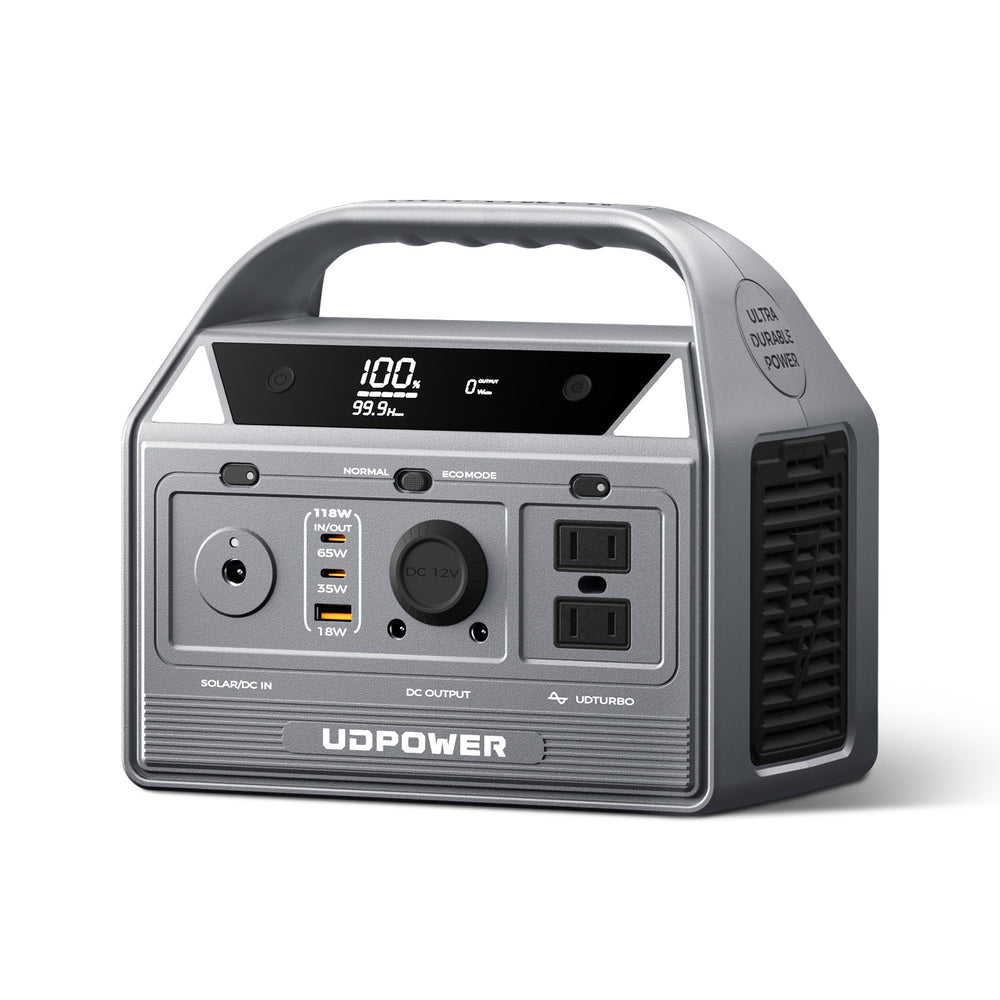
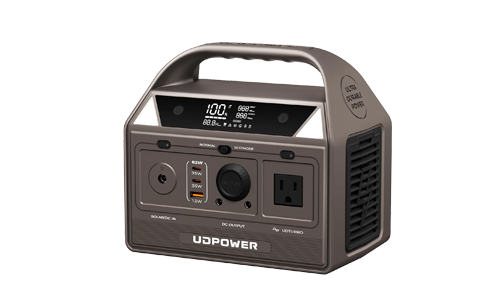
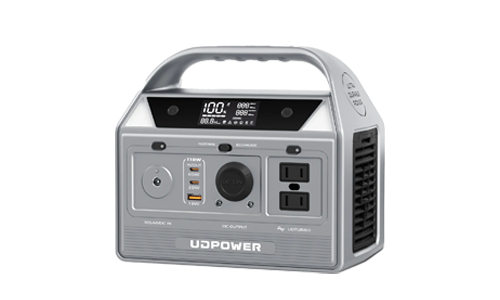
UDPOWER C400: Compact Power for Small Electronics
The C400 is a practical choice for phones, cameras, laptops, routers, lights, CPAP use with a verified power requirement, and other compact camping or outage essentials. It offers more flexibility than a basic power bank while remaining easy to carry.
Choose it when your converted wattage is comfortably below its relevant output limit and you need short-duration backup rather than extended appliance runtime.
View UDPOWER C400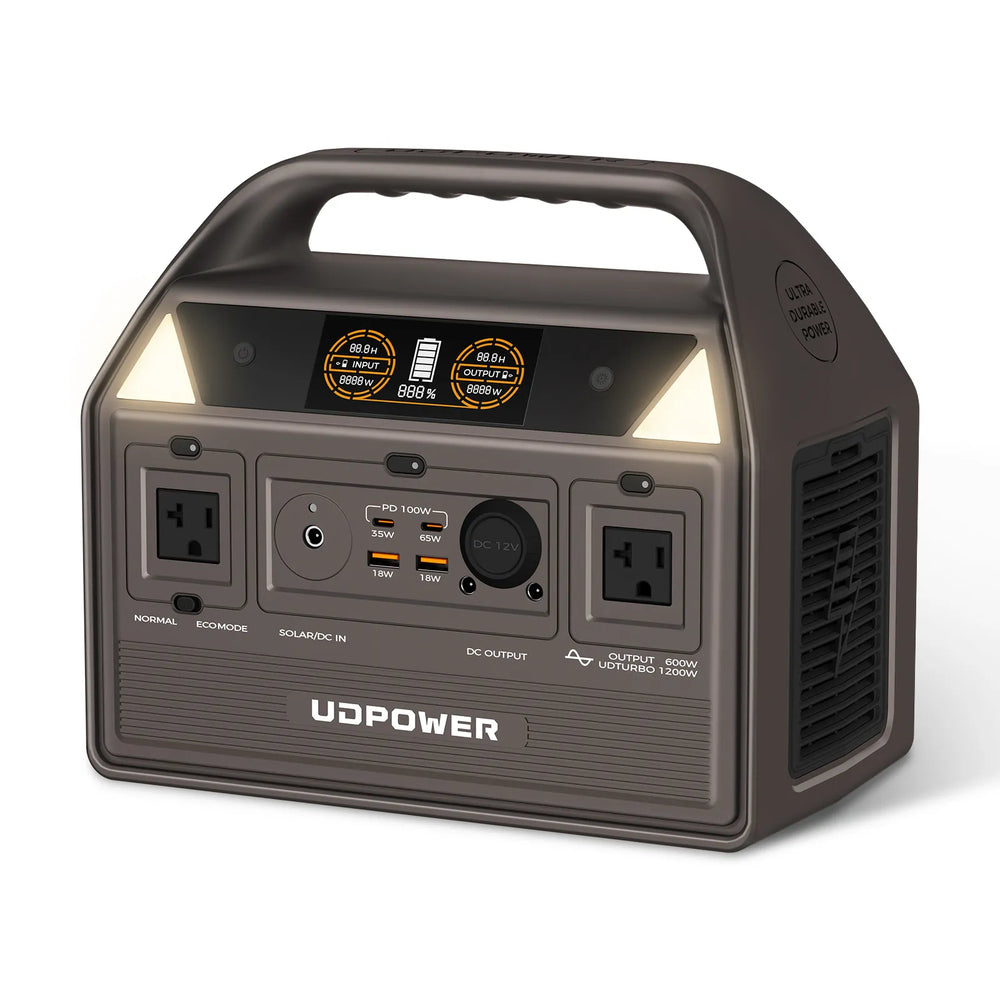
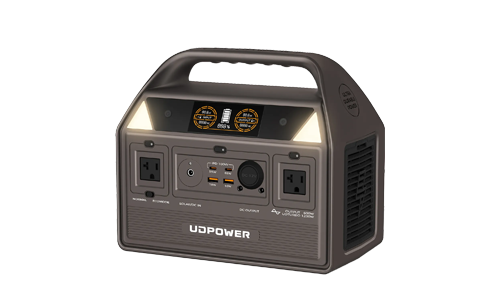
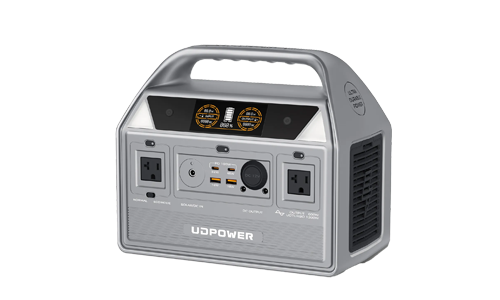
UDPOWER C600: More Runtime for Camping and Multiple Devices
The C600 provides more stored energy for camping electronics, portable workstations, fans, lighting, charging several devices, and moderate backup loads.
It is a useful middle option when a 256Wh unit does not provide enough runtime but a larger home-backup model would be more than you need.
View UDPOWER C600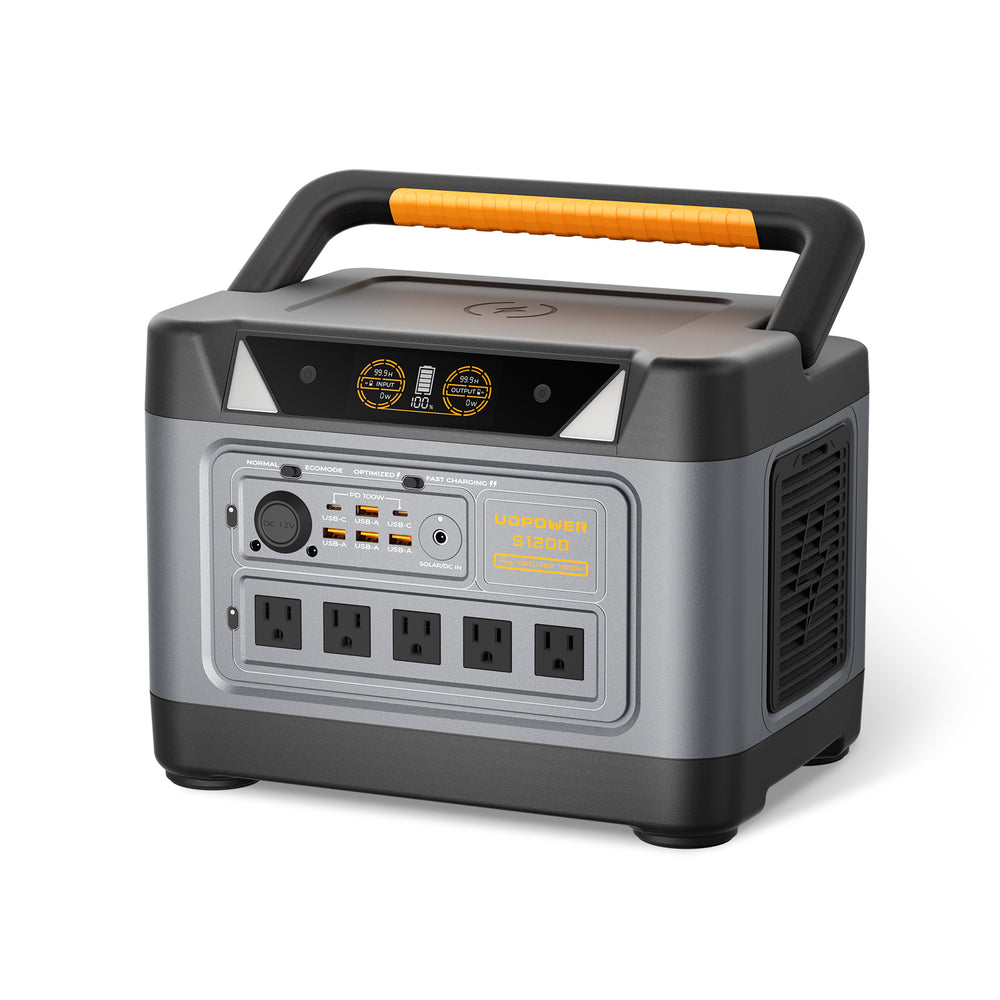
UDPOWER S1200: Home Essentials and Longer Backup
The S1200 is better suited to longer backup for home-office equipment, refrigerators with verified startup requirements, CPAP equipment, camping setups, and multiple devices used together.
Its larger battery capacity matters when the goal is not merely powering a device, but keeping it running for many hours.
View UDPOWER S1200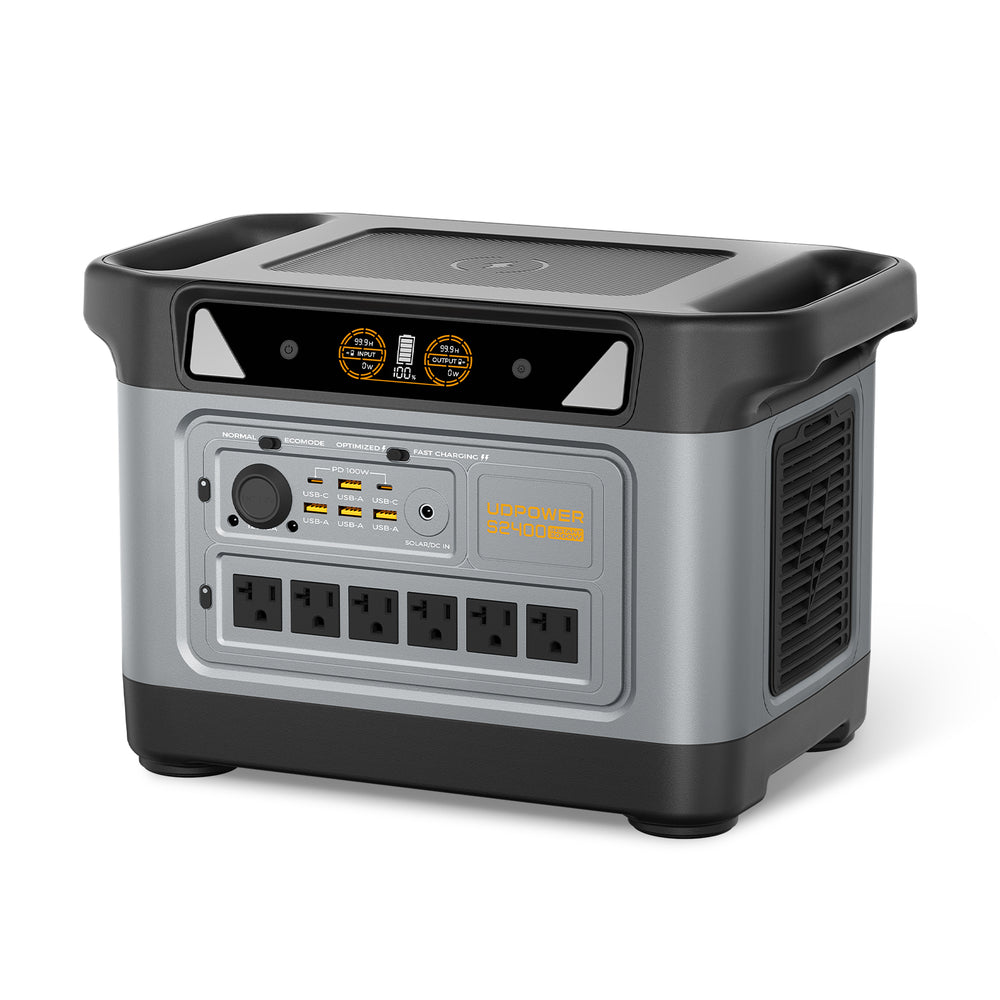
UDPOWER S2400: Higher-Power Appliances and Extended Backup
The S2400 is intended for larger appliance loads, RV use, power tools, emergency backup, and situations where several devices may be running at the same time.
It provides substantially more output and stored energy than a compact station, but every appliance should still be checked for running wattage, startup demand, voltage, and expected runtime.
View UDPOWER S2400For a broader comparison, visit the UDPOWER portable power station collection .
Common Milliamps-to-Amps Mistakes
1. Multiplying Instead of Dividing
Milliamps are the smaller unit. To convert mA to A, divide by 1,000. Multiplication is used only when converting amps back to milliamps.
2. Moving the Decimal in the Wrong Direction
When converting mA to A, move the decimal three places to the left: 2,500mA becomes 2.500A, or 2.5A.
3. Confusing mA with mAh
mA is current. mAh is battery charge capacity over time. The units cannot be substituted for each other.
4. Ignoring Voltage
Current alone does not reveal wattage. A 2A rating at 5V is 10W, but a 2A rating at 24V is 48W.
5. Comparing an Adapter's Input Amps with Its Output Amps
Input and output values refer to opposite sides of the adapter. Compare the device requirement with the adapter's output specifications.
6. Assuming a Higher-Amp Charger Always Charges Faster
Charging speed is controlled by the device, charger, cable, voltage, supported charging protocol, temperature, and battery-management system. A large amp rating alone does not guarantee faster charging.
7. Choosing a Power Station from Amps Alone
Use watts to check whether the station can run the device and watt-hours to estimate how long it can run. Also verify the correct output voltage, connector, and startup demand.
8. Treating a Maximum Rating as Constant Consumption
A label may show the maximum current a device or adapter can use. Actual current can vary during operation, so real energy consumption may be lower or may change over time.
9. Adding USB-C Profiles Together
A charger marked 5V/3A, 9V/3A, 15V/3A, and 20V/5A does not provide all four profiles simultaneously through one connection. The device and charger select an appropriate supported profile.
10. Assuming V × A Is Always Exact for Every AC Device
Multiplying voltage by current gives a useful estimate. For some AC equipment, actual watts may also be affected by power factor and operating conditions. Use the device's listed wattage or measured power whenever it is available.
Milliamps to Amps FAQ
How many milliamps are in one amp?
There are exactly 1,000 milliamps in one amp. Therefore, 1,000mA = 1A.
How do I convert mA to A?
Divide the milliamp value by 1,000. For example, 2,500mA ÷ 1,000 = 2.5A.
How do I convert amps to milliamps?
Multiply the amp value by 1,000. For example, 1.5A × 1,000 = 1,500mA.
What is 500 mA in amps?
500mA equals 0.5A because 500 ÷ 1,000 = 0.5.
What is 1,200 mA in amps?
1,200mA equals 1.2A.
What is 2,000 mA in amps?
2,000mA equals 2A.
What is 2.5 mA in amps?
2.5mA equals 0.0025A because 2.5 ÷ 1,000 = 0.0025.
What is 10,000 mA in amps?
10,000mA equals 10A.
Is mA the same as mAh?
No. mA measures electric current, while mAh measures battery charge capacity over time.
How many watts is 1,000 mA?
It depends on voltage. At 5V, 1,000mA equals 1A and 5W. At 12V, the same 1A equals 12W.
Does a higher milliamp rating mean more power?
Only when the voltage is the same. Power depends on both current and voltage, so compare watts rather than current alone.
Can a 3A charger damage a device that needs 2A?
A compatible regulated charger with the correct voltage can generally have a higher available current rating because the device draws only what it needs. The voltage, connector, polarity, and charging standard must still be compatible.
Can I use a 1A charger for a device rated at 2,000mA?
A 1A charger provides less current capacity than the device's 2A requirement. It may charge slowly, fail to operate the device correctly, or become overloaded. Use the manufacturer-recommended charger.
What does 5V 2,000mA mean?
It means the output is rated at 5 volts and up to 2 amps. The maximum listed power is 5V × 2A = 10W.
Why are an adapter's input and output amps different?
The adapter changes voltage and converts power between the wall outlet and the device. Input current and output current therefore describe different sides of the conversion process.
Is the mA-to-A conversion different for AC and DC?
No. The unit conversion remains 1,000mA = 1A for both AC and DC. However, calculating actual AC power can involve additional factors, so use listed or measured watts when available.
Can I choose a portable power station using milliamps alone?
No. You need voltage to convert current into watts. You then need the station's output rating for compatibility and its watt-hour capacity for runtime.
How many microamps are in one milliamp?
One milliamp equals 1,000 microamps. Therefore, 1,000µA = 1mA = 0.001A.
Sources
Turn Your Current Rating into a Real Power Plan
Convert milliamps to amps, use the device voltage to calculate watts, and compare the result with a power station's output and watt-hour capacity.
Open All Battery Conversion Tools Compare UDPOWER Portable Power Stations Read the Device Compatibility GuideRelated Articles