

What American-Made Portable Power Station Is Recommended?
Finding a genuinely American-made portable power station is harder than finding an American brand. This guide separates products that are made in the United States from those that are only designed, assembled, owned, or shipped from the United States.
For buyers who strictly prioritize a documented U.S.-made product, Grid Eraser is the clearest current recommendation we found. Its solar generator systems are built and tested in Wisconsin. However, they are large, cabinet-style AGM systems rather than compact suitcase-style LiFePO4 power stations.
For a configurable and weather-resistant system with a qualified “Assembled in USA” claim, consider the RevoPower Fortress. Buyers should understand that “assembled in the USA” does not automatically mean every major component was made domestically.
For most households that care more about portability, LiFePO4 battery life, output, charging speed, and value, the UDPOWER S1200 is our best all-around practical recommendation. The UDPOWER S2400 is better for heavier backup loads.

What Does “American-Made” Actually Mean?
The phrase is often used loosely in online product listings. Under the Federal Trade Commission’s standard, an unqualified “Made in USA” claim generally means that the product is “all or virtually all” made in the United States. Final assembly must take place in the United States, all significant processing must occur domestically, and foreign content must be negligible.
Portable power stations make this especially complicated. A single unit may contain battery cells, an inverter, a battery-management system, circuit boards, charging controllers, cooling components, an enclosure, cables, and display hardware sourced from several countries.
| Claim on the product | What it normally tells you | What it does not prove | How buyers should treat it |
|---|---|---|---|
| Made in USA | An unqualified claim should meet the FTC’s “all or virtually all” standard. | It does not automatically reveal where every raw material was mined or processed. | Look for a product-specific statement and supporting details. See the FTC Made in USA guidance. |
| Made in USA with imported components | A qualified claim acknowledging meaningful foreign content. | It does not tell you which components are imported unless the manufacturer provides more detail. | Ask whether the battery cells, inverter, and electronics are domestic or imported. |
| Assembled in USA | Principal assembly took place in the United States and should be substantial. | It does not mean the battery cells or other major components were manufactured in the United States. | Treat it as a separate and narrower claim than “Made in USA.” |
| Designed or engineered in USA | Product development or engineering work occurred in the United States. | It does not establish the country of manufacture. | Check the product label or manufacturer’s origin statement. |
| American company | The brand may be headquartered, founded, or owned in the United States. | Company ownership does not determine where a product is built. | Evaluate ownership and manufacturing origin separately. |
| Ships from a U.S. warehouse | Inventory is stored and fulfilled domestically. | It says nothing about where the unit was manufactured. | Use this information to judge delivery and service convenience, not product origin. |
Quick Recommendations by Buyer Priority
| Your main priority | Recommended option | Why it fits | Main limitation |
|---|---|---|---|
| Clearest documented U.S.-made system | Grid Eraser | The manufacturer states that its systems are built and tested in Trevor, Wisconsin. | Large cabinet construction, AGM batteries, and much higher cost than mainstream portable LiFePO4 stations. |
| Weather-resistant U.S.-assembled system | RevoPower Fortress | Configurable inverter and battery options with a product-specific “Assembled in USA” statement. | Assembled in the USA is a qualified claim and does not establish that every major component is domestically manufactured. |
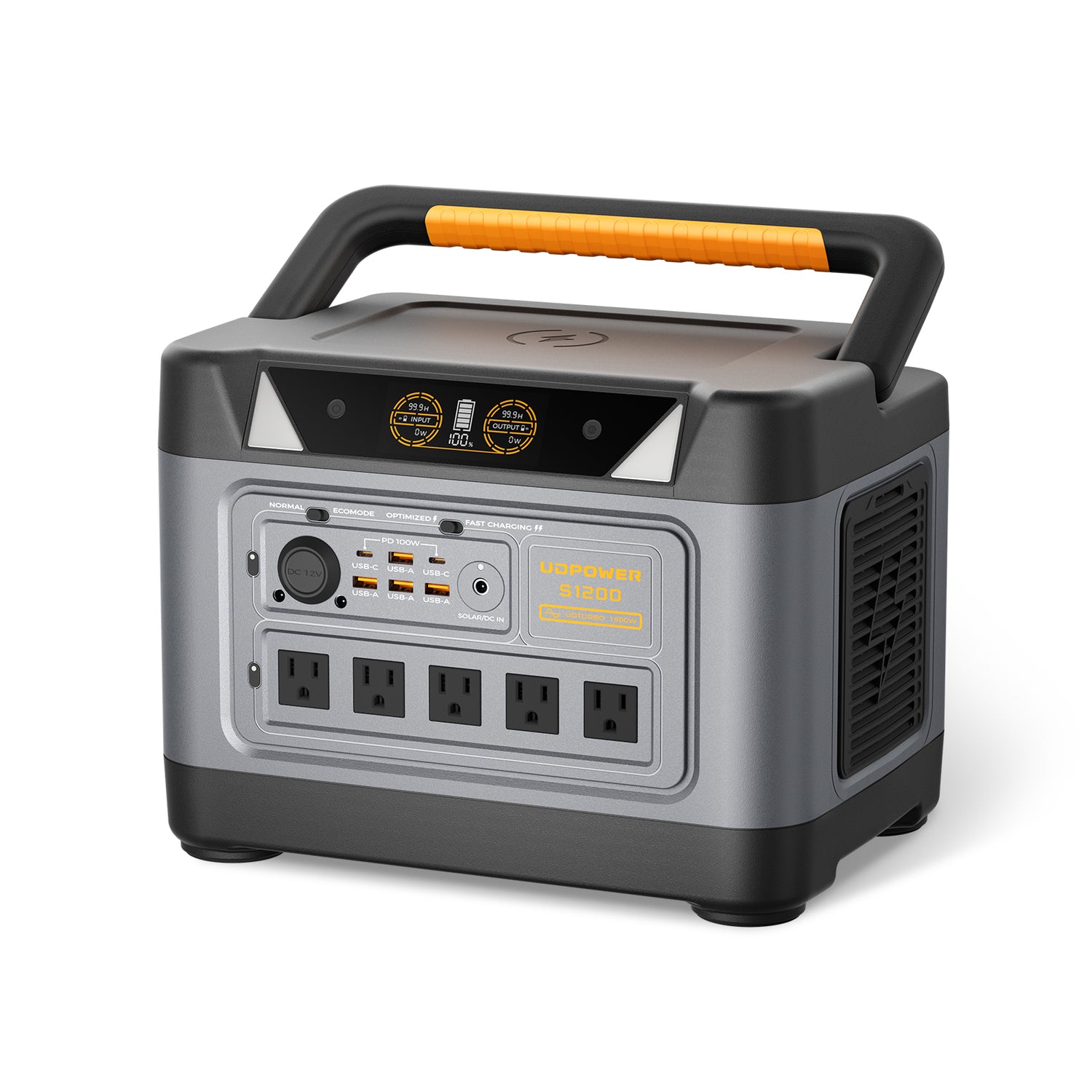
| Best all-around mainstream value | UDPOWER S1200 | 1,190Wh capacity, 1,200W continuous output, LiFePO4 battery, UPS function, and manageable 26-pound weight. | Not presented as American-made. |
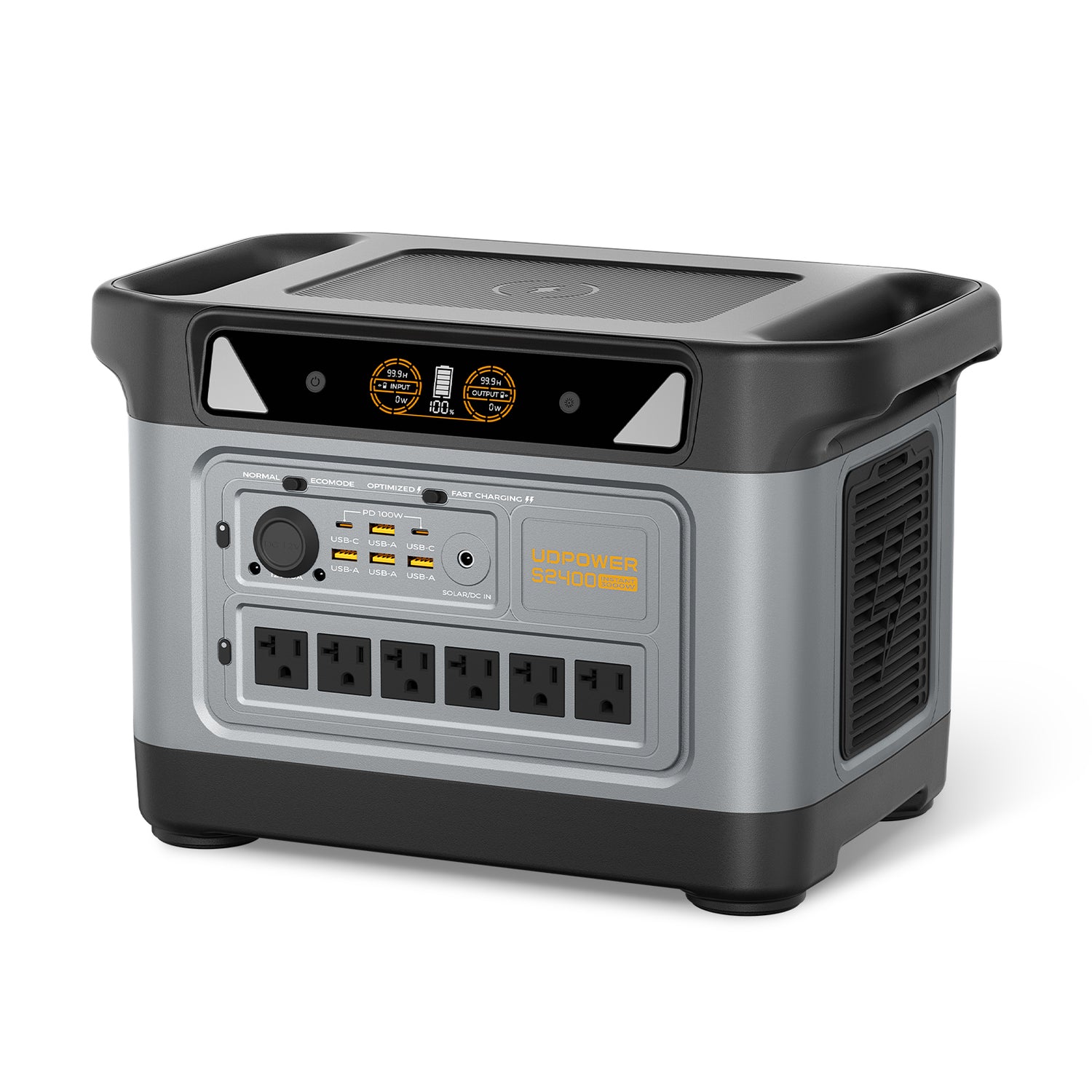
| Higher-output household backup | UDPOWER S2400 | 2,083Wh capacity, 2,400W continuous output, six AC outlets, and support for up to 400W of solar input. | At 40.8 pounds, it is transportable rather than lightweight. |
| Light camping and low-power backup | UDPOWER C600 | 596Wh capacity and 600W output in a 12.3-pound package. | Not suitable for high-wattage cooking appliances, heaters, or large power tools. |
American-Made and U.S.-Assembled Options Worth Considering
1. Grid Eraser: Best Match for a Strict U.S.-Made Priority
Grid Eraser is the clearest current match for buyers who place domestic manufacturing ahead of compact size and low weight. The company states that its systems are built and tested in Trevor, Wisconsin.
Its Signature system is listed with approximately 1,748Wh of battery capacity, a 900W maximum output, a 200W solar array, and an AGM battery. The larger Maximus increases capacity to approximately 3,496Wh, output to 1,800W, and solar capacity to 400W.
Not ideal for: Air travel, frequent car-to-campsite carrying, apartment storage, or buyers seeking a small LiFePO4 unit.
The construction is closer to a movable solar-generator cabinet than the molded suitcase format most shoppers picture when they hear “portable power station.” Buyers should review dimensions, battery chemistry, replacement-battery requirements, and mobility before ordering.
2. RevoPower Fortress: Best Qualified U.S.-Assembled Option
RevoPower describes the Fortress as assembled in the United States with a U.S.-made enclosure. Depending on configuration, it can be equipped with 1,000W, 2,000W, or 3,000W inverter options, an optional 2,400Wh LiFePO4 battery, and up to 480W of solar charging.
The weather-resistant enclosure and configurable design make it more attractive for field use, emergency response, mobile businesses, and outdoor work than a typical indoor-focused consumer station.
Check before buying: Which configuration is included, battery capacity, inverter output, component origin, total weight, included charging equipment, and the exact warranty coverage.
3. Why an American Brand Is Not Automatically American-Made
Some recognizable power-station brands have American roots but use global manufacturing. For example, Goal Zero states that its products are designed, engineered, and tested in Salt Lake City while being manufactured with partners in China.
Lion Energy states that it designs and engineers energy-storage products from American Fork, Utah. That may matter to buyers who want to support U.S.-based product development, but a company-wide statement should not replace a product-specific country-of-origin declaration.
This does not automatically make an internationally manufactured product inferior. It simply means buyers should not confuse company location, engineering location, and manufacturing origin.
How to Verify an American-Made Claim Before You Buy
Product listings often use language that sounds domestic without making a legally meaningful manufacturing claim. Before spending hundreds or thousands of dollars, ask the seller these questions:
- Does the product carry an unqualified “Made in USA” label, a qualified claim, or only an “Assembled in USA” statement?
- Where are the battery cells manufactured?
- Where are the inverter, battery-management system, circuit boards, and solar charge controller manufactured?
- Where does final assembly occur?
- What manufacturing steps are completed at the U.S. facility?
- Is the origin claim printed on the product itself or only used in broad company marketing?
- Can the company provide a written product-specific origin statement?
A clear manufacturer should be able to distinguish between domestic manufacturing, domestic assembly, domestic engineering, and domestic fulfillment without changing the subject.
Recommended UDPOWER Alternatives by Power Requirement
A strict country-of-origin preference is only one part of choosing backup power. Output, usable capacity, battery chemistry, weight, charging input, warranty support, and outlet configuration determine whether the station will actually run your equipment.
The following UDPOWER models are practical alternatives for buyers whose priority is a compact LiFePO4 station with U.S. inventory and support availability. They are not presented here as American-made products.
 Best for lightweight use
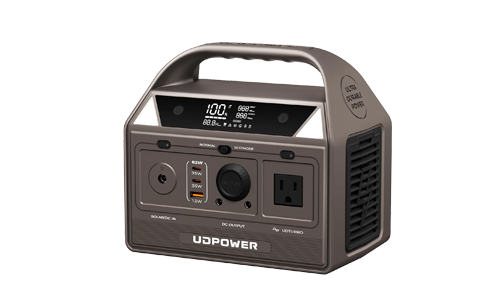
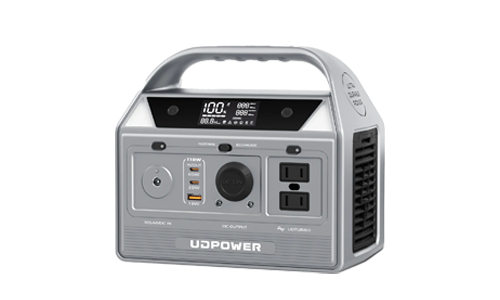
UDPOWER C600
The C600 is the easiest of the three models to carry. It is a sensible choice for camping lights, laptops, phones, camera equipment, routers, small fans, and many low-wattage CPAP setups.
- Battery capacity: 596Wh
- Continuous AC output: 600W pure sine wave
- Maximum output: 1,200W
- Battery chemistry: LiFePO4
- Weight: 12.3 pounds
- Maximum solar input: 240W
- AC outlets: 2
- USB-C output: Up to 100W total
Do not choose the C600 for space heaters, electric kettles, large coffee makers, high-power microwaves, or appliances that require more than 600W continuously.
 Best all-around recommendation
UDPOWER S1200
The S1200 offers the most balanced combination of capacity, output, and portability. It can support a refrigerator, television, router, laptops, lights, CPAP equipment, and many medium-power appliances when loads are managed carefully.
- Battery capacity: 1,190Wh
- Continuous AC output: 1,200W pure sine wave
- Surge output: 1,800W
- Battery chemistry: LiFePO4
- Weight: 26 pounds
- Maximum solar input: 400W
- AC outlets: 5
- UPS transfer time: 10 milliseconds or less
The S1200 is usually the better starting point than a 500–600Wh station for refrigerator backup because it provides more capacity for compressor cycling and more output headroom for startup demand.
 Best for heavier backup loads
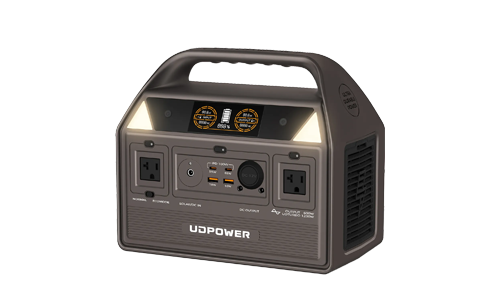
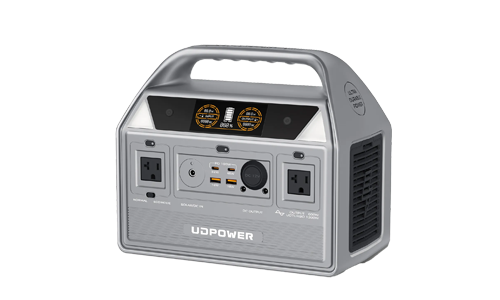
UDPOWER S2400
The S2400 is intended for users who need substantially more output and capacity. It is better suited to running a refrigerator alongside communication equipment, lights, televisions, small kitchen appliances, or selected tools.
- Battery capacity: 2,083Wh
- Continuous AC output: 2,400W pure sine wave
- Startup surge: Up to 3,000W
- Battery chemistry: LiFePO4
- Weight: 40.8 pounds
- Maximum solar input: 400W
- AC outlets: 6
- UPS transfer time: 10 milliseconds or less
Although the S2400 can handle many 120V household appliances, it should not be confused with a permanently installed whole-home battery system. Always check continuous wattage, startup wattage, voltage, and plug type before connecting an appliance.
UDPOWER Portable Power Station Specification Comparison
| Specification | UDPOWER C600 | UDPOWER S1200 | UDPOWER S2400 |
|---|---|---|---|
| Battery capacity | 596Wh | 1,190Wh | 2,083Wh |
| Continuous AC output | 600W | 1,200W | 2,400W |
| Maximum or surge output | 1,200W maximum | 1,800W surge | 3,000W startup surge |
| Battery chemistry | LiFePO4 | LiFePO4 | LiFePO4 |
| Published cycle specification | 3,000 cycles to at least 80% capacity | 3,000 cycles to at least 80% capacity | 3,000 cycles to at least 80% capacity |
| Weight | 12.3 lb | 26 lb | 40.8 lb |
| Dimensions | 11.1 × 6.1 × 9.4 in | 13.7 × 9.5 × 9.7 in | 15.8 × 9.5 × 10.1 in |
| Maximum solar input | 240W | 400W | 400W |
| AC outlets | 2 | 5 | 6 |
| Fast-transfer UPS | No | Yes, 10 ms or less | Yes, 10 ms or less |
| Best use | Light camping and electronics | General emergency and refrigerator backup | Higher-load household and RV backup |
| Official specifications | View C600 specifications | View S1200 specifications | View S2400 specifications |
Surge output is intended for brief startup demand. It should not be used as the station’s continuous operating limit. Choose a model whose continuous rating remains above the combined running wattage of all connected equipment.
Estimated Runtime by Appliance Load
Nameplate battery capacity is not the same as energy delivered through an AC outlet. The inverter and internal electronics consume some power. The estimates below use a 90% conversion-efficiency planning factor.
| Example continuous load | C600 estimated runtime | S1200 estimated runtime | S2400 estimated runtime |
|---|---|---|---|
| 40W CPAP or low-power electronics | About 13.4 hours | About 26.8 hours | About 46.9 hours |
| 60W laptop, fan, or average small load | About 8.9 hours | About 17.9 hours | About 31.2 hours |
| 100W television and networking equipment | About 5.4 hours | About 10.7 hours | About 18.7 hours |
| 150W average refrigerator load | About 3.6 hours | About 7.1 hours | About 12.5 hours |
| 500W appliance or combined load | About 1.1 hours | About 2.1 hours | About 3.7 hours |
| 1,000W appliance | Above continuous output limit | About 1.1 hours | About 1.9 hours |
| 1,500W appliance | Above continuous output limit | Above continuous output limit | About 1.2 hours |
These are planning estimates, not guaranteed runtimes. Refrigerator compressors cycle on and off, CPAP humidifiers change consumption, startup surges can be several times the running wattage, and cold or hot weather can affect available battery energy.
How to Choose the Right Portable Power Station
For camping and vehicle travel
Weight matters every time the station moves between your home, vehicle, tent, and campsite. The C600 is easier to carry for electronics and lighting. The S1200 is more appropriate when a portable refrigerator, CPAP, or several devices must run overnight.
See the UDPOWER RV and camping power station collection for models and solar bundles intended for mobile use.
For refrigerator backup
Check both running wattage and compressor startup demand. A refrigerator that averages 100–200W may briefly require much more power when the compressor starts. The S1200 is the more practical minimum for many household refrigerators, while the S2400 provides more runtime and room for other essential loads.
For CPAP use
Confirm whether the quoted wattage includes the humidifier and heated hose. Disabling heat functions can substantially extend runtime, but users should follow their medical provider’s instructions. DC operation may also reduce conversion losses when the correct manufacturer-approved adapter is available.
Browse portable battery backup options for CPAP use .
For home emergency backup
List the equipment that must remain available during an outage. Prioritize refrigeration, communication, medical equipment, lighting, and selected small appliances. Trying to power everything at once increases the output requirement and reduces runtime.
A portable power station is not automatically a whole-home solution. Central air conditioning, electric water heaters, electric ranges, well pumps, and other 240V equipment may require a larger installed system or generator.
For solar recharging
Match the solar panel’s operating voltage, current, connector, and total wattage to the station’s published input range. A panel’s advertised wattage is a laboratory rating; real input changes with sun angle, temperature, shade, clouds, panel cleanliness, and cable loss.
Explore UDPOWER solar generator kits if you want a power station and compatible solar panel in one package.
What Many Portable Power Station Comparisons Miss
Country of origin does not determine appliance compatibility
A domestically produced station can still be the wrong choice if its continuous output is below your appliance load. Start with electrical requirements, then compare origin claims among products capable of doing the job.
The battery cells and inverter are more important than the outer case
A U.S.-made enclosure is meaningful, but it does not tell you where the battery cells, inverter, power electronics, or battery-management system were manufactured. Those components have a larger influence on output, efficiency, safety controls, and long-term serviceability.
Repairability may matter more than final assembly location
Ask whether the battery, inverter, fans, display, and charge controller can be serviced. A product assembled domestically may still be difficult to repair if replacement parts and technical documentation are unavailable.
Warranty length and warranty execution are different
A long warranty is useful only when the seller provides accessible support, clear troubleshooting, replacement parts or units, and a workable shipping process. Review the warranty exclusions and return policy before purchase.
Portability should be judged by the entire trip
“Portable” can describe anything from a 12-pound battery to a cabinet on wheels. Consider stairs, lifting height, vehicle space, campsite distance, and whether one person can move the station safely.
Portable Power Station Buying Checklist
- Origin claim: Made in USA, assembled in USA, designed in USA, or simply shipped from a U.S. warehouse?
- Continuous output: Is it higher than the combined running wattage of your equipment?
- Startup output: Can it handle refrigerator, compressor, pump, or motor startup demand?
- Usable capacity: How many watt-hours remain after normal conversion losses?
- Battery chemistry: Is it LiFePO4, NMC, AGM, or another chemistry?
- Cycle specification: How many cycles are stated, and to what remaining capacity?
- Solar input: Are the voltage, current, wattage, and connector compatible with your panels?
- Charging speed: How long does AC, car, and solar charging take under realistic conditions?
- UPS capability: Is transfer time appropriate for your intended equipment?
- Weight and dimensions: Can the intended user carry and store it safely?
- Outlet layout: Are there enough AC, USB-C, USB-A, and DC outputs?
- Warranty and returns: Who handles support, and where must a defective unit be shipped?
- Certifications: Verify the exact model and certification rather than relying on a general brand statement.
Frequently Asked Questions
Are any portable power stations completely made in the USA?
Options with clear product-level U.S.-made claims are limited. Grid Eraser is one of the clearest current examples found during this review, although its products are larger cabinet-style systems rather than compact suitcase-style LiFePO4 stations. Buyers should recheck the current product label and manufacturer statement before ordering.
What is the difference between made in USA and assembled in USA?
An unqualified Made in USA claim generally requires the product to be all or virtually all made domestically. An assembled-in-USA claim focuses on substantial final assembly in the United States and may still involve imported battery cells, electronics, and other major parts.
Is UDPOWER made in the USA?
This article does not represent UDPOWER portable power stations as American-made. UDPOWER is recommended here as a performance and value alternative with products available through U.S.-market warehousing and support. Warehouse location and manufacturing origin are separate issues.
Is Goal Zero made in the USA?
Goal Zero states that its products are designed, engineered, and tested in Salt Lake City and manufactured with partners in China. That makes it an example of a U.S.-based brand whose product-development location is different from its manufacturing location.
Does a LiFePO4 battery mean the power station is American-made?
No. LiFePO4 describes the battery chemistry, not the country of origin. LiFePO4 cells and completed power stations can be manufactured in many countries.
Which UDPOWER model is best for a refrigerator?
The S1200 is the best general starting point for many household refrigerators because it offers 1,190Wh of capacity and 1,200W of continuous output. The S2400 is better when longer runtime or additional appliances are required. Always verify compressor startup wattage.
Which UDPOWER model is easiest to carry?
The C600 is the lightest option in this comparison at approximately 12.3 pounds. It is best suited to low-power electronics, lights, small fans, laptops, and similar loads within its 600W continuous limit.
Can a portable power station run an entire house?
Most portable models are intended for selected essential circuits or individual appliances, not every load in a house. Central HVAC systems, electric ranges, water heaters, well pumps, and other 240V equipment may require a larger installed battery system or generator.
Should country of origin be the main buying factor?
It can be an important preference, but the station must first meet your continuous wattage, startup wattage, runtime, outlet, charging, and portability requirements. A product that matches your origin preference but cannot run your equipment is not a useful backup solution.
How can I calculate portable power station runtime?
Multiply the station’s watt-hour capacity by an estimated efficiency factor and divide by the appliance wattage. For conservative UDPOWER planning, use capacity × 0.90 ÷ load watts. Actual runtime varies with temperature, appliance cycling, standby consumption, and inverter efficiency.
Choose a Power Station by Load, Runtime, and Portability
Start with the appliances you need to run, add their continuous wattage, check startup demand, and estimate the runtime required. Then compare battery capacity, weight, charging input, and warranty support.
Sources Checked for This Guide
- Federal Trade Commission: Complying with the Made in USA Standard
- Grid Eraser official product and manufacturing information
- RevoPower Fortress official product page
- Goal Zero official manufacturing-location statement
- Lion Energy official company information
- UDPOWER official company information
- UDPOWER C600 official specifications
- UDPOWER S1200 official specifications
- UDPOWER S2400 official specifications
Related Articles


