How Many Watts Does a Dishwasher Use?
Last updated: July 3, 2026
Many full-size residential dishwashers are rated at roughly 1,200 to 2,400 watts, with about 1,800 watts serving as a practical planning midpoint. That does not mean a dishwasher continuously draws 1,800 watts for the entire cycle. Power rises and falls as the pump, water heater, drain pump, and drying system switch on and off.
For your electric bill or battery planning, the more useful number is kilowatt-hours per load. Under current ENERGY STAR criteria, a standard dishwasher can use no more than 240 kWh per year, or about 1.12 kWh per standardized load. A compact model can use no more than 155 kWh per year, or about 0.72 kWh per load. View the current ENERGY STAR criteria.
At the April 2026 U.S. residential average electricity rate of 18.83 cents per kWh, those ENERGY STAR limits work out to approximately $0.21 per standard load or $0.14 per compact load for electricity.

A dishwasher is not a constant-wattage appliance. Its heating element may create a relatively high short-term demand, while the controls and pump use much less power during other parts of the cycle. That difference is why a single “average wattage” cannot answer every question.
Homeowners trying to estimate operating cost should focus on kWh per load. Anyone trying to run a dishwasher from a generator, inverter, or portable power station must check both maximum wattage and total cycle energy. This guide explains how to find all three numbers without confusing watts, runtime, and energy use.
Dishwasher Wattage at a Glance
A general range is useful for early planning, but it should never replace the electrical rating on the actual appliance. Two dishwashers of the same physical size can have different heaters, drying systems, cycle options, and maximum current ratings.
On a phone, swipe the table horizontally to see every column.
| Dishwasher type | General planning range | What usually causes the highest draw | What to verify | Reference |
|---|---|---|---|---|
| Countertop or portable dishwasher | About 600–1,500W | Internal water heater and heated drying | Nameplate watts or amps; plug type | ENERGY STAR dishwasher resources |
| Compact 18-inch dishwasher | About 1,000–1,800W | Water-heating portion of the cycle | Maximum input, annual kWh, and installation method | Compact-model criteria |
| Standard 24-inch dishwasher | About 1,200–2,400W | Water heater or heated-dry element | Exact model label and owner’s manual | General dishwasher wattage overview |
| Model using sanitize or high-temperature settings | May approach its nameplate maximum for longer periods | Additional water heating | Cycle specifications and measured peak draw | U.S. Department of Energy guidance |
Watts vs. kWh: The Three Numbers That Matter
The easiest way to understand dishwasher power use is to separate three different ratings.
1. Maximum or nameplate watts
Maximum wattage tells you whether an outlet, inverter, generator, or portable power station can supply enough power when the dishwasher’s highest-demand components are active.
This number matters most for equipment compatibility. A 1,500W power source should not be assumed to run a dishwasher carrying a 1,800W electrical rating, even if the dishwasher uses far less energy during other parts of the cycle.
2. Kilowatt-hours per cycle
Kilowatt-hours measure the total electrical energy consumed from the beginning to the end of a wash cycle. This is the number needed to estimate:
- Electricity cost per load
- How much of a battery will be used
- How many loads a portable power station may support
- How one dishwasher compares with another in real energy use
3. Annual kWh on the EnergyGuide label
The yellow EnergyGuide label provides an estimated annual electricity consumption and annual operating cost under standardized assumptions. It is designed for comparing models rather than predicting a household’s exact bill.
The Federal Trade Commission explains how to read this label in its EnergyGuide shopping guide.
Annual kWh ÷ 215 cycles = estimated kWh per cycle
Example: a dishwasher labeled at 240 kWh per year uses approximately 240 ÷ 215 = 1.12 kWh per standardized cycle.
How Dishwasher Power Use Changes During a Cycle
A dishwasher may run for two or three hours without drawing its maximum wattage for that entire period. Modern machines spend significant time soaking, circulating water, monitoring soil levels, or pausing between active stages.
| Cycle stage | Main components operating | Relative power demand | Why it matters |
|---|---|---|---|
| Filling | Water inlet valve and controls | Low | Usually a short stage with limited energy impact |
| Washing and circulation | Circulation pump, controls, and sensors | Low to moderate | Can run for long periods, but normally below heater demand |
| Water heating | Heating element or inline heater | High | Often creates the highest sustained electrical demand |
| Draining | Drain pump | Low to moderate | Short duration, so total energy use is generally limited |
| Heated drying | Heating element and possibly a fan | Moderate to high | Can materially increase cycle energy consumption |
| Air-dry or door-open drying | Controls, fan, or no active heater | Very low to low | Usually consumes less energy than heated drying |
This changing load explains why multiplying a dishwasher’s maximum watts by its full cycle duration usually overstates consumption. For example, treating a 1,800W dishwasher as a constant 1,800W load for three hours would produce a 5.4 kWh estimate. That is far above the standardized annual energy allowance for current ENERGY STAR models because the heater does not remain at full power throughout the entire cycle.
How Many kWh Does a Dishwasher Use per Load?
Actual consumption depends on the model, water temperature, selected cycle, load size, soil level, and drying option. Current ENERGY STAR limits provide a useful reference point for efficient models.
| Annual EnergyGuide figure | Estimated kWh per standardized load | Estimated cost per load at 18.83¢/kWh | Estimated annual electricity cost | How to interpret it |
|---|---|---|---|---|
| 155 kWh/year | 0.72 kWh | $0.14 | $29.19 | Current ENERGY STAR maximum for qualifying compact models |
| 200 kWh/year | 0.93 kWh | $0.18 | $37.66 | Example of a particularly efficient annual rating |
| 240 kWh/year | 1.12 kWh | $0.21 | $45.19 | Current ENERGY STAR maximum for qualifying standard models |
| 300 kWh/year | 1.40 kWh | $0.26 | $56.49 | Example of a higher-consumption model or annual label |
| 400 kWh/year | 1.86 kWh | $0.35 | $75.32 | Example of an older or substantially less efficient unit |
Calculations use 215 standardized cycles per year and the April 2026 U.S. residential average electricity rate of 18.83 cents per kWh. See the ENERGY STAR criteria and EIA electricity price data.
The 155 and 240 kWh figures are certification ceilings, not promises that every qualifying dishwasher consumes exactly that amount. Your exact model may use less, and a household’s cycle choices can move real consumption above or below the label-based estimate.
How Much Does It Cost to Run a Dishwasher?
kWh per load × electricity rate per kWh = cost per load Example: 1.12 kWh × $0.1883 = about $0.21 per load
Electricity prices differ significantly by state, utility, season, and rate plan. The table below shows why using your own utility rate gives a better answer than relying on a national average.
| Energy used per load | At 12¢/kWh | At 18.83¢/kWh | At 25¢/kWh | At 35¢/kWh |
|---|---|---|---|---|
| 0.72 kWh | $0.09 | $0.14 | $0.18 | $0.25 |
| 1.12 kWh | $0.13 | $0.21 | $0.28 | $0.39 |
| 1.40 kWh | $0.17 | $0.26 | $0.35 | $0.49 |
| 1.80 kWh | $0.22 | $0.34 | $0.45 | $0.63 |
Does this include the cost of hot water?
The annual energy figure used for federal dishwasher comparisons accounts for standardized machine energy and water-heating assumptions. Your real household cost can still differ because of your water-heater type, incoming water temperature, utility prices, and cycle selection.
A home using an electric water heater may see more of the total cost on the electric bill. A home using gas for water heating will split the cost between electricity and gas.
How to Find Your Dishwasher’s Exact Wattage
Do not buy a backup power source based only on the generic wattage ranges above. Use the following process for the actual dishwasher.
Step 1: Find the model and electrical rating
Check the label around the dishwasher door, side of the door frame, kick-plate area, installation guide, or owner’s manual. Look for:
- Input voltage, usually shown as V
- Maximum current, shown as A or amps
- Rated input power, shown as W or watts
- Frequency, commonly 60 Hz for U.S. household models
- Whether the unit is cord-connected or hardwired
Step 2: Calculate watts when only volts and amps are listed
Watts = Volts × Amps
A dishwasher rated at 120V and 12A has a calculated electrical input of:
120V × 12A = 1,440W
This multiplication is a conservative sizing calculation. The dishwasher may not draw the full current during every stage, but the power source still needs enough output capacity for the appliance’s highest demand.
Step 3: Read the yellow EnergyGuide label
Use the annual kWh figure to compare total energy consumption. Divide that number by 215 for a standardized per-cycle estimate.
Step 4: Measure a complete cycle when appropriate
For a factory cord-connected countertop or portable dishwasher, a properly rated energy meter can show both peak watts and total kWh over a full cycle. Confirm that the meter is rated for the appliance’s voltage and current.
Can a Portable Power Station Run a Dishwasher?
A portable power station can run some plug-in dishwashers, but only when both of the following conditions are met:
- The power station’s continuous AC output is higher than the dishwasher’s maximum operating demand.
- The battery has enough usable watt-hours to complete the selected cycle with a reasonable reserve.
Checking only battery capacity is not enough. A 2,000Wh battery with a 1,000W inverter still cannot properly supply a dishwasher that demands 1,800W during water heating.
Checking only output wattage is also not enough. A 2,400W inverter may start the appliance, but a small battery could shut down before the cycle finishes.
| Dishwasher electrical rating | 1,200W power station | 2,400W power station | Practical conclusion |
|---|---|---|---|
| 600–1,000W | Potentially compatible | Compatible by output rating | Verify plug type and total cycle kWh |
| 1,001–1,200W | Possible, but little headroom near 1,200W | Compatible by output rating | A higher-output model provides more operating margin |
| 1,201–2,000W | Not compatible by continuous output | Potentially compatible | Do not run other heavy AC loads at the same time |
| 2,001–2,400W | Not compatible | Possible, but limited output headroom | Confirm actual peak demand before use |
| Above 2,400W | Not compatible | Not compatible by rated continuous output | Select a higher-output source |
| Hardwired built-in dishwasher | Do not improvise a connection | Do not improvise a connection | Consult an electrician about a code-compliant backup system |
Continuous output matters more than a surge headline
A dishwasher heater may remain active long enough to be treated as a sustained load. A short-duration surge capability does not turn a 1,200W inverter into a 1,800W continuous power source.
Use a pure sine wave AC output
Modern dishwashers contain electronic controls, sensors, pumps, and motors. A pure sine wave inverter is the appropriate choice for supplying household-quality AC power to this type of appliance.
Keep a practical output margin
Avoid sizing a power station so closely that the dishwasher consumes its entire rated output. Actual current can vary with cycle stage, voltage, water temperature, and other connected equipment.
Which UDPOWER Model Fits a Dishwasher?
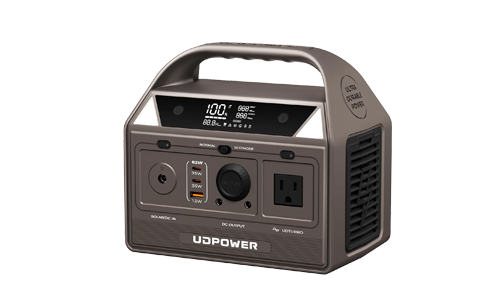
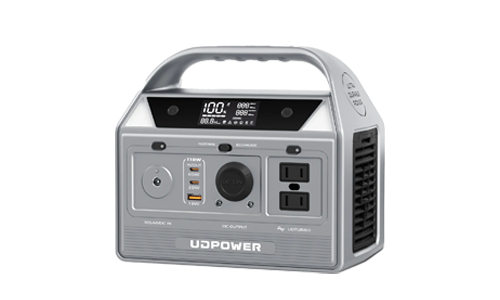
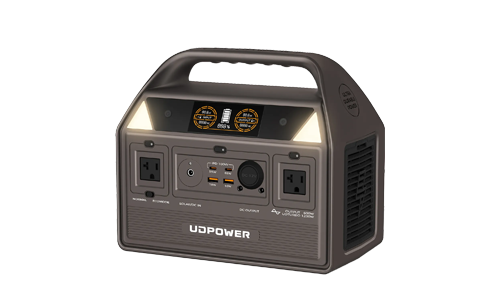
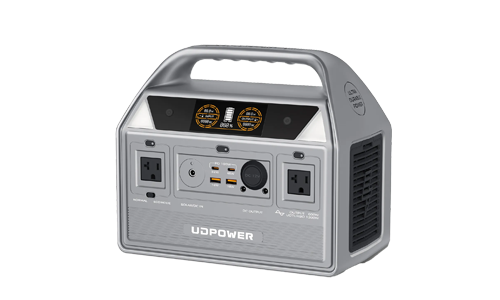
Among the current UDPOWER lineup, the UDPOWER S2400 is the more practical dishwasher option because its 2,400W rated AC output covers a much broader portion of the common residential dishwasher range. The S1200 should be considered only for a verified lower-wattage plug-in model.
UDPOWER S2400: Better Fit for Many Full-Size Dishwashers
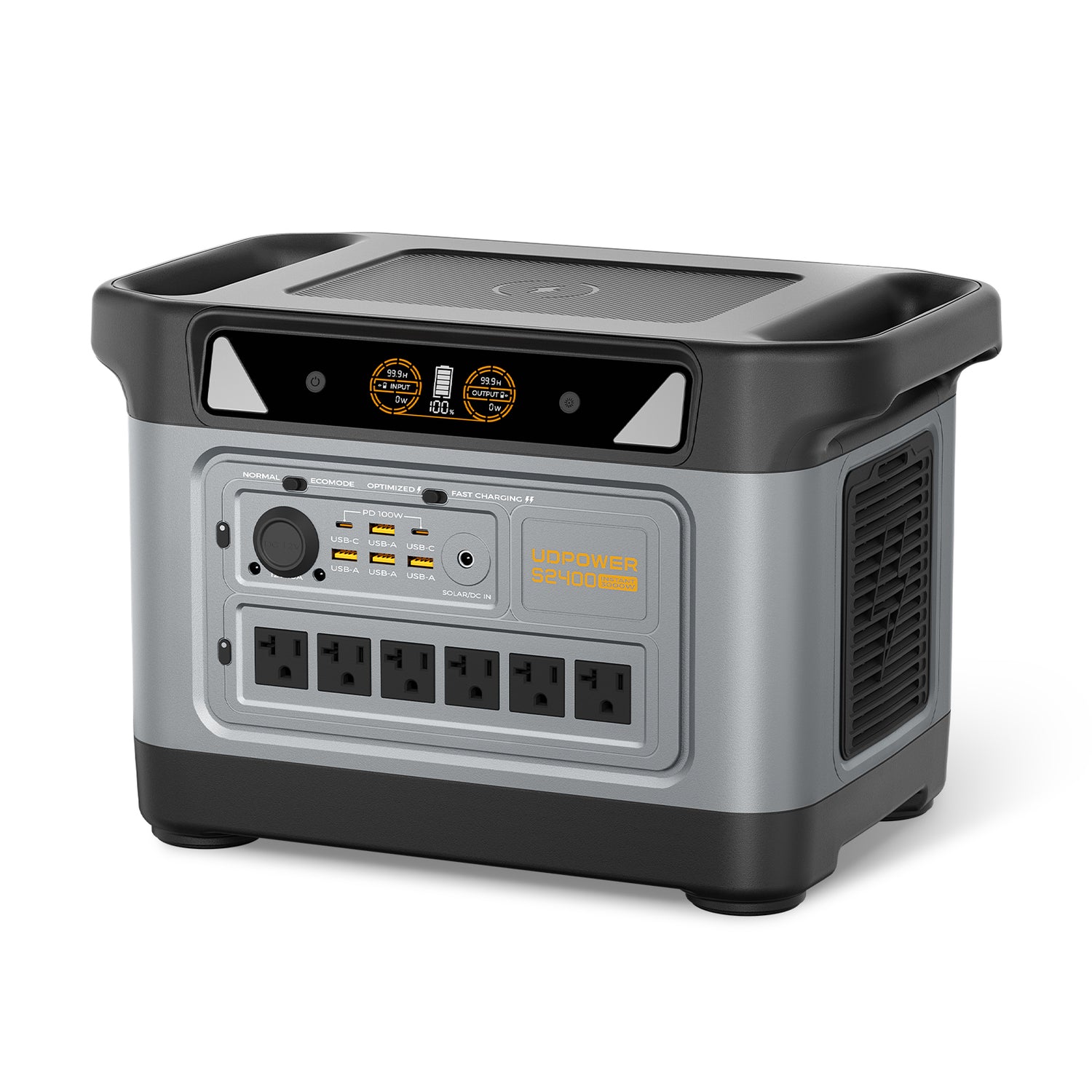
- Battery capacity: 2,083Wh
- Rated AC output: 2,400W pure sine wave
- Surge support: Up to 3,000W
- AC outlets: 6
- Total output ports: 15
- Battery chemistry: LiFePO4
- UPS switchover: Less than 10 ms
- Maximum solar input: Up to 400W
- Weight: 40.8 lb
The S2400 is the preferred choice when the dishwasher’s verified electrical demand is below 2,400W. For a unit rated close to the full 2,400W limit, there is little room for voltage variation or other AC loads, so testing and additional output margin are advisable.
During a dishwasher cycle, avoid operating other high-wattage appliances such as a microwave, electric kettle, toaster, space heater, or hair dryer from the same power station.
View the UDPOWER S2400 See What a 2000W-Class Power Station Can RunUDPOWER S1200: Only for Verified Low-Wattage Models
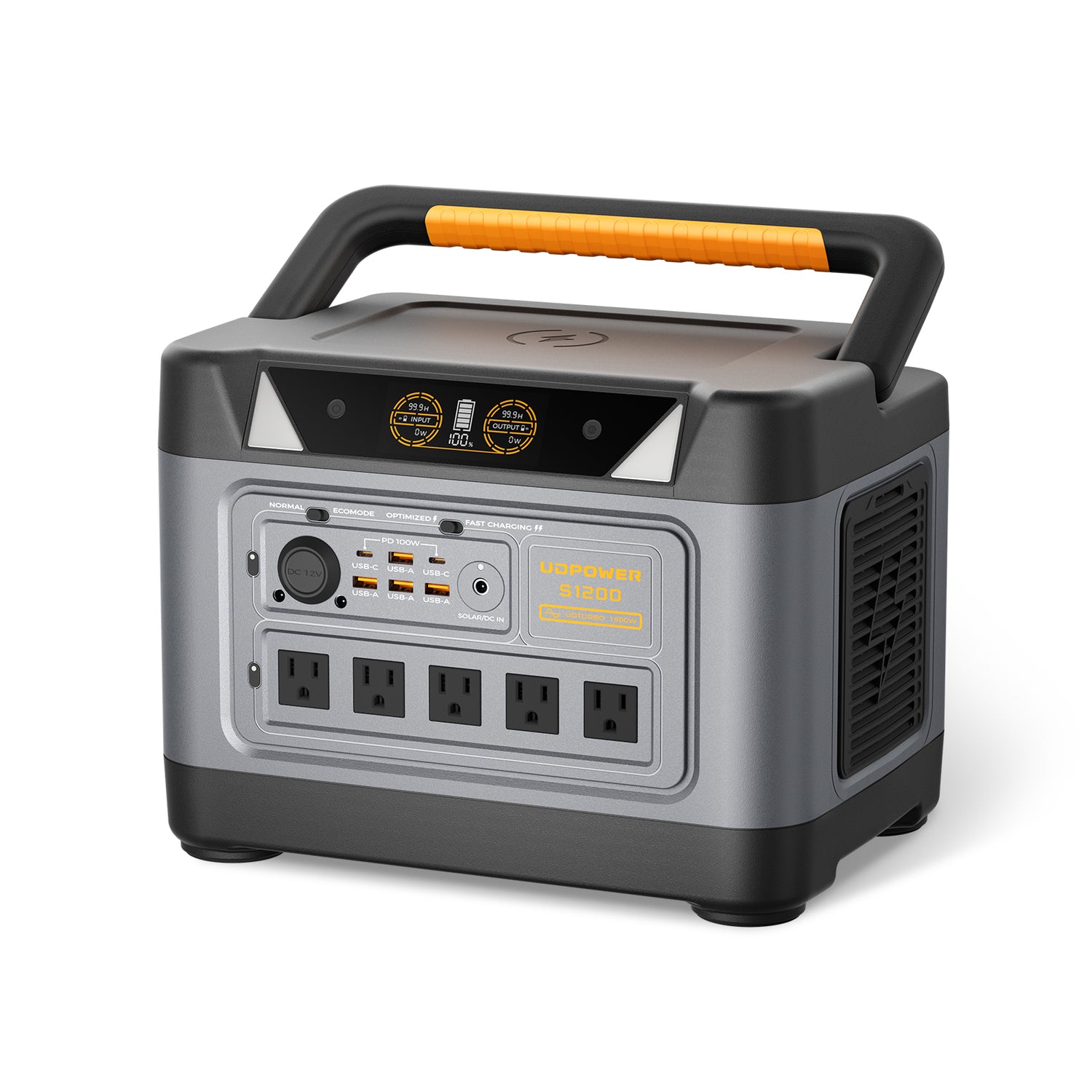
- Battery capacity: 1,190Wh
- Rated AC output: 1,200W pure sine wave
- Surge support: Up to 1,800W
- AC outlets: 5
- Total output ports: 14
- Battery chemistry: LiFePO4
- UPS switchover: Less than 10 ms
- Maximum solar input: Up to 400W
- Weight: 26 lb
The S1200 may be suitable for a countertop, portable, or compact dishwasher whose documented maximum demand stays below 1,200W. It is not the recommended choice for an unknown full-size dishwasher.
Its 1,800W surge capability is intended for brief start-up demand. It should not be interpreted as permission to run a 1,500W or 1,800W heating load continuously.
View the UDPOWER S1200 See What a 1200W Power Station Can RunEstimated Dishwasher Cycles per Power Station Charge
The following estimates use a conservative planning method:
- 90% AC conversion efficiency
- A 10% battery reserve instead of planning to reach 0%
- No simultaneous loads
- No solar energy added during the cycle
Battery Wh × 0.90 conversion efficiency × 0.90 remaining-use allowance
S2400 planning energy: 2,083Wh × 0.90 × 0.90 = about 1,687Wh
S1200 planning energy: 1,190Wh × 0.90 × 0.90 = about 964Wh
These are energy-only estimates. Output compatibility must be checked separately.
| Dishwasher energy per cycle | Example type | S2400 estimated cycle equivalents | S1200 estimated cycle equivalents | Important limitation |
|---|---|---|---|---|
| 0.72 kWh | Compact ENERGY STAR ceiling | About 2.3 cycles | About 1.3 cycles | The dishwasher must also stay within the inverter output limit |
| 0.93 kWh | Very efficient standard-size example | About 1.8 cycles | About 1.0 cycle | S1200 still requires a verified load of 1,200W or less |
| 1.12 kWh | Standard ENERGY STAR ceiling | About 1.5 cycles | About 0.9 cycle | S1200 may lack both output headroom and cycle energy |
| 1.40 kWh | Higher-consumption dishwasher | About 1.2 cycles | About 0.7 cycle | A full S1200 charge may not finish the cycle |
| 1.80 kWh | Older, intensive, or heated-dry scenario | About 0.9 cycle | About 0.5 cycle | Even the S2400 may not complete one cycle with reserve |
A result of 1.5 cycles does not mean you should intentionally start a second load. It means one full cycle is within the battery’s energy budget, with some estimated capacity remaining. Actual results change with the dishwasher, selected cycle, battery state, temperature, and inverter losses.
For a broader explanation of capacity and runtime, see How Long Will a 2000Wh Power Station Last?
Should You Run a Dishwasher During a Power Outage?
A dishwasher may be electrically possible to run, but it is rarely the first appliance to prioritize during an extended outage. A standard efficient dishwasher cycle consuming around 1.12 kWh can use a meaningful portion of a backup battery.
| Alternative load | Approximate operating time using 1.12 kWh | Why it may have higher outage priority |
|---|---|---|
| 10W LED light | About 112 hours | Basic nighttime lighting and household safety |
| 20W internet modem and router | About 56 hours | Communication, weather alerts, and remote work |
| 60W laptop | About 18.7 hours | Work, communication, and access to information |
| 100W average refrigerator load | About 11.2 hours | Food preservation and medication storage |
These are simple energy comparisons before conversion losses and appliance cycling. They show the opportunity cost of using more than 1 kWh on one dishwasher load.
During a brief outage, running a dishwasher may be reasonable after confirming sufficient battery reserve. During a multi-day outage, a refrigerator, communication equipment, medical equipment, lighting, and device charging normally deserve priority.
How to Reduce Dishwasher Energy Use
Run full loads without overloading
A full dishwasher spreads the water-heating and pumping energy across more dishes. Avoid crowding items so tightly that spray arms cannot reach them, since rewashing a load eliminates the expected savings.
Use Eco or Normal mode for everyday loads
Eco cycles often run longer because they use lower water temperatures, less water, or longer soaking periods. A longer cycle is not automatically a higher-energy cycle.
Turn off heated drying when practical
Selecting air dry, opening the door at the end of the cycle when the manufacturer allows it, or using an automatic door-opening feature can reduce active heater use.
Scrape dishes instead of pre-rinsing under running water
Remove bones, seeds, and large food scraps, but avoid unnecessary hot-water rinsing when the dishwasher manufacturer does not require it. The U.S. Department of Energy recommends scraping rather than rinsing and running full loads. Read the DOE dishwasher guidance.
Clean the filter and inspect the spray arms
A blocked filter or spray arm can reduce cleaning performance and lead to repeat cycles. Follow the appliance manual rather than using a generic maintenance schedule.
Use lower-cost hours when you have time-of-use pricing
Delayed-start operation may lower the bill for customers whose utilities charge less during off-peak hours. It reduces cost rather than total kWh, so confirm the applicable schedule with your utility.
Choose the right cycle rather than always using Quick Wash
A shorter cycle is not guaranteed to use less electricity. Some quick cycles compensate for reduced time with hotter water or more intensive pumping. Compare the cycle information in your specific owner’s manual.
Frequently Asked Questions
How many watts does an average dishwasher use?
Many full-size residential dishwashers fall within a general 1,200–2,400W planning range, with roughly 1,800W commonly used as a midpoint. The exact model rating is more reliable than any average.
Does a dishwasher use 1,800 watts for the entire cycle?
Usually not. Power demand changes as the circulation pump, water heater, drain pump, controls, and drying system cycle on and off. Use kWh per cycle to measure total energy consumption.
How many kWh does a dishwasher use per load?
Current ENERGY STAR limits equal approximately 0.72 kWh per standardized load for compact models and 1.12 kWh per standardized load for standard models. Actual appliances and cycle settings may use more or less.
How much does one dishwasher load cost?
At 18.83 cents per kWh, a 0.72 kWh load costs about $0.14 in electricity, while a 1.12 kWh load costs about $0.21. Multiply your dishwasher’s actual kWh per load by your local electricity rate for a personalized estimate.
How many amps does a dishwasher use?
The exact amperage varies by model. Check the electrical label or installation manual. When amps are listed instead of watts, multiply volts by amps for a conservative input-watt estimate. For example, 120V × 12A equals 1,440W.
Can a 1,200W power station run a dishwasher?
Only when the dishwasher’s documented maximum demand remains within the power station’s 1,200W continuous output. This may include certain countertop or compact models, but many full-size dishwashers exceed that limit.
Can a 2,000W or 2,400W power station run a dishwasher?
It can run many plug-in dishwashers when the appliance’s maximum demand is below the power station’s continuous AC rating and the battery has enough usable energy for the complete cycle. Confirm the actual model before connecting it.
Can I run a hardwired dishwasher from a portable power station?
Do not create a temporary plug, backfeed a circuit, or modify a hardwired connection yourself. Ask a qualified electrician whether a code-compliant transfer system or dedicated backup circuit is appropriate.
Why does Eco mode take longer if it uses less energy?
Eco mode may rely on lower temperatures, less water, longer soaking, and slower cleaning action. Extending time can reduce the need for high-power heating, so cycle duration alone does not determine energy consumption.
Does heated dry use more electricity?
Yes. Heated drying adds active heater time and can raise the cycle’s total kWh. Air-dry, fan-dry, or automatic door-opening options generally require less heating energy.
Will a dishwasher drain more battery on Sanitize mode?
It often can because Sanitize or High Temperature modes may heat water to a higher target and keep the heater active longer. Measure or review the specific cycle data if battery runtime is important.
Is a longer dishwasher cycle always more expensive?
No. A long Eco cycle can consume less energy than a shorter, high-temperature cycle. Total kWh depends on which components operate and for how long, not simply the elapsed time shown on the display.
Choose Backup Power Based on the Actual Appliance
Start with the dishwasher’s nameplate watts or amps, then compare its cycle energy with the battery capacity. For many full-size plug-in dishwashers, the 2,400W-rated S2400 provides substantially more output headroom than a 1,200W-class unit.
View the UDPOWER S2400 Compare All UDPOWER Models Browse Portable Power StationsData Sources and Calculation Notes
- Current dishwasher efficiency limits and the 215-cycle annual test assumption: ENERGY STAR Dishwasher Key Product Criteria
- Dishwasher selection and energy-saving guidance: U.S. Department of Energy
- Explanation of annual appliance operating estimates: Federal Trade Commission EnergyGuide Guide
- U.S. residential electricity prices: U.S. Energy Information Administration
- Product capacity, output, port, charging, and weight specifications: UDPOWER S2400 Official Product Page and UDPOWER S1200 Official Product Page
Cost figures are mathematical estimates rounded to the nearest cent. Battery-cycle figures use 90% conversion efficiency and retain a 10% planning reserve. They are not guaranteed runtimes because dishwasher demand, cycle selection, battery condition, temperature, and inverter behavior vary.
Related Articles