

Generac Generator Cost in 2026: Installed Price & Running Cost
A professionally installed Generac home standby generator typically costs about $8,000 to $16,000 including the generator, according to Generac's current installation guidance. The equipment itself costs considerably less. As of September 8, 2026, Generac's current catalog lists cellular standby models bundled with a transfer switch starting around $4,619 for 10kW, $5,949 for 14kW, $6,769 for 18kW, $7,369 for 22kW, $7,789 for 24kW, and $8,219 for 26kW.
The number that matters to a homeowner is rarely the online generator price. Gas piping, electrical work, the transfer switch, permits, site preparation, trenching, panel changes, load management, startup testing, and local labor can easily make installation and related work cost as much as—or more than—the generator itself.
If you only want to keep a refrigerator, Wi-Fi, lights, phones, CPAP, laptop, TV, and a few household essentials running, spending five figures on an automatic whole-home generator may not be necessary. An essentials-first battery backup can cost far less, although it is not a replacement for a properly sized whole-house standby generator.

If you searched for "Generac generator cost", there is a good chance you have already seen prices that seem to contradict each other. One website may say $5,000. Another may say $10,000. A local installer may quote $14,000 or more.
Those numbers can all describe different things. Some refer only to the generator. Some include a transfer switch. Some use older Generac models. Others represent a complete permitted installation with fuel and electrical work.
This guide separates those numbers so you can compare actual costs instead of comparing different scopes of work.
Generac Generator Cost Snapshot for 2026
For budgeting purposes, separate the project into three prices: the generator itself, the generator-plus-transfer-switch package, and the finished installed system.
| Cost you may see | Typical 2026 reference point | What it usually includes | What may still be missing | Source |
|---|---|---|---|---|
| Generator only | About $3,769–$7,159 for selected current 10–26kW cellular models | Outdoor standby generator | Transfer switch, wiring, gas work, permits, labor and site work | Generac |
| Generator + transfer switch | About $4,619–$8,219 for selected current 10–26kW cellular bundles | Generator plus specified transfer switch | Professional installation, fuel work, permits and site-specific materials | Generac |
| Professionally installed standby system | About $8,000–$16,000 for many homes | Generator, system equipment/materials and installation | Complex sites may still fall outside the average range | Generac installation guide |
| Complex whole-house generator project | Can exceed ordinary averages | Large generator plus more difficult installation | Long gas/electrical runs, major panel work, difficult excavation and unusual site requirements | HomeGuide |
Why Generac Generator Prices Online Do Not Match
This is one of the most important 2026 updates because older cost articles can now be misleading even when they were accurate when originally published.
1. Generac currently lists more than one generation of standby products
Generac's current catalog includes newer cellular-connected standby products as well as older Wi-Fi-enabled Guardian models. That means two legitimate Generac pages can show different prices for generators with the same nominal kW rating.
For example, a previous-generation 22kW model with a whole-house switch may still appear online around $6,979, while the current 22kW cellular transfer-switch bundle is listed at $7,369.
That difference is one reason old cost guides drift out of date quickly.
2. "22kW Generac price" may mean generator-only or transfer-switch bundle
The current 22kW cellular generator by itself is listed lower than the version bundled with a transfer switch. If two homeowners send each other screenshots without checking the model number, they may think one dealer is hundreds or thousands of dollars more expensive when they are actually looking at different packages.
3. MSRP is not an installed quote
Generac's own installation guidance says home standby installation commonly lands between $8,000 and $16,000 including the generator. The difference between that figure and online MSRP is the part many cost comparisons miss.
4. A national average cannot describe your gas and electrical layout
A generator positioned close to both the electrical service and a correctly sized natural-gas meter is a very different project from one that requires trenching across a yard, a long gas line, meter upgrades, panel changes, multiple load-management devices and difficult access.
Current Generac Generator Prices by Size
The table below uses Generac's current catalog entries for cellular standby models. The bundle column includes the specified transfer switch but does not represent a finished home installation.
| Generac size | Generator-only starting MSRP | With transfer switch starting MSRP | Approx. bundle premium | What homeowners should know |
|---|---|---|---|---|
| 10kW | $3,769 | $4,619 | $850 | More appropriate for prioritized circuits than an all-electric whole-home plan |
| 14kW | $4,889 | $5,949 | $1,060 | Can cover substantial essential loads when the home's largest loads are controlled |
| 18kW | $5,709 | $6,769 | $1,060 | More headroom for HVAC and household loads, depending on actual load calculation |
| 22kW | $6,309 | $7,369 | $1,060 | A common whole-home conversation point, but not automatically enough for every house |
| 24kW | $6,729 | $7,789 | $1,060 | Useful when calculated loads require more margin than a smaller system provides |
| 26kW | $7,159 | $8,219 | $1,060 | More capacity, but fuel availability and installation requirements still matter |
Source: Generac standby generator catalog. Prices checked September 8, 2026. Manufacturer pricing can change.
Notice what this table does not do: it does not estimate installed price by simply adding a fixed labor amount to each generator. That shortcut looks convenient but often gives homeowners false confidence.
Installation cost depends more on the property than on a simple dollars-per-kilowatt formula.
How Much Does a Generac Generator Cost Installed?
Generac currently states that installation of a home standby generator averages roughly $8,000 to $16,000 including the generator itself.
That is the strongest starting point for a homeowner specifically researching Generac because it comes from the manufacturer rather than a generic generator cost table.
Independent cost guides can show lower averages. For example, HomeGuide reports a broader whole-house generator average of roughly $6,000 to $11,000 installed, while noting that long distances and systems above 20kW can push total costs substantially higher.
The two ranges are not necessarily contradictory. They cover different data sets, brands, project sizes and installation situations.
| Project type | Reasonable budgeting approach | Why the final cost moves |
|---|---|---|
| Straightforward essential-load installation | Potentially toward the lower end of local standby quotes | Short wiring and fuel runs, simpler transfer setup, easy outdoor access |
| Typical professionally installed Generac standby system | Use Generac's $8,000–$16,000 range as a starting budget | Generator, transfer equipment, materials, labor, fuel work and local requirements |
| Large or electrically complex home | Expect the possibility of exceeding ordinary averages | Large HVAC loads, electric appliances, pumps, panel changes and load management |
| Difficult generator placement | Get a site-specific quote before choosing the generator | Long trenching, concrete work, retaining walls, difficult equipment access or code clearances |
Where Does the Generac Installation Money Go?
A home standby generator is not a large appliance that is dropped beside the house and plugged into an outlet. It becomes part of the home's electrical and fuel infrastructure.
| Cost component | What it covers | Why the price can change | Question to ask before signing |
|---|---|---|---|
| Generator | Outdoor standby unit | kW size, model generation and included connectivity/features | What is the exact model and SKU? |
| Automatic transfer switch | Transfers the home or selected loads from utility power to generator power | Amperage, service-rated configuration and whole-house vs selected-load setup | Which switch is included and what does it actually back up? |
| Electrical labor | Conduit, conductors, breakers, control wiring, panel work and testing | Distance, panel age, routing difficulty and service configuration | Is any panel or subpanel work excluded? |
| Natural gas or propane work | Fuel line, regulators, pressure verification and connections | Pipe size, distance, meter capacity and propane tank requirements | Has fuel capacity been checked for generator demand? |
| Site preparation | Pad, leveling, gravel, concrete or other approved base | Drainage, soil, grade and equipment access | What foundation or pad is included? |
| Trenching | Underground gas/electrical routing | Distance, pavement, landscaping and buried utilities | How many feet are included in the quote? |
| Load management | Controls large appliances so they do not all demand power at once | Number and type of HVAC units and large appliances | Which loads are managed, shed or excluded? |
| Permits and inspections | Electrical, fuel, building or zoning approvals where required | Local jurisdiction and utility requirements | Are all permit fees included? |
| Startup and commissioning | Initial start, transfer test and system verification | Dealer procedures and system complexity | Will the installer test the actual intended outage loads? |
| Starting battery | Battery used to start the generator engine | Some configurations may treat it separately | Is the battery included? |
What Makes One Generac Quote Thousands More Than Another?
Two houses on the same street can install the same generator and still receive very different quotes.
Distance to the natural-gas meter
A short, accessible fuel connection is cheaper than a long line that requires trenching and larger-diameter pipe. Generator demand may also expose a limitation in the home's existing gas service.
Distance to the electrical service
Every extra foot can mean more conduit, conductor, trenching and labor. Placement should therefore be discussed before buying a generator based only on kW.
Existing gas-meter capacity
A furnace, water heater, range, dryer and generator may all rely on the same natural-gas supply. The fact that the home already has natural gas does not automatically mean the existing meter and piping can support a large generator at full demand.
Propane tank requirements
A propane generator shifts the planning problem from gas-meter capacity to propane storage, tank placement, delivery logistics and available fuel during a prolonged outage.
Central air conditioning
Large compressors can create substantial starting demand. A home that expects normal central A/C operation during an outage may require more generator capacity or load-management equipment than a home willing to leave A/C off.
Electric heat and water heating
Electric resistance heat and electric water heaters can consume large amounts of power. Backing up an all-electric home exactly as if the grid were still available can make generator sizing much more expensive.
Well and sump pumps
Pumps are important outage loads and may have significant startup demand. They need to be included in the load calculation instead of added as an afterthought.
Older electrical panels
If panel work is already overdue, a standby-generator project can expose problems that must be corrected before the installation can be completed safely and legally.
Permitting and local installation rules
Required setbacks, fuel rules, electrical inspections, utility coordination, HOA restrictions and local noise rules can affect placement, timing and cost.
What Does a 22kW Generac Really Cost in 2026?
The 22kW category is useful for showing why homeowners should think in terms of project cost rather than generator MSRP.
Generac currently lists its 22kW cellular model with a transfer switch at approximately $7,369 starting MSRP. The unit provides 22kW maximum continuous power on liquid propane and 21kW on natural gas according to the current product specifications.
That $7,369 figure is still not a finished installation.
A realistic way to read a 22kW quote
| If your 22kW quote includes... | What to verify |
|---|---|
| 22kW generator | Confirm it is the same SKU and generation you compared online |
| Transfer switch | Confirm rating and whether it is appropriate for the home's service |
| Natural-gas hookup | Confirm pipe length, pipe size, regulator work and meter capacity |
| Electrical installation | Confirm conduit length, panel modifications and load management |
| Generator pad | Confirm material and site preparation |
| Permits | Confirm permit and inspection fees are not added later |
| Battery | Confirm starting battery and installation are included |
| Commissioning | Confirm the system will be transfer-tested under meaningful load |
Generac's own $8,000–$16,000 installed range shows why a $7,369 equipment package can become a five-figure project without anything unusual happening.
See the current Generac 22kW specifications.
How Much Does a Generac Generator Cost to Run?
The purchase price gets most of the attention, but a long outage turns fuel consumption into a meaningful part of the cost.
The latest U.S. Energy Information Administration monthly residential natural-gas figure available when this article was updated was $24.09 per thousand cubic feet for June 2026.
For propane, EIA's most recent national residential heating-season average available was $2.674 per gallon on March 30, 2026. EIA does not collect residential propane prices nationally through the summer, so that propane number should be treated as a reference rather than your local September price.
Generator gas use in ft³/hour ÷ 1,000 × your utility price per 1,000 ft³
Generator propane use in gallons/hour × your local propane price per gallon
Estimated fuel cost using current published reference prices
| Generac size | NG use at 50% load | Estimated NG cost/hr | NG use at 100% load | Estimated NG cost/hr | LP cost/hr at 50% load | LP cost/hr at 100% load |
|---|---|---|---|---|---|---|
| 14kW | 189 ft³/hr | About $4.55 | 243 ft³/hr | About $5.85 | About $4.71 | About $7.81 |
| 18kW | 164 ft³/hr | About $3.95 | 235 ft³/hr | About $5.66 | About $4.41 | About $7.67 |
| 22kW | 221 ft³/hr | About $5.32 | 311 ft³/hr | About $7.49 | About $6.55 | About $9.92 |
| 26kW | 182 ft³/hr | About $4.38 | 316 ft³/hr | About $7.61 | About $5.48 | About $10.56 |
Generator fuel-consumption data: Generac. Energy-price references: U.S. EIA natural gas data and U.S. EIA propane data.
22kW Generac fuel cost during a 24-hour outage
Using the reference prices above, a current 22kW model running continuously would look roughly like this:
| 22kW example | Approx. 24-hour fuel cost | Approx. 72-hour fuel cost |
|---|---|---|
| Natural gas at 50% load | $128 | $383 |
| Natural gas at 100% load | $180 | $539 |
| Propane at 50% load | $157 | $472 |
| Propane at 100% load | $238 | $714 |
These are calculation examples, not forecasts of your bill. Your generator will not necessarily remain at exactly 50% or 100% load, and local fuel prices can differ significantly from national averages.
Why your actual cost can be lower or higher
- Your house load changes throughout the day.
- Air conditioning compressors cycle instead of drawing maximum power continuously.
- Heating and cooking loads may be gas rather than electric.
- Your local natural-gas price may differ greatly from the national residential average.
- Propane delivery prices vary by region, season, tank ownership and order quantity.
- A generator running lightly loaded may have very different fuel economics than one carrying heavy loads.
Generac Maintenance Cost: What Happens After Installation?
A standby generator is not maintenance-free. Even if outages are rare, it still contains an engine, oil, filters, ignition components, a starting battery and a fuel system.
Generac's current maintenance guidance for applicable home standby units includes time-based and hour-based service intervals.
| Maintenance point | Generac guidance | Why homeowners should care |
|---|---|---|
| Routine yearly maintenance | Every year or 100 operating hours, whichever comes first | A generator that rarely experiences outages can still reach the calendar interval |
| Schedule A | Every 2 years or 200 hours | Heavy outage use can bring the service date forward |
| Schedule B | Every 4 years or 400 hours | Long-term ownership includes more than oil changes |
| Break-in maintenance on applicable next-generation models | After the first 25 operating hours | A single long outage can reach this threshold quickly |
| Continuous outage checks | When operating continuously for 24 hours or more, check oil level, fuel connections and enclosure airflow as directed | A standby generator running for days is not a set-it-and-forget-it appliance |
Sources: Generac maintenance schedule and Generac continuous-use maintenance guidance.
Dealer service prices vary, so rather than inserting a national maintenance estimate into your budget, ask the installer for the actual annual service-plan price before signing the installation contract.
Also ask whether remote-monitoring features or premium services involve ongoing subscription charges. The current Generac product pages note that some Mobile Link features require a premium subscription.
The Better Question: What Will the Generac Cost You to Own?
Most articles stop at installed price. For a homeowner deciding whether to spend $10,000 or more, that is not enough.
A better comparison is total ownership cost:
Installed price + fuel used during outages + scheduled service + repairs not covered by warranty + battery replacement + optional subscriptions + future site or fuel-system work
Example: the homeowner who rarely loses power
Suppose a homeowner spends $12,000 on a standby installation but experiences only a few short outages over the next decade. Fuel may be a relatively small cost. Most of the financial commitment is the installed system plus scheduled maintenance.
Example: the homeowner who regularly loses power for two days
That homeowner gets much more use from the automatic backup, but fuel and operating-hour maintenance become more meaningful. A single 48- or 72-hour outage can add hundreds of dollars in fuel consumption depending on load and local fuel prices.
Example: the homeowner who really only needs six devices
If the actual outage list is refrigerator, router, phones, lights, CPAP and laptop, a five-figure whole-home installation may be solving a much larger problem than the homeowner actually has.
That is when an essentials-focused home battery backup deserves serious consideration.
How Much Generac Generator Do You Actually Need?
Do not choose generator size from square footage alone.
Two 2,000-square-foot homes can have completely different electrical demands.
| Household feature | Effect on generator sizing |
|---|---|
| Gas furnace | Usually much less electrical demand than electric resistance heat |
| Heat pump | Can add substantial compressor and auxiliary-heat demand |
| Central A/C | Running and starting requirements must be considered |
| Gas water heater | Usually reduces electrical backup demand |
| Electric water heater | Can consume several kilowatts while heating |
| Well pump | Motor startup demand matters, not only running watts |
| Sump pump | Often a high-priority outage load with motor startup requirements |
| Electric range | Can materially increase required generator capacity |
| Electric clothes dryer | High-wattage load that many outage plans can simply postpone |
| EV charging | Usually better treated as a controllable load instead of something that must operate during an outage |
Use three load categories
Before asking a dealer for a size recommendation, put every major load into one of these groups:
- Must run: refrigeration, medical equipment, well pump, sump pump, heat required for safe living conditions, communications.
- Would like to run: TV, selected kitchen appliances, one HVAC system, office equipment.
- Can wait: electric dryer, EV charging, multiple HVAC zones, pool equipment and other discretionary high-power loads.
This simple exercise can prevent paying thousands more to support appliances you would willingly leave off during an outage.
Is a Generac Generator Worth the Cost?
A Generac standby generator can absolutely be worth the money. The question is whether its strengths solve your specific outage problem.
| Situation | Standby generator fit | Why |
|---|---|---|
| Frequent multi-day outages | Strong fit | Continuous fuel supply and automatic operation are valuable |
| Home must remain powered while nobody is there | Strong fit | Automatic transfer requires little homeowner intervention |
| Well pump, sump pump and HVAC are critical | Strong fit when correctly sized | Higher power and automatic backup may justify installation cost |
| Medical equipment requires dependable backup | Often a strong fit | Automatic backup can be valuable, although device-specific battery backup should also be considered |
| Only refrigerator, Wi-Fi, phones and lights matter | Often more system than necessary | Selected-load battery backup may accomplish the goal for far less |
| Apartment or rental property | Usually poor fit | Permanent fuel and electrical installation may not be possible |
| Outages are short and rare | Depends on value placed on convenience | The financial return is harder to justify purely on outage frequency |
What If You Do Not Need a $10,000+ Whole-House Backup System?
Whole-home automatic backup and essential-load backup are different purchases.
A permanently installed Generac is designed to take over household circuits automatically and can supply large loads for as long as fuel remains available.
A portable power station stores a limited amount of electricity and powers selected devices directly. It cannot be treated as a whole-home substitute, but for many outage plans that limitation is perfectly acceptable.
| Backup strategy | Best for | Main advantage | Main limitation |
|---|---|---|---|
| Generac standby generator | Automatic whole-home or large critical-load backup | High output and long runtime with fuel supply | Highest installation complexity and cost |
| Portable fuel generator | Manual high-power backup | Can keep producing energy as long as fuel is available | Must be safely operated outdoors and requires fuel and maintenance |
| Portable power station | Indoor essential-load backup | Quiet, no combustion exhaust at point of use and minimal routine maintenance | Runtime is limited by battery capacity and recharging |
| Power station + solar | Essential-load backup with daytime recharging | Can replenish part of daily energy use without fuel | Solar production depends on weather and panel capacity |
| Hybrid battery + generator strategy | Long outages where quiet indoor power is also valuable | Battery handles light/night loads while generator is reserved for heavier needs | Requires more planning and two power sources |
For a deeper comparison, read Portable Power Station vs Generator: Which Is Better?
UDPOWER Options for Essential-Load Home Backup
If your goal is not automatic whole-house power but keeping priority devices running during an outage, two UDPOWER models are especially relevant.
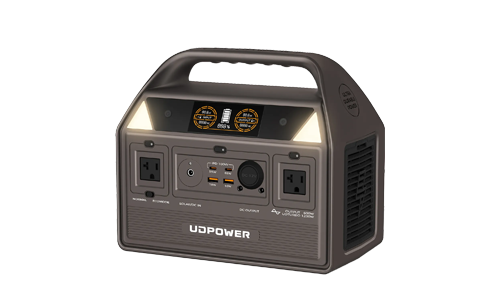
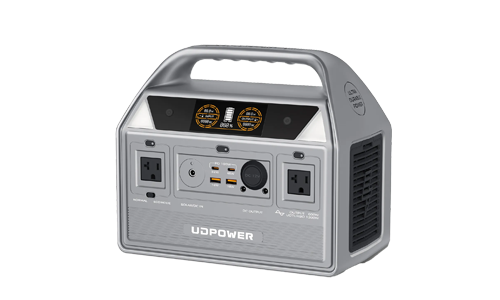
UDPOWER S2400: Best Fit for Larger Essential-Load Backup
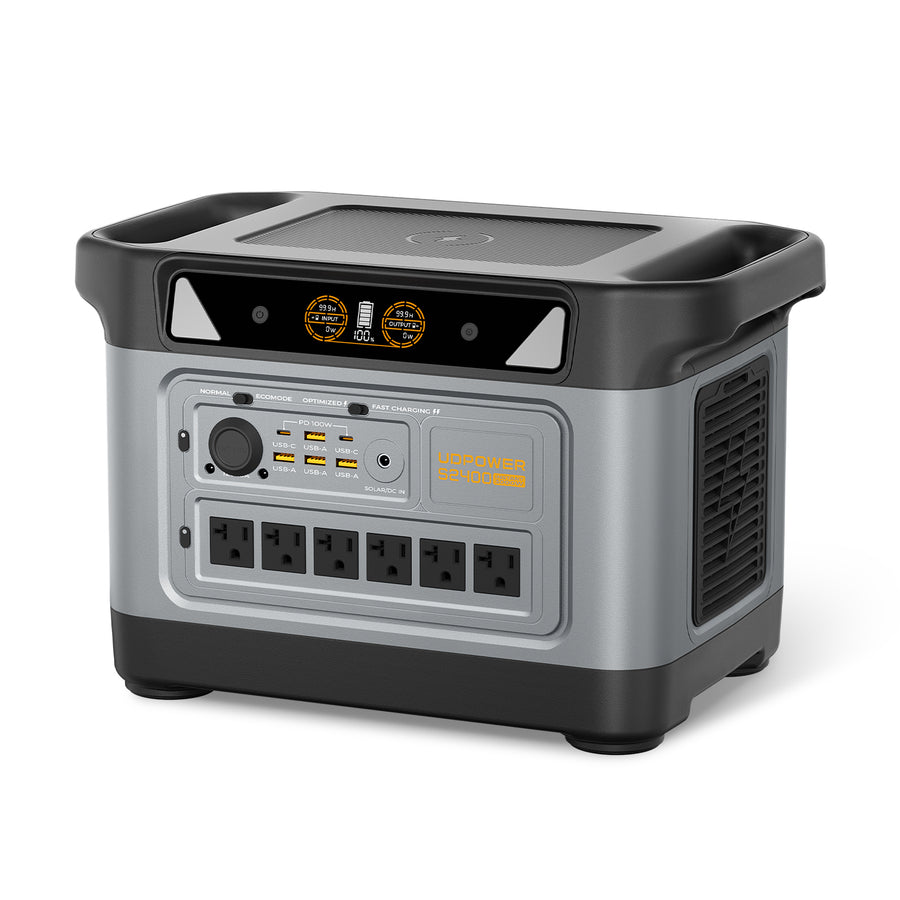
- Battery capacity: 2,083Wh
- Rated AC output: 2,400W pure sine wave
- UDTURBO capability: up to 3,000W for compatible higher-power loads
- AC outlets: 6
- Battery chemistry: LiFePO4
- UPSPrime switchover: less than 10ms
- Solar input: up to 400W
- Weight: approximately 40.8 lb
- Warranty: 5 years
- Current unit-only listed price: $699.99 when checked September 8, 2026
The S2400 is the stronger choice if your outage plan includes a refrigerator plus Wi-Fi, phones, laptops, lights, CPAP, TV, fans and occasional higher-wattage appliances, provided the connected loads remain within the unit's operating limits.
It provides standard U.S. 120V AC output and is not a whole-home 240V generator. It should not be treated as a direct replacement for a Generac connected to a whole-house transfer switch.
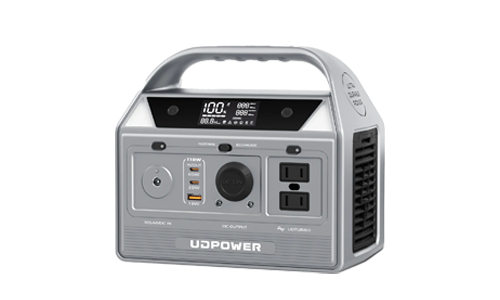
View UDPOWER S2400UDPOWER S1200: Best Fit for a Smaller Essential-Load Plan
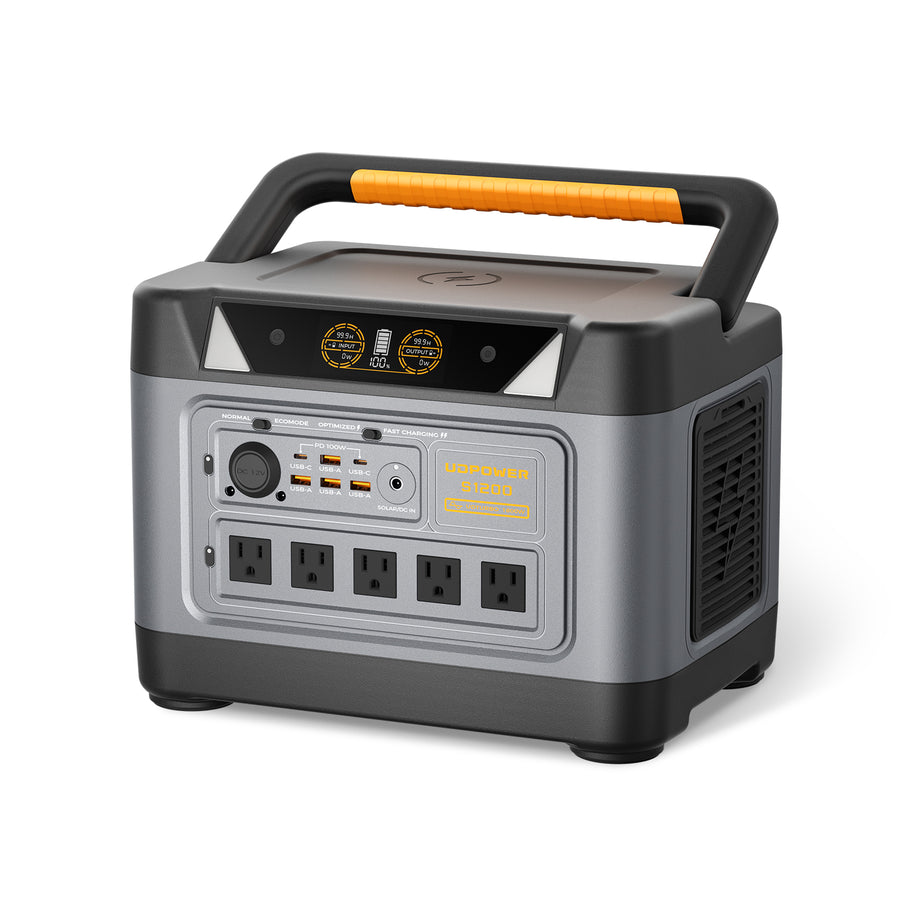
- Battery capacity: 1,190Wh
- Rated AC output: 1,200W pure sine wave
- UDTURBO capability: up to 1,800W for compatible higher-power devices
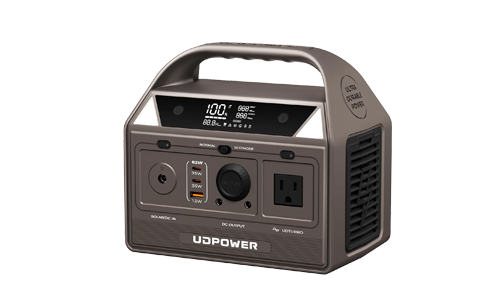
- AC outlets: 5 on the current gray version
- Battery chemistry: LiFePO4
- UPSPrime switchover: less than 10ms
- Solar input: up to 400W
- Weight: approximately 26 lb
- Warranty: 5 years
- Current listed 5-AC unit-only price: $399.99 when checked September 8, 2026
The S1200 is a more economical option when you are intentionally prioritizing a smaller set of loads such as refrigerator cycling, Wi-Fi, phones, laptop, CPAP, lighting and other moderate appliances.
View UDPOWER S1200How long could these batteries run an essential load?
A simple runtime estimate uses battery watt-hours multiplied by approximately 90% usable conversion efficiency, then divides by the device's average watts.
Battery capacity in Wh × 0.90 ÷ average device watts
| Average load | S1200 estimated runtime | S2400 estimated runtime | Example use |
|---|---|---|---|
| 50W | About 21.4 hours | About 37.5 hours | Small electronics and communications load |
| 100W | About 10.7 hours | About 18.7 hours | Average moderate continuous load |
| 300W | About 3.6 hours | About 6.2 hours | Multiple essentials operating together |
| 600W | About 1.8 hours | About 3.1 hours | Heavier continuous appliance load |
Runtime estimates are planning examples. Real appliances cycle, startup demand varies, inverter consumption changes with load and environmental conditions affect performance.
If refrigerator backup is your main concern, see our detailed guide: Can a Portable Power Station Run a Refrigerator?
What a portable power station should not be expected to replace
- Automatic whole-panel backup from a permanently installed standby generator
- 240V central air conditioners
- 240V electric water heaters
- Electric ranges operating as normal during a long outage
- Whole-home electric resistance heating
- Large hardwired equipment beyond the unit's voltage and output capabilities
If you are considering solar recharging during a longer outage, see Can a Solar Generator Power a House? and browse UDPOWER solar generator kits.
Generac Quote Checklist: Ask These Questions Before You Buy
Do not compare quotes by the final number alone. Send each installer the same questions and compare the answers line by line.
- What is the exact generator model number and SKU?
- Is this the current cellular model or an older Wi-Fi model?
- What transfer switch is included?
- What is the transfer-switch amperage?
- Is it service rated?
- Which circuits and appliances will actually be powered?
- Will the system run central A/C?
- Are load-management modules included?
- Has a real electrical load calculation been completed?
- Has natural-gas meter and pipe capacity been verified?
- If using propane, what tank size is required?
- How many feet of gas piping are included?
- How many feet of electrical conduit are included?
- Is trenching included?
- Is restoration of landscaping, concrete or pavement included?
- What pad or foundation is included?
- Are electrical, gas and building permits included?
- Are inspection fees included?
- Is the starting battery included?
- Is startup and commissioning included?
- Will the installer perform an actual transfer test?
- What does the warranty cover?
- Does the quoted warranty include dealer labor?
- What does annual maintenance cost?
- Are monitoring subscriptions optional or required for any features you want?
Three Practical Backup Budgets
Budget 1: Keep only the essentials alive
Prioritize refrigeration, internet, communications, lighting, CPAP and electronics. For many households, this is the point where a portable power station can provide the best value.
Compare UDPOWER portable power stations.
Budget 2: Battery for everyday outages, fuel generator for extreme events
A hybrid strategy keeps quiet indoor loads on a battery while reserving an outdoor fuel generator for long outages and heavier demands. It can also reduce the hours a combustion generator needs to run.
Budget 3: Automatic whole-home standby power
If your goal is for the house to transfer automatically when the grid fails and continue operating major circuits without moving cords or manually starting equipment, a properly sized Generac standby generator is the more appropriate category.
Related UDPOWER Home Backup Guides
Generac Generator Cost FAQ
How much does a Generac whole-house generator cost installed in 2026?
Generac currently says a professionally installed home standby generator commonly costs about $8,000 to $16,000 including the generator itself. Your actual price depends on generator size, transfer switch, fuel connection, electrical work, permits, site preparation, load management and local labor.
How much does a 22kW Generac generator cost?
As of September 8, 2026, Generac lists its current 22kW cellular generator at about $6,309 starting MSRP and the 22kW version bundled with a transfer switch at about $7,369. Those are equipment prices, not guaranteed installed prices.
Why can a $7,000 Generac become a $12,000 installation?
The generator is only one part of a standby system. The final project may also include a transfer switch, electrical wiring, conduit, fuel piping, trenching, load-management equipment, a generator pad, permits, inspection, startup testing, battery and professional labor.
Is a 22kW Generac enough to run a whole house?
It can be enough for many homes, but the answer depends on actual electrical loads rather than square footage alone. Central A/C, heat pumps, electric water heaters, ranges, dryers, well pumps and other large loads can significantly change the required generator size.
How much does it cost to run a 22kW Generac for 24 hours?
Using Generac's current 22kW fuel-consumption specifications and the latest EIA natural-gas reference price available when this article was updated, the example works out to roughly $128 for 24 hours at 50% load or about $180 at full load. Actual costs depend on your utility rate and how heavily the generator is loaded.
Is propane or natural gas cheaper for a Generac?
There is no universal answer because local natural-gas and propane prices vary substantially. Natural gas avoids on-site refueling when utility service remains available, while propane provides stored fuel on the property. Compare your local fuel price with the specific generator's published consumption instead of using a national rule of thumb.
How often does a Generac standby generator need maintenance?
For applicable current home standby generators, Generac lists yearly maintenance at every year or 100 operating hours, Schedule A maintenance every two years or 200 hours, and Schedule B maintenance every four years or 400 hours. Applicable next-generation units also have break-in maintenance after the first 25 operating hours.
Does a Generac generator increase home value?
A standby generator can make a home more attractive to buyers in areas with frequent outages, but you should not assume that every dollar spent on installation will be recovered in resale value. Its practical value is usually highest where outages are frequent, long or expensive for the household.
What is the cheapest way to back up a refrigerator during a power outage?
If a refrigerator and a few small essentials are the only critical loads, installing a whole-home standby generator is usually not the lowest-cost option. A correctly sized portable power station can provide refrigerator backup without permanent gas piping or whole-home electrical installation.
Can a portable power station replace a Generac standby generator?
Not for automatic whole-home backup. A portable power station is better treated as an essential-load solution for selected devices such as refrigerators, Wi-Fi routers, phones, lights, laptops, CPAP machines, TVs and compatible appliances. A Generac standby generator is designed for much larger permanent home-backup applications.
Should I buy a bigger Generac than I currently need?
Some reserve capacity can be useful, but oversizing solely because a larger model appears safer can increase equipment and fuel costs. A professional load calculation that considers both current loads and realistic future additions is a better approach than sizing by square footage or buying the largest model in the budget.
Should I get more than one Generac installation quote?
Yes. Because fuel routing, electrical work, permitting, generator placement and load-management design can vary, comparing multiple detailed quotes is useful. Make sure each installer is quoting the same generator model and the same scope before comparing final prices.
Bottom Line
For most homeowners, the useful answer to "How much does a Generac generator cost?" is not the price displayed beside the generator online.
In 2026, current Generac equipment packages can start in the mid-$4,000s and exceed $8,000 before installation, while Generac itself places many completed home standby projects around $8,000 to $16,000 installed.
That investment makes sense when automatic, long-duration and high-output backup is genuinely important. But if your outage goal is much narrower—refrigeration, internet, phones, lighting, CPAP, laptops and selected household appliances—start by calculating those essential loads. You may discover that you do not need to buy whole-house capability to solve your actual outage problem.
Choose the Backup Strategy That Fits Your Home
Compare battery capacity, output and real-world outage needs before spending thousands on backup capacity you may never use.
View Home Backup Options Compare Portable Power Stations View Solar Generator Kits Read the Home Backup Sizing GuideRelated Articles


