





Electric Air Pump Guide: How to Use It Correctly
Last updated: June 25, 2026
Quick Answer: How Do You Use an Electric Air Pump Correctly?
First, confirm that the pump is designed for the item you want to inflate. Use a high-volume, low-pressure pump for air mattresses, pool floats, and most recreational inflatables. Use a high-pressure inflator with a gauge for car tires, bicycle tires, and sports balls.
Attach the correct nozzle, connect the pump to a compatible power source, insert the nozzle firmly into the valve, and start the pump. Watch the pressure gauge, product shape, or firmness instead of walking away. Stop before the item becomes drum-tight, turn the pump off, remove the nozzle, and close the valve immediately.
The three things that must match are air pressure, airflow, and electrical power. A pump can have enough wattage and still be wrong for the job if it delivers the wrong type of airflow or pressure.

What Is an Electric Air Pump?
An electric air pump uses an electric motor to move air into or out of an inflatable object. Depending on its design, it may be powered by a household AC outlet, a 12V vehicle outlet, an internal rechargeable battery, USB, or a portable power station.
The term “electric air pump” covers several tools that perform very different jobs. A compact mattress pump moves a large volume of air at low pressure. A tire inflator moves less air but can build much higher pressure. A dual-stage paddleboard pump starts with fast airflow and then switches to a slower high-pressure stage.
The most common mistake is treating airflow and pressure as the same thing. Large soft inflatables need fast airflow. Tires and sports balls need controlled pressure. Buying the pump with the highest PSI rating does not automatically make inflation faster.
| Pump type | How it works | Best uses | Usually unsuitable for | Primary measurement |
|---|---|---|---|---|
| High-volume, low-pressure pump | Moves a large amount of air quickly without building high pressure | Air mattresses, pool floats, inflatable furniture, beach toys | Car tires, high-pressure bicycle tires, suspension components | Airflow, often listed as L/min or CFM |
| High-pressure tire inflator | Compresses air to a selected PSI but usually has lower airflow | Car tires, motorcycle tires, bicycle tires, sports balls | Large air beds and oversized pool inflatables | PSI, bar, or kPa |
| Dual-stage SUP or kayak pump | Uses high airflow first and switches to high pressure near the target | Inflatable paddleboards, kayaks, rigid drop-stitch products | Products outside its listed pressure range | Airflow plus PSI |
| Continuous-air blower | Runs continuously to keep an inflatable structure upright | Bounce houses, display inflatables, some event structures | Sealed tires, balls, or small inflatables | CFM and continuous wattage |
| Rechargeable mini pump | Uses a small internal battery for portable low-pressure inflation | Travel pillows, sleeping pads, small floats, vacuum bags if supported | Large tires or products requiring sustained high pressure | Airflow, battery capacity, and duty cycle |
Choose the Correct Pump Before You Start
Before looking at pump speed, battery size, or accessories, answer three questions: What pressure does the item require? How much air volume must be moved? What power source will be available where you use it?
1. Match the pump to the required pressure
Soft inflatables normally require low pressure. Car tires, road-bike tires, sports balls, and some paddleboards require measured pressure. Never assume a low-pressure mattress pump can inflate a tire simply because its nozzle fits the valve.
2. Match airflow to the size of the inflatable
A tiny rechargeable pump may fill a camping pillow quickly but take much longer on a queen-size air mattress. Conversely, a powerful high-volume pump can fill a small pool toy so quickly that it becomes difficult to stop at the right moment.
3. Match the pump connector to your available power source
Check whether the pump uses a household plug, 12V car plug, USB cable, removable tool battery, or built-in battery. The connector and the electrical rating both matter. A 12V socket is not automatically compatible with every 12V pump because the pump may draw more current than the outlet can supply.
| What you are inflating | Recommended pump | What to check | Stop inflation when |
|---|---|---|---|
| Air mattress | High-volume, low-pressure AC, 12V, or rechargeable pump | Valve size, inflate/deflate ports, recommended duty cycle | The bed is supportive but still has slight surface give |
| Pool float or beach toy | Low-pressure pump with a small tapered nozzle | Seams, separate chambers, one-way valve | The shape is fully formed without stretched seams |
| Car or motorcycle tire | High-pressure inflator with an accurate gauge | Vehicle placard pressure, hose condition, pump duty cycle | The recommended cold PSI is reached |
| Bicycle tire | High-pressure inflator compatible with Schrader or Presta valves | Tire pressure range and correct valve adapter | The selected pressure is within the tire and bicycle manufacturer's range |
| Sports ball | Gauge-equipped inflator with the correct ball needle | Ball manufacturer's pressure range | The specified PSI is reached |
| Inflatable paddleboard | Dual-stage SUP pump | Valve adapter and board-specific PSI | The exact pressure specified by the board manufacturer is reached |
| Bounce house or display inflatable | Manufacturer-approved continuous blower | Required CFM, blower wattage, extension-cord requirements | The blower normally remains running during use |
Pre-Use Safety and Compatibility Checklist
A one-minute inspection can prevent damaged valves, split seams, blown fuses, overheated pumps, and incorrectly inflated tires.
- Read the inflatable product's label or owner's manual.
- Confirm whether the product needs low pressure, high pressure, or a dual-stage pump.
- Check the pump's voltage, wattage, amperage, maximum pressure, and duty cycle.
- Inspect the hose, plug, cable, nozzle, and valve for cracks or damage.
- Unfold the inflatable completely and move sharp objects away from it.
- Make sure the correct valve cap or one-way valve insert is present.
- Place the pump where its air intake and cooling vents will remain open.
- Keep the pump, extension connections, and portable power station dry.
- Do not begin inflation if a tire has a bulge, exposed cords, sidewall damage, or a badly damaged valve stem.
- Know your stopping point before switching the pump on.
Do not choose a nozzle only because it can be forced into the opening. An oversized nozzle can damage the valve, while an undersized nozzle leaks air and makes the pump run longer and hotter.
How to Use an Electric Air Pump Step by Step
- Identify the correct inflation target. For a tire, find the recommended cold pressure. For an air mattress or pool float, look for the manufacturer's firmness or inflation instructions. Do not use a tire sidewall's maximum pressure as a vehicle's normal target.
- Open and inspect the valve. Remove the cap and confirm that the valve is clean, undamaged, and fully open. Some inflatables use a removable inner plug, Boston valve, pinch valve, or spring-loaded paddleboard valve.
- Select the closest-fitting nozzle or adapter. The nozzle should enter far enough to create a seal without stretching or deforming the valve. Attach a Presta adapter, ball needle, or SUP adapter when required.
- Connect the hose to the pump's inflation port. Pumps with both inflation and deflation functions usually have separate ports. Confirm that you are using the outlet that blows air rather than the suction inlet.
- Connect a compatible power source. Plug an AC pump into a suitable outlet, connect a 12V pump to a socket with enough current capacity, or verify that a rechargeable pump has sufficient battery charge.
- Seat the nozzle before starting the motor. Hold the nozzle straight and firmly in the valve. Starting first and then searching for the valve wastes air and can pull dirt into the pump.
- Start the pump and monitor the item continuously. Watch the gauge on high-pressure products. For low-pressure inflatables, watch the seams, shape, and firmness. Listen for changes in pump sound that may indicate restricted airflow or rising back pressure.
- Stop at the correct pressure or firmness. Use automatic shutoff when available, but stay nearby. For soft inflatables, stop while the surface still has a small amount of give instead of inflating until it feels rigid.
- Turn the pump off before removing the nozzle. Quickly remove the nozzle and close the valve cap or internal plug to reduce air loss.
- Recheck after the item settles. Air temperature, material stretching, and load can change firmness. Recheck a tire with a reliable gauge or adjust an air mattress after it has rested for several minutes.
Listen to the pump. A steady motor sound usually indicates free airflow. A sudden higher-pitched sound can mean the valve is blocked, the item is nearly full, or the pump is building more back pressure than it was designed to handle.
How to Inflate Common Items Correctly
How to Use an Electric Air Pump for an Air Mattress
- Spread the mattress on a clean floor with no sharp objects underneath.
- Locate the main inflation valve and determine whether the mattress has a built-in or external pump.
- Use a low-pressure pump and the largest nozzle that seals the valve correctly.
- Inflate until the mattress holds its intended shape and feels supportive.
- Stop before the top surface becomes hard and the seams appear stretched.
- Close the valve and wait several minutes before adding bedding or lying on it.
New vinyl air mattresses often feel softer after their first inflation because the material stretches. Cooler nighttime temperatures can also reduce internal pressure. A small top-off may be normal and does not automatically indicate a leak. Intex specifically advises using a low-pressure inflator and avoiding overinflation in its air-mattress safety guidance .
For a more detailed discussion of pump wattage and off-grid inflation, read Can a Generator Power an Air Mattress Pump?
How to Inflate Pool Floats and Inflatable Toys
Use a low-pressure pump with a tapered nozzle. Inflate separate chambers one at a time and stop when the product has reached its intended shape. The seams should not look stretched, shiny, or distorted.
Remember that air expands as it warms. A float inflated firmly in a cool garage can become much tighter after sitting in direct summer sun. Leave a little surface give and recheck it before use.
How to Use an Electric Tire Inflator
- Check tire pressure before driving or after the tires have cooled.
- Find the recommended cold PSI on the driver's-door placard or in the owner's manual.
- Inspect the tire for punctures, bulges, cuts, and sidewall damage.
- Remove the valve cap and attach the hose connector securely.
- Set the target PSI if the inflator has automatic shutoff.
- Start the inflator and remain beside it.
- Stop at the recommended pressure and verify with a separate gauge when possible.
- Remove the connector and reinstall the valve cap.
For vehicle tires, use the pressure listed by the vehicle manufacturer—not the maximum pressure molded into the tire sidewall. The National Highway Traffic Safety Administration recommends using the vehicle's tire placard or owner's manual.
How to Inflate a Bicycle Tire
First identify whether the tire uses a Schrader or Presta valve. A Presta valve normally requires unscrewing the small tip before inflation and may require an adapter. Set the pressure within the tire and bicycle manufacturer's recommended range.
Pressure varies greatly by tire width, rider load, terrain, tube type, and tubeless setup. Do not copy a pressure from another bicycle simply because both are described as road bikes or mountain bikes. For general valve and pump guidance, see REI's bike pump guide .
How to Inflate a Sports Ball
Use the correct ball needle and insert it straight into the valve. Do not bend the needle sideways while it is inside the ball. Inflate slowly near the target because a small ball's pressure rises quickly. Use the pressure range printed near the valve or provided by the ball manufacturer.
How to Inflate a Paddleboard or Inflatable Kayak
Use a pump and valve adapter approved for the product. Many inflatable paddleboards need much higher pressure than pool floats and should be inflated with a dual-stage SUP pump. Enter the exact pressure listed by the board manufacturer rather than selecting a generic SUP preset.
Confirm that a spring-loaded valve is in the inflation position before attaching the hose. After inflation, disconnect the hose and install the valve cap. A valve cap is a secondary seal, not a replacement for a properly seated internal valve.
How to Deflate an Inflatable with an Electric Pump
- Open all main air valves.
- Move the hose to the pump's deflation or suction port.
- Insert the correct nozzle without blocking the valve passage.
- Run the pump until most of the air is removed.
- Stop if the pump becomes unusually hot or the material begins sealing tightly around the nozzle.
- Fold or roll the product according to its storage instructions.
A deflation port is intended to remove air, but it is not automatically a wet vacuum, shop vacuum, or food vacuum sealer. Never allow water, sand, fabric, or loose material to enter the intake.
Pressure Units and Inflation Targets
Pressure may be displayed in PSI, bar, or kilopascals. Switching units on a digital pump without noticing can cause a serious setting error, so confirm the unit shown on the display before pressing Start.
| Unit | Meaning | Useful conversion | Common applications |
|---|---|---|---|
| PSI | Pounds per square inch | 1 PSI ≈ 6.895 kPa | Vehicle tires, bicycle tires, sports balls, U.S. inflators |
| bar | Metric pressure unit | 1 bar ≈ 14.5 PSI | Bicycle tires, paddleboards, European specifications |
| kPa | Kilopascals | 100 kPa ≈ 14.5 PSI | Vehicle placards and international product labels |
| CFM | Cubic feet per minute | Measures airflow, not pressure | Blowers, large inflatables, air-volume comparisons |
| L/min | Liters per minute | Measures airflow, not pressure | Portable pumps, paddleboard pumps, mattress pumps |
Typical pressure guidance by product type
| Product | How to determine the correct target | What not to do | Source or reference |
|---|---|---|---|
| Passenger-vehicle tire | Use the recommended cold pressure on the driver's-door placard or in the owner's manual | Do not use the tire sidewall maximum as the normal target | NHTSA TireWise |
| Bicycle tire | Stay within the tire and bicycle manufacturer's range and adjust for load and terrain | Do not assume every bike of the same category uses the same PSI | REI Bike Pump Guide |
| Air mattress | Follow the mattress instructions and inflate until supportive with slight surface give | Do not make the mattress rigid or visibly stretch the seams | Intex Air Mattress Safety |
| Pool float | Use shape, seam condition, and manufacturer instructions | Do not leave a tightly inflated product heating in direct sun | Intex Pump Information |
| Sports ball | Use the PSI or bar range printed near the valve or in the product instructions | Do not judge only by bouncing or squeezing the ball | Ball manufacturer's label |
| SUP or inflatable kayak | Use the exact pressure printed near the valve or in the owner's manual | Do not copy the setting from another board or kayak | Watercraft manufacturer's manual |
Electric Air Pump Power Requirements
Electric air pumps range from small USB models to large continuous blowers. The label on the pump is more reliable than a general wattage estimate. Look for watts directly, or calculate watts when voltage and current are listed.
Power formula: Watts = Volts × Amps
Example: A 12V pump rated at 10A can draw approximately 120W. A 12V pump rated at 15A can draw approximately 180W and may exceed the limit of some vehicle-style DC outlets.
| Pump category | Common power range | Typical power connection | Important compatibility check |
|---|---|---|---|
| USB mini pump | About 5–30W | USB-A or USB-C | Required voltage, current, and charging protocol |
| Rechargeable low-pressure pump | Internal battery; charging commonly below 30W | USB charging cable | Whether it can operate while charging |
| 12V air-mattress or utility pump | About 40–120W | Vehicle-style 12V plug | Socket amperage and fuse rating |
| 120V household air-bed pump | About 50–300W | Standard AC plug | Running wattage and motor startup demand |
| Portable tire inflator | About 100–180W for many 12V models | 12V plug, tool battery, or internal battery | Maximum current, hose temperature, duty cycle |
| Dual-stage SUP pump | About 100–250W | 12V plug or rechargeable battery | High-pressure stage current and required PSI |
| Continuous inflatable blower | About 250W to more than 1,000W | AC outlet | Continuous load, startup surge, cord rating |
These ranges are general planning estimates. The electrical label and operating manual for the individual pump take priority.
Running watts are not the only limit
A pump motor may briefly draw more power when starting. The power source should cover the pump's normal running demand and its short startup demand. For an AC pump, choose a power source with rated output above the pump's running watts and enough surge capacity to start the motor.
Check the pump's duty cycle
Many portable inflators are not designed to run continuously. A label may instruct you to run the pump for a certain number of minutes and then let it cool. A power station with several hours of battery runtime does not cancel the pump's duty-cycle limit.
Can You Run an Electric Air Pump from a Portable Power Station?
Yes. Most household air-mattress pumps, portable tire inflators, SUP pumps, and other compact electric pumps can run from a properly sized portable power station. Match the pump to the correct AC or DC output and confirm all of the following:
- The pump's running wattage is below the output's continuous rating.
- The pump's startup demand is below the power station's surge capability.
- The connector matches the selected AC, 12V, or USB output.
- A 12V pump does not exceed the DC outlet's current or wattage limit.
- The power station has enough remaining battery capacity for the planned inflation sessions.
- The pump and power station remain dry and ventilated.
For a complete compatibility method covering voltage, wattage, surge power, and runtime, see How Do You Know if a Portable Power Station Can Power Your Device?
Estimated runtime formula
A practical estimate for an AC-powered pump is:
Estimated runtime = battery capacity in Wh × 0.90 ÷ pump wattage
The calculation below uses 90% conversion efficiency. Real performance varies with pump startup behavior, battery charge level, temperature, cable losses, and automatic shutdown settings.
| Power station | Battery capacity | 100W pump estimate | 150W pump estimate | Approximate 5-minute sessions at 150W |
|---|---|---|---|---|
| UDPOWER C400 | 256Wh | About 2.3 hours | About 1.5 hours | About 18 sessions |
| UDPOWER C600 | 596Wh | About 5.4 hours | About 3.6 hours | About 43 sessions |
| UDPOWER S1200 | 1,190Wh | About 10.7 hours | About 7.1 hours | About 85 sessions |
These figures describe available battery energy, not permission to run a pump continuously. Stop at the pump manufacturer's duty-cycle limit even when the power station still has plenty of charge.
AC outlet or 12V outlet: which is better?
Use the connection designed for the pump. An AC pump should normally use the power station's AC outlet. A 12V pump can use a compatible vehicle-style socket, but you must check current. For example, a 12V pump drawing 15A needs about 180W, which is more than a 12V/10A-class outlet can continuously provide.
Direct DC operation can avoid inverter losses, but only when the voltage, polarity, connector, and current limit all match. Never modify a connector or use an improvised adapter merely to make the plug fit.
Recommended UDPOWER Power Stations for Electric Air Pumps
The correct model depends primarily on pump wattage and the other devices you plan to use during the trip. A small power station is sufficient for many air-bed pumps. Larger capacity becomes useful when you also need to run lights, phones, fans, a camping refrigerator, or repeated inflation sessions.

UDPOWER C400: Best Compact Choice for Most Small Pumps
The C400 is a practical match for many AC air-mattress pumps, compact utility pumps, and low-to-medium-power outdoor inflators. Its compact body is easier to carry with tents, mattresses, pool equipment, or roadside gear.
- 256Wh LiFePO4 battery
- 400W rated AC output
- Up to 800W peak output with UD-TURBO
- Two AC outlets
- 12V vehicle-style output rated up to 136W
- Approximately 6.88 lb
- 4,000+ battery cycles
Best match: Air-mattress pumps and other compact pumps below 400W. For a 12V inflator, verify that its draw stays within the C400's 136W DC output limit.
View UDPOWER C400
UDPOWER C600: Best for Camping Gear and Repeated Inflation
The C600 provides more battery capacity and output headroom for larger pumps or trips where the power station also supports phones, cameras, lights, laptops, and other camping devices.
- 596Wh LiFePO4 battery
- 600W rated AC output
- Up to 1,200W peak output
- Two AC outlets
- 12V vehicle-style output
- USB-C and USB-A charging ports
- 4,000+ battery cycles
Best match: Air-bed pumps, many SUP pumps, campsite inflation equipment, and users who want enough capacity for several devices instead of carrying power only for the pump.
View UDPOWER C600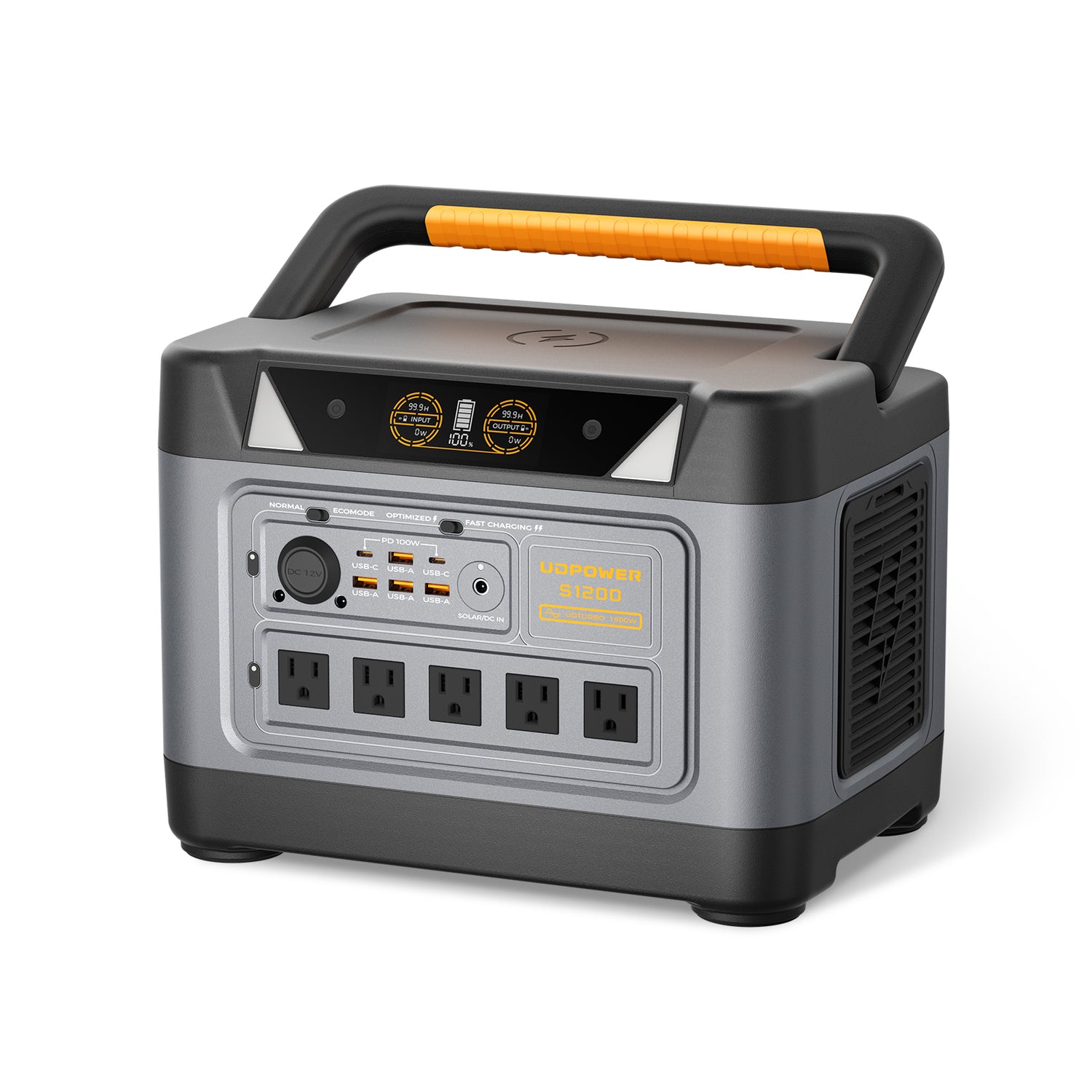
UDPOWER S1200: Best for Larger Blowers and Shared Campsite Loads
The S1200 offers substantially more AC output and battery capacity. It is better suited to larger recreational blowers or a campsite where the air pump is only one part of a broader power setup.
- 1,190Wh LiFePO4 battery
- 1,200W rated AC output
- Up to 1,800W output with UD-TURBO
- Five AC outlets on the current gray version
- Approximately 26 lb
- 4,000+ battery cycles
Best match: Larger recreational blowers, multiple air pumps, or combined camping and backup loads. It is not a substitute for an industrial air compressor or a blower requiring more than its supported continuous output.
View UDPOWER S1200Unsure which model fits your pump? Check the pump label for volts, amps, and watts, then compare it with the UDPOWER portable power station collection . For lightweight camping-focused models, browse the UDPOWER C-Series.
Common Electric Air Pump Mistakes
Using a high-pressure tire inflator for a large air mattress
A tire inflator may eventually move enough air, but it is usually much slower than a high-volume mattress pump and may reach its duty-cycle limit before finishing.
Using a low-pressure mattress pump for a tire
A mattress pump can move air quickly but may be unable to build the pressure required by a tire. Stop if the pump is not specifically rated for the target PSI.
Ignoring the pressure unit on the display
Confusing bar, PSI, and kPa can produce a serious pressure error. Confirm the displayed unit every time the pump is switched on or a preset is changed.
Inflating to the tire sidewall maximum
The sidewall value is not the normal pressure recommendation for your vehicle. Use the cold pressure specified on the vehicle placard.
Walking away during inflation
Automatic shutoff is helpful but should not replace supervision. Incorrect presets, loose connectors, blocked valves, or a damaged pressure sensor can still create problems.
Blocking the pump's cooling vents
Soft bedding, sand, clothing, and tent fabric can cover an intake or cooling vent. Place the pump on a stable, clean surface with open space around it.
Running beyond the duty-cycle limit
Portable tire inflators often become hot during use. Follow the run-and-cool schedule in the pump manual even when inflation is not complete.
Assuming every 12V socket provides the same power
One socket may be limited to 10A while a pump requests 15A. Check the outlet rating, pump amperage, power-station limit, and fuse before use.
Overinflating soft products to compensate for overnight softening
New material can stretch, and cooler air contracts. Add only a small amount after checking for leaks and allowing the product to reach the temperature where it will be used.
Pulling the hose instead of the connector
Repeatedly pulling on the hose or cable can loosen internal connections. Grip the connector body when disconnecting the pump.
Electric Air Pump Troubleshooting Guide
| Problem | Likely causes | What to check | Recommended action |
|---|---|---|---|
| Pump does not start | No power, discharged battery, disabled output, blown fuse, loose connector | Power indicator, outlet switch, plug fit, battery percentage, vehicle fuse | Reconnect power, enable the correct output, recharge the battery, or inspect the fuse |
| Power station shuts off immediately | Startup surge or running wattage exceeds the output limit | Pump nameplate watts and power-station output rating | Disconnect other loads and use a higher-output power source |
| 12V pump repeatedly stops | Pump current exceeds socket limit or plug connection is poor | Pump amperage, socket wattage, plug temperature, connector fit | Use a properly rated outlet and stop using any hot or damaged connector |
| Pump runs but inflation is slow | Wrong pump type, leaking nozzle, open secondary valve, restricted intake | Nozzle fit, unused valves, hose kinks, intake vents | Use the correct nozzle, close other valves, straighten the hose, clear the intake |
| Air leaks as soon as the nozzle is removed | One-way valve insert is missing, cap is delayed, or valve is damaged | Inner plug, flap valve, cap seal, valve threads | Replace the valve insert or seal and close the cap immediately |
| Pump becomes very hot | Long runtime, restricted airflow, high back pressure, exceeded duty cycle | Cooling vents, run time, valve opening, manual instructions | Switch off, unplug, and allow the pump to cool completely |
| Digital pressure reading jumps | Loose connection, hose movement, pressure pulsing, sensor delay | Valve connector and reading after the motor stops | Reseat the connector and verify with a separate gauge |
| Air mattress becomes soft overnight | Material stretching, cooler temperature, valve leak, small puncture | Valve seal, seams, punctures, room temperature | Top off slightly, then test for leaks if softening continues |
| Pump makes a higher-pitched sound | Blocked valve, item nearly full, wrong nozzle, rising back pressure | Valve opening and product firmness | Stop and inspect rather than continuing against the restriction |
| Automatic shutoff stops too early | Air trapped at the connector or inaccurate preset sensing | Hose seal, selected unit, target pressure | Reconnect, confirm the unit, restart, and verify with another gauge |
Stop using the pump if you notice smoke, a burning smell, melted plastic, sparking, a swollen battery, exposed wiring, or a connector that becomes too hot to touch safely.
Cleaning, Storage, and Maintenance
- Disconnect the pump from power and let it cool before cleaning.
- Wipe the exterior with a dry or lightly damp cloth.
- Keep water and cleaning liquid away from vents, electrical contacts, and switches.
- Remove sand, lint, and debris from intake openings.
- Inspect hoses for hardening, splits, and loose fittings.
- Store nozzles and adapters together so the correct fitting is available when needed.
- Avoid tightly wrapping the power cord around the pump body.
- Recharge built-in batteries periodically according to the pump manual.
- Store the pump in a dry place away from extreme heat and freezing conditions.
- Do not place heavy equipment on the hose or pressure gauge during storage.
A practical pre-trip test
Test the pump and inflatable at home before a camping trip, beach day, or road trip. Confirm that the nozzle fits, the power cord reaches, the portable power station supports the load, and the pump can complete one full inflation without overheating.
A short home test is especially important for a 12V pump because plug shape alone does not confirm that the outlet can supply the required current.
Electric Air Pump Frequently Asked Questions
Can an electric air pump inflate a car tire?
Only if it is a high-pressure tire inflator rated for the required PSI. A low-pressure air-mattress pump normally cannot build enough pressure for a vehicle tire.
Can I use a tire inflator for an air mattress?
It may move some air, but it is usually inefficient because tire inflators provide high pressure at relatively low airflow. A high-volume, low-pressure pump is normally faster and better suited to an air mattress.
How many watts does an electric air pump use?
Small USB pumps may use less than 30W, while many household and 12V portable pumps use roughly 40–300W. Continuous inflatable blowers can use several hundred watts or more. Always check the pump's electrical label.
Can I run an electric air pump from a portable power station?
Yes, provided the pump's running and startup power remain within the power station's limits. You must also match the pump's AC, 12V, or USB connection to a compatible output.
Why does my electric air pump get hot?
The motor and compression mechanism naturally create heat. Excessive heat can result from long continuous operation, blocked vents, restricted airflow, high back pressure, or exceeding the stated duty cycle.
How long can an electric air pump run continuously?
It depends on the model. Some pumps can run continuously, while compact tire inflators may require a cooling break after several minutes. Follow the run-time and cooling instructions in the pump manual.
How do I know when an air mattress is fully inflated?
The mattress should hold its intended shape and feel supportive while retaining a small amount of surface give. Stop before the mattress feels rigid or its seams look stretched.
Why does an air mattress become softer overnight?
New material may stretch during initial use, and cooler nighttime air reduces internal pressure. A small top-off may be normal. Repeated major pressure loss can indicate a valve leak or puncture.
Should I inflate a car tire to the PSI printed on the tire sidewall?
No. Use the recommended cold pressure shown on the vehicle's driver-door placard or in the owner's manual. The sidewall number is not the normal operating target for the vehicle.
Why does my power station shut down when the pump starts?
The pump may be exceeding the output's continuous or startup limit. Disconnect other devices, confirm the pump's wattage, and check whether a 12V pump exceeds the DC outlet's current limit.
Can an electric air pump also deflate inflatables?
Yes, when the pump includes a dedicated deflation or suction port. Move the hose to that port and use the correct nozzle. Do not use the pump to remove liquids or debris.
Can I use an electric air pump in the rain?
Do not expose a pump, plug, extension connection, or portable power station to rain unless the specific equipment is expressly rated for wet conditions. Operate it in a dry, ventilated location.
What nozzle should I use?
Choose the nozzle that creates a secure seal without stretching or damaging the valve. Use a dedicated adapter for Presta valves, sports balls, paddleboards, or other specialized fittings.
Is a higher-PSI pump always better?
No. High PSI is useful for tires and pressure-rated equipment, but large soft inflatables depend more on airflow. A lower-pressure, high-volume pump may fill an air mattress much faster.
Sources and Further Reading
| Source | Information used in this guide |
|---|---|
| National Highway Traffic Safety Administration | Vehicle tire pressure, tire placards, and tire inspection guidance |
| Intex Air Mattress Safety Information | Low-pressure inflation, overinflation prevention, and normal material stretching |
| Intex Electric and Manual Air Pumps | Pump and nozzle use for air mattresses and recreational inflatables |
| REI Bike Pump Guide | Bicycle pump types, valve compatibility, and pressure considerations |
| UDPOWER C400 Official Product Page | C400 capacity, AC output, peak output, ports, weight, and battery cycle specifications |
| UDPOWER C600 Official Product Page | C600 capacity, rated output, peak output, available ports, and battery specifications |
| UDPOWER S1200 Official Product Page | S1200 capacity, rated output, UDTURBO output, AC outlets, weight, and cycle life |
Choose the Right Portable Power Setup for Your Air Pump
Start with the pump's label. Check its voltage, amperage, running watts, connector type, and duty cycle. Then choose a portable power station that provides enough output headroom and capacity for the rest of your camping, recreational, or emergency equipment.
View All UDPOWER Portable Power Stations Compare Compact C-Series Models Get the Device Sizing GuideRelated Articles


