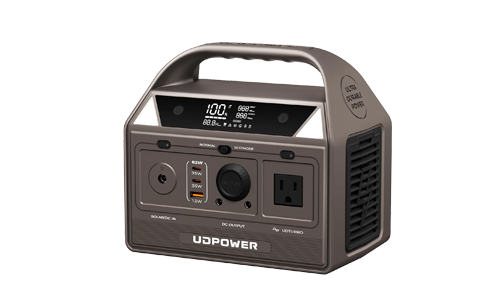
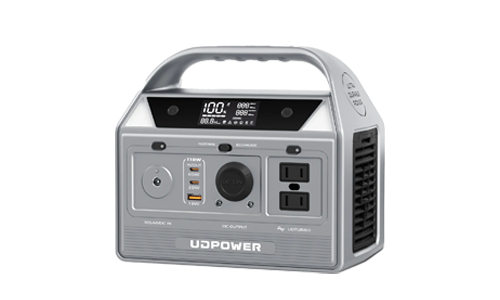
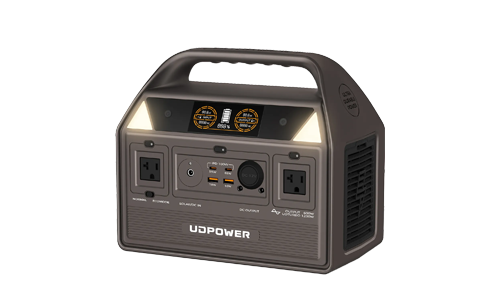
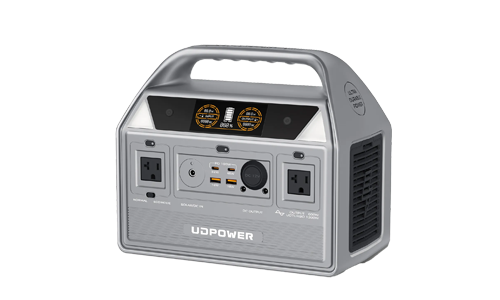
Battery Powered Outlet: What to Know Before You Buy
A battery powered outlet, also called a portable power station, stores electricity and provides household-style AC power without a live wall connection. This guide explains output watts, battery capacity, surge power, runtime calculations, charging methods, safety, and how to choose the right UDPOWER model.
Quick answer: A battery powered outlet is a rechargeable portable power station that gives you household-style AC outlets without requiring a live wall connection. It stores electricity in a battery and converts that energy into 120V AC power for devices such as laptops, Wi-Fi routers, CPAP machines, fans, televisions, small refrigerators, and selected appliances.
The right model is determined by three numbers: continuous output in watts, surge output in watts, and battery capacity in watt-hours. Watts tell you what it can run. Watt-hours tell you approximately how long it can run.
- Choose output watts based on the highest combined load you expect to run.
- Choose battery capacity based on how many watt-hours your devices use each day.
- Allow for conversion losses instead of dividing battery capacity by device watts without an efficiency adjustment.
- Check startup surge for refrigerators, pumps, compressors, and power tools.
- For sensitive electronics, look for pure sine wave AC output.
- Plan how the unit will be recharged if an outage or off-grid trip lasts more than one day.
People search for these products using several names: battery powered outlet, battery operated outlet, portable outlet, rechargeable outlet, battery generator, power box, or portable power station. In most shopping situations, they are describing the same basic product: a rechargeable battery with an inverter and multiple output ports.
This guide explains how battery powered outlets work, what they can realistically power, how to calculate runtime, which specifications matter before buying, and where smaller or larger models make more sense.

What Is a Battery Powered Outlet?
A battery powered outlet is a portable energy-storage device with one or more AC receptacles similar to those found in a U.S. home. Instead of receiving electricity directly from the grid, the receptacles receive electricity from an internal rechargeable battery.
Most modern units also provide USB-A, USB-C, 12V car outlets, and DC barrel ports. Larger models may include wireless charging, multiple AC receptacles, solar charging inputs, and UPS-style backup functions.
A battery powered outlet is not an outlet that creates unlimited electricity. It is better understood as a portable energy tank:
- Battery capacity controls how much energy is stored.
- The inverter controls how much AC power can be delivered at once.
- The output ports determine which devices can connect directly.
- The charging system determines how quickly the battery can be refilled.
Simple shopping rule: Do not choose a battery powered outlet only because it has an AC socket. Confirm that its continuous wattage, surge capability, capacity, port arrangement, and charging inputs match your intended use.
Common names and what shoppers usually mean
| Search term | What it usually describes | Important distinction |
|---|---|---|
| Battery powered outlet | A rechargeable power station with 120V AC receptacles | Check continuous watts and watt-hours, not just the presence of an outlet |
| Battery operated outlet | Usually the same product category | It is not a permanently installed household receptacle |
| Portable outlet | A compact power station or power bank with AC output | Some very small units have limited AC output and short runtime |
| Battery generator | A portable power station, sometimes sold with solar panels | The battery stores energy; it does not generate electricity without a charging source |
| Solar generator | A portable power station paired with compatible solar panels | The power station and solar panels are separate parts of the system |
| Power box | An informal term for a portable power station | Specifications vary widely between products using this name |
How Does a Battery Powered Outlet Work?
A battery powered outlet combines several systems inside one enclosure. Understanding the basic power path makes specifications much easier to compare.
- The battery stores DC energy. Capacity is normally listed in watt-hours, such as 596Wh, 1,190Wh, or 2,083Wh.
- The inverter converts DC electricity into AC electricity. This creates the 120V, 60Hz output used by common U.S. appliances.
- The battery management system monitors operation. It helps protect the battery against conditions such as overcurrent, overcharge, over-discharge, overheating, and short circuits.
- The output controller sends power to the selected ports. AC, USB, car, and DC outputs may have separate switches.
- The charging controller manages incoming electricity. Depending on the model, the station may recharge from a wall outlet, vehicle socket, or compatible solar panels.
When an AC appliance is connected, stored DC energy passes through the inverter before reaching the AC outlet. That conversion consumes some energy. This is why a 1,000Wh battery does not normally provide a full 1,000Wh of usable AC energy at the receptacle.
Devices connected directly through USB-C or a regulated DC output may avoid part of the AC conversion process. In some situations, direct DC or USB-C use can improve efficiency compared with plugging an additional wall charger into the AC outlet.
Battery Powered Outlet vs. Power Bank, UPS, and Gas Generator
These products overlap, but they are not interchangeable. Choosing the wrong category can leave you with insufficient output, inadequate runtime, or a backup function that does not behave as expected.
| Product | Main purpose | Typical strengths | Main limitations |
|---|---|---|---|
| Small power bank | Charging phones, tablets, and USB devices | Lightweight, inexpensive, easy to carry | Usually lacks household AC output or has very limited AC capacity |
| Battery powered outlet | Portable AC and DC power for electronics and selected appliances | Quiet, rechargeable, no engine exhaust, usable indoors when operated correctly | Finite battery capacity; high-wattage loads drain it quickly |
| Traditional computer UPS | Short-term automatic backup for computers and network equipment | Fast automatic switchover and simple desk installation | Often shorter runtime and fewer outdoor or solar capabilities |
| Gas or propane generator | Long-duration or high-output backup when fuel is available | Can support larger loads and be refueled quickly | Engine noise, maintenance, fuel storage, and deadly carbon-monoxide risk if used incorrectly |
| Installed home battery system | Backup for selected circuits or an entire home | Automatic operation and much larger system capacity | Higher cost, fixed installation, permitting, and professional electrical work |
A portable power station is not automatically a whole-home backup system. Never connect a portable AC outlet directly to household wiring, a breaker panel, or a wall receptacle to “backfeed” a home. Whole-home or selected-circuit connections require approved transfer equipment and qualified electrical installation.
The Five Numbers That Matter Before You Buy
1. Continuous output watts
Continuous output is the amount of power the inverter is designed to supply during normal operation. If a station is rated for 600W, the combined continuous AC load should remain within that rating.
When several appliances are connected, add their watts together. A 100W television, 60W laptop, and 50W fan create an estimated combined load of 210W.
2. Surge or startup watts
Some equipment briefly needs more power when it starts. Refrigerators, compressors, water pumps, and selected tools can draw substantially more during startup than during normal running.
A station may have enough continuous output for a refrigerator but still shut down if the compressor’s startup surge exceeds the inverter’s capability. Check the appliance manual, specification plate, manufacturer data, or a suitable power meter.
3. Battery capacity in watt-hours
Watt-hours measure stored energy. A larger Wh number generally means longer runtime at the same load.
- A 600W inverter rating does not mean the battery contains 600Wh.
- A 2,000Wh battery does not mean the inverter can supply 2,000W.
- Capacity and output must both match the job.
4. Solar and charging input limits
Solar-ready does not mean every solar panel can be connected. Confirm the station’s allowed input voltage range, current limit, watt limit, and connector type. A connector that physically fits does not prove electrical compatibility.
For a deeper compatibility explanation, read Can You Charge a Portable Power Station with a Solar Panel?.
5. Port type and port count
Count the devices you expect to connect at the same time. Also check the output rating of each port. Two stations with similar battery capacity can have very different combinations of AC receptacles, USB-C charging, USB-A ports, 12V outputs, and wireless charging.
For laptops, tablets, cameras, and modern phones, a high-output USB-C port can be more useful than an additional low-power USB-A socket. For refrigerators, coffee makers, and household equipment, the number and placement of AC receptacles matter more.
What Can You Plug Into a Battery Powered Outlet?
You can connect any compatible device whose voltage, continuous power, startup demand, and combined load remain within the station’s limits. The appliance category alone does not determine compatibility.
| Device or load | Planning range | What to check before connecting | Useful UDPOWER guide |
|---|---|---|---|
| Wi-Fi router and modem | Often approximately 8–25W combined | Low-load auto-off behavior and desired outage runtime | Device compatibility guide |
| Laptop | Often approximately 45–100W while charging | Charger input rating and whether direct USB-C PD is available | Portable power station beginner’s guide |
| CPAP machine | May range from roughly 10W to 90W or more | Heated humidifier, heated tube, pressure setting, AC adapter losses, and required overnight hours | CPAP battery runtime guide |
| Fan | Often approximately 20–100W | Speed setting, motor startup, and intended operating hours | Runtime calculator |
| Television | Often approximately 40–200W | Screen size, brightness, sound system, streaming device, and standby consumption | Runtime calculator |
| Portable refrigerator | Often approximately 30–70W while its compressor is running | 12V versus AC use, compressor duty cycle, ambient temperature, and startup demand | Refrigerator power guide |
| Household refrigerator | Running and average watts vary significantly | Startup surge, EnergyGuide annual kWh, room temperature, ice maker, defrost cycle, and door openings | Can a power station run a refrigerator? |
| Coffee maker | Often approximately 600–1,500W while heating | Measured input watts and whether other appliances are running simultaneously | Compatibility checklist |
| Microwave | Input may be approximately 900–1,800W or more | The cooking-output number on the front is not necessarily the electricity drawn from the outlet | Compatibility checklist |
| Space heater, hair dryer, or hot plate | Frequently approximately 750–1,500W | High continuous load, rapid battery drain, plug condition, and station output limit | Runtime calculator |
The ranges above are planning references, not appliance specifications. The device label, manufacturer manual, EnergyGuide label, or measured wall power should take priority.
The microwave label trap: A microwave marketed as “1,000 watts” may describe cooking output rather than AC input. Its actual electricity draw can be considerably higher. Check the electrical rating plate before assuming a 1,000W inverter can run it.
How to Calculate Battery Powered Outlet Runtime Correctly
The simplest theoretical calculation divides battery watt-hours by device watts. However, that method assumes every stored watt-hour reaches the appliance. Real systems lose energy through the inverter, internal electronics, wiring, cooling, and standby operation.
For UDPOWER planning examples, this guide uses a 90% conversion-efficiency assumption:
Example: 1,190Wh power station running a 100W load
This is an estimate for a relatively constant 100W load. Real runtime may be shorter or longer depending on temperature, battery state of health, inverter behavior, power-factor characteristics, load changes, and whether the device cycles on and off.
For cycling appliances, use average energy consumption
A refrigerator does not normally pull its full running watts every minute. The compressor turns on and off. Instead of assuming continuous compressor operation, use one of these methods:
- Check the refrigerator’s EnergyGuide annual kWh and divide by 365.
- Measure actual energy use over 24 hours with a suitable plug-in meter.
- Use the manufacturer’s documented daily consumption.
For example, a refrigerator listed at 400kWh per year averages:
A battery with approximately 1,071 usable AC watt-hours would therefore be close to one average day in this simplified example, while a battery with approximately 1,875 usable watt-hours could provide about 1.7 average days. Startup compatibility must still be checked separately.
A better way to size a backup system
Create a simple energy budget before shopping:
| Essential device | Measured or estimated watts | Hours needed | Daily energy |
|---|---|---|---|
| Router and modem | 12W | 10 hours | 120Wh |
| LED lamp | 10W | 5 hours | 50Wh |
| Laptop | 65W | 3 hours | 195Wh |
| CPAP without heated humidification | 20W | 8 hours | 160Wh |
| Total | — | — | 525Wh |
A 596Wh station provides an estimated 536Wh at 90% efficiency, leaving almost no reserve in this example. A 1,190Wh model provides substantially more breathing room for changing loads, cold weather, aging, or a longer outage.
Do not size to the exact mathematical minimum. A practical system should have reserve capacity for startup events, changing usage, conversion losses, battery aging, and unexpected extra devices. A 20% to 30% planning buffer is reasonable for many ordinary situations.
Estimated Runtime by Measured Load
The table below uses a 90% usable-energy assumption. It is based on a constant measured load, not an appliance name or advertised cooking output.
| Measured constant load | Possible example | C600 596Wh / 600W |
S1200 1,190Wh / 1,200W |
S2400 2,083Wh / 2,400W |
|---|---|---|---|---|
| 12W | Router or low-power network setup | About 44.7 hours | About 89.3 hours | About 156.2 hours |
| 20W | Low-power CPAP configuration | About 26.8 hours | About 53.6 hours | About 93.7 hours |
| 50W | Fan, compact TV, or device-charging setup | About 10.7 hours | About 21.4 hours | About 37.5 hours |
| 80W | Average combined essential load | About 6.7 hours | About 13.4 hours | About 23.4 hours |
| 100W | TV, laptop setup, or measured average fridge load | About 5.4 hours | About 10.7 hours | About 18.7 hours |
| 300W | Small appliance or combined campsite load | About 1.8 hours | About 3.6 hours | About 6.2 hours |
| 600W | Coffee maker or heating appliance | About 0.9 hour | About 1.8 hours | About 3.1 hours |
| 1,000W | High-power appliance with verified input below the inverter limit | Not a normal match | About 1.1 hours | About 1.9 hours |
| 1,500W | Large heating or cooking load | Not compatible as a continuous load | Not compatible as a continuous load | About 1.2 hours |
| 2,000W | Multiple appliances or a verified high-power load | Not compatible as a continuous load | Not compatible as a continuous load | About 0.9 hour |
These estimates are mathematical planning values. Real runtime changes with load behavior, temperature, battery age, inverter overhead, cable losses, cooling fans, and the station’s shutdown settings. A device must also remain within the station’s continuous and surge output limits.
For a custom estimate, use the UDPOWER portable power station runtime calculator.
How to Choose the Right Battery Powered Outlet Size
Compact use: phones, cameras, lights, and short laptop charging
A smaller unit may be sufficient when your devices use little power and you can recharge frequently. Prioritize low weight, useful USB-C output, simple controls, and enough battery capacity for the trip.
Do not buy a large station only because it has more watts. If your main requirement is charging a phone, camera, tablet, or laptop during a day trip, extra capacity can mean unnecessary weight and cost.
Medium use: camping, portable fridges, office equipment, and overnight essentials
A 500Wh to 700Wh-class station is a useful middle ground for weekend camping, mobile work, camera equipment, fans, a portable refrigerator, and selected overnight loads.
This size still requires an energy budget. Running a compressor fridge, CPAP humidifier, laptop, lights, and entertainment equipment together can consume the battery much faster than a single-device estimate suggests.
Extended backup: refrigerator, CPAP, router, and home essentials
A 1,000Wh-class station is often the practical starting point when the goal is overnight or extended backup rather than occasional charging. It provides more runtime and usually includes a stronger inverter for appliances with startup demand.
This category is a strong fit for users who want to keep communication, sleep equipment, lighting, computers, fans, or a refrigerator under control during an outage.
Higher-power backup: cooking appliances and multiple devices
A 2,000Wh-class station with more than 2,000W of continuous output is better suited to larger cooking appliances, multiple simultaneous loads, longer refrigerator backup, RV use, and situations where output headroom matters as much as runtime.
Even a large portable station is not unlimited. Electric heaters, hot plates, kettles, microwave ovens, and hair dryers convert electricity into heat and can empty a battery quickly.
Plan for the second day. Many buyers calculate how long the battery lasts but never decide how it will be recharged. For multi-day outages or off-grid travel, consider available wall power, vehicle charging time, solar conditions, panel input limits, and the loads that will continue running while the battery charges.
Recommended UDPOWER Battery Powered Outlets
The models below cover three distinct needs: portable medium-capacity power, longer home and RV backup, and higher-output multi-device support. Specifications are taken from the linked UDPOWER product pages.

UDPOWER C600: Best for Portable Everyday Power
The C600 is the most portable option in this comparison. It is suited to camping, road trips, camera equipment, laptops, fans, portable refrigerators, projectors, and moderate emergency loads.
- Battery capacity: 596Wh
- Rated AC output: 600W pure sine wave
- Surge output: Up to 1,200W
- AC receptacles: 2
- USB: 2 USB-C and 2 USB-A outputs
- Other outputs: 12V car outlet and DC5521 outputs
- Solar input: Up to 240W within the supported input range
- Weight: Approximately 12.3 lb
- Battery chemistry: LiFePO₄
Choose the C600 when: portability is important and your continuous load remains under 600W. It is a practical size for weekend use and selected overnight essentials, but it is not the best choice for high-wattage kitchen appliances or long refrigerator backup without recharging.
View the UDPOWER C600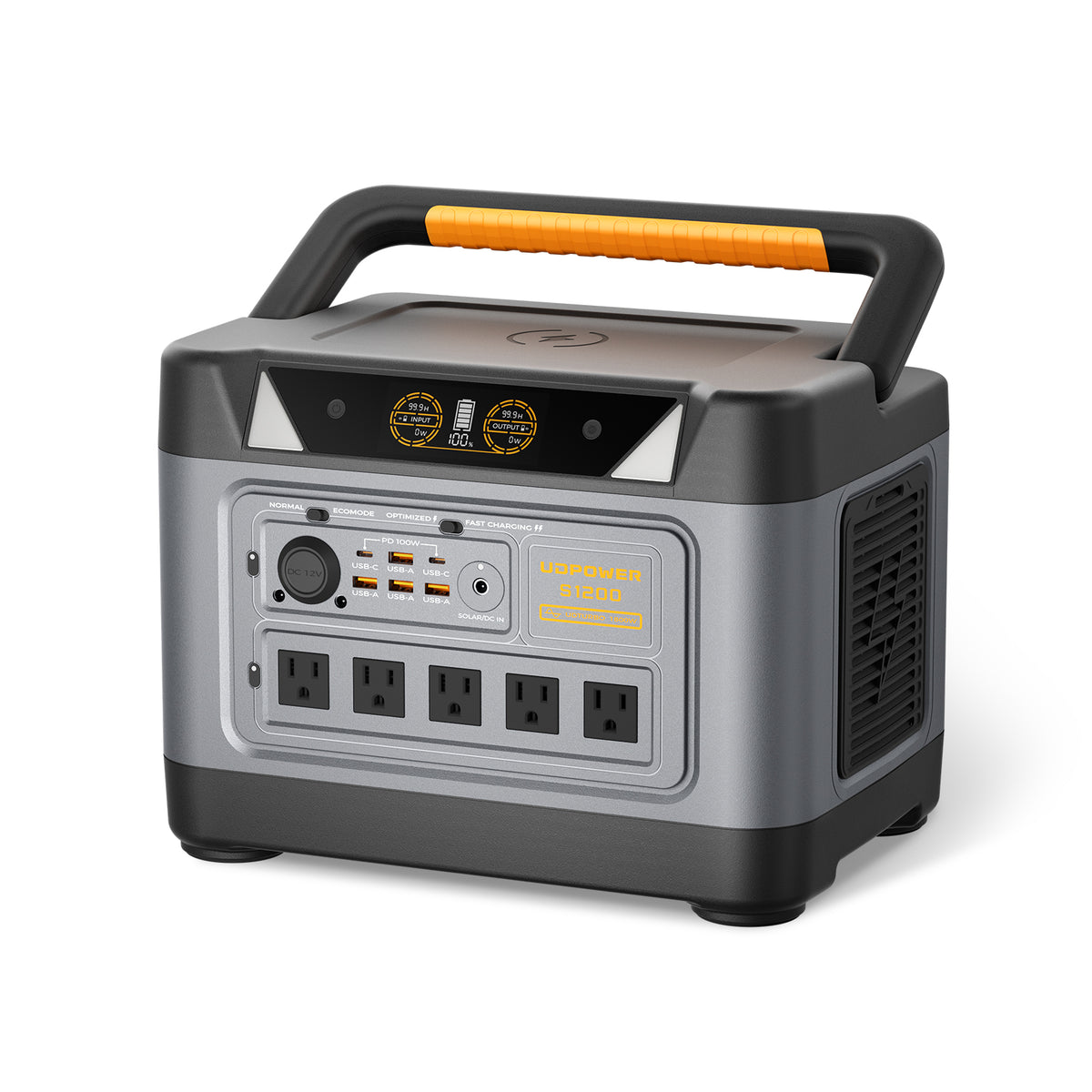
UDPOWER S1200: Best Balance for Home Backup and RV Use
The S1200 provides substantially more energy and AC output than a compact power station while remaining portable enough to move around a home, RV, campsite, or work area.
- Battery capacity: 1,190Wh
- Rated AC output: 1,200W pure sine wave
- Surge support: Up to 1,800W
- AC receptacles: 5
- Additional outputs: USB-A, USB-C, DC5521, 12V car outlet, and wireless charging
- Solar input: Up to 400W
- UPS transfer: Less than 10 milliseconds on the supported UPS function
- Weight: Approximately 26.0 lb
- Battery chemistry: LiFePO₄
Choose the S1200 when: you need longer CPAP, router, computer, fan, refrigerator, or camping runtime and want more inverter headroom than a 600W unit provides. It is the strongest all-around choice for many ordinary backup plans.
View the UDPOWER S1200
UDPOWER S2400: Best for Higher-Wattage and Multi-Device Backup
The S2400 is designed for users who need both more stored energy and a stronger inverter. It can support larger measured loads and more simultaneous devices than the smaller models in this guide.
- Battery capacity: 2,083Wh
- Rated AC output: 2,400W pure sine wave
- Surge support: Up to 3,000W
- AC receptacles: 6
- Total outputs: Up to 16 AC, USB, DC, car, and wireless outputs
- Solar input: Up to 400W
- UPS transfer: 10 milliseconds or less on the supported UPS function
- Weight: Approximately 40.8 lb
- Battery chemistry: LiFePO₄
Choose the S2400 when: you need longer refrigerator backup, higher-wattage cooking equipment, multiple home essentials, RV power, or more output headroom. Its higher capacity improves runtime, but its 40.8-pound weight should be considered before frequent carrying.
View the UDPOWER S2400How Do You Recharge a Battery Powered Outlet?
AC wall charging
Wall charging is normally the fastest and most predictable method. Charging time depends on battery size, maximum AC input, charging mode, temperature, and whether the station is also powering devices.
Do not assume a larger battery always takes longer. A large station with a high AC input may recharge faster than a smaller station with a low-power adapter.
Vehicle charging
Vehicle charging is useful while driving, but a 12V vehicle socket usually provides much less power than a home wall outlet. It can take many hours to refill a large battery.
Avoid leaving a power station charging from a parked vehicle if doing so could discharge the starter battery. Follow the vehicle and power-station instructions.
Solar charging
Solar panels can extend off-grid use, but solar output changes with sunlight, panel angle, temperature, clouds, shade, cable loss, and the station’s input limit.
Before connecting a panel, verify:
- The power station’s accepted solar voltage range
- The panel’s open-circuit voltage
- The maximum input current
- The station’s maximum accepted solar wattage
- The connector and cable type
- Whether multiple panels should be connected in series or parallel
Do not select a solar panel by watts alone. A panel array can remain below the station’s watt limit but still exceed its maximum voltage. Excessive voltage can damage the charging system.
Can you use the outlets while the battery is charging?
Many portable power stations support some form of pass-through operation, but the exact behavior is model-specific. Charging while powering loads can increase heat, reduce net charging speed, and create additional battery cycling.
Pass-through operation is also not automatically the same as a true UPS. If continuous backup matters, confirm:
- Whether the model has a documented UPS or EPS function
- The stated transfer time
- Whether all output ports remain active during transfer
- Whether low-load automatic shutdown can interrupt the device
- Whether the connected equipment manufacturer permits this setup
Battery Powered Outlet Buying Checklist
- List the exact devices you want to run. Avoid shopping with vague categories such as “camping gear” or “home appliances.”
- Find measured or documented watts. Use the appliance label, manual, manufacturer page, EnergyGuide label, or a suitable power meter.
- Add simultaneous loads. The inverter must support the combined watts, not only the largest single device.
- Check startup surge. Motors, compressors, pumps, and some power supplies need extra power for a short period.
- Calculate daily watt-hours. Multiply each device’s watts by its expected hours of use.
- Apply conversion loss. This guide uses 90% for UDPOWER runtime planning.
- Add reserve capacity. Avoid buying a battery that only works under perfect mathematical conditions.
- Check pure sine wave output. This is especially important for sensitive electronics, compressors, audio equipment, computers, and medical-related devices.
- Count and inspect the ports. Confirm AC spacing, USB-C power, DC voltage, car output, and simultaneous-use limits.
- Review charging options. Check AC charging speed, vehicle input, solar voltage range, solar watt limit, and included cables.
- Ask about low-load shutdown. Some stations automatically turn off when a router, modem, or other low-power device draws too little current.
- Confirm UPS behavior if required. Pass-through charging and documented UPS operation are not identical.
- Compare battery chemistry and cycle definitions. A cycle claim should ideally state the remaining-capacity threshold and test conditions.
- Check weight and dimensions. A technically portable station may still be too heavy for frequent carrying.
- Review certification and warranty information. Look for clearly stated product testing, transport compliance, service terms, and accessible support.
The 10-minute pre-purchase test
Before ordering, perform this quick check:
- Write down the devices you would connect during the first six hours of an outage.
- Record each device’s running watts and startup requirement.
- Add the watts of devices that may run together.
- Calculate watt-hours for the desired operating time.
- Check whether the station can be recharged before the battery is empty.
This simple process prevents the most common mistake: buying enough inverter watts but not enough battery capacity, or buying a large battery with an inverter that cannot start the intended appliance.
Common Battery Powered Outlet Mistakes
Confusing watts with watt-hours
Watts measure power at a moment in time. Watt-hours measure stored energy. A 2,000W station is not automatically a 2,000Wh station, and a 2,000Wh battery is not automatically able to run a 2,000W appliance.
Using the advertised appliance name instead of measured input watts
Product names can be misleading. A “1,000W microwave” may draw more than 1,000W from the AC outlet. A refrigerator may show a high nameplate value but use a much lower average over 24 hours. Measured energy is more useful than category assumptions.
Ignoring combined loads
A 600W coffee maker may run on a 600W-rated station by itself under ideal conditions, but adding a refrigerator, laptop, or fan at the same time can exceed the inverter rating.
Treating surge power as continuous power
Surge ratings are normally intended for brief startup events. They should not be treated as permission to operate an appliance continuously above the station’s rated output.
Assuming every solar panel is compatible
Connector shape is only one part of solar compatibility. Voltage, current, wattage, polarity, and array configuration matter.
Planning only for the first battery charge
A station may handle one night perfectly and become useless on the second day if no adequate charging source is available.
Leaving no runtime reserve
Temperature, battery aging, inverter overhead, device settings, and unexpected loads can reduce runtime. A backup system sized to exactly 100% of the expected demand has little tolerance for change.
Assuming every station stays on with tiny loads
Energy-saving modes may turn an output off when the connected load remains below a threshold. This matters for routers, modems, low-power medical equipment, trickle chargers, and monitoring devices.
Storing the unit in a hot vehicle
Heat can accelerate battery aging and may place the unit outside its specified storage range. Store the station in a cool, dry area and follow the manufacturer’s long-term storage instructions.
Are Battery Powered Outlets Safe Indoors?
A properly designed battery powered outlet does not burn gasoline or propane and does not create engine exhaust during normal use. This makes it fundamentally different from a combustion generator.
However, indoor-safe does not mean risk-free. Follow these rules:
- Keep air vents unobstructed during charging and discharging.
- Do not place the station on bedding, thick carpet, or other material that blocks cooling airflow.
- Keep it dry and away from sinks, rain, standing water, and condensation.
- Do not use a damaged, swollen, punctured, wet, or unusually hot battery.
- Stop using the unit if it produces an unusual odor, smoke, sparking, or repeated safety errors.
- Use charging cables and adapters that match the manufacturer’s specifications.
- Stay within the listed charging, discharging, and storage temperature ranges.
- Do not open or modify the battery enclosure.
UL 2743 is one recognized standard associated with portable power packs. Buyers should check the exact certification claims for the complete product rather than assuming a logo applied to one component covers the entire station.
Battery powered outlet vs. gas-generator safety
A battery station can be used indoors when operated according to its instructions because it does not produce combustion exhaust. A gas or propane generator must never be operated inside a home, garage, basement, crawlspace, shed, or other enclosed area.
The U.S. Consumer Product Safety Commission warns that generator carbon monoxide can incapacitate or kill within minutes. Combustion generators must be operated outdoors and far from windows, doors, and vents.
Can you use an extension cord or power strip?
An appropriate extension cord or power strip can be used when the power station manufacturer permits it, but the combined load must remain within:
- The power station’s continuous AC rating
- The individual AC receptacle rating
- The extension cord or power strip rating
- The connector and cable temperature limits
Use a grounded cord when the connected equipment requires grounding. Inspect plugs and cords for heat, looseness, cuts, crushing, or discoloration. Avoid daisy-chaining multiple power strips and do not run a high-wattage heating appliance through a light-duty cord.
Never plug the power station into a household wall receptacle to energize home wiring. This is unsafe backfeeding. A home electrical connection requires approved transfer equipment and a qualified electrician.
For a more detailed review, read the UDPOWER power station safety guide.
Can You Take a Battery Powered Outlet on a Plane?
Most full-size battery powered outlets cannot be carried on passenger aircraft because their batteries are much larger than normal airline limits.
The Federal Aviation Administration states that lithium-ion batteries up to 100Wh are generally allowed under passenger-baggage rules. Batteries from 101Wh to 160Wh require airline approval and are subject to quantity and carry-on restrictions. Batteries exceeding 160Wh are generally forbidden on passenger aircraft.
That means products with capacities such as 192Wh, 256Wh, 596Wh, 1,190Wh, or 2,083Wh should not be assumed to be airline-compatible. Shipping a large lithium battery is also regulated and must be arranged through an eligible carrier and service.
Always check current airline and FAA rules before travel. See the FAA airline passenger battery guidance.
Frequently Asked Questions
Is there really such a thing as a battery powered outlet?
Yes. It is normally sold as a portable power station. The internal battery stores energy, while an inverter supplies household-style AC power through one or more receptacles.
Can a battery powered outlet run a refrigerator?
Yes, when the station’s continuous and surge output can support the refrigerator and the battery has enough watt-hours for the desired runtime. Check both compressor startup power and average daily energy use.
How long will a battery powered outlet last?
Runtime depends on battery capacity and the connected load. A practical estimate is battery Wh × 0.90 ÷ measured load watts. Cycling appliances, temperature, battery age, and standby operation can change the result.
Can I use a battery powered outlet while it is charging?
Many models permit pass-through operation, but the behavior is model-specific. Charging may be slower when loads are connected, and additional heat may be produced. Confirm the manufacturer’s instructions and do not assume pass-through operation provides true UPS protection.
Is a battery powered outlet safe to use inside a house?
A properly functioning battery power station does not produce combustion exhaust and can generally be used indoors according to its instructions. Keep it dry, ventilated, undamaged, and within its specified operating temperature and output limits.
Can I connect a power strip to a battery powered outlet?
You can use a suitable power strip if the manufacturer permits it and the combined load remains within the ratings of the station, AC receptacle, power strip, and cord. A power strip adds connection points; it does not increase available watts.
Can a battery powered outlet run a microwave?
Some larger models can, but check the microwave’s actual AC input rating. The wattage printed prominently on the front may describe cooking output rather than electricity drawn from the wall. Startup behavior and other simultaneous loads must also be considered.
Can it run an electric heater?
A sufficiently powerful station may run a heater within its output rating, but resistance heaters commonly draw 750W to 1,500W continuously and can drain a portable battery quickly. Heating is usually one of the least energy-efficient uses of limited stored electricity.
Do I need solar panels?
No. A battery powered outlet can normally recharge from a wall outlet and may also support vehicle charging. Solar panels are optional but useful for camping, RV travel, remote work, and longer outages where grid charging is unavailable.
Can solar panels charge the battery while it powers appliances?
Many systems can accept solar input while outputs are active. Whether the battery percentage rises or falls depends on the real solar input compared with the connected load and internal losses. A 150W load will still discharge the battery if the panels are only delivering 80W.
Is LiFePO₄ the best battery chemistry for a portable outlet?
LiFePO₄ is a strong choice when long cycle life and thermal stability are priorities. The complete product still matters: cell quality, battery management, cooling, inverter design, certifications, and warranty support can differ between brands.
Can I take a portable power station on an airplane?
Most portable power stations exceed passenger-aircraft lithium-battery limits. FAA guidance generally permits batteries up to 100Wh, allows 101–160Wh only with airline approval and restrictions, and prohibits batteries above 160Wh on passenger aircraft.
Does a battery powered outlet replace a gas generator?
It can replace a gas generator for many quiet, indoor, low-to-medium-power uses. It may not replace one for continuous multi-day operation, central air conditioning, large pumps, electric heating, or other heavy loads unless the battery system and recharging plan are specifically sized for them.
What size battery powered outlet should I buy?
Add the watt-hours required by your essential devices, account for conversion losses, and add a practical reserve. Then confirm that the inverter’s continuous and surge ratings support the highest combined load. For ordinary backup, a 500Wh-class model suits moderate portable use, a 1,000Wh-class model provides more useful overnight backup, and a 2,000Wh-class model is better for higher loads and longer runtime.
Find the Right Battery Powered Outlet
Start with your measured load, required runtime, and recharging plan. Then choose the model that provides enough continuous watts, surge capability, usable energy, and port flexibility without adding unnecessary weight.
Shop Battery Powered Outlets Compare UDPOWER Models Calculate Your RuntimeSources and Calculation Method
Product specifications were checked against the linked UDPOWER product pages. Runtime examples use a 90% conversion-efficiency planning assumption and are rounded to one decimal place. Actual performance depends on the connected device, load behavior, temperature, battery condition, charging state, and operating mode.
| Information checked | Source |
|---|---|
| UDPOWER C600 capacity, output, ports, weight, charging input, and certification information | UDPOWER C600 official product page |
| UDPOWER S1200 capacity, output, ports, solar input, UPS function, and weight | UDPOWER S1200 official product page |
| UDPOWER S2400 capacity, output, ports, solar input, UPS function, and weight | UDPOWER S2400 official product page |
| Portable power-pack safety-standard context | UL Solutions: Portable Power Pack Testing |
| Passenger-aircraft lithium-battery limits | Federal Aviation Administration battery guidance |
| Gas-generator carbon-monoxide precautions | U.S. Consumer Product Safety Commission generator guidance |
Related Articles