

Best Portable Power Stations for Sale in 2026
Last updated: October 30, 2026
Quick answer: If I were choosing among UDPOWER portable power stations currently for sale, I would pick the S1200 for most home backup, CPAP, refrigerator, camping, and RV users. Its 1,190Wh battery, 1,200W rated AC output, manageable 26 lb weight, UPS capability, and current price put it in the strongest all-around position.
For phones, laptops, cameras, and short trips, the C200 or C400 makes more sense because you are not paying for or carrying battery capacity you probably will not use.
If your priority is microwaves, coffee makers, power tools, several appliances at once, or longer home-backup runtime, the S2400 is the stronger choice with 2,083Wh capacity and 2,400W rated output.
Current availability note: C600 is currently sold out, so I would not build a new buying recommendation around it unless inventory returns.

Shopping for a portable power station is easier when you stop asking which model has the biggest number and start asking which one solves your actual power problem.
I look at four things first: the highest load I need to run, how many watt-hours I need between charges, how often I will carry the station, and how quickly I can recharge it.
Price comes after those four checks. A $130 station that cannot run your appliance is not a bargain. A 2,000Wh station can also be poor value if all you ever do is charge a laptop.
Table of Contents
- Best Portable Power Stations for Sale at a Glance
- Current UDPOWER Models, Prices and Availability
- Which Portable Power Station Gives You the Most for Your Money?
- How I Choose the Right Portable Power Station
- Realistic Runtime Comparison
- Recommended UDPOWER Models
- Which Model Fits Your Use Case?
- Should You Buy a Power Station With Solar Panels?
- What to Watch for When Buying a Power Station on Sale
- When Is a Portable Power Station Worth Buying?
- Common Buying Mistakes
- Frequently Asked Questions
Best Portable Power Stations for Sale at a Glance
| Best For | Model | Capacity | Rated AC Output | Weight | Current Listed Price |
|---|---|---|---|---|---|
| Lowest-cost lightweight option | C200 | 192Wh | 200W | Approx. 5.4 lb | About $129.99 |
| Best lightweight camping and travel option | C400 | 256Wh | 400W | Approx. 6.88 lb | About $169.99 |
| Best overall balance for most buyers | S1200 | 1,190Wh | 1,200W | Approx. 26 lb | From about $399.99 |
| Best for high-power loads and longer backup | S2400 | 2,083Wh | 2,400W | Approx. 40.8 lb | About $699.99 |
Prices above were checked when this guide was updated. Promotions, coupon codes, bundles, and inventory can change, so use the linked product page for the live checkout price.
My short recommendation: C200 if minimum cost and weight come first; C400 if you want a compact station with more usable AC headroom; S1200 if you want one station that can cover most everyday backup jobs; S2400 if your appliance wattage or required runtime makes S1200 too restrictive.
Current UDPOWER Models, Prices and Availability
The word “sale” matters here because a buying guide should reflect what you can actually order, not simply every model that has existed in the lineup.
| Model | Status | Capacity | Rated Output | Planning Usable Energy at 90% | Solar | Official Source |
|---|---|---|---|---|---|---|
| C200 | In stock | 192Wh | 200W | About 173Wh | Up to 150W | C200 product page |
| C400 | In stock | 256Wh | 400W | About 230Wh | Up to 150W | C400 product page |
| C600 | Sold out at time of update | 596Wh | 600W | About 536Wh | Not used as a primary recommendation while unavailable | C-Series availability |
| S1200 | In stock | 1,190Wh | 1,200W | About 1,071Wh | Up to 400W | S1200 product page |
| S2400 | In stock | 2,083Wh | 2,400W | About 1,875Wh | Up to 420W recommended solar setup | S2400 product page |
The 90% column is not a claim that every load will always receive exactly 90% of the battery's rated capacity. It is the planning factor I use for UDPOWER runtime estimates so I do not pretend that inverter and conversion losses disappear.
Which Portable Power Station Gives You the Most for Your Money?
Sale percentage is one of the least useful numbers on a power-station page if you look at it by itself.
What matters more is what the current purchase price buys you in battery capacity and usable output.
| Model | Approx. Current Price | Price per Rated Wh | Price per Planning Usable Wh | Price per Rated AC Watt | Value Takeaway |
|---|---|---|---|---|---|
| C200 | $129.99 | About $0.68/Wh | About $0.75/Wh | About $0.65/W | You are paying for minimum size and low weight rather than maximum energy value. |
| C400 | $169.99 | About $0.66/Wh | About $0.74/Wh | About $0.42/W | More AC output than C200 without giving up compact portability. |
| S1200 | $399.99 | About $0.34/Wh | About $0.37/Wh | About $0.33/W | Strong balance of capacity, output, weight, UPS functionality, and price. |
| S2400 | $699.99 | About $0.34/Wh | About $0.37/Wh | About $0.29/W | Best current output value if you genuinely need high-power capability. |
This table explains why “cheapest” and “best value” are not the same thing.
C200 costs the least, but that does not make it the cheapest way to buy battery capacity. S1200 and S2400 currently provide roughly twice as much rated battery capacity per dollar.
That still does not mean everyone should buy an S2400. Carrying a 40.8 lb battery for a weekend where you only need 150Wh is not good value either.
Value is use-case dependent. The most economical station is the smallest one that can safely run your highest required load, provide enough runtime, and be recharged before you need the energy again.
How I Choose the Right Portable Power Station
1. Start With Rated AC Output
Output tells you whether the station can operate your appliance.
If your equipment draws 1,000W continuously, a conventional 400W station is not the right starting point regardless of battery capacity.
If several devices run at the same time, add their watts together.
For example:
2. Check Higher-Power and Startup Requirements
Refrigerators, compressors, pumps, and tools can require significantly more power when starting or working under load.
UDPOWER models provide different levels of higher-power appliance support. Do not confuse that capability with battery capacity.
For S-series units, UDTURBO can support compatible loads above the normal rated output while the station is supplying power through its battery and inverter. Conversion efficiency can decrease in this operating range. When S1200 or S2400 is operating through UPS/bypass, keep the load within the normal rated output.
3. Calculate Watt-Hours
A 60W load running for eight hours requires:
Because real power conversion is not 100% efficient, you need more battery capacity than the appliance's raw energy calculation.
4. Include Conversion Losses
For UDPOWER planning estimates:
For a deeper explanation, read How to Know If a Portable Power Station Can Power Your Device.
5. Decide How Much Weight You Are Willing to Carry
This is the specification I think buyers underestimate most.
A 5.4 lb station and a 40.8 lb station solve different problems even if both technically have an AC outlet.
For something that will live beside a refrigerator during outages, weight may not matter much. For photography, tent camping, a picnic table, or frequent vehicle unloading, weight can matter as much as battery capacity.
6. Plan the Recharge Before Buying
A battery is only useful until it runs empty.
For an overnight outage, starting at 100% may be enough. For multi-day camping or emergency use, you also need to ask how much energy you can put back each day through wall, vehicle, or solar charging.
Realistic Runtime Comparison
Here is what the four currently recommended models look like under steady loads using the same 90% planning factor.
| Steady Load | C200 192Wh |
C400 256Wh |
S1200 1,190Wh |
S2400 2,083Wh |
|---|---|---|---|---|
| 20W | About 8.6 hr | About 11.5 hr | About 53.6 hr | About 93.7 hr |
| 40W | About 4.3 hr | About 5.8 hr | About 26.8 hr | About 46.9 hr |
| 60W | About 2.9 hr | About 3.8 hr | About 17.9 hr | About 31.2 hr |
| 100W | About 1.7 hr | About 2.3 hr | About 10.7 hr | About 18.7 hr |
| 300W | Above normal rated output | About 0.8 hr | About 3.6 hr | About 6.2 hr |
| 600W | Not the appropriate size | Above normal rated output | About 1.8 hr | About 3.1 hr |
| 1,000W | Not the appropriate size | Not the appropriate size | About 1.1 hr | About 1.9 hr |
| 1,500W | Not the appropriate size | Not the appropriate size | Above normal rated output | About 1.2 hr |
| 2,000W | Not the appropriate size | Not the appropriate size | Above normal rated output | About 0.9 hr |
These are mathematical estimates for comparison, not guaranteed appliance runtimes. Refrigerators cycle. Laptop consumption changes. Very low AC loads are affected more by inverter standby consumption. Battery temperature, age, appliance power factor, and higher-power operation can also change the result.
Best UDPOWER Portable Power Stations for Sale
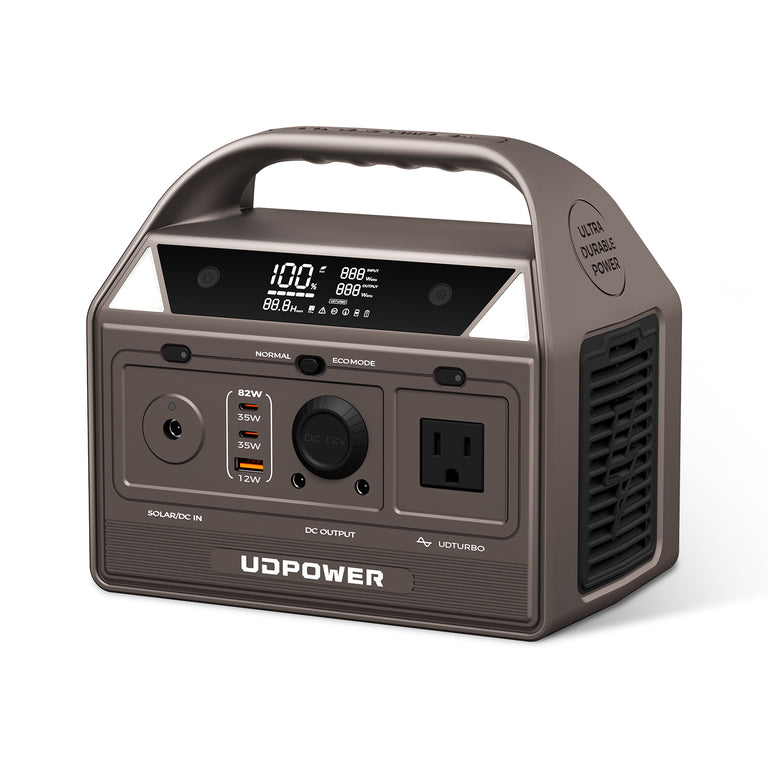
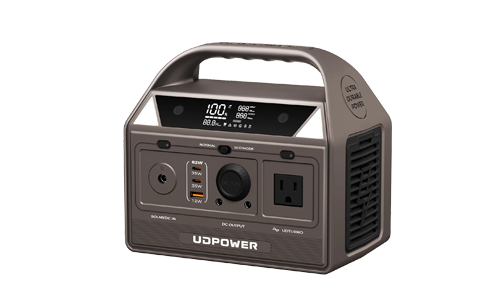
UDPOWER C200
C200 is the model I would buy when the real priority is having an AC-capable battery that is small enough to carry almost anywhere.
Its 192Wh battery and 200W rated output are intended for light electrical loads rather than household backup. Think phones, cameras, routers, LED lights, laptops, small fans, and other electronics.
- 192Wh LiFePO4 battery
- 200W rated pure sine wave AC output
- Compatible higher-power support up to 400W
- Approximately 5.4 lb
- Up to 150W compatible solar input
- AC, USB and 12V DC outputs
Why buy it: low purchase price, low weight, easy storage, and enough energy for basic electronics.
Why not buy it: 192Wh is not much energy for refrigerators, overnight heating loads, cooking appliances, or long outages.
Best fit: day trips, photography, vehicle emergency kits, communications, light camping, and short power interruptions.
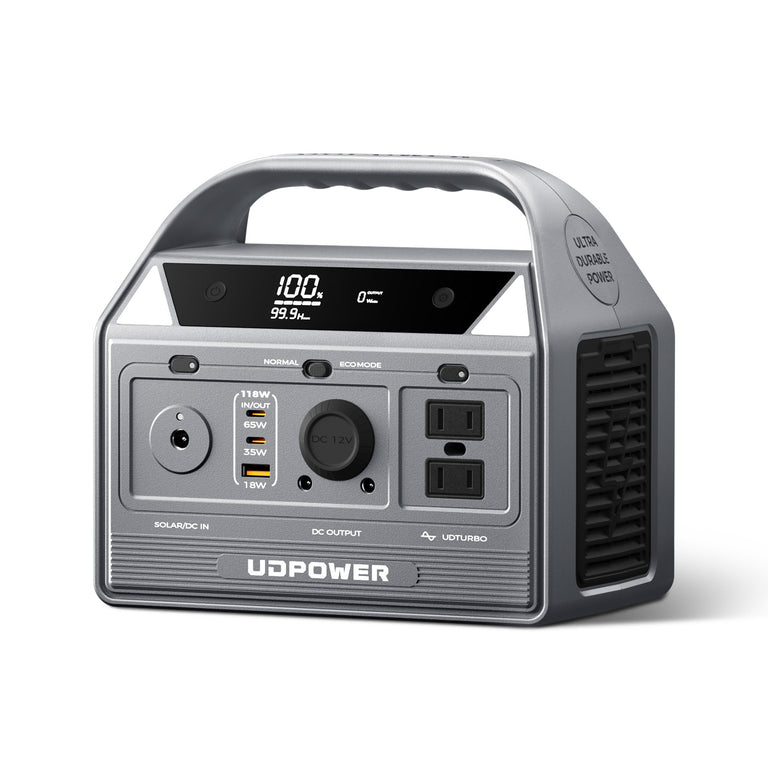
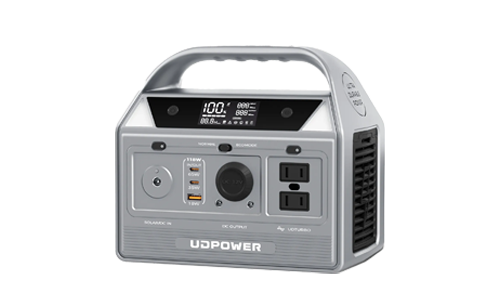
UDPOWER C400
C400 is where the compact lineup becomes noticeably more flexible. Going from 200W to 400W rated AC output doubles the normal inverter headroom while adding relatively little weight.
That makes C400 a better match for camping, laptops, fans, camera equipment, routers, selected CPAP setups, vehicle travel, and other loads where portability still matters.
- 256Wh LiFePO4 battery
- 400W rated pure sine wave AC output
- UDTURBO-compatible appliance support up to 800W
- Approximately 6.88 lb
- Up to 150W solar input
- Two AC outlets
- USB-C, USB-A and 12V DC outputs
- Dedicated vehicle jump-start connection
Why buy it: it provides substantially more AC flexibility than C200 while remaining under 7 lb.
Why not buy it: 256Wh is still a relatively small energy reservoir, so a refrigerator, CPAP with high heating demand, or other continuous load can drain it quickly.
Best fit: camping, road trips, mobile work, drone/camera kits, laptops, fans, routers, and compact emergency backup.
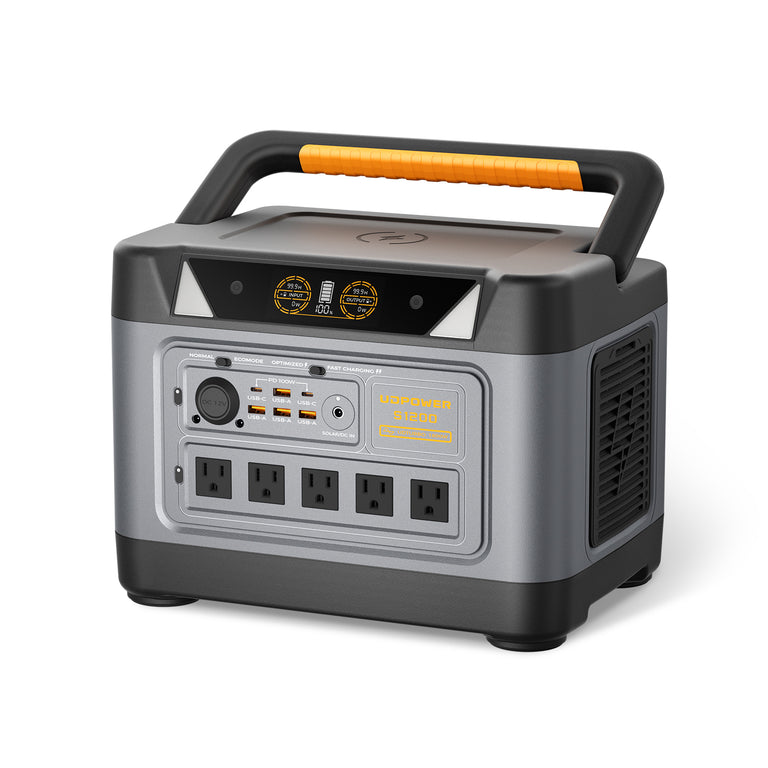
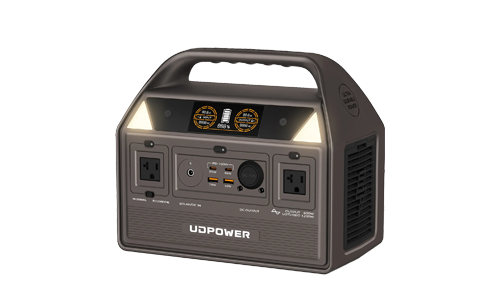
UDPOWER S1200
S1200 is the point in the lineup where I stop thinking of the unit primarily as a charger and start thinking of it as practical backup power.
The 1,190Wh battery gives you roughly 1,071Wh of planning energy at 90% conversion efficiency, while the 1,200W rated inverter can operate a much wider range of household and camping loads than C-series models.
- 1,190Wh LiFePO4 battery
- 1,200W rated 120V/60Hz pure sine wave AC output
- UDTURBO higher-power compatibility up to 1,800W in battery/inverter operation
- Approximately 26 lb
- Up to 400W solar input
- 3-AC and 5-AC versions available
- USB-C, USB-A, DC5521 and 12V car output
- UPSPrime response time of 10ms or less
- No wireless charging on current models
Why buy it: this is the strongest balance between stored energy, appliance capability, portability, UPS support, and current purchase price.
Why not buy it: if your regular loads are microwaves, heaters, large coffee makers, or several high-power devices running together, 1,200W rated output may be the limiting factor.
Best fit: refrigerator backup, CPAP, Wi-Fi, home-office equipment, TVs, family camping, RV use, lighting, and general emergency power.
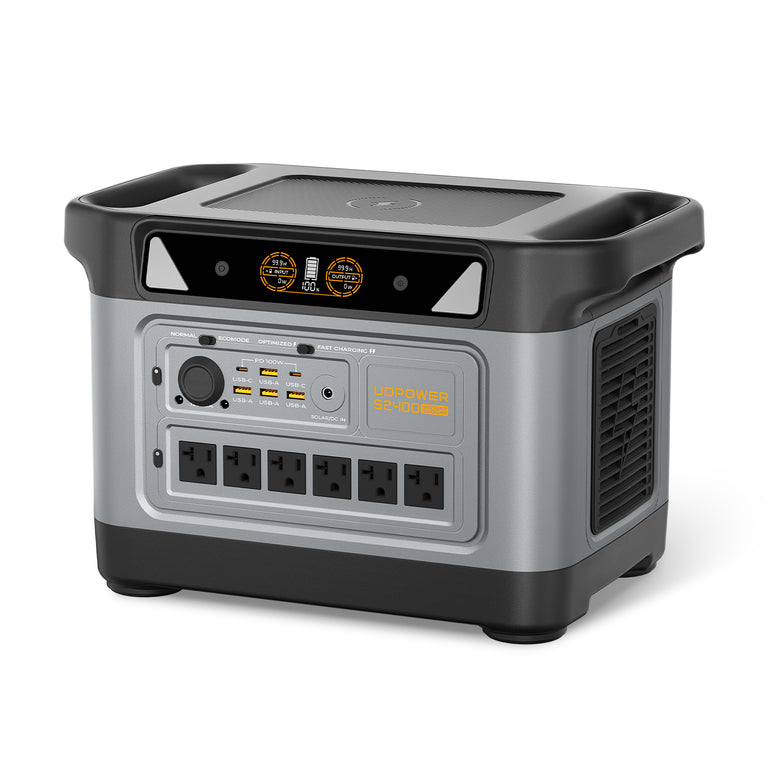
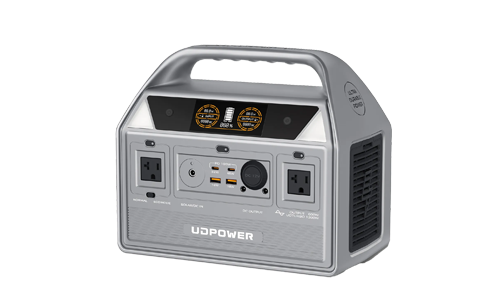
UDPOWER S2400
S2400 is what I would choose when output power is just as important as battery capacity.
At 2,083Wh and 2,400W rated AC output, it roughly doubles both the energy storage and normal AC output of S1200 while remaining in a format one person can still move when necessary.
- 2,083Wh LiFePO4 battery
- 2,400W rated 120V/60Hz pure sine wave AC output
- UDTURBO higher-power compatibility up to 3,000W in battery/inverter operation
- Approximately 40.8 lb
- Up to 420W recommended solar panel setup
- 6 AC outlets
- USB-C, USB-A, DC5521 and 12V car output
- UPSPrime response time of 10ms or less
- No wireless charging on current models
Why buy it: you get substantially more appliance headroom, about 1,875Wh of planning usable energy at 90%, and the lowest current cost per rated AC watt among these four models.
Why not buy it: 40.8 lb is unnecessary if your entire power requirement is a laptop, phone, light, or other low-energy electronics.
Best fit: microwaves, coffee makers, power tools, larger refrigeration loads, longer home outages, RV/basecamp power, and multi-device backup.
Which Portable Power Station Should You Buy for Your Use Case?
Phones, Cameras, Laptop and Day Trips
Start with C200. There is little benefit in paying for a 1,000Wh battery if your total daily demand is only 100–150Wh.
If your laptop has a high-power charger or you expect several devices at once, C400 gives you more useful output margin.
Weekend Camping
Start with C400 for basic camping and S1200 for appliance-heavy camping.
C400 makes sense for lights, cameras, phones, laptops, fans, and modest electrical loads. Add a CPAP, refrigerator, several family devices, or multiple nights without reliable recharging and S1200 becomes easier to live with.
CPAP Backup
Start with S1200 if the station is intended for reliable overnight outage protection.
CPAP energy consumption can change dramatically with humidifier level and heated tubing. Smaller batteries may work when heating features are disabled, but S1200 gives substantially more reserve.
Refrigerator Backup
S1200 is my practical starting point.
A refrigerator is not just a wattage problem. Its compressor cycles, startup demand changes, and the battery may also need to support Wi-Fi, lights, phones, or other essentials.
Choose S2400 when longer runtime or several household appliances need to share the station.
Home Office and Internet Backup
A router, modem, laptop, monitor, and phone chargers normally use far less power than kitchen appliances, but outages can last for hours.
C400 can cover a compact setup. S1200 makes more sense if you want the same battery to support the refrigerator, CPAP, TV, or other home essentials.
Microwave, Coffee Maker and Kitchen Appliances
S2400 is the safer starting point.
Heating appliances use a lot of power even when they run for only a few minutes. A microwave may advertise cooking wattage that is lower than its actual electrical input, so always check the appliance label.
Power Tools and Mobile Work
S1200 may handle many moderate tool loads, while S2400 gives you much more margin for saws, compressors, chargers, and multiple worksite devices.
Motor-driven tools should be sized from both running requirements and their harder starting or under-load demand.
Whole-Home Backup
Do not confuse a large portable power station with a complete whole-home system.
S1200 and S2400 provide standard U.S. 120V output for compatible devices. They are not native 240V whole-home systems and should not be treated as replacements for a properly designed transfer-switch, battery-storage, or standby-generator installation.
Should You Buy a Portable Power Station With Solar Panels?
For a one-night trip or short outage, I would prioritize the correct battery before buying panels.
For repeated off-grid use, solar becomes much more valuable because it gives you a way to replace energy after the battery has been depleted.
| Model | Battery | Solar Capability | When Solar Makes Sense |
|---|---|---|---|
| C200 | 192Wh | Up to 150W compatible input | Short off-grid trips and light daytime charging |
| C400 | 256Wh | Up to 150W | Weekend camping and vehicle travel |
| S1200 | 1,190Wh | Up to 400W | RV, extended camping and outage recovery |
| S2400 | 2,083Wh | Up to 420W recommended solar setup | Larger daily energy budgets and extended off-grid backup |
A panel rated at 420W does not continuously produce 420W. Real output changes with weather, sun angle, shade, panel temperature, season, cable loss, and the receiving power station.
For longer trips, I prefer thinking about solar as an energy-replacement problem:
If you consume 900Wh per day but recover only 400Wh, you are still losing roughly 500Wh of stored energy each day.
See current UDPOWER solar generator kits if you want the station and panels together.
What to Watch for When Buying a Portable Power Station on Sale
Do Not Buy From the Discount Percentage
A large percentage discount tells you nothing about whether the battery is correctly sized for your equipment.
Compare the final price with capacity, rated output, weight, battery chemistry, charging system, warranty, and the loads you actually need to run.
Check Whether the Product Is Actually in Stock
This sounds obvious, but older guides often keep recommending models long after inventory changes.
C600 is a good example. Its specifications may still fit some users, but it is currently sold out. If you need a station now, an unavailable model should not be the center of your decision.
Check Whether the Price Refers to the Same Variant
S1200 is available in different AC-outlet configurations, so two legitimate S1200 prices may refer to different versions.
Always compare the exact variant before deciding one listing is cheaper.
Check the Unit-Only Price Against the Solar Kit
If you already know you need solar, buying a bundle can make more sense than purchasing the station and panels separately.
If you mainly need emergency battery backup at home and expect to recharge from the wall, paying for panels you rarely use is not automatically a better deal.
Do Not Treat a Higher-Power Number as Battery Capacity
Watts and watt-hours are not interchangeable.
A 2,400W station tells you about appliance capability. A 2,083Wh battery tells you about stored energy.
Check the Battery-Life Definition
For current UDPOWER content, use approximately 80% remaining capacity after 3,000 cycles and 70% remaining capacity after 4,000 cycles.
Battery cycle life describes gradual capacity retention, not the day the battery suddenly stops working.
Do Not Pay for Features the Current Product Does Not Have
Current UDPOWER S-series models should not be purchased with the expectation of wireless charging. Use the available USB or AC outputs instead.
When Is a Portable Power Station Worth Buying?
I think a portable power station is worth buying when it solves a power problem that matters enough to justify the battery.
Good examples include:
- Keeping a refrigerator cold during an outage
- Keeping a CPAP running overnight
- Maintaining Wi-Fi and communications during utility failures
- Working remotely where there is no outlet
- Running campsite electronics without a fuel generator
- Powering an RV or overland setup
- Operating tools at a remote property or jobsite
- Charging cameras, drones, laptops and mobile equipment
It may not be worth buying a large station if your only need is phone charging. A conventional USB power bank can solve that job much more cheaply.
A portable power station may also be the wrong category if your actual goal is central air conditioning, a large electric water heater, a 240V well pump, or automatic whole-home backup.
For a deeper breakdown, read Are Portable Power Stations Worth It?
Common Portable Power Station Buying Mistakes
- Buying only by price. The cheapest station is expensive if it cannot do the job.
- Buying only by wattage. Output tells you what can run, not how long it can run.
- Buying only by watt-hours. A large battery still needs enough inverter output for your appliance.
- Ignoring simultaneous loads. Add together everything that may operate at the same time.
- Ignoring compressor or motor behavior. Refrigerators, pumps and tools can have higher starting or under-load demand.
- Assuming every advertised Wh reaches the appliance. Real systems have conversion losses.
- Buying much more battery than you need. Extra capacity adds weight and cost.
- Buying too little battery because the appliance wattage looks low. Low-watt devices can still consume substantial energy when they run all night.
- Ignoring recharge planning. A battery that cannot be refilled in time can become the limiting part of the system.
- Choosing solar by wattage alone. Voltage, current, connectors, polarity and wiring also need to be compatible.
- Assuming all product variants are identical. Outlet configuration and included accessories can change by version or bundle.
- Assuming 120V power means 240V capability. Check the electrical requirements of the actual appliance.
- Waiting for an outage before testing your setup. Test refrigerators, CPAP equipment and other important loads before relying on them.
My Final Picks
Best Budget Pick: C200
Choose it because you want the lowest-cost, lightest way into portable AC power and your equipment is genuinely low wattage.
Best Lightweight Pick: C400
Choose it when 200W feels restrictive but carrying a 20–40 lb battery does not make sense.
Best Overall Pick: S1200
Choose it for the best balance of battery capacity, 1,200W rated output, portability, UPS capability, and current price.
Best High-Power Pick: S2400
Choose it when microwaves, coffee makers, tools, multiple household devices, or longer outage runtime are part of your actual plan.
You can also use the UDPOWER comparison tool to compare models side by side.
Frequently Asked Questions
What is the best portable power station for sale right now?
For most buyers, the UDPOWER S1200 offers the strongest overall balance of capacity, rated output, portability, UPS capability, and current price. C200 and C400 are better if low weight is the priority, while S2400 is better for high-wattage appliances and longer backup.
What is the best cheap portable power station?
C200 is the lowest-cost current UDPOWER option, with a 192Wh LiFePO4 battery and 200W rated AC output. C400 costs more but doubles the rated AC output to 400W while remaining under 7 lb.
Which portable power station gives the best value per Wh?
Based on the prices checked when this guide was updated, S1200 and S2400 both cost roughly $0.34 per rated watt-hour, compared with roughly $0.66–$0.68 per Wh for C200 and C400. Smaller stations cost more per Wh partly because portability is one of the things you are paying for.
How many watt-hours should I buy?
Calculate the wattage of each device multiplied by the hours you need to run it, then account for conversion losses and additional reserve. For UDPOWER planning, battery capacity multiplied by about 90% provides a useful starting estimate for available appliance energy.
How many watts should my portable power station have?
The rated AC output should exceed the total normal wattage of the devices you plan to operate simultaneously. Also check higher startup or under-load demand for refrigerators, pumps, compressors, and motor-driven tools.
Is a 1,000Wh portable power station enough?
A roughly 1,000Wh-class station is a useful size for many households because it can support routers, laptops, TVs, CPAP equipment, lighting, refrigeration, and other selected essentials. It may not provide enough output or runtime for several high-wattage appliances operating together.
What portable power station should I buy for home backup?
S1200 is a practical starting point for refrigerator, router, CPAP, lighting, TV, laptops, and other selected household loads. S2400 provides more output and runtime when several appliances need to share the battery or high-wattage equipment is involved.
What portable power station should I buy for camping?
C400 is a strong compact option for phones, laptops, cameras, lights, fans, and other campsite electronics. S1200 makes more sense for CPAP, refrigeration, family camping, longer trips, or heavier electrical use. S2400 is better for larger RV and basecamp setups.
Can a portable power station run a refrigerator?
Yes, provided its inverter can handle the refrigerator's operating and compressor demand and the battery contains enough energy for the required runtime. S1200 is a practical starting point for household refrigerator backup, while S2400 provides more reserve.
Can a portable power station run a microwave?
Some larger models can. Microwave electrical input can often exceed 1,000W, so check the appliance label rather than relying only on advertised cooking wattage. S2400's 2,400W rated output makes it a more appropriate UDPOWER option for this type of load.
Should I buy a portable power station with solar panels?
Solar is most valuable for multi-day camping, RV travel, remote work, and extended outages where you need to restore battery energy without grid power. For short outages or occasional home backup, buying the correct battery first may be more important than immediately adding solar.
Is LiFePO4 better for a portable power station?
LiFePO4 is well suited to portable power stations because of its long cycle life and thermal stability. Current UDPOWER power stations use LiFePO4 battery chemistry.
How long do UDPOWER batteries last?
For current UDPOWER battery-life planning, use approximately 80% remaining battery capacity after 3,000 cycles and approximately 70% remaining capacity after 4,000 cycles. Capacity gradually decreases with use rather than the battery suddenly failing at a specific cycle count.
Is the UDPOWER C600 still available?
C600 was listed as sold out when this guide was updated on October 30, 2026. Inventory can change, so check the current C-Series or product page if you specifically want that model.
Should I buy the biggest portable power station I can afford?
Not necessarily. A larger battery gives you more runtime and usually more output, but it also costs and weighs more. The better approach is to buy the smallest station that safely handles your highest required load, provides enough runtime, and fits your recharge plan.
Choose Your Portable Power Station From the Load Backward
List the equipment you actually need to power, calculate simultaneous watts, estimate watt-hours, decide how you will recharge, and then compare the models that pass those requirements. That approach is much more reliable than buying from discount percentage or battery size alone.
Related Articles


