

How Much Does a Propane Tank Cost to Fill?
Last updated: September 22, 2026
Quick answer: The cost to fill a propane tank depends on how many gallons actually go into it and the local propane price. For a standard 20 lb propane cylinder, a full refill from empty is roughly 4.6–4.7 gallons, not 20 gallons. At $4.00 per gallon, that works out to about $18.90 before taxes or fees.
As a real-world September 2026 check, U-Haul refill locations we reviewed were advertising roughly $3.80 to $4.25 per gallon. At those rates, filling an empty 20 lb cylinder with about 4.7 gallons would cost roughly $18 to $20. Tank exchange can cost more: sampled U-Haul locations listed exchanges around $24.95–$29.95 each.
For larger home tanks, the math works differently. A nominal 500-gallon stationary propane tank is normally considered full at about 400 gallons because liquid propane needs expansion space.
Important: A 100 lb propane cylinder and a 100-gallon propane tank are completely different sizes. A 100 lb cylinder holds about 23.6 gallons of propane, while a 100-gallon stationary tank would hold roughly 80 gallons at a normal maximum fill level.

Propane Tank Refill Cost by Size
For portable propane cylinders, the most useful number is the amount of propane the cylinder is rated to hold by weight. Liquid propane weighs about 4.24 lb per gallon, so you can estimate gallons by dividing propane weight by 4.24.
The table below shows the approximate cost of filling an empty cylinder at several possible retail propane prices.

| Nominal Cylinder Size | Propane Weight When Full | Approx. Propane Gallons | At $3.00/gal | At $4.00/gal | At $5.00/gal | Common Uses |
|---|---|---|---|---|---|---|
| 5 lb | 5 lb | 1.18 gal | $3.54 | $4.72 | $5.90 | Portable grills, camping |
| 10 lb | 10 lb | 2.36 gal | $7.08 | $9.43 | $11.79 | Camping, grills, small heaters |
| 20 lb | 20 lb | About 4.7 gal | $14.15 | $18.87 | $23.58 | BBQ grills, patio heaters, RVs, generators |
| 30 lb | 30 lb | About 7.1 gal | $21.23 | $28.30 | $35.38 | Travel trailers and RVs |
| 40 lb | 40 lb | About 9.4 gal | $28.30 | $37.74 | $47.17 | RVs, heaters, larger appliances |
| 100 lb | 100 lb | About 23.6 gal | $70.75 | $94.34 | $117.92 | Cabins, heaters, generators, temporary backup |
These are fuel-only calculations. Local taxes, flat fill charges, minimum purchases or other fees can change the final bill.
Conversion reference: AmeriGas states that liquid propane weighs about 4.24 lb per gallon, while its tank-size guidance lists a standard 20 lb cylinder at roughly 4.6 gallons when full.
How Much Does It Cost to Fill a 20 lb Propane Tank?
A standard grill cylinder is commonly called a 20 lb propane tank. That does not mean it holds 20 gallons. It means the cylinder is designed to contain approximately 20 lb of propane when properly filled.
20 lb ÷ 4.24 lb per gallon ≈ 4.72 gallons
In practice, published tank specifications often describe a standard 20 lb cylinder as holding roughly 4.6 to 4.7 gallons when full.
| Local Refill Price | Approx. 20 lb Fill |
|---|---|
| $2.50/gal | About $11.79 |
| $3.00/gal | About $14.15 |
| $3.50/gal | About $16.51 |
| $4.00/gal | About $18.87 |
| $4.25/gal | About $20.05 |
| $5.00/gal | About $23.58 |
That makes roughly $15–$24 a useful planning range for many retail refill situations when propane costs around $3–$5 per gallon, although actual local prices can fall outside that range.
Do not compare refill and exchange only by the price on the sign. A refill may put close to 20 lb of propane into an empty 20 lb cylinder, while major exchange programs commonly provide 15 lb of propane in a 20 lb-size cylinder.
30 lb, 40 lb and 100 lb Propane Tank Refill Costs
30 lb Propane Tank Refill Cost
A 30 lb cylinder holds approximately:
30 ÷ 4.24 ≈ 7.1 gallons
At $4 per gallon, filling it from empty would cost about $28.30.
Thirty-pound cylinders are common on travel trailers because they provide more fuel than grill cylinders without becoming as difficult to handle as larger 100 lb cylinders.
40 lb Propane Tank Refill Cost
40 ÷ 4.24 ≈ 9.4 gallons
At $4 per gallon, a full refill from empty is approximately $37.74.
100 lb Propane Tank Refill Cost
100 ÷ 4.24 ≈ 23.6 gallons
At $4 per gallon, the fuel cost would be about $94.34. At $3 per gallon, it falls to roughly $70.75; at $5 per gallon, it rises to about $117.92.
AmeriGas lists a 100 lb propane cylinder as holding approximately 23 gallons of propane when full.
100 lb is not 100 gallons. A 100 lb cylinder contains only about 23–24 gallons of liquid propane. This distinction matters when comparing portable cylinders with large residential tanks.
Propane Pounds vs Gallons Explained
Propane tank terminology is confusing because portable cylinders are usually described in pounds, while permanent residential tanks are usually described in gallons.
| Label | What the Number Means | Approx. Propane When Full |
|---|---|---|
| 20 lb cylinder | Rated propane weight | About 20 lb / 4.6–4.7 gal |
| 30 lb cylinder | Rated propane weight | About 30 lb / 7.1 gal |
| 40 lb cylinder | Rated propane weight | About 40 lb / 9.4 gal |
| 100 lb cylinder | Rated propane weight | About 100 lb / 23.6 gal |
| 250-gallon tank | Nominal tank volume | About 200 gal propane at normal full level |
| 500-gallon tank | Nominal tank volume | About 400 gal propane at normal full level |
| 1,000-gallon tank | Nominal tank volume | About 800 gal propane at normal full level |
This distinction prevents one of the most common propane calculations from going wrong.
The Propane 80% Rule: Where People Get the Math Wrong
Propane needs vapor space because liquid propane expands as its temperature rises. Large gallon-rated propane tanks therefore are normally filled to about 80% of their nominal container capacity.
AmeriGas, for example, lists:
- 120-gallon tank → about 96 gallons of propane
- 250-gallon tank → about 200 gallons
- 500-gallon tank → about 400 gallons
- 1,000-gallon tank → about 800 gallons
See the AmeriGas residential propane tank size guide.
But Do Not Apply 80% Twice to a 20 lb Cylinder
This is where online refill-cost calculations often become confusing.
A standard cylinder described as a 20 lb propane cylinder is already described by the amount of propane it is intended to contain at a normal proper fill. Twenty pounds of propane converts to roughly 4.7 gallons.
You should not take 4.7 gallons and then multiply it by 80% again to conclude that the tank should hold only 3.8 gallons.
Portable cylinder: 20 lb propane capacity ≈ 4.7 gallons of propane.
Large stationary tank: 500-gallon nominal tank ≈ 400 gallons of propane at normal full level.
The two naming systems are describing different things.
What Is the Propane Refill Price per Gallon Right Now?
There is no single nationwide retail cylinder-refill price. Even locations operated by the same company can post different per-gallon prices.
Here are several real retail examples checked on September 22, 2026:
| Location | Refill Price | Listed Exchange Price | Estimated 20 lb Refill From Empty | Source |
|---|---|---|---|---|
| U-Haul, Western Ave, Los Angeles | $4.25/gal + tax | Not listed | About $20.05 | U-Haul |
| U-Haul, Koreatown, Los Angeles | $4.15/gal + tax | $29.95 | About $19.58 | U-Haul |
| U-Haul, North Long Beach | $3.95/gal + tax | $24.95 | About $18.63 | U-Haul |
| U-Haul, Baton Rouge, Louisiana | $3.80/gal + tax | $24.95 | About $17.92 | U-Haul |
| U-Haul, Hialeah, Florida | $4.10/gal + tax | Not listed | About $19.34 | U-Haul |
These are examples, not national averages. Prices can change at any time, so check the actual refill station before driving there.
What About the EIA National Propane Price?
The U.S. Energy Information Administration reported a U.S. residential propane average of $2.674 per gallon on March 30, 2026, excluding taxes. However, that is a residential propane market benchmark, not a guarantee of the price charged to refill a portable grill or RV cylinder at a retail filling station.
EIA notes that weekly heating-season price reporting runs from October through March and will return in October 2026. See the EIA Heating Oil and Propane Update.
Use the right price for the right job. If you are estimating a 20 lb grill cylinder refill, use the local station's posted pump price. If you are budgeting a 400-gallon residential propane delivery, residential bulk-delivery pricing is the more relevant comparison.
How to Calculate Your Own Propane Refill Cost
If you know how many gallons you need and the local refill price, the calculation is simple.
Refill cost = gallons added × price per gallon
Example: Empty 20 lb Cylinder
If the local price is $4.15 per gallon:
20 lb ÷ 4.24 = about 4.72 gallons
4.72 × $4.15 = about $19.58
Example: Empty 30 lb RV Cylinder
30 lb ÷ 4.24 = about 7.08 gallons
7.08 × $4.15 = about $29.38
Example: Empty 100 lb Cylinder
100 lb ÷ 4.24 = about 23.58 gallons
23.58 × $4.15 = about $97.86
The dispenser's measured quantity determines the actual sale, so a real bill may differ slightly from these estimates.
How Much Does It Cost If Your Propane Tank Is Not Completely Empty?
One advantage of a refill station is that you can often pay for the propane actually added instead of throwing away the fuel already in your cylinder.
The easiest way to estimate the amount remaining is to weigh the cylinder.
Find the TW Mark
Portable cylinders are stamped with a TW, or tare weight. That is approximately how much the empty cylinder itself weighs.
Propane remaining = current cylinder weight − tare weight
Example
Suppose your 20 lb cylinder has:
- Tare weight: 17.2 lb
- Current scale weight: 25.2 lb
You still have:
25.2 − 17.2 = 8 lb of propane remaining
To get back to approximately 20 lb:
20 − 8 = 12 lb needed
12 ÷ 4.24 ≈ 2.83 gallons
2.83 × $4.15 ≈ $11.75
This is much more useful than assuming every refill automatically costs the price of 4.7 gallons.
Ferrellgas also recommends the tare-weight method for estimating propane remaining and explains the calculation in its propane tank level guide.
Propane Exchange vs Refill Cost: Which Is Cheaper?
For a usable cylinder that is still within its required qualification period, refill usually gives you better fuel value. Exchange wins on convenience.
| Factor | Propane Refill | Propane Exchange |
|---|---|---|
| What happens | Your existing cylinder is filled | You trade your cylinder for another cylinder |
| Typical billing | Often by gallons dispensed | Flat exchange price |
| Keep your own tank? | Yes | No, it enters the exchange pool |
| Propane already remaining | Normally remains in your tank | You give remaining fuel away when exchanging |
| Potential 20 lb cylinder fill | Up to the cylinder's normal rated fill | Major exchange brands commonly provide 15 lb |
| Convenience | Requires an operating refill station and trained attendant | Exchange cages are widely available |
| Old cylinder | May be rejected if damaged or out of qualification | Exchange can be convenient when an accepted cylinder is nearing the end of its useful life |
| Fuel value | Usually better | Usually higher cost per pound of propane |
Blue Rhino states that its grill exchange cylinders contain a net 15 lb of propane. AmeriGas also states that its exchange grill tanks contain 15 lb.
A Simple Apples-to-Apples Example
Suppose you have these two choices:
- Refill an empty 20 lb cylinder at $4.00/gallon
- Exchange for a cylinder containing 15 lb for $25
| Option | Propane Received | Total Price | Approx. Cost per lb |
|---|---|---|---|
| Refill | 20 lb | $18.87 | $0.94/lb |
| Exchange example | 15 lb | $25.00 | $1.67/lb |
In that example, refill gives you about one-third more propane and costs less overall.
That does not make exchange a bad service. If you need propane quickly at night, your cylinder is becoming troublesome, or the nearest refill station is far away, convenience can be worth paying for.
How Much Does It Cost to Fill a 100, 250, 500 or 1,000 Gallon Propane Tank?
Large stationary tanks should not be calculated the same way as pound-rated grill and RV cylinders.
Because a gallon-rated tank normally keeps expansion space, a nominal 500-gallon tank holds about 400 gallons of propane when considered full.
| Nominal Tank Size | Approx. Propane at Normal Full Level | At $2.674/gal | At $3.00/gal | At $4.00/gal | At $5.00/gal |
|---|---|---|---|---|---|
| 100 gallon | About 80 gal | $213.92 | $240 | $320 | $400 |
| 120 gallon | 96 gal | $256.70 | $288 | $384 | $480 |
| 250 gallon | 200 gal | $534.80 | $600 | $800 | $1,000 |
| 500 gallon | 400 gal | $1,069.60 | $1,200 | $1,600 | $2,000 |
| 1,000 gallon | 800 gal | $2,139.20 | $2,400 | $3,200 | $4,000 |
The $2.674 column uses the U.S. EIA residential propane benchmark for March 30, 2026. It is useful for scale, but it is not a current quote from a local propane supplier.
Actual residential deliveries may include or be affected by minimum-delivery quantities, tank rental, delivery fees, location, contract terms, seasonal pricing and the amount already remaining in the tank.
You Usually Do Not Add the Tank's Entire "Full" Capacity
If a 500-gallon tank is currently at 30%, you do not need 400 gallons delivered to reach 80%.
500 × 30% = 150 gallons already in tank
500 × 80% = 400 gallons target
400 − 150 = 250 gallons to deliver
At $3.00 per gallon:
250 × $3.00 = $750
This percentage-based approach is much more useful for home-delivery budgeting.
How Much Does an RV Propane Refill Cost?
Travel trailers frequently use removable 20 lb or 30 lb DOT cylinders. Motorhomes may instead use a permanently mounted ASME tank.
| RV Propane Setup | Approx. Propane Capacity | Cost at $4/gal From Empty |
|---|---|---|
| Single 20 lb cylinder | About 4.7 gal | About $18.87 |
| Two 20 lb cylinders | About 9.4 gal total | About $37.74 |
| Single 30 lb cylinder | About 7.1 gal | About $28.30 |
| Two 30 lb cylinders | About 14.2 gal total | About $56.60 |
| 40 lb cylinder | About 9.4 gal | About $37.74 |
Actual RV propane consumption is extremely seasonal. Cooking may use relatively little fuel, while operating a propane furnace in cold weather can change your refill frequency dramatically.
For broader RV budgeting, see How Much Does RV Living Cost?. If you also want to understand how the battery, converter and campground electrical hookup work together, read RV Shore Power: 30 Amp vs. 50 Amp.
Why Does Propane Refill Cost So Much More in Some Places?
Two people filling identical cylinders can pay different prices even on the same day.
| Factor | How It Changes Your Cost |
|---|---|
| Local propane market | Fuel supply, transportation and regional demand affect local pricing. |
| Retail cylinder refill vs bulk delivery | Small retail transactions often cost more per gallon than large residential deliveries. |
| Exchange vs refill | Exchange includes convenience, cylinder handling and retailer/vendor costs. |
| Taxes | Tax treatment varies by location and propane use. |
| Minimum fill charge | A very small cylinder may still trigger a minimum transaction charge. |
| Delivery | Residential bulk orders may involve delivery or minimum-order requirements. |
| Tank rental | Residential customers who lease a tank may have separate rental or service terms. |
| Season | Heating demand can influence propane markets, particularly in cold regions. |
| Tank is not empty | A refill can cost less because you may pay only for fuel actually dispensed. |
The most reliable way to estimate a small-cylinder refill is to check the local station's per-gallon price on the same day you plan to refill.
How Can You Tell How Much Propane Is Left Before Refilling?
Method 1: Weigh the Cylinder
This is one of the most useful methods for portable cylinders.
Propane remaining = total measured weight − TW
If a cylinder weighs 24 lb and has a tare weight of 17 lb:
24 − 17 = 7 lb of propane remaining
That is equivalent to approximately:
7 ÷ 4.24 = 1.65 gallons
Method 2: Use a Propane Gauge
Some systems use pressure, weight or level indicators. Understand what the gauge is actually measuring and follow its instructions.
Method 3: Warm Water Test
Pouring warm water down the side of a portable cylinder and feeling for the temperature transition can provide a rough indication of the liquid level, but it is less precise than weighing the cylinder.
Do not use an open flame to check propane level or search for leaks.
How Long Does a Propane Tank Last?
The U.S. Energy Information Administration lists propane at approximately 91,452 Btu per gallon.
See the EIA energy conversion data.
A roughly 4.7-gallon 20 lb cylinder therefore contains around:
4.7 × 91,452 ≈ 430,000 Btu of fuel energy
A rough runtime formula is:
Runtime ≈ total fuel Btu ÷ appliance propane input in Btu/h
| Appliance Input | Theoretical Runtime From About 430,000 Btu |
|---|---|
| 10,000 Btu/h | About 43 hours |
| 20,000 Btu/h | About 21.5 hours |
| 30,000 Btu/h | About 14.3 hours |
| 40,000 Btu/h | About 10.8 hours |
| 60,000 Btu/h | About 7.2 hours |
These are simple fuel-energy estimates. Real appliances cycle on and off, operate at different settings and have different efficiencies.
For a detailed heating comparison, see Propane Heater vs Battery-Powered Heater: Safety, Runtime & Real Costs.
Why Would a Propane Refill Station Refuse to Fill Your Tank?
A refill station is not required to fill a cylinder simply because it is empty.
The cylinder needs to be safe and legally eligible for refill.
1. The Cylinder Is Out of Qualification
Current U.S. Department of Transportation consumer guidance states that qualifying cylinders generally require requalification within 12 years of the original manufacture date. After requalification, the next interval depends on the test method.
PHMSA's current consumer guide explains that:
- External visual requalification marked with "E" is valid for 5 years.
- Proof-pressure requalification marked with "S" is valid for 10 years.
- Volumetric expansion requalification without a letter is valid for 12 years.
See PHMSA's "Is Your Cylinder Safe to Fill?" guidance.
2. Excessive Rust or Corrosion
Severe corrosion, especially around the bottom of a cylinder, can make it unsafe for refill.
3. Dents, Bulges, Cuts or Cracks
Visible structural damage can cause the filler to reject the cylinder.
4. Valve or Pressure-Relief Problems
A leaking or defective valve or pressure-relief device is a reason not to refill the cylinder.
5. Missing or Damaged Protective Components
Damage to the cylinder footing, collar or valve protection can also affect whether it can legally and safely be filled.
Do not try to persuade an attendant to fill a rejected cylinder. If a trained filling station refuses it because of condition or qualification status, have the cylinder properly requalified, replaced or disposed of through an appropriate propane service provider.
Where Can You Refill a Propane Tank?
Depending on your area, refill services may be available at:
- Dedicated propane dealers
- U-Haul propane locations
- Farm and ranch supply stores
- Some hardware stores
- RV parks and campgrounds
- RV service centers
- Commercial fuel suppliers
Not every location can fill every cylinder size. U-Haul, for example, states that many of its propane locations can fill tanks from 3 lb through 100 lb as well as RVs and campers, but availability varies by location.
Ask These Questions Before Driving There
- Do you refill or only exchange cylinders?
- What is today's propane price per gallon?
- Can you fill my tank size?
- Is there a minimum charge?
- Do you inspect the cylinder before filling?
- Do I need to remove an RV cylinder or can you fill the mounted tank?
- Are there any taxes or other charges beyond the posted gallon price?
Propane and Battery Backup Often Work Better Together
Propane and portable battery power solve different problems. You do not always need to choose one or the other.
Propane is especially energy-dense for combustion heating, cooking and fuel-burning appliances. A portable power station is better suited to quiet electrical backup for devices that need electricity rather than heat from combustion.

| Need | Propane | Portable Power Station |
|---|---|---|
| High-output space heating | Strong fit with an approved properly vented or rated heating system | Large electric heaters can drain a battery quickly |
| Cooking | Useful for compatible propane stoves and grills | Can run compatible electric cooking equipment within output limits |
| Wi-Fi and router | Not directly useful | Strong fit |
| Phones and laptops | Not directly useful | Strong fit |
| CPAP | Not appropriate as a direct power source | Strong fit when power requirements are compatible |
| Lights | Possible with specialized propane lighting but uncommon for modern backup use | Strong fit |
| Refrigerator | Useful for appliances designed for propane operation | Useful for compatible electric refrigerators |
| Indoor electronics backup | Combustion equipment introduces fuel and ventilation requirements | No engine exhaust during operation |
In an RV, for example, propane may provide furnace heat while battery power operates electrical essentials. During a home outage, propane may handle an approved heater or grill outdoors while a portable power station keeps refrigeration, communications, lighting and medical comfort equipment powered.
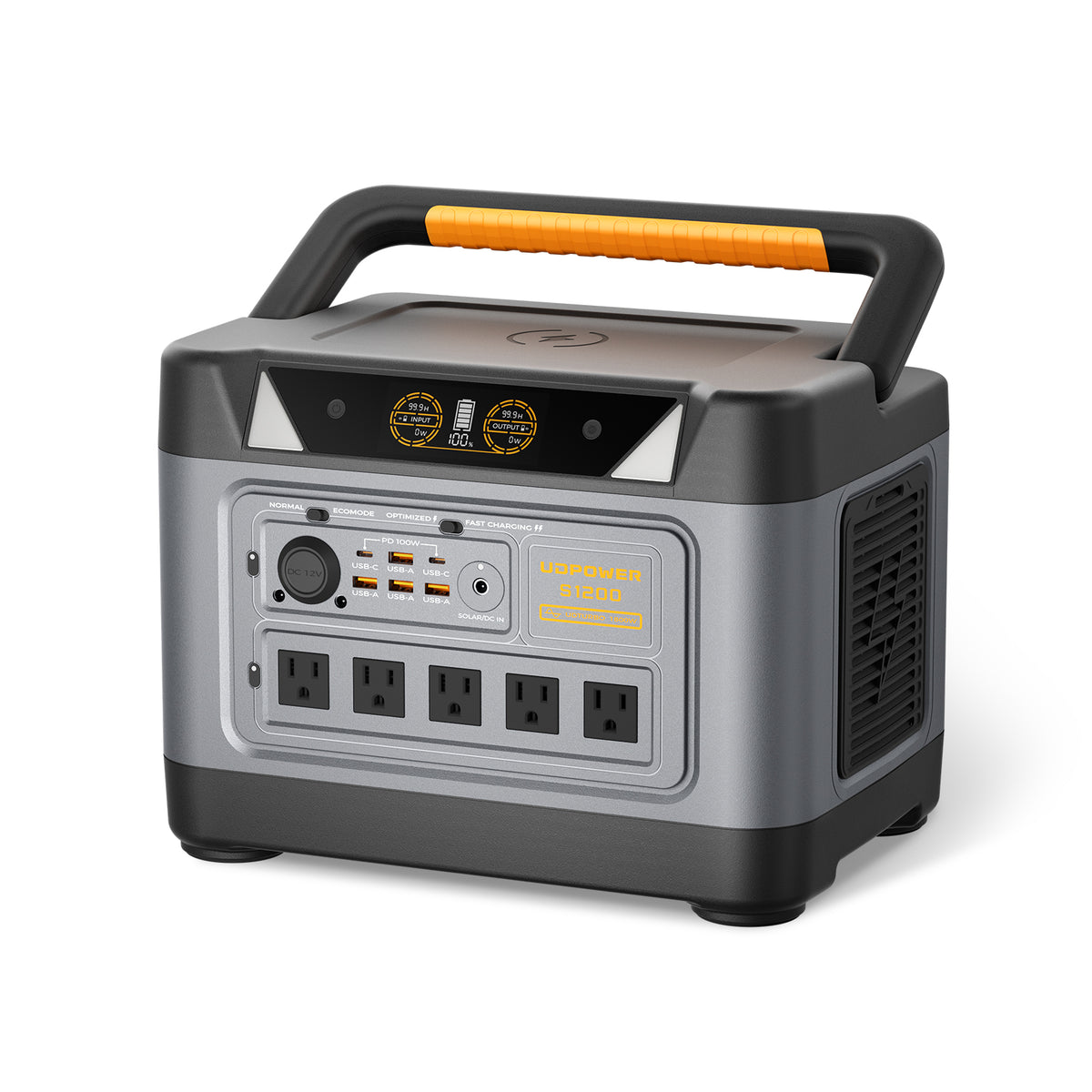
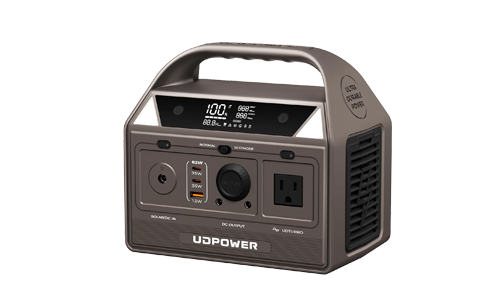
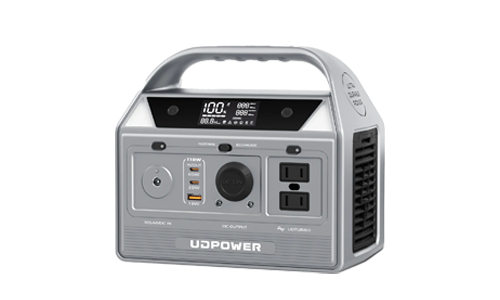
UDPOWER S1200: Backup for Essential Electrical Loads
The S1200 is a practical companion to propane when the goal is to keep electrical essentials powered rather than replace propane heating.
| Specification | UDPOWER S1200 |
|---|---|
| Battery | 1,190Wh LiFePO4 |
| Rated AC output | 1,200W pure sine wave |
| UDTURBO | Supports compatible higher-power loads up to 1,800W, with lower conversion efficiency above rated output |
| Weight | Approximately 26 lb |
| AC outlets | 5 on the current grey 5-AC version |
| Solar input | Up to 400W |
| UPSPrime | Less than 10 ms under specified conditions |
It makes the most sense for loads such as CPAP equipment, routers, laptops, lights, phones, fans and compatible refrigeration rather than sustained electric space heating.
View UDPOWER S1200
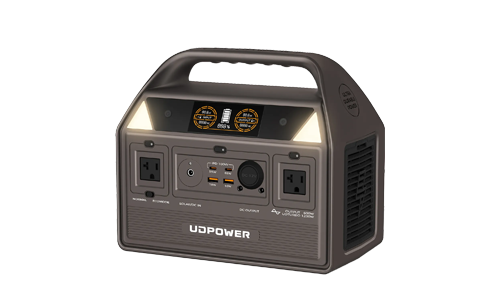
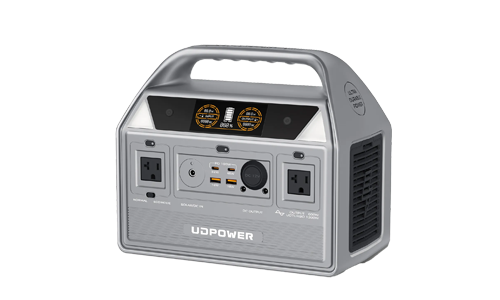
UDPOWER S2400: Larger Electrical Backup Alongside Propane
The S2400 offers more stored electricity and higher AC output for RV, camping and emergency setups where several electrical devices or larger compatible appliances need backup power.
| Specification | UDPOWER S2400 |
|---|---|
| Battery | 2,083Wh LiFePO4 |
| Rated AC output | 2,400W pure sine wave |
| UDTURBO | Supports compatible higher-power loads up to 3,000W, with lower conversion efficiency above rated output |
| Weight | Approximately 40.8 lb |
| AC outlets | 6 |
| Solar input | Up to 400W |
| UPSPrime | ≤10 ms under specified conditions |
For an RV or emergency kit, the S2400 can cover larger electrical loads while propane remains available for applications where fuel-based heating or cooking is more practical.
View UDPOWER S2400For a complete power-station sizing comparison, see the Camping Power Station Buying Guide.
Explore RV & Camping Power Stations Compare All UDPOWER Power StationsHow to Spend Less on Propane Refills
- Compare the actual per-gallon price. Do not assume every refill station in the same city charges the same amount.
- Refill instead of exchange when practical. You may receive more propane for less money.
- Do not exchange a tank that still contains significant propane. The remaining fuel goes with the cylinder.
- Check cylinder qualification before making a special trip. An expired cylinder may be refused.
- Compare fuel received, not just checkout price. Fifteen pounds and twenty pounds are not equivalent.
- For home tanks, compare total delivered pricing. Ask about delivery fees, minimum quantities and tank rental instead of looking only at the propane price.
- Avoid emergency run-outs. A planned delivery usually gives you more choices than needing fuel immediately.
Related Guides
Propane Tank Refill FAQ
How much does a propane tank cost to fill?
The cost is usually the number of gallons added multiplied by the local propane price. At $4 per gallon, an empty 20 lb cylinder holding about 4.7 gallons would cost roughly $18.87 to refill before taxes or fees.
How much does it cost to refill a 20 lb propane tank?
A 20 lb propane cylinder holds approximately 4.6–4.7 gallons when properly filled. At $3 per gallon the fuel costs about $14, at $4 per gallon about $19, and at $5 per gallon about $24.
How much does it cost to fill a 30 lb propane tank?
A 30 lb cylinder holds about 7.1 gallons of propane. Filling an empty cylinder costs approximately $21 at $3 per gallon, $28 at $4 per gallon or $35 at $5 per gallon.
How much does it cost to fill a 40 lb propane tank?
A 40 lb cylinder holds approximately 9.4 gallons. At $4 per gallon, filling it from empty costs roughly $37.74 before applicable taxes or fees.
How much does it cost to fill a 100 lb propane tank?
A 100 lb propane cylinder holds roughly 23.6 gallons. That works out to about $71 at $3 per gallon, $94 at $4 per gallon or $118 at $5 per gallon.
Does a 20 lb propane tank hold 20 gallons?
No. The 20 lb label refers to propane weight, not gallons. Twenty pounds of liquid propane is approximately 4.7 gallons.
How much does one gallon of propane weigh?
Liquid propane weighs approximately 4.24 lb per gallon. The exact relationship can vary slightly with temperature, but 4.24 lb per gallon is a useful planning conversion.
Is propane cheaper to refill or exchange?
Refilling is generally cheaper per pound of propane if you already own a safe, qualified cylinder. Exchange is more convenient but can cost more and major exchange brands commonly provide 15 lb of propane in a standard 20 lb-size cylinder.
How much propane is in a Blue Rhino tank?
Blue Rhino states that its standard grill exchange tanks contain a net weight of 15 lb of propane.
Do I pay for a full tank if my propane cylinder is only half empty?
At refill stations that sell propane by the gallon, you generally pay for the propane actually dispensed. Billing practices can vary, so check whether the station has a flat or minimum refill charge.
How do I calculate how much propane is left in a cylinder?
Weigh the cylinder and subtract the tare weight stamped as TW on the cylinder. The difference is approximately the weight of propane remaining. Divide the remaining propane weight by 4.24 to estimate gallons.
Why is a 500-gallon propane tank only filled to about 400 gallons?
Liquid propane needs expansion space as temperature changes. A nominal 500-gallon stationary tank is therefore normally considered full at about 80%, or roughly 400 gallons of propane.
Is a 100 lb propane tank the same as a 100-gallon propane tank?
No. A 100 lb cylinder contains roughly 23.6 gallons of propane. A nominal 100-gallon stationary tank can hold roughly 80 gallons of propane at its normal maximum fill level.
Can an old propane cylinder still be refilled?
Only if it remains eligible for service. U.S. DOT guidance states that applicable cylinders generally require requalification within 12 years of manufacture, with later requalification intervals depending on the inspection or test method. Damaged, badly corroded or leaking cylinders can also be refused.
Where can I refill a propane tank?
Propane dealers, some U-Haul locations, farm supply stores, hardware stores, RV parks and other fuel suppliers may offer refills. Call first because not every location fills every cylinder size.
How much energy is in one gallon of propane?
The U.S. Energy Information Administration lists propane at approximately 91,452 Btu per gallon. Actual appliance runtime depends on its fuel input, operating setting, cycling and efficiency.
Planning Propane and Electrical Backup Together?
Use propane where combustion fuel makes sense, and size battery backup around the electrical devices you actually need during camping, RV travel or a power outage.
View RV & Camping Power Options Compare Portable Power Stations Read Propane vs Battery Heating GuideRelated Articles


