

Can You Leave a Power Station in a Car? Hot & Cold Storage Guide
Last updated: August 14, 2026

A portable power station feels like natural road-trip equipment. You load it next to the cooler, camping gear, laptop bag, or portable refrigerator, drive to your destination, and use it when you need power.
The problem starts when “taking it in the car” turns into “keeping it in the car.”
A parked car is not a temperature-controlled storage cabinet. On a sunny afternoon, the interior can heat far beyond the outdoor forecast. During winter, a vehicle parked overnight can cold-soak the battery for hours. Those conditions matter because a lithium battery has separate limits for storage, charging, and discharging.
This guide explains when keeping a battery power station in a car is reasonable, when you should take it inside, how hot and cold weather affect the decision, what to do after a power station has been exposed to an extreme temperature, and how to carry one safely on a road trip.
Can You Leave a Power Station in a Car?
Yes for transportation and properly managed use. No as a default long-term storage location.
The distinction matters.
| Situation | Practical Answer | What to Do |
|---|---|---|
| Driving with the climate control running | Usually fine | Secure the unit, keep it dry, and leave ventilation openings unobstructed. |
| Using it at a campsite next to the vehicle | Usually fine | Move it out of direct sun, keep it dry, and stay within its operating limits. |
| Brief stop on a cool day | Use judgment | Remember that sunshine can raise cabin temperature quickly even when the weather feels mild. |
| Parked in summer sun for hours | Avoid | Take the power station indoors when practical. |
| Left overnight during freezing weather | Not recommended as routine storage | Check the model's storage range and warm the unit before charging if it has become too cold. |
| Stored in the vehicle for weeks or months | Avoid | Use a dry indoor storage location with moderate temperature instead. |
The best way to think about it is simple: a vehicle is a transportation environment, not a battery storage environment.
Why a Hot Car Is the Biggest Summer Risk
Outdoor temperature and parked-car temperature are not the same thing.
The U.S. National Weather Service reports that the temperature inside a vehicle can rise roughly 20°F in as little as 10 minutes and around 50°F in an hour, even when outside temperatures are only in the 70s. It also notes that vehicle interiors can reach around 120°F quickly and, under severe conditions, approach 150°F.
Source: U.S. National Weather Service vehicle heat guidance
| Vehicle Heat Observation | Why It Matters to a Power Station | Source |
|---|---|---|
| Interior temperature may rise about 20°F in 10 minutes | A mild outdoor temperature does not guarantee the battery remains inside its storage range. | National Weather Service |
| Interior temperature may rise about 50°F in an hour | A power station that was fine when you parked may be sitting in substantially hotter air by the time you return. | National Weather Service |
| Cracking the windows provides little relief from dangerous heat buildup | A slightly open window should not be treated as temperature control for battery storage. | NHTSA |
These government figures are published for human heat safety, not as a battery-temperature calculator. The important lesson for a power station owner is that the outside forecast cannot tell you what temperature your battery will experience inside a closed vehicle.
Why direct sunlight makes the situation worse
A station sitting beside a window can receive additional radiant heat even when the cabin air itself has not yet reached its maximum temperature. Dark plastic, metal trim, seats, dashboards, and cargo surfaces can also become much hotter than the surrounding air.
That is why moving the battery from the seat to the trunk is not a complete solution. You may reduce direct sunlight, but you have not created climate-controlled storage.
The Detail Many Owners Miss: Storage, Charging, and Operating Temperatures Are Different
One of the easiest mistakes is finding one temperature number in a product manual and assuming it applies to everything.
It usually does not.
A portable power station may be able to discharge at a temperature where it should not be charged. Its approved storage range can be different again.
| Temperature Rating | What It Means | Car Example |
|---|---|---|
| Storage temperature | The environmental range in which the unit may be kept when it is not being actively charged or powering equipment. | A power station left overnight or while the vehicle is parked. |
| Charging temperature | The battery temperature range allowed while energy is being put back into the battery. | Charging from the car's 12V outlet, AC charger, or solar panel. |
| Discharging / operating temperature | The range allowed while the station is supplying power to another device. | Running a portable refrigerator, laptop, fan, camera charger, or CPAP. |
This distinction becomes especially important in winter. A battery may still be able to run a device after sitting in cold conditions, yet be too cold for charging.
UDPOWER Power Station Temperature Limits
The current UDPOWER maintenance guidance lists the following temperature ranges for common UDPOWER portable power stations. Always check the current manual or product documentation for the exact model you own.
| UDPOWER Model | Discharging | Charging | Storage | Official Source |
|---|---|---|---|---|
| C600 | -4°F to 113°F (-20°C to 45°C) |
32°F to 104°F (0°C to 40°C) |
32°F to 104°F (0°C to 40°C) |
UDPOWER maintenance guide |
| S1200 | -4°F to 113°F (-20°C to 45°C) |
23°F to 104°F (-5°C to 40°C) |
32°F to 104°F (0°C to 40°C) |
UDPOWER maintenance guide |
| S2400 | -4°F to 113°F (-20°C to 45°C) |
32°F to 104°F (0°C to 40°C) |
32°F to 104°F (0°C to 40°C) |
UDPOWER maintenance guide |
This table explains why a hot parked vehicle can become a problem surprisingly quickly. A listed storage ceiling of 104°F does not leave much margin when vehicle interiors can rise far above the outdoor temperature.
For a deeper explanation of battery care, see How to Maintain Your Portable Power Station.
Can You Leave a Power Station in a Cold Car?
Cold weather presents a different problem from summer heat.
A short period of cold exposure is not automatically the same as battery damage, and many portable power stations can discharge below freezing. The bigger concern is what you do after the battery becomes cold.
If your station has been sitting overnight in a freezing vehicle, do not immediately bring it inside and connect a high-power charger simply because the screen turns on.
Use this winter sequence instead
- Bring the power station into a dry, moderate indoor environment.
- Leave it powered off while its temperature gradually normalizes.
- Make sure there is no condensation around ports or vents.
- Confirm that the unit is within its specified charging-temperature range.
- Then connect the approved charger.
Do not try to accelerate the process with a space heater, heat gun, heating pad, hot water, or other concentrated heat source.
For more winter-specific guidance, read How Cold Is Too Cold for a Solar Generator?.
Cold storage and cold charging are not the same question
This is worth repeating because it is one of the most useful rules for winter travel:
Check the charging range separately before connecting a wall charger, solar panel, or vehicle charging cable.
Car Storage Decision Table
There is no useful universal rule such as “30 minutes is safe” or “two hours is dangerous.” Sunlight, cabin color, location, season, cloud cover, vehicle design, battery starting temperature, and where the unit sits all change the result.
A scenario-based decision is more useful.
| Scenario | Risk Level | Best Practice |
|---|---|---|
| Power station secured in an air-conditioned car while driving | Low | Keep vents clear and prevent the unit from sliding. |
| Parked for a short errand on a cool, cloudy day | Variable | Check weather and sun exposure rather than relying only on the clock. |
| Parked in direct summer sun | High | Take the station with you or move it to a suitable indoor location. |
| Station sitting directly beside a sun-facing window | High | Do not use that location for storage. |
| Power station left in a freezing car overnight | Temperature dependent | Check storage limits and warm the battery naturally before charging. |
| Car camping while station powers a fridge | Manageable | Keep the station shaded, ventilated, dry, and within its operating range. |
| Power station stored permanently in a parked vehicle | Not recommended | Store indoors and bring it when you expect to need it. |
Where Should a Portable Power Station Go in the Car?
When you are transporting a power station, temperature is only one concern. A large battery can also become a heavy moving object during sudden braking or a crash.
1. Secure it so it cannot slide
Place the station on a stable surface and use the vehicle's cargo restraints when appropriate. Avoid putting a heavy unit loose on a seat where it can move forward during hard braking.
2. Keep it away from direct sun
A shaded cargo-floor location is generally preferable to a sun-facing seat or dashboard area during transportation. This reduces direct radiant heating, but it does not make the vehicle suitable for long-term storage.
3. Keep the cooling vents open
Do not bury an operating or charging power station under sleeping bags, coats, blankets, luggage, or camping equipment.
The station needs airflow when its inverter or charger is active.
4. Keep it away from liquids
Melting cooler ice, spilled drinks, wet beach equipment, rain-soaked tents, and water containers should not be stored where they can leak onto the power station or its electrical ports.
5. Do not put an operating power station inside a sealed container
An insulated cooler may sound like an easy way to protect a battery from heat, but a sealed container can also trap heat generated while the station is charging or supplying power. Do not seal an operating unit in a cooler, storage box, cabinet, or bag unless the product and enclosure are specifically designed for that use.
Can You Charge a Portable Power Station While Driving?
Yes, compatible portable power stations can be charged from a vehicle while driving when you use the correct car charging cable and input port.
But charging while driving is different from leaving the battery charging in a parked hot car.
| Charging Situation | Recommendation | Reason |
|---|---|---|
| Driving, climate controlled, engine running | Appropriate when supported | The alternator is supplying the vehicle electrical system and cabin temperature is easier to control. |
| Engine off, power station connected to starter-battery socket | Avoid unnecessary charging | You may drain the vehicle's starter battery. |
| Parked car in summer heat | Avoid prolonged charging | The battery is being heated by the vehicle environment while charging produces additional internal heat. |
| Battery just brought in from freezing conditions | Wait before charging | Allow the battery to return to its approved charging-temperature range first. |
UDPOWER's Road Trip Guide also recommends charging from the vehicle while the engine is running, keeping the station secured, and keeping ventilation clear.
What If You Already Left Your Power Station in a Hot or Cold Car?
Do not panic, and do not immediately connect a charger or heavy appliance.
Use this sequence.
Step 1: Remove it from the extreme environment
Move the station to a dry, shaded, well-ventilated area with a moderate temperature.
Step 2: Leave it disconnected
Do not charge it and do not immediately run a large AC load.
Step 3: Inspect the unit
Look for:
- Swelling or case deformation
- Cracks
- Leaking material
- Unusual chemical or burning odor
- Melted or discolored ports
- Repeated warning messages
- Unusual heat that does not gradually decrease
Step 4: Let the internal temperature normalize naturally
The outside shell may cool or warm faster than the battery cells inside. Do not assume the battery core has reached room temperature just because the handle feels normal.
There is no universal waiting time that applies to every battery size. A small power station and a 2kWh unit have very different thermal mass.
Step 5: Check the approved temperature range
Once the station has returned to the model's allowable charging or operating range, power it on without a heavy load and check for warnings.
Step 6: Stop if anything looks abnormal
If the unit is swollen, leaking, smoking, producing a burning odor, making unusual popping sounds, or repeatedly reporting a serious fault, stop using it and contact the manufacturer or emergency services when appropriate.
For broader battery and electrical safety guidance, see UDPOWER's Portable Power Station Safety Guide.
Can You Keep a Power Station in the Car as an Emergency Battery?
It sounds convenient: buy a power station, put it in the trunk, and forget about it until a roadside emergency, storm, evacuation, or blackout.
For most climates, that is not the best plan.
Permanent vehicle storage creates four problems:
- Summer heat: the cabin or trunk can exceed the battery's approved storage temperature.
- Winter cold: the battery may fall below its storage or charging range.
- Battery readiness: you may not notice that the state of charge has fallen until you need it.
- Physical exposure: months of vibration, humidity, cargo impacts, dust, and accidental spills add unnecessary wear.
A better emergency routine is to store the station indoors in a suitable environment, check it periodically, and load it into the vehicle when you are preparing for a trip, storm, evacuation, camping weekend, or other situation where portable backup power could be useful.
Does LiFePO4 Make Hot-Car Storage Safe?
No.
LiFePO4, or lithium iron phosphate, is widely used in newer portable power stations because of its long cycle life and strong thermal stability compared with some older lithium-ion chemistries. UDPOWER's current portable power station lineup uses LiFePO4 batteries across models such as the C600, S1200, and S2400.
But “more thermally stable” does not mean “heat-proof.”
The product's specified storage and charging limits still apply. If a LiFePO4 power station lists a maximum storage temperature of 104°F, the fact that the battery chemistry is LiFePO4 does not turn a 120°F or hotter vehicle into an approved storage location.
Battery chemistry should be viewed as one layer of safety—not permission to ignore temperature limits.
Recommended UDPOWER Power Stations for Road Trips and Vehicle-Based Use
The best vehicle power station is not automatically the largest one. For road trips, car camping, photography, portable refrigerators, and mobile work, weight and ease of loading matter almost as much as watt-hours.
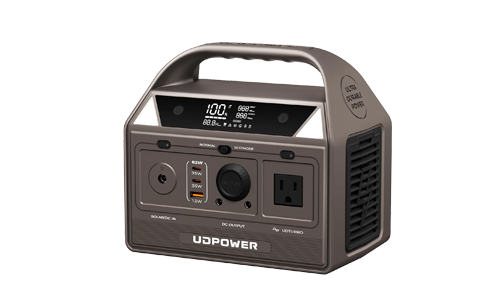
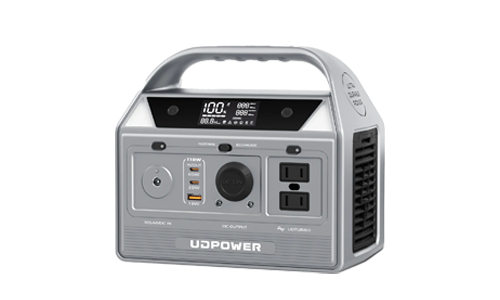
UDPOWER C600: Best Fit for Road Trips and Car Camping

The C600 is the most natural choice for regular car-based travel because it combines useful capacity with a much more manageable size and weight than larger home-backup stations.
- Battery capacity: 596Wh
- Rated AC output: 600W
- Peak output: 1,200W
- Battery chemistry: LiFePO4
- Cycle life: 4,000+ cycles
- Weight: approximately 12.3 lb
- Best for: portable refrigerators, laptops, cameras, drones, phones, lights, fans, and weekend camping
Its 12.3-pound weight is especially relevant in a vehicle. A battery you can easily take out of the car when you park is easier to protect from temperature extremes than a much heavier unit that tends to stay in the cargo area.
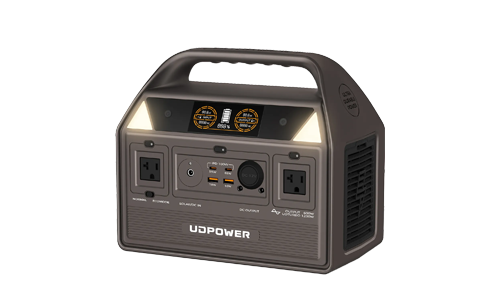
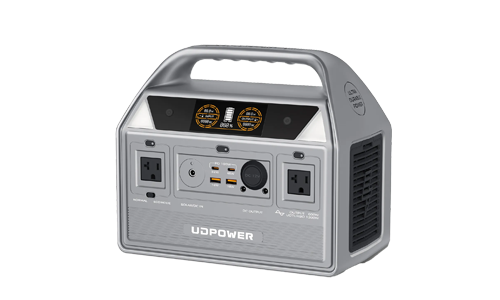
View UDPOWER C600UDPOWER S1200: Better for Longer Trips, CPAP, and Refrigerator Backup
The S1200 offers substantially more stored energy while remaining practical for car camping, family road trips, RV travel, and emergency backup.
- Battery capacity: 1,190Wh
- Rated AC output: 1,200W pure sine wave
- UDTURBO output: up to 1,800W for compatible higher-power loads
- Battery chemistry: LiFePO4
- Cycle life: 4,000+ cycles
- Weight: approximately 26 lb
- Solar input: up to 400W
- Best for: longer portable-fridge use, CPAP, laptops, multi-device charging, camping, and emergency backup
At roughly 26 pounds, the S1200 is still movable but deserves a more secure cargo position than a compact station. It is a good middle ground when the C600 does not provide enough runtime but a 2kWh-class unit would be unnecessarily large for the trip.
View UDPOWER S1200UDPOWER S2400: Better for RVs and High-Capacity Mobile Basecamps
The S2400 makes more sense when the vehicle is supporting a larger campsite, RV setup, multiple appliances, or longer periods away from grid power.
- Battery capacity: 2,083Wh
- Rated AC output: 2,400W pure sine wave
- UDTURBO surge support: up to 3,000W
- Battery chemistry: LiFePO4
- Cycle life: 4,000+ cycles
- AC outlets: 6
- Weight: approximately 40.8 lb
- Best for: RV trips, powered basecamps, larger appliances, refrigerator/freezer backup, and longer off-grid stays
The tradeoff is mobility. At about 40.8 pounds, it is much more important to plan where the station will ride, how it will be secured, and whether you can reasonably take it out of the vehicle when temperatures become extreme.
View UDPOWER S2400Which Size Makes the Most Sense for a Car?
| Model | Capacity | Rated Output | Weight | Best Vehicle Use | Product Source |
|---|---|---|---|---|---|
| C600 | 596Wh | 600W | 12.3 lb | Weekend road trips, car fridge, camera gear, laptop, camping | Official product page |
| S1200 | 1,190Wh | 1,200W | 26 lb | Family road trips, CPAP, longer fridge runtime, multi-device camping | Official product page |
| S2400 | 2,083Wh | 2,400W | 40.8 lb | RV travel, large campsite loads, longer off-grid stays | Official product page |
For most ordinary car trips, the useful question is not “What is the biggest battery I can fit?” It is:
“What is the smallest station that gives me enough energy and output without becoming something I am reluctant to remove from the vehicle?”
That matters because portability itself can become a temperature-management feature. A 12-pound station is much easier to take into a hotel room, house, cabin, or campground building than a 40-pound unit.
Portable Power Station Car Travel Checklist
- Charge the station before departure.
- Check the weather at your destination and overnight stops.
- Know the model's storage, charging, and discharge temperature limits.
- Secure the station so it cannot slide during hard braking.
- Keep it out of direct sunlight when possible.
- Keep vents uncovered whenever the unit is charging or powering equipment.
- Do not store wet equipment or a leaking cooler above the station.
- Use the correct vehicle charging cable.
- Charge from the vehicle while the engine is running when appropriate.
- Do not leave it charging for long periods in a closed, hot parked vehicle.
- Do not assume cracking a window makes summer storage safe.
- Bring the station indoors during extreme heat or cold when practical.
- If the battery becomes very cold, let it warm naturally before charging.
- If the battery becomes very hot, let it cool naturally before charging or applying a heavy load.
- Inspect the unit after extreme temperature exposure.
Frequently Asked Questions
Can you leave a power station in a car overnight?
You can transport a power station in a vehicle, but leaving it there overnight is only reasonable if the vehicle environment remains within the model's approved storage-temperature range. In very hot or freezing weather, take the unit indoors when practical.
Is it safe to leave a portable power station in a hot car?
It is not recommended. A closed vehicle can become much hotter than the outdoor air and may exceed the power station's storage-temperature limit. The National Weather Service reports that vehicle interiors can rise roughly 20°F in 10 minutes and about 50°F in an hour under hot-car conditions.
Can I keep a LiFePO4 power station in my car?
LiFePO4 chemistry has strong thermal stability, but it still has manufacturer-specified storage, charging, and operating limits. A LiFePO4 battery should not be treated as heat-proof or permanently stored in a vehicle exposed to extreme summer or winter temperatures.
Can I store my power station in the trunk?
A trunk can be a practical place to secure a station during transportation, but it is not climate controlled. Moving the battery into the trunk may reduce direct sunlight but does not solve extreme cabin or vehicle temperature exposure. Do not use the trunk as permanent battery storage in hot or freezing weather.
Can a portable power station stay in a cold car?
Cold exposure should be evaluated against the exact model's storage-temperature range. Some stations can discharge below freezing even though charging is restricted at higher temperatures. If the station has become very cold, let it return to its approved charging range before recharging it.
Can I charge a portable power station while driving?
Yes, compatible power stations can be charged from the vehicle with the correct car charging cable. Keep the engine running, secure the station, leave the vents open, and follow the model's input and charging-temperature limits.
Should I charge my power station immediately after taking it out of a freezing car?
No. Bring it into a dry, moderate environment and let the battery warm naturally until it is within the model's approved charging range. Check for condensation before connecting a charger.
Does cracking the car windows protect a battery from summer heat?
Do not rely on it. NHTSA states that rolling windows down or parking in the shade does little to prevent dangerous vehicle interior heat buildup. The safest approach for the battery is to remove it from the hot vehicle when practical.
Will the BMS protect a portable power station if the car gets too hot?
A Battery Management System can provide important protections against conditions such as excessive temperature, current, voltage, or short circuits, depending on the model. It should be treated as a backup protection layer, not as permission to exceed the manufacturer's storage or operating limits.
What should I do if my power station feels very hot after sitting in the car?
Move it to a dry, shaded, ventilated area, disconnect loads and chargers, and let it cool naturally. Inspect the case and ports for swelling, deformation, odor, leakage, or other abnormal signs. Do not immediately fast-charge or heavily load a battery that is still hot.
What is the best UDPOWER power station for road trips?
The C600 is a strong road-trip choice when portability matters because it combines a 596Wh LiFePO4 battery and 600W rated output with a weight of about 12.3 pounds. The S1200 provides more capacity for longer fridge, CPAP, or multi-device use, while the S2400 is better suited to RVs and larger powered basecamps.
Should I keep my emergency power station at 100% in the car all year?
No. A vehicle is generally a poor year-round storage environment because of heat and cold swings. Store the station in a suitable indoor location, check its state of charge periodically, and charge it fully before a trip, storm, evacuation, or other situation when maximum backup runtime is useful.
Bottom Line: Bring It in the Car, But Don't Make the Car Its Home
A portable power station belongs on road trips, camping weekends, RV adventures, emergency drives, and mobile work setups. That does not mean it belongs permanently in the trunk.
The practical rule is straightforward:
- Transport it in the car: Yes.
- Use it in or around the vehicle: Yes, when temperature, ventilation, moisture, and load limits are controlled.
- Charge it while driving: Yes, with the correct cable and within the model's charging limits.
- Leave it in a closed summer vehicle for hours: Avoid it.
- Charge it immediately after freezing exposure: No; warm it naturally first.
- Store it permanently in the vehicle: Not recommended.
The most important number is not the outdoor temperature shown by your weather app. It is the temperature the battery actually experiences—and whether that temperature falls inside the manufacturer's limits for what you are doing at that moment.
Choose the Right Portable Power Station for Your Trip
Compare capacity, output, weight, and real-world use before you load your vehicle. A road-trip battery should provide enough energy without becoming too large to move, secure, and protect from temperature extremes.
View All Portable Power Stations View the Travel-Friendly C600 Get the Complete Road Trip GuideRelated Articles


