





Best Portable Power Station for Pennsic War: A Practical SCA Camping Power Guide
Last updated: August 14, 2026
Campers whose electrical needs are mainly phones, tablets, rechargeable lights, cameras, fans, and other small devices can reasonably step down to the UDPOWER C600. A verified C600 owner reported using it during a 10-day large camping event while charging multiple phones and tablets, putting it on solar only twice, and specifically recommended it to fellow SCA members for Pennsic.
Group camps running refrigeration, several overnight devices, medical equipment alongside ordinary camp loads, or higher-power appliances should consider the UDPOWER S2400. For a long event like Pennsic, however, battery capacity alone is not enough. Your daily watt-hour budget and your ability to recharge are just as important as the size of the power station.

Pennsic is not an ordinary weekend campground trip. It is one of the largest annual gatherings of the Society for Creative Anachronism, bringing thousands of people together for battles, classes, performances, merchants, camp life, and nearly continuous activity.
Pennsic War 53 took place from July 24 through August 9, 2026 at Cooper's Lake Campground in Pennsylvania. Future dates and policies can change, so always check the official Pennsic War website before planning your trip.
The length of Pennsic changes the way you should think about portable power. A 300Wh battery that feels generous during a two-night camping weekend can become restrictive halfway through a long War.
The most useful question is therefore not simply, “How many watts does the power station have?” It is:
How many watt-hours will my camp use every day, and how will I replace those watt-hours tomorrow?
Why Pennsic Power Is Different From Normal Camping
Pennsic combines three things that make power planning unusually important: a long stay, limited electrical infrastructure, and a camp environment where quiet operation matters.
Pennsic's published rules describe the site as a rustic campground with limited electrical service. Attendees are also prohibited from modifying or making unauthorized connections to existing electrical boxes.
In practical terms, that means you should not arrive assuming there will be an unused outlet close to your tent.
Check the current Pennsic rules, policies, and procedures before each event.
Pennsic also establishes campground-wide quiet hours. A battery power station is particularly convenient in this kind of environment because it does not require a combustion engine running next to sleeping campers.
How Much Power Do You Actually Need at Pennsic?
Start by listing everything you expect to run during a normal 24-hour period.
Small devices are easy to overlook because each individual charge consumes little energy. At Pennsic, however, those charges repeat day after day.
| Typical Pennsic Load | Planning Wattage | Daily Use | Approx. Energy per Day | Why It Matters |
|---|---|---|---|---|
| Phone + smartwatch | Varies | One full recharge each | About 20Wh | Communication, schedules, photos, navigation |
| LED camp lighting | 5W | 5 hours | 25Wh | Low draw but typically used every evening |
| Efficient USB fan | 10W | 8 hours | 80Wh | Extremely useful during warm summer nights |
| Laptop | 60W | 2 hours | 120Wh | Work, photos, writing, camp administration |
| CPAP example | 40W average | 8 hours | 320Wh | Heated humidification can increase consumption |
| Efficient compressor fridge | 30W average | 24 hours | 720Wh | Temperature and compressor cycling make a major difference |
| 1,000W kettle | 1,000W | 6 minutes | 100Wh | High wattage but short operating time |
These are planning examples rather than guarantees for a specific appliance. Check the actual label or power adapter on your equipment whenever possible.
For a more detailed sizing method, see How Many Wh Do I Need for Camping?.
Four Realistic Pennsic Power Budgets
| Camp Style | Example Loads | Daily Energy Budget | Recommended Capacity |
|---|---|---|---|
| Light individual | Phone, smartwatch, LED lights, efficient fan | About 125Wh/day | 500–600Wh can work well with occasional recharge |
| Comfort-oriented individual | Light setup + laptop or extra electronics | About 245Wh/day | Around 1,000Wh offers much more flexibility |
| CPAP + everyday devices | Phone, lights, fan, laptop, CPAP example | About 565Wh/day | 1,000Wh+ with dependable recharging |
| Fridge-centered camp | Fridge plus basic lighting, phones, and fan | About 965Wh/day | 2,000Wh-class station plus substantial solar |
What Size Portable Power Station Is Best for Pennsic?
There is no single correct size because two Pennsic camps can use electricity in completely different ways.
A camper charging an iPhone, iPad, rechargeable lantern, and USB fan may use less electricity over several days than another camper uses in a single night with a CPAP humidifier and compressor refrigerator.
In general, three capacity ranges make the most sense.
500–600Wh: Best for Personal Electronics
This size works particularly well for:
- Phones
- Tablets
- Rechargeable lights
- Cameras
- Small USB fans
- Power banks
- Occasional laptop charging
If that describes your Pennsic setup, a 596Wh C600 may be more practical than carrying a much heavier battery.
1,000–1,200Wh: Best All-Around Size
This is the most versatile range for one person or a couple who want enough reserve that every individual phone charge does not matter.
It is also more forgiving if you encounter a cloudy solar day.
2,000Wh+: Best for Shared Camp Power
Consider a larger station if one battery will be supporting:
- Several campers
- Refrigeration
- Medical equipment
- Multiple overnight loads
- Cooking equipment
- Several laptops or larger electronics
Browse the UDPOWER camping portable power station collection if your setup falls between these examples.
Best UDPOWER Portable Power Stations for Pennsic War
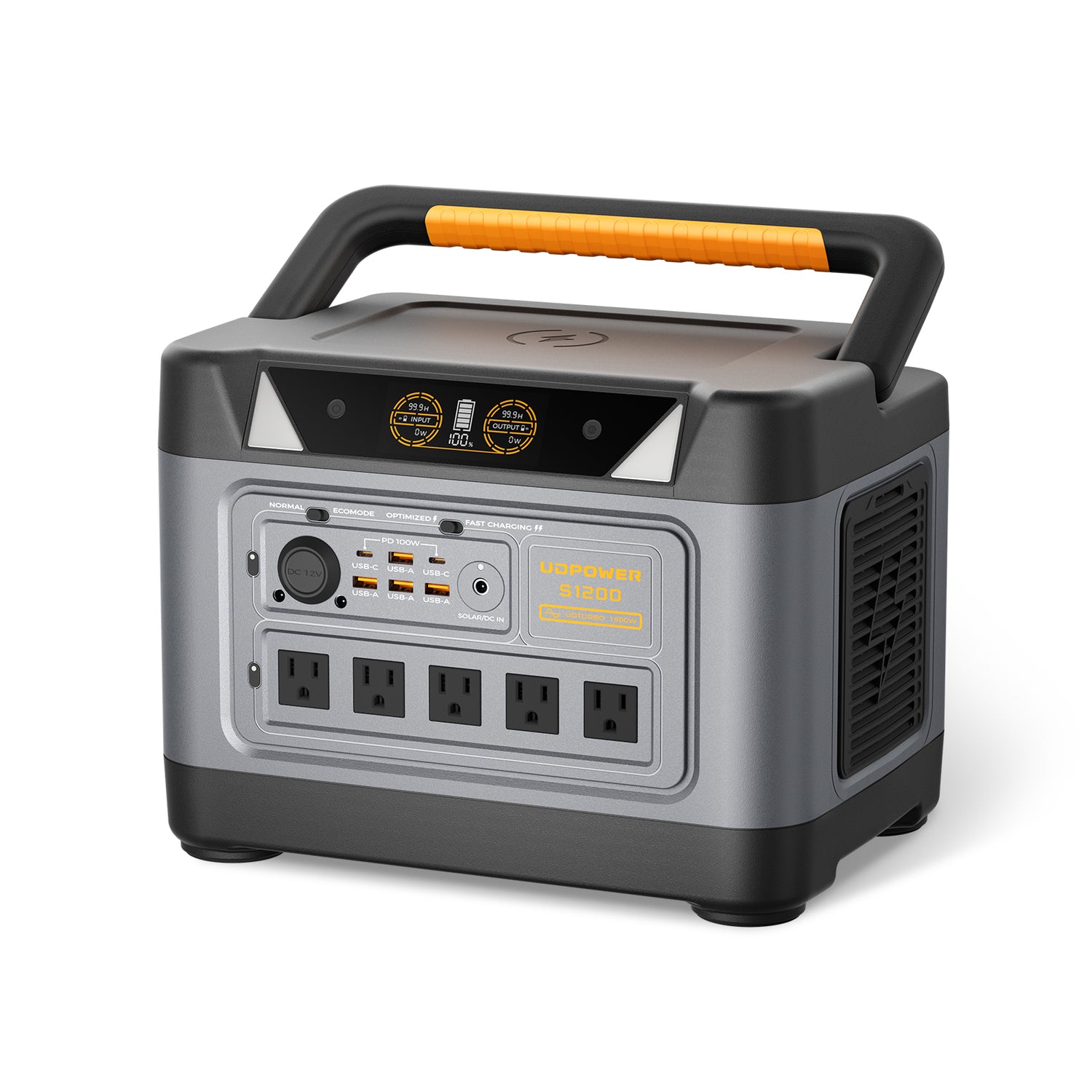
UDPOWER S1200
The S1200 is the model that makes sense for the widest range of Pennsic camps.
Its 1,190Wh battery gives considerably more breathing room than a compact power station, while its roughly 26-pound weight is still manageable for most campers moving equipment between a vehicle and camp.
- Battery capacity: 1,190Wh LiFePO4
- Rated AC output: 1,200W pure sine wave
- Maximum solar input: 400W
- USB-C: up to 100W
- Weight: about 26 lb
- Best fit: solo campers, couples, electronics-heavy camps, moderate overnight loads
The 1,200W rated inverter also gives you considerably more appliance flexibility than a 600W unit. More importantly for Pennsic, however, the 1,190Wh battery gives you enough stored energy to absorb normal day-to-day variation without immediately rationing every device charge.
Source: UDPOWER S1200 official product page
View S1200
UDPOWER C600
The C600 is particularly well suited to Pennsic campers whose power needs revolve around phones, tablets, rechargeable lighting, cameras, USB fans, and other small electronics.
At 596Wh and only 12.3 pounds, it is considerably easier to move around camp than a 1–2kWh station while still storing enough electricity to make a meaningful difference during a long event.
- Battery capacity: 596Wh LiFePO4
- Rated AC output: 600W pure sine wave
- Solar input: up to 240W
- Weight: 12.3 lb
- Recommended solar pairing: UDPOWER 120W portable solar panel
- Best fit: phones, tablets, lights, fans, cameras, laptops, and other low-to-moderate power electronics
The C600 is also the one model in this guide for which we have an unusually relevant real-world SCA camping experience from a verified owner.
Product source: UDPOWER C600 official product page
View C600A Real SCA Camper's Experience With the C600
Runtime tables are useful, but Pennsic campers also want to know how a power station behaves when it is actually surrounded by tents, people, phones, tablets, inconsistent sunshine, and days away from normal household power.
Erin, a verified UDPOWER C600 purchaser, shared an experience that closely matches that exact use case.
Verified UDPOWER C600 Owner Experience
Erin reported taking her C600 to a 10-day camping event with roughly 10,000 other attendees. During the trip, she used it heavily for charging her own phone and iPad as well as other campers' phones, tablets, and portable charging equipment.
Sunshine was limited during the trip, but she said she was able to fully recharge the station within a couple of hours when she did put it on solar.
Most notably, she reported that the C600 never dropped below 60% charge despite the repeated device charging, and that she only connected it to the solar panels twice during the entire 10-day trip.
“If you are a member of the SCA, this thing is perfect for Pennsic.”
— Erin, Verified UDPOWER C600 Owner
Review source: verified C600 customer reviews

What This Review Actually Tells Us
Erin's experience highlights something that simple capacity comparisons often miss: the number of days you camp does not determine battery size by itself.
A 10-day trip dominated by phones and tablets can consume far less energy than a two-day trip running refrigeration, heating equipment, or a large fan continuously.
This is why the C600 can be a very good Pennsic choice for one camper while being much too small for another.
Erin's use was mostly personal electronics. Those are relatively low-energy loads. A refrigerator, CPAP with heated humidification, electric cooking appliance, large AC fan, or other continuous load can consume several times more energy.
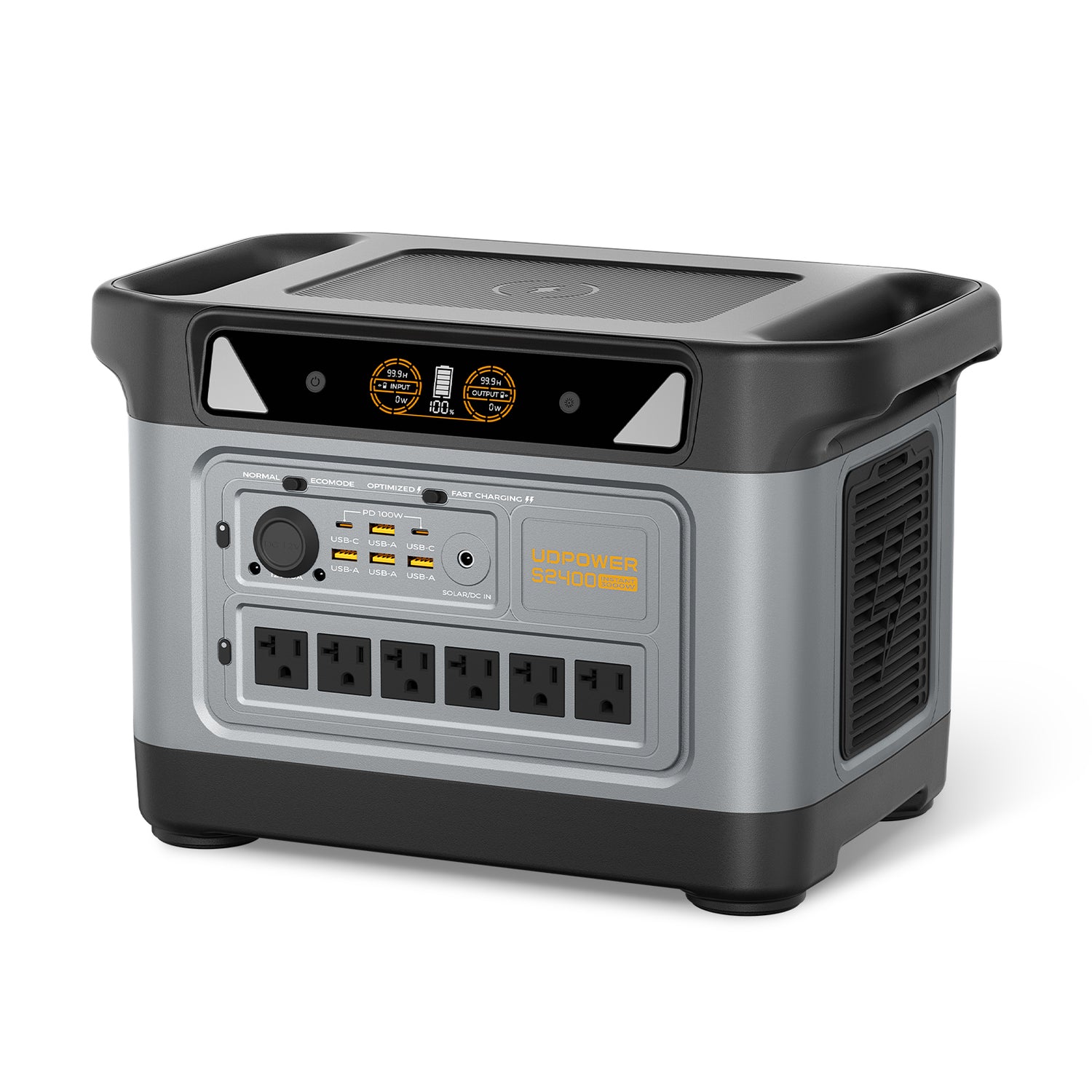
UDPOWER S2400
The S2400 makes more sense when one power station is effectively becoming part of your camp infrastructure.
A 2,083Wh battery is useful when several people are charging devices, refrigeration is cycling around the clock, or medical equipment has to share capacity with ordinary camp electronics.
- Battery capacity: 2,083Wh LiFePO4
- Rated AC output: 2,400W pure sine wave
- Maximum solar input: 400W
- AC outlets: 6
- USB-C: up to 100W
- Weight: about 40.8 lb
- Best fit: group camps, refrigeration, multiple overnight loads, higher-watt appliances
The tradeoff is weight. At around 40.8 pounds, this is not something most people will want to carry around Pennsic repeatedly.
Decide where camp power will live, place the S2400 there, and let smaller USB power banks handle truly mobile charging.
Source: UDPOWER S2400 official product page
View S2400How Long Will These Power Stations Last at Pennsic?
For the planning examples below, we use 90% usable energy after conversion losses:
Estimated runtime = battery capacity × 0.90 ÷ load watts
Actual runtime varies with inverter overhead, temperature, cable losses, appliance cycling, device efficiency, and other operating conditions.
| Example Load | C600 596Wh | S1200 1,190Wh | S2400 2,083Wh |
|---|---|---|---|
| 10W efficient fan | About 53.6 hours | About 107.1 hours | About 187.5 hours |
| 40W CPAP example | About 13.4 hours | About 26.8 hours | About 46.9 hours |
| 60W laptop | About 8.9 hours | About 17.9 hours | About 31.2 hours |
| 45W average cooling load | About 11.9 hours | About 23.8 hours | About 41.7 hours |
| 75W fan | About 7.2 hours | About 14.3 hours | About 25.0 hours |
Runtime Based on Daily Energy Use
| Daily Energy Budget | C600 | S1200 | S2400 |
|---|---|---|---|
| 125Wh/day — light individual | About 4.3 days | About 8.6 days | About 15 days |
| 245Wh/day — comfort setup | About 2.2 days | About 4.4 days | About 7.7 days |
| 565Wh/day — CPAP + devices | Less than 1 day | About 1.9 days | About 3.3 days |
| 965Wh/day — fridge-heavy camp | About 0.6 day | About 1.1 days | About 1.9 days |
This table exposes one of the biggest mistakes people make when choosing camping batteries: assuming that high inverter wattage means long runtime.
It does not.
Watts tell you what a station can run. Watt-hours determine how long it can keep running it.
Even a 2,083Wh station is not a 10- or 17-day energy supply if a refrigerator is consuming hundreds of watt-hours every day.
That is why solar matters so much at Pennsic.
How Much Solar Should You Bring to Pennsic?
For a long Pennsic stay, think of your portable power station as an overnight energy reservoir and the solar panels as your daytime refill.
Solar panels rarely produce their nameplate wattage continuously in real outdoor use. Output changes with:
- Sun angle
- Cloud cover
- Haze
- Panel temperature
- Trees
- Tent shadows
- Panel orientation
- Time of day
For rough trip planning, collecting around 70–85% of nameplate wattage during good sunlight is more realistic than assuming perfect laboratory output for every sunny hour.
See 120W vs. 210W vs. larger portable solar setups for more detailed solar pairing guidance.
| Solar Setup | 4 Good Sun Hours at 70–85% | Good Pennsic Match | Source |
|---|---|---|---|
| 120W panel | About 336–408Wh/day | C600 with light daily loads | UDPOWER 120W panel |
| 210W panel | About 588–714Wh/day | S1200 with moderate daily use | UDPOWER 210W panel |
| 2 × 210W panels | About 1,176–1,428Wh/day before station input limits | S1200 or S2400 higher-use camp | UDPOWER 210W panel |
Two 210W panels provide 420W of nameplate panel capacity, while the S1200 and S2400 accept up to 400W solar input at the power station.
Real-world panel production will usually vary below nameplate output, but the power station's electrical input specification remains the hard limit.
Solar Placement Matters More at Pennsic Than You Might Expect
Pennsic camps are full of things that create shade:
- Canvas tents
- Dining flies
- Trees
- Banners
- Guy lines
- Pavilions
- Other camps
A narrow shadow crossing part of a solar panel can reduce output noticeably.
Place the panel where the entire active surface receives direct sunlight. If practical, reposition it during the day and watch the live input wattage on the power station to find the best orientation.
For more detailed setup guidance, see How to Set Up a Foldable Portable Solar Panel for Maximum Efficiency.
Using a CPAP or Other Medical Equipment at Pennsic
CPAP is one situation where you should build redundancy into your power plan rather than simply calculating the theoretical minimum battery size.
Pennsic Accessibility Services provides information related to charging required medical equipment such as CPAP and mobility equipment.
If electrical power is medically necessary, review the current Pennsic Accessibility Services information before the event.
A portable power station can make overnight CPAP use much more convenient, but medically necessary equipment should not depend on a single point of failure whenever alternatives are available.
CPAP Energy Example
A CPAP averaging 40W over eight hours consumes:
40W × 8 hours = 320Wh per night.
Heated humidifiers and heated tubing can substantially increase power consumption.
- C600: workable for approximately one typical 40W overnight example before recharging becomes important.
- S1200: more reserve for CPAP plus phones, lighting, and a fan.
- S2400: better when medical equipment shares the battery with several other camp loads.
If CPAP is a major reason you are buying a power station, read How Long Will a CPAP Run on a Battery Backup?.
Can a Portable Power Station Run a Fridge at Pennsic?
Yes, but refrigeration is where a modest Pennsic energy budget can suddenly become a large one.
A compressor refrigerator normally cycles rather than running continuously at full rated wattage. That makes average energy consumption more useful than simply reading the compressor's maximum wattage.
Suppose an efficient camping refrigerator averages 30W across a full day:
30W × 24 hours = 720Wh per day.
That one fridge could therefore consume more energy in one day than several phones, lights, cameras, and USB fans combined.
Real refrigerator consumption depends on:
- Outdoor temperature
- Fridge insulation
- Internal temperature setting
- How often the lid or door is opened
- Whether warm food is added
- Ventilation around the compressor
- Direct sunlight
Portable Power Station vs. Generator at Pennsic
Always use current Pennsic rules as the primary authority for what is permitted in your camping area.
For ordinary electronics and moderate appliance loads, a battery power station has several practical advantages in a crowded camping environment:
- No gasoline engine running beside the tent
- No combustion exhaust during battery operation
- No gasoline storage required for normal use
- Quiet overnight operation
- Can run CPAP, fans, phones, laptops, and refrigerators while people sleep
- Can recharge from portable solar panels during the day
- Minimal routine maintenance
A combustion generator still has advantages when a camp requires very large amounts of continuous energy and generator operation is permitted and practical.
Battery power is strongest when the goal is quiet, repeatable electricity for electronics and moderate appliances.
See Portable Power Station vs. Generator for Camping for a more detailed comparison.
How to Set Up a Portable Power Station at Pennsic
- Charge it fully before leaving home. Do not arrive at Pennsic with an already half-empty battery.
- Test important equipment before the trip. Run your CPAP, refrigerator, fan, laptop charger, and other important devices at home.
- Measure overnight battery use. If your station drops from 100% to 72% overnight with your real equipment, that number is much more useful than an internet estimate.
- Label your cables. A camp can accumulate charging cables quickly. Label solar, DC, AC, and device cables before packing.
- Keep the station off bare ground. Use a stable table, crate, platform, or protected location.
- Keep it dry. Do not assume the battery itself is weatherproof simply because you are using it with a portable solar panel.
- Keep cooling vents clear. Do not bury the station underneath blankets, garb, bags, bedding, or other equipment.
- Keep the battery shaded. The solar panel belongs in direct sunlight. The power station itself should remain in a shaded, ventilated location.
- Avoid foot-traffic cable routes. Think about where people will walk after dark.
- Use USB and DC outputs directly when practical. Avoid running the AC inverter solely to charge a USB device when a compatible USB output is already available.
- Recharge when sunlight is available. Do not wait until the battery is nearly empty before deploying the solar panel.
Common Pennsic Portable Power Mistakes
1. Buying by Watts Instead of Watt-Hours
Watts tell you whether the power station can run an appliance.
Watt-hours tell you how long it can keep running that appliance.
For a long event like Pennsic, watt-hours often matter more.
2. Assuming You Will Find an Outlet
Pennsic has limited electrical infrastructure.
Unless you already know you have authorized access to electricity, plan as though your camp is off-grid.
3. Ignoring Low-Watt Devices That Run for Hours
A 10W fan does not look important next to a 1,000W kettle.
But the kettle may run for six minutes while the fan runs for eight hours.
Energy use is power multiplied by time.
4. Choosing a Huge Inverter for Tiny Loads
If your entire setup consists of phones, tablets, LEDs, and small USB fans, a 2,400W inverter is not automatically better.
Battery capacity, weight, and efficient low-voltage charging may matter more.
5. Waiting Until Pennsic to Test CPAP Runtime
Run your exact CPAP machine, humidifier setting, heated tube, and pressure configuration from the power station at home for a complete night.
Your measured percentage drop is more valuable than a generic runtime estimate.
6. Expecting Rated Solar Wattage All Day
A 210W panel does not mean you will continuously collect 210W from sunrise to sunset.
Cloud cover, heat, shadows, and sun angle all matter.
7. Leaving the Power Station in a Hot Car
A closed vehicle can become considerably hotter than the outdoor air.
Bring the power station into a shaded, ventilated camp location rather than using a parked car as daytime battery storage.
8. Trying to Run Tent Air Conditioning From a Small Battery
Portable air conditioners can consume hundreds of watts continuously.
Even when an inverter is powerful enough to start one, battery runtime may be short.
For most Pennsic tents, good shade and an efficient fan provide far more comfort per watt-hour.
9. Buying Far More Battery Than Your Camp Actually Needs
Erin's verified C600 experience demonstrates the opposite side of the sizing problem.
If your main loads are phones, tablets, rechargeable devices, and other low-energy electronics, a compact 596Wh station may provide much more useful runtime than the capacity number initially suggests.
Do the energy calculation before assuming you need the largest power station available.
Our Pennsic Picks at a Glance
| Model | Capacity | Rated Output | Weight | Best Pennsic Use | Product |
|---|---|---|---|---|---|
| UDPOWER C600 | 596Wh | 600W | 12.3 lb | Phones, tablets, lights, fans, cameras, personal electronics | View C600 |
| UDPOWER S1200 | 1,190Wh | 1,200W | About 26 lb | Best all-around Pennsic setup | View S1200 |
| UDPOWER S2400 | 2,083Wh | 2,400W | About 40.8 lb | Group camp, fridge, shared power, larger loads | View S2400 |
Related UDPOWER Guides
- Portable Power Stations for Camping — compare camping-oriented battery options.
- How Many Wh Do I Need for Camping? — calculate capacity from your real devices.
- How Long Will a CPAP Run on a Battery Backup? — CPAP-specific runtime planning.
- Are Portable Solar Panels Worth It? — when solar makes sense for longer camping trips.
- Can You Charge a Portable Power Station With a Solar Panel? — solar charging basics and compatibility.
- UDPOWER Solar Generators — power station and solar combinations for longer off-grid stays.
Frequently Asked Questions
What is the best portable power station for Pennsic War?
For most solo campers and couples, a power station around 1,000Wh offers a strong balance between runtime and portability. The UDPOWER S1200 provides 1,190Wh capacity and 1,200W rated output, making it our best overall Pennsic recommendation.
Is the UDPOWER C600 good for Pennsic?
Yes, particularly for campers whose main loads are phones, tablets, rechargeable lighting, cameras, USB fans, and other personal electronics. A verified C600 owner reported using the station during a 10-day large camping event while charging multiple devices and specifically recommended it to other SCA members for Pennsic. Individual runtime will vary with actual power consumption and solar conditions.
Can I use a portable power station at Pennsic?
Battery power stations are well suited to an off-grid Pennsic camp because they store electricity without requiring an engine to run during use. Always review the current official Pennsic rules before the event, particularly if your setup includes unusual electrical equipment.
Does Pennsic have electricity for campers?
Pennsic's official information describes electrical availability as limited, and unauthorized connections to campground electrical infrastructure are not permitted. Unless you already have approved electrical access, plan your campsite as an off-grid setup.
How many watt-hours do I need for Pennsic?
Light users may consume roughly 100–200Wh per day, while a CPAP, refrigerator, laptop, or several users can push a camp beyond 500Wh per day. Calculate your expected daily watt-hours first, then select battery and solar capacity around that number.
Is 500Wh enough for Pennsic War?
It can be enough for low-energy electronics such as phones, tablets, lights, cameras, and an efficient fan, especially when you have solar or another recharge method. It is usually too small for many days of refrigeration or high overnight consumption without frequent recharging.
Is 1,000Wh enough for Pennsic?
Around 1,000Wh is a strong starting point for one person or a couple who want more flexibility for phones, fans, lights, laptops, and moderate overnight equipment. A long Pennsic stay still requires a reliable recharge strategy if daily consumption is significant.
Should I bring a solar panel to Pennsic?
Solar is strongly worth considering if you are staying for many days and using your power station daily. Without recharging, a battery provides a fixed amount of stored energy. Solar allows you to replace some or all of the energy you consume when weather conditions are favorable.
Can a portable power station run a CPAP at Pennsic?
Yes, provided the station has enough usable capacity for your CPAP's actual consumption. Heated humidification and heated tubing can increase energy use considerably. Test your exact machine and settings before the trip, and review Pennsic Accessibility Services if the equipment is medically required.
Can I run a refrigerator from a power station at Pennsic?
Yes, but refrigeration can become one of the largest daily energy loads in camp. A refrigerator averaging 30W over 24 hours would consume about 720Wh per day, making a larger battery and dependable recharging much more practical for a long event.
Is a portable power station better than a generator for Pennsic?
For phones, lights, fans, CPAP, laptops, and moderate refrigeration, a battery power station can be more convenient because it avoids engine noise, combustion exhaust, and routine fuel handling during normal use. Generators can provide more continuous energy for very large loads, but current Pennsic and campground rules must always be followed.
Can I leave my portable power station in my tent all day?
Keep the power station dry, shaded, stable, and well ventilated. Do not place it in direct summer sun, under insulating bedding, or anywhere water can collect. Avoid storing it in a closed hot vehicle during the day.
How can I make my battery last longer at Pennsic?
Use efficient USB fans and LED lights, charge USB devices directly from USB outputs, keep refrigerators shaded, switch off unused outputs, avoid unnecessary heating appliances, and use available solar energy during daylight instead of waiting until the battery is almost empty.
Final Recommendation
If your Pennsic electricity needs are mainly phones, tablets, rechargeable lighting, cameras, small fans, and similar electronics, the UDPOWER C600 is a particularly compelling option.
Its 596Wh capacity is not huge on paper, but Erin's verified SCA camping experience shows why daily energy consumption matters more than simply counting the number of days you will be away.
If you want more reserve, plan to run a wider range of equipment, or simply do not want to think about every individual device charge, the UDPOWER S1200 is our strongest all-around Pennsic choice.
If several people will share the power station, refrigeration is important, or significant overnight loads will run from the same battery, consider the UDPOWER S2400.
Whichever model you choose, the most important Pennsic lesson is simple: this is an energy-management problem, not just a battery-buying problem.
Calculate what your camp will actually consume each day, leave some reserve for cloudy weather or unexpected use, and make sure you have a realistic way to put those watt-hours back.
Build Your Pennsic Power Setup
Compare battery capacity, output, portability, and solar options before your next Pennsic War or SCA camping event.
View Portable Power Stations View Camping Power Options Get the Camping Power GuideRelated Articles


