

How to Jump-Start a Car With the UDPOWER C400
Last updated:
Quick Answer
To jump-start a car with the UDPOWER C400, place the C400 on a dry, flat surface and connect the original jump cable to the dedicated EC5 port on the back of the unit. Attach the red clamp to the vehicle battery’s positive terminal and the black clamp to its negative terminal. Power on the C400 and start the vehicle.
After the engine starts, disconnect the jump cable from the C400’s EC5 port first. Then remove the black clamp followed by the red clamp.
The C400 jump-start function is designed only for 12-volt vehicle batteries. The current user manual lists compatibility with gasoline engines up to 5.0L and diesel engines up to 4.0L.

What You Need
The C400 jump-start process requires fewer items than a traditional vehicle-to-vehicle jump, but every component still needs to be in good condition.
- A charged UDPOWER C400 portable power station
- The original or compatible UDPOWER EC5 jump cable
- A vehicle with a 12V starting battery
- Access to the correct battery terminals or designated jump posts
- The vehicle owner’s manual
- A dry, stable location away from moving traffic
- Protective gloves and safety glasses when available
Which Vehicles Can the UDPOWER C400 Jump-Start?
The C400 is intended for conventional 12V vehicle starting batteries. It is not a universal starter for every engine, battery voltage, or vehicle electrical system.
| Vehicle or Battery Type | C400 Compatibility | What to Check | Official Source |
|---|---|---|---|
| 12V gasoline vehicle | Supported up to 5.0L gasoline engines | Confirm the battery is 12V and use the vehicle’s approved jump points. | C400 user manual |
| 12V diesel vehicle | Supported up to 4.0L diesel engines | Diesel starting demand can increase in cold weather or with a weak battery. | C400 user manual |
| Motorcycle or other small 12V vehicle | Potentially compatible | Confirm battery voltage, polarity, and manufacturer instructions first. | C400 product page |
| 24V truck or commercial vehicle | Not supported | Never connect the C400 jump port to a 24V battery system. | C400 user manual |
| Hybrid or electric vehicle | Only when the vehicle manual permits support of its 12V low-voltage battery | Never connect the C400 to a high-voltage traction battery or orange high-voltage components. | Vehicle owner’s manual |
| Damaged, swollen, leaking, or frozen battery | Do not use | Move away and arrange professional roadside or battery service. | Battery and vehicle safety guidance |
Engine displacement is only one factor. Battery condition, temperature, terminal corrosion, starter condition, oil viscosity, and the vehicle’s electrical system can all affect whether a jump-start succeeds.
Safety Check Before Connecting the C400
Do not immediately attach the clamps when a vehicle fails to start. First determine whether the battery and work area are safe.
| Check | Safe Condition | Stop If You See |
|---|---|---|
| Vehicle battery | Case is intact, dry, and correctly mounted | Cracks, swelling, leaking fluid, smoke, ice, or severe physical damage |
| Battery voltage | Confirmed 12V starting system | 24V system or uncertain voltage |
| C400 jump cable | Insulation, EC5 plug, clamps, and jaws are undamaged | Exposed wire, melted insulation, cracked connector, or loose clamp |
| Battery terminals | Clearly identified positive and negative terminals | Unclear polarity or terminals hidden by severe corrosion |
| C400 placement | Dry, stable, flat surface away from moving engine parts | Rain, standing water, unstable placement, or blocked ventilation |
| Vehicle controls | Transmission in Park or Neutral, parking brake applied, accessories off | Vehicle in gear or people working near belts and fans |
Where Is the EC5 Jump-Start Port on the C400?
The dedicated car jump-start connection is on the back of the C400. It is labeled “JUMP STARTER” and is separate from the AC outlets, USB ports, DC5521 outputs, car socket, and charging input.
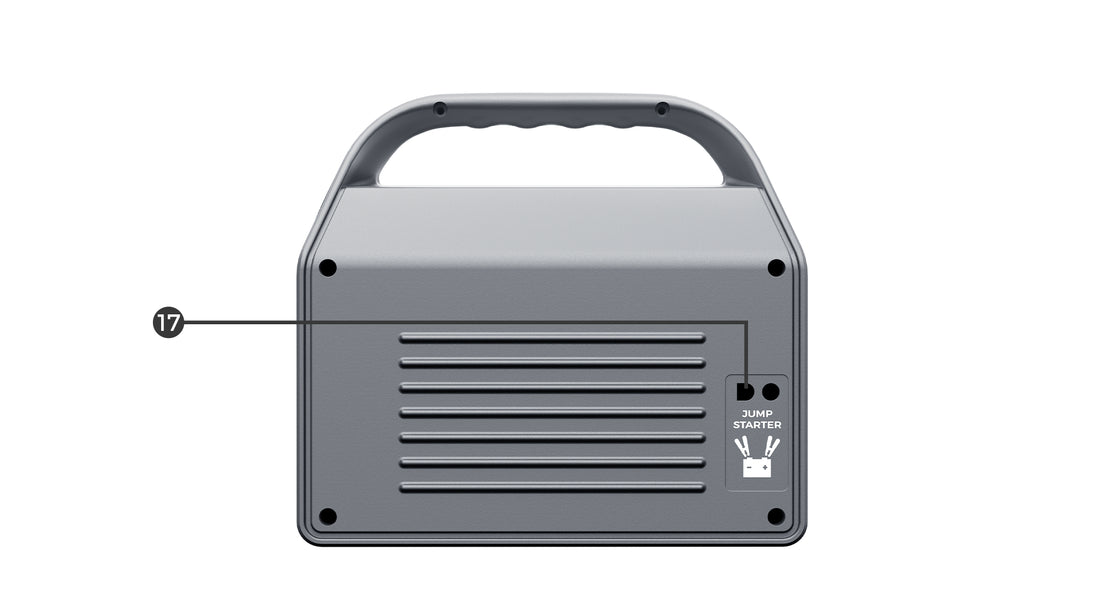
How to Jump-Start a Car With the UDPOWER C400
Park Safely and Turn the Vehicle Off
Put the vehicle in Park. For a manual transmission, use Neutral and follow the vehicle manufacturer’s instructions. Apply the parking brake and turn off the ignition.
Switch off the headlights, climate control, audio system, seat heaters, phone chargers, and other accessories. This reduces unnecessary electrical demand during the starting attempt.
Place the C400 on a Flat, Dry Surface
Position the C400 where it will not fall, slide, or contact hot or moving engine components. Do not place it on the battery, radiator fan, belts, exhaust components, or an unstable edge.
Make sure the jump cable can reach the battery without being pulled tight.
Insert the Jump Cable Into the Rear EC5 Port
Insert the compatible jump cable into the port labeled “JUMP STARTER” on the rear of the C400. Push the connector in securely, but do not force it at an incorrect angle.
Keep the red and black clamps separated while connecting the device end of the cable.
Connect the Red Clamp to Positive
Attach the red clamp to the positive battery terminal marked with a plus sign. Make sure the clamp jaws grip the metal terminal firmly rather than resting on a plastic cover.
Do not rely on color alone. Confirm the positive symbol on the battery or designated jump post.
Connect the Black Clamp to Negative
Attach the black clamp to the negative battery terminal marked with a minus sign, following the C400 manual.
When the vehicle has dedicated remote jump points, use the negative connection location specified by the vehicle manufacturer instead of guessing.
Check the Connection Before Starting
Confirm that the red clamp is on positive and the black clamp is on negative. The clamps should be secure, and the cable should remain clear of fans, belts, pulleys, and hot surfaces.
If the smart cable gives a polarity or connection warning, do not attempt to start the vehicle. Switch off the process and correct the connection first.
Power On the C400
Press the C400’s main power button. The jump-start function uses the rear EC5 port; it does not send starting current through the normal AC or DC appliance outputs.
Start the Vehicle
Start the vehicle in the normal way by turning the ignition key or pressing the engine start button.
Use a brief starting attempt. Do not continuously crank the starter if the engine does not respond.
Disconnect the C400 After the Engine Starts
Once the engine is running steadily, disconnect the jump cable from the C400’s EC5 port first. Then remove the clamps from the vehicle battery in reverse order.
The Correct C400 Disconnection Order
The C400 manual specifies disconnecting the cable from the EC5 port before removing the battery clamps.
| Order | Disconnect | Location |
|---|---|---|
| 1 | EC5 connector | Rear jump-start port on the C400 |
| 2 | Black clamp | Negative battery terminal or approved negative jump point |
| 3 | Red clamp | Positive battery terminal or approved positive jump point |
Hold each clamp by its insulated handle. Do not allow the clamp jaws to touch each other or nearby metal while the cable remains connected.
What to Do If the Car Will Not Start
A jump starter can supply missing cranking current, but it cannot repair a damaged battery, failed starter, broken cable, fuel problem, immobilizer fault, or other mechanical issue.
| Symptom | Possible Cause | What to Do |
|---|---|---|
| No response from the vehicle | Poor clamp contact, incorrect jump point, deeply discharged battery, or vehicle electrical fault | Stop, check polarity and clamp contact, and confirm the vehicle’s approved jump locations. |
| Rapid clicking | Insufficient starting current or poor terminal contact | Inspect for corrosion and make sure both clamps grip clean metal securely. |
| One solid click | Possible starter, cable, relay, or battery fault | Do not keep repeating the attempt. Arrange vehicle diagnosis. |
| Engine cranks normally but does not start | The problem may not be the battery | Stop jump-starting and investigate fuel, ignition, immobilizer, or engine faults. |
| C400 shows low battery or E6 | C400 battery voltage is too low for normal operation | Disconnect it from the vehicle and recharge the C400 before trying again. |
| Clamp or cable becomes unusually hot | Poor connection, damaged cable, or excessive resistance | Stop the attempt and disconnect safely. Do not reuse a damaged cable. |
| Smoke, strong odor, swelling, or leaking | Battery or electrical failure | Move away from the vehicle and contact professional assistance. |
Why a Successful Jump Does Not Mean the Battery Is Fixed
The C400 helps provide the short burst of current needed to turn the starter. Once the engine runs, the vehicle’s own charging system normally supplies electrical power and begins restoring some energy to the battery.
A battery that repeatedly needs a jump may have one of several underlying problems:
- The battery is old or has lost starting capacity.
- An interior light or accessory was left on.
- The alternator or charging system is not working correctly.
- Corroded or loose terminals are restricting current.
- An electrical component is draining the battery while parked.
- Cold weather has reduced available cranking performance.
UDPOWER C400 vs. Traditional Jumper Cables
Both methods can help start a vehicle with insufficient battery power, but the setup and connection sequence are different.
| Difference | UDPOWER C400 | Traditional Jumper Cables |
|---|---|---|
| Power source | Internal C400 LiFePO4 battery | Battery and charging system of a second vehicle |
| Second vehicle required | No | Yes |
| Number of vehicle clamps | Two clamps on the disabled vehicle | Four clamps across two vehicles |
| Device connection | Dedicated EC5 jump-start port | No separate jump device |
| Black clamp connection | Negative terminal or vehicle-approved negative jump point | Commonly a ground point on the disabled vehicle, depending on vehicle instructions |
| Removal procedure | Disconnect EC5 from C400, then black clamp, then red clamp | Normally remove the four clamps in reverse connection order |
| Readiness requirement | C400 must be adequately charged | Donor vehicle and battery must be compatible and healthy |
| Best use case | Solo roadside recovery, camping, commuting, or emergency kit | Situations where a suitable second vehicle is readily available |
For a broader explanation of portable starting devices, see Do Portable Jump Starters Really Work?
C400 Specifications Relevant to Jump-Starting
The C400 has both appliance-output ratings and a separate jump-start rating. These numbers describe different functions and should not be treated as interchangeable.
| Specification | Official Rating | What It Means | Source |
|---|---|---|---|
| Jump-start port | Dedicated EC5 connection | The only C400 output intended for vehicle starting | C400 product specifications |
| Jump-start current | 400A, up to 1500A peak | A short high-current output for vehicle starting | C400 product specifications |
| Supported battery system | 12V vehicles only | Not designed for 24V vehicle systems | C400 user manual |
| Gasoline engine guidance | Up to 5.0L | Maximum engine guidance listed in the current manual | C400 user manual |
| Diesel engine guidance | Up to 4.0L | Maximum diesel-engine guidance listed in the current manual | C400 user manual |
| Internal battery capacity | 256Wh LiFePO4 | Stored energy used for portable power and emergency functions | C400 product specifications |
| AC output | 400W rated, 800W surge | Appliance output rating, not the jump-start current rating | C400 product specifications |
| Weight | Approximately 6.88 lb | Compact enough for a vehicle emergency kit or trunk organizer | C400 product specifications |
| Dimensions | 8.27 × 5.12 × 7.09 in | Compact portable form factor | C400 product specifications |
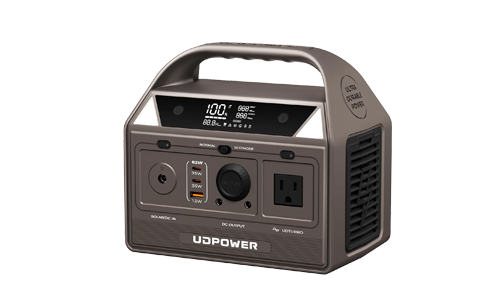
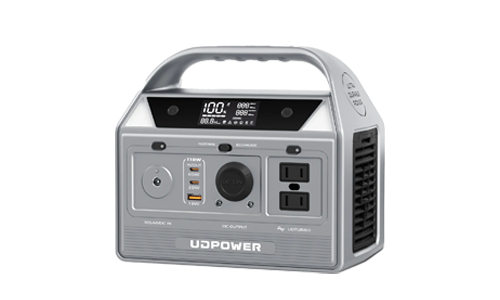
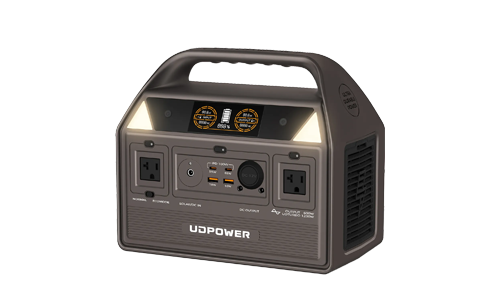
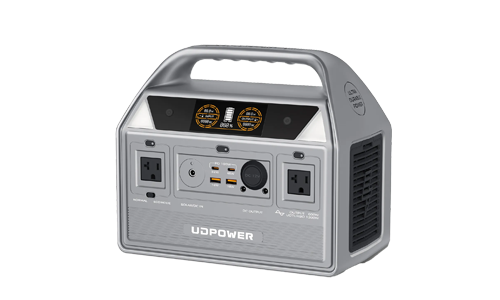
UDPOWER C400: Portable Power and Emergency Starting in One Unit

- Battery: 256Wh LiFePO4
- AC output: 400W rated, 800W surge
- Jump-start port: EC5
- Jump rating: 400A, up to 1500A peak
- Vehicle voltage: 12V only
- Weight: Approximately 6.88 lb
- Fast charging: Up to 165W combined input
How to Keep the C400 Ready for a Roadside Emergency
A portable jump starter is only useful when its battery and cable are ready. Do not leave the unit forgotten in a trunk for years without inspection or charging.
- Recharge the C400 after using the jump-start function.
- Inspect the EC5 connector, cable insulation, and clamp jaws regularly.
- Keep the cable and C400 together in a protective storage bag or trunk organizer.
- Store the unit in a dry environment.
- Avoid leaving it in locations that exceed its listed storage-temperature range.
- Check the battery level before long road trips or severe-weather seasons.
- Do not store it with metal objects that could contact the connector or clamps.
For long-term storage, the user manual recommends cycling the battery at least once every three months by discharging it to approximately 30% and then charging it to approximately 60%. The listed storage range is 32°F to 104°F (0°C to 40°C).
The full current manual is available through the UDPOWER FAQ and user manual page.
Frequently Asked Questions
Can the UDPOWER C400 jump-start a completely dead battery?
It may start a 12V vehicle whose battery no longer has enough power to crank the engine, provided the battery is not damaged and the vehicle is otherwise operational. It cannot repair a failed, frozen, internally damaged, or disconnected battery.
Do I need another vehicle to use the C400?
No. The C400 supplies starting current through its internal battery and rear EC5 jump-start port, so a donor vehicle is not required.
Where is the jump-start port on the C400?
The dedicated EC5 jump-start port is located on the back of the C400 and is labeled “JUMP STARTER.”
Which clamp do I connect first?
After inserting the jump cable into the C400’s EC5 port, connect the red clamp to the vehicle battery’s positive terminal first. Then connect the black clamp to the negative terminal or manufacturer-approved negative jump point.
Which clamp should I remove first?
After the vehicle starts, disconnect the cable from the C400’s EC5 port first. Then remove the black clamp followed by the red clamp.
How long should I wait before trying again?
Wait at least 30 seconds before another starting attempt. Stop after three unsuccessful attempts and arrange professional assistance.
Can the C400 jump-start a diesel vehicle?
The current C400 manual lists support for 12V diesel engines up to 4.0L. Cold temperatures, battery condition, and the vehicle’s starting demand can affect results.
Can the C400 jump-start a truck?
It may support a light-duty truck that uses a compatible 12V battery and falls within the listed engine limits. It must not be connected to a 24V commercial-truck starting system.
Can I jump-start a hybrid or electric vehicle with the C400?
Only use it on a vehicle’s 12V low-voltage battery when the vehicle manufacturer specifically permits that procedure. Never connect the C400 to a high-voltage traction battery.
Can I use a generic EC5 cable?
Use the original UDPOWER cable or a replacement specifically confirmed as compatible with the C400. An EC5 plug shape alone does not guarantee that the cable, clamp assembly, polarity, and current capability are suitable.
Can I use the AC outlets to jump-start a car?
No. The C400’s AC outlets are for compatible appliances. Vehicle starting must use the dedicated EC5 jump-start port and compatible battery clamps.
Can I use the C400 in the rain?
No. Keep the C400 and jump cable dry. The user manual instructs users not to operate the product in rain or extremely humid environments.
Why does the car crank but still not start?
If the engine turns at normal speed but does not start, the battery may not be the main problem. Fuel, ignition, immobilizer, sensor, or mechanical faults may require professional diagnosis.
Final Takeaway
The UDPOWER C400 uses a dedicated EC5 jump cable rather than the four-clamp setup used between two vehicles. Connect the EC5 cable, attach red to positive and black to negative, power on the C400, and make a brief starting attempt.
Once the vehicle starts, disconnect the EC5 connector from the C400 first, then remove the black and red clamps. Wait at least 30 seconds between attempts and stop after the third unsuccessful attempt.
Most importantly, use the jump-start feature only with compatible 12V vehicles. Never connect it to a 24V system, damaged battery, high-voltage EV battery, or an unidentified electrical connection.
Keep Emergency Starting Power in Your Vehicle
The C400 combines a dedicated 12V jump-start port with portable AC, USB, and DC power for road trips, camping, and everyday emergency preparation.
View the UDPOWER C400 View the Replacement Jump Cable Download the C400 User ManualRelated Articles


