
How Many Watts Do Musical Instruments Use? A Practical Power Guide for Musicians
Wondering how many watts musical instruments use? This guide breaks down the typical wattage of digital pianos, keyboards, guitar amps, electronic drums, PA speakers, mixers, laptops, and full music setups. You’ll learn how to read power labels, estimate total load, calculate runtime, and choose the right portable power station for practice, busking, outdoor gigs, small bands, and backup power.
Instrument Wattage Guide
Last updated: June 4, 2026
If you want to power a keyboard, guitar amp, electronic drum kit, mixer, PA speaker, or full outdoor music setup, the most important question is not simply “does this instrument need power?” The better question is: how many watts does the full setup actually use?
This guide breaks down typical musical instrument wattage, explains how to read power labels, shows real setup examples, and helps you choose a portable power station with enough output and runtime for practice, busking, church events, outdoor performances, recording, and emergency backup.
Quick Answer: How Many Watts Do Musical Instruments Use?
Many electronic instruments use less power than people expect. A digital piano may use around 10–40 watts, a MIDI controller may use under 15 watts, and an electronic drum module may use only a few watts. The bigger power draw usually comes from amplifiers, powered PA speakers, bass amps, mixers, laptops, monitors, and lights.
As a practical rule, a solo practice setup may use 30–150 watts, a busking setup may use 100–300 watts, and a small band or PA setup may use 500–1,500+ watts depending on speakers, volume, and equipment.

Musical Instrument Wattage Chart
The numbers below are practical planning ranges. Exact power use depends on the specific model, output volume, power adapter, and accessories. When possible, check the manufacturer’s power consumption spec or the label near the power input.
| Instrument or Music Device | Typical Wattage Range | What Usually Changes the Wattage | Example / Source |
|---|---|---|---|
| Digital piano / stage piano | 10W–40W | Built-in speakers, screen brightness, volume, pedal unit | Yamaha P-125 lists 9W power consumption |
| Electronic keyboard | 10W–60W | Built-in speakers, arranger functions, display, volume | Check the keyboard’s adapter label or product manual |
| Synthesizer / workstation | 10W–80W | Large screens, sampling engine, internal power supply, audio outputs | Check the official power consumption spec |
| MIDI controller | 2W–15W | USB power, pad lights, faders, aftertouch, connected laptop | Often powered from USB, but the laptop still needs to be counted |
| Electronic drum module | 5W–20W | Module type, display, Bluetooth, output level | Roland TD-17 lists DC 9V, 490mA current draw |
| Drum monitor / keyboard monitor | 30W–250W+ | Speaker size, volume, bass response, venue size | Check AC input watts or amps, not only speaker output watts |
| Electric guitar itself | 0W for most passive guitars | Active pickups may use a 9V battery, but the amp uses wall power | The guitar is usually not the load; the amp and pedals are |
| Guitar amp | 20W–300W+ | Solid-state vs tube, output level, speaker size, effects, master volume | BOSS Katana-50 MkII lists 47W power consumption |
| Bass amp | 80W–600W+ | Bass extension, cabinet size, stage volume, headroom | Use the amp’s AC power label or manual |
| Guitar pedalboard | 5W–50W | Number of pedals, digital modelers, multi-effects, 9V current draw | Add the current draw of each pedal or use the power supply rating |
| Loop station / vocal processor | 5W–30W | Display, phantom power, effects engine, USB audio | Check the adapter voltage and amp rating |
| Small mixer | 10W–80W | Channel count, phantom power, digital processing, USB recording | Check the mixer’s AC adapter or IEC input label |
| Powered PA speaker | 80W–300W+ per speaker during typical use | Volume, bass-heavy music, speaker efficiency, venue size | QSC K12.2 lists AC consumption at 1/8 power |
| Subwoofer | 200W–800W+ | Low bass, dance music, outdoor use, crowd size | Subwoofers are often the largest draw in a small PA system |
| Laptop for tracks, DJ, recording, or livestreaming | 45W–140W | CPU load, charger size, screen brightness, audio software | Use the charger wattage as a safe planning number |
| Tablet / phone for backing tracks or lyrics | 5W–30W | Charging speed, screen brightness, USB-C PD charger | Small load, but easy to forget in runtime planning |
| LED music stand light / small stage light | 2W–50W each | Brightness, number of lights, USB vs AC power | Count every light if you play outdoors or at night |
How to Read a Music Gear Power Label
Before buying a battery or portable power station, check the actual power input label on your gear. This is more reliable than guessing from the product name.
1. If the label shows watts
This is the easiest case. If the label says “Power Consumption: 47W,” use 47 watts in your estimate.
2. If the label shows volts and amps
Use this formula:
Watts = Volts × Amps
Example: if a powered speaker label says 120V and 1.9A, the rough planning number is 120 × 1.9 = 228 watts.
3. If the label shows DC adapter output
For small electronics, the adapter may say something like 9V 1A or 12V 2A. Multiply volts by amps.
| Adapter Label | Simple Calculation | Estimated Watts | Common Music Gear Example |
|---|---|---|---|
| 9V 0.5A | 9 × 0.5 | 4.5W | Small pedal, drum module, compact processor |
| 9V 2A | 9 × 2 | 18W | Pedalboard power supply or multi-effects unit |
| 12V 2A | 12 × 2 | 24W | Keyboard, small mixer, wireless receiver |
| 19V 3.42A | 19 × 3.42 | About 65W | Laptop charger |
| 20V 5A | 20 × 5 | 100W | USB-C laptop charger |
One Instrument vs. the Full Music System
The biggest mistake is calculating only the instrument. A digital piano may use very little power, but if you connect it to a PA speaker, add a mixer, charge a laptop, and run lights, the total load changes completely.
| Setup | Instrument Load | Support Gear Load | Total Planning Range |
|---|---|---|---|
| Digital piano at home | 10W–40W | Phone/tablet: 5W–20W | 15W–60W |
| Keyboard busking setup | 10W–60W | PA speaker, small mixer, phone, light | 100W–250W |
| Electric guitar practice | Guitar itself: usually 0W | Guitar amp, pedalboard, phone/tablet | 50W–150W |
| Electronic drums | Drum module: 5W–20W | Drum monitor or speaker: 30W–250W+ | 50W–300W+ |
| Acoustic duo | Guitar pickups/mics are small loads | Mixer, two mics, one or two powered speakers | 150W–400W |
| Small band PA | Keyboards, pedals, amps | Powered speakers, monitors, mixer, laptop | 500W–1,500W+ |
Real-World Music Setup Wattage Examples
These examples are designed for ordinary planning. They are not lab measurements, but they give you a realistic starting point before you test your own gear.
| Use Case | Typical Gear List | Estimated Total Watts | Recommended Power Station Output | Why |
|---|---|---|---|---|
| Quiet home practice | Digital piano, phone, small lamp | 25W–60W | 200W–400W | Small load, but extra output gives flexibility for other devices. |
| Guitar practice setup | Small guitar amp, pedalboard, tablet | 60W–150W | 400W+ | Allows amp startup and avoids running the battery at its limit. |
| Electronic drums | Drum module, drum monitor, phone | 80W–250W | 400W–600W+ | The monitor usually matters more than the drum module. |
| Solo street performance | Keyboard, compact PA speaker, small mixer, phone, light | 120W–250W | 600W+ | Good balance of portability, runtime, and output headroom. |
| Acoustic duo | Two microphones, acoustic guitar DI, mixer, powered speaker | 150W–350W | 600W–1,200W | Enough room for one or two powered speakers and a longer set. |
| Small band rehearsal | Keyboard, guitar amp, bass amp, mixer, two powered speakers | 500W–1,000W | 1,200W–2,400W | Multiple audio devices can create a much higher total load. |
| Outdoor PA with subwoofer | Two powered speakers, subwoofer, mixer, laptop, instruments | 800W–1,800W+ | 2,400W recommended | Subwoofers and outdoor volume require more headroom. |
How to Calculate Runtime from Instrument Wattage
Once you know the total watts, runtime is easy to estimate. For UDPOWER portable power stations, use this practical formula:
Runtime = Battery Capacity × 0.90 ÷ Total Watts
The 0.90 factor allows for typical conversion loss when using AC power. For faster estimates, use the UDPOWER Portable Power Station Runtime Calculator. If you need to convert amps, volts, watts, or watt-hours, use the UDPOWER Battery Unit Conversion Tools.
| Total Music Gear Load | Example Setup | UDPOWER C400 256Wh | UDPOWER C600 596Wh | UDPOWER S1200 1,190Wh | UDPOWER S2400 2,083Wh |
|---|---|---|---|---|---|
| 30W | Digital piano practice | About 7.7 hours | About 17.9 hours | About 35.7 hours | About 62.5 hours |
| 75W | Small guitar amp + pedalboard | About 3.1 hours | About 7.2 hours | About 14.3 hours | About 25.0 hours |
| 150W | Keyboard + compact speaker | About 1.5 hours | About 3.6 hours | About 7.1 hours | About 12.5 hours |
| 300W | Acoustic duo with PA | Not ideal for long use | About 1.8 hours | About 3.6 hours | About 6.2 hours |
| 600W | Small band rehearsal | Not supported by output rating | About 0.9 hours | About 1.8 hours | About 3.1 hours |
| 1,000W | Larger PA or speakers with sub | Not supported | Not supported by output rating | About 1.1 hours | About 1.9 hours |
| 1,500W | Outdoor PA with subwoofer | Not supported | Not supported | Not supported by output rating | About 1.2 hours |
Runtime is an estimate. Actual results vary with volume, speaker efficiency, battery temperature, AC/DC output choice, and whether low-power or eco mode is enabled.
Recommended UDPOWER Models by Music Gear Wattage
Match the power station to your total watts, not just the name of the instrument. For clean power, sensitive audio gear such as keyboards, mixers, laptops, and powered speakers should be used with pure sine wave AC output.
 For 30W–150W music setups
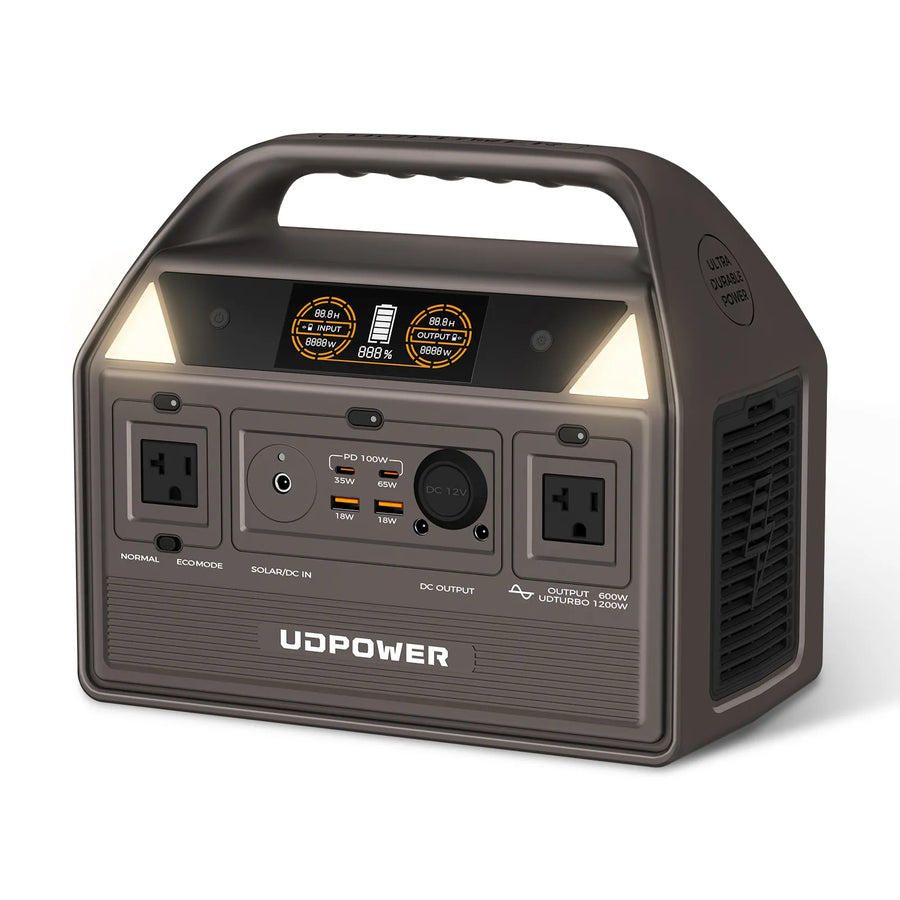
UDPOWER C400 Portable Power Station
Best for low-wattage music gear such as digital piano practice, MIDI controller setups, small guitar amps, pedalboards, phones, tablets, and light recording accessories.
- Capacity: 256Wh
- Rated AC output: 400W
- Surge: 800W
- Battery type: LiFePO4
- Good fit: home practice, small amp, pedalboard, keyboard, phone, tablet
 For 100W–300W music setups
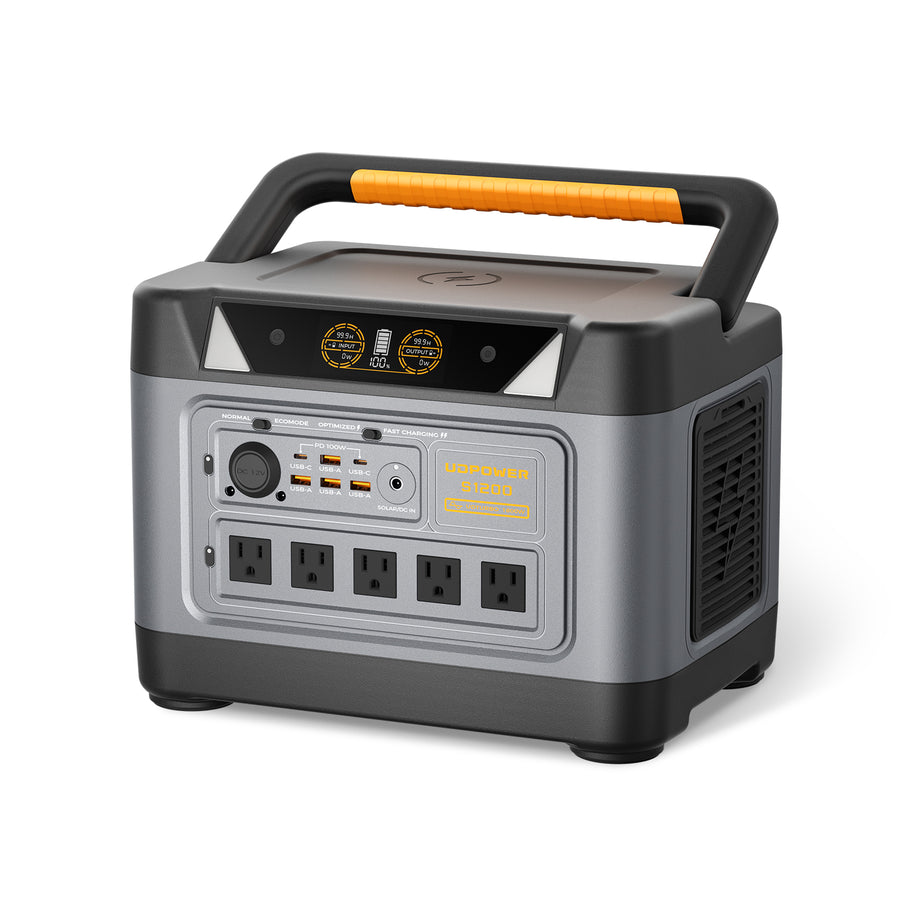
UDPOWER C600 Portable Power Station
A better fit when your instrument wattage is still modest but you are adding a compact PA speaker, small mixer, electronic drums, laptop, or livestream gear.
- Capacity: 596Wh
- Rated output: 600W
- Peak output: 1,200W
- Ports: 2 AC outlets, USB-C, USB-A, and 12V car outlet
- Good fit: busking, lessons, acoustic duo, compact PA, drum monitor
 For 250W–800W music setups
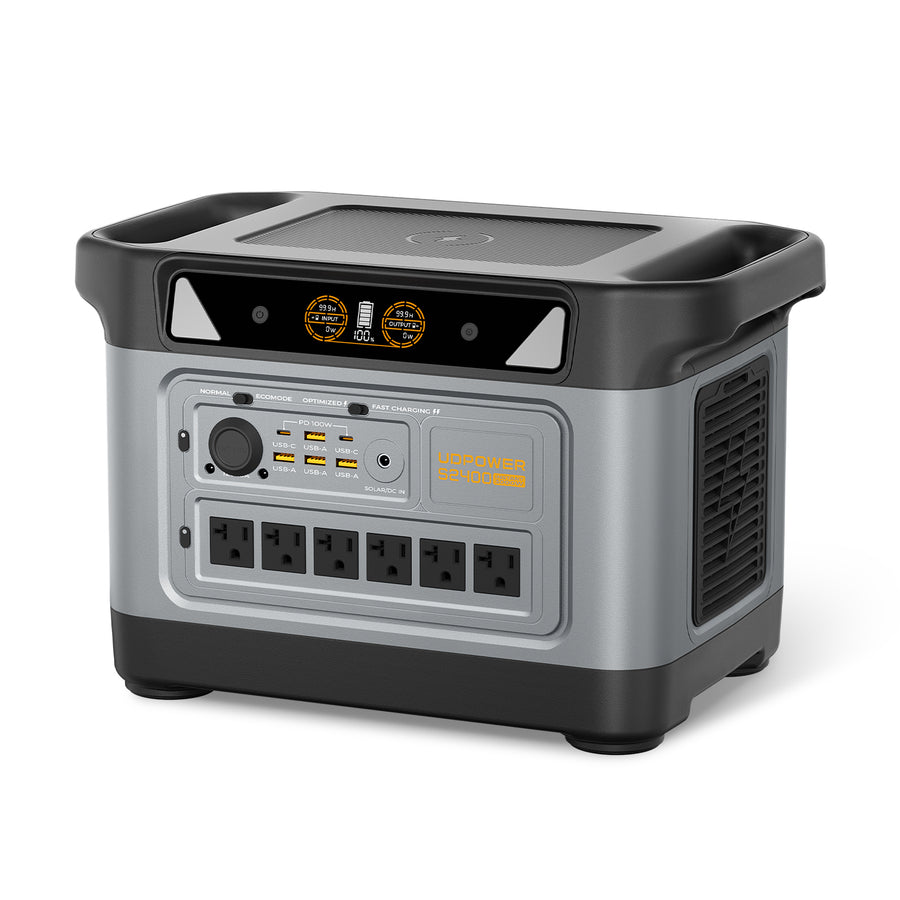
UDPOWER S1200 Portable Power Station
Best for longer sets, compact event audio, powered speakers, keyboard rigs, mixers, laptop recording, church events, small outdoor performances, and quiet backup power.
- Capacity: 1,190Wh
- Rated AC output: 1,200W
- UDTURBO surge support: up to 1,800W
- Ports: 5 AC outlets plus USB-A, USB-C, DC5521, car outlet, and wireless charging
- Noise: rated under 25dB
- Good fit: small PA, powered speakers, mixer, keyboard, laptop, guitar modeler
 For 800W–1,800W+ music setups
UDPOWER S2400 Portable Power Station
Best for bands, higher-wattage PA systems, multiple powered speakers, subwoofers, rehearsal spaces, outdoor events, and setups where extra output headroom matters.
- Capacity: 2,083Wh
- Rated AC output: 2,400W
- Surge support: up to 3,000W
- Ports: 6 AC outlets plus USB-A, USB-C, DC5521, 12V car outlet, and wireless charging
- Good fit: band rehearsal, larger PA, subwoofer, multi-device music power backup
For more options, visit the UDPOWER portable power station collection. If you want solar charging for outdoor performances, camping music setups, or off-grid events, explore UDPOWER solar generator kits. For home outage preparation, see portable power stations for home backup.
Common Mistakes When Estimating Instrument Power
- Using speaker output watts as battery load. A 1,000W powered speaker may not draw 1,000W continuously, but it can still need more headroom than a small instrument.
- Forgetting the PA system. The keyboard may use 20W, but the powered speaker may use ten times more.
- Ignoring startup and peaks. Some amps, powered speakers, and subwoofers can briefly demand more power when turned on or pushed hard.
- Running too close to the power station limit. For music gear, leave 20%–30% headroom when possible.
- Only planning for the show time. Add sound check, setup, breaks, background music, and pack-down time.
- Not testing before the event. Run the full setup at real performance volume before relying on it outdoors.
- Forgetting small accessories. Phones, tablets, lights, wireless receivers, pedalboards, and laptops all add to total watts.
Simple Buying Rule by Total Watts
If you do not want to calculate every detail, use this simple starting point:
| Your Total Music Gear Load | Typical Setup | Recommended UDPOWER Model | Why It Fits |
|---|---|---|---|
| Under 150W | Digital piano, small amp, pedalboard, phone, tablet | C400 | Enough output for light setups and several hours of runtime. |
| 150W–300W | Keyboard plus compact speaker, electronic drums, small mixer | C600 | More capacity and output for small performance setups. |
| 300W–800W | Powered speaker, mixer, laptop, keyboard, guitar modeler | S1200 | Better headroom for longer sets and sensitive audio gear. |
| 800W–1,800W+ | Band rehearsal, multiple speakers, subwoofer, larger PA | S2400 | Higher AC output and larger capacity for demanding music setups. |
FAQ: Musical Instrument Wattage
How many watts does a digital piano use?
Many digital pianos use around 10–40 watts, although the exact number depends on the model and built-in speakers. Always check the product manual or adapter label for your piano.
How many watts does an electric guitar use?
Most passive electric guitars do not use wall power. The power draw comes from the guitar amp, pedalboard, modeler, audio interface, or PA speaker connected to the guitar.
How many watts does a guitar amp use?
Small practice amps may use under 100 watts from the wall, while larger guitar or bass amps can use several hundred watts. Use the amp’s power consumption label instead of only looking at speaker output watts.
How many watts does an electronic drum kit use?
The drum module itself may use only a small amount of power, often under 20 watts. The bigger load is usually the drum monitor, powered speaker, or headphones amp.
How many watts does a PA speaker use?
A powered PA speaker can use roughly 80–300 watts or more during typical operation, depending on the model and volume. Large speakers and subwoofers can draw much more.
Can a portable power station run musical instruments?
Yes, as long as the total wattage stays within the power station’s rated output and the battery capacity is large enough for the runtime you need. Add up the instrument, amp, speaker, mixer, laptop, and lights before choosing.
What size power station do I need for busking?
For a simple busking setup, many musicians should start around 600W output and choose capacity based on set length. If you use larger powered speakers or a subwoofer, move up to a higher-output model.
What size power station do I need for a small band?
A small band setup can range from 500W to over 1,500W depending on amps, powered speakers, monitors, and subwoofers. For higher-wattage PA systems, choose a larger unit such as the UDPOWER S2400.
Should musicians use pure sine wave power?
Yes. Keyboards, mixers, laptops, powered speakers, audio interfaces, and other sensitive electronics are better matched with pure sine wave AC power.
How can I get the most accurate wattage number?
Check the official power consumption spec, read the label on the device or adapter, or use a plug-in watt meter during a real practice session at the volume you normally use.
Choose Power Based on Your Real Instrument Wattage
Add up the watts from your instrument, amp, speaker, mixer, laptop, lights, and accessories. Then choose a power station with enough rated output, enough battery capacity, and enough headroom for the full session.
Check runtime · View portable power stations · Explore solar generator kits
Related Articles





