
How Many Amps Does a Washing Machine Use? (2026 Guide)
Most residential washing machines use approximately 5–15 amps on a 120V circuit, but actual electrical demand varies by model, motor design, cycle setting, internal heating and spin speed. This guide explains the difference between appliance amperage and breaker capacity, compares real manufacturer ratings, shows how washer power changes throughout a cycle, and helps readers determine whether a portable power station can safely run their washing machine.
Last updated:
Quick answer: Most standalone washing machines sold for U.S. homes use a 120-volt outlet and fall within a broad planning range of about 5 to 15 amps. Published manufacturer examples include a 5-amp top-load washer and a 10-amp front-load washer. A 120-volt heat-pump washer-dryer combo may be rated around 11 amps.
The 15-amp or 20-amp number in an installation manual usually describes the required branch circuit or breaker—not the amount of current the washer continuously uses. Always check the rating label for your exact model before choosing a circuit, generator, or portable power station.

Knowing a washer's amperage matters for more than choosing an outlet. The number helps you investigate a tripping breaker, compare appliance efficiency, avoid overloaded extension cords, and determine whether backup power can complete a full load during an outage.
The difficult part is that several different electrical numbers are often treated as though they mean the same thing. This guide separates those numbers and shows you how to find the one that matters for your situation.
How Many Amps Does a Washing Machine Use?
A useful general estimate for a residential washer is 5 to 15 amps at 120 volts. However, that range is intentionally broad. The actual rating depends on the washer's motor, control system, pumps, internal heater, and whether the appliance also dries clothes.
| Washer type | Common planning range | Typical supply | What changes the number |
|---|---|---|---|
| Small portable washer | About 3–8A | 120V | Drum size, spin motor, drain pump and whether the machine has a heated cycle |
| Full-size top-load washer | About 5–12A | 120V | Agitator or impeller design, load size, motor type and spin speed |
| Full-size front-load washer | About 5–12A | 120V | Inverter motor, high-speed spin, steam cycle and internal heating |
| 120V heat-pump washer-dryer combo | Often about 10–15A | 120V | Wash-only versus wash-and-dry operation, compressor and cycle temperature |
| Electric laundry center | Check the complete-unit label | Usually 208/240V | The electric dryer heating element dominates the total electrical requirement |
On a phone, swipe the table sideways to view every column.
Important: These are planning ranges, not substitute specifications. Two washers with the same drum capacity can have very different electrical ratings.
Three Electrical Numbers People Commonly Mix Up
When someone says a washer “uses 20 amps,” that statement may be referring to the circuit rather than the appliance. Before using any number, identify what it represents.
1. Actual current during the cycle
This is the changing amount of electricity the washer draws at a particular moment. It rises and falls as valves, pumps, the drum motor and any internal heater turn on and off.
2. The appliance's nameplate rating
This is the manufacturer's electrical rating printed on the washer or listed in its specifications. It is the safer number to use when checking outlet, generator or portable-power-station compatibility.
3. The branch-circuit or breaker rating
This describes the circuit supplying the washer. A manufacturer may require an individual 15-amp or 20-amp branch circuit even though the washer normally draws less than that.
Never install a larger breaker simply because the existing breaker trips. The breaker must match the wiring and installation. Increasing breaker size without verifying the wire can create an overheating and fire risk.
Real Manufacturer Amp Ratings
The following examples show why there is no single amperage that applies to every washer. These figures come from manufacturer specification sheets and electrical-requirement pages.
| Appliance example | Type | Published electrical figure | What the figure means | Source |
|---|---|---|---|---|
| LG WT5270CW | Full-size top-load washer | 120V, 5A | Manufacturer-listed electrical requirement | LG specification sheet |
| LG WM4000H | Full-size front-load washer | 120V, 10A | Manufacturer-listed electrical requirement | LG specification sheet |
| GE Profile PFQ97HSPVDS | Ventless heat-pump washer-dryer combo | 120V, 11A; 15A circuit | The appliance rating and branch-circuit requirement are listed separately | GE quick specifications |
| GE and Hotpoint standalone washers | General installation guidance | 120V individual circuit protected by a 15A or 20A breaker | This is a circuit requirement, not a claim that every washer continuously draws 15–20A | GE electrical requirements |
| GE electric unitized washer-dryer | Washer with electric dryer | 208/240V, 30A circuit | The 30A requirement applies to the complete laundry unit, including electric drying heat | GE electrical requirements |
Specifications may differ by model revision. Check the label and manual supplied with your own appliance.
How this guide was checked
The amp ranges in this article were compared with published appliance specification sheets rather than calculated from generic appliance lists alone. Portable-power recommendations were then checked against the official continuous output, surge output, voltage and battery capacity listed on the corresponding UDPOWER product pages.
How to Convert Amps, Watts, and Volts
If a washer lists watts but not amps, you can make a basic estimate with this formula:
You can reverse the formula when you know volts and amps:
| Current | Simple 120V calculation | Approximate electrical level |
|---|---|---|
| 3A | 120 × 3 | 360W |
| 5A | 120 × 5 | 600W |
| 7A | 120 × 7 | 840W |
| 8A | 120 × 8 | 960W |
| 10A | 120 × 10 | 1,200W |
| 11A | 120 × 11 | 1,320W |
| 12A | 120 × 12 | 1,440W |
| 15A | 120 × 15 | 1,800W |
| 20A | 120 × 20 | 2,400W circuit capacity—not a typical continuous washer draw |
Why this remains an estimate: A washer contains motors and electronic controls, so dividing watts by volts may not reproduce its exact nameplate current. Use the manufacturer's listed amps or a suitable power meter whenever possible.
How Amp Draw Changes During a Wash Cycle
A washing machine does not pull its maximum electrical load for the entire cycle. That is why estimating battery use by multiplying the highest wattage by the full cycle time often produces an unrealistically high result.
| Cycle stage | Relative electrical demand | What is operating | Practical observation |
|---|---|---|---|
| Standby and cycle selection | Very low | Display, sensors and electronic controls | This stage has little effect on total cycle energy |
| Water filling | Low | Control board and inlet valves | The household water supply provides the water pressure |
| Agitation or tumbling | Low to moderate and variable | Drum motor and controls | The motor repeatedly starts, slows, reverses or pauses |
| Draining | Moderate | Drain pump and controls | A blocked or failing pump can increase strain or cause a fault |
| High-speed spin | Often one of the strongest motor stages | Drum motor and balance-control system | An unbalanced load may trigger repeated attempts to reach full speed |
| Steam, sanitize or internal water heating | Potentially high and sustained | Electric heating element plus normal washer components | This can matter more to backup-power sizing than the motor alone |
Do all washers have a two- or three-times startup surge?
No fixed multiplier applies to every washer. Older conventional motors can create a noticeable brief starting peak. Many modern inverter-driven washers ramp the motor more gradually. The peak can also occur when the drum accelerates into a high-speed spin rather than at the beginning of the entire wash cycle.
When selecting backup power, use the washer's manufacturer data or measure the highest wattage across a representative cycle. Do not assume that every washer will have exactly two or three times its normal power draw.
Does Hot Water Increase Washer Amps?
The answer depends on where the heat comes from.
Washer supplied by a household hot-water line
With a conventional washer, hot water may already have been heated by a gas or electric water heater before it reaches the machine. In that situation, selecting hot water increases the home's overall laundry energy use, but much of that extra energy is not drawn through the washer's 120V plug.
Washer with an internal heater
If the washer contains its own heating element for steam, allergy, extra-hot or sanitize cycles, the machine's plug-in electrical demand can rise while that heater operates. These cycles deserve special attention when sizing a portable power station.
ENERGY STAR reports that water heating accounts for a large share of the energy associated with washing clothes and recommends cold-water cycles when appropriate. It also notes that certified washers use about 20% less energy and about 30% less water than regular models.
What Circuit and Breaker Does a Washer Need?
Many standalone U.S. washers require a grounded 120V receptacle on an individual branch circuit protected by a 15A or 20A breaker. The exact requirement appears in the appliance installation manual.
The circuit rating provides operating headroom and protects the wiring. It should not be interpreted as the washer's normal continuous current.
Basic circuit checks
- Confirm whether the appliance requires 120V or 208/240V.
- Use a properly grounded outlet that matches the plug.
- Follow the washer manufacturer's specified circuit and breaker rating.
- Avoid sharing the circuit with a space heater, iron, microwave or other high-draw appliance.
- Do not use an adapter to defeat the grounding pin.
- Do not replace a tripping breaker with a larger breaker without an electrician checking the wire and circuit.
- Stop using an outlet if the plug, faceplate or cord becomes hot, discolored or smells burned.
What about a washer and dryer on the same circuit?
A separate electric dryer normally uses a dedicated 208/240V circuit. A gas dryer may use a 120V outlet for its drum motor and controls. Laundry centers and all-in-one appliances vary widely, so use the complete appliance's installation requirements rather than applying a standalone-washer rule.
How to Find Your Washer's Exact Amperage
- Locate the rating label. Look around the door opening, lid hinge, back panel or inside edge of the cabinet.
- Write down the voltage and amperage. Look for markings such as “120V,” “60Hz,” “5A” or “10A.”
- Check the model-specific installation manual. The manual may list both the appliance rating and the required branch circuit.
- Do not confuse the breaker requirement with actual current. “20A circuit required” does not automatically mean the washer draws 20A.
- Measure a complete cycle when backup-power sizing matters. Use a grounded plug-in energy meter rated for the appliance's voltage and current.
What should you record with a power meter?
- The highest displayed wattage during the cycle
- The total kilowatt-hours used by one complete load
- The cycle selected and whether internal heating was used
- The approximate load size
- Whether the washer completed high-speed spin without an overload warning
Do not connect a 240V appliance to a standard plug-in 120V meter. If the washer's plug or rating exceeds the meter's limits, have a qualified technician take the measurement.
Why a Washing Machine Trips the Breaker
A tripped breaker does not automatically prove that the washer uses too many amps. The timing of the trip can help narrow down the problem.
| When the trip happens | Possible causes | Safe next step |
|---|---|---|
| Immediately after plugging in | Damaged cord, outlet fault, moisture or internal electrical short | Unplug the washer and arrange professional inspection |
| When another appliance starts | Shared circuit is overloaded | Turn off the other load and confirm whether the washer requires an individual circuit |
| When agitation or spin begins | Motor problem, seized component, weak breaker, overloaded drum or brief starting peak | Remove excess laundry, rebalance the load and stop testing if the trip repeats |
| During draining | Blocked pump, obstructed hose or failing drain-pump motor | Follow the manufacturer's drain-filter and hose inspection procedure |
| During steam or sanitize mode | Internal heater demand or heater-related fault | Try a normal cold cycle only for diagnosis; service the machine if the problem repeats |
| GFCI or AFCI trips repeatedly | Electrical leakage, moisture, damaged insulation or an arc condition | Do not bypass the protective device; have the circuit and washer checked |
| Outlet or plug becomes warm | Loose connection, worn receptacle or excessive resistance | Stop using the outlet immediately and have it inspected |
Can a Portable Power Station Run a Washing Machine?
Yes, many 120V washing machines can run from a sufficiently powerful portable power station. Compatibility depends on more than battery capacity, however.
Five numbers must match
- Voltage: The power station must provide the voltage required by the washer. A 120V power station cannot run a 240V laundry center.
- Continuous output: The washer's maximum sustained demand must remain below the station's rated AC output.
- Short peak demand: The station must tolerate the washer's highest motor or heater peak without shutting down.
- Energy per load: The battery must contain enough usable watt-hours to complete the selected cycle.
- Connection and environment: The washer should plug directly into the power station while both units remain dry, ventilated and safely positioned.
For a more detailed appliance-checking process, see How to Know If a Portable Power Station Can Run Your Device.
Do not backfeed a wall outlet or electrical panel. Connect the washer directly to a compatible AC outlet on the portable power station. Neither of the models below provides 240V output.
Recommended UDPOWER Models for Washing Machines
The right model depends on the washer's label and measured peak. The recommendations below are compatibility guidelines, not a guarantee for every washing machine.
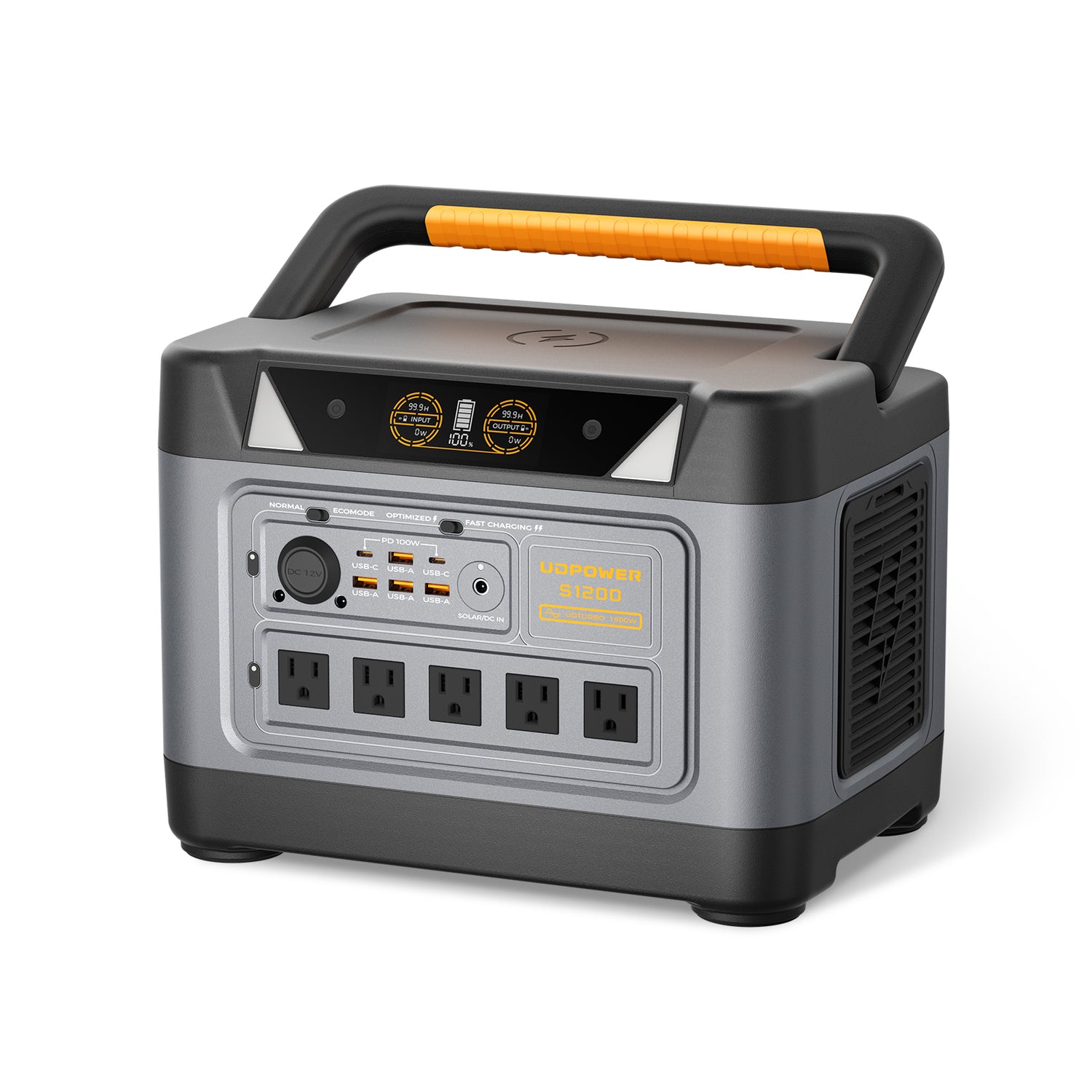
UDPOWER S1200: For Lower-Demand 120V Washers
- Battery capacity: 1,190Wh
- Rated AC output: 1,200W
- Maximum surge support: Up to 1,800W
- AC output: 120V, 60Hz pure sine wave
- Battery chemistry: LiFePO4
The S1200 may be suitable for an efficient compact washer or a full-size 120V washer whose sustained draw remains at or below 1,200W and whose brief peak stays within the station's limit.
A washer marked 10A at 120V is already near a simple 1,200W calculation. Because actual motor behavior and internal heating vary, that appliance should be tested rather than assumed compatible.
View UDPOWER S1200 See What a 1200W Power Station Can Run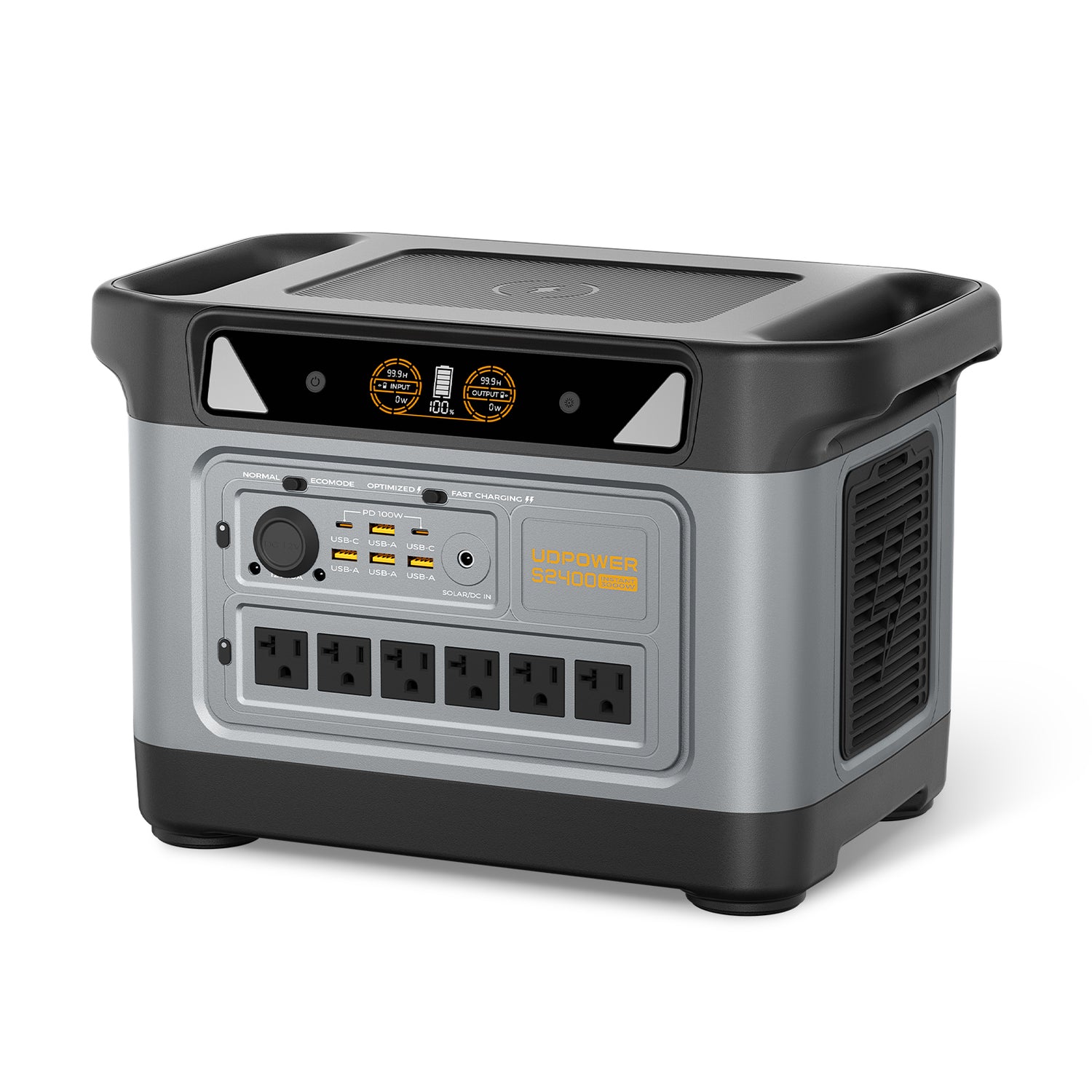
UDPOWER S2400: The Better Choice for Many Full-Size 120V Washers
- Battery capacity: 2,083Wh
- Rated AC output: 2,400W
- Maximum surge support: Up to 3,000W
- AC output: 120V, 60Hz pure sine wave
- AC outlets: Six
- Battery chemistry: LiFePO4
The S2400 provides more inverter headroom and battery capacity, making it the more practical UDPOWER option for many full-size 120V washers, including models with stronger spin motors or occasional higher-power stages.
It still cannot power a 208/240V electric laundry center, and an appliance that exceeds 2,400W continuously or 3,000W at startup is not compatible.
View UDPOWER S2400 See What a 2000W-Class Power Station Can Run| Model | Battery capacity | Continuous AC output | Surge support | Best washer match | Important limitation |
|---|---|---|---|---|---|
| S1200 | 1,190Wh | 1,200W | Up to 1,800W | Lower-demand compact or efficient 120V washer after compatibility testing | No 240V output; limited headroom for a washer rated near 1,200W |
| S2400 | 2,083Wh | 2,400W | Up to 3,000W | Many full-size 120V washers whose measured demand stays within limits | No 240V output; verify internal-heater and washer-dryer-combo demand |
How Many Loads Can a Portable Power Station Run?
For a washing machine, estimating the number of complete loads is usually more useful than calculating continuous runtime in hours.
Use the total energy reading from a complete measured cycle. Do not use only the washer's highest displayed wattage, because that peak may last for a small portion of the cycle.
| Measured energy per load | Example cycle type | S1200 estimate | S2400 estimate |
|---|---|---|---|
| 200Wh per load | Efficient wash-only cycle with no internal heating | About 5.4 loads | About 9.4 loads |
| 350Wh per load | Moderate-energy wash cycle | About 3.1 loads | About 5.4 loads |
| 500Wh per load | Longer or more energy-intensive cycle | About 2.1 loads | About 3.7 loads |
These are mathematical examples, not guaranteed test results. Temperature, battery state, cycle selection, load balance, washer design and internal heating all affect the outcome. The washer must also pass the continuous-output and surge checks before battery-capacity calculations matter.
How to Test a Washer Safely on Backup Power
- Confirm that the washer is a 120V appliance.
- Check that its listed or measured wattage is below the power station's continuous output.
- Fully charge the power station before the first test.
- Place the power station in a dry, stable, ventilated location away from water connections and drain hoses.
- Turn off other devices connected to the power station.
- Plug the washer directly into the station's grounded AC outlet.
- Begin with a normal cold-water cycle rather than steam or sanitize mode.
- Watch the power station display during agitation, draining and high-speed spin.
- Stop the test if the station reports overload, shuts down, smells unusual or becomes excessively hot.
- Record the highest watts and remaining battery percentage after the complete load.
Do not leave the first compatibility test unattended. Do not place a portable power station on top of the washer, where vibration could cause it to move or fall.
For additional precautions, read the Portable Power Station Safety Guide.
How to Reduce Laundry Energy Use
You generally cannot change a washer's rated amperage, but you can reduce the total energy used per load and make battery backup last longer.
- Choose cold water when appropriate. This reduces water-heating energy and may avoid activating an internal heater.
- Avoid steam and sanitize cycles unless needed. Extra heating can materially increase cycle energy.
- Run properly sized loads. Several tiny loads waste water and energy, while an overloaded drum may struggle to balance and spin.
- Distribute heavy items evenly. An unbalanced load can trigger repeated spin attempts.
- Use a higher final spin when fabrics permit. Removing more water can reduce dryer energy afterward.
- Clean the drain filter and inspect the hose. Restricted drainage can lengthen the cycle and strain the pump.
- Compare the EnergyGuide label when replacing a washer. Annual energy consumption is more useful for operating-cost comparisons than amperage alone.
- Measure your most-used cycle. A plug-in meter provides a better battery estimate than a generic internet wattage range.
Frequently Asked Questions About Washing Machine Amps
How many amps does a typical washing machine use?
A useful planning range is about 5–15 amps at 120 volts. Published standalone-washer examples include 5A and 10A models, but the exact figure must come from the rating label or manual.
How many watts is a 10-amp washing machine?
A simple 120V calculation gives 1,200 watts: 120V × 10A = 1,200W. Because a washer contains a motor and electronic controls, use this as a planning estimate rather than a precise real-time wattage.
Can a washing machine run on a 15-amp outlet?
Many washers are designed for a grounded 120V circuit protected by a 15A or 20A breaker. Follow the model-specific installation manual and local electrical requirements rather than relying on a universal rule.
Does a 20-amp washer circuit mean the washer uses 20 amps?
No. The 20A figure usually describes the circuit's protective rating. The washer's actual and nameplate current are normally lower, although they vary by model and cycle.
Do front-load washers use more amps than top-load washers?
Not necessarily. Motor design, internal heating and specific cycle settings matter more than door orientation alone. Manufacturer examples show both washer types can have relatively modest ratings.
How many amps does a portable washing machine use?
Many small portable washers fall around 3–8 amps at 120V, but compact washer-dryer combinations can use more. Check the electrical label before connecting one to an RV outlet, generator or power station.
How many amps does a washer-dryer combo use?
It depends heavily on the drying technology. One published 120V heat-pump combo is rated at 11A, while electric laundry centers with resistance-heated dryers may require a 208/240V, 30A circuit for the complete unit.
Does a washing machine have a startup surge?
A motor can create a brief peak when it accelerates, but there is no universal multiplier. Modern inverter-driven machines may ramp more gradually, while older or conventional motor designs may produce a stronger peak.
Why does my washer trip the breaker during spin?
Possible causes include an overloaded or unbalanced drum, another appliance sharing the circuit, a motor problem, a weak breaker or a wiring fault. Stop using the washer and seek service if the trip repeats after reducing and balancing the load.
Can a portable power station run a washing machine?
Yes, when the washer uses 120V and its continuous wattage, brief peak and energy per load all remain within the power station's limits. Voltage compatibility must be checked first.
What size power station is best for a washing machine?
A 2,000W-class unit generally provides more useful headroom for a full-size 120V washer. Lower-output models may work with compact or efficient washers, but compatibility should be confirmed from the appliance label and a monitored test.
Will the UDPOWER S1200 run a washing machine?
It may run a lower-demand 120V washer if sustained power remains within 1,200W and the highest brief demand stays within its supported limit. A washer rated near 10A at 120V should be tested carefully because it leaves little continuous-output headroom.
Will the UDPOWER S2400 run a washing machine?
The S2400's 2,400W rated output and 3,000W surge support make it suitable for many full-size 120V washers. It will not run a 240V laundry center, and the washer's exact electrical requirements still need to be checked.
Can I use an extension cord with a washing machine?
Direct connection to a grounded wall outlet or compatible power-station outlet is safer. Many appliance manuals advise against extension cords. Do not use a light-duty cord, power strip or adapter, and follow the washer manufacturer's instructions.
How can I measure how much electricity one wash cycle uses?
Use a grounded plug-in energy meter whose voltage and amperage limits exceed the washer's rating. Reset the meter, run a complete representative cycle, and record both the highest wattage and total kilowatt-hours.
Can a 120V power station run a 240V washer-dryer unit?
No. Output wattage does not change voltage compatibility. A portable power station that provides only 120V cannot operate an appliance requiring 208V or 240V.
Related Washing-Machine and Backup-Power Guides
Primary Sources
- LG WT5270CW top-load washer specification sheet
- LG WM4000H front-load washer specification sheet
- GE Profile PFQ97HSPVDS washer-dryer combo specifications
- GE washer electrical and breaker requirements
- ENERGY STAR clothes-washer guidance
- Official UDPOWER S1200 specifications
- Official UDPOWER S2400 specifications
Choose Backup Power for Your Washer
Start with the voltage, nameplate amps and highest measured wattage on your own washing machine. Then choose a power station with enough continuous output, peak headroom and usable battery capacity for the complete cycle.
Compare UDPOWER Portable Power Stations View the UDPOWER S2400 Get the Appliance Compatibility GuideRelated Articles





