

Electric Bed Power Backup: Size & Runtime Guide
Last updated: September 1, 2026
An electric adjustable bed can run from a compatible battery backup during a power outage, but the small emergency battery supplied with many bases is usually meant only to lower the bed once—not to preserve normal operation all night. For full bed movement, use a manufacturer-approved rechargeable pack, a compatible UPS, or a pure sine wave portable power station. A 300–500Wh unit may be enough for brief positioning of one ordinary adjustable base, while a 1,000Wh-class unit is a more practical starting point when you want automatic backup, generous reserve, or power for another low-wattage device. Measure your own bed before buying: split bases, massage motors, air pumps, USB ports, and medical equipment can change the requirement substantially.

A bed motor is not a space heater. It normally runs for seconds or minutes, then sits idle. That makes electric bed power backup easier than its plug label may suggest—but also easier to calculate incorrectly. A large battery can theoretically supply hundreds of short adjustments, yet a nearly idle AC inverter may use more energy over a long outage than the bed motor itself.
The right plan starts with the function you cannot lose. Do you only need to return the bed to flat? Do you need the head and foot controls available throughout the night? Is it a split king with two powered halves? Does the bed share power with a mattress pump or prescribed sleep equipment? Those are different backup jobs and should not be sized the same way.
What Happens to an Electric Bed When the Power Goes Out?
Most consumer adjustable bases stop wherever they are when utility power disappears. The head, foot, lumbar, and height controls no longer move. Massage, under-bed lighting, USB charging, app connectivity, and other powered features may stop as well. The mattress does not automatically become unsafe, but a person who needs a particular position to get in or out of bed can be left in a difficult situation.
Many bases include an emergency power-down box or a strap that accepts disposable 9-volt batteries. The important word is down. This feature is commonly intended to move the base to a flat or desired safe position during an outage, not to operate every feature repeatedly. For example, Tempur-Pedic instructs owners of one Ergo Advanced base to use two fresh 9-volt batteries and hold the emergency button until the base lowers; the company notes that movement is slower than normal. See the manufacturer’s emergency power-down instructions.
Do not assume “battery backup included” means uninterrupted use. Check the exact owner’s manual. A disposable-battery power-down device, a rechargeable full-function battery, and an automatic UPS are three different systems.
The answer can be different for each type of electric bed
| Bed type | What may stop during an outage | What to verify | Best planning approach |
|---|---|---|---|
| Standard adjustable base | Head, foot, lumbar, massage, lights and USB power | Emergency power-down feature, power-brick rating and approved backup type | Manufacturer backup for lowering only, or pure sine wave AC backup for continued adjustment |
| Split king or split queen | One or both independently powered halves | Number of power supplies and maximum draw when both halves move together | Connect and test both bases; do not size from one half |
| Smart or air-adjustable bed | Base movement, air pump, firmness control, Wi-Fi hub or integrated accessories | Every plug and power supply, not just the frame motor | Measure the complete setup in its highest-use mode |
| Home hospital bed | Frame positioning, height adjustment and possibly powered support surfaces | Bed supplier instructions, medical equipment compatibility and an emergency care plan | Use the separate hospital bed battery backup guide |
Four Electric Bed Backup Options Compared
There is no single best backup for every bed. The smallest option may be perfect if the only goal is to flatten the base once. It may be completely inadequate if someone needs the bed raised several times through a long outage.
| Backup option | What it usually does | Advantages | Limitations | Best fit |
|---|---|---|---|---|
| Disposable 9V emergency pack | Temporarily lowers a compatible base | Inexpensive, compact and often supplied with the bed | Usually not full-function or rechargeable; batteries may need replacement after use | One emergency return to flat |
| Bed-specific rechargeable battery | Powers approved bed functions according to the manufacturer’s design | Direct compatibility and simple operation | May fit only certain control boxes; capacity and availability vary | Owners who want a dedicated solution for one bed |
| Computer-style UPS | Switches to an internal battery when wall power fails | Automatic transfer and familiar plug-in setup | Many models have limited watt-hours; waveform, motor compatibility and runtime must be checked | Short outages and brief automatic bridging |
| Portable power station | Provides rechargeable pure sine wave AC power with substantially more stored energy | Longer runtime, multiple outlets, quiet indoor operation and broader emergency use | Costs more, takes floor space and must be kept ventilated; automatic transfer varies by model | Full bed use, longer outages, split bases or shared essential loads |
A surge protector is not a battery backup. It may help protect compatible equipment from voltage spikes, but it stores no useful outage energy. Also follow the bed manufacturer’s instructions: Sleep Number, for example, says some traditional FlexFit control boxes should not be connected to a surge protector. Check the Sleep Number guidance.
Check Your Bed Before Choosing a Battery
Do not start with a battery capacity. Start under the bed—with the power disconnected and the frame in a safe position—and identify what actually needs electricity.
- Find the model and owner’s manual. Search the exact base model, not only the mattress brand. The mattress and adjustable base may come from different manufacturers.
- Locate every power supply. A single base may have one brick for movement and another for a pump or accessory. A split bed commonly has two independent supplies.
- Read the electrical label. Record input voltage, amps or watts, output voltage, and any duty-cycle restriction. Photograph the label so it is available during an outage.
- Identify the emergency feature. Confirm whether it uses disposable batteries, where the box is located, which functions remain available, and whether batteries should stay installed.
- Ask what must keep working. Separate comfort features from mobility or care needs. Bed movement, mattress pumps and prescribed equipment should each have their own watt and runtime target.
- Confirm external-power compatibility. Ask the base manufacturer or supplier whether a pure sine wave inverter, UPS or portable power station is permitted. Keep the answer with the manual.
Manufacturer evidence shows why the exact model matters
| Manufacturer information | What it says | Why it matters for backup sizing | Source |
|---|---|---|---|
| Tempur-Pedic Ergo Smart manual | Lists a 29V, 2A, 58W output and limits lift-motor operation to two minutes in an 18-minute period | The motor is an intermittent load; continuous-runtime math alone does not describe real use | View the owner’s manual |
| Tempur-Pedic Ergo Advanced support | Uses two fresh 9V batteries in the emergency box to lower the base slowly | Emergency lowering is not the same as normal, repeated operation | Read the procedure |
| Sleep Number FlexFit support | Describes replacing two 9V batteries after returning certain bases to flat | Disposable batteries should be treated as a limited emergency resource | Read the troubleshooting guidance |
How Many Watts Does an Adjustable Bed Use?
There is no dependable universal wattage for all electric beds. A basic head-and-foot base, a dual-motor split king, a massage base, and an air-adjustable smart bed are different electrical systems. The number printed on the power brick may also be a maximum rating rather than the wattage the bed uses every second.
One current Tempur-Pedic manual lists 58W for its power supply output. That is a useful real manufacturer example, not an industry-wide average. Your own bed may be lower or higher, and accessories may continue drawing power after the lift motor stops.
Three ways to get a reliable number
- Use a listed watt rating. If the manual or label gives watts, use that as the initial output check.
- Calculate watts when appropriate. For a DC output label, volts × amps gives watts. A 29V, 2A output equals 58W. Do not automatically treat a broad AC input rating as continuous consumption; it may describe the power supply’s maximum input envelope.
- Measure at the wall. A plug-in watt meter can show standby watts, active movement watts, and watt-hours used during a realistic adjustment. Test with the mattress and normal occupant load, but never run the motors longer than the manual permits.
The low-load trap: If the bed uses almost no power while stationary, the backup unit’s AC inverter overhead can become the largest part of the energy budget. Low-load auto-shutoff can also turn an outlet off before the next adjustment. Confirm that the selected operating mode keeps AC available while the bed is idle, then test it over the length of time you expect to need.
Measure these four conditions
| Test | What to operate | Number to record | What it tells you |
|---|---|---|---|
| Standby | Bed plugged in, all movement stopped | Stable watts after several minutes | Whether overnight idle use or inverter overhead will dominate |
| Normal movement | Head and foot adjustments used in daily life | Typical watts and Wh per adjustment | Energy required for routine positioning |
| Highest combined mode | Permitted simultaneous motors, massage or both split halves | Highest observed watts | Minimum AC output compatibility |
| Overnight setup | Every device that would share the backup | Total Wh over a normal night | The most useful capacity target for real outage planning |
Electric Bed Battery Runtime: Use the Right Math
A continuous device and an adjustable bed motor need different calculations. Use hours for equipment that stays on. Use minutes or measured watt-hours per adjustment for a motor that moves only when a button is pressed.
Continuous load: Runtime hours = battery capacity Wh × 0.90 ÷ load watts
Intermittent bed movement: Energy Wh = motor watts × movement minutes ÷ 60
Capacity target: Required battery Wh = total load Wh ÷ 0.90 × reserve factor
For UDPOWER planning in this guide, 90% AC conversion efficiency is used. The reserve factor should reflect the consequence of running out of power; 1.25 adds a 25% planning reserve. Actual runtime can be shorter because of inverter overhead, battery age, temperature, low-load behavior, simultaneous devices, and the difference between a label rating and measured consumption.
Why the bed motor may be the smallest part of the energy budget
Take the 58W manufacturer example above. Ten total minutes of movement uses only about 9.7Wh:
58W × 10 minutes ÷ 60 = 9.7Wh
By comparison, a separate 40W device running for eight hours uses 320Wh, and a 60W device running all day uses 1,440Wh. That is why “How many watts is the bed?” is only the first question. The more useful question is “What stays on, and for how long?”
Continuous-load runtime chart for S1200 and S2400
The table below is most useful for continuously powered accessories or a measured combined load. A bed motor rarely runs continuously, so the 58W row is a mathematical comparison, not a recommendation to operate a lift motor for hours.
| Measured continuous load | Example interpretation | UDPOWER S1200 1,190Wh |
UDPOWER S2400 2,083Wh |
|---|---|---|---|
| 25W | Low continuous accessory load | About 42.8 hours | About 75.0 hours |
| 50W | One moderate continuous device | About 21.4 hours | About 37.5 hours |
| 58W | Published rating example, treated as continuous for comparison | About 18.5 hours | About 32.3 hours |
| 75W | Bed setup plus a small continuous accessory | About 14.3 hours | About 25.0 hours |
| 100W | Several combined low-power loads | About 10.7 hours | About 18.7 hours |
| 150W | Larger combined continuous load | About 7.1 hours | About 12.5 hours |
| 200W | Higher-power combined setup | About 5.4 hours | About 9.4 hours |
Calculation: rated capacity × 0.90 ÷ continuous load. Values are estimates, not guaranteed runtimes. At very low loads, inverter overhead and low-load shutdown behavior can make the simple formula optimistic.
For your own measured number, use the UDPOWER runtime calculator, then reduce the result for reserve and real operating losses.
What Size Battery Backup Do You Need for an Electric Bed?
Choose in this order: required function, AC output, battery capacity, transfer behavior, then convenience. Buying by watt-hours alone can leave you with a battery that stores enough energy but does not stay on at low load, does not switch automatically, or is not approved for the bed.
| Backup goal | Practical capacity class | What it can cover | What to check before buying |
|---|---|---|---|
| Return the bed to flat once | Manufacturer emergency pack | One limited power-down procedure on a compatible base | Battery type, installation location, replacement instructions and supported positions |
| Occasional adjustment during a short outage | About 300–500Wh may be sufficient | One ordinary base with no substantial continuous accessories | Pure sine wave, measured peak load, low-load behavior and manual compatibility |
| Full overnight access with reserve | About 1,000Wh | Repeated bed adjustment plus selected low-power essentials | Total overnight Wh, automatic transfer need and outlet count |
| Split base, longer outage or shared equipment | About 2,000Wh | Two powered halves or more hours for a larger combined load | Both power supplies, simultaneous draw, continuous accessories and recharge plan |
| Bed used with life-sustaining or prescribed equipment | Determined by a device-specific emergency plan | Only equipment explicitly verified for the backup setup | Healthcare provider, equipment supplier and manufacturer instructions; do not rely on a generic chart |
Output watts and battery watt-hours solve different problems
- Rated AC output determines whether the backup can power the bed and all simultaneous loads.
- Battery capacity in Wh determines how long those loads can run.
- Pure sine wave AC is the preferred waveform for equipment with electronic controls and motors when the manufacturer permits inverter use.
- Transfer time matters when you want the bed to remain connected and switch automatically during an outage.
- Low-load mode matters because an idle bed may draw too little to keep some backup outlets awake.
- Recharge speed matters after the first night; capacity without a recovery plan is not a multi-day solution.
Recommended UDPOWER Electric Bed Backup Options
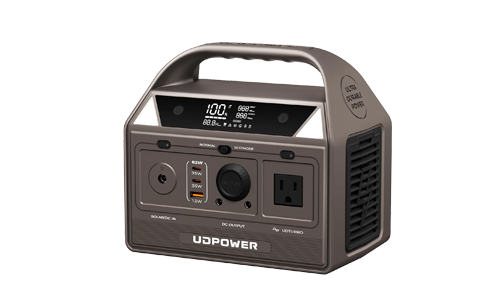
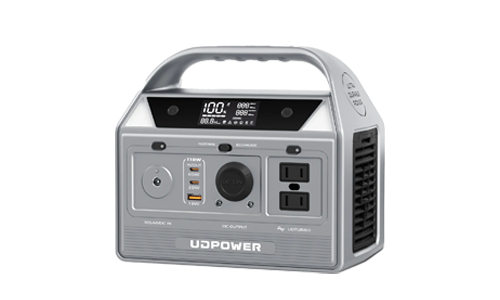
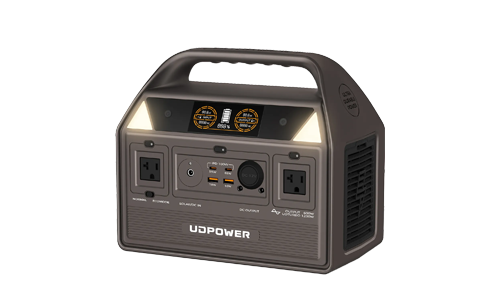
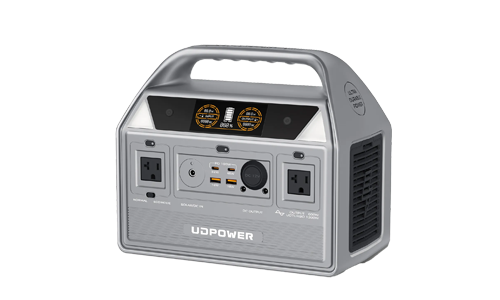
UDPOWER S-Series power stations provide pure sine wave AC output and substantially more capacity than a disposable emergency power-down pack. Both models below list LiFePO4 batteries, 4,000+ cycles, fast AC charging, and UPSPrime transfer in under 10 milliseconds. Compatibility still depends on the exact bed and any other connected equipment.
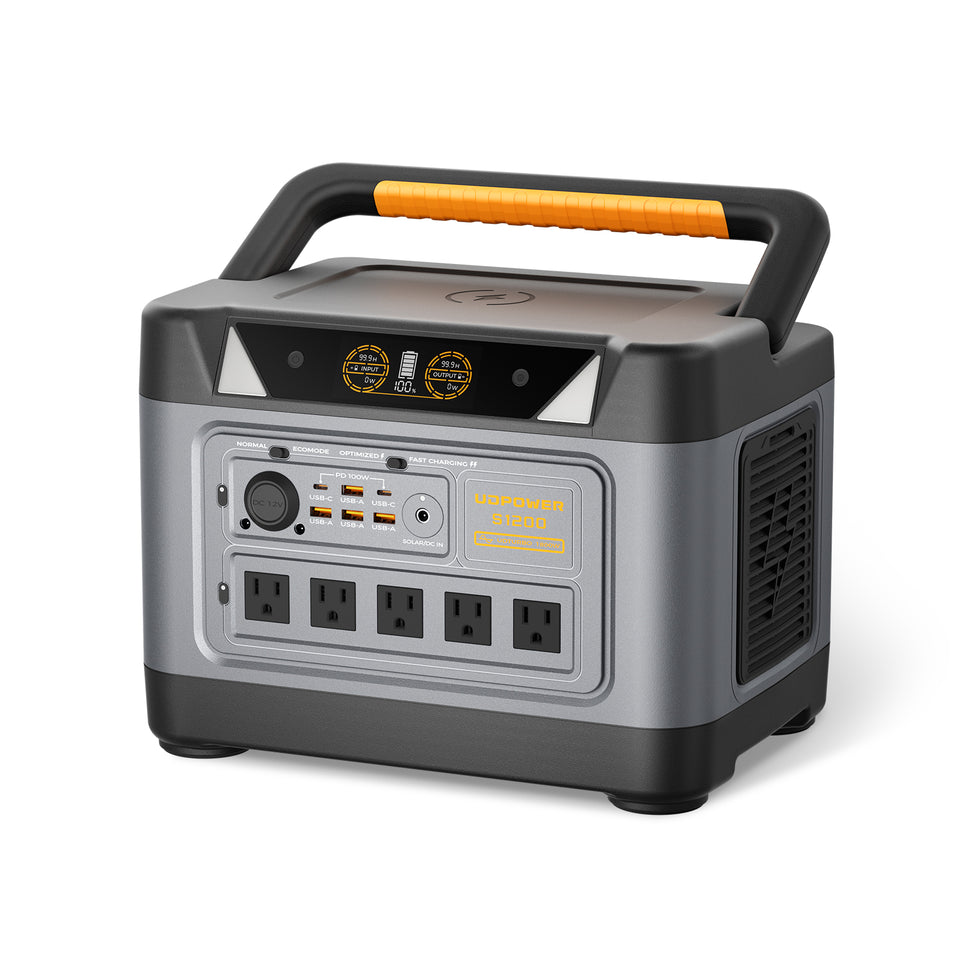
UDPOWER S1200: Best Balance for One Adjustable Bed
The S1200 is the practical first choice when one ordinary adjustable base is the primary load and you want more than a one-time return-to-flat feature. Its 1,190Wh capacity provides about 1,071Wh of planning energy at 90% AC conversion efficiency. The 1,200W rated pure sine wave output gives far more output headroom than a typical low-wattage bed base, while the 26.0 lb weight makes it easier to position or move than a 2,000Wh-class unit.
- 1,190Wh LiFePO4 battery
- 1,200W rated pure sine wave AC output
- UDTURBO support up to 1,800W
- Five AC outlets and nine DC/USB outputs on the current 5-AC version
- UPSPrime transfer in under 10ms
- 4,000+ listed cycles and 5-year warranty
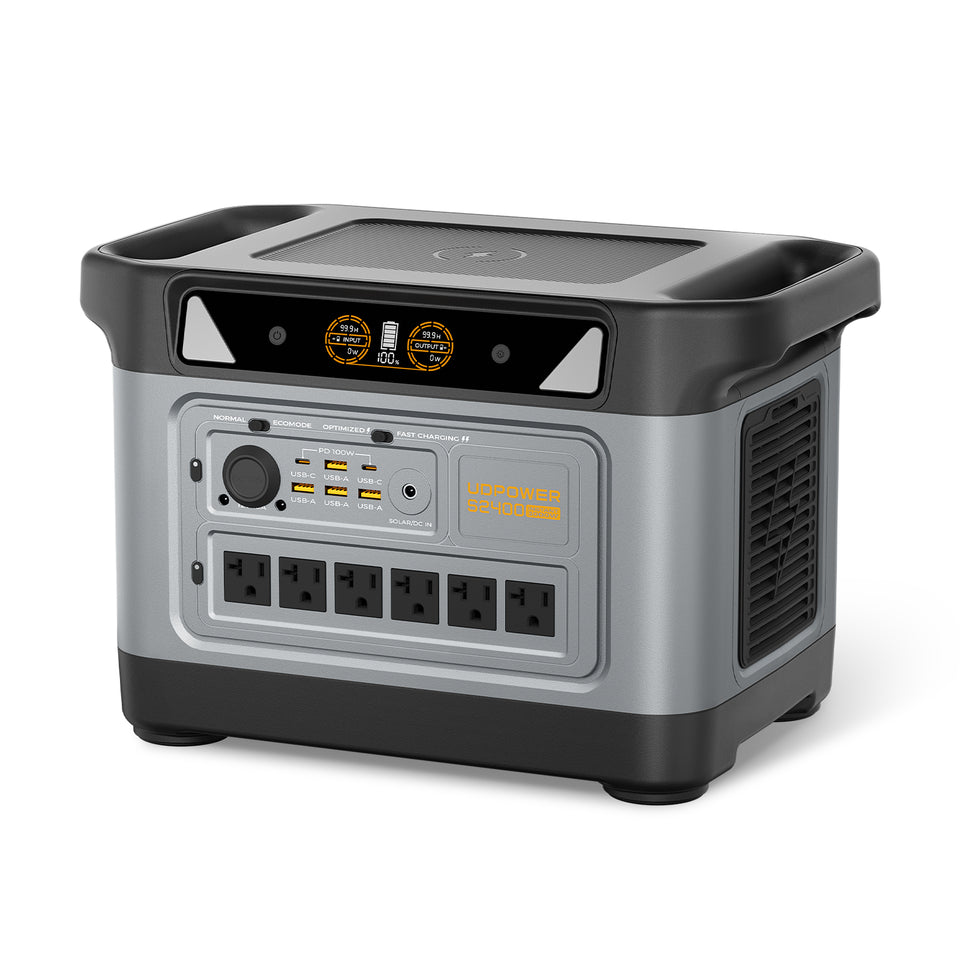
UDPOWER S2400: Better for Split Bases and Longer Outages
The S2400 is the stronger fit when both halves of a split bed may move together, the backup will serve several devices, or longer runtime matters more than portability. Its 2,083Wh battery provides about 1,875Wh of planning energy at 90% AC conversion efficiency—roughly 75% more than the S1200. Six AC outlets also make it easier to connect two base power supplies without treating a multi-outlet strip as the default solution.
- 2,083Wh LiFePO4 battery
- 2,400W rated pure sine wave AC output
- UDTURBO support up to 3,000W
- Six AC outlets plus DC and USB outputs
- UPSPrime transfer in under 10ms
- 4,000+ listed cycles and 5-year warranty
Official S1200 vs. S2400 specification comparison
| Specification | UDPOWER S1200 | UDPOWER S2400 | What it means for an electric bed |
|---|---|---|---|
| Battery capacity | 1,190Wh | 2,083Wh | S2400 stores about 75% more energy |
| Planning energy at 90% | About 1,071Wh | About 1,875Wh | Used for the runtime chart above; not a separate official capacity rating |
| Rated AC output | 1,200W pure sine wave | 2,400W pure sine wave | Both offer ample output for many ordinary bases; measure the whole setup |
| UDTURBO support | Up to 1,800W | Up to 3,000W | S2400 has more headroom for multiple simultaneous loads |
| AC outlets | Five on the current 5-AC version | Six | Useful for two base supplies and selected outage essentials |
| Weight | 26.0 lb | 40.8 lb | S1200 is easier to move; S2400 prioritizes capacity |
| UPS transfer | Under 10ms | Under 10ms | Designed for fast automatic transition, subject to device compatibility and testing |
| Official source | S1200 specifications | S2400 specifications | Check live pages for current configuration and availability |
If you are deciding between the two models for other household loads as well, compare the full differences in the UDPOWER S1200 vs. S2400 guide.
How to Set Up and Test Electric Bed Backup Power
A backup is not ready merely because it is charged. Test the complete path—from wall power to battery transfer to bed movement—before an outage.
- Fully charge the backup. Complete setup while utility power is stable and another person is available if the bed user needs assistance.
- Choose a safe location. Place the power station on a stable, dry surface where vents remain clear and the moving frame, bedding, pets, and feet cannot strike it.
- Inspect the bed cord path. Keep the power brick and cord away from hinges, lift arms, wheels, sharp edges, and sections that change position.
- Connect the bed directly when possible. Plug the bed’s AC power supply into a compatible AC outlet on the backup. For a split base, connect both supplies if both must work.
- Select the correct operating mode. Enable the AC output and confirm that energy-saving or auto-shutoff settings will not turn it off while the bed is idle.
- Test every required function. Move the head and foot through normal ranges. Test both split halves, massage, pumps, and required accessories without exceeding the bed’s duty-cycle limit.
- Simulate an outage. Disconnect the backup’s wall input while leaving the bed connected to the backup. Confirm that AC remains on and that the bed responds normally after transfer.
- Run a timed trial. Reproduce one realistic night or care period, record the starting and ending battery percentages, and calculate how much reserve remains.
- Restore and document. Reconnect wall power, confirm recharging, label the required buttons, and keep the bed manual, battery instructions, and support numbers where a caregiver can find them.
Best real-world sizing method: After a representative test, divide the battery percentage used by the number of hours tested. If eight hours consumes 35%, one full charge theoretically covers about 22.9 hours at that same pattern. Plan for less than the theoretical result so temperature, battery aging and unexpected adjustments do not eliminate your reserve.
Bedroom Safety and Medical-Use Precautions
A portable power station does not burn gasoline, so it avoids the carbon monoxide risk created by an engine running indoors. It is still electrical equipment with a high-capacity battery and must be used according to both the power station manual and the bed manual.
- Keep the unit dry, upright, ventilated and away from heat sources.
- Do not hide it beneath a moving bed frame or cover it with bedding.
- Protect every cord from pinching, crushing, abrasion and trip hazards.
- Do not connect a UPS to another UPS or build a chain of adapters and multi-outlet devices unless all manufacturers explicitly allow the arrangement.
- Do not exceed the backup’s rated output or any individual outlet limit.
- Keep the disposable emergency batteries required by the bed manual available even when a larger power station is installed.
- Test after any change to the bed, power supply, remote, battery mode or connected equipment.
- Never operate a gasoline generator inside a bedroom, garage or other enclosed area.
If loss of bed movement could create an immediate health or transfer risk, treat the bed as part of a care plan—not as an ordinary appliance. Ask the bed supplier and healthcare provider what to do during a prolonged outage, who can assist, and when relocation is necessary. Ready.gov advises people who use electricity-powered medical devices to discuss a power-outage plan with their medical provider. Review the federal power-outage guidance.
If a mattress pump, CPAP machine, oxygen concentrator, ventilator, monitor, or other medical device shares the setup, verify each item separately. A general-purpose power station is not a substitute for an approved medical backup system or emergency response plan. For CPAP-specific load planning, use the CPAP battery runtime guide.
Common Electric Bed Backup Mistakes
1. Treating the 9V power-down box as an overnight battery
Many emergency boxes are designed for limited lowering. Repeated movement, massage, app control and USB charging may not be available. Read the model-specific instructions before an outage.
2. Sizing from one motor on a split bed
Two independently powered halves can draw at the same time. Connect both power supplies to the watt meter and test the movement pattern you actually use.
3. Using the maximum label rating as daily energy consumption
Watts describe instantaneous demand; watt-hours describe stored energy. A 58W motor that runs for ten minutes uses about 9.7Wh, not 58Wh. Continuous accessories require separate calculations.
4. Ignoring inverter idle draw and low-load shutdown
A bed that sits idle for hours may not keep every power station awake in an energy-saving mode. A calculation based only on motor minutes can therefore overstate outage duration.
5. Assuming “pure sine wave” proves compatibility
Pure sine wave is an important electrical characteristic, but the bed manufacturer still decides which external power sources, surge protectors, UPS units and connection methods are permitted.
6. Testing the backup without simulating an outage
Moving the bed while utility power is present does not prove automatic transfer or battery operation. Disconnect the backup’s wall input during a controlled test and confirm the bed still responds.
7. Using all remaining capacity with no exit plan
Preserve a reserve for unexpected repositioning, a longer outage, reduced cold-weather performance, or safe transfer out of bed. Decide in advance what battery percentage triggers recharging, assistance or relocation.
Frequently Asked Questions
Will an adjustable bed work during a power outage?
Not from the wall outlet. The bed may remain in its current position unless it has an emergency power-down device, a charged manufacturer-approved battery, or a compatible external backup. Available functions vary by base model.
Can 9-volt batteries keep an electric bed working all night?
Usually not. On many adjustable bases, disposable 9V batteries are intended only to lower the bed during an outage. Some systems are different, so follow the exact manual rather than assuming full operation.
What size battery backup is best for an adjustable bed?
For limited movement of one ordinary base, 300–500Wh may be enough after compatibility is confirmed. A 1,000Wh-class power station is a more practical starting point for overnight availability and reserve. Consider about 2,000Wh for a split base, several connected loads, or longer outages. Measure your setup before choosing.
How many watts does an electric adjustable bed use?
It depends on the base, number of motors and accessories. One Tempur-Pedic manual lists a 58W output, but that is a model-specific example rather than a universal average. Use your manual, power-supply label, or a plug-in watt meter.
Can I plug an adjustable bed into a portable power station?
Yes, if the bed manufacturer permits inverter power and the station provides the required voltage, waveform, output and grounding arrangement. A pure sine wave AC output is preferred for compatible electronic controls and motors. Test the entire setup before relying on it.
Can I use a computer UPS for an electric bed?
Possibly, but check the UPS waveform, rated output, stored watt-hours, motor-load compatibility and low-load behavior. Many computer UPS units are designed for short electronics runtime rather than repeated bed operation through a long outage.
How long will the UDPOWER S1200 run an electric bed?
At a hypothetical continuous 58W load, the 1,190Wh S1200 calculates to about 18.5 hours using 90% conversion efficiency. A real adjustable bed motor runs intermittently, so the actual outage duration depends more on standby draw, power-station inverter overhead, adjustment frequency and any accessories. A timed home test is more reliable than the continuous-load figure.
Does a split king need two backup outlets?
Often yes. Many split systems have a separate power supply for each half. If both sleepers need independent movement, connect and test both supplies and size for simultaneous operation.
Can I leave the bed connected to a power station all the time?
Only if the power station supports the intended backup or pass-through configuration and the bed manufacturer approves it. Confirm transfer behavior, charging limits, ventilation and low-load settings, then perform periodic outage tests.
Where should I put the backup battery?
Place it on a stable, dry, ventilated surface outside the bed frame’s movement path. Do not put it where bedding can cover the vents or where lift arms, wheels, cords, pets or feet can strike it.
What if the electric bed is needed for mobility or medical care?
Confirm the backup with the bed supplier and healthcare provider, keep the manufacturer’s emergency lowering method available, and establish a plan for assistance, recharging and relocation during a prolonged outage. Do not depend on a generic runtime estimate for a critical care decision.
Build an Electric Bed Backup Plan Before the Next Outage
Measure the bed, list every device that must remain available, and keep enough reserve for a longer-than-expected blackout. Then compare capacity, output, transfer behavior and portability using your real numbers.
View UDPOWER portable power stations Get a runtime estimate Compare S1200 and S2400How the estimates were prepared: UDPOWER product specifications were checked against the current official S1200 and S2400 pages on September 1, 2026. Runtime estimates use 90% AC conversion efficiency and are rounded. Bed examples are identified as examples because power requirements and emergency functions vary by manufacturer and model.
Related Articles


