

Cylindrical vs. Prismatic Battery Cells: Which Is Better?
Last updated: September 8, 2026
Quick answer: Portable power stations do not universally use cylindrical cells instead of prismatic cells. Both formats can produce excellent battery systems. Cylindrical cells are attractive for portable equipment because their rigid round metal cases handle mechanical stress well, standardized manufacturing can deliver good consistency, and spaces between cells can help designers create predictable cooling paths. Prismatic cells, however, use enclosure space more efficiently and can build a large battery with fewer individual cells and fewer interconnections.
For a buyer, the cell shape alone should not decide which power station is better. Battery chemistry, cell quality, BMS design, thermal management, inverter capability, structural protection, certifications, operating-temperature limits and warranty usually matter more than whether the cells are cylindrical or prismatic.
There is also an important newer development: large-format cylindrical LiFePO4 cells reduce one of the traditional drawbacks of cylindrical packs. Instead of assembling hundreds of small 18650-style cells, manufacturers can use much larger cylinders with substantially more energy per cell. UDPOWER's current S-Series is one example, using large 60130 LiFePO4 battery cells rather than traditional small cylindrical cells.

Do Portable Power Stations Really Prefer Cylindrical Cells?
Not always. That is the first misconception worth clearing up.
Cylindrical, prismatic and pouch cells all appear in modern lithium battery products. The best format depends on what engineers are trying to optimize: portability, enclosure size, power output, mechanical durability, manufacturing cost, cooling architecture, cell count or total energy capacity.
A small power tool that gets dropped regularly has very different requirements from a wall-mounted home battery. A 1,000Wh portable power station that moves between a garage, RV and campsite also has a different design problem from a 10kWh stationary energy-storage cabinet.
This is why statements such as "cylindrical is always better" or "prismatic is always safer" are too simplistic.
The practical way to think about it:
Cylindrical cells are particularly attractive when mechanical strength, standardized production, modular pack construction and flexible cooling paths are priorities. Prismatic cells become especially attractive when engineers want to fit more battery capacity into a rectangular enclosure with fewer individual cells.
A 2025 review of lithium-ion cell design reached the same broader conclusion: cell format affects energy density, manufacturability, safety and pack integration, but each architecture involves trade-offs rather than a universal winner. You can read the research in Batteries.
First, Separate Cell Format From Battery Chemistry
This is the most important distinction for anyone shopping for a portable power station.
Cylindrical and prismatic describe the physical construction of the cell. LiFePO4, NMC and NCA describe battery chemistry.
They are not interchangeable terms.
| Term | What It Describes | Examples | Why Buyers Care |
|---|---|---|---|
| Cell format | Physical shape and enclosure | Cylindrical, prismatic, pouch | Affects packaging, mechanical behavior, cooling strategy and assembly |
| Battery chemistry | Cathode and electrochemical system | LiFePO4/LFP, NMC, NCA | Strongly affects cycle life, voltage, thermal behavior and energy density |
| Pack design | How cells are electrically and mechanically assembled | Series/parallel layout, busbars, cell holders, compression, thermal paths | Determines how well the individual cells perform as a system |
| BMS | Electronic battery monitoring and protection | Voltage, current and temperature monitoring; balancing and protection | Helps prevent cells from operating outside safe limits |
| Inverter | Converts battery DC power into household AC | 1,200W, 2,400W pure sine wave inverter | Determines which AC appliances the power station can operate |
On a phone, swipe sideways to view the full table.
For example, LiFePO4 can be made as a cylindrical cell or a prismatic cell. A cylindrical battery is therefore not automatically NMC, and a prismatic battery is not automatically LiFePO4.
If you want a deeper explanation of the chemistry itself, see UDPOWER's LFP battery buying guide.
Cylindrical vs. Prismatic Battery Cells: Full Comparison
| Factor | Cylindrical Cells | Prismatic Cells | What It Means in a Portable Power Station | Source |
|---|---|---|---|---|
| Physical shape | Round rigid metal can | Rectangular rigid metal case | Changes how cells fit inside the enclosure | 2025 cell-format review |
| Mechanical behavior | Round casing distributes internal mechanical stress effectively | Rigid case also provides structural protection but requires appropriate pack restraint | Both can be durable when the pack is engineered correctly | 2026 pressure review |
| Space utilization | Air gaps naturally remain between round cells | Rectangular cells can be packed tightly together | Prismatic designs generally have a packaging-efficiency advantage | Wiley cell-format comparison |
| Cell count | Traditionally higher when small 18650/21700 cells are used; much lower with large-format cylinders | Large individual cell capacities can reduce the number of cells needed | Cell size matters almost as much as cell shape | Cell design review |
| Interconnections | Small-cell designs require many electrical joints | Large prismatic cells can require fewer intercell connections | More joints increase manufacturing complexity, although automated welding can manage this well | NREL battery integration paper |
| Cooling | Round geometry and cell spacing can support airflow and uniform radial heat paths | Flat faces can work very well with plates, pads and other direct-contact cooling systems | There is no universal thermal winner; the complete cooling design matters | 2026 thermal-management review |
| Manufacturing | Highly mature standardized production for many common formats | Strong industrial-scale manufacturing with many sizes and architectures | Cell supplier quality and consistency matter more than general format stereotypes | Cell manufacturer overview |
| Typical strength | Mechanical robustness, modularity and standardized manufacturing | Packaging efficiency and lower cell count in high-capacity packs | The best choice depends on the power station's design target | Research review |
On a phone, swipe sideways to view all columns.
The table highlights why the question is more interesting than simply asking which shape is "better." Every advantage creates another design consideration somewhere else in the battery pack.
Why Cylindrical Cells Work Well in Portable Power Stations
1. The round metal case is mechanically strong
Cylindrical lithium cells place their electrode roll inside a rigid metal can. The circular structure naturally handles internal pressure differently from a flat-sided container and provides strong mechanical containment.
That is useful in equipment that may spend its life being moved between a house, garage, vehicle, RV, campsite or work area.
It does not mean a power station can be dropped or abused without consequence. The cell is only one part of the structure. Cell holders, enclosure materials, mounting points, padding and the overall frame still determine how well the product handles vibration and impact.
2. Cylindrical manufacturing is highly mature
Cylindrical lithium cells have been mass-produced for decades. Common formats can be manufactured on highly automated production lines using repeatable winding, filling, sealing and testing processes.
That manufacturing maturity can help cell makers control dimensional tolerances and batch consistency.
Consistency matters in a battery pack because cells are expected to charge and discharge together. When one cell behaves very differently from the others, the BMS may need to limit the entire pack around the weakest part of the group.
3. Cell spacing can become part of the cooling strategy
Put several round cells next to each other and small spaces naturally remain between them. Engineers can use those spaces for airflow, thermal barriers or other pack components.
The circular geometry also creates well-understood radial heat-transfer behavior.
But this advantage should not be exaggerated. A badly designed cylindrical pack can still run hotter than a well-designed prismatic pack.
4. They give engineers modular design options
Cylindrical cells can be arranged in different series and parallel combinations to create the voltage, current and capacity required by the product.
This flexibility is useful in portable equipment where engineers are simultaneously fitting a battery, inverter, charger, BMS, cooling system, display and several output ports into one enclosure.
5. Large-format cylinders solve part of the old cell-count problem
Older discussions about cylindrical battery packs often assume hundreds of relatively small 18650 cells. That assumption is increasingly outdated.
Modern large-format cylinders can store far more energy in each cell. A manufacturer can therefore retain a rigid cylindrical architecture without requiring anything close to the cell count associated with a traditional small-cell design.
This development is particularly relevant to UDPOWER's current S-Series, which uses large 60130 LiFePO4 cells.
Where Prismatic Cells Have the Advantage
Prismatic cells are not an inferior alternative. In some portable power station designs, they can be the more logical engineering choice.
1. Better use of rectangular enclosure space
Rectangular cells can sit closely against one another without the unavoidable gaps created when circles are packed together.
That can improve pack-level volumetric efficiency, which is valuable when engineers want to fit more watt-hours into a limited enclosure.
2. Fewer cells can mean fewer major electrical connections
A large prismatic LiFePO4 cell may carry much more capacity than a conventional small cylindrical cell. This allows a high-capacity pack to be assembled from relatively few cells.
Fewer cells can simplify busbars, monitoring connections and manufacturing assembly.
3. Flat surfaces can be useful for direct-contact cooling
A flat prismatic case gives engineers a large surface that can contact thermal pads, heat spreaders, cooling plates or the pack structure.
This is one reason it is inaccurate to claim that cylindrical cells always have superior thermal management.
4. Prismatic cells fit high-capacity stationary systems particularly well
When a battery is not moved frequently and maximizing stored energy per cabinet matters more than portability, the packaging advantages of large prismatic cells become especially attractive.
That helps explain their popularity in larger energy-storage systems.
Which Has Better Cooling: Cylindrical or Prismatic Cells?
The most accurate answer is: it depends on how the battery pack is cooled.
A cylindrical cell's radial symmetry and the spaces between neighboring cells can be useful in air-cooled systems. Recent thermal-management research also notes that cell geometry changes temperature distribution and the way a cooling system needs to be designed.
Prismatic cells present a different opportunity. Their flat surfaces can provide broad contact areas for cooling plates or thermal interface materials.
Not necessarily. Cell dimensions, chemistry, internal resistance, current, spacing, airflow, heat sinks, thermal pads, fan control and ambient temperature all affect actual cell temperature. A complete thermal design matters more than shape alone.
This is one reason buyers should pay attention to the power station's operating-temperature specifications and cooling design instead of relying on a marketing statement about cell shape.
Are Cylindrical Cells Safer Than Prismatic Cells?
Cell format affects safety engineering, but neither format is automatically safe or unsafe.
Cylindrical cells benefit from a rigid metal enclosure and circular geometry that handles mechanical and internal stresses effectively. Prismatic cells also normally use rigid metal housings and can include carefully engineered pressure-relief and thermal-management systems.
The bigger safety picture includes:
- Battery chemistry
- Cell manufacturing quality
- Cell matching and consistency
- Overcharge and over-discharge protection
- Current protection
- Temperature monitoring
- BMS logic
- Pack-level thermal barriers
- Mechanical structure
- Charging design
- Product testing and certification
- Correct user operation
For portable power stations used around homes, RVs and campsites, LiFePO4 chemistry has become especially popular because of its long cycle life and thermal characteristics. For more practical safety guidance, see Are Portable Power Stations Safe?
Do Cylindrical Cells Give a Portable Power Station More Surge Power?
Not by themselves.
This is another point that is often oversimplified.
The maximum power a portable power station can deliver depends on the entire electrical system, including:
- The discharge capability of the cells
- Cell internal resistance
- Battery pack voltage
- Series and parallel configuration
- Busbars and electrical connections
- BMS current limits
- Thermal limits
- Inverter design
- Firmware and protection settings
A high-quality prismatic cell designed for high current can deliver substantial power. A poorly selected cylindrical cell can deliver much less.
So when evaluating whether a station can run a refrigerator, microwave, coffee maker, power tool or other appliance, look at the product's rated AC output and supported higher-power operating range, not simply the shape of its battery cells.
For an explanation of how the battery, BMS and inverter work together, read How Does a Portable Power Station Work?
Why Large-Format Cylindrical Cells Change the Old Cylindrical vs. Prismatic Debate
This is one of the most important changes that older battery comparisons often miss.
The traditional criticism of cylindrical packs is simple: small cells mean lots of individual cells, lots of welds and lots of unused space between cylinders.
That criticism makes sense when you are talking about relatively small 18650 or 21700 cells.
It becomes less decisive when the cylinder itself becomes much larger.
A 60130 cell is roughly a 60mm-class diameter, 130mm-class large cylindrical format. The DFDLFR60130 LFP cell family used in UDPOWER S-Series products is listed at approximately 46.5Ah capacity. Independent cell databases and supplier documentation identify DFDLFR60130 as a cylindrical LiFePO4 format. See the battery cell data reference.
That much greater per-cell capacity lets manufacturers build kilowatt-hour-class packs from a relatively small number of large cylinders.
Why this matters:
Large-format cylindrical cells preserve many of the structural characteristics associated with cylindrical architecture while reducing one of its traditional disadvantages: excessive cell count.
It does not eliminate the packaging-efficiency advantage of rectangular cells. Round objects will still leave gaps when placed next to one another. But it changes the practical balance between mechanical structure, assembly complexity and pack size.
How UDPOWER Uses Large Cylindrical LiFePO4 Cells
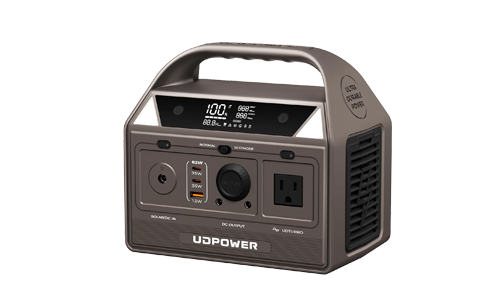
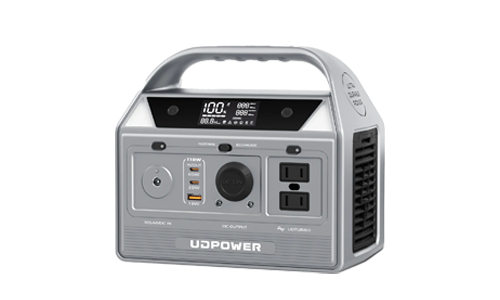
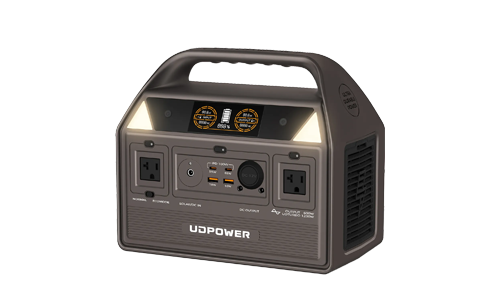
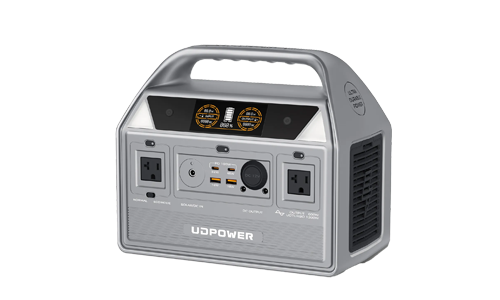
UDPOWER's current S1200 and S2400 provide a useful real-world example because their official specifications identify the battery model rather than simply saying "LiFePO4."
| Model | Official Capacity | Battery Information Listed by UDPOWER | Pack Voltage | Capacity Math | Official Source |
|---|---|---|---|---|---|
| UDPOWER S1200 | 1,190Wh / detailed spec approximately 1,191Wh | DFDLFR 60130, LiFePO4, 46.5Ah | 25.6V | 25.6V × 46.5Ah = 1,190.4Wh | S1200 specifications |
| UDPOWER S2400 | 2,083Wh | 60130 large-format LiFePO4 cells; product page describes a large tabless design | 44.8V | 44.8V × 46.5Ah = 2,083.2Wh | S2400 specifications |
On a phone, swipe sideways to view the complete specifications.
The capacity math is useful because it shows that the watt-hour ratings are consistent with the battery voltage and amp-hour figures listed on the official product pages.
It also illustrates why a modern cylindrical power station should not automatically be pictured as a box containing hundreds of tiny cells.

What Should You Check Instead of Obsessing Over Cell Shape?
If two portable power stations use different cell formats, the format is worth knowing. It just should not be the first specification you compare.
- Battery chemistry: Check whether the station uses LiFePO4/LFP or another lithium chemistry.
- Usable battery capacity: Compare watt-hours, not only marketing model names.
- Rated AC output: Make sure the normal continuous output covers your appliances.
- Higher-power capability: Check the manufacturer's supported range for demanding loads.
- Cycle-life conditions: A cycle number means little unless you know the remaining-capacity target and test conditions.
- BMS: Look for voltage, current and temperature monitoring rather than assuming the cell chemistry does all the safety work.
- Temperature limits: Check both charging and discharging ranges.
- Certifications: Look for applicable product and transport testing rather than relying solely on phrases such as "safe battery."
- Cooling and ventilation: A good thermal system matters regardless of whether the cells are round or rectangular.
- Weight: More capacity is useful only if the station is still practical for your intended use.
- Charging options: Check AC recharge speed, solar input voltage/current limits and car-charging support.
- Warranty and support: Long-term support matters because a power station is a complete integrated system rather than a replaceable loose battery.
One more point deserves emphasis: a welded cylindrical battery pack is not automatically user-serviceable. Modularity can help manufacturers assemble and test a pack, but consumers should never assume that individual cells can safely be replaced at home.
Portable power stations contain high-current battery systems and should not be opened or modified by the user.
Recommended UDPOWER Portable Power Stations
If your interest in cylindrical vs. prismatic cells comes from deciding which portable power station to buy, the more useful question is how much capacity and output your real appliances require.
UDPOWER's current S-Series combines large-format cylindrical LiFePO4 cells with integrated BMS, pure sine wave AC output, solar charging and UPS functionality.
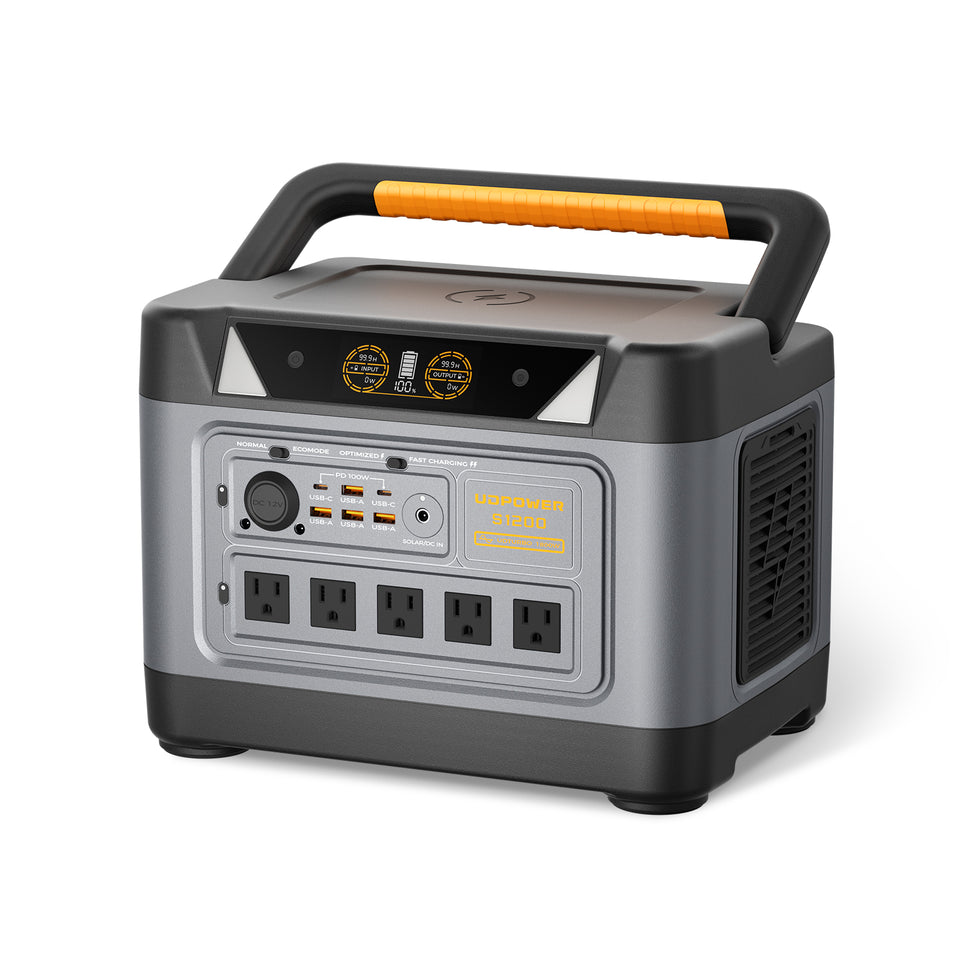
UDPOWER S1200: Best Balance of Capacity and Portability
The S1200 is the better fit when you want meaningful home, RV or camping backup without moving into the weight class of a larger 2kWh station.
- 1,190Wh battery capacity
- LiFePO4 battery
- Large DFDLFR 60130 battery cells listed in the official specifications
- 1,200W rated pure sine wave AC output
- UDTURBO support up to 1,800W for compatible higher-power loads
- Up to 400W solar input
- UPSPRIME response time ≤10ms
- Approximately 26.0 lb
- UL2743, PSE, FCC, RoHS and UN38.3 listed on the official specifications page
Best for: refrigerator backup, CPAP, Wi-Fi, TVs, computers, RV equipment, camping appliances and household essentials whose combined normal load fits within the rated output.
View UDPOWER S1200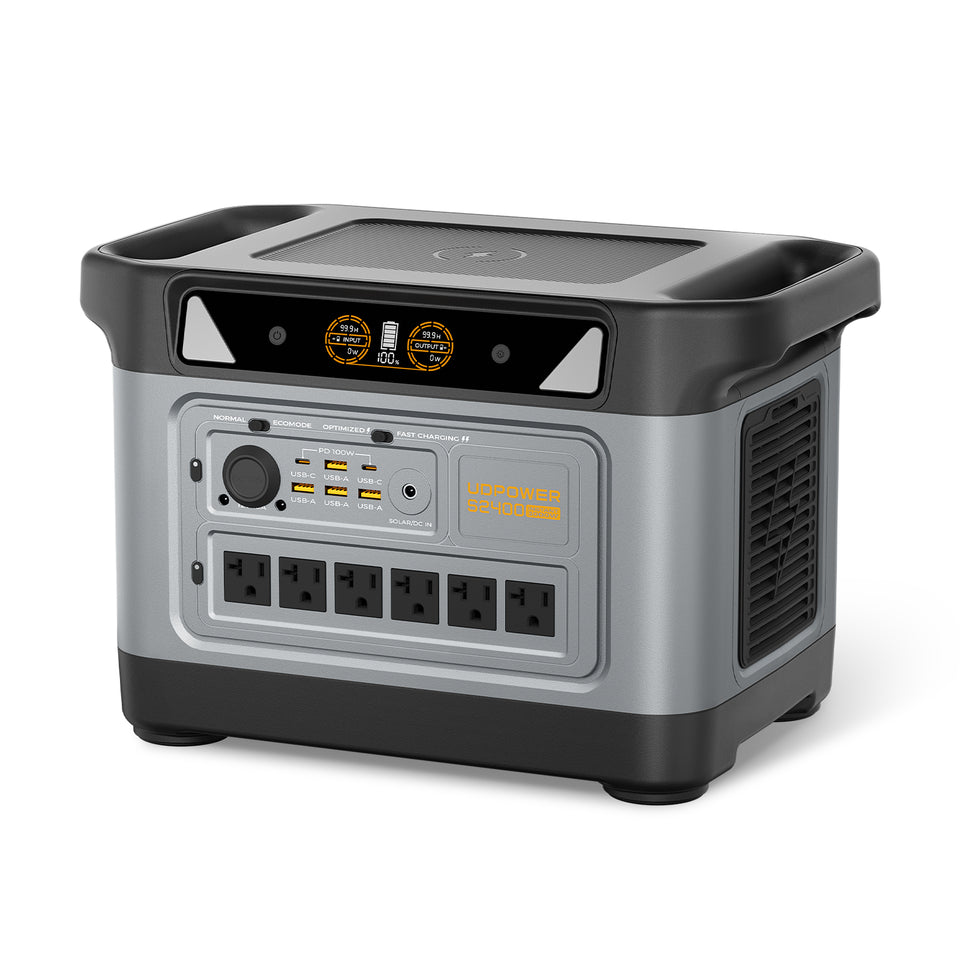
UDPOWER S2400: Better for Larger Appliances and Longer Backup
The S2400 makes more sense when output headroom and longer runtime matter more than minimizing weight.
- 2,083Wh battery capacity
- Brand-new LiFePO4 battery
- 60130 large tabless cells listed by UDPOWER
- 2,400W rated pure sine wave AC output
- UDTURBO support up to 3,000W for compatible higher-power loads
- Up to 400W solar charging
- 6 AC outlets plus DC and USB outputs
- UPSPRIME response time ≤10ms
- Approximately 40.8 lb
- UL2743, FCC, RoHS and UN38.3 listed on the official specifications page
Best for: refrigerators, larger cooking appliances, home outage backup, RV use, power tools and situations where several devices may need power at the same time.
View UDPOWER S2400If you are not sure which capacity you need, compare the full range on the UDPOWER Portable Power Station page or read the S1200 vs. S2400 comparison.
Which Format Makes More Sense for Different Uses?
| Application | What Matters Most | Format Tendency | Why |
|---|---|---|---|
| Portable power station | Durability, weight, power, thermal design, cost | Either cylindrical or prismatic | Both formats can meet the requirements with the right pack engineering |
| Power tools | High current, vibration resistance, compact modular packs | Often cylindrical | Standardized small high-power cells work well in tool packs |
| Large home energy storage | Maximum capacity per cabinet and lower cell count | Often prismatic | Rectangular high-capacity cells pack efficiently |
| Camping/RV portable backup | Mechanical durability plus usable capacity | Either | The total system design matters more than cell shape |
| Very thin electronics | Minimal thickness and weight | Often pouch | Flexible packaging suits thin device shapes |
On a phone, swipe sideways to view the complete table.
What This Means in Real Life
Imagine two 1,000Wh portable power stations sitting next to each other.
One uses cylindrical LiFePO4 cells. The other uses prismatic LiFePO4 cells.
You cannot determine which one is better from that fact alone.
The cylindrical model might have excellent cell consistency but a small inverter. The prismatic model might use excellent cooling and a larger inverter. Or the opposite might be true.
The useful comparison starts with the jobs you actually need the station to perform:
- How many watts does your appliance use?
- How many watt-hours do you need overnight?
- Will the unit be moved frequently?
- Will it be used in a hot vehicle or cold environment?
- How fast can you recharge it?
- Can solar input keep up during a multi-day outage?
- Does it have the output ports your equipment requires?
- Does the manufacturer provide clear safety and operating specifications?
For camping and off-grid use, you can also browse UDPOWER's solar generator systems. For overnight medical-device planning, see the CPAP battery backup selection.
Frequently Asked Questions
Are cylindrical cells better than prismatic cells in a portable power station?
Not automatically. Cylindrical cells offer strong mechanical characteristics, mature manufacturing and flexible pack layouts, while prismatic cells generally make better use of rectangular enclosure space and can reduce cell count. The better power station is the one with stronger overall battery, BMS, inverter, cooling and structural engineering.
Are cylindrical battery cells safer than prismatic cells?
Cell shape alone cannot determine safety. Cylindrical cells have a rigid round metal case that handles mechanical and internal stress well, but high-quality prismatic cells also use rigid housings and engineered safety systems. Chemistry, cell quality, BMS protection, thermal management and product design are more important to the final safety of a portable power station.
Do cylindrical cells last longer than prismatic cells?
Not necessarily. Cycle life depends heavily on chemistry, electrode design, cell quality, charge rate, discharge rate, depth of discharge, temperature and BMS strategy. You should compare manufacturer cycle-life specifications and test conditions rather than assuming one physical format automatically lasts longer.
Is LiFePO4 a cylindrical battery?
No. LiFePO4 is a battery chemistry, not a physical format. LiFePO4 cells can be manufactured in cylindrical, prismatic and other formats.
What are 18650 and 21700 cells?
They are common cylindrical lithium-ion cell formats. The numbers refer roughly to their physical dimensions. They became popular because standardized dimensions support high-volume production and modular pack construction.
What is a 60130 battery cell?
60130 refers to a much larger cylindrical cell format than a traditional 18650 or 21700. UDPOWER's current S-Series specifications identify 60130 LiFePO4 battery cells. The DFDLFR60130 family is a large cylindrical LFP design with approximately 46.5Ah capacity, allowing much more energy to be stored in each individual cell.
Does a cylindrical battery mean the power station has better surge power?
No. Appliance compatibility depends on the cells' discharge capability plus pack voltage, current limits, BMS, busbars, thermal system and inverter. The portable power station's rated AC output and supported higher-power range are more useful specifications for a buyer.
Are prismatic cells bad for camping or RV power stations?
No. A properly engineered prismatic battery pack can work very well in a portable power station. Mechanical mounting, compression where required, BMS protection, enclosure design and thermal management determine how well the complete product tolerates mobile use.
Which cell type packs more energy into a small space?
At pack level, prismatic cells generally have an advantage in space utilization because rectangular cells can sit closely together. Cylindrical cells leave gaps between neighboring cells, although those spaces can also be used as part of the thermal and structural design.
Do large cylindrical cells still need hundreds of cells?
No. That is one of the important differences between modern large-format cylinders and older 18650-based pack designs. A large cylindrical cell can hold many times more energy than a small cylinder, allowing kilowatt-hour-class packs to be built with far fewer individual cells.
Which battery specification matters most when buying a portable power station?
Start with battery capacity in watt-hours and rated AC output in watts because those determine approximately how long your equipment can run and which appliances the station can support. Then compare battery chemistry, BMS, charging speed, solar-input limits, operating temperatures, weight, certifications, warranty and cell quality.
Can I replace individual cylindrical cells inside a portable power station?
No. A portable power station is an integrated high-current battery system and should not be opened or modified by the user. Even when cylindrical cells are arranged in modular groups during manufacturing, that does not make the finished battery pack a user-serviceable device.
Bottom Line
Portable power stations use cylindrical cells for several good engineering reasons, including mechanical strength, mature manufacturing, modular pack design and flexible thermal architecture. But saying that cylindrical cells are simply "better" than prismatic cells misses half the story.
Prismatic cells can use space more efficiently and can build large battery packs with fewer individual cells. Their flat surfaces can also work effectively with direct-contact thermal systems.
The more useful modern insight is that cell size is changing the old trade-off. Large-format cylindrical LiFePO4 cells can deliver much more energy per cell than classic 18650 or 21700 designs, reducing cell count while retaining cylindrical construction.
That is why the cell format is worth understanding, but it should remain one item on a much larger checklist.
When choosing a portable power station, prioritize the complete system: battery chemistry and quality, usable capacity, inverter output, BMS, cooling, charging options, certifications, operating limits, warranty and the manufacturer's ability to support the product after purchase.
Choose the Right Portable Power Station for Your Setup
Compare capacity, output and real-world use cases instead of choosing a power station from battery-cell shape alone.
View the S1200 vs. S2400 Selection Guide View Portable Power Stations Get More Portable Power GuidesTechnical sources and further reading: This guide was prepared using current UDPOWER product specifications together with published research on lithium-ion cell geometry, mechanical behavior, packaging efficiency and thermal management. External research links are provided throughout the comparison tables and are marked nofollow. Product specifications should always be confirmed on the linked official product page because models and specifications may be updated.
Related Articles


