Volts to Watts Conversion: Simple Formula, Calculator, Tables, and Real-World Examples
ZacharyWilliamUDPOWER Electrical Basics Guide
Last updated: May 8, 2026
Trying to figure out how many watts a device uses from its voltage label? Start here. This guide explains volts-to-watts conversion in plain English, shows the exact formulas for DC and AC power, gives quick-reference tables, and shows how to use the result when choosing a portable power station for home backup, camping, RV use, CPAP, routers, mini fridges, and everyday electronics.
Quick Answer: How Do You Convert Volts to Watts?
For DC power, use: watts = volts × amps.
For single-phase AC power, use: watts = volts × amps × power factor.
You usually cannot convert volts to watts from voltage alone. A 120V outlet does not automatically mean 120 watts. You also need current in amps, or another load detail such as resistance. For most everyday shopping and backup-power planning, the fastest path is to find the device label, read the volts and amps, then multiply them.
Example: A device labeled 120V and 5A uses about 120 × 5 = 600 watts if it is a simple resistive load. For AC motor or electronic loads, real watts may be lower because of power factor.

Volts to Watts Calculator
Enter the voltage and current from your device label. For DC devices, leave power factor at 1. For AC devices, use the listed power factor if you know it. If you do not know it, use 1 for a simple estimate or 0.8–0.9 as a more cautious planning range for many motor or electronic loads.
The Formula You Actually Need
The right formula depends on whether you are working with DC power, ordinary single-phase AC power, or a three-phase system. Most household appliances, power stations, chargers, and extension-cord questions use either DC or single-phase AC.
| Power Type | Formula | Best For | Simple Example |
|---|---|---|---|
| DC | W = V × A |
USB output, 12V car sockets, DC adapters, battery-powered gear, solar panel output estimates | 12V × 5A = 60W |
| AC single-phase | W = V × A × PF |
Most U.S. household plug-in devices, portable power station AC outlets, small appliances | 120V × 10A × 0.9 = 1,080W |
| AC three-phase | W = 1.732 × V × A × PF |
Commercial equipment, shops, industrial motors, professional electrical planning | 208V × 10A × 1.732 × 0.9 ≈ 3,242W |
Plain-English Rule
Volts tell you the electrical “pressure.” Amps tell you how much current is moving. Watts tell you how much power is being used or delivered. To get watts, you need both voltage and current. For AC, power factor tells you how much of the apparent power is doing real work.
Why Volts Alone Are Not Enough
A common mistake is asking, “How many watts is 120 volts?” The answer is: it depends on the current draw. The same 120V outlet can run a 9W LED bulb, a 65W laptop charger, a 700W microwave on a low setting, or a 1,500W space heater. The voltage may be the same, but the current is different.
| Question | Can You Answer It? | What Else You Need | Example |
|---|---|---|---|
| How many watts is 120V? | No | Current in amps or device wattage label | 120V × 1A = 120W, but 120V × 10A = 1,200W |
| How many watts is 12V? | No | Current in amps | 12V × 2A = 24W, but 12V × 10A = 120W |
| How many watts is 5V 2A? | Yes | Nothing else for DC estimate | 5V × 2A = 10W |
| How many watts is 120V 10A? | Yes, as an estimate | Power factor for exact AC real watts | 120V × 10A = 1,200VA; real watts may be lower if PF is below 1 |
Quick Conversion Tables
Use these tables for quick estimates. For critical electrical work, always confirm the device label, manual, circuit rating, and local code requirements.
DC Volts to Watts Table
This is useful for USB ports, DC adapters, 12V car outlets, low-voltage devices, and solar/DC planning.
| Current | 5V | 12V | 19V | 24V | 48V | Source / Formula |
|---|---|---|---|---|---|---|
| 0.5A | 2.5W | 6W | 9.5W | 12W | 24W | W = V × A |
| 1A | 5W | 12W | 19W | 24W | 48W | W = V × A |
| 2A | 10W | 24W | 38W | 48W | 96W | W = V × A |
| 5A | 25W | 60W | 95W | 120W | 240W | W = V × A |
| 10A | 50W | 120W | 190W | 240W | 480W | W = V × A |
| 15A | 75W | 180W | 285W | 360W | 720W | W = V × A |
120V AC Volts to Watts Table
Most U.S. plug-in household loads use 120V AC. If the device has a power factor listed, use it. If not, this table gives both a simple PF=1 estimate and a more conservative PF=0.8 planning value.
| Current | 120V at PF 1.0 | 120V at PF 0.9 | 120V at PF 0.8 | What It Often Represents | Source / Formula |
|---|---|---|---|---|---|
| 1A | 120W | 108W | 96W | Small charger, light load | AC formula |
| 2A | 240W | 216W | 192W | Small appliance, fan, electronics | AC formula |
| 5A | 600W | 540W | 480W | Mid-size load | AC formula |
| 8A | 960W | 864W | 768W | Coffee maker, cooking appliance, larger tool depending on model | AC formula |
| 10A | 1,200W | 1,080W | 960W | Higher household load | AC formula |
| 12A | 1,440W | 1,296W | 1,152W | Near the upper range for many plug-in appliances | AC formula |
| 15A | 1,800W | 1,620W | 1,440W | Very high plug-in load; check circuit and cord ratings | Cord safety |
Common Device Examples
These are examples based on labels you may see. Always use your own device label when available.
| Device Label Example | Calculation | Estimated Watts | What to Check Before Backup Use |
|---|---|---|---|
| Phone charger: 5V 2A | 5 × 2 | 10W | USB chargers may switch voltage depending on the phone and charging stage. |
| USB-C laptop charger: 20V 3.25A | 20 × 3.25 | 65W | The laptop may draw less once the battery is near full. |
| 12V fridge: 12V 5A | 12 × 5 | 60W | Compressor fridges cycle on and off; startup draw can be higher than running draw. |
| Router adapter: 12V 1.5A | 12 × 1.5 | 18W | Small AC loads may also include inverter overhead when run from a power station AC outlet. |
| CPAP adapter: 24V 2A | 24 × 2 | 48W | Humidifier and heated tube settings can greatly increase power draw. |
| AC appliance: 120V 5A | 120 × 5 × PF | Up to about 600W before PF adjustment | Check startup surge if it has a motor, compressor, pump, or heating element. |
How to Read a Device Label Without Overthinking It
Most devices give you enough information on the adapter, charger brick, bottom label, or user manual. Look for these markings:
| Label Marking | Meaning | How to Use It | Example |
|---|---|---|---|
| V | Voltage | Use this as the first number in the formula. | 12V, 20V, 120V |
| A | Amps / current | Multiply by volts to estimate watts. | 2A, 5A, 10A |
| W | Watts | If watts are already listed, use that number directly. | 65W laptop charger |
| Wh | Watt-hours / energy capacity | Use this to estimate runtime, not instant load. | 596Wh battery capacity |
| Hz | Frequency | For U.S. household AC, you usually see 60Hz. | 120V~60Hz |
| PF | Power factor | For AC real watts, multiply volts × amps × PF. | PF 0.9 |
Important Safety Note
Do not use a volts-to-watts estimate to modify wiring, bypass safety ratings, or connect a portable power station to a home electrical panel. For panel work, transfer switches, hardwired circuits, or 240V appliances, use a licensed electrician. UDPOWER portable power stations are designed for direct plug-in use through their outlets and provide U.S. standard 120V AC output, not 240V split-phase output.
Watts vs Watt-Hours: The Part Most People Mix Up
Watts tell you how much power a device needs right now. Watt-hours tell you how much energy is stored or used over time. This difference matters when you choose a portable power station.
Runtime estimate: runtime hours ≈ battery capacity in Wh × usable efficiency ÷ device watts
For a simple planning estimate, many shoppers use 80%–90% usable efficiency because inverters, DC conversion, temperature, and standby draw all take some energy. Small AC loads may be less efficient than expected because the inverter itself consumes power while it is on.
| Device Load | Estimated Runtime on 256Wh | Estimated Runtime on 596Wh | Estimated Runtime on 1,190Wh | Estimated Runtime on 2,083Wh |
|---|---|---|---|---|
| 20W router or light load | About 10.2 hrs | About 23.8 hrs | About 47.6 hrs | About 83.3 hrs |
| 60W mini fridge running load | About 3.4 hrs | About 7.9 hrs | About 15.9 hrs | About 27.8 hrs |
| 100W TV or workstation | About 2.0 hrs | About 4.8 hrs | About 9.5 hrs | About 16.7 hrs |
| 300W appliance | About 0.7 hrs | About 1.6 hrs | About 3.2 hrs | About 5.6 hrs |
| 600W appliance | Not a good match | About 0.8 hrs | About 1.6 hrs | About 2.8 hrs |
The table above uses an 80% usable-energy estimate. Compressor appliances such as fridges do not run at full draw every minute, so real-world runtime can be longer or shorter depending on temperature, thermostat setting, door openings, and startup behavior.
Using Watts to Pick a Power Station
Once you convert volts to watts, you can make a smarter backup-power decision. Use this simple process:
- Find running watts. Use the label wattage if listed. If not, multiply volts × amps.
- Check startup surge. Fridges, pumps, compressors, and some tools may briefly need several times their running watts.
- Compare to rated AC output. Your power station’s continuous output should be higher than the device’s running watts.
- Compare to surge output. The power station should also handle the device’s startup demand.
- Estimate runtime using Wh. Capacity affects how long it runs; output wattage affects whether it can start and power the load.
- Add margin. A 20%–30% cushion helps account for real-world variation, inverter overhead, heat, and aging.
| Converted Load | What It Means | Recommended Headroom | Typical UDPOWER Direction |
|---|---|---|---|
| Under 100W | Phones, routers, LED lights, small fans, laptops | Choose by runtime and portability | C400 or C600 for light portable backup |
| 100W–400W | Workstation, camera gear, CPAP without heavy heating, small appliances | 400W+ output; more Wh for overnight use | C400 for short use; C600 for longer use |
| 400W–600W | Mini fridge, TV plus router, multiple small loads | 600W+ output and check surge | C600 for compact backup; S1200 for more headroom |
| 600W–1,200W | Coffee maker, microwave on some settings, heavier home essentials | 1,200W+ output and strong surge support | S1200 for balanced home/RV use |
| 1,200W–2,400W | Higher-wattage plug-in appliances | 2,400W output class; confirm appliance surge | S2400 for higher output headroom |
Recommended UDPOWER Models by Watt Range
These recommendations are based on the converted wattage of the device you want to run. Always check both running watts and startup surge before choosing.

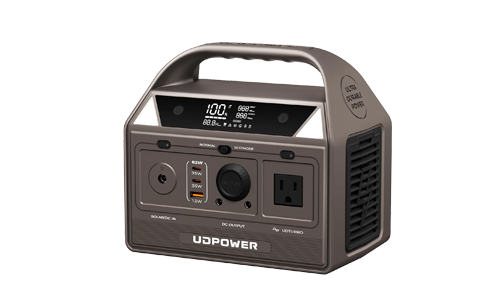
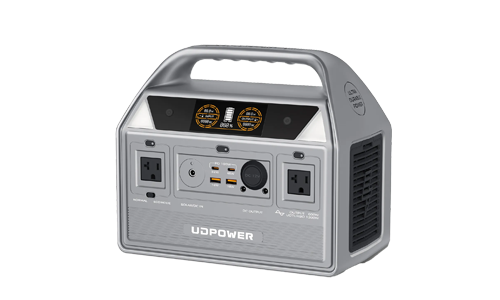
UDPOWER C400 — Best for Small Electronics and Light Backup
Choose C400 when your converted load is small and you care about portability: phones, laptops, cameras, router backup, small fans, and short camping use. Its 400W output gives more room than tiny power banks while staying easy to carry.
- Good match for loads under about 300W with reasonable headroom.
- Useful for 12V/DC gear, laptop charging, and light AC use.
- Supports fast charging up to 165W using adapter plus USB-C input.
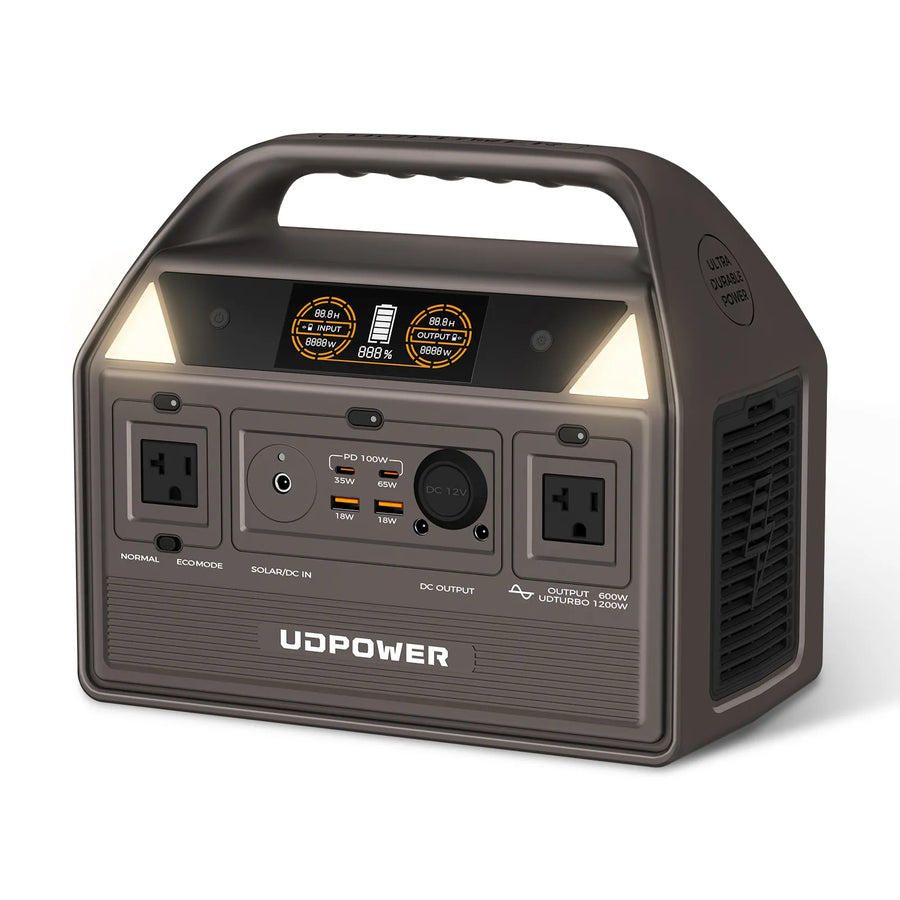
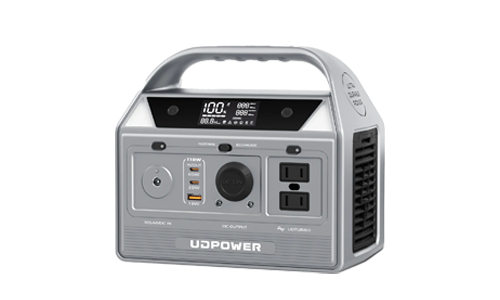
UDPOWER C600 — Best for Camping, CPAP, Mini Fridge, and Longer Small-Load Runtime
Choose C600 if your converted wattage is still moderate but you need more stored energy than a compact unit. It is a strong middle ground for camping, road trips, Wi-Fi backup, CPAP planning, and small fridge use.
- Good match for many loads under about 500W.
- Better runtime than smaller units for overnight essentials.
- Solar charging input supports up to 240W max.
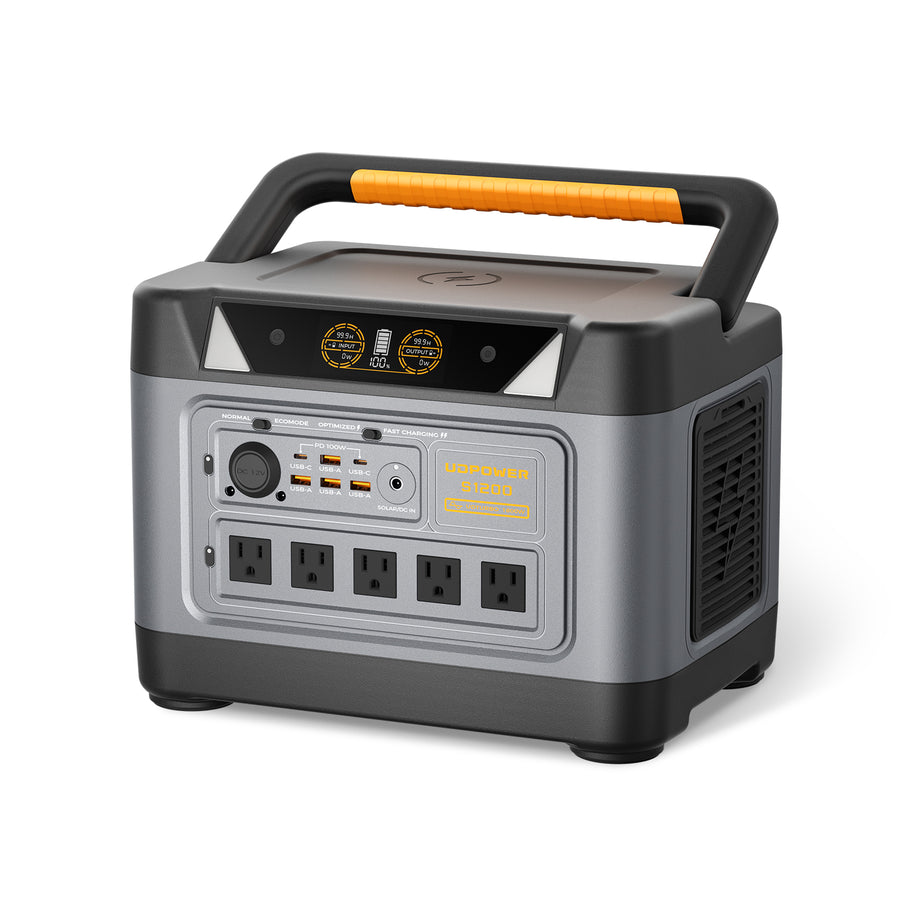
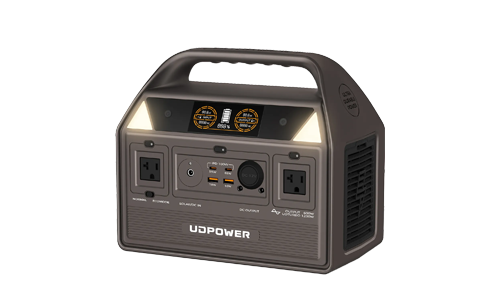
UDPOWER S1200 — Best Balanced Choice for Home Essentials and RV Use
Choose S1200 when the converted load is too high for compact models or when you want more runtime and UPS-style backup for key devices. It is a practical match for a small fridge, CPAP setup, router, laptop, lights, and RV/camping essentials.
- Good match for many 600W–1,200W plug-in loads, depending on startup surge.
- Useful for home backup scenarios where both output and capacity matter.
- Solar charging input supports up to 400W max.
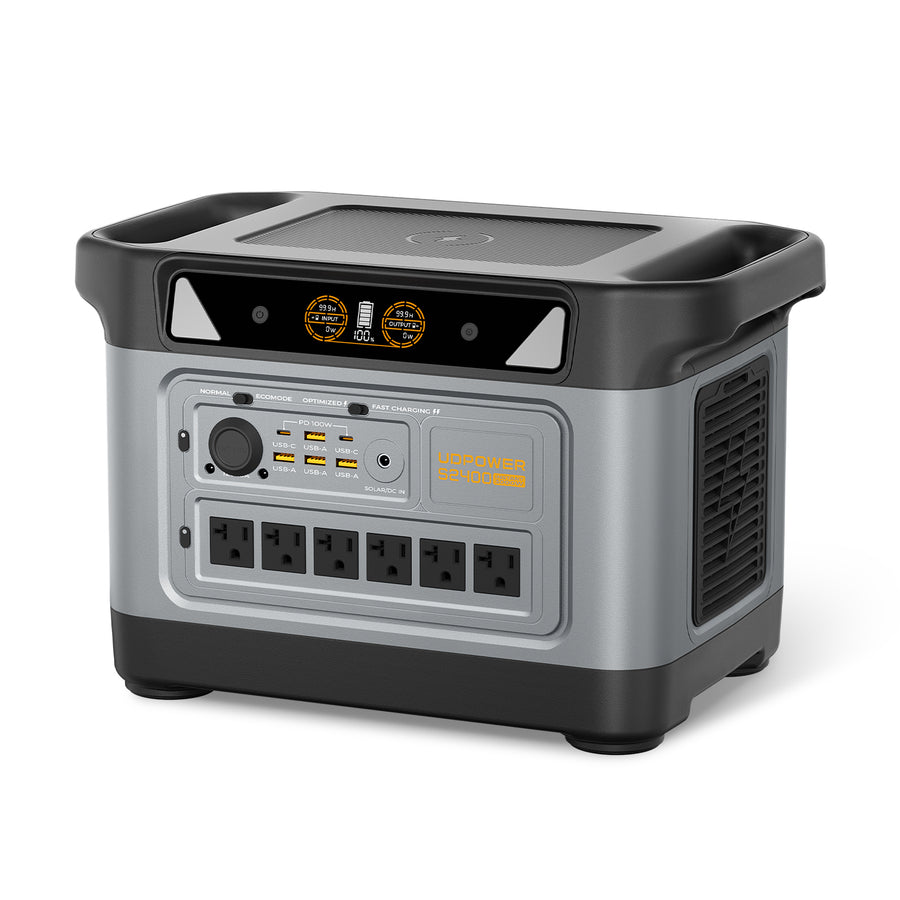
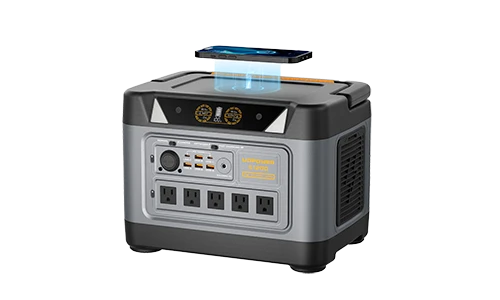
UDPOWER S2400 — Best for Higher-Wattage Plug-In Appliances
Choose S2400 when your volts-to-watts calculation points to a higher-wattage load or multiple home essentials running together. It gives the most output headroom in this group while still using standard U.S. 120V AC outlets.
- Good match for many high-output 120V plug-in appliances.
- Useful for home essentials, RV power, and larger backup setups.
- Best choice here when converted wattage approaches or exceeds 1,200W.
Want Solar Charging Too?
If your goal is backup power during outages or longer camping trips, pair the power station with a compatible solar panel kit. See UDPOWER solar generator kits or browse portable solar panels.
Common Volts-to-Watts Mistakes to Avoid
1. Treating Volts as Watts
Voltage alone does not tell you power. You need amps. A 120V device can be tiny or power-hungry depending on current draw.
2. Forgetting Power Factor on AC Loads
For AC loads, volts × amps gives apparent power in VA. Real watts are VA × power factor. If PF is not listed, use the device’s actual watt label or measure with a power meter when accuracy matters.
3. Confusing Running Watts With Surge Watts
A refrigerator may run at 80W after it starts, but the compressor may require a much higher startup surge. This is why a power station’s surge rating matters.
4. Ignoring Inverter Overhead
When you run a small device through an AC outlet on a power station, the inverter consumes energy too. For tiny loads like routers, DC output can sometimes be more efficient if your device and cable setup support it safely.
5. Assuming 240V Support From a 120V Power Station
Most portable power stations in this category provide 120V AC output for plug-in devices. They are not a replacement for a 240V home electrical system, central air conditioner circuit, electric water heater circuit, or hardwired panel setup.
Helpful Source Links for Checking the Basics
For ordinary readers, these are useful references when you want to double-check formulas, energy-use terms, or electrical safety basics.
| Topic | Why It Helps | Source |
|---|---|---|
| DC, AC single-phase, and three-phase formulas | Shows the common volts-to-watts formulas in calculator form. | RapidTables volts to watts calculator |
| Appliance energy use | Explains how wattage and hours of use become kWh consumption. | U.S. Department of Energy appliance energy use guide |
| Watts vs watt-hours | Explains why watts measure power at a moment and watt-hours measure energy over time. | U.S. EIA measuring electricity |
| Power factor | Explains why apparent power and real power can differ in AC circuits. | All About Circuits power factor explanation |
| Cord and plug equipment safety | Useful reminder to inspect cords and respect equipment ratings. | OSHA use of equipment standard |
Related UDPOWER Guides
Continue with these related pages if you are choosing a real backup-power setup:
FAQ: Volts to Watts Conversion
Can you convert volts to watts without amps?
Usually, no. Voltage alone does not tell you power. You need current in amps, device wattage, or another load detail such as resistance.
What is the simplest volts-to-watts formula?
For DC power, use watts = volts × amps. For AC power, use watts = volts × amps × power factor.
How many watts is 12 volts?
It depends on current. At 1 amp, 12V is 12W. At 5 amps, 12V is 60W. At 10 amps, 12V is 120W.
How many watts is 120 volts?
It depends on amps. At 1 amp, 120V is about 120W before power factor adjustment. At 10 amps, 120V is about 1,200W before power factor adjustment.
What does power factor mean in volts-to-watts conversion?
Power factor is used for AC loads. It shows how much of the apparent power is converted into real working power. If the formula is 120V × 10A × 0.9, the result is 1,080W.
Is VA the same as watts?
Not always. VA is apparent power, calculated as volts × amps. Watts are real power. For DC or AC loads with a power factor of 1, VA and watts can be the same. For many AC loads, watts are lower than VA.
Why does my appliance label show amps instead of watts?
Many labels list voltage and current because those values are important for circuits, cords, and power supplies. You can estimate watts by multiplying volts by amps, then applying power factor for AC if needed.
How do I use volts and amps to choose a portable power station?
First calculate running watts. Then check whether the power station’s continuous AC output is higher than that load. For fridges, pumps, and tools, also check startup surge. Finally, use watt-hours to estimate runtime.
Does higher voltage always mean higher watts?
No. Watts depend on both voltage and current. A device can use higher voltage but draw lower current, resulting in similar wattage.
What is the difference between watts and watt-hours?
Watts measure power at a moment. Watt-hours measure energy over time. A 100W device running for 5 hours uses 500Wh.
Can a portable power station run a 120V appliance?
Yes, if the appliance’s running watts and startup surge stay within the power station’s output limits. UDPOWER models provide U.S. standard 120V AC output for plug-in devices, but they do not provide 240V split-phase output.
Which UDPOWER model should I choose after converting volts to watts?
For light loads, consider C400 or C600. For larger home essentials and RV use, consider S1200. For higher-wattage plug-in appliances, S2400 provides more output and capacity headroom.
Need a Power Station That Matches Your Wattage?
Convert your device label first, then choose a power station with enough continuous output, surge headroom, and watt-hour capacity for the runtime you expect.